LogiCo: A Unified Framework for Logical and Structural Anomaly Detection
Pith reviewed 2026-06-30 10:02 UTC · model grok-4.3
The pith
LogiCo unifies logical and structural anomaly detection by reconstructing features at component and patch levels from pre-trained images.
A machine-rendered reading of the paper's core claim, the machinery that carries it, and where it could break.
Core claim
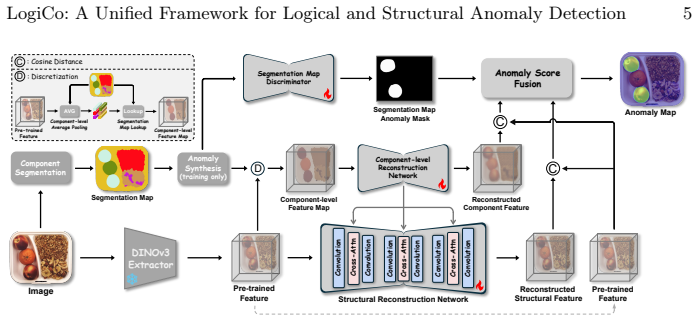
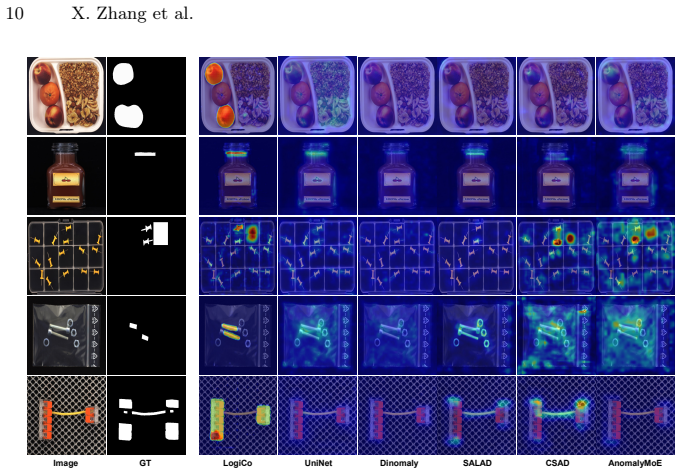
By mapping pre-trained image features into a discrete component-level feature space and performing collaborative feature reconstruction at both component and patch levels, LogiCo captures inter-component logical constraints without explicit global semantic modeling, supplemented by a segmentation-map discriminator for count-related anomalies, achieving state-of-the-art results on MVTec-LOCO, MVTec-AD, VisA, and Real-IAD.
What carries the argument
Component-level feature reconstruction that discretizes pre-trained features into components and reconstructs them jointly at component and patch scales to enforce logical relations between components.
If this is right
- The same model can flag both rule violations between parts and local defects without switching architectures.
- Patch-level reconstruction preserves the ability to detect small structural changes that global semantic models overlook.
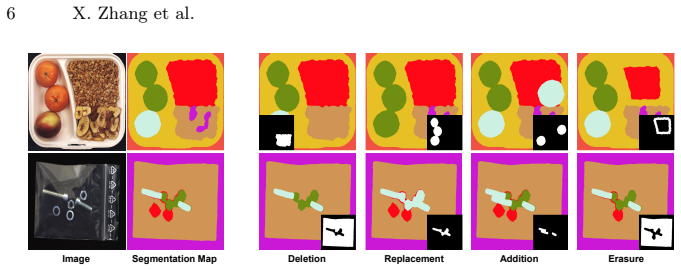
- The added segmentation discriminator directly addresses quantitative logical anomalies such as incorrect object counts.
- Unified training on mixed anomaly types yields top scores on dedicated logical benchmarks like MVTec-LOCO and structural ones like MVTec-AD.
Where Pith is reading between the lines
- Discrete component spaces may serve as a lightweight substitute for explicit scene graphs in other constraint-satisfaction vision tasks.
- The dual reconstruction scales could transfer to detecting logical inconsistencies in video by treating frames as successive component sets.
- Industrial inspection pipelines might consolidate separate logical and structural detectors into one component-reconstruction stage.
Load-bearing premise
Mapping pre-trained image features into a discrete component-level feature space and performing collaborative reconstruction at component and patch levels suffices to capture inter-component logical constraints without explicit global semantic modeling.
What would settle it
A controlled test where the method is applied to a new dataset containing logical constraints that cannot be expressed through component co-occurrence or reconstruction error, resulting in performance no better than random or below specialized logical detectors while structural performance remains intact.
Figures
read the original abstract
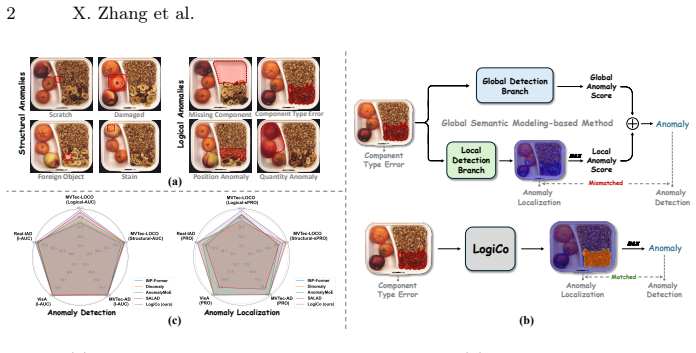
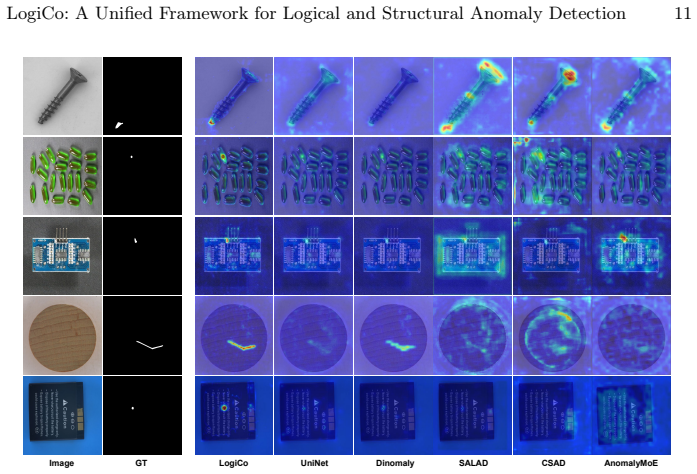
Current anomaly detection methods primarily focus on structural anomalies, while paying insufficient attention to anomalies that violate logical constraints. Conversely, top-performing logical anomaly detection approaches address this by modeling global semantic consistency, but perform poorly on subtle structural anomalies due to inadequate detection granularity. In this paper, we propose LogiCo, a unified framework for Logical and structural anomaly detection via Component-level feature reconstruction. Unlike existing methods that rely on explicit global semantic modeling, LogiCo employs a novel component-level feature reconstruction technique to capture inter-component logical constraints. Specifically, LogiCo maps pre-trained image features into a discrete component-level feature space and performs collaborative feature reconstruction at both component and patch levels, enabling it to effectively detect both logical and structural anomalies. Furthermore, to address the specific challenge of count-related logical anomalies, we integrate a segmentation-map discriminator that extends the model's capability to identify quantitative inconsistencies. LogiCo achieves state-of-the-art performance on both logical and structural anomaly detection across four benchmarks, including MVTec-LOCO, MVTec-AD, VisA, and Real-IAD, demonstrating its superiority and practical feasibility. The code is available at https://github.com/cnulab/LogiCo.
Editorial analysis
A structured set of objections, weighed in public.
Referee Report
Summary. The paper proposes LogiCo, a unified framework for logical and structural anomaly detection via component-level feature reconstruction. It maps pre-trained image features into a discrete component-level feature space, performs collaborative feature reconstruction at both component and patch levels, and integrates a segmentation-map discriminator for count-related logical anomalies. The framework claims to achieve state-of-the-art performance on MVTec-LOCO, MVTec-AD, VisA, and Real-IAD benchmarks.
Significance. If the results hold, the work could be significant for providing a single model that addresses both logical constraints (via component-level reconstruction) and structural anomalies (via patch-level reconstruction) without explicit global semantic modeling, which is a noted limitation of prior approaches.
major comments (1)
- [Abstract] Abstract: the claim of state-of-the-art performance on four benchmarks is asserted without any quantitative results, tables, error bars, or methodological details, making it impossible to verify support for the central performance claim.
Simulated Author's Rebuttal
We thank the referee for their review and for highlighting the need for stronger support of the central performance claim in the abstract. We address this point below.
read point-by-point responses
-
Referee: [Abstract] Abstract: the claim of state-of-the-art performance on four benchmarks is asserted without any quantitative results, tables, error bars, or methodological details, making it impossible to verify support for the central performance claim.
Authors: We agree that the abstract would be strengthened by including key quantitative results to immediately substantiate the SOTA claim. While abstracts are concise by nature and detailed tables/error bars belong in the main text (where they are provided in Tables 1-4 with standard deviations), we will revise the abstract to incorporate specific metrics, such as the average AUROC improvements on MVTec-LOCO, MVTec-AD, VisA, and Real-IAD. This revision will make the performance claim verifiable at a glance without altering the abstract's length constraints. revision: yes
Circularity Check
No significant circularity identified
full rationale
The provided abstract and description contain no equations, derivations, fitted parameters presented as predictions, or self-citations. The method is described at a high level as mapping features and performing reconstruction, with no load-bearing step shown that reduces to its own inputs by construction. The central claim is empirical SOTA performance on benchmarks, which is independent of any internal derivation chain. Full manuscript details are referenced but absent from the query, precluding identification of any circular steps.
Axiom & Free-Parameter Ledger
Reference graph
Works this paper leans on
-
[1]
In: Proceedings of the IEEE/CVF International Con- ference on Computer Vision
Bae, J., Lee, J.H., Kim, S.: Pni: industrial anomaly detection using position and neighborhood information. In: Proceedings of the IEEE/CVF International Con- ference on Computer Vision. pp. 6373–6383 (2023)
2023
-
[2]
In: Proceedings of the IEEE/CVF winter conference on applications of computer vision
Batzner, K., Heckler, L., König, R.: Efficientad: Accurate visual anomaly detection at millisecond-level latencies. In: Proceedings of the IEEE/CVF winter conference on applications of computer vision. pp. 128–138 (2024)
2024
-
[3]
International Journal of Computer Vision129(4), 1038–1059 (2021)
Bergmann, P., Batzner, K., Fauser, M., Sattlegger, D., Steger, C.: The mvtec anomaly detection dataset: a comprehensive real-world dataset for unsupervised anomaly detection. International Journal of Computer Vision129(4), 1038–1059 (2021)
2021
-
[4]
International Journal of Computer Vision130(4), 947–969 (2022)
Bergmann,P.,Batzner,K.,Fauser,M.,Sattlegger,D.,Steger,C.:Beyonddentsand scratches: Logical constraints in unsupervised anomaly detection and localization. International Journal of Computer Vision130(4), 947–969 (2022)
2022
-
[5]
In: Proceedings of the IEEE/CVF conference on computer vision and pattern recognition
Bergmann, P., Fauser, M., Sattlegger, D., Steger, C.: Mvtec ad–a comprehen- sive real-world dataset for unsupervised anomaly detection. In: Proceedings of the IEEE/CVF conference on computer vision and pattern recognition. pp. 9592–9600 (2019)
2019
-
[6]
In: Pro- ceedings of the IEEE/CVF conference on computer vision and pattern recognition
Bergmann, P., Fauser, M., Sattlegger, D., Steger, C.: Uninformed students: Student-teacher anomaly detection with discriminative latent embeddings. In: Pro- ceedings of the IEEE/CVF conference on computer vision and pattern recognition. pp. 4183–4192 (2020)
2020
-
[7]
In: International Conference on Medical Im- age Computing and Computer-Assisted Intervention
Cai, Y., Chen, H., Yang, X., Zhou, Y., Cheng, K.T.: Dual-distribution discrepancy for anomaly detection in chest x-rays. In: International Conference on Medical Im- age Computing and Computer-Assisted Intervention. pp. 584–593. Springer (2022)
2022
-
[8]
In: 2025 IEEE/CVF Winter Con- ference on Applications of Computer Vision (WACV)
Damm, S., Laszkiewicz, M., Lederer, J., Fischer, A.: Anomalydino: Boosting patch- based few-shot anomaly detection with dinov2. In: 2025 IEEE/CVF Winter Con- ference on Applications of Computer Vision (WACV). pp. 1319–1329. IEEE (2025)
2025
-
[9]
In: The Twelfth International Conference on Learning Representations (2024)
Darcet, T., Oquab, M., Mairal, J., Bojanowski, P.: Vision transformers need regis- ters. In: The Twelfth International Conference on Learning Representations (2024)
2024
-
[10]
In: International conference on pattern recognition
Defard,T.,Setkov,A.,Loesch,A.,Audigier,R.:Padim:apatchdistributionmodel- ing framework for anomaly detection and localization. In: International conference on pattern recognition. pp. 475–489. Springer (2021)
2021
-
[11]
In: Proceedings of the IEEE/CVF conference on computer vision and pattern recognition
Deng, H., Li, X.: Anomaly detection via reverse distillation from one-class embed- ding. In: Proceedings of the IEEE/CVF conference on computer vision and pattern recognition. pp. 9737–9746 (2022) 16 X. Zhang et al
2022
-
[12]
International Journal of Computer Vision131(10), 2553–2581 (2023)
Diers, J., Pigorsch, C.: A survey of methods for automated quality control based on images. International Journal of Computer Vision131(10), 2553–2581 (2023)
2023
-
[13]
In: European conference on computer vision
Fučka, M., Zavrtanik, V., Skočaj, D.: Transfusion–a transparency-based diffusion model for anomaly detection. In: European conference on computer vision. pp. 91–108. Springer (2024)
2024
-
[14]
In: Proceedings of the IEEE/CVF International Conference on Computer Vision
Fučka, M., Zavrtanik, V., Skočaj, D.: Salad–semantics-aware logical anomaly de- tection. In: Proceedings of the IEEE/CVF International Conference on Computer Vision. pp. 21843–21852 (2025)
2025
-
[15]
In: Proceedings of the AAAI Conference on Artificial Intelligence
Gu, Z., Zhu, B., Zhu, G., Chen, Y., Ge, W., Tang, M., Wang, J.: Anomalymoe: Towards a language-free generalist model for unified visual anomaly detection. In: Proceedings of the AAAI Conference on Artificial Intelligence. vol. 40, pp. 4348– 4356 (2026)
2026
-
[16]
In: Proceedings of the IEEE/CVF winter conference on applications of computer vision
Gudovskiy,D.,Ishizaka,S.,Kozuka,K.:Cflow-ad:Real-timeunsupervisedanomaly detection with localization via conditional normalizing flows. In: Proceedings of the IEEE/CVF winter conference on applications of computer vision. pp. 98–107 (2022)
2022
-
[17]
In: Proceedings of the Computer Vision and Pattern Recognition Conference
Guo, J., Lu, S., Zhang, W., Chen, F., Li, H., Liao, H.: Dinomaly: The less is more philosophy in multi-class unsupervised anomaly detection. In: Proceedings of the Computer Vision and Pattern Recognition Conference. pp. 20405–20415 (2025)
2025
-
[18]
In: 35th British Machine Vision Conference 2024, BMVC 2024, Glasgow, UK, November 25-28, 2024
Hsieh, Y.H., Lai, S.H.: Csad: Unsupervised component segmentation for logical anomaly detection. In: 35th British Machine Vision Conference 2024, BMVC 2024, Glasgow, UK, November 25-28, 2024. BMVA (2024)
2024
-
[19]
Hu, T., Zhang, J., Yi, R., Du, Y., Chen, X., Liu, L., Wang, Y., Wang, C.: Anomaly- diffusion:Few-shotanomalyimagegenerationwithdiffusionmodel.In:Proceedings of the AAAI conference on artificial intelligence. vol. 38, pp. 8526–8534 (2024)
2024
-
[20]
The Visual Computer36(1), 85–96 (2020)
Huang, Y., Qiu, C., Yuan, K.: Surface defect saliency of magnetic tile. The Visual Computer36(1), 85–96 (2020)
2020
-
[21]
In: Proceedings of the AAAI conference on artificial intelligence
Kim, S., An, S., Chikontwe, P., Kang, M., Adeli, E., Pohl, K.M., Park, S.H.: Few shot part segmentation reveals compositional logic for industrial anomaly detec- tion. In: Proceedings of the AAAI conference on artificial intelligence. vol. 38, pp. 8591–8599 (2024)
2024
-
[22]
In: Proceedings of the IEEE/CVF international conference on computer vision
Kirillov, A., Mintun, E., Ravi, N., Mao, H., Rolland, C., Gustafson, L., Xiao, T., Whitehead, S., Berg, A.C., Lo, W.Y., et al.: Segment anything. In: Proceedings of the IEEE/CVF international conference on computer vision. pp. 4015–4026 (2023)
2023
-
[23]
In: European Conference on Computer Vision
Lee, J.C., Kim, T., Park, E., Woo, S.S., Ko, J.H.: Continuous memory represen- tation for anomaly detection. In: European Conference on Computer Vision. pp. 438–454. Springer (2024)
2024
-
[24]
In: Proceedings of the IEEE/CVF conference on computer vision and pattern recognition
Lei, J., Hu, X., Wang, Y., Liu, D.: Pyramidflow: High-resolution defect contrastive localization using pyramid normalizing flow. In: Proceedings of the IEEE/CVF conference on computer vision and pattern recognition. pp. 14143–14152 (2023)
2023
-
[25]
In: Proceedings of the IEEE/CVF conference on computer vision and pattern recognition
Li, C.L., Sohn, K., Yoon, J., Pfister, T.: Cutpaste: Self-supervised learning for anomaly detection and localization. In: Proceedings of the IEEE/CVF conference on computer vision and pattern recognition. pp. 9664–9674 (2021)
2021
-
[26]
arXiv preprint arXiv:2503.14910 (2025)
Liao, J., Xu, X., Su, Y., Tu, R.C., Liu, Y., Tao, D., Yang, X.: Robust distribution alignment for industrial anomaly detection under distribution shift. arXiv preprint arXiv:2503.14910 (2025)
-
[27]
Lin, T.Y., Goyal, P., Girshick, R., He, K., Dollár, P.: Focal loss for dense object detection.In:ProceedingsoftheIEEEinternationalconferenceoncomputervision. pp. 2980–2988 (2017) LogiCo: A Unified Framework for Logical and Structural Anomaly Detection 17
2017
-
[28]
Machine Intelligence Research21(1), 104–135 (2024)
Liu, J., Xie, G., Wang, J., Li, S., Wang, C., Zheng, F., Jin, Y.: Deep industrial image anomaly detection: A survey. Machine Intelligence Research21(1), 104–135 (2024)
2024
-
[29]
In: Proceedings of the Computer Vision and Pattern Recognition Con- ference
Luo, W., Cao, Y., Yao, H., Zhang, X., Lou, J., Cheng, Y., Shen, W., Yu, W.: Exploring intrinsic normal prototypes within a single image for universal anomaly detection. In: Proceedings of the Computer Vision and Pattern Recognition Con- ference. pp. 9974–9983 (2025)
2025
-
[30]
Knowledge-Based Systems 314, 113176 (2025)
Peng, Y., Lin, X., Ma, N., Du, J., Liu, C., Liu, C., Chen, Q.: Sam-lad: Segment any- thing model meets zero-shot logic anomaly detection. Knowledge-Based Systems 314, 113176 (2025)
2025
-
[31]
IEEE Transactions on Circuits and Systems for Video Technology (2026)
Peng, Y., Lin, X., Ma, N., Liu, C., Chen, Q.: Vllm-lad: Visual large language model for zero-shot logical anomaly detection. IEEE Transactions on Circuits and Systems for Video Technology (2026)
2026
-
[32]
In: 2020 25th International Conference on Pattern Recognition (ICPR)
Rippel, O., Mertens, P., Merhof, D.: Modeling the distribution of normal data in pre-trained deep features for anomaly detection. In: 2020 25th International Conference on Pattern Recognition (ICPR). pp. 6726–6733. IEEE (2021)
2020
-
[33]
In: Proceedings of the IEEE/CVF conference on computer vision and pattern recognition
Roth, K., Pemula, L., Zepeda, J., Schölkopf, B., Brox, T., Gehler, P.: Towards total recall in industrial anomaly detection. In: Proceedings of the IEEE/CVF conference on computer vision and pattern recognition. pp. 14318–14328 (2022)
2022
-
[34]
In: European Conference on Com- puter Vision
Schlüter, H.M., Tan, J., Hou, B., Kainz, B.: Natural synthetic anomalies for self- supervised anomaly detection and localization. In: European Conference on Com- puter Vision. pp. 474–489. Springer (2022)
2022
-
[35]
Siméoni, O., Vo, H.V., Seitzer, M., Baldassarre, F., Oquab, M., Jose, C., Khali- dov, V., Szafraniec, M., Yi, S., Ramamonjisoa, M., et al.: Dinov3. arXiv preprint arXiv:2508.10104 (2025)
work page internal anchor Pith review Pith/arXiv arXiv 2025
-
[36]
In: 2024 IEEE International Conference on Image Processing (ICIP)
Sugawara, S., Imamura, R.: Puad: Frustratingly simple method for robust anomaly detection. In: 2024 IEEE International Conference on Image Processing (ICIP). pp. 842–848. IEEE (2024)
2024
-
[37]
IEEE Transactions on Instru- mentation and Measurement71, 1–21 (2022)
Tao, X., Gong, X., Zhang, X., Yan, S., Adak, C.: Deep learning for unsupervised anomaly localization in industrial images: A survey. IEEE Transactions on Instru- mentation and Measurement71, 1–21 (2022)
2022
-
[38]
In: Proceedings of the IEEE/CVF conference on computer vision and pattern recognition
Tien, T.D., Nguyen, A.T., Tran, N.H., Huy, T.D., Duong, S., Nguyen, C.D.T., Truong, S.Q.: Revisiting reverse distillation for anomaly detection. In: Proceedings of the IEEE/CVF conference on computer vision and pattern recognition. pp. 24511–24520 (2023)
2023
-
[39]
In: 2025 IEEE International Conference on Robotics and Automation (ICRA)
Tong, X., Chang, Y., Zhao, Q., Yu, J., Wang, B., Lin, J., Lin, Y., Mai, X., Wang, H., Tao, Z., et al.: Component-aware unsupervised logical anomaly generation for industrial anomaly detection. In: 2025 IEEE International Conference on Robotics and Automation (ICRA). pp. 16722–16729. IEEE (2025)
2025
-
[40]
In: Proceedings of the IEEE/CVF Conference on Computer Vision and Pattern Recognition
Wang, C., Zhu, W., Gao, B.B., Gan, Z., Zhang, J., Gu, Z., Qian, S., Chen, M., Ma, L.: Real-iad: A real-world multi-view dataset for benchmarking versatile industrial anomaly detection. In: Proceedings of the IEEE/CVF Conference on Computer Vision and Pattern Recognition. pp. 22883–22892 (2024)
2024
-
[41]
In: Proceedings of the Computer Vision and Pattern Recognition Conference
Wei, S., Jiang, J., Xu, X.: Uninet: A contrastive learning-guided unified framework with feature selection for anomaly detection. In: Proceedings of the Computer Vision and Pattern Recognition Conference. pp. 9994–10003 (2025)
2025
-
[42]
In: Proceed- ings of the IEEE/CVF conference on computer vision and pattern recognition
Wyatt, J., Leach, A., Schmon, S.M., Willcocks, C.G.: Anoddpm: Anomaly detec- tion with denoising diffusion probabilistic models using simplex noise. In: Proceed- ings of the IEEE/CVF conference on computer vision and pattern recognition. pp. 650–656 (2022) 18 X. Zhang et al
2022
-
[43]
Xiang, T., Zhang, Y., Lu, Y., Yuille, A.L., Zhang, C., Cai, W., Zhou, Z.: Squid: Deepfeaturein-paintingforunsupervisedanomalydetection.In:Proceedingsofthe IEEE/CVF Conference on Computer Vision and Pattern Recognition. pp. 23890– 23901 (2023)
2023
-
[44]
IEEE Trans- actions on Circuits and Systems for Video Technology34(5), 3589–3605 (2023)
Yao, H., Yu, W., Luo, W., Qiang, Z., Luo, D., Zhang, X.: Learning global-local cor- respondence with semantic bottleneck for logical anomaly detection. IEEE Trans- actions on Circuits and Systems for Video Technology34(5), 3589–3605 (2023)
2023
-
[45]
Advances in Neural Information Processing Systems 35, 4571–4584 (2022)
You, Z., Cui, L., Shen, Y., Yang, K., Lu, X., Zheng, Y., Le, X.: A unified model for multi-class anomaly detection. Advances in Neural Information Processing Systems 35, 4571–4584 (2022)
2022
-
[46]
arXiv preprint arXiv:2111.07677 (2021)
Yu, J., Zheng, Y., Wang, X., Li, W., Wu, Y., Zhao, R., Wu, L.: Fastflow: Unsuper- vised anomaly detection and localization via 2d normalizing flows. arXiv preprint arXiv:2111.07677 (2021)
-
[47]
In: Proceedings of the IEEE/CVF international conference on computer vision
Zavrtanik, V., Kristan, M., Skočaj, D.: Draem-a discriminatively trained re- construction embedding for surface anomaly detection. In: Proceedings of the IEEE/CVF international conference on computer vision. pp. 8330–8339 (2021)
2021
-
[48]
In: European conference on computer vision
Zavrtanik, V., Kristan, M., Skočaj, D.: Dsr–a dual subspace re-projection network for surface anomaly detection. In: European conference on computer vision. pp. 539–554. Springer (2022)
2022
-
[49]
Computer Vision and Image Understanding253, 104308 (2025)
Zhang, J., Chen, X., Wang, Y., Wang, C., Liu, Y., Li, X., Yang, M.H., Tao, D.: Exploring plain vit features for multi-class unsupervised visual anomaly detection. Computer Vision and Image Understanding253, 104308 (2025)
2025
-
[50]
In: Proceedings of the Computer Vision and Pattern Recognition Conference
Zhang, J., Wang, G., Jin, Y., Huang, D.: Towards training-free anomaly detection with vision and language foundation models. In: Proceedings of the Computer Vision and Pattern Recognition Conference. pp. 15204–15213 (2025)
2025
-
[51]
In: International Conference on Medical Image Computing and Computer-Assisted Intervention
Zhang, X., Xu, M., Qiu, D., Yan, R., Lang, N., Zhou, X.: Mediclip: Adapting clip for few-shot medical image anomaly detection. In: International Conference on Medical Image Computing and Computer-Assisted Intervention. pp. 458–468. Springer (2024)
2024
-
[52]
In: Proceedings of the IEEE/CVF conference on computer vision and pattern recognition
Zhang, X., Xu, M., Zhou, X.: Realnet: A feature selection network with realis- tic synthetic anomaly for anomaly detection. In: Proceedings of the IEEE/CVF conference on computer vision and pattern recognition. pp. 16699–16708 (2024)
2024
-
[53]
arXiv preprint arXiv:2508.12931 (2025)
Zhang, X., Xu, M., Zhou, X.: Towards high-resolution industrial image anomaly detection. arXiv preprint arXiv:2508.12931 (2025)
-
[54]
In: Proceedings of the IEEE/CVF Conference on Computer Vision and Pattern Recognition
Zhao, Y.: Logical: Towards logical anomaly synthesis for unsupervised anomaly localization. In: Proceedings of the IEEE/CVF Conference on Computer Vision and Pattern Recognition. pp. 4022–4031 (2024)
2024
-
[55]
Breakfast Box
Zou, Y., Jeong, J., Pemula, L., Zhang, D., Dabeer, O.: Spot-the-difference self- supervised pre-training for anomaly detection and segmentation. In: European conference on computer vision. pp. 392–408. Springer (2022) LogiCo: A Unified Framework for Logical and Structural Anomaly Detection Supplementary Material Ximiao Zhang1, Min Xu2, and Xiuzhuang Zhou1...
2022
discussion (0)
Sign in with ORCID, Apple, or X to comment. Anyone can read and Pith papers without signing in.