Enhancing VLBI Capability with the SKA-Mid and the Jingdong 120-m Radio Telescope
Pith reviewed 2026-06-30 09:05 UTC · model grok-4.3
The pith
The Jingdong 120-m telescope paired with phased SKA-Mid can advance VLBI networks through coordinated observations.
A machine-rendered reading of the paper's core claim, the machinery that carries it, and where it could break.
Core claim
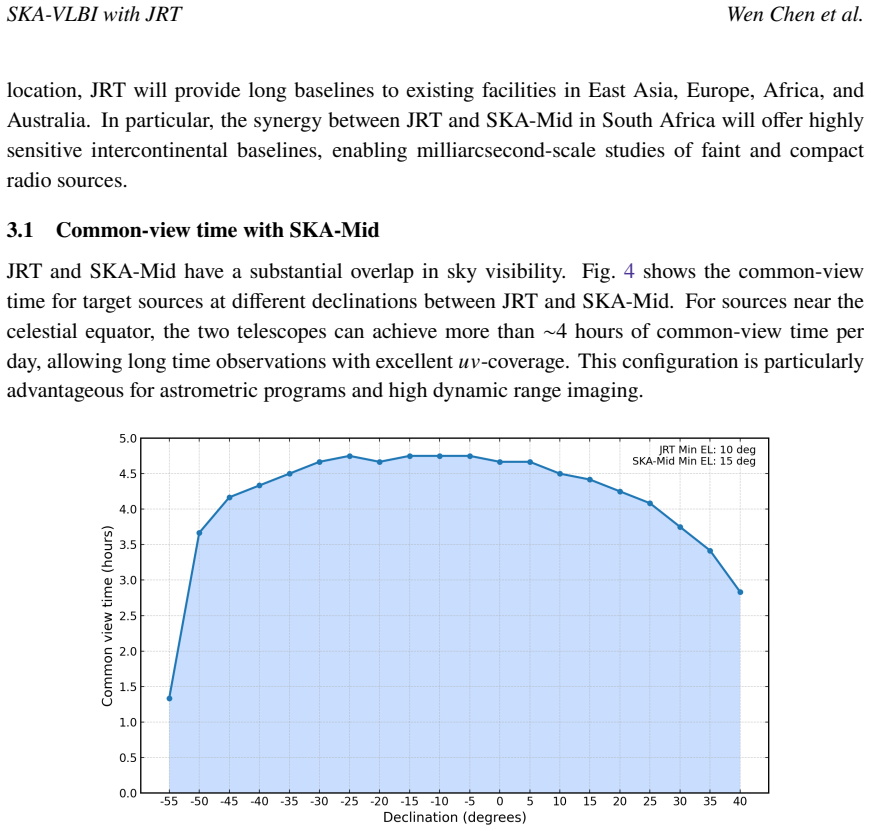
The JRT will contribute approximately 800 hours annually to international VLBI observations via a standard VLBI backend. When operating in conjunction with the phased-up SKA-Mid, the JRT will significantly enhance the technical and scientific capabilities of existing VLBI networks. Coordinated VLBI observations involving both the SKA-Mid and the JRT have the potential to significantly advance the field, with promising early science cases including measuring the distance to PSR J0437-4715 with less than 1 light year accuracy and exploring jet formation with event-horizon-scale resolution in M60*.
What carries the argument
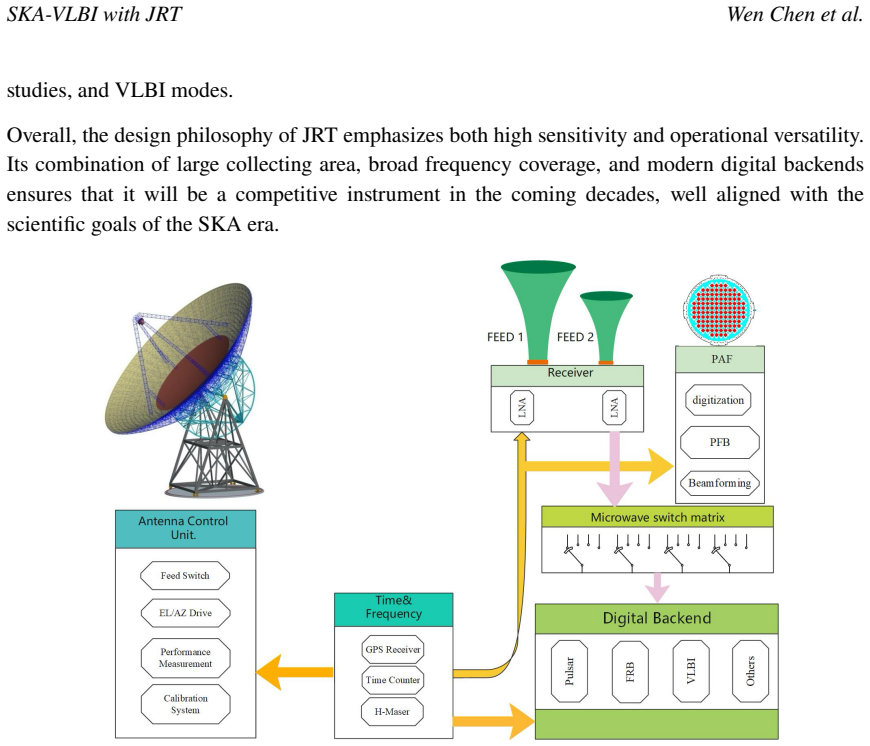
The JRT's VLBI module, consisting of broadband single-pixel receivers covering 1-8 GHz and 6-18 GHz together with a standard VLBI backend, coordinated with the phased-up SKA-Mid.
If this is right
- The JRT will supply approximately 800 hours of VLBI time each year to international networks.
- Coordinated use with the phased SKA-Mid will raise the technical and scientific performance of existing VLBI arrays.
- Early science will include distance measurements to PSR J0437-4715 accurate to less than one light year.
- Event-horizon-scale resolution will become available for studying jet formation in sources such as M60*.
Where Pith is reading between the lines
- The low-latitude site of the JRT could extend VLBI coverage toward southern-sky targets that northern arrays reach only with difficulty.
- Single-dish pulsar timing at the JRT combined with its VLBI role may strengthen data sets used for nanohertz gravitational-wave searches.
- The integration model described could guide how other large single-dish telescopes are added to global interferometric networks.
Load-bearing premise
The JRT's location, receivers, and backend will deliver the stated VLBI performance gains once the telescope is built and integrated into networks.
What would settle it
Actual post-construction VLBI data from the JRT plus SKA-Mid that show no measurable improvement in baseline coverage, sensitivity, or image fidelity compared with current networks alone.
Figures
read the original abstract
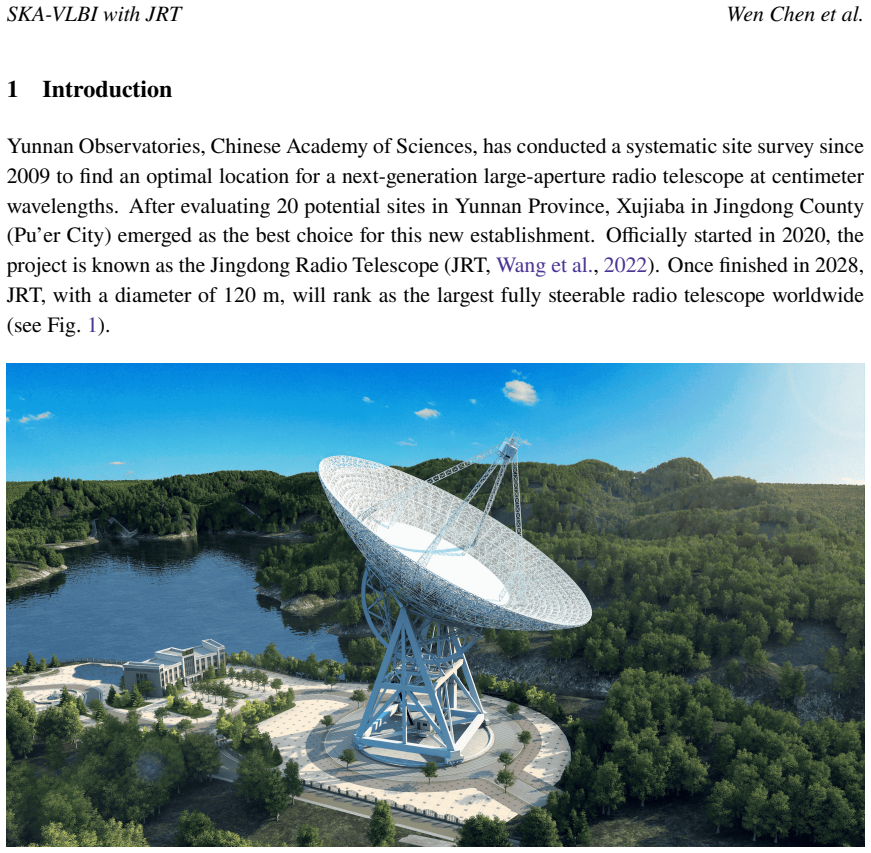
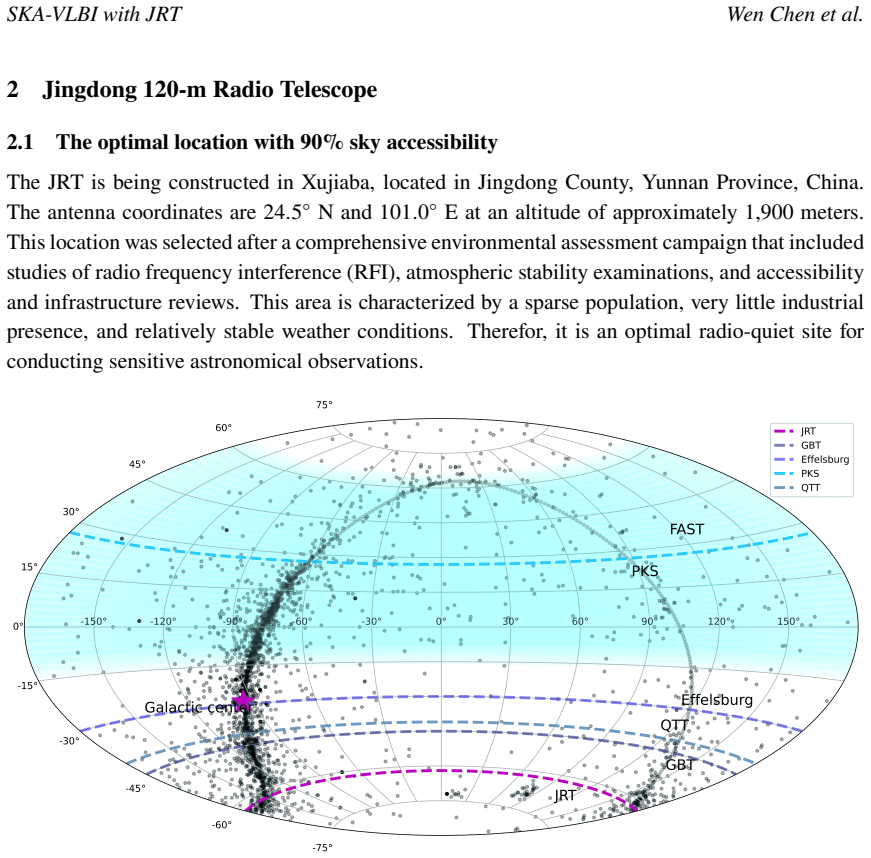
The Jingdong Radio Telescope (JRT) is a 120-meter fully steerable radio telescope currently under construction in Jingdong County, Yunnan Province, China. Located at a relatively low latitude (24.5 degree), the JRT will enable observations of nearly 90% of the sky. Equipped with two broadband single-pixel receivers covering 1-8 GHz and 6-18 GHz, and a powerful digital backend, the telescope will support single-dish studies of various radio sources-particularly millisecond pulsars for enhancing the detection of nanohertz gravitational waves. In addition to single-dish capabilities, the JRT is expected to contribute approximately 800 hours annually to international Very Long Baseline Interferometry (VLBI) observations via a standard VLBI backend. When operating in conjunction with the phased-up SKA-Mid, the JRT will significantly enhance the technical and scientific capabilities of existing VLBI networks. This paper presents a comprehensive overview of the JRT's VLBI module and explores its potential to improve joint VLBI observations with current VLBI networks. Our analysis suggests that coordinated VLBI observations involving both the SKA-Mid and the JRT have the potential to significantly advance the field. For early sciences, we also highlight a few highly promising scientific cases, e.g. measuring the distance to PSR J0437-4715 with <1 ly accuracy and exploring jet formation with an event-horizon-scale resolution in M60*.
Editorial analysis
A structured set of objections, weighed in public.
Referee Report
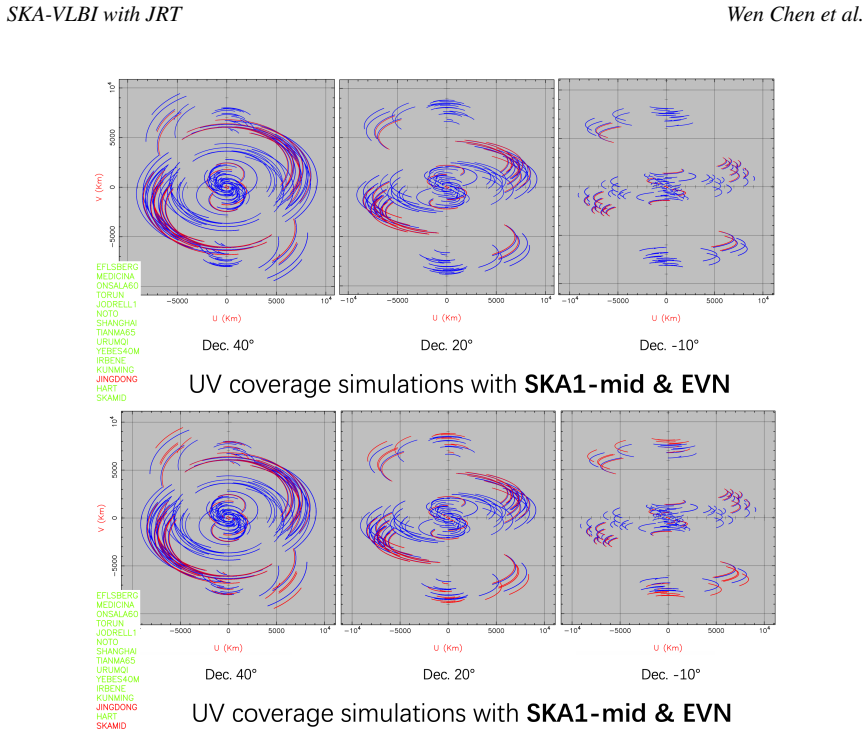
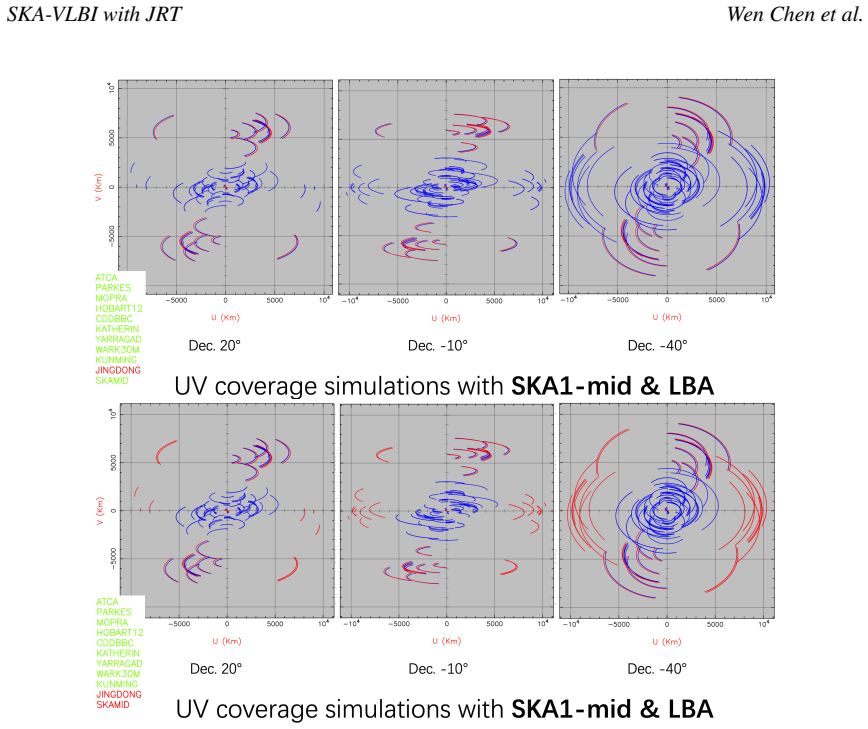
Summary. The manuscript describes the Jingdong Radio Telescope (JRT), a 120 m fully steerable dish under construction at 24.5° latitude in Yunnan, China, equipped with 1–8 GHz and 6–18 GHz single-pixel receivers and a VLBI backend. It outlines the telescope’s planned single-dish pulsar timing program and its intended contribution of ~800 hours per year to international VLBI, then qualitatively discusses how joint observations with the phased SKA-Mid array could improve uv-coverage and sensitivity for southern-sky sources. Two early-science cases are highlighted: sub-light-year distance measurements to PSR J0437−4715 and event-horizon-scale imaging of the jet in M60*.
Significance. If the projected performance gains are realized, the JRT would add a large, low-latitude aperture to existing VLBI arrays, potentially improving baseline coverage and integration times for southern pulsars and AGN. The manuscript, however, supplies only descriptive specifications and does not demonstrate these gains through SEFD values, simulated visibilities, or error budgets, so the claimed scientific advancement remains an assertion rather than a quantified result.
major comments (2)
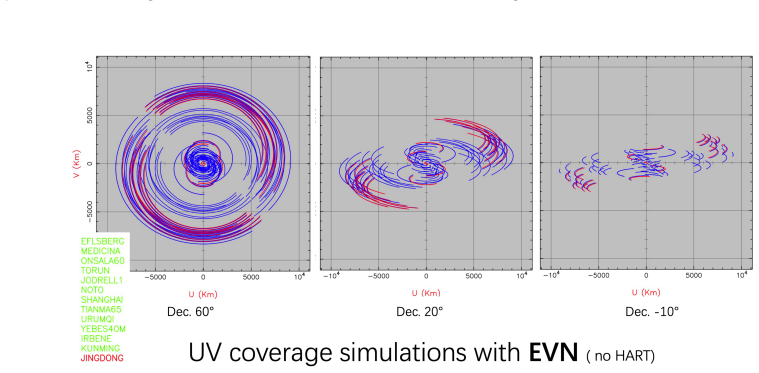
- [Abstract, §4] Abstract and §4 (VLBI module description): the central claim that “coordinated VLBI observations involving both the SKA-Mid and the JRT have the potential to significantly advance the field” is unsupported by any quantitative analysis. No SEFD estimates, baseline-dependent noise budgets, simulated dirty maps, or integration-time calculations for the joint array are presented, leaving the performance increment unverified.
- [§5] §5 (scientific cases): the stated <1 ly distance accuracy for PSR J0437−4715 and event-horizon-scale resolution for M60* are presented without error-propagation analysis or simulated uv-coverage for the SKA-Mid + JRT configuration. These numbers therefore cannot be assessed against existing VLBI performance.
minor comments (2)
- The manuscript would benefit from a table comparing the JRT’s expected SEFD and frequency coverage with existing VLBI stations (e.g., Effelsberg, Parkes, or the current SKA-Mid VLBI stations).
- Figure captions should explicitly state whether any plotted quantities are measured, simulated, or projected.
Simulated Author's Rebuttal
We thank the referee for the detailed review and for identifying the need for quantitative support. The manuscript is an overview of the JRT facility and its intended VLBI role rather than a technical simulation study; we agree that several claims would benefit from additional supporting calculations. We address each major comment below and outline the revisions we will make.
read point-by-point responses
-
Referee: [Abstract, §4] Abstract and §4 (VLBI module description): the central claim that “coordinated VLBI observations involving both the SKA-Mid and the JRT have the potential to significantly advance the field” is unsupported by any quantitative analysis. No SEFD estimates, baseline-dependent noise budgets, simulated dirty maps, or integration-time calculations for the joint array are presented, leaving the performance increment unverified.
Authors: We accept that the manuscript presents only a qualitative discussion of the expected benefits. The statements rest on the well-established advantages of adding a large, low-latitude aperture (improved uv-coverage for southern declinations and increased collecting area), but no explicit SEFD values or sensitivity calculations are provided. In the revised manuscript we will add the JRT SEFD estimates at the two receiver bands, a short derivation of the expected thermal-noise improvement for SKA-Mid + JRT baselines, and a brief comparison with existing arrays. Full end-to-end simulations of dirty maps and integration-time budgets remain outside the scope of this facility-description paper and will be noted as future work. revision: partial
-
Referee: [§5] §5 (scientific cases): the stated <1 ly distance accuracy for PSR J0437−4715 and event-horizon-scale resolution for M60* are presented without error-propagation analysis or simulated uv-coverage for the SKA-Mid + JRT configuration. These numbers therefore cannot be assessed against existing VLBI performance.
Authors: The quoted figures are order-of-magnitude projections based on standard VLBI parallax and imaging scaling relations applied to the anticipated sensitivity and baseline improvements. No explicit error-propagation or uv-coverage simulations are included. We will revise §5 to qualify these numbers as preliminary estimates, supply a short reference to the underlying scaling (e.g., parallax precision ∝ 1/SNR and resolution set by longest baseline), and add a sentence noting that detailed Monte-Carlo error budgets would require dedicated follow-up simulations. revision: yes
Circularity Check
No circularity: purely descriptive overview with no derivations or fitted quantities
full rationale
The manuscript is a hardware-description and qualitative potential-assessment paper. It states telescope specifications (120 m aperture, 1-8/6-18 GHz receivers, VLBI backend, ~800 h/yr allocation) and asserts that joint operation with phased SKA-Mid “will significantly enhance” VLBI networks and “have the potential to significantly advance the field,” but supplies no equations, no fitted parameters, no simulated uv-coverage or SEFD budgets, and no derivation chain that could reduce to its own inputs. No self-citations are invoked as load-bearing uniqueness theorems or ansatzes. The central claim therefore rests on unquantified engineering assumptions rather than on any circular reduction; the absence of a derivation chain makes circularity impossible by definition.
Axiom & Free-Parameter Ledger
Reference graph
Works this paper leans on
-
[1]
doi: 10.3390/galaxies10060113. T. An et al. InAdvancing Astrophysics with the SKA – II (AASKAII)
-
[2]
arXiv search: Report number AASKAII/TaoAn03. R.Braunetal. Anticipatedperformanceofthesquarekilometrearray–phase1(ska1),2019. URL https://arxiv.org/abs/1912.12699. A. Brunthaler et al. In W. J. Jin, I. Platais, and M. A. C. Perryman, editors,A Giant Step: from Milli- to Micro-arcsecond Astrometry, volume 248, pages 474–480, July
-
[3]
doi: 10.3847/1538-4357/ac3f32. A. T. Deller, J. P. W. Verbiest, S. J. Tingay, and M. Bailes.ApJL, 685(1):L67, Sept
-
[4]
doi: 10.1086/592401. A. T. Deller et al.ApJ, 875(2):100, Apr
-
[5]
doi: 10.3847/1538-4357/ab11c7. P. G. Edwards, C. J. Phillips, C. Reynolds, and G. H. Heald.URSI GASS 2023, Aug
-
[6]
doi: 10.3847/1538-4357/adbdb8. G. Hobbs et al.MNRAS, 491(4):5951–5965, Feb
-
[7]
doi: 10.1093/mnras/stz3071. H. Hu.Astro. & Space Sci., 370(7):74, July
-
[8]
doi: 10.1007/s10509-025-04463-2. P. Jiang et al.Science China Physics, Mechanics, and Astronomy, 62(5):959502, May
-
[9]
doi: 10.1007/s11433-018-9376-1. J.-S. Kim et al.A&A, 696:A169, Apr
-
[10]
doi: 10.1051/0004-6361/202452038. X. Li et al.ApJ, 960(1):1, Jan. 2024a. doi: 10.3847/1538-4357/ad0be6. Y. Li et al.Res. Astron. Astrophys., 24(7):072001, July 2024b. doi: 10.1088/1674-4527/ad420c. Z. Li et al.MNRAS, 476(1):399–406, May
-
[11]
doi: 10.1093/mnras/sty210. D. G. Nair et al. In E. Ros et al., editors,Proceedings of the 16th EVN Symposium, pages 75–84, Sept
-
[12]
doi: 10.48550/arXiv.2412.20276. Z. Paragi et al. InAdvancing Astrophysics with the Square Kilometre Array (AASKA14), page 143, Apr
-
[13]
doi: 10.22323/1.215.0143. Z. Paragi, A. Chrysostomou, and C. Garcia-Miro. In14th European VLBI Network Symposium & Users Meeting (EVN 2018), page 85, Nov
-
[14]
doi: 10.22323/1.344.0085. E. Petroff, J. W. T. Hessels, and D. R. Lorimer.A&ARv, 27(1):4, Dec
-
[15]
doi: 10.3847/2041-8213/ad614a. M. J. Rioja and R. Dodson.A&ARv, 28(1):6, Sept
-
[16]
doi: 10.1007/s00159-020-00126-z. A. E. Rogers and S. S. Doeleman. Fringe detection methods for very long baseline arrays (mm- 12 SKA-VLBI with JRT Wen Chen et al. vlbi memo #020). mm-VLBI Memo Series,
-
[17]
URLhttps://www.haystack.mit.edu/ wp-content/uploads/2020/07/memo_mmVLBI_020.pdf. Accessed 2026-01-25. A.E.E.Rogers,S.S.Doeleman,andJ.M.Moran.AJ,109:1391,Mar.1995. doi: 10.1086/117371. X. Shu et al. InAdvancing Astrophysics with the SKA – II (AASKAII)
-
[18]
doi: 10.1360/SSPMA-2022-0162. N. Wang.Scientia Sinica Physica, Mechanica & Astronomica, 44(8):783–794, July
-
[19]
doi: 10.1360/SSPMA2014-00039. E. White et al.A&A, 659:A113, Mar
-
[20]
doi: 10.1051/0004-6361/202141936. R. Wielebinski, N. Junkes, and B. H. Grahl.Journal of Astronomical History and Heritage, 14(1): 3–21, Mar
-
[21]
doi: 10.3847/1538-4357/ad7fe2. Z. Yan et al.Universe, 10(5):195, Apr
-
[22]
doi: 10.3390/universe10050195. J. A. Zensus and E. Ros.arXiv e-prints, art. arXiv:1501.05079, Jan
work page internal anchor Pith review Pith/arXiv arXiv doi:10.3390/universe10050195
-
[23]
European VLBI Network: Present and Future
doi: 10.48550/arXiv. 1501.05079. 13
work page internal anchor Pith review Pith/arXiv arXiv doi:10.48550/arxiv
discussion (0)
Sign in with ORCID, Apple, or X to comment. Anyone can read and Pith papers without signing in.