Full Conformal Prediction under Stochastic Non-Conformity Measure
Pith reviewed 2026-06-30 08:59 UTC · model grok-4.3
The pith
The standard relaxation to permutation invariance in distribution does not guarantee validity of full conformal prediction when the non-conformity measure is stochastic.
A machine-rendered reading of the paper's core claim, the machinery that carries it, and where it could break.
Core claim
We show that the condition of almost sure permutation invariance is too restrictive for stochastic non-conformity measures arising from machine learning, and that the relaxation to permutation invariance in distribution is insufficient to guarantee the validity of full conformal prediction. We provide a correct sufficient condition consisting of conditional independence together with permutation invariance in distribution, which is satisfied in several stochastic machine learning settings.
What carries the argument
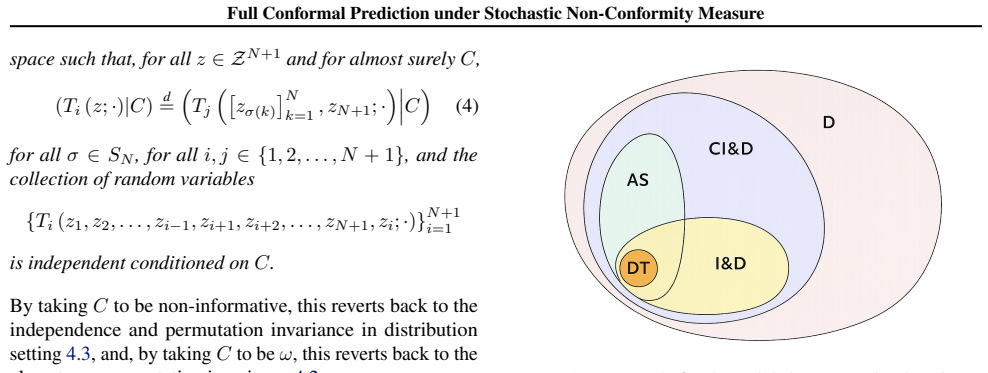
Conditional Independence & Permutation Invariance in Distribution: the joint requirement that the stochastic non-conformity measure remains distributionally unchanged under data permutations and is independent of those permutations conditional on the observed data.
If this is right
- Full conformal prediction retains its coverage guarantee under any stochastic training process obeying the corrected condition.
- The condition is satisfied by several common sources of randomness in machine-learning pipelines.
- Validity proofs no longer require the non-conformity measure to be deterministic or almost surely invariant.
Where Pith is reading between the lines
- Implementations that add controlled randomness to training may still produce valid conformal sets if the independence structure is preserved.
- The result highlights that dependence between training randomness and data ordering, rather than randomness alone, is what breaks coverage.
- Testing the condition on concrete randomized learners such as bagged models or networks with dropout would give practical guidance on when the guarantee holds.
Load-bearing premise
The randomness introduced by machine-learning training can be captured by making the non-conformity measure conditionally independent of data permutations.
What would settle it
An explicit counterexample consisting of a finite data set, a stochastic training procedure, and a non-conformity score that is permutation-invariant in distribution but not conditionally independent of the permutation, for which the resulting prediction sets undercover below the nominal level.
Figures
read the original abstract
The theory of full conformal prediction uses deterministic non-conformity measure, but modern usage of full conformal prediction often relies on machine learning training, making stochasticity inevitable. A simple sufficient condition of almost sure permutation invariance of the non-conformity measure can be too restrictive, so many have suggested the relaxation to permutation in distribution as a condition for full conformal prediction validity. We, however, show that this commonly known condition is actually insufficient. We then provide a correct sufficient condition: Conditional Independence & Permutation Invariance in Distribution, which encompasses several stochastic settings that may be used in machine learning.
Editorial analysis
A structured set of objections, weighed in public.
Referee Report
Summary. The paper argues that the commonly invoked sufficient condition of permutation invariance in distribution for a stochastic non-conformity measure is insufficient to guarantee marginal coverage in full conformal prediction. It supplies a counterexample and then proposes the stronger condition of conditional independence between the randomness and the data together with permutation invariance in distribution; this pair is claimed to be sufficient and to cover typical stochastic training procedures in machine learning.
Significance. If the counterexample is valid and the sufficiency proof is correct, the result clarifies a subtle but practically relevant gap in the theory of conformal prediction with randomized predictors. The new condition is stated in a form that can be checked for common stochastic training schemes, which is a concrete advance over the literature that had treated distributional invariance as adequate.
major comments (2)
- [§3] §3 (counterexample construction): the joint distribution of the score vector must be shown to remain permutation-invariant while the realized coverage fails; the construction must explicitly keep the auxiliary randomness R independent of the test point (as required by the setup) rather than coupling R to the augmented data set. Without this verification the claimed insufficiency does not follow.
- [Theorem 4.1] Theorem 4.1 (sufficiency): the proof that conditional independence of R plus distributional invariance implies exchangeability of the realized scores is load-bearing; the argument should be written out in full rather than sketched, because any hidden dependence between R and the test point would invalidate the exchangeability step.
minor comments (2)
- Notation for the stochastic non-conformity measure A_n should be introduced once and used consistently; the current alternation between A and A_n is distracting.
- The abstract states the insufficiency result without any indication of the counterexample; a one-sentence pointer to the construction would help readers.
Simulated Author's Rebuttal
We thank the referee for the careful reading and the constructive comments, which help strengthen the presentation of the counterexample and the sufficiency result. We address the two major comments point by point below and will revise the manuscript to incorporate the requested clarifications and expansions.
read point-by-point responses
-
Referee: [§3] §3 (counterexample construction): the joint distribution of the score vector must be shown to remain permutation-invariant while the realized coverage fails; the construction must explicitly keep the auxiliary randomness R independent of the test point (as required by the setup) rather than coupling R to the augmented data set. Without this verification the claimed insufficiency does not follow.
Authors: We agree that the counterexample requires explicit verification to be fully rigorous. In the revised manuscript we will add a dedicated paragraph (or subsection) that (i) confirms the auxiliary randomness R is generated independently of the test point, (ii) shows that the joint distribution of the realized score vector remains permutation-invariant, and (iii) demonstrates that marginal coverage nevertheless fails. This will make the insufficiency claim self-contained. revision: yes
-
Referee: [Theorem 4.1] Theorem 4.1 (sufficiency): the proof that conditional independence of R plus distributional invariance implies exchangeability of the realized scores is load-bearing; the argument should be written out in full rather than sketched, because any hidden dependence between R and the test point would invalidate the exchangeability step.
Authors: We accept that the current sketch of the proof is insufficient for a load-bearing result. In the revision we will replace the sketch with a complete, self-contained proof of Theorem 4.1. The expanded argument will explicitly invoke the conditional independence of R from the data (including the test point) at each step, derive the exchangeability of the score vector, and thereby obtain the marginal coverage guarantee. We will also add a short remark ruling out hidden dependence between R and the test point under the stated assumptions. revision: yes
Circularity Check
No circularity; derivation is self-contained
full rationale
The paper claims to exhibit insufficiency of 'permutation invariance in distribution' via counterexample and then states an independent sufficient condition (conditional independence plus distributional invariance). No equations, definitions, or self-citations in the abstract reduce the validity result to a fit, renaming, or prior author work; the new condition is introduced as an external strengthening rather than being defined in terms of coverage. The derivation chain therefore rests on external probabilistic arguments rather than internal self-reference.
Axiom & Free-Parameter Ledger
axioms (1)
- standard math Standard axioms of probability theory including definitions of random variables, conditional independence, and distributional equality under permutations
Reference graph
Works this paper leans on
-
[1]
The Annals of Statistics , volume=
Conformal prediction beyond exchangeability , author=. The Annals of Statistics , volume=. 2023 , publisher=
2023
-
[2]
Symposium on conformal and probabilistic prediction with applications , pages=
Criteria of efficiency for conformal prediction , author=. Symposium on conformal and probabilistic prediction with applications , pages=. 2016 , organization=
2016
-
[3]
Conformal and Probabilistic Prediction and Applications , pages=
Conformal testing in a binary model situation , author=. Conformal and Probabilistic Prediction and Applications , pages=. 2021 , organization=
2021
-
[4]
Asian conference on machine learning , pages=
Conditional validity of inductive conformal predictors , author=. Asian conference on machine learning , pages=. 2012 , organization=
2012
-
[5]
arXiv preprint arXiv:2007.03114 , year=
Efficient conformal prediction via cascaded inference with expanded admission , author=. arXiv preprint arXiv:2007.03114 , year=
-
[6]
Theoretical Foundations of Conformal Prediction
Theoretical foundations of conformal prediction , author=. arXiv preprint arXiv:2411.11824 , year=
work page internal anchor Pith review Pith/arXiv arXiv
-
[7]
conformal and probabilistic prediction and applications , pages=
Universally consistent conformal predictive distributions , author=. conformal and probabilistic prediction and applications , pages=. 2019 , organization=
2019
-
[8]
Electronic Journal of Statistics , volume=
Training-conditional coverage for distribution-free predictive inference , author=. Electronic Journal of Statistics , volume=. 2023 , publisher=
2023
-
[9]
Optimized conformal selection: Powerful selective inference after conformity score optimization , author=. arXiv preprint arXiv:2411.17983 , year=
-
[10]
Diversifying conformal selections
Diversifying conformal selections , author=. arXiv preprint arXiv:2506.16229 , year=
-
[11]
Full-conformal novelty detection
Full-conformal novelty detection: A powerful and non-random approach , author=. arXiv preprint arXiv:2501.02703 , year=
work page internal anchor Pith review Pith/arXiv arXiv
-
[12]
arXiv preprint arXiv:2306.06342 , year=
Distribution-free inference with hierarchical data , author=. arXiv preprint arXiv:2306.06342 , year=
-
[13]
Journal of the American Statistical Association , volume=
Distribution-free predictive inference for regression , author=. Journal of the American Statistical Association , volume=. 2018 , publisher=
2018
-
[14]
2022 , eprint=
A Gentle Introduction to Conformal Prediction and Distribution-Free Uncertainty Quantification , author=. 2022 , eprint=
2022
-
[15]
European conference on machine learning , pages=
Inductive confidence machines for regression , author=. European conference on machine learning , pages=. 2002 , organization=
2002
-
[16]
Advances in neural information processing systems , volume=
Conformalized quantile regression , author=. Advances in neural information processing systems , volume=
-
[17]
Journal of the American Statistical Association , volume=
Least ambiguous set-valued classifiers with bounded error levels , author=. Journal of the American Statistical Association , volume=. 2019 , publisher=
2019
-
[18]
2026 , url=
Elliot L Epstein and John Winnicki and Thanawat Sornwanee and Rajat Vadiraj Dwaraknath , booktitle=. 2026 , url=
2026
-
[19]
2005 , publisher=
Testing statistical hypotheses , author=. 2005 , publisher=
2005
-
[20]
The Twelfth International Conference on Learning Representations , year=
Conformal Language Modeling , author=. The Twelfth International Conference on Learning Representations , year=
-
[21]
Findings of the association for computational linguistics: ACL 2023 , pages=
Conformal nucleus sampling , author=. Findings of the association for computational linguistics: ACL 2023 , pages=
2023
-
[22]
Findings of the Association for Computational Linguistics: EMNLP 2024 , pages=
API Is Enough: Conformal Prediction for Large Language Models Without Logit-Access , author=. Findings of the Association for Computational Linguistics: EMNLP 2024 , pages=
2024
-
[23]
IFIP International conference on artificial intelligence applications and innovations , pages=
Efficiency comparison of unstable transductive and inductive conformal classifiers , author=. IFIP International conference on artificial intelligence applications and innovations , pages=. 2014 , organization=
2014
-
[24]
The Thirteenth International Conference on Learning Representations , year=
Leave-One-Out Stable Conformal Prediction , author=. The Thirteenth International Conference on Learning Representations , year=
-
[25]
The Thirteenth International Conference on Learning Representations , year=
Approximating Full Conformal Prediction for Neural Network Regression with Gauss-Newton Influence , author=. The Thirteenth International Conference on Learning Representations , year=
-
[26]
2018 , eprint=
conformalClassification: A Conformal Prediction R Package for Classification , author=. 2018 , eprint=
2018
-
[27]
2005 , publisher=
Algorithmic learning in a random world , author=. 2005 , publisher=
2005
discussion (0)
Sign in with ORCID, Apple, or X to comment. Anyone can read and Pith papers without signing in.