Radio Diagnostics of Particle Acceleration in Solar Flares with SKAO Observations
Pith reviewed 2026-06-30 09:03 UTC · model grok-4.3
The pith
The Square Kilometre Array Observatory will enable detailed characterisation of weaker particle populations in solar flares through radio observations.
A machine-rendered reading of the paper's core claim, the machinery that carries it, and where it could break.
Core claim
The central claim is that SKAO observations will provide high-fidelity data enabling detailed characterisation of weaker particle populations in solar flares, statistical studies of particle beams, and insights into their interaction with magnetic topologies, while high-resolution capabilities especially from SKA-Mid and synergy with EUV and X-ray observations will refine diagnostics of coronal and acceleration-region properties.
What carries the argument
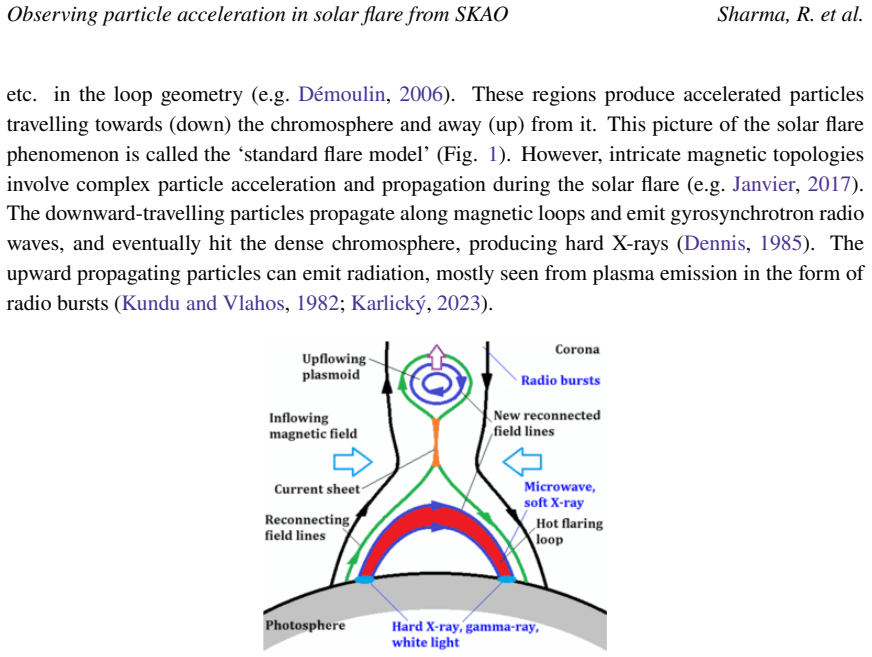
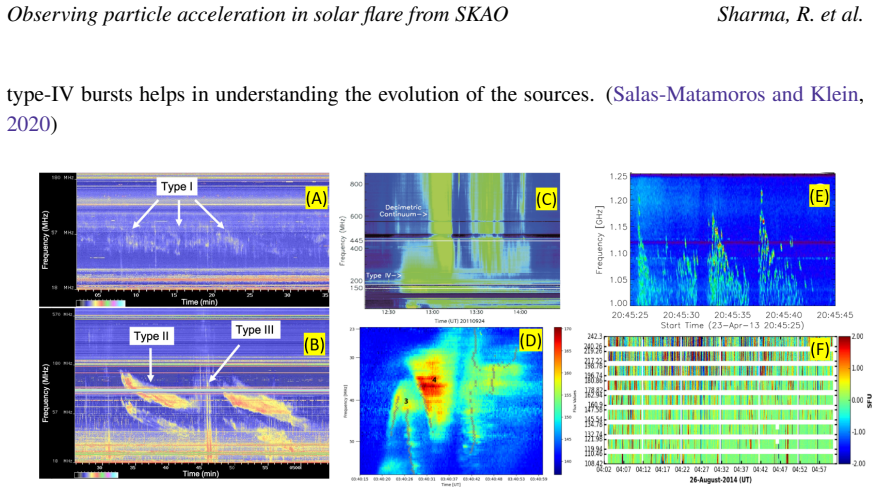
Distinction between plasma emission and gyrosynchrotron emission based on brightness temperature and spectrum, with fine spectral structures in gyrosynchrotron bursts used to map magnetic fields along particle acceleration tracks.
If this is right
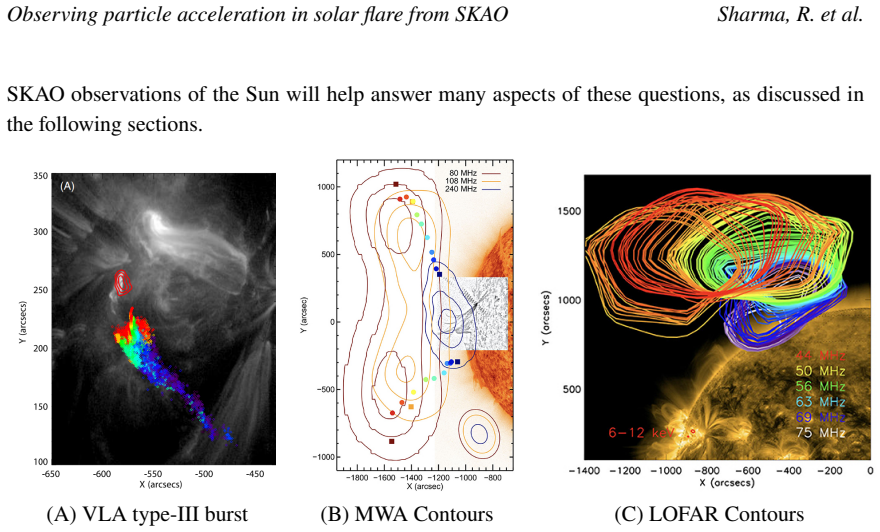
- High spatial-temporal resolution and polarimetry will track electron beams in evolving magnetic fields while constraining coronal magnetic strength, density, and temperature.
- Fine spectral structures from gyrosynchrotron bursts will map magnetic fields along acceleration tracks.
- Statistical studies of particle beams from the more common weaker populations will become feasible.
- Multi-wavelength synergy with EUV and X-rays will refine diagnostics of coronal and acceleration-region properties.
Where Pith is reading between the lines
- Improved statistics on power-law particle distributions could tighten constraints on energy release mechanisms in flares.
- Similar radio diagnostics might eventually be applied to particle acceleration in other systems such as active galaxy jets.
- Direct comparison of SKAO data with current models could reveal the need for updated emission theory at higher sensitivities.
Load-bearing premise
That current distinctions between plasma emission and gyrosynchrotron emission along with existing models of fine spectral structures will be sufficient to interpret SKAO data for mapping magnetic fields and tracking electron beams.
What would settle it
SKAO observations of solar flares that fail to resolve or correctly classify emission mechanisms for weaker particle populations or that cannot map magnetic fields using existing gyrosynchrotron models would falsify the expected advances.
Figures
read the original abstract
Particle acceleration is a fundamental astrophysical process occurring across diverse systems and scales, producing electromagnetic emission across all wavelengths. Radio bursts from astrophysical systems like active galaxy jets, solar flares, pulsars, etc., provide a probe into the emission mechanism and particle acceleration processes. Among all astrophysical phenomena, magnetically driven solar flares provide unique diagnostics of nonthermal particles due to the advantage of multiple spatial-temporal and spectral measurements. The subsequent emitted radiation spans various sections of the radio spectrum. Based on brightness temperature and spectrum, one can distinguish between bright plasma emission or 'nonthermal' emission. Nonthermal radio bursts in meter and microwave bands arise from suprathermal particles, while the surrounding plasma produces fainter thermal emission. High spatial-temporal studies along with polarimetry will enable tracking of electron beams in evolving magnetic fields and constrain coronal properties such as magnetic strength, density, and temperature. Fine spectral structures from gyrosynchrotron bursts allow mapping of magnetic fields along acceleration tracks. However, emissions from the more numerous, weaker particle populations remain difficult to observe. Particles in solar flares follow a power-law energy distribution, with weaker populations being more common. The Square Kilometre Array Observatory (SKAO) will provide high-fidelity data that will enable detailed characterisation of these populations, statistical studies of particle beams, and insights into their interaction with magnetic topologies. Its high-resolution (especially SKA-Mid) and multi-wavelength synergy (EUV, X-rays) will refine diagnostics of coronal and acceleration-region properties. This chapter reviews particle acceleration models and expected advances from SKAO.
Editorial analysis
A structured set of objections, weighed in public.
Referee Report
Summary. The manuscript is a review chapter summarizing established models of particle acceleration in solar flares, the distinction between plasma emission and gyrosynchrotron emission based on brightness temperature and spectral properties, and the anticipated role of SKAO (particularly SKA-Mid) in enabling high-fidelity observations of weak particle populations, statistical studies of electron beams, and constraints on coronal magnetic fields, density, and temperature via high-resolution imaging, polarimetry, and multi-wavelength synergy with EUV and X-ray data.
Significance. If the projections hold, the review usefully frames how SKAO's capabilities can extend existing diagnostics to more numerous weak particle populations that are currently difficult to observe, thereby supporting statistical studies and improved mapping of magnetic topologies in flares. The manuscript correctly positions these advances as building on established emission-mechanism distinctions rather than introducing new derivations.
minor comments (2)
- The abstract states that 'fine spectral structures from gyrosynchrotron bursts allow mapping of magnetic fields along acceleration tracks' but does not cite specific prior works or models (e.g., those using gyrosynchrotron spectra for B-field inference) that would ground this claim for readers new to the topic.
- The transition from the discussion of thermal vs. nonthermal emission to the SKAO section would benefit from an explicit sentence linking the two, to clarify how the instrument's sensitivity directly addresses the 'more numerous, weaker particle populations' mentioned earlier.
Simulated Author's Rebuttal
We thank the referee for their thorough and positive assessment of our review chapter. Their summary accurately reflects the manuscript's focus on established particle acceleration models, emission mechanism distinctions, and the anticipated contributions of SKAO observations. We are pleased with the recommendation to accept.
Circularity Check
No significant circularity: review paper with no derivations
full rationale
The paper is a descriptive review chapter summarizing established particle acceleration models, plasma vs. gyrosynchrotron emission mechanisms, and forward-looking expectations for SKAO observations. No equations, derivations, fitted parameters, or predictions are present that could reduce by construction to inputs or self-citations. Central claims rest on literature overviews rather than novel internal logic, making the derivation chain self-contained with no load-bearing circular steps.
Axiom & Free-Parameter Ledger
Reference graph
Works this paper leans on
-
[1]
2019 , eprint=
Anticipated Performance of the Square Kilometre Array -- Phase 1 (SKA1) , author=. 2019 , eprint=
2019
-
[2]
2015 , publisher=
Advancing Astrophysics with the Square Kilometre Array (AASKA14) , author=. 2015 , publisher=
2015
-
[3]
Solar Flares as Electron Accelerators: Toward a Resolution of the Acceleration Efficiency Issue. , keywords =. doi:10.3847/1538-4357/adee25 , archivePrefix =. 2502.04769 , primaryClass =
-
[4]
Bridging High-density Electron Beam Coronal Transport and Deep Chromospheric Heating in Stellar Flares. , keywords =. doi:10.3847/2041-8213/acb144 , archivePrefix =. 2301.03477 , primaryClass =
-
[5]
The Efficiency of Electron Acceleration during the Impulsive Phase of a Solar Flare. , keywords =. doi:10.3847/2041-8213/acc9b7 , archivePrefix =. 2304.01088 , primaryClass =
-
[6]
Wave-particle interactions in non-uniform plasma and the interpretation of hard X-ray spectra in solar flares. , keywords =. doi:10.1051/0004-6361/201118216 , archivePrefix =. 1112.4448 , primaryClass =
work page internal anchor Pith review Pith/arXiv arXiv doi:10.1051/0004-6361/201118216
-
[7]
Plasma radio emission from inhomogeneous collisional plasma of a flaring loop
Plasma radio emission from inhomogeneous collisional plasma of a flaring loop. , keywords =. doi:10.1051/0004-6361/201322263 , archivePrefix =. 1312.2792 , primaryClass =
work page internal anchor Pith review Pith/arXiv arXiv doi:10.1051/0004-6361/201322263
-
[8]
Electron acceleration during three-dimensional relaxation of an electron beam-return current plasma system in a magnetic field. , keywords =. doi:10.1051/0004-6361/201219400 , archivePrefix =. 1207.6248 , primaryClass =
work page internal anchor Pith review Pith/arXiv arXiv doi:10.1051/0004-6361/201219400
-
[9]
Local re-acceleration and a modified thick target model of solar flare electrons
Local re-acceleration and a modified thick target model of solar flare electrons. , keywords =. doi:10.1051/0004-6361/200913145 , archivePrefix =. 0909.4243 , primaryClass =
work page internal anchor Pith review Pith/arXiv arXiv doi:10.1051/0004-6361/200913145
-
[10]
An Anisotropic Density Turbulence Model from the Sun to 1 au Derived from Radio Observations. , keywords =. doi:10.3847/1538-4357/acf6c1 , archivePrefix =. 2308.05839 , primaryClass =
-
[11]
Imaging Spectroscopy of Solar Radio Burst Fine Structures
Imaging spectroscopy of solar radio burst fine structures. Nature Communications , keywords =. doi:10.1038/s41467-017-01307-8 , archivePrefix =. 1708.06505 , primaryClass =
work page internal anchor Pith review Pith/arXiv arXiv doi:10.1038/s41467-017-01307-8
-
[12]
Data-model comparison using FORWARD and CoMP
Data-model comparison using FORWARD and CoMP. Polarimetry , year = 2015, editor =. doi:10.1017/S1743921315004846 , archivePrefix =. 1511.04416 , primaryClass =
work page internal anchor Pith review Pith/arXiv arXiv doi:10.1017/s1743921315004846 2015
-
[13]
Astronomy and Computing , keywords =
Karabo: A versatile SKA observation simulation framework. Astronomy and Computing , keywords =. doi:10.1016/j.ascom.2025.101004 , archivePrefix =. 2504.00303 , primaryClass =
-
[14]
First Frequency-time-resolved Imaging Spectroscopy Observations of Solar Radio Spikes. , keywords =. doi:10.3847/2041-8213/ac1a7d , archivePrefix =. 2108.06191 , primaryClass =
-
[15]
Particle acceleration in astrophysical jets. , keywords =. doi:10.1016/j.newar.2020.101543 , archivePrefix =. 2003.06587 , primaryClass =
-
[16]
Solar Radio Spikes and Type IIIb Striae Manifestations of Subsecond Electron Acceleration Triggered by a Coronal Mass Ejection. , keywords =. doi:10.3847/1538-4357/acbd3f , archivePrefix =. 2302.11265 , primaryClass =
-
[17]
Particle acceleration in interstellar shocks. , keywords =. doi:10.1007/s10509-019-3669-y , archivePrefix =. 1910.06006 , primaryClass =
-
[18]
Particle acceleration by supernova shocks and spallogenic nucleosynthesis of light elements
Particle Acceleration by Supernova Shocks and Spallogenic Nucleosynthesis of Light Elements. Annual Review of Nuclear and Particle Science , keywords =. doi:10.1146/annurev-nucl-101917-021151 , archivePrefix =. 1803.01794 , primaryClass =
work page internal anchor Pith review Pith/arXiv arXiv doi:10.1146/annurev-nucl-101917-021151
-
[19]
Particle acceleration in axisymmetric pulsar current sheets
Particle acceleration in axisymmetric pulsar current sheets. , keywords =. doi:10.1093/mnras/stv042 , archivePrefix =. 1410.3757 , primaryClass =
work page internal anchor Pith review Pith/arXiv arXiv doi:10.1093/mnras/stv042
-
[20]
Recent Advances in Understanding Particle Acceleration Processes in Solar Flares
Recent Advances in Understanding Particle Acceleration Processes in Solar Flares. , keywords =. doi:10.1007/s11214-011-9803-y , archivePrefix =. 1110.2359 , primaryClass =
work page internal anchor Pith review Pith/arXiv arXiv doi:10.1007/s11214-011-9803-y
-
[21]
Living Reviews in Solar Physics , keywords =
Flare Observations. Living Reviews in Solar Physics , keywords =. doi:10.1007/s41116-016-0004-3 , adsurl =
-
[22]
Living Reviews in Solar Physics , keywords =
Flare Observations. Living Reviews in Solar Physics , keywords =. doi:10.12942/lrsp-2008-1 , adsurl =
-
[23]
AGU Fall Meeting Abstracts , year = 2024, series =
Necessity for Triggered Solar Radio Imaging Observation for Statistical Study of Spatially Resolved Solar Radio Bursts: A Demonstration using the Yamagawa and MWA. AGU Fall Meeting Abstracts , year = 2024, series =
2024
-
[24]
Do solar decimetric spikes originate in coronal X-ray sources?
Do solar decimetric spikes originate in coronal X-ray sources?. , keywords =. doi:10.1051/0004-6361/200912143 , archivePrefix =. 0904.4146 , primaryClass =
work page internal anchor Pith review Pith/arXiv arXiv doi:10.1051/0004-6361/200912143
-
[25]
Living Reviews in Solar Physics , keywords =
Stellar flares. Living Reviews in Solar Physics , keywords =. doi:10.1007/s41116-024-00039-4 , archivePrefix =. 2402.07885 , primaryClass =
-
[26]
Estimation of a coronal mass ejection magnetic field strength using radio observations of gyrosynchrotron radiation. , keywords =. doi:10.1051/0004-6361/201731368 , archivePrefix =. 1709.05184 , primaryClass =
work page internal anchor Pith review Pith/arXiv arXiv doi:10.1051/0004-6361/201731368
-
[27]
A Review of Solar Type III Radio Bursts
A review of solar type III radio bursts. Research in Astronomy and Astrophysics , keywords =. doi:10.1088/1674-4527/14/7/003 , archivePrefix =. 1404.6117 , primaryClass =
work page internal anchor Pith review Pith/arXiv arXiv doi:10.1088/1674-4527/14/7/003
-
[28]
An Observational Overview of Solar Flares
An Observational Overview of Solar Flares. , keywords =. doi:10.1007/s11214-010-9701-8 , archivePrefix =. 1109.5932 , primaryClass =
work page internal anchor Pith review Pith/arXiv arXiv doi:10.1007/s11214-010-9701-8
-
[29]
Sixty-five years of solar radioastronomy: flares, coronal mass ejections and Sun Earth connection. , keywords =. doi:10.1007/s00159-008-0013-x , adsurl =
-
[30]
, year = 2004, month = dec, volume =
Recent advances in the long-wavelength radio physics of the Sun. , year = 2004, month = dec, volume =. doi:10.1016/j.pss.2004.09.016 , adsurl =
-
[31]
Radio emission from the sun and stars. , keywords =. doi:10.1146/annurev.aa.23.090185.001125 , adsurl =
-
[32]
Gyrosynchrotron Emission of Solar Flares. , keywords =. doi:10.1007/BF00159964 , adsurl =
-
[33]
Frontiers in Astronomy and Space Sciences , keywords =
Incoherent Solar Radio Emission. Frontiers in Astronomy and Space Sciences , keywords =. doi:10.3389/fspas.2020.00057 , archivePrefix =. 2007.14888 , primaryClass =
-
[34]
The gyrosynchrotron emission from quasi-thermal electrons and applications to solar flares. , keywords =. doi:10.1086/157597 , adsurl =
-
[35]
Frontiers in Astronomy and Space Sciences , keywords =
Radio Measurements of the Magnetic field in the Solar Chromosphere and the Corona. Frontiers in Astronomy and Space Sciences , keywords =. doi:10.3389/fspas.2020.591075 , adsurl =
-
[36]
Advances in Space Research , year = 2005, month = jan, volume =
Energetic electrons in impulsive solar flares: Radio diagnostics. Advances in Space Research , year = 2005, month = jan, volume =. doi:10.1016/j.asr.2005.03.069 , adsurl =
-
[37]
The Relationship Between Solar Radio and Hard X-ray Emission
The Relationship Between Solar Radio and Hard X-ray Emission. , keywords =. doi:10.1007/s11214-010-9708-1 , archivePrefix =. 1109.6629 , primaryClass =
work page internal anchor Pith review Pith/arXiv arXiv doi:10.1007/s11214-010-9708-1
-
[38]
Nature Communications , keywords =
Ultra-high-resolution observations of persistent null-point reconnection in the solar corona. Nature Communications , keywords =. doi:10.1038/s41467-023-37888-w , archivePrefix =. 2304.08725 , primaryClass =
-
[39]
3D magnetic reconnection and its application to solar flares
Three-dimensional magnetic reconnection and its application to solar flares. Journal of Plasma Physics , keywords =. doi:10.1017/S0022377817000034 , archivePrefix =. 1612.06513 , primaryClass =
work page internal anchor Pith review Pith/arXiv arXiv doi:10.1017/s0022377817000034
-
[40]
Radio bursts observed during solar eruptive flares and their schematic summary. arXiv e-prints , keywords =. doi:10.48550/arXiv.2307.07144 , archivePrefix =. 2307.07144 , primaryClass =
-
[41]
Solar Hard X-Ray Bursts. , keywords =. doi:10.1007/BF00158441 , adsurl =
-
[42]
Millisecond Radio Spikes. , keywords =. doi:10.1007/BF00159950 , adsurl =
-
[43]
Solar radiophysics : studies of emission from the sun at metre wavelengths
-
[44]
Volume 2 - Astrophysical applications
Plasma astrophysics: Nonthermal processes in diffuse magnetized plasmas. Volume 2 - Astrophysical applications
-
[45]
Solar radio astronomy
-
[46]
Tracing Electron Beams in the Sun's Corona with Radio Dynamic Imaging Spectroscopy
Tracing Electron Beams in the Sun's Corona with Radio Dynamic Imaging Spectroscopy. , keywords =. doi:10.1088/2041-8205/763/1/L21 , archivePrefix =. 1211.3058 , primaryClass =
work page internal anchor Pith review Pith/arXiv arXiv doi:10.1088/2041-8205/763/1/l21 2041
-
[47]
Study of the spatial association between an active region jet and a nonthermal type III radio burst. , keywords =. doi:10.1051/0004-6361/201936369 , adsurl =
-
[48]
Interplanetary Type IV Solar Radio Bursts: A Comprehensive Catalog and Statistical Results. , keywords =. doi:10.3847/1538-4357/ad5315 , archivePrefix =. 2406.00194 , primaryClass =
-
[49]
, keywords =
The position and polarization of Type V solar bursts. , keywords =
-
[50]
Imaging Spectroscopy of Type U and J Solar Radio Bursts with LOFAR
Imaging spectroscopy of type U and J solar radio bursts with LOFAR. , keywords =. doi:10.1051/0004-6361/201730701 , archivePrefix =. 1706.07410 , primaryClass =
work page internal anchor Pith review Pith/arXiv arXiv doi:10.1051/0004-6361/201730701
-
[51]
Solar microwave bursts A review. , keywords =. doi:10.1007/BF00177449 , adsurl =
-
[52]
Millisecond microwave spikes in a solar flare. , keywords =. doi:10.1038/275520a0 , adsurl =
-
[53]
Electron Cyclotron Maser Emission and the Brightest Solar Radio Bursts. , keywords =. doi:10.3847/1538-4357/ad4640 , archivePrefix =. 2405.01755 , primaryClass =
-
[54]
Multiple Electron Acceleration Instances during a Series of Solar Microflares Observed Simultaneously at X-Rays and Microwaves. , keywords =. doi:10.3847/1538-4357/ac2aa6 , archivePrefix =. 2109.12847 , primaryClass =
-
[55]
Detection of Ubiquitous Weak and Impulsive Nonthermal Emissions from the Solar Corona. , keywords =. doi:10.3847/1538-4357/ac87fc , archivePrefix =. 2208.07147 , primaryClass =
-
[56]
Study of Particle Acceleration Using Fine Structures and Oscillations in Microwaves from the Electron Cyclotron Maser. , keywords =. doi:10.3847/1538-4357/ad4884 , archivePrefix =. 2405.04351 , primaryClass =
-
[57]
Solar Physics with the Square Kilometre Array
Solar physics with the Square Kilometre Array. Advances in Space Research , keywords =. doi:10.1016/j.asr.2018.10.023 , archivePrefix =. 1810.04951 , primaryClass =
work page internal anchor Pith review Pith/arXiv arXiv doi:10.1016/j.asr.2018.10.023 2018
-
[58]
Location of Narrowband Spikes in Solar Flares
Location of narrowband spikes in solar flares. , keywords =. doi:10.1051/0004-6361:20011774 , archivePrefix =. astro-ph/0112442 , primaryClass =
work page internal anchor Pith review Pith/arXiv arXiv doi:10.1051/0004-6361:20011774
-
[59]
The Coevolution of Decimetric Millisecond Spikes and Hard X-Ray Emission during Solar Flares. , keywords =. doi:10.1086/172101 , adsurl =
-
[60]
Solar Physics96(2), 357–370 (1985) https://doi.org/10.1007/BF00149690
Radio Spikes and the Fragmentation of Flare Energy Release. , keywords =. doi:10.1007/BF00149690 , adsurl =
-
[61]
J.R. Abalde and F.A. Borotto and A.C.-L. Chian , abstract =. Plasma emission mechanism for radio spikes from solar flares , journal =. 2001 , issn =. doi:https://doi.org/10.1016/S0273-1177(01)00521-X , url =
-
[62]
On deterministic chaos, stationarity, periodicity and intermittency in coronal bursts and flares. , keywords =. doi:10.1007/BF00749136 , adsurl =
-
[63]
Estimating solar flux density at low radio frequencies using a sky brightness model
Estimating Solar Flux Density at Low Radio Frequencies Using a Sky Brightness Model. , keywords =. doi:10.1007/s11207-017-1096-1 , archivePrefix =. 1701.07798 , primaryClass =
work page internal anchor Pith review Pith/arXiv arXiv doi:10.1007/s11207-017-1096-1
-
[64]
American Astronomical Society Meeting Abstracts \#220 , year = 2012, series =
Expanded Owens Valley Solar Array (EOVSA) Testbed and Prototype. American Astronomical Society Meeting Abstracts \#220 , year = 2012, series =
2012
-
[65]
Noise in Maps of the Sun at Radio Wavelengths II: Solar Use Cases. , keywords =. doi:10.1007/s11207-025-02498-w , archivePrefix =. 2506.09843 , primaryClass =
-
[66]
Polarisation and source structure of solar stationary type IV radio bursts. , keywords =. doi:10.1051/0004-6361/202037989 , adsurl =
-
[67]
, keywords =
Millisecond microwave spikes at 8 GHz during solar flares. , keywords =
-
[68]
Exploring the Circular Polarisation of Low-Frequency Solar Radio Bursts with LOFAR. , keywords =. doi:10.1007/s11207-022-01976-9 , archivePrefix =. 2203.14674 , primaryClass =
-
[69]
Tackling the Unique Challenges of Low-frequency Solar Polarimetry with the Square Kilometre Array Low Precursor: The Algorithm. , keywords =. doi:10.3847/1538-4357/ac6758 , archivePrefix =. 2204.04578 , primaryClass =
-
[70]
A Formalism for Calibrating the Instrumental Polarization of Radio Interferometric Arrays at Meter Wavelengths Using Unpolarized Sky: A Demonstration Using MWA Observations. , keywords =. doi:10.3847/1538-4365/adc443 , archivePrefix =. 2503.16675 , primaryClass =
-
[71]
A Simple Solar Microwave Burst Observed with High Spectral Resolution. , keywords =. doi:10.1086/167366 , adsurl =
-
[72]
, year = 2022, month = jun, volume =
Solar flare accelerates nearly all electrons in a large coronal volume. , year = 2022, month = jun, volume =. doi:10.1038/s41586-022-04728-8 , adsurl =
-
[73]
Frontiers in Astronomy and Space Sciences , keywords =
Solar observation with MeerKAT: demonstration of technical readiness and initial science highlights. Frontiers in Astronomy and Space Sciences , keywords =. doi:10.3389/fspas.2025.1666743 , archivePrefix =. 2508.17983 , primaryClass =
-
[74]
First Detailed MeerKAT Imaging Spectroscopy of a Solar Flare. , keywords =. doi:10.3847/2041-8213/ae42c1 , archivePrefix =. 2602.05282 , primaryClass =
-
[75]
Dynamics of the Coronal Magnetic Field in the 2022 October 2 X-class Flare. , keywords =. doi:10.3847/1538-4357/ae42c8 , archivePrefix =. 2602.05024 , primaryClass =
-
[76]
Microwave Spectral Imaging of an Erupting Magnetic Flux Rope: Implications for the Standard Solar Flare Model in Three Dimensions. , keywords =. doi:10.3847/2041-8213/ab901a , archivePrefix =. 2005.01900 , primaryClass =
-
[77]
Spectropolarimetric Radio Imaging of Faint Gyrosynchrotron Emission from a CME: A Possible Indication of the Insufficiency of Homogeneous Models. , keywords =. doi:10.3847/1538-4357/ad43e9 , archivePrefix =. 2404.14714 , primaryClass =
-
[78]
Energetic Electron Distribution of the Coronal Acceleration Region: First Results from Joint Microwave and Hard X-Ray Imaging Spectroscopy. , keywords =. doi:10.3847/2041-8213/abe471 , archivePrefix =. 2102.05173 , primaryClass =
-
[79]
Electron beams and radio waves of solar type III bursts. , keywords =. doi:10.1029/97JA03061 , adsurl =
-
[80]
Decimetric Type-Iii Radio Bursts and Associated Hard X-Ray Spikes. , keywords =. doi:10.1007/BF00173964 , adsurl =
discussion (0)
Sign in with ORCID, Apple, or X to comment. Anyone can read and Pith papers without signing in.