Automated SysML-Based Verification of Discipline-Specific Models
Pith reviewed 2026-06-30 08:24 UTC · model grok-4.3
The pith
A SysML verification process automates checks on behavioral and interface properties of discipline-specific models and traces results back to the model.
A machine-rendered reading of the paper's core claim, the machinery that carries it, and where it could break.
Core claim
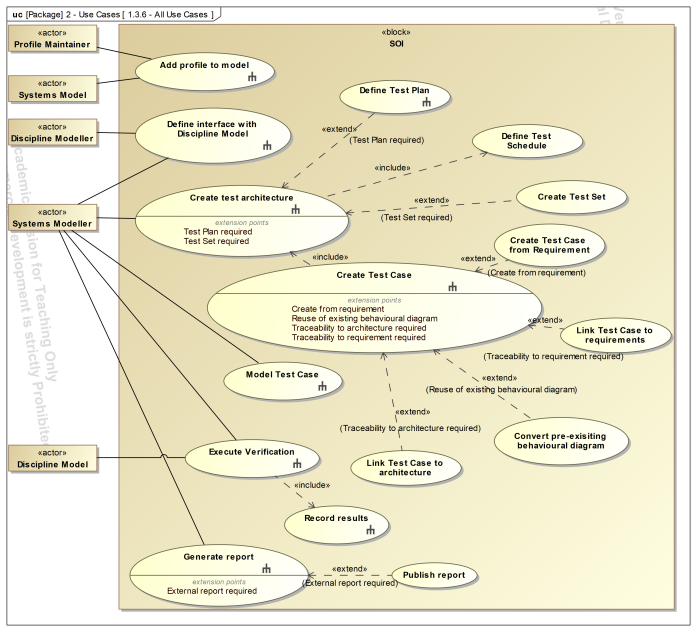
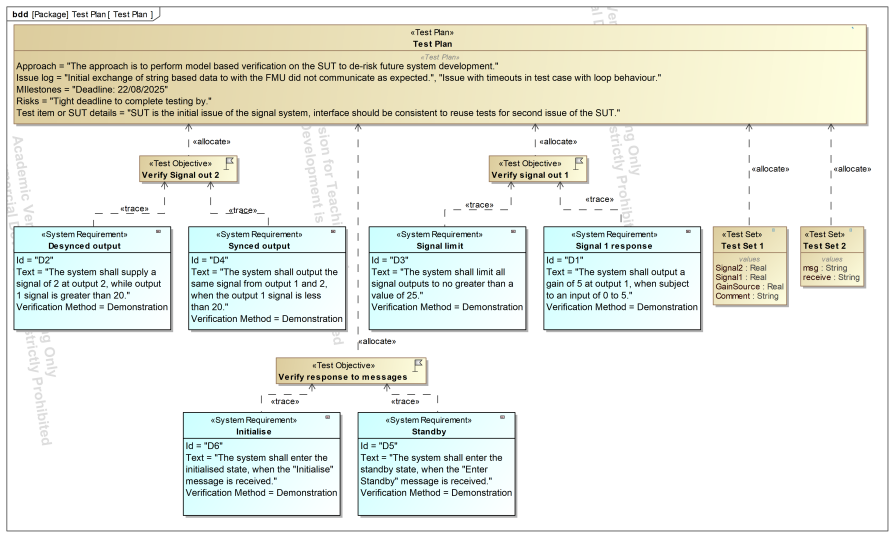
The central discovery is a model-based verification process that converts SysML test cases into automated verifications of discipline-specific models, covering behavioral and interface requirements, and feeds the outcomes back into the SysML model, with the entire workflow shown to operate independently in two different tool environments.
What carries the argument
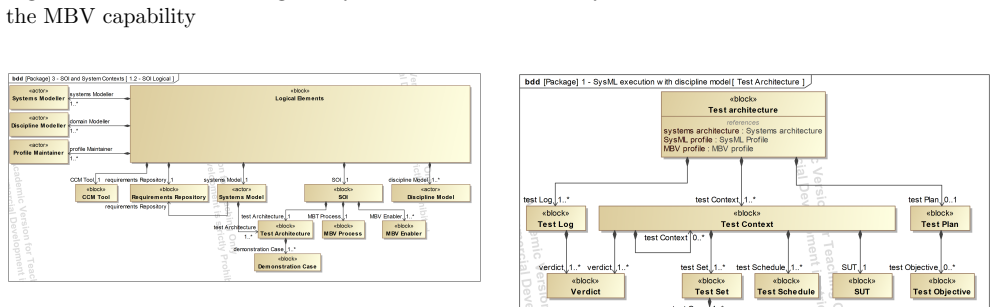
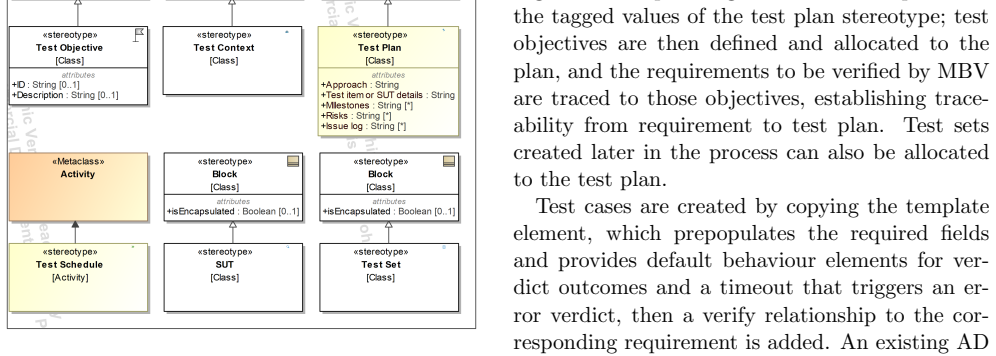
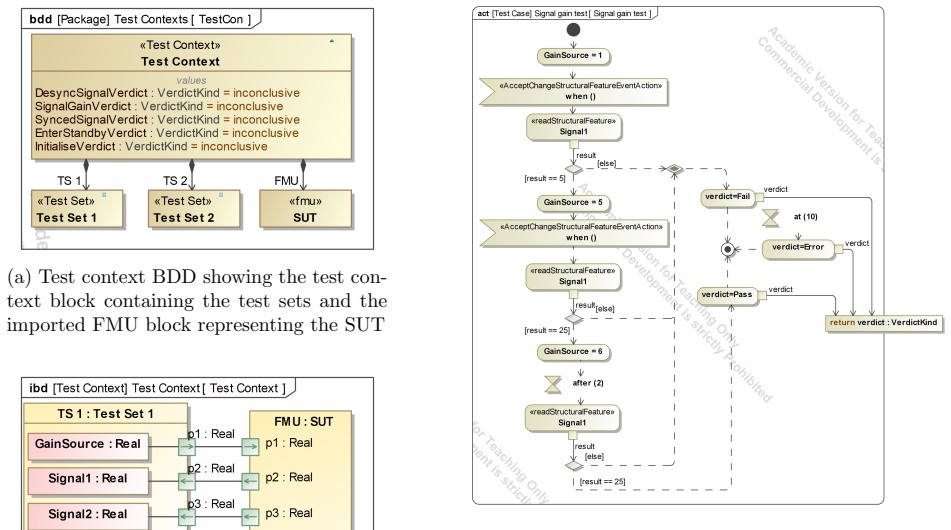
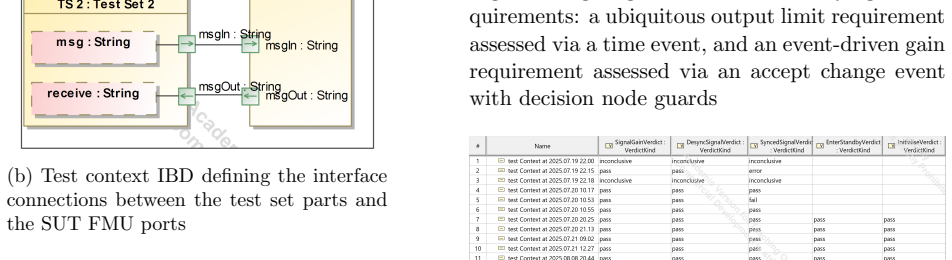
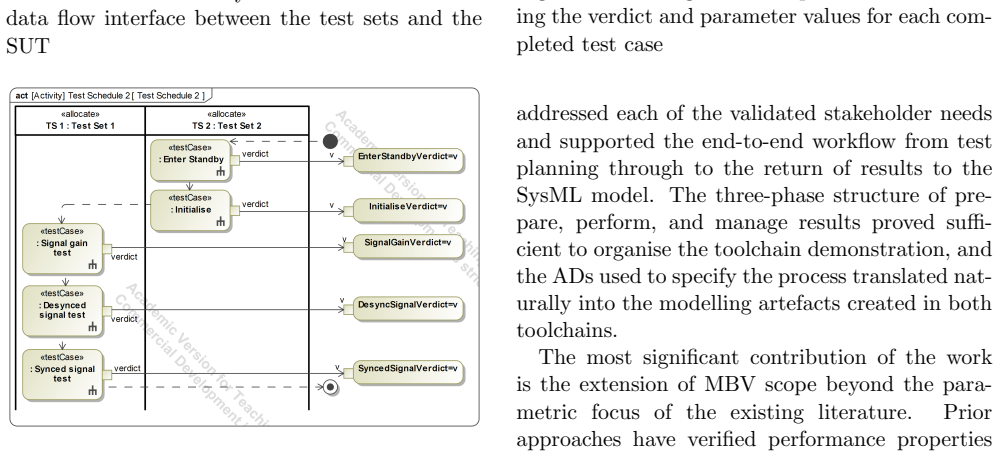
The verification process derived from validated stakeholder needs and implemented using SysML behavioral diagram constructs and UML Testing Profile elements to bridge SysML test cases with discipline-specific model checks.
If this is right
- Automated verification becomes possible for properties beyond performance, including behavior and interfaces.
- Traceability is maintained by returning verification results directly to the SysML model.
- Portability is achieved without dependence on proprietary tool APIs.
- The approach supports verification of ordering, timing, and state-based responses.
Where Pith is reading between the lines
- The process could be extended to additional SysML tool environments beyond the two tested.
- It might enable more comprehensive verification in multi-disciplinary engineering projects.
- Integration with other modeling standards could broaden its applicability.
Load-bearing premise
Stakeholder needs from literature research and interviews provide a complete and general set of requirements for the verification process.
What would settle it
Failure to successfully implement the process or verify the targeted properties in an additional SysML tool-chain not used in the demonstrations.
Figures

read the original abstract
Current examples of SysML-based verification of discipline-specific models in the literature typically have two flaws. Firstly, they are developed in a tool-specific manner using proprietary APIs, limiting portability. Secondly, they focus on performance properties modelled via parametric diagrams, overlooking behavioural and interface properties that also require verification. This project addresses the problem with a verification process tailored to model-based verification, informed by common SysML tool capabilities and the UML Testing Profile, that enables automated verification of discipline\-/specific models from SysML test cases and returns the results to the SysML model for traceability. A mixed-method approach combining literature research and stakeholder interviews was used to derive validated stakeholder needs, which drove the specification and design of the process. The process was demonstrated end-to-end in two independent SysML tool-chains to evidence tool-agnosticism, and was shown to verify behavioural and interface requirements, including ordering, timing, and state-based responses, using SysML behavioural diagram constructs that parametric approaches alone cannot address.
Editorial analysis
A structured set of objections, weighed in public.
Referee Report
Summary. The paper claims that existing SysML-based verification approaches are limited by tool-specific proprietary APIs and a focus on parametric diagrams for performance properties. It addresses this by deriving stakeholder needs via literature review and interviews, then specifying a verification process informed by common SysML tool capabilities and the UML Testing Profile. This process enables automated verification of behavioral and interface properties (ordering, timing, state-based responses) from SysML test cases, with results returned to the SysML model for traceability. The process is demonstrated end-to-end in two independent SysML tool-chains to support tool-agnosticism.
Significance. If the process holds as described, it would provide a portable alternative to tool-specific methods and extend verification coverage beyond parametric diagrams to behavioral properties using standard SysML constructs. The mixed-method derivation of needs and explicit use of documented common capabilities are strengths; the two end-to-end demonstrations with traceability add concrete evidence of feasibility.
major comments (2)
- [Abstract] Abstract and demonstration description: the tool-agnosticism claim rests on end-to-end execution in two tool-chains, but supplies no quantitative validation metrics, error rates, or analysis of failure modes when common capabilities are absent; this is load-bearing for the generalizability asserted.
- [Process specification] Stakeholder needs derivation: the process is driven by needs from literature and interviews, yet the manuscript provides no explicit mapping or validation showing these needs suffice for a general process beyond the two demonstrated chains (weakest assumption in the approach).
minor comments (1)
- [Abstract] The abstract mentions 'detailed implementation steps' are absent; adding pseudocode or explicit activity diagrams for the verification workflow would improve reproducibility without altering the central claim.
Simulated Author's Rebuttal
Thank you for the opportunity to respond to the referee's report. We address each major comment point-by-point below. We propose targeted revisions to strengthen the presentation of generalizability and the traceability of the needs derivation.
read point-by-point responses
-
Referee: [Abstract] Abstract and demonstration description: the tool-agnosticism claim rests on end-to-end execution in two tool-chains, but supplies no quantitative validation metrics, error rates, or analysis of failure modes when common capabilities are absent; this is load-bearing for the generalizability asserted.
Authors: We agree that the manuscript does not supply quantitative metrics, error rates, or an explicit failure-mode analysis. The tool-agnosticism claim is grounded in the process being restricted to documented common SysML capabilities and in the two independent end-to-end demonstrations; however, these demonstrations alone do not constitute statistical validation. We will add a dedicated limitations subsection that (a) enumerates plausible failure modes when a tool lacks support for required UML Testing Profile elements and (b) explicitly states the absence of large-scale empirical testing as a boundary on the current generalizability claim. revision: yes
-
Referee: [Process specification] Stakeholder needs derivation: the process is driven by needs from literature and interviews, yet the manuscript provides no explicit mapping or validation showing these needs suffice for a general process beyond the two demonstrated chains (weakest assumption in the approach).
Authors: The needs were obtained through a mixed-method sequence (literature review followed by stakeholder interviews) and the process was subsequently specified to satisfy them. We concur that an explicit mapping from each need to the corresponding process elements, together with an argument for sufficiency beyond the two demonstrated tool-chains, is not present. We will insert a traceability table (or appendix) that links each validated need to the process steps and will add a short paragraph arguing why the needs set, being derived from common tool capabilities and the UML Testing Profile, supports broader applicability. revision: yes
Circularity Check
No significant circularity
full rationale
The paper's derivation begins with a mixed-method approach of literature research and stakeholder interviews to derive validated needs, which then drive the specification of a verification process informed by common SysML capabilities and the UML Testing Profile. This process is demonstrated end-to-end in two independent tool-chains for tool-agnosticism. No equations, fitted parameters, self-citations, or uniqueness theorems are invoked in a load-bearing way that reduces the result to its inputs by construction. The central claim rests on external inputs and explicit demonstrations rather than self-referential definitions.
Axiom & Free-Parameter Ledger
axioms (2)
- domain assumption SysML supports definition of test cases and automated verification of discipline-specific models via its behavioral diagram constructs
- domain assumption The UML Testing Profile provides a suitable foundation for the verification process
Reference graph
Works this paper leans on
-
[1]
ERTS 2010 proceedings , year =
Feiler, P and Wrage, L and Hansson, J , title =. ERTS 2010 proceedings , year =
2010
-
[2]
Madni, Azad M. and Purohit, Shatad , title =. Systems 2019, Vol. 7, Page 12 , year =. doi:10.3390/SYSTEMS7010012 , issn =
-
[3]
1st IEEE International Symposium on Systems Engineering, ISSE 2015 - Proceedings , year =
Morkevicius, Aurelijus and Jankevicius, Nerijus , title =. 1st IEEE International Symposium on Systems Engineering, ISSE 2015 - Proceedings , year =. doi:10.1109/SYSENG.2015.7302739 , isbn =
-
[4]
INCOSE International Symposium , year =
Wang, Gan and Pavalkis, Saulius , title =. INCOSE International Symposium , year =. doi:https://doi.org/10.1002/j.2334-5837.2019.00634.x , issn =
-
[5]
Wind , VOLUME =
Zhang, Yizhe and Roeder, Julian and Jacobs, Georg and Berroth, Joerg and Hoepfner, Gregor , TITLE =. Wind , VOLUME =. 2022 , NUMBER =
2022
-
[6]
Bajaj, Manas and Friedenthal, Sanford and Seidewitz, Ed , title =. INSIGHT , year =. doi:10.1002/INST.12367 , issn =
-
[7]
2023 , publisher =
INCOSE , title =. 2023 , publisher =
2023
-
[8]
ISO/IEC/IEEE 15288:2023 , year =
ISO/IEC/IEEE , title =. ISO/IEC/IEEE 15288:2023 , year =. doi:10.1109/IEEESTD.2023.10123367 , isbn =
-
[9]
2018 , number =
ISO/IEC/IEEE , title =. 2018 , number =
2018
-
[10]
ISO/IEC/IEEE 15288:2023 , year =
ISO/IEC/IEEE , title =. 2023 , publisher =. doi:10.1109/IEEESTD.2023.10123376 , isbn =
-
[11]
2017 , publisher =
Dick, Jeremy and Hull, Elizabeth and Jackson, Ken , title =. 2017 , publisher =
2017
-
[12]
Requirements Engineering , year =
Yue, Tao and Briand, Lionel C and Labiche, Yvan , title =. Requirements Engineering , year =
-
[13]
2009 17th IEEE International Requirements Engineering Conference , year =
Mavin, Alistair and Wilkinson, Philip and Harwood, Adrian and Novak, Mark , title =. 2009 17th IEEE International Requirements Engineering Conference , year =. doi:10.1109/RE.2009.9 , isbn =
-
[14]
Systems Modeling Language™ (SysML® ) Version 1.7 , year =
-
[15]
2014 , publisher =
Friedenthal, Sanford and Moore, Alan and Steiner, Rick , title =. 2014 , publisher =
2014
-
[16]
Salado, Alejandro and Wach, Paul , title =. Systems 2019 , year =. doi:10.3390/SYSTEMS7020019 , issn =
-
[17]
2020 , url =
Omg , title =. 2020 , url =
2020
-
[18]
Bernardino, Maicon and Rodrigues, Elder M. and Zorzo, Avelino F. and Marchezan, Luciano , title =. IET Software , year =. doi:10.1049/iet-sen.2015.0154 , issn =
-
[19]
ACM Transactions on Software Engineering and Methodology , year =
Cederbladh, Johan and Cicchetti, Antonio and Suryadevara, Jagadish , title =. ACM Transactions on Software Engineering and Methodology , year =. doi:10.1145/3631976 , issn =
-
[20]
Baker, Paul and Jervis, Clive , title =. Testing: Academic and Industrial Conference Practice and Research Techniques - MUTATION (TAICPART-MUTATION 2007) , year =. doi:10.1109/TAIC.PART.2007.33 , isbn =
-
[21]
2010 36th EUROMICRO Conference on Software Engineering and Advanced Applications , year =
Stefanescu, Alin and Wendland, Marc-Florian and Wieczorek, Sebastian , title =. 2010 36th EUROMICRO Conference on Software Engineering and Advanced Applications , year =. doi:10.1109/SEAA.2010.44 , isbn =
-
[22]
2006 IEEE International Conference on Global Software Engineering (ICGSE'06) , year =
Andaloussi, Brahim and Braun, Andreas , title =. 2006 IEEE International Conference on Global Software Engineering (ICGSE'06) , year =. doi:10.1109/ICGSE.2006.261230 , isbn =
-
[23]
IBM Engineering Systems Design Rhapsody ‐ TestConductor Add On | TestConductor User Guide | Release 2.9.2 , year =
-
[24]
Innovations in Systems and Software Engineering , year =
Lasalle, Jonathan and Peureux, Fabien and Fondement, Frédéric , title =. Innovations in Systems and Software Engineering , year =. doi:10.1007/s11334-011-0164-1 , issn =
-
[25]
Hossain, Niamat Ullah Ibne and Lutfi, Mostafa and Ahmed, Ifaz and Akundi, Aditya and Cobb, Daniel , title =. Systems , year =. doi:10.3390/SYSTEMS10060264 , issn =
-
[26]
and Varmazyar, Mojtaba and Nejati, Shiva and Briand, Lionel C
González, Carlos A. and Varmazyar, Mojtaba and Nejati, Shiva and Briand, Lionel C. and Isasi, Yago , title =. Proceedings of the 21th ACM/IEEE International Conference on Model Driven Engineering Languages and Systems , year =. doi:10.1145/3239372.3239409 , isbn =
-
[27]
Habermehl, Christian and Höpfner, Gregor and Berroth, Jörg and Neumann, Stephan and Jacobs, Georg , title =. Applied Sciences , year =. doi:10.3390/app12115316 , issn =
-
[28]
Stenzel, June and Masterson, Rebecca and Simcoe, Robert A. , title =. 2024 IEEE Aerospace Conference , year =. doi:10.1109/AERO58975.2024.10521313 , isbn =
-
[29]
Nigischer, Christian and Bougain, Sébastien and Riegler, Rainer and Stanek, Heinz Peter and Grafinger, Manfred , title =. Procedia CIRP , year =. doi:10.1016/J.PROCIR.2021.05.073 , issn =
-
[30]
Developer Guide - MagicDraw 19.0 LTR , howpublished =
-
[31]
MDG Technology for DDS , howpublished =
-
[32]
Enterprise Architect User Guide (Version 17.1) , howpublished =
-
[33]
Overview of custom tables (Utilities profile) , howpublished =
-
[34]
INCOSE International Symposium , year =
Cederbladh, Johan and Krems, Daniel , title =. INCOSE International Symposium , year =. doi:10.1002/iis2.13135 , issn =
-
[35]
and March, Salvatore T
Hevner, Alan R. and March, Salvatore T. and Park, Jinsoo and Ram, Sudha , title =. MIS Quarterly , year =
-
[36]
and Chatterjee, Samir , title =
Peffers, Ken and Tuunanen, Tuure and Rothenberger, Marcus A. and Chatterjee, Samir , title =. Journal of Management Information Systems , year =
-
[37]
2022 , edition =
Leavy, Patricia , title =. 2022 , edition =
2022
-
[38]
Systems Engineering , year =
Salado, Alejandro and Kannan, Hanumanthrao , title =. Systems Engineering , year =
-
[39]
Systems Engineering , volume =
Kannan, Hanumanthrao and Salado, Alejandro , title =. Systems Engineering , volume =. doi:https://doi.org/10.1002/sys.70034 , year =
discussion (0)
Sign in with ORCID, Apple, or X to comment. Anyone can read and Pith papers without signing in.