Weak Dominant Balance for Robust Identification of Dynamically Consistent Fluid Flow Structure
Pith reviewed 2026-06-30 08:03 UTC · model grok-4.3
The pith
Weak dominant balance identifies consistent fluid flow regimes from noisy data by projecting equations into integrals.
A machine-rendered reading of the paper's core claim, the machinery that carries it, and where it could break.
Core claim
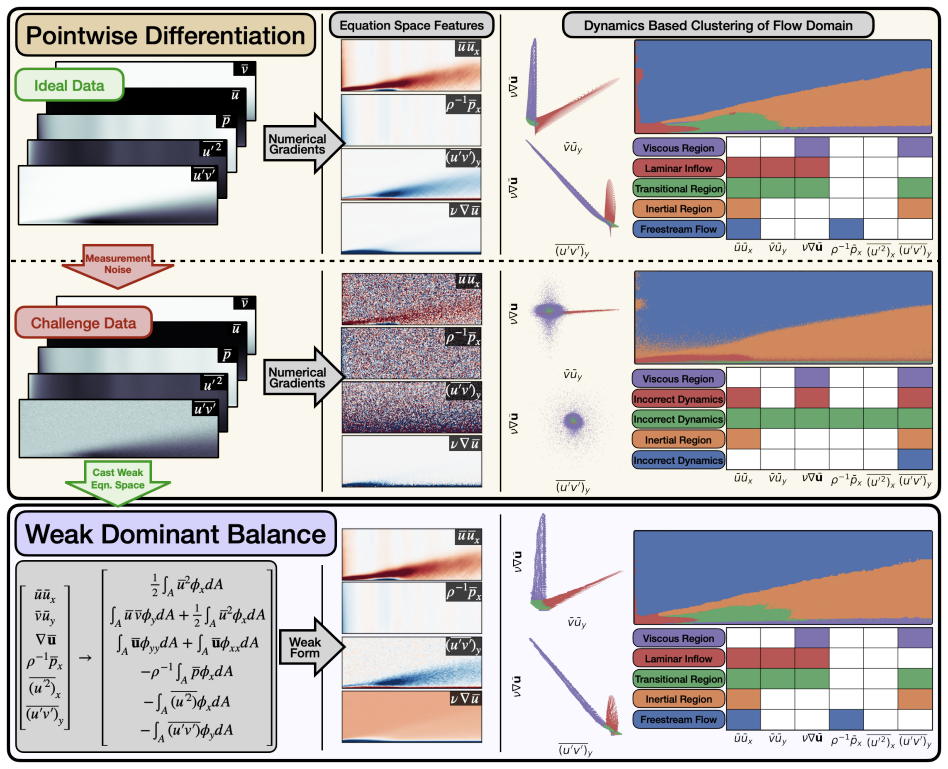
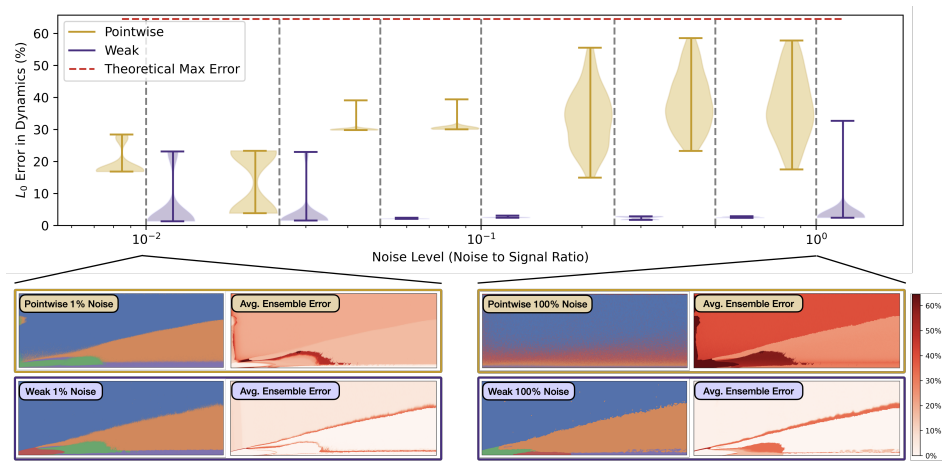
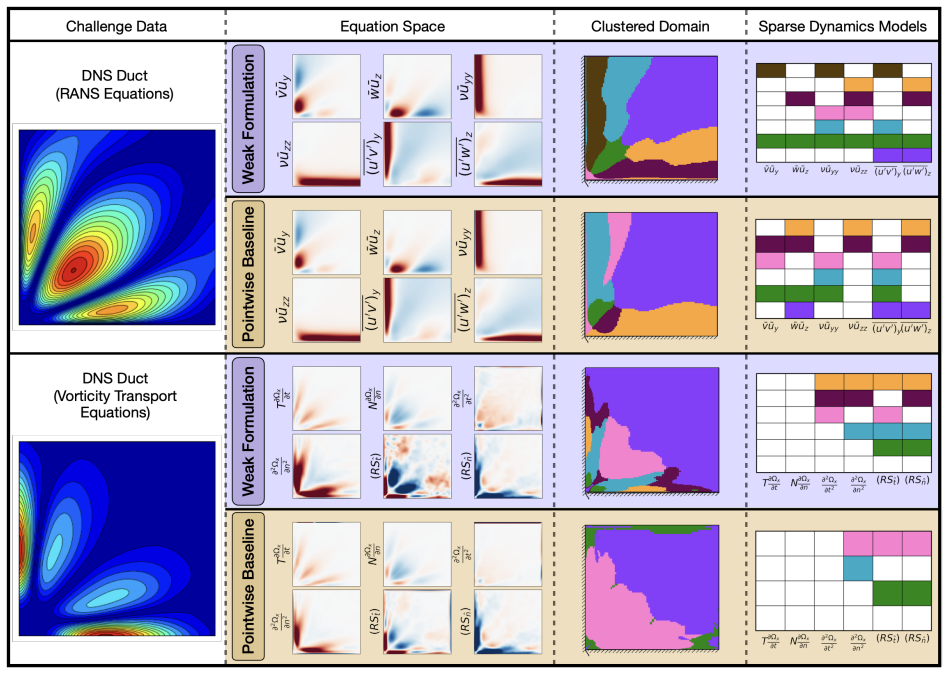
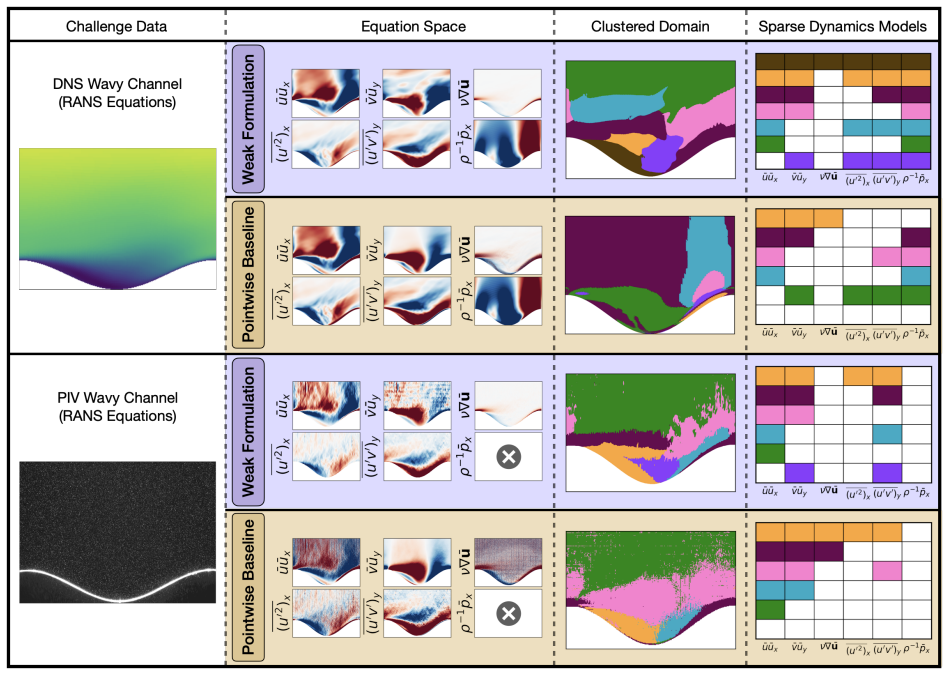
Weak dominant balance projects the governing equations into a weak integral formulation, offloading differentiation onto analytical test functions and leaving the measured data untouched, thereby sustaining accurate regime identification under severe noise, enabling the first data-driven decomposition of third-order PDEs in turbulent duct flow, and producing consistent decompositions between direct numerical simulation and particle-image velocimetry data that uncover a previously uncharacterized dynamical regime.
What carries the argument
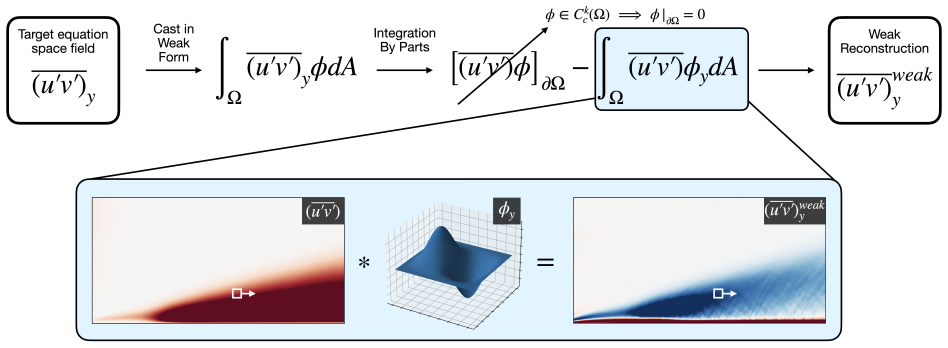
The weak dominant balance framework, which projects the governing equations into an integral form using smooth analytical test functions so that differentiation is never applied to the data.
If this is right
- Regime identification stays accurate on severely noisy data where existing methods fail.
- Third-order partial differential equations become decomposable directly from turbulent flow data.
- Decompositions match between simulation and experiment, revealing new dynamical regimes in measured flows.
- Mechanism-level analysis extends from simulations to real experimental measurements of complex systems.
Where Pith is reading between the lines
- The same integral projection idea could be applied to other known-equation systems in physics or biology where data are noisy but the equations are trusted.
- If test-function choice proves robust, the method might support real-time regime tracking during experiments without post-processing derivatives.
- Testing on flows with irregular boundaries or even higher-order equations would check whether the approach scales beyond the duct and channel cases shown.
Load-bearing premise
The governing equations are known exactly and the chosen test functions capture the true dominant balances without projection artifacts that would change the identified regimes.
What would settle it
Apply the method to synthetic data generated from a known exact balance under added noise levels where derivative methods fail; the identified regimes must match the known ground truth.
Figures
read the original abstract
Extracting interpretable, localized physical mechanisms from complex spatiotemporal data is a foundational challenge across physics, biology, and engineering, but has remained out of reach on real measurements. The central obstacle is obtaining high-quality gradients of data via numerical differentiation, which amplifies noise, diverges for high-order equations, and falters on irregular geometries, limiting the scope of existing approaches to clean simulations of low-order systems. Here, we present weak dominant balance, a derivative-free framework that projects governing equations into a weak (integral) formulation, offloading differentiation onto smooth analytical test functions and leaving the data untouched. The method sustains accurate regime identification under severe noise where existing approaches categorically fail, delivers the first data-driven decomposition of a third-order partial differential equation applied to turbulent duct flow, and produces matching decompositions across direct numerical simulation and particle-image velocimetry measurements of a wavy channel flow, uncovering a previously uncharacterized dynamical regime. Weak dominant balance brings mechanism-level analysis out of simulation and onto measured data, and opens complex physical systems to direct, equation-grounded interpretation.
Editorial analysis
A structured set of objections, weighed in public.
Referee Report
Summary. The paper introduces 'weak dominant balance,' a derivative-free method that projects governing PDEs into a weak (integral) formulation using smooth test functions to identify localized dominant balances from noisy spatiotemporal data. It claims robustness under severe noise (unlike existing methods), the first data-driven decomposition of a third-order PDE on turbulent duct flow, and consistent decompositions between DNS and PIV data on wavy channel flow that reveal a previously uncharacterized dynamical regime.
Significance. If the central claims hold, the approach would enable mechanism-level, equation-grounded analysis directly on experimental measurements such as PIV, extending beyond clean low-order simulations. This addresses a longstanding barrier in fluid dynamics and could open complex systems to direct interpretation, with particular value for high-order PDEs and noisy real-world data.
major comments (2)
- [Abstract/Methods] The central claim of accurate regime identification under severe noise and for third-order PDEs rests on the unverified assumption that the chosen test functions introduce no projection bias or scale-dependent artifacts (see skeptic note on multiple integrations by parts). The abstract provides no details on test-function selection criteria, support scales relative to flow structures in turbulent duct or wavy-channel cases, or quantitative validation metrics, preventing assessment of whether the weak projection recovers true balances or redistributes term magnitudes.
- [Results] The manuscript asserts matching decompositions across DNS and PIV that uncover a new regime, but without reported error quantification, cross-validation statistics, or sensitivity analysis to test-function choice, it is not possible to determine if the PIV result is robust or an artifact of the projection on noisy data.
minor comments (2)
- [Methods] Notation for the weak formulation and dominant-balance identification should be clarified with explicit equations showing how term magnitudes are compared after projection.
- [Abstract] The abstract mentions 'parameter-free' aspects implicitly through the weak approach, but any hyperparameters in test-function construction or thresholding should be stated explicitly.
Simulated Author's Rebuttal
We thank the referee for their constructive comments. We address each major comment point by point below and indicate the revisions made.
read point-by-point responses
-
Referee: The central claim of accurate regime identification under severe noise and for third-order PDEs rests on the unverified assumption that the chosen test functions introduce no projection bias or scale-dependent artifacts. The abstract provides no details on test-function selection criteria, support scales relative to flow structures in turbulent duct or wavy-channel cases, or quantitative validation metrics.
Authors: We agree the abstract requires more detail on these points. The revised manuscript expands the abstract to specify test-function selection criteria (smoothness and compact support), support scales chosen relative to observed flow structures, and references to quantitative validation metrics on synthetic data. A new Methods subsection discusses integration-by-parts effects and verifies that the weak projection preserves dominant-balance identification without redistributing term magnitudes. revision: yes
-
Referee: The manuscript asserts matching decompositions across DNS and PIV that uncover a new regime, but without reported error quantification, cross-validation statistics, or sensitivity analysis to test-function choice, it is not possible to determine if the PIV result is robust or an artifact of the projection on noisy data.
Authors: We accept that additional quantification strengthens the claim. The revised Results section now reports error quantification and cross-validation statistics for the DNS-PIV agreement, plus a sensitivity analysis over test-function support scales showing that the identified regimes (including the new dynamical regime) remain consistent. These additions confirm the PIV decomposition is not an artifact. revision: yes
Circularity Check
No circularity: method is a direct projection technique with independent verification on DNS and PIV data
full rationale
The abstract and available description present weak dominant balance as a new integral projection that offloads differentiation to test functions. No equations, derivations, or results are shown to reduce by construction to fitted parameters, self-definitions, or self-citation chains. Claims of noise robustness and new regime identification rest on application to external data (DNS/PIV) rather than tautological inputs. Self-citations, if present, are not load-bearing for the core method. This matches the default expectation of non-circularity for a projection-based technique.
Axiom & Free-Parameter Ledger
axioms (1)
- domain assumption The governing partial differential equations for the fluid flow are known exactly in advance.
Reference graph
Works this paper leans on
-
[1]
Arranz, Y
G. Arranz, Y. Ling, S. Costa, K. Goc, and A. Lozano-Dur ´an. Building-block-flow computational model for large-eddy simulation of external aerodynamic applications.Communications Engineering, 3(1):127, 2024
2024
-
[2]
Arranz and A
G. Arranz and A. Lozano-Dur´an. Informative and non-informative decomposition of turbulent flow fields.Journal of Fluid Mechanics, 1000:A95, 2024
2024
-
[3]
C. M. Bender and S. A. Orszag.Advanced Mathematical Methods for Scientists and Engineers.Springer, 1999
1999
-
[4]
Bishop.Pattern recognition and machine learning.Springer New York, 2006
C. Bishop.Pattern recognition and machine learning.Springer New York, 2006
2006
-
[5]
Bodnar, W
C. Bodnar, W. P. Bruinsma, A. Lucic, M. Stanley, A. Allen, J. Brandstetter, P. Garvan, M. Riechert, J. A. Weyn, H. Dong, et al. A foundation model for the earth system.Nature, 641(8065):1180–1187, 2025
2025
-
[6]
D. M. Bortz, D. A. Messenger, and V. Dukic. Direct estimation of parameters in ode models using wendy: Weak-form estimation of nonlinear dynamics.Bulletin of Mathematical Biology, 85(11):110, 2023
2023
-
[7]
S. L. Brunton, J. L. Proctor, and J. N. Kutz. Discovering governing equations from data by sparse identification of nonlinear dynamical systems.Proceedings of the National Academy of Sciences, 113(15):3932–3937, 2016
2016
-
[8]
Buchanan, M
T. Buchanan, M. L ˘ac˘atus ¸, A. West, and R. P. Dwight. Data-driven rans closures using a relative importance term analysis based classifier for 2d and 3d separated flows.Computers & Fluids, 305:106899, 2026
2026
-
[9]
Buckingham
E. Buckingham. On physically similar systems; illustrations of the use of dimensional equations.Phys. Rev., 4:345 – 376, 1914
1914
-
[10]
J. L. Callaham, J. V. Koch, B. W. Brunton, J. N. Kutz, and S. L. Brunton. Learning dominant physical processes with data-driven balance models.Nature Communications, 12(1):1016, 2021
2021
-
[11]
Cremades, S
A. Cremades, S. Hoyas, R. Deshpande, P. Quintero, M. Lellep, W. J. Lee, J. P. Monty, N. Hutchins, M. Linkmann, I. Marusic, and R. Vinuesa. Identifying regions of importance in wall-bounded turbulence through explainable deep learning.Nature Communications, 15(1):3864, 2024
2024
-
[12]
Fasel, J
U. Fasel, J. N. Kutz, B. W. Brunton, and S. L. Brunton. Ensemble-sindy: Robust sparse model discovery in the low-data, high-noise limit, with active learning and control.Proceedings of the Royal Society A: Mathematical, Physical and Engineering Sciences, 478(2260):20210904, 2022
2022
-
[13]
D. R. Gurevich, P. A. K. Reinbold, and R. O. Grigoriev. Robust and optimal sparse regression for nonlinear pde models.Chaos: An Interdisciplinary Journal of Nonlinear Science, 29(10):103113, 2019
2019
-
[14]
G. Haller. Lagrangian coherent structures from approximate velocity data.Physics of Fluids, 14(6):1851–1861, 2002
2002
-
[15]
Hubert and P
L. Hubert and P. Arabie. Comparing partitions.Journal of Classification, 2(1):193–218, 1985
1985
-
[16]
J. D. Hudson, L. Dykhno, and T. J. Hanratty. Turbulence production in flow over a wavy wall.Experiments in Fluids, 20(4):257–265, 1996
1996
-
[17]
B. E. Kaiser, J. A. Saenz, M. Sonnewald, and D. Livescu. Automated identification of dominant physical processes.Engineering Applications of Artificial Intelligence, 116:105496, 2022
2022
-
[18]
A. A. Kaptanoglu, K. D. Morgan, C. J. Hansen, and S. L. Brunton. Characterizing magnetized plasmas with dynamic mode decomposition.Physics of Plasmas, 27(3):032108, 2020
2020
-
[19]
A. N. Kolmogorov. The local structure of turbulence in incompressible viscous fluid for very large reynolds numbers.Dokl. Akad. Nauk SSSR, pages 299–303, 1941
1941
-
[20]
von K ´arm´an
T. von K ´arm´an. Mechanische aenlichkeit und turbulenz.Nachrichten von der Gesellschaft der Wissenschaften zu G¨ottingen, Mathematisch-Physikalische Klasse, 1930:58–76, 1930
1930
-
[21]
C. Lagemann, S. Mokbel, M. Gondrum, M. R¨ uttgers, Y. Wang, P. Su ´arez, L. Paehler, D. A. Bezgin, A. B. Buhendwa, J. Callaham, S. Ahnert, N. Zolman, X. Shao, J. C. Loiseau, N. Adams, M. Meinke, W. Schr ¨oder, K. Lagemann, E. Lagemann, R. Vinuesa, and S. L. Brunton. The hydrogym reinforcement learning platform for fluid dynamics.arXiv preprint arXiv:2512....
work page internal anchor Pith review arXiv 2025
-
[22]
Lagemann, L
C. Lagemann, L. Paehler, J. Callaham, S. Mokbel, S. Ahnert, K. Lagemann, E. Lagemann, N. Adams, and S. L. Brunton. Hydrogym: A reinforcement learning platform for fluid dynamics. In7th Annual Learning for Dynamics & Control Conference, pages 497–512. PMLR, 2025. 18
2025
-
[23]
Lagemann, M
E. Lagemann, M. Albers, C. Lagemann, and W. Schr ¨oder. Impact of reynolds number on the drag reduction mechanism of spanwise travelling surface waves.Flow, Turbulence and Combustion, 113(1):27–40, 2024
2024
-
[24]
Lagemann, S
E. Lagemann, S. L. Brunton, and C. Lagemann. Uncovering wall-shear stress dynamics from neural-network enhanced fluid flow measurements.Proceedings of the Royal Society A: Mathematical, Physical and Engineering Sciences, 480(2292):20230798, 2024
2024
-
[25]
Y. Li, E. Perlman, M. Wan, Y. Yang, C. Meneveau, R. Burns, S. Chen, A. Szalay, and G. Eyink. A public turbulence database cluster and applications to study lagrangian evolution of velocity increments in turbulence. Journal of Turbulence, 9(31), 2008
2008
-
[26]
Lozano-Dur ´an and H
A. Lozano-Dur ´an and H. J. Bae. Machine learning building-block-flow wall model for large-eddy simulation. Journal of Fluid Mechanics, 963:A35, 2023
2023
-
[27]
J. L. Lumley. The structure of inhomogeneous turbulent flows.Atmos. Turbul. Radio Wave Propag, pages 166–178, 1967
1967
-
[28]
van der Maaten and G
L. van der Maaten and G. Hinton. Visualizing data using t-sne.Journal of Machine Learning Research, 9(86):2579–2605, 2008
2008
-
[29]
Matai and P
R. Matai and P. A. Durbin. Zonal eddy viscosity models based on machine learning.Flow, Turbulence and Combustion, 103(1):93–109, 2019
2019
-
[30]
McInnes, J
L. McInnes, J. Healy, N. Saul, and L. Großberger. Umap: Uniform manifold approximation and projection. Journal of Open Source Software, 3(29):861, 2018
2018
-
[31]
B. J. McKeon and A. S. Sharma. A critical-layer framework for turbulent pipe flow.Journal of Fluid Mechanics, 658:336–382, 2010
2010
-
[32]
D. A. Messenger and D. M. Bortz. Weak sindy for partial differential equations.Journal of Computational Physics, 443:110525, 2021
2021
-
[33]
D. A. Messenger and D. M. Bortz. Weak sindy: Galerkin-based data-driven model selection.Multiscale Modeling & Simulation, 19(3):1474–1497, 2021
2021
-
[34]
K. E. Otmani, A. Mateo-Gabin, G. Rubio, and E. Ferrer. Accelerating high order discontinuous galerkin solvers through a clustering-based viscous/turbulent-inviscid domain decomposition.Engineering with Computers, 41(2):949–964, 2025
2025
-
[35]
Pantazis and I
Y. Pantazis and I. Tsamardinos. A unified approach for sparse dynamical system inference from temporal measurements.Bioinformatics, 35(18):3387–3396, 2018
2018
-
[36]
J. Y. Park, Y. D. Yoon, and Y. S. Hwang. Kinetic turbulence drives mhd equilibrium change via 3d reconnection. Nature, 644(8075):59–63, 2025
2025
-
[37]
Perlman, R
E. Perlman, R. Burns, Y. Li, and C. Meneveau. Data exploration of turbulence simulations using a database cluster. InProceedings of the 2007 ACM/IEEE Conference on Supercomputing, SC ’07. Association for Computing Machinery, 2007
2007
-
[38]
L. Prandtl. ¨ uber fl¨ ussigkeitsbewegung bei sehr kleiner reibung.Verhandl III, Intern. Math. Kongr., 2:484–491, 1904
1904
-
[39]
Quarteroni, T
A. Quarteroni, T. Lassila, S. Rossi, and R. Ruiz-Baier. Integrated heart—coupling multiscale and multiphysics models for the simulation of the cardiac function.Computer Methods in Applied Mechanics and Engineering, 314:345–407, 2017
2017
-
[40]
Quarteroni, A
A. Quarteroni, A. Manzoni, and C. Vergara. The cardiovascular system: Mathematical modelling, numerical algorithms and clinical applications.Acta Numerica, 26:365–590, 2017
2017
-
[41]
C. Roques. Aggregation of turbulence models for turbomachinery flows using bayesian calibration and machine learning, 2024
2024
-
[42]
C. W. Rowley, I. Mezi ´c, S. Bagheri, P. Schlatter, and D.S. Henningson. Spectral analysis of nonlinear flows. Journal of Fluid Mechanics, 641:115–127, 2009
2009
-
[43]
Rubbert, M
A. Rubbert, M. Albers, and W. Schr¨oder. Streamline segment statistics propagation in inhomogeneous turbulence. Phys. Rev. Fluids, 4:034605, 2019
2019
-
[44]
S. H. Rudy, S. L. Brunton, J. L. Proctor, and J. N. Kutz. Data-driven discovery of partial differential equations. 19 Science Advances, 3(e1602614), 2017
2017
-
[45]
Salcedo-Sanz, P
S. Salcedo-Sanz, P. Ghamisi, M. Piles, M. Werner, L. Cuadra, A. Moreno-Mart ´ınez, E. Izquierdo-Verdiguier, J. Mu˜noz-Mar´ı, A. Mosavi, and G. Camps-Valls. Machine learning information fusion in earth observation: A comprehensive review of methods, applications and data sources.Information Fusion, 63:256–272, 2020
2020
-
[46]
Schaeffer and S
H. Schaeffer and S. G. McCalla. Sparse model selection via integral terms.Phys. Rev. E, 96:023302, 2017
2017
-
[47]
P. J. Schmid, D. S. Henningson, and D. F. Jankowski. Stability and transition in shear flows. applied mathematical sciences, vol. 142.Appl. Mech. Rev., 55(3):B57–B59, 2002
2002
-
[48]
Sonnewald, S
M. Sonnewald, S. Dutkiewicz, C. Hill, and G. Forget. Elucidating ecological complexity: Unsupervised learning determines global marine eco-provinces.Science Advances, 6(22):eaay4740, 2020
2020
-
[49]
Sonnewald and R
M. Sonnewald and R. Lguensat. Revealing the impact of global heating on north atlantic circulation using transparent machine learning.Journal of Advances in Modeling Earth Systems, 13(8), 2021
2021
-
[50]
Sonnewald, R
M. Sonnewald, R. Lguensat, D. C. Jones, P. D. Dueben, J. Brajard, and V. Balaji. Bridging observations, theory and numerical simulation of the ocean using machine learning.Environmental Research Letters, 16(7):073008, 2021
2021
-
[51]
Sonnewald, C
M. Sonnewald, C. Wunsch, and P. Heimbach. Unsupervised learning reveals geography of global ocean dynamical regions.Earth and Space Science, 6(5):784–794, 2019
2019
-
[52]
S. G. Sterrett.Physically Similar Systems - A History of the Concept, pages 377–411. Springer International Publishing, 2017
2017
-
[53]
H. Stommel. The westward intensification of wind-driven ocean currents.Eos, Transactions American Geophys- ical Union, 29(2):202–206, 1948
1948
-
[54]
A. Tran and D. Bortz. Weak form scientific machine learning: Test function construction for system identification. arXiv preprint arXiv:2507.03206, 2025
-
[55]
G. K. Vallis. Geophysical fluid dynamics: whence, whither and why?Proceedings of the Royal Society A: Mathematical, Physical and Engineering Sciences, 472(2192):20160140, 2016
2016
-
[56]
N. X. Vinh, J. Epps, and J. Bailey. Information theoretic measures for clusterings comparison: Variants, properties, normalization and correction for chance.Journal of Machine Learning Research, 11(95):2837–2854, 2010
2010
-
[57]
R. Vinuesa, S. L. Brunton, and G. Mengaldo. Explainable ai: Learning from the learners.arXiv preprint arXiv:2601.05525, 2026
-
[58]
Vinuesa, A
R. Vinuesa, A. Noorani, A. Lozano-Dur ´an, G. K. El Khoury, P. Schlatter, P. F. Fischer, and H. M. Nagib. Aspect ratio effects in turbulent duct flows studied through direct numerical simulation.Journal of Turbulence, 15(10):677–706, 2014
2014
-
[59]
Vinuesa, C
R. Vinuesa, C. Prus, P. Schlatter, and H. M. Nagib. Convergence of numerical simulations of turbulent wall- bounded flows and mean cross-flow structure of rectangular ducts.Meccanica, 51(12):3025–3042, 2016
2016
-
[60]
Z. Wang, X. Huan, and K. Garikipati. Variational system identification of the partial differential equations governing the physics of pattern-formation: Inference under varying fidelity and noise.Computer Methods in Applied Mechanics and Engineering, 356:44–74, 2019
2019
-
[61]
H. S. Yoon, O. A. El-Samni, A. T. Huynh, H. H. Chun, H. J. Kim, A. H. Pham, and I. R. Park. Effect of wave amplitude on turbulent flow in a wavy channel by direct numerical simulation.Ocean Engineering, 36(9):697–707, 2009
2009
-
[62]
T. A. Zaki. From streaks to spots and on to turbulence: Exploring the dynamics of boundary layer transition. Flow, Turbulence and Combustion, 91(3):451–473, 2013
2013
-
[63]
J. Zeng, L. Cao, M. Xu, T. Zhu, and J. Z. H. Zhang. Complex reaction processes in combustion unraveled by neural network-based molecular dynamics simulation.Nature communications, 11(1):5713, 2020
2020
-
[64]
balance models
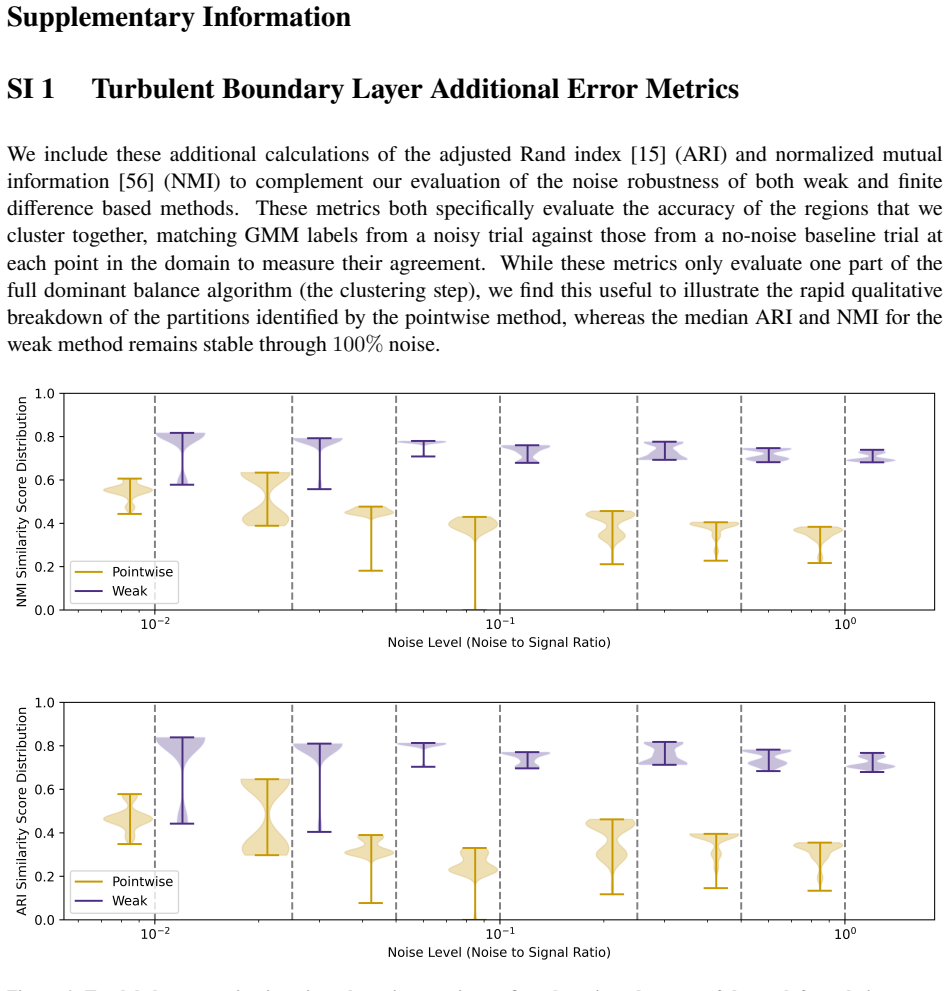
H. Zou, T. Hastie, and R. Tibshirani. Sparse principal component analysis.Journal of Computational and Graphical Statistics, 15(2):265–286, 2006. 20 Supplementary Information SI 1 Turbulent Boundary Layer Additional Error Metrics We include these additional calculations of the adjusted Rand index [15] (ARI) and normalized mutual information [56] (NMI) to ...
2006
discussion (0)
Sign in with ORCID, Apple, or X to comment. Anyone can read and Pith papers without signing in.