REVIEW 2 major objections 1 minor 36 references
Peculiarities Of High-Speed Dynamics Of Two-Photon Absorption In Si Nanowire Waveguides
T0 review · 2 major / 1 minor · reviewed 2026-06-30 · grok-4.3
Pith's one-line read Measurements in silicon nanowire waveguides show nonlinear photon absorption more than twice the rate needed to explain observed electron excitations, with most carriers recombining in under 13 ps.
desk verdict The abstract reports rate mismatches and sub-13 ps recombination in Si nanowire TPA, but those claims rest on unverified cross-calibration between the three techniques. read the letter →
The pith
A machine-rendered reading of the paper's core claim, the machinery that carries it, and where it could break.
The reading
What carries the argument
Three independent high-speed measurement techniques that separately quantify nonlinear photon absorption, valence-to-conduction transitions, and long-lived free-carrier density.
What would settle it
A controlled experiment in which the nonlinear absorption rate exactly equals the transition rate and the free-carrier density exactly equals the transition count would falsify the reported discrepancies.
Extended reading notes
Core claim
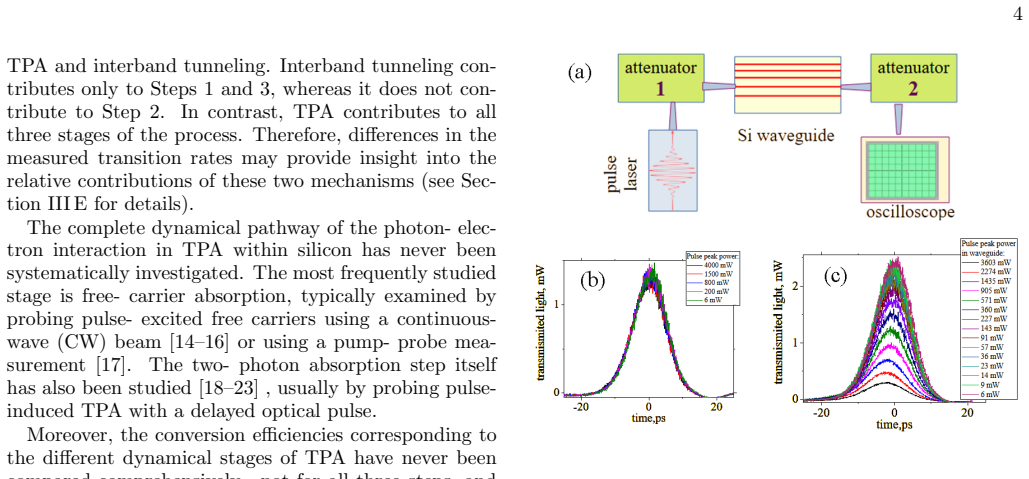
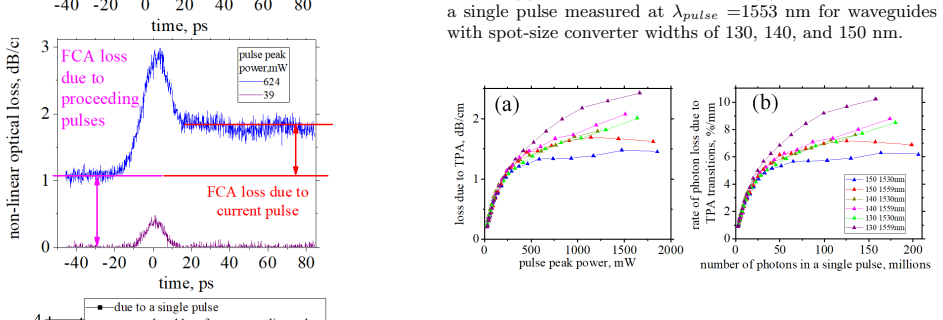
According to the conventional model of TPA, nonlinear photon absorption, valence-to-conduction electron excitation, and long-lived free-carrier generation should occur at identical rates. Measurements using three independent techniques on silicon nanowire waveguides instead find that nonlinear photon absorption is more than twice the value needed to account for the measured transitions, while the number of transitions substantially exceeds the measured free-carrier density, implying that most TPA-excited electrons recombine back to the valence band on a timescale shorter than 13 ps. The stages further display distinct saturation behaviors at different photon densities, pointing to additional
Load-bearing premise
The three measurement techniques cleanly isolate distinct stages of the TPA process with no significant cross-talk or calibration offsets between them.
Editorial extensions
If this is right
- The TPA process in silicon is more complex than the conventional model and involves additional absorption pathways.
- Long-lifetime free carriers represent only a small fraction of TPA-excited electrons.
- The majority of excited electrons recombine rapidly on a timescale shorter than 13 ps.
- The three stages of the TPA pathway saturate at different photon densities.
- Strategies for minimizing nonlinear losses or exploiting TPA in silicon photonic circuits must account for these multiple pathways.
Reading between the lines
- Device models for high-speed silicon photonics may need to incorporate short-lived excited states to predict loss accurately.
- Similar rate mismatches could appear in other direct- or indirect-gap semiconductors and would be testable with the same three-technique approach.
- The unclear origin of any virtual midgap level may be clarified by extending the measurements to varied wavelengths or doping levels.
Signed reviews
Editorial analysis
A structured set of objections, weighed in public.
Referee Report
Summary. The manuscript investigates the high-speed dynamics of two-photon absorption (TPA) in silicon nanowire waveguides using three independent measurement techniques probing nonlinear photon absorption, valence-to-conduction electron excitation, and long-lived free-carrier generation. It reports that the measured nonlinear photon absorption exceeds by more than a factor of two the value needed to account for the observed TPA transitions, and that the number of TPA transitions substantially exceeds the measured free-carrier density, implying that most excited electrons recombine on timescales shorter than 13 ps. The three stages also exhibit distinct saturation behaviors, leading to the conclusion that TPA in silicon involves additional pathways or nontrivial dynamics beyond the conventional model.
Significance. If the factor-of-two discrepancy and the rapid-recombination inference are substantiated by absolute calibration with quantified uncertainties, the results would challenge the standard TPA model in silicon and offer new insight into the virtual midgap level and competing pathways. This has direct relevance to nonlinear loss management and TPA-based switching in silicon photonics. The multi-technique high-speed approach is a methodological strength, but the current evidential basis is limited by the absence of an explicit error budget.
major comments (2)
- The central claim that nonlinear photon absorption is more than twice the value required to explain the measured TPA transitions (abstract) rests on the three techniques having absolute accuracy better than ~2× with negligible cross-talk or calibration offsets. The manuscript provides no quantitative error budget, conversion-factor validation, or direct cross-check on the same waveguide, which is load-bearing for the inference of additional absorption pathways.
- The inference that the majority of TPA-excited electrons recombine rapidly (<13 ps) because the number of TPA transitions substantially exceeds the measured free-carrier density likewise depends on the long-lifetime carrier measurement cleanly isolating carriers with lifetime >13 ps. No evidence is supplied that the high-speed gating windows have negligible temporal overlap or that shorter-lived carriers do not contribute to the reported density.
minor comments (1)
- The abstract states that the stages 'exhibit distinct saturation behaviors at different photon densities' but does not report the specific photon-density values, the functional form of the saturation, or the fitting procedure used to extract them.
Simulated Author's Rebuttal
We thank the referee for the careful and constructive review, which highlights important aspects of our multi-technique approach to studying TPA dynamics. We agree that explicit documentation of uncertainties is necessary to fully substantiate the reported discrepancies. In the revised manuscript we will incorporate a dedicated error-budget section and expanded technical details on the measurement windows. These changes address the concerns directly while preserving the core observations of mismatched rates and rapid recombination.
read point-by-point responses
-
Referee: The central claim that nonlinear photon absorption is more than twice the value required to explain the measured TPA transitions (abstract) rests on the three techniques having absolute accuracy better than ~2× with negligible cross-talk or calibration offsets. The manuscript provides no quantitative error budget, conversion-factor validation, or direct cross-check on the same waveguide, which is load-bearing for the inference of additional absorption pathways.
Authors: We acknowledge that the absence of an explicit error budget limits the strength of the factor-of-two claim as presented. In the revision we will add a new subsection that quantifies absolute calibration for each technique, including conversion factors, cross-talk estimates derived from control measurements, and an uncertainty budget based on repeated trials and instrument specifications. Direct cross-checks were performed on the same waveguides for subsets of the data; these will be described explicitly. The additional documentation will make the evidential basis transparent without altering the reported discrepancies. revision: yes
-
Referee: The inference that the majority of TPA-excited electrons recombine rapidly (<13 ps) because the number of TPA transitions substantially exceeds the measured free-carrier density likewise depends on the long-lifetime carrier measurement cleanly isolating carriers with lifetime >13 ps. No evidence is supplied that the high-speed gating windows have negligible temporal overlap or that shorter-lived carriers do not contribute to the reported density.
Authors: The 13 ps bound is set by the temporal resolution of the ultrafast gating used in the free-carrier measurement. We will revise the text to include a quantitative description of the gating window, calculations of temporal overlap, and results from auxiliary experiments that demonstrate negligible contribution from shorter-lived carriers to the reported long-lifetime density. The numerical discrepancy between TPA transitions and free-carrier density remains robust across the dataset; the added details will clarify how the isolation is achieved. revision: yes
Circularity Check
No circularity: experimental comparison of independent measurements to conventional TPA model
full rationale
The paper reports three independent high-speed experimental techniques applied to Si nanowire waveguides and compares their outputs against the rates expected from the standard TPA model. No mathematical derivation chain exists that reduces a claimed prediction or first-principles result to fitted parameters, self-citations, or ansatzes internal to the work. Discrepancies are presented as direct observational outcomes rather than quantities forced by construction from the input data. The analysis therefore contains no self-definitional, fitted-input-called-prediction, or self-citation-load-bearing steps.
Assumptions & free parameters
assumptions (1)
- domain assumption According to the conventional model of TPA, the three processes (nonlinear photon absorption, electron excitation, free-carrier generation) should occur at identical rates.
Cite this review
Pith. "Pith review of Peculiarities Of High-Speed Dynamics Of Two-Photon Absorption In Si Nanowire Waveguides." pith.science (2026). https://pith.science/paper/DIYBHYZD
@misc{pith2026260629127,
  author       = {Pith},
  title        = {Pith review of: Peculiarities Of High-Speed Dynamics Of Two-Photon Absorption In Si Nanowire Waveguides},
  year         = {2026},
  howpublished = {\url{https://pith.science/paper/DIYBHYZD}},
  note         = {Machine review of arXiv:2606.29127}
}
read the original abstract
We investigate the complete dynamical pathway of photon-electron interactions involved in two-photon absorption (TPA) in a silicon nanowire waveguide using three independent high-speed measurement techniques. These methods probe different stages of the process: nonlinear photon absorption, electron excitation from the valence to the conduction band, and free-carrier generation. According to the conventional model of TPA, these three processes should occur at identical rates. However, our measurements reveal significant discrepancies between them. The measured nonlinear photon absorption is more than twice the value required to account for the measured TPA transitions, indicating the presence of additional absorption pathways or nontrivial TPA dynamics. Furthermore, the number of measured TPA transitions substantially exceeds the measured free-carrier density, indicating that long-lifetime free carriers represent only a small fraction of the TPA-excited electrons, while the majority recombine rapidly back to the valence band on a timescale shorter than 13 ps. In addition, the three stages of the TPA pathway exhibit distinct saturation behaviors at different photon densities, further indicating that the TPA process in silicon is more complex than described by the conventional model. These findings provide new insight into the physical mechanisms governing TPA, suggesting the existence of multiple competing pathways for this optical transition. A major obstacle to a complete understanding of TPA is the unclear physical origin of the virtual midgap level. The potential strategies for minimizing unwanted nonlinear losses in high-speed silicon photonic circuits, as well as for exploiting TPA in high-speed optical switching and photonic signal processing are investigated.
Figures


Figures from the paper (8 more)




Reference graph
Works this paper leans on
-
[1]
Saturation is a well-known characteristic of TPA and has been experimentally observed in the nonlinear changes of both optical loss [21, 34] and refractive index [5, 35]
The detailed physical mechanisms responsible for this behavior remain to be clarified. Saturation is a well-known characteristic of TPA and has been experimentally observed in the nonlinear changes of both optical loss [21, 34] and refractive index [5, 35]. IV. CONCLUSION For the first time, we have experimentally traced the complete dynamical pathway of ...
-
[2]
Weninger, S
D. Weninger, S. Serna, L. Ranno, L. Kimerling, and A. Agarwal, Advances in waveguide to waveguide cou- plers for 3d integrated photonic packaging (2026)
2026
-
[3]
S. Suda, A. Noriki, H. Kuwatsuka, F. Nakamura, Y. At- sumi, T. Kurosu, T. Murao, and T. Amano, High-power stability and reliability of polymer optical waveguide for co-packaged optics, Journal of Lightwave Technology43, 4903 (2025)
2025
-
[4]
A. D. Bristow, N. Rotenberg, and H. M. V. Driel, Two- photon absorption and kerr coefficients of silicon for 850- 2200 nm, Applied Physics Letters90, 10.1063/1.2737359 (2007)
-
[5]
Grojo, S
D. Grojo, S. Leyder, P. Delaporte, W. Marine, M. Sentis, and O. Ut´ eza, Long-wavelength multiphoton ionization inside band-gap solids (2013)
2013
-
[6]
Qu´ er´ e, S
F. Qu´ er´ e, S. Guizard, and P. Martin, Time-resolved study of laser-induced breakdown in dielectrics, Europhysics Letters56, 138 (2001)
2001
-
[7]
Y. Zhao, Y. Lv, X. Wu, Z. Li, Z. Xiao, Q. Wu, Y. Song, and Y. Fang, Ultrafast and broadband all-optical switch- ing in zno via ga-defect modulation, Applied Physics Let- ters128, 132101 (2026)
2026
-
[8]
V. R. Almeida, C. A. Barrios, R. R. Panepucci, and M. Lipson, All-optical control of light on a silicon chip, Nature431, 1081 (2004)
2004
Show all 36 references
-
[9]
S. F. Preble, Q. Xu, B. S. Schmidt, and M. Lipson, Ultra- fast all-optical modulation on a silicon chip, Opt. Lett. 30, 2891 (2005)
2005
-
[10]
Osaka, I
T. Osaka, I. Inoue, J. Yamada, Y. Inubushi, S. Mat- sumura, Y. Sano, K. Tono, K. Yamauchi, K. Tamasaku, and M. Yabashi, Hard x-ray intensity autocorrelation 12 using direct two-photon absorption, Phys. Rev. Res.4, L012035 (2022)
2022
-
[11]
Takagi, T
Y. Takagi, T. Kobayashi, K. Yoshihara, and S. Imamura, Multiple- and single-shot autocorrelator based on two- photon conductivity in semiconductors, Opt. Lett.17, 658 (1992)
1992
-
[12]
R. P. Feynman, Mathematical formulation of the quan- tum theory of electromagnetic interaction, Phys. Rev.80, 440 (1950)
1950
-
[13]
J. H. Shirley, Solution of the schr¨ odinger equation with a hamiltonian periodic in time, Phys. Rev.138, B979 (1965)
1965
-
[14]
Sambe, Steady states and quasienergies of a quantum- mechanical system in an oscillating field, Phys
H. Sambe, Steady states and quasienergies of a quantum- mechanical system in an oscillating field, Phys. Rev. A 7, 2203 (1973)
1973
-
[15]
Dekker, N
R. Dekker, N. Usechak, M. F¨ orst, and A. Driessen, Ultra- fast nonlinear all-optical processes in silicon-on-insulator waveguides, Journal of Physics D: Applied Physics40, R249 (2007)
2007
-
[16]
Gil-Molina, I
A. Gil-Molina, I. Aldaya, J. L. Pita, L. H. Gabrielli, H. L. Fragnito, and P. Dainese, Optical free-carrier generation in silicon nano-waveguides at 1550nm, Applied Physics Letters112, 251104 (2018)
2018
-
[17]
Liu and H
Y. Liu and H. K. Tsang, Time dependent density of free carriers generated by two photon absorption in silicon waveguides, Applied Physics Letters90, 211105 (2007)
2007
-
[18]
A. C. Turner-Foster, M. A. Foster, J. S. Levy, C. B. Poitras, R. Salem, A. L. Gaeta, and M. Lipson, Ultra- short free-carrier lifetime in low-loss silicon nanowaveg- uides, Opt. Express18, 3582 (2010)
2010
-
[19]
S. Suda, T. Ogasawara, Y. Shoji, K. Kintaka, H. Kawashima, T. Hasama, and H. Ishikawa, Optical nonlinear properties and carrier plasma effect at low car- rier density in silicon wire waveguides, IEEE Journal of Quantum Electronics47, 1208 (2011)
2011
-
[20]
Krauss-Kodytek, C
L. Krauss-Kodytek, C. Ruppert, and M. Betz, Near- infrared non-degenerate two-photon absorption coeffi- cients of bulk gaas and si, Optics Express, Vol. 29, Issue 21, pp. 34522-3453029, 34522 (2021)
2021
-
[21]
G. W. Rieger, K. S. Virk, and J. F. Young, Nonlinear propagation of ultrafast 1.5 um pulses in high-index- contrast silicon-on-insulator waveguides, Applied Physics Letters84, 900 (2004)
2004
-
[22]
Yamada, M
H. Yamada, M. Shirane, T. Chu, H. Yokoyama, S. Ishida, and Y. Arakawa, Nonlinear-optic silicon-nanowire waveg- uides, Japanese Journal of Applied Physics44, 6541 (2005)
2005
-
[23]
M. Dinu, F. Quochi, and H. Garcia, Third-order non- linearities in silicon at telecom wavelengths, Applied Physics Letters82, 2954 (2003)
2003
-
[24]
Liang, L
T. Liang, L. Nunes, T. Sakamoto, K. Sasagawa, T. Kawanishi, M. Tsuchiya, G. Priem, D. V. Thourhout, P. Dumon, R. Baets, and H. Tsang, Ultrafast all-optical switching by cross-absorption modulation in silicon wire waveguides, Opt. Express13, 7298 (2005)
2005
-
[25]
Aldaya, A
I. Aldaya, A. Gil-Molina, J. L. Pita, L. H. Gabrielli, H. L. Fragnito, and P. Dainese, Nonlinear carrier dynamics in silicon nano-waveguides, Optica4, 1219 (2017)
2017
-
[26]
G. T. Reed and C. Jason Png, Silicon optical modulators, Materials Today8, 40 (2005)
2005
-
[27]
Tanimura, J
H. Tanimura, J. Kanasaki, K. Tanimura, J. Sjakste, and N. Vast, Ultrafast relaxation dynamics of highly excited hot electrons in silicon, Phys. Rev. B100, 035201 (2019)
2019
-
[28]
R. Sen, N. Vast, and J. Sjakste, Hot electron relaxation and energy loss rate in silicon: Temperature dependence and main scattering channels, Applied Physics Letters 120, 082101 (2022)
2022
-
[29]
Ghimire and D
S. Ghimire and D. A. Reis, High-harmonic generation from solids, Nature Physics15, 10 (2018)
2018
-
[30]
Keldysh, Ionization in the field of a strong electromag- netic wave, Sov
L. Keldysh, Ionization in the field of a strong electromag- netic wave, Sov. Phys., JETP20, 1307 (1964)
1964
-
[31]
F. H. M. Faisal, Multiple absorption of laser photons by atoms, Journal of Physics B: Atomic and Molecular Physics6, L89 (1973)
1973
-
[32]
H. R. Reiss, Effect of an intense electromagnetic field on a weakly bound system, Phys. Rev. A22, 1786 (1980)
1980
-
[33]
ionization in the field of a strong electromagnetic wave
M. V. Fedorov, L. v. keldysh’s “ionization in the field of a strong electromagnetic wave” and modern physics of atomic interaction with a strong laser field, Journal of Experimental and Theoretical Physics122, 449–455 (2016)
2016
-
[34]
A. Das, A. Wang, O. Uteza, and D. Grojo, Pulse-duration dependence of laser-induced modifications inside silicon, Opt. Express28, 26623 (2020)
2020
-
[35]
Tokushima, J
M. Tokushima, J. Ushida, and T. Nakamura, Nonlinear loss characterization of continuous wave guiding in sili- con wire waveguides, Applied Physics Express14, 122008 (2021)
2021
-
[36]
Krauss-Kodytek, W.-R
L. Krauss-Kodytek, W.-R. Hannes, T. Meier, C. Rup- pert, and M. Betz, Nondegenerate two-photon absorp- tion in znse: Experiment and theory, Phys. Rev. B104, 085201 (2021). Appendix A: Loss due to free-carries created by the proceeding pump In our experimental setup, the repeti...
2021
Reviewed June 30, 2026 · model on record in the stance chip above.
Discussion (0). Continue with ORCID to comment.