BrainRiem: Riemannian Prototype Learning for Source-Free Cross-Site Brain Network Diagnosis
Pith reviewed 2026-06-30 08:58 UTC · model grok-4.3
The pith
BrainRiem learns Riemannian prototypes on the SPD manifold that serve as anchors for source-free brain network diagnosis across sites.
A machine-rendered reading of the paper's core claim, the machinery that carries it, and where it could break.
Core claim
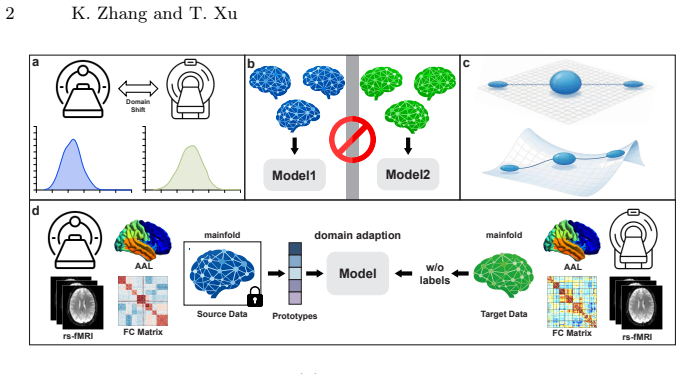
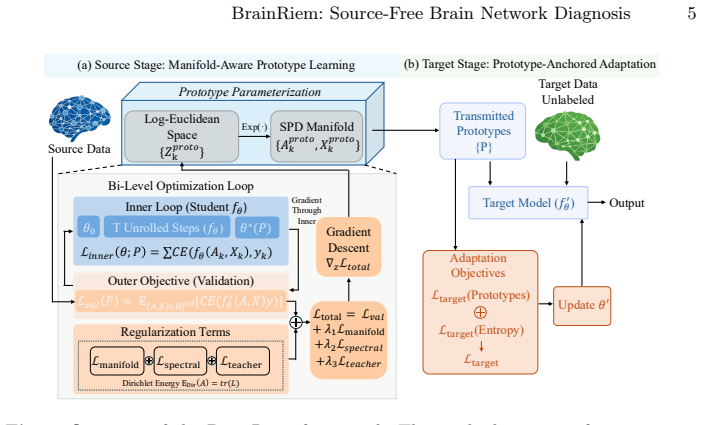
We propose BrainRiem, a source-free domain adaptation framework learning compact Riemannian brain prototypes via manifold-aware bi-level optimization. It employs the Log-Euclidean Metric to ensure prototypes remain valid SPD matrices, while Dirichlet Energy spectral calibration aligns their frequency characteristics with real brain networks. Only anonymized prototypes are transmitted to target sites, serving as stable anchors for training local models without source data access and reducing leakage under the evaluated attacks.
What carries the argument
Manifold-aware bi-level optimization that produces Riemannian prototypes on the SPD manifold via the Log-Euclidean Metric and Dirichlet Energy spectral calibration.
If this is right
- Target sites can train diagnostic models using only the received prototypes as anchors without any source data access.
- Privacy leakage is reduced because only anonymized prototypes leave the source site.
- Performance exceeds state-of-the-art source-free, traditional, and graph domain adaptation methods on ABIDE and REST-meta-MDD across scanners and demographics.
- The resulting prototypes exhibit connectivity patterns that align with established neuroscience findings.
Where Pith is reading between the lines
- Geometric preservation of manifold structure appears necessary to avoid distorting diagnostic signals that Euclidean operations would corrupt.
- The prototype-only transmission pattern could support larger multi-site collaborations without requiring data centralization.
- If the calibration step generalizes, similar spectral alignment techniques might improve prototype stability in other manifold-valued medical data.
Load-bearing premise
The learned Riemannian prototypes retain enough diagnostic signal after Log-Euclidean optimization and Dirichlet Energy calibration to act as stable anchors for target-site training when no source data is present.
What would settle it
If target-site models trained using the transmitted prototypes show no accuracy gain over models trained without any anchors or with Euclidean prototypes on held-out ABIDE or REST-meta-MDD test sets, the central claim would be falsified.
Figures
read the original abstract
Multi-site functional MRI (fMRI) studies are essential for robust neuropsychiatric diagnosis yet suffer severe domain shifts from scanner heterogeneity, demographics, and site-specific acquisition protocols. Traditional domain adaptation requires concurrent source and target data access, violating clinical privacy regulations. Moreover, functional connectivity matrices lie on the Symmetric Positive Definite (SPD) manifold, where Euclidean operations cause geometric distortions corrupting diagnostic patterns. We propose BrainRiem, a source-free domain adaptation framework learning compact Riemannian brain prototypes via manifold-aware bi-level optimization. It employs the Log-Euclidean Metric to ensure prototypes remain valid SPD matrices, while Dirichlet Energy spectral calibration aligns their frequency characteristics with real brain networks. Only anonymized prototypes are transmitted to target sites, serving as stable anchors for training local models without source data access and reducing leakage under the evaluated attacks. Comprehensive experiments on ABIDE and REST-meta-MDD show BrainRiem consistently outperforms state-of-the-art source-free, traditional, and graph domain adaptation methods across diverse scanners and demographics. Notably, learned prototypes exhibit biologically interpretable connectivity patterns aligning with established neuroscience findings, validating the necessity of Riemannian geometry for brain network analysis.
Editorial analysis
A structured set of objections, weighed in public.
Referee Report
Summary. The manuscript proposes BrainRiem, a source-free domain adaptation framework for multi-site fMRI brain network diagnosis. It learns compact Riemannian prototypes on the SPD manifold via bi-level optimization that combines Log-Euclidean projection with Dirichlet Energy spectral calibration; only the anonymized prototypes are transmitted to target sites to anchor local model training without any source data access. The central claims are consistent outperformance over source-free, traditional, and graph domain adaptation baselines on ABIDE and REST-meta-MDD across scanners and demographics, plus biological interpretability of the learned prototypes.
Significance. If the empirical claims are substantiated with proper controls, the work would address a practically important privacy constraint in clinical neuroimaging while respecting the SPD geometry of functional connectivity. The Riemannian formulation is well-motivated and the source-free transmission of prototypes is a clear operational advantage. No machine-checked proofs or parameter-free derivations are present, but the explicit handling of manifold geometry and the attempt at biological validation are positive features.
major comments (3)
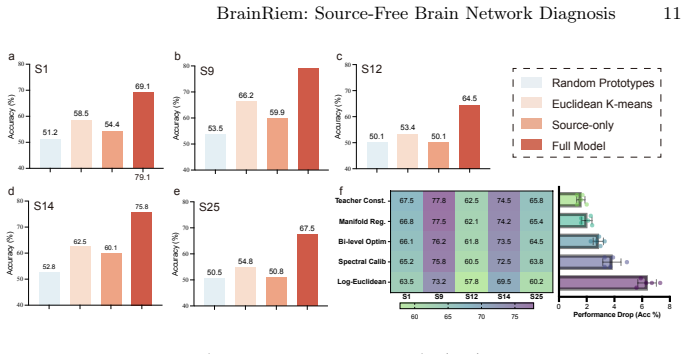
- [Abstract, §4] Abstract and §4 (Experiments): the central claim of consistent outperformance is asserted without any quantitative tables, statistical tests, ablation results, or error analysis supplied in the manuscript text. This directly prevents evaluation of whether the prototypes function as stable anchors under domain shift.
- [§3.2] §3.2 (Bi-level optimization): the claim that Log-Euclidean projection plus Dirichlet Energy calibration preserves class-discriminative connectivity patterns is load-bearing for the source-free guarantee, yet no analysis, ablation on the energy weighting coefficient, or comparison against randomized/generic SPD matrices is provided to rule out collapse of diagnostic directions.
- [§3] §3 (Prototype transmission): the source-free protocol assumes the transmitted prototypes retain sufficient diagnostic signal after manifold projection; without a quantitative check that target-site performance degrades when prototypes are replaced by non-informative SPD matrices, the circularity concern (performance metrics reducing to quantities defined by the fitted prototypes) remains unaddressed.
minor comments (2)
- [§3.1] Notation for the Dirichlet Energy term and the prototype update rule should be introduced with explicit equations rather than prose descriptions.
- [§2] The manuscript should cite prior Riemannian SPD work on brain networks (e.g., Log-Euclidean applications in fMRI) to situate the geometric contribution.
Simulated Author's Rebuttal
We thank the referee for the constructive feedback highlighting the need for stronger empirical substantiation of the claims. We address each major comment point-by-point below and will revise the manuscript to incorporate the requested analyses and controls.
read point-by-point responses
-
Referee: [Abstract, §4] Abstract and §4 (Experiments): the central claim of consistent outperformance is asserted without any quantitative tables, statistical tests, ablation results, or error analysis supplied in the manuscript text. This directly prevents evaluation of whether the prototypes function as stable anchors under domain shift.
Authors: While §4 presents the full experimental tables and comparisons on ABIDE and REST-meta-MDD, the abstract indeed summarizes without specific metrics. In the revision we will insert key quantitative results (e.g., mean accuracy gains with standard deviations) into the abstract and add statistical significance tests (paired t-tests or Wilcoxon signed-rank with p-values) plus error analysis to the experimental section. revision: yes
-
Referee: [§3.2] §3.2 (Bi-level optimization): the claim that Log-Euclidean projection plus Dirichlet Energy calibration preserves class-discriminative connectivity patterns is load-bearing for the source-free guarantee, yet no analysis, ablation on the energy weighting coefficient, or comparison against randomized/generic SPD matrices is provided to rule out collapse of diagnostic directions.
Authors: We agree that direct evidence is required. The revised manuscript will add an ablation on the Dirichlet Energy weighting coefficient together with comparisons against randomized and generic SPD matrices, demonstrating that the calibration step retains class-discriminative directions rather than inducing collapse. revision: yes
-
Referee: [§3] §3 (Prototype transmission): the source-free protocol assumes the transmitted prototypes retain sufficient diagnostic signal after manifold projection; without a quantitative check that target-site performance degrades when prototypes are replaced by non-informative SPD matrices, the circularity concern (performance metrics reducing to quantities defined by the fitted prototypes) remains unaddressed.
Authors: To directly address the circularity concern, the revision will include a controlled experiment in which the transmitted prototypes are replaced by non-informative SPD matrices (identity or random SPD) and report the resulting drop in target-site performance, confirming that diagnostic signal is carried by the learned prototypes. revision: yes
Circularity Check
No significant circularity; derivation is self-contained.
full rationale
The paper describes a source-free adaptation pipeline in which prototypes are learned on source data via Log-Euclidean projection and Dirichlet Energy calibration, then transmitted as fixed anchors for target-site training. No equation or claim reduces a reported performance metric to a quantity defined by the same fitted prototypes; the target evaluation uses independent data and the transmitted prototypes are treated as external inputs. No self-citation is invoked as a load-bearing uniqueness theorem, no ansatz is smuggled via prior work, and no known empirical pattern is merely renamed. The central claim therefore rests on the empirical behavior of the bi-level optimization rather than on definitional equivalence.
Axiom & Free-Parameter Ledger
free parameters (2)
- Number and dimensionality of prototypes
- Dirichlet Energy weighting coefficient
axioms (2)
- domain assumption Functional connectivity matrices are elements of the SPD manifold
- standard math Log-Euclidean metric maps SPD matrices to a flat space while preserving positive-definiteness
invented entities (1)
-
Riemannian brain prototypes
no independent evidence
Reference graph
Works this paper leans on
-
[1]
In: Proceedings of the IEEE conference on computer vision and pattern recognition workshops
Acharya, D., Huang, Z., Pani Paudel, D., Van Gool, L.: Covariance pooling for facial expression recognition. In: Proceedings of the IEEE conference on computer vision and pattern recognition workshops. pp. 367–374 (2018)
2018
-
[2]
SIAM journal on matrix analysis and applications29(1), 328–347 (2007)
Arsigny, V., Fillard, P., Pennec, X., Ayache, N.: Geometric means in a novel vector space structure on symmetric positive-definite matrices. SIAM journal on matrix analysis and applications29(1), 328–347 (2007)
2007
-
[3]
Advances in Neural Information Processing Systems32(2019)
Brooks, D., Schwander, O., Barbaresco, F., Schneider, J.Y., Cord, M.: Rieman- nian batch normalization for spd neural networks. Advances in Neural Information Processing Systems32(2019)
2019
-
[4]
In: 2023 3rd International conference on electronic information engineering and computer communication (EIECC)
Cheng, W., Long, Z., Ma, X., Li, C.: Spd manifold-based graph neural network for fault diagnosis of harmonic drive. In: 2023 3rd International conference on electronic information engineering and computer communication (EIECC). pp. 1–
2023
-
[5]
Molecular psychiatry19(6), 659–667 (2014)
Di Martino, A., Yan, C.G., Li, Q., Denio, E., Castellanos, F.X., Alaerts, K., An- derson, J.S., Assaf, M., Bookheimer, S.Y., Dapretto, M., et al.: The autism brain imaging data exchange: towards a large-scale evaluation of the intrinsic brain ar- chitecture in autism. Molecular psychiatry19(6), 659–667 (2014)
2014
-
[6]
In: Proceedings of the IEEE/CVF conference on computer vision and pattern recognition
Ding, N., Xu, Y., Tang, Y., Xu, C., Wang, Y., Tao, D.: Source-free domain adap- tation via distribution estimation. In: Proceedings of the IEEE/CVF conference on computer vision and pattern recognition. pp. 7212–7222 (2022)
2022
-
[7]
Advances in neural information processing systems 34, 2848–2860 (2021)
Dong, J., Fang, Z., Liu, A., Sun, G., Liu, T.: Confident anchor-induced multi- source free domain adaptation. Advances in neural information processing systems 34, 2848–2860 (2021)
2021
-
[8]
In: International conference on machine learning
Finn, C., Abbeel, P., Levine, S.: Model-agnostic meta-learning for fast adaptation of deep networks. In: International conference on machine learning. pp. 1126–1135. PMLR (2017)
2017
-
[9]
Journal of machine learning research17(59), 1–35 (2016)
Ganin, Y., Ustinova, E., Ajakan, H., Germain, P., Larochelle, H., Laviolette, F., March, M., Lempitsky, V.: Domain-adversarial training of neural networks. Journal of machine learning research17(59), 1–35 (2016)
2016
-
[10]
Nature Communications17, 1589 (2026) 16 K
Gifford,A.T.,Cichy,R.M.,Naselaris,T.,Kay,K.:A7tfmridatasetofsyntheticim- ages for out-of-distribution modeling of vision. Nature Communications17, 1589 (2026) 16 K. Zhang and T. Xu
2026
-
[11]
Advances in neural information processing systems30(2017)
Hamilton, W., Ying, Z., Leskovec, J.: Inductive representation learning on large graphs. Advances in neural information processing systems30(2017)
2017
-
[12]
In: Pro- ceedings of the AAAI conference on artificial intelligence
Huang, Z., Van Gool, L.: A riemannian network for spd matrix learning. In: Pro- ceedings of the AAAI conference on artificial intelligence. vol. 31 (2017)
2017
-
[13]
In: Proceedings of the AAAI Conference on Artificial Intelligence
Huang, Z., Wu, J., Van Gool, L.: Building deep networks on grassmann manifolds. In: Proceedings of the AAAI Conference on Artificial Intelligence. vol. 32 (2018)
2018
-
[14]
Brain Sciences12(5), 659 (2022)
Jiang, Q., Zhang, Y., Zheng, K.: Motor imagery classification via kernel-based domain adaptation on an spd manifold. Brain Sciences12(5), 659 (2022)
2022
-
[15]
IEEE Transactions on Neural Networks and Learning Systems (2023)
Ju, C., Guan, C.: Graph neural networks on spd manifolds for motor imagery classification: A perspective from the time–frequency analysis. IEEE Transactions on Neural Networks and Learning Systems (2023)
2023
-
[16]
NeuroImage146, 1038– 1049 (2017)
Kawahara, J., Brown, C.J., Miller, S.P., Booth, B.G., Chau, V., Grunau, R.E., Zwicker, J.G., Hamarneh, G.: Brainnetcnn: Convolutional neural networks for brain networks; towards predicting neurodevelopment. NeuroImage146, 1038– 1049 (2017)
2017
-
[17]
Semi-Supervised Classification with Graph Convolutional Networks
Kipf, T.: Semi-supervised classification with graph convolutional networks. arXiv preprint arXiv:1609.02907 (2016)
work page internal anchor Pith review Pith/arXiv arXiv 2016
-
[18]
In: Proceedings of the IEEE/CVF international conference on computer vision
Kundu, J.N., Kulkarni, A., Singh, A., Jampani, V., Babu, R.V.: Generalize then adapt: Source-free domain adaptive semantic segmentation. In: Proceedings of the IEEE/CVF international conference on computer vision. pp. 7046–7056 (2021)
2021
-
[19]
In: Proceedings of the IEEE/CVF conference on computer vision and pattern recognition
Li, G., Jampani, V., Sevilla-Lara, L., Sun, D., Kim, J., Kim, J.: Adaptive pro- totype learning and allocation for few-shot segmentation. In: Proceedings of the IEEE/CVF conference on computer vision and pattern recognition. pp. 8334–8343 (2021)
2021
-
[20]
Medical Image Analysis74, 102233 (2021)
Li, X., Zhou, Y., Dvornek, N., Zhang, M., Gao, S., Zhuang, J., Scheinost, D., Staib, L.H., Ventola, P., Duncan, J.S.: Braingnn: Interpretable brain graph neural network for fmri analysis. Medical Image Analysis74, 102233 (2021)
2021
-
[21]
In: International conference on machine learning
Liang, J., Hu, D., Feng, J.: Do we really need to access the source data? source hy- pothesis transfer for unsupervised domain adaptation. In: International conference on machine learning. pp. 6028–6039. PMLR (2020)
2020
-
[22]
In: Euro- pean conference on computer vision
Liu, J., Song, L., Qin, Y.: Prototype rectification for few-shot learning. In: Euro- pean conference on computer vision. pp. 741–756. Springer (2020)
2020
-
[23]
In: International conference on machine learn- ing
Liu, S., Li, T., Feng, Y., Tran, N., Zhao, H., Qiu, Q., Li, P.: Structural re-weighting improves graph domain adaptation. In: International conference on machine learn- ing. pp. 21778–21793. PMLR (2023)
2023
-
[24]
Liu, Y., Sun, M., Zhang, Y., Wang, Y.: Information bottleneck based graph struc- turallearningforoodgeneralization.InformationProcessing&Management63(5), 104691 (2026)
2026
-
[25]
On First-Order Meta-Learning Algorithms
Nichol, A., Achiam, J., Schulman, J.: On first-order meta-learning algorithms. arXiv preprint arXiv:1803.02999 (2018)
work page internal anchor Pith review Pith/arXiv arXiv 2018
-
[26]
In: Medical Image Computing and Computer Assisted Intervention – MICCAI 2017
Parisot, S., Ktena, S.I., Ferrante, E., Lee, M., Moreno, R.G., Glocker, B., Rueck- ert, D.: Spectral graph convolutions for population-based disease prediction. In: Medical Image Computing and Computer Assisted Intervention – MICCAI 2017. pp. 177–185. Springer-Verlag, Berlin, Heidelberg (2017)
2017
-
[27]
Rahman, A., Rahman, M.S., Mahdy, M.R.C.: 3c-gan: class-consistent cyclegan for malariadomainadaptationmodel.BiomedicalPhysics&EngineeringExpress7(5), 055002 (2021)
2021
-
[28]
Ad- vances in neural information processing systems30(2017)
Snell, J., Swersky, K., Zemel, R.: Prototypical networks for few-shot learning. Ad- vances in neural information processing systems30(2017)
2017
-
[29]
In: European conference on computer vision
Sun,B.,Saenko,K.:Deepcoral:Correlationalignmentfordeepdomainadaptation. In: European conference on computer vision. pp. 443–450. Springer (2016) BrainRiem: Source-Free Brain Network Diagnosis 17
2016
-
[30]
In: Proceedings of the IEEE conference on computer vision and pattern recognition
Sung, F., Yang, Y., Zhang, L., Xiang, T., Torr, P.H., Hospedales, T.M.: Learning to compare: Relation network for few-shot learning. In: Proceedings of the IEEE conference on computer vision and pattern recognition. pp. 1199–1208 (2018)
2018
-
[31]
IEEE Transactions on Neural Networks and Learning Systems35(6), 7363–7375 (2024)
Tang, H., Ma, G., Guo, L., Fu, X., Huang, H., Zhan, L.: Contrastive brain network learning via hierarchical signed graph pooling model. IEEE Transactions on Neural Networks and Learning Systems35(6), 7363–7375 (2024)
2024
-
[32]
In: Proceedings of the AAAI conference on artificial intelligence
Tang, H., Jia, K.: Discriminative adversarial domain adaptation. In: Proceedings of the AAAI conference on artificial intelligence. vol. 34, pp. 5940–5947 (2020)
2020
-
[33]
In: Proceedings of the IEEE conference on computer vision and pattern recognition
Tzeng, E., Hoffman, J., Saenko, K., Darrell, T.: Adversarial discriminative domain adaptation. In: Proceedings of the IEEE conference on computer vision and pattern recognition. pp. 7167–7176 (2017)
2017
-
[34]
Briefings in Bioinfor- matics27(1), bbag038 (2026)
Wang,Y.,Liang,V.,Yin,N.,Liu,S.,Segal,E.:Sgac:agraphneuralnetworkframe- work for imbalanced and structure-aware amp classification. Briefings in Bioinfor- matics27(1), bbag038 (2026)
2026
-
[35]
DisRFM: Polar Riemannian Flow Matching for Structure-Preserving Graph Domain Adaptation
Wang, Y., Liu, X., Wang, M., Gao, S., Yin, N.: Riemannian flow matching for disentangled graph domain adaptation. arXiv preprint arXiv:2602.00656 (2026)
work page internal anchor Pith review Pith/arXiv arXiv 2026
-
[36]
In: Proceedings of the AAAI Conference on Artificial Intelligence
Wang, Y., Wang, M., Huang, Z., Liu, S., Yin, N.: Nested graph pseudo-label re- finement for noisy label domain adaptation learning. In: Proceedings of the AAAI Conference on Artificial Intelligence. vol. 40, pp. 26697–26705 (2026)
2026
-
[37]
arXiv preprint arXiv:2602.08431 (2026)
Wang, Y., Zhang, K., Wang, M., Gao, S., Yin, N.: Usbd: Universal struc- tural basis distillation for source-free graph domain adaptation. arXiv preprint arXiv:2602.08431 (2026)
-
[38]
When Brain Networks Travel: Learning Beyond Site
Wang, Y., Zhang, K., Yang, Y., Wolfers, T., Wu, Y., Gao, S., Yin, N.: When brain networks travel: Learning beyond site. arXiv preprint arXiv:2605.06050 (2026)
work page internal anchor Pith review Pith/arXiv arXiv 2026
-
[39]
In: Proceedings of the web conference 2020
Wu, M., Pan, S., Zhou, C., Chang, X., Zhu, X.: Unsupervised domain adaptive graph convolutional networks. In: Proceedings of the web conference 2020. pp. 1457–1467 (2020)
2020
-
[40]
Proceedings of the National Academy of Sciences116(18), 9078–9083 (2019)
Yan, C.G., Chen, X., Li, L., Castellanos, F.X., Bai, T.J., Bo, Q.J., Cao, J., Chen, G.M., Chen, N.X., Chen, W., et al.: Reduced default mode network functional connectivity in patients with recurrent major depressive disorder. Proceedings of the National Academy of Sciences116(18), 9078–9083 (2019)
2019
-
[41]
In: Proceedings of the IEEE/CVF international conference on computer vision
Yang, S., Wang, Y., Van De Weijer, J., Herranz, L., Jui, S.: Generalized source-free domain adaptation. In: Proceedings of the IEEE/CVF international conference on computer vision. pp. 8978–8987 (2021)
2021
-
[42]
Advances in neural in- formation processing systems34, 29393–29405 (2021)
Yang, S., Van de Weijer, J., Herranz, L., Jui, S., et al.: Exploiting the intrinsic neighborhood structure for source-free domain adaptation. Advances in neural in- formation processing systems34, 29393–29405 (2021)
2021
-
[43]
In: ICASSP 2024-2024 IEEE International Conference on Acoustics, Speech and Signal Process- ing (ICASSP)
Yang,Y.,Guo,X.,Cai,G.,Ye,C.,Ma,T.:Topology-regularizedself-knowledgedis- tillation for transductive-inductive learning of brain disorder diagnosis. In: ICASSP 2024-2024 IEEE International Conference on Acoustics, Speech and Signal Process- ing (ICASSP). pp. 4045–4049. IEEE (2024)
2024
-
[44]
IEEE Transactions on Medical Imaging43(1), 108–121 (2024)
Yang, Y., Ye, C., Guo, X., Wu, T., Xiang, Y., Ma, T.: Mapping multi-modal brain connectome for brain disorder diagnosis via cross-modal mutual learning. IEEE Transactions on Medical Imaging43(1), 108–121 (2024)
2024
-
[45]
IEEE Transactions on Medical Imaging43(11), 4004–4016 (2024)
Yang, Y., Ye, C., Su, G., Zhang, Z., Chang, Z., Chen, H., Chan, P., Yu, Y., Ma, T.: Brainmass: Advancing brain network analysis for diagnosis with large-scale self- supervised learning. IEEE Transactions on Medical Imaging43(11), 4004–4016 (2024)
2024
-
[46]
In: The eleventh international conference on learning representations (2023) 18 K
You, Y., Chen, T., Wang, Z., Shen, Y.: Graph domain adaptation via theory- grounded spectral regularization. In: The eleventh international conference on learning representations (2023) 18 K. Zhang and T. Xu
2023
-
[47]
In: Proceedings of the IEEE/CVF conference on computer vision and pattern recognition
Zhang, H., Koniusz, P., Jian, S., Li, H., Torr, P.H.: Rethinking class relations: Absolute-relative supervised and unsupervised few-shot learning. In: Proceedings of the IEEE/CVF conference on computer vision and pattern recognition. pp. 9432–9441 (2021)
2021
-
[48]
Zhang, K., Li, Q., Calhoun, V.D., Yu, S.: Modeling higher-order brain interactions via a multi-view information bottleneck framework for fmri-based psychiatric di- agnosis. arXiv preprint arXiv:2604.17713 (2026)
work page internal anchor Pith review Pith/arXiv arXiv 2026
-
[49]
In: International Conference on Medical Image Computing and Computer-Assisted Intervention
Zhang, K., Li, Q., Yu, S.: Mvho-ib: Multi-view higher-order information bottle- neck for brain disorder diagnosis. In: International Conference on Medical Image Computing and Computer-Assisted Intervention. pp. 407–417. Springer (2025)
2025
-
[50]
arXiv preprint arXiv:2602.21046 (2026)
Zhang, K., Yang, Y., Zhang, J., Shi, X., Yu, S.: Pime: Prototype-based in- terpretable mcts-enhanced brain network analysis for disorder diagnosis. arXiv preprint arXiv:2602.21046 (2026)
-
[51]
Medical Image Analysis90, 102932 (2023)
Zhang, S., Chen, X., Shen, X., Ren, B., Yu, Z., Yang, H., Jiang, X., Shen, D., Zhou, Y., Zhang, X.Y.: A-gcl: Adversarial graph contrastive learning for fmri analysis to diagnose neurodevelopmental disorders. Medical Image Analysis90, 102932 (2023)
2023
discussion (0)
Sign in with ORCID, Apple, or X to comment. Anyone can read and Pith papers without signing in.