Pointer-CAD v2: Plan-Then-Construct CAD Generation with Dimension-Aware Parametric Precision
Pith reviewed 2026-06-30 07:53 UTC · model grok-4.3
The pith
Pointer-CAD v2 generates dimensionally precise CAD by first planning explicit metrics then referencing them via pointers during construction.
A machine-rendered reading of the paper's core claim, the machinery that carries it, and where it could break.
Core claim
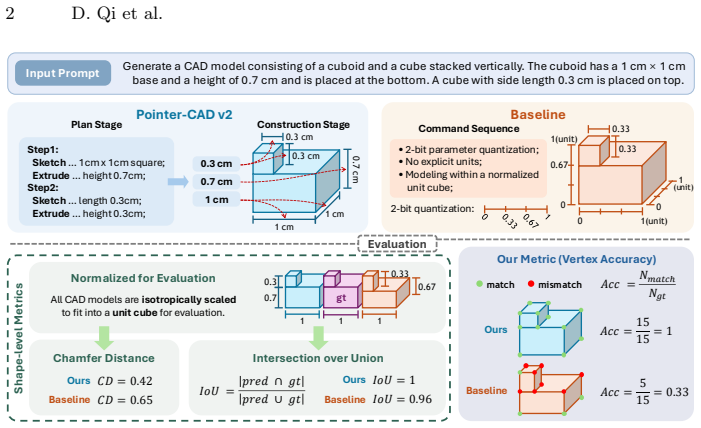
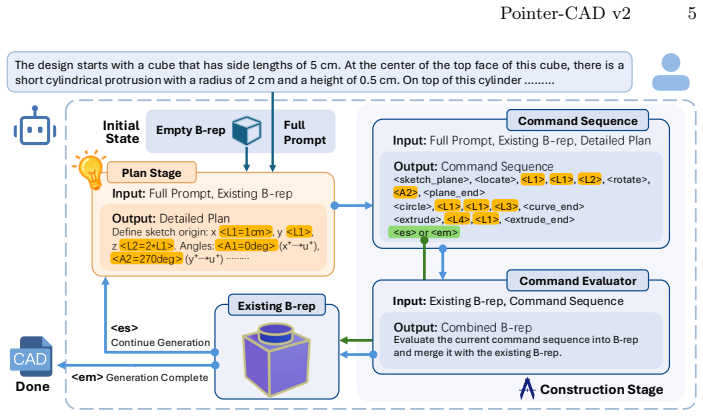
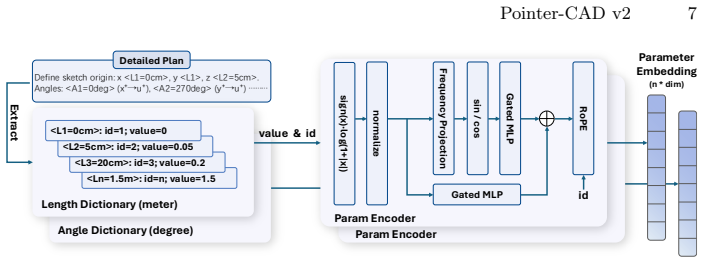
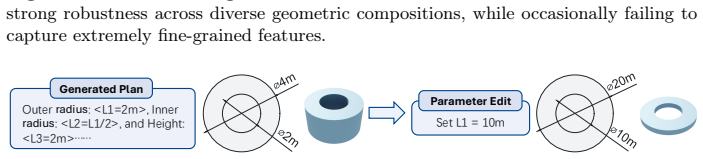
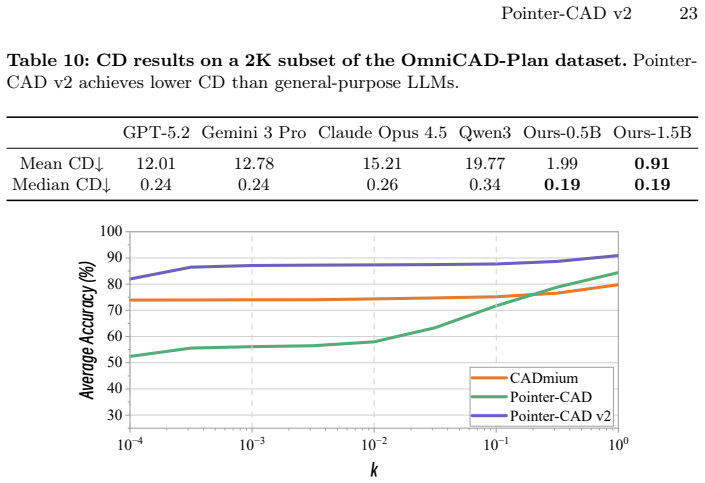
Pointer-CAD v2 first produces a structured design plan containing explicit metric scale parameters, organizes those parameters into a dictionary, and then references them directly via a pointer mechanism while generating the command sequence. This allows continuous value prediction instead of quantized values, eliminates discretization errors, and produces dimensionally consistent CAD outputs that outperform prior baselines on geometric accuracy measures.
What carries the argument
The Plan-Then-Construct paradigm with a pointer mechanism that references explicit metric parameters from a dictionary during autoregressive sequence generation.
If this is right
- CAD generation becomes suitable for precision-critical engineering tasks that require exact metric compliance.
- Geometric accuracy improves measurably at vertex, edge, and face levels without relying on post-hoc corrections.
- Quantization steps are eliminated, allowing direct output of continuous parameter values in sequence models.
- Evaluation can shift from visual similarity to parametric fidelity using the new hierarchical metrics.
Where Pith is reading between the lines
- The same plan-then-reference structure could reduce precision loss in other autoregressive generation domains such as 3D assembly or manufacturing code.
- The hierarchical geometry metrics may generalize to other parametric modeling tasks where small deviations matter.
- Robust plan generation would allow scaling to assemblies with many interdependent dimensions.
Load-bearing premise
An LLM can reliably produce a correct structured design plan with accurate explicit metric parameters that the pointer mechanism will reference without introducing mismatches or inconsistencies.
What would settle it
A test set where CAD outputs generated from the plan show vertex or edge dimensions that deviate beyond tolerance from the explicit metric values listed in the plan.
Figures
read the original abstract
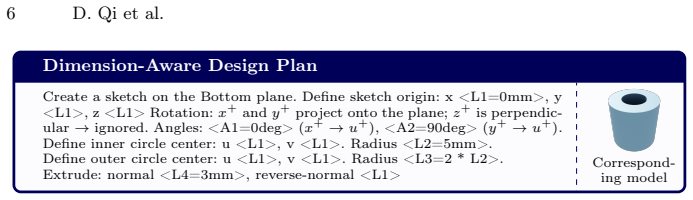
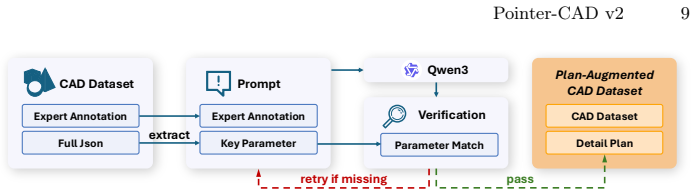
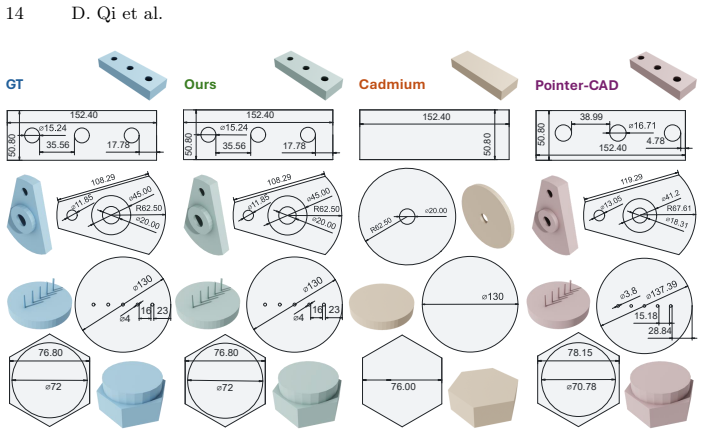
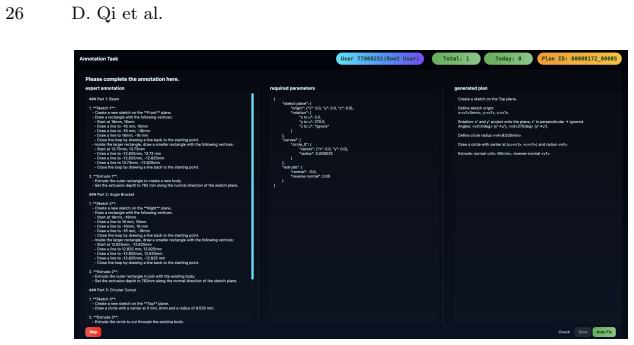
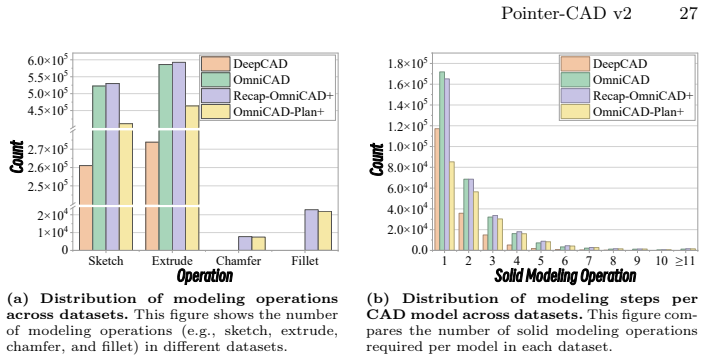
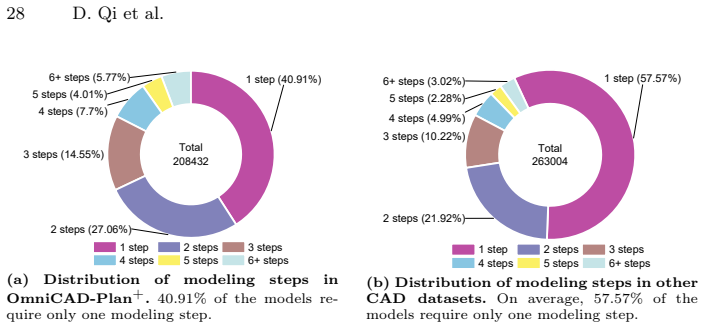
Computer-aided design (CAD) plays a fundamental role in modern manufacturing by providing the high precision required for industrial production. Recent large language model based approaches formulate CAD generation as a sequence prediction problem and have achieved promising results. However, existing methods and evaluation protocols primarily emphasize visual similarity, while overlooking precise geometric parameters and correct metric scale. Small numerical deviations that are negligible at the shape-level may still violate industrial tolerance requirements, a problem further compounded by current autoregressive paradigms that utilize command sequence representations, aggressively quantize numerical parameters to ease LLM prediction. In this work, we present Pointer-CAD v2. Compared with v1 (arXiv:2603.04337), this version directly predicts continuous values, bypassing the need for quantized numerical parameters and thereby eliminating quantization errors. Specifically, we propose a unified framework that decouples parameter reasoning from geometric construction through a Plan-Then-Construct paradigm. Our method first produces a structured design plan with explicit metric scale parameters. These parameters are organized into a dictionary and directly referenced during sequence generation via a pointer mechanism, eliminating discretization errors and ensuring dimensionally consistent execution. In addition, we construct a new large-scale dataset with plan-level annotation and introduce three hierarchical geometry accuracy metrics to evaluate parametric fidelity at the vertex, edge, and face levels. Extensive experiments demonstrate that Pointer-CAD v2 consistently outperforms existing baselines and achieves substantial improvements in geometric accuracy, enabling reliable CAD generation for precision-critical engineering applications.
Editorial analysis
A structured set of objections, weighed in public.
Referee Report
Summary. Pointer-CAD v2 presents a Plan-Then-Construct framework for LLM-based CAD generation. It first produces a structured design plan containing explicit metric-scale parameters organized as a dictionary; these are then referenced by a pointer mechanism during autoregressive sequence construction to directly predict continuous values and eliminate quantization error. The work introduces a new large-scale dataset with plan-level annotations and three hierarchical geometry-accuracy metrics (vertex, edge, face) intended to evaluate parametric fidelity beyond visual similarity. Experiments are stated to show consistent outperformance over baselines for precision-critical applications.
Significance. If the plan-generation accuracy and pointer-consistency claims are substantiated, the decoupling of parameter reasoning from geometric construction and the avoidance of discretization could meaningfully advance LLM-driven CAD for engineering tolerances. The hierarchical metrics and annotated dataset would also provide useful evaluation tools for the community. The significance hinges on whether the reported geometric gains are attributable to the pointer mechanism rather than post-hoc metric design or unverified upstream plan quality.
major comments (2)
- [Abstract] Abstract: the central claim that the pointer mechanism 'eliminates quantization errors and ensures dimensionally consistent execution' rests on the unverified load-bearing assumption that the upstream structured design plan is generated correctly; no plan-level metrics (parameter correctness rate, reference error rate) are reported, so downstream geometric accuracy improvements cannot be isolated or confirmed.
- [Abstract] Abstract / Experiments: the statements 'consistently outperforms existing baselines' and 'achieves substantial improvements in geometric accuracy' are presented without any quantitative results, error bars, dataset statistics, or table references, preventing assessment of whether the hierarchical metrics actually demonstrate the claimed parametric gains under identical conditions for baselines.
Simulated Author's Rebuttal
We thank the referee for the constructive feedback on the abstract and the need for stronger substantiation of our claims. We address each major comment below and commit to revisions that improve verifiability without altering the core contributions.
read point-by-point responses
-
Referee: [Abstract] Abstract: the central claim that the pointer mechanism 'eliminates quantization errors and ensures dimensionally consistent execution' rests on the unverified load-bearing assumption that the upstream structured design plan is generated correctly; no plan-level metrics (parameter correctness rate, reference error rate) are reported, so downstream geometric accuracy improvements cannot be isolated or confirmed.
Authors: We agree that plan-level metrics are necessary to isolate the pointer mechanism's contribution. The revised manuscript will include explicit plan-level metrics (parameter correctness rate and reference error rate) on the annotated dataset. These additions will allow direct verification of upstream plan quality and confirm that geometric gains arise from exact continuous parameter referencing rather than plan inaccuracies. revision: yes
-
Referee: [Abstract] Abstract / Experiments: the statements 'consistently outperforms existing baselines' and 'achieves substantial improvements in geometric accuracy' are presented without any quantitative results, error bars, dataset statistics, or table references, preventing assessment of whether the hierarchical metrics actually demonstrate the claimed parametric gains under identical conditions for baselines.
Authors: The abstract is a high-level summary; full quantitative results with tables, error bars, dataset statistics, and baseline comparisons under the new hierarchical metrics appear in the Experiments section. We will revise the abstract to incorporate key quantitative improvements and explicit table references, enabling readers to assess the parametric gains directly from the abstract. revision: yes
Circularity Check
No significant circularity detected
full rationale
The paper presents a Plan-Then-Construct framework with a pointer mechanism for referencing explicit parameters from a generated design plan, directly predicting continuous values instead of quantized ones, and introduces new hierarchical geometry accuracy metrics plus a dataset with plan-level annotations. No equations, derivations, or central claims reduce by construction to fitted inputs or self-citations; the v1 reference (arXiv:2603.04337) is used only for comparison. The new metrics evaluate parametric fidelity at vertex/edge/face levels but are not shown to be tuned in a self-definitional way that forces the reported gains. The method's claims rest on empirical outperformance under the proposed evaluation protocol rather than any self-referential loop or imported uniqueness theorem.
Axiom & Free-Parameter Ledger
Reference graph
Works this paper leans on
-
[1]
com/bf10f64990cfda0ba858290be7b8cc6317685f47.pdf
Anthropic: Claude opus 4.5 system card (2025),https://www-cdn.anthropic. com/bf10f64990cfda0ba858290be7b8cc6317685f47.pdf
2025
-
[2]
https://doi.org/10.5281/zenodo
CadQuery Contributors: CadQuery (2025),https://doi.org/10.5281/zenodo. 14590990
-
[3]
In: CVPR
Chen, C., Wei, J., Chen, T., Zhang, C., Yang, X., Zhang, S., Yang, B., Foo, C.S., Lin, G., Huang, Q., et al.: CADCrafter: Generating computer-aided design models from unconstrained images. In: CVPR. pp. 11073–11082 (2025)
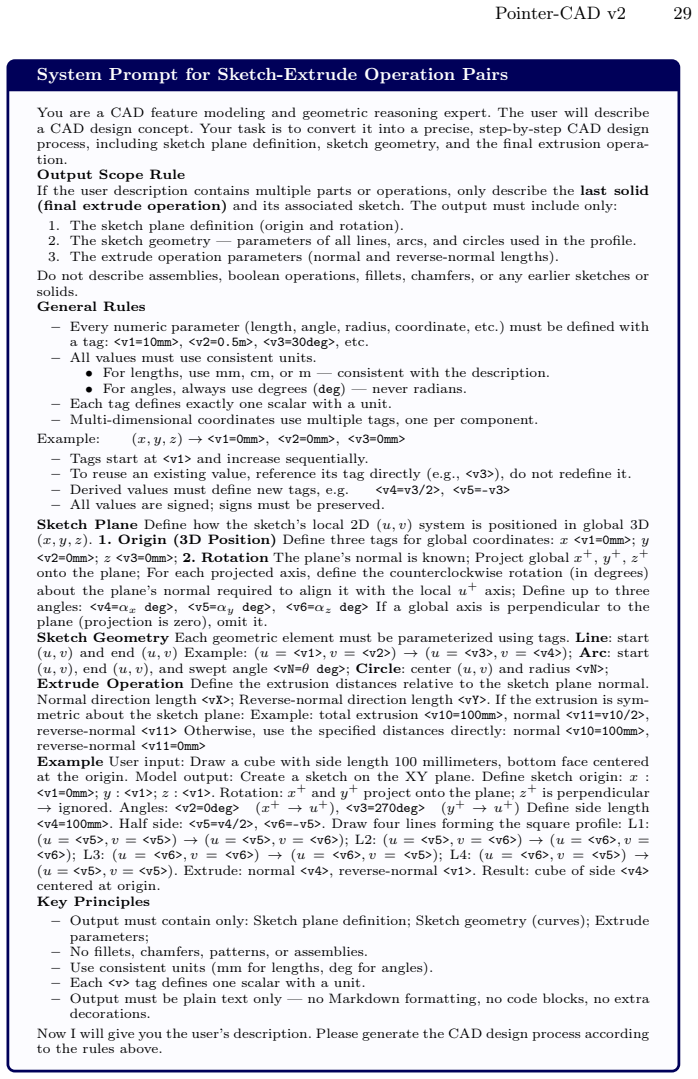
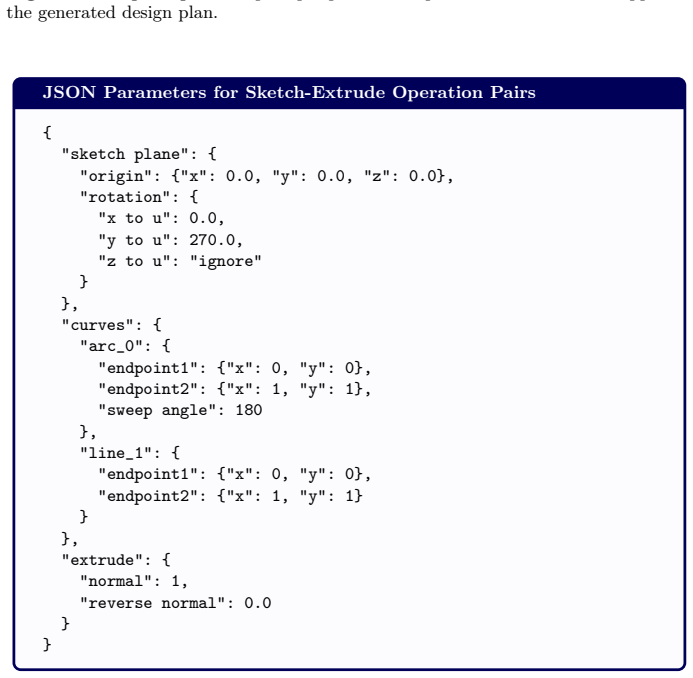
2025
-
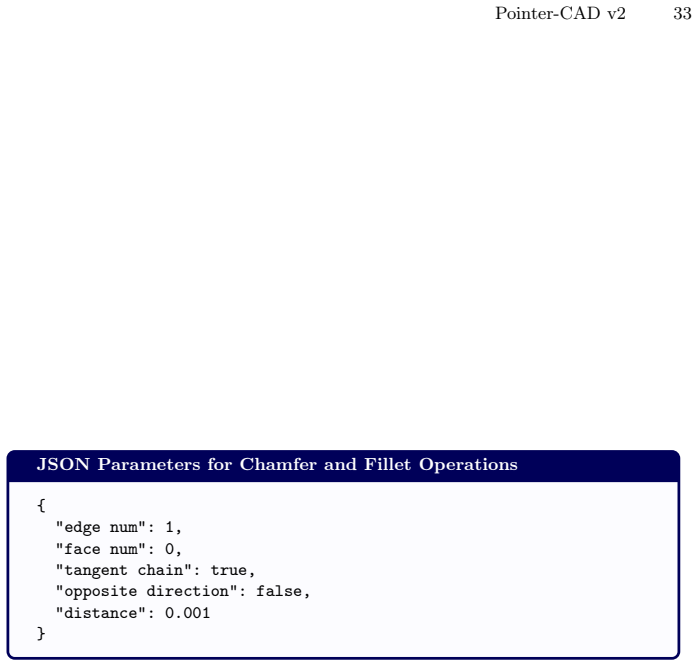
[4]
Evaluating Large Language Models Trained on Code
Chen, M., Tworek, J., Jun, H., Yuan, Q., Pinto, H.P.D.O., Kaplan, J., Edwards, H., Burda, Y., Joseph, N., Brockman, G., et al.: Evaluating large language models trained on code. arXiv preprint arXiv:2107.03374 (2021)
work page internal anchor Pith review Pith/arXiv arXiv 2021
-
[5]
IEEE Transactions on Industrial Informatics (2025)
Chen, T., Yu, C., Hu, Y., Li, J., Xu, T., Cao, R., Zhu, L., Zang, Y., Zhang, Y., Li, Z., et al.: Img2CAD: Conditioned 3-d cad model generation from single image with structured visual geometry. IEEE Transactions on Industrial Informatics (2025)
2025
-
[6]
In: ICML
Dauphin, Y.N., Fan, A., Auli, M., Grangier, D.: Language modeling with gated convolutional networks. In: ICML. pp. 933–941. PMLR (2017)
2017
-
[7]
Dong, X., Li, C., Han, C., Zheng, P., Jing, J., Song, Y., Yang, Z.: HistCAD: Geometrically constrained parametric history-based cad dataset. arXiv preprint arXiv:2602.19171 (2025)
work page internal anchor Pith review Pith/arXiv arXiv 2025
-
[8]
In: ICML
Du, Y., Durkan, C., Strudel, R., Tenenbaum, J.B., Dieleman, S., Fergus, R., Sohl- Dickstein, J., Doucet, A., Grathwohl, W.S.: Reduce, reuse, recycle: Compositional generation with energy-based diffusion models and mcmc. In: ICML. pp. 8489–
-
[9]
In: ECCV
Dupont, E., Cherenkova, K., Mallis, D., Gusev, G., Kacem, A., Aouada, D.: Tran- sCAD: A hierarchical transformer for cad sequence inference from point clouds. In: ECCV. pp. 19–36. Springer (2024)
2024
-
[10]
Cadevolve: Creating realistic cad via program evolution.arXiv preprint arXiv:2602.16317, 2026
Elistratov,M.,Barannikov,M.,Ivanov,G.,Khrulkov,V.,Konushin,A.,Kuznetsov, A., Zhemchuzhnikov, D.: CADEvolve: Creating realistic cad via program evolution. arXiv preprint arXiv:2602.16317 (2026)
-
[11]
In: ICML (2024)
Esser, P., Kulal, S., Blattmann, A., Entezari, R., Müller, J., Saini, H., Levi, Y., Lorenz, D., Sauer, A., Boesel, F., et al.: Scaling rectified flow transformers for high-resolution image synthesis. In: ICML (2024)
2024
-
[12]
Integrated Computer-Aided Engineering32(1), 75–96 (2025)
Fan, R., He, F., Liu, Y., Song, Y., Fan, L., Yan, X.: A parametric and feature- based cad dataset to support human-computer interaction for advanced 3d shape learning. Integrated Computer-Aided Engineering32(1), 75–96 (2025)
2025
-
[13]
FreeCAD Community: FreeCAD (2024),https://www.freecad.org/
2024
-
[14]
Google DeepMind: Gemini 3 pro (2025),https://deepmind.google/models/ gemini/pro/
2025
-
[15]
TMLR (2026)
Govindarajan, P., Baldelli, D., Pathak, J., Fournier, Q., Chandar, S.: CADmium: Fine-tuning code language models for text- driven sequential cad design. TMLR (2026)
2026
-
[16]
CAD-Coder: Text-to-CAD Generation with Chain-of-Thought and Geometric Reward
Guan, Y., Wang, X., Xing, X., Zhang, J., Xu, D., Yu, Q.: CAD-Coder: Text- to-cad generation with chain-of-thought and geometric reward. arXiv preprint arXiv:2505.19713 (2025)
work page internal anchor Pith review Pith/arXiv arXiv 2025
-
[17]
In: ICLR (2026),https://openreview
Guo,Q.,Dai,G.,Liu,Z.,Huang,S.,Hu,Y.,Zhang,H.,Chen,T.:PlanthenAct:Bi- level CAD command sequence generation. In: ICLR (2026),https://openreview. net/forum?id=LhE03r8X8z
2026
-
[18]
In: Computer Graphics Forum
Jones, B.T., Zhang, Z., Hähnlein, F., Matusik, W., Ahmad, M., Kim, V., Schulz, A.: A solver-aided hierarchical language for llm-driven cad design. In: Computer Graphics Forum. vol. 44, p. e70250. Wiley Online Library (2025) Pointer-CAD v2 17
2025
-
[19]
NeurIPS35, 26565–26577 (2022)
Karras,T.,Aittala,M.,Aila,T.,Laine,S.:Elucidatingthedesignspaceofdiffusion- based generative models. NeurIPS35, 26565–26577 (2022)
2022
-
[20]
NeurIPS37, 7552–7579 (2024)
Khan,M.S.,Sinha,S.,Sheikh,T.U.,Stricker,D.,Ali,S.A.,Afzal,M.Z.:Text2CAD: Generating sequential cad designs from beginner-to-expert level text prompts. NeurIPS37, 7552–7579 (2024)
2024
-
[21]
In: CVPR
Khan, M.S., Dupont, E., Ali, S.A., Cherenkova, K., Kacem, A., Aouada, D.: CAD- SIGNet: Cad language inference from point clouds using layer-wise sketch instance guided attention. In: CVPR. pp. 4713–4722 (2024)
2024
-
[22]
cadrille: Multi-modal cad reconstruction with online reinforcement learning
Kolodiazhnyi, M., Tarasov, D., Zhemchuzhnikov, D., Nikulin, A., Zisman, I., Vorontsova, A., Konushin, A., Kurenkov, V., Rukhovich, D.: cadrille: Multi- modal cad reconstruction with online reinforcement learning. arXiv preprint arXiv:2505.22914 (2025)
-
[23]
arXiv preprint arXiv:2512.11199 (2025)
Le, T., Nguyen, K., Huang, B., Ta, T.D., Nguyen, A.: CADKnitter: Compositional cad generation from text and geometry guidance. arXiv preprint arXiv:2512.11199 (2025)
-
[24]
In: CVPR
Li, J., Ma, W., Li, X., Lou, Y., Zhou, G., Zhou, X.: CAD-Llama: leveraging large language models for computer-aided design parametric 3d model generation. In: CVPR. pp. 18563–18573 (2025)
2025
-
[25]
arXiv preprint arXiv:2601.09428 (2026)
Li, S., Lambourne, J.G., Zhang, L., Jayaraman, P.K., Willis, K., et al.: Draw it like Euclid: Teaching transformer models to generate cad profiles using ruler and compass construction steps. arXiv preprint arXiv:2601.09428 (2026)
-
[26]
Li, X., Li, J., Song, Y., Lou, Y., Zhou, X.: Seek-CAD: A self-refined generative modeling for 3d parametric cad using local inference via deepseek. arXiv preprint arXiv:2505.17702 (2025)
-
[27]
In: CVPR
Li, Y., Lin, C., Liu, Y., Long, X., Zhang, C., Wang, N., Li, X., Wang, W., Guo, X.: CADDreamer: Cad object generation from single-view images. In: CVPR. pp. 21448–21457 (2025)
2025
-
[28]
Journal of Computational Design and Engineering12(10), 176–184 (2025)
Liang, J., He, F., Fan, R., Chu, Y., Yan, X.: CADCL: Reconstruct parametric cad models from b-rep via contrastive learning. Journal of Computational Design and Engineering12(10), 176–184 (2025)
2025
-
[29]
In: ACM MM
Lin, D., Yuan, M., Wang, Z., Wu, T., Liu, Y.: FreeCAD: A multimodal framework for 3d cad model generation from free-form prompts. In: ACM MM. pp. 1948–1956 (2025)
1948
-
[30]
In: CVPR
Ma, W., Chen, S., Lou, Y., Li, X., Zhou, X.: Draw step by step: Reconstructing cad construction sequences from point clouds via multimodal diffusion. In: CVPR. pp. 27154–27163 (2024)
2024
-
[31]
In: ICCV
Mallis, D., Karadeniz, A.S., Cavada, S., Rukhovich, D., Foteinopoulou, N., Cherenkova, K., Kacem, A., Aouada, D.: CAD-Assistant: tool-augmented vllms as generic cad task solvers. In: ICCV. pp. 7284–7294 (2025)
2025
-
[32]
In: ECCV (2020)
Mildenhall, B., Srinivasan, P.P., Tancik, M., Barron, J.T., Ramamoorthi, R., Ng, R.: NeRF: Representing scenes as neural radiance fields for view synthesis. In: ECCV (2020)
2020
-
[33]
arXiv preprint arXiv:2506.00568 (2025)
Niu,K.,Chen,Z.,Yu,H.,Chen,Y.,Fu,T.,Zhao,M.,Li,B.,Xue,X.:CReFT-CAD: Boosting orthographic projection reasoning for cad via reinforcement fine-tuning. arXiv preprint arXiv:2506.00568 (2025)
-
[34]
arXiv preprint arXiv:2508.10118 (2025)
Niu, K., Yu, H., Chen, Z., Zhao, M., Fu, T., Li, B., Xue, X.: From intent to execution: Multimodal chain-of-thought reinforcement learning for precise cad code generation. arXiv preprint arXiv:2508.10118 (2025)
-
[35]
Qi et al
OpenAI: Introducing gpt 5.2 (2025),https://openai.com/index/introducing- gpt-5-2 18 D. Qi et al
2025
-
[36]
In: CVPR
Qi, D., Wang, C., Xu, J., Chu, T., Zhao, Z., Liu, W., Ding, W., Ma, Y., Gao, S.: Pointer-CAD: Unifying b-rep and command sequences via pointer-based edges & faces selection. In: CVPR. pp. 17377–17387 (2026)
2026
-
[37]
In: ACM MM
Qin, F., Lu, S., Hou, J., Wang, C., Fang, M., Liu, L.: Drawing2CAD: Sequence- to-sequence learning for cad generation from vector drawings. In: ACM MM. pp. 10573–10582 (2025)
2025
-
[38]
In: ICCV
Rukhovich, D., Dupont, E., Mallis, D., Cherenkova, K., Kacem, A., Aouada, D.: CAD-Recode: Reverse engineering cad code from point clouds. In: ICCV. pp. 9801– 9811 (2025)
2025
-
[39]
Proceedings of the Design Society5, 1893–1902 (2025)
Schüpbach, A., San Miguel, R., Ferchow, J., Meboldt, M.: From text to design: a framework to leverage llm agents for automated cad generation. Proceedings of the Design Society5, 1893–1902 (2025)
1902
-
[40]
Neurocomputing568, 127063 (2024)
Su, J., Ahmed, M., Lu, Y., Pan, S., Bo, W., Liu, Y.: RoFormer: Enhanced trans- former with rotary position embedding. Neurocomputing568, 127063 (2024)
2024
-
[41]
NeurIPS (2020)
Tancik, M., Srinivasan, P.P., Mildenhall, B., Fridovich-Keil, S., Raghavan, N., Sing- hal, U., Ramamoorthi, R., Barron, J.T., Ng, R.: Fourier features let networks learn high frequency functions in low dimensional domains. NeurIPS (2020)
2020
-
[42]
Kimi K2.5: Visual Agentic Intelligence
Team, K., Bai, T., Bai, Y., Bao, Y., Cai, S., Cao, Y., Charles, Y., Che, H., Chen, C., Chen, G., et al.: Kimi K2. 5: Visual agentic intelligence. arXiv preprint arXiv:2602.02276 (2026)
work page internal anchor Pith review Pith/arXiv arXiv 2026
-
[43]
In: Proceedings of the 17th ACM Conference on Recommender Systems
Wang, C., Ye, J., Wang, W., Gao, C., Feng, F., He, X.: RecAD: Towards a unified library for recommender attack and defense. In: Proceedings of the 17th ACM Conference on Recommender Systems. pp. 234–244 (2023)
2023
-
[44]
In: AAAI
Wang, S., Chen, C., Le, X., Xu, Q., Xu, L., Zhang, Y., Yang, J.: CAD-GPT: Syn- thesising cad construction sequence with spatial reasoning-enhanced multimodal llms. In: AAAI. vol. 39, pp. 7880–7888 (2025)
2025
-
[45]
ACM TOG40(4), 1–24 (2021)
Willis, K.D., Pu, Y., Luo, J., Chu, H., Du, T., Lambourne, J.G., Solar-Lezama, A., Matusik, W.: Fusion 360 gallery: A dataset and environment for programmatic cad construction from human design sequences. ACM TOG40(4), 1–24 (2021)
2021
-
[46]
In: ICCV
Wu, R., Xiao, C., Zheng, C.: DeepCAD: A deep generative network for computer- aided design models. In: ICCV. pp. 6772–6782 (2021)
2021
-
[47]
In: ECCV
Wu, S., Khasahmadi, A.H., Katz, M., Jayaraman, P.K., Pu, Y., Willis, K., Liu, B.: CadVLM: Bridging language and vision in the generation of parametric cad sketches. In: ECCV. pp. 368–384. Springer (2024)
2024
-
[48]
Xie, H., Ju, F.: Text-to-CadQuery: A new paradigm for cad generation with scal- able large model capabilities. arXiv preprint arXiv:2505.06507 (2025)
-
[49]
Xu, J., Wang, C., Zhao, Z., Liu, W., Ma, Y., Gao, S.: CAD-MLLM: Uni- fying multimodality-conditioned cad generation with mllm. arXiv preprint arXiv:2411.04954 (2024)
-
[50]
arXiv preprint arXiv:2307.00149 (2023)
Xu, X., Jayaraman, P.K., Lambourne, J.G., Willis, K.D., Furukawa, Y.: Hi- erarchical neural coding for controllable cad model generation. arXiv preprint arXiv:2307.00149 (2023)
-
[51]
Skexgen: Autoregressive generation of cad construction sequences with disentangled codebooks
Xu, X., Willis, K.D., Lambourne, J.G., Cheng, C.Y., Jayaraman, P.K., Furukawa, Y.: SkexGen: Autoregressive generation of cad construction sequences with disen- tangled codebooks. arXiv preprint arXiv:2207.04632 (2022)
-
[52]
Yang, A., Li, A., Yang, B., Zhang, B., Hui, B., Zheng, B., Yu, B., Gao, C., Huang, C., Lv, C., et al.: Qwen3 technical report. arXiv preprint arXiv:2505.09388 (2025)
work page internal anchor Pith review Pith/arXiv arXiv 2025
-
[53]
Computer-Aided Design p
Yin, X., Lu, X., Shen, J., Ni, J., Li, H., Tong, R., Tang, M., Du, P.: RLCAD: Re- inforcement learning training gym for revolution involved cad command sequence generation. Computer-Aided Design p. 104027 (2025) Pointer-CAD v2 19
2025
-
[54]
In: Proceedings of the SIGGRAPH Asia 2025 Conference
You, Y., Uy, M.A., Han, J., Thomas, R., Zhang, H., Du, Y., Chen, H., Engelmann, F., You, S., Guibas, L.: Img2CAD: Reverse engineering 3d cad models from images through vlm-assisted conditional factorization. In: Proceedings of the SIGGRAPH Asia 2025 Conference. pp. 1–12 (2025)
2025
-
[55]
Journal of Mechanical Design148(3), 031703 (2026)
Yu, N., Ferdous Alam, M., Hart, A.J., Ahmed, F.: GenCAD-three-dimensional: Computer-aided design program generation using multimodal latent space align- ment and synthetic dataset balancing. Journal of Mechanical Design148(3), 031703 (2026)
2026
-
[56]
Computers & Graphics124, 104048 (2024)
Yuan, Z., Shi, J., Huang, Y.: OpenECAD: An efficient visual language model for editable 3d-cad design. Computers & Graphics124, 104048 (2024)
2024
-
[57]
IEEE TVCG 31(12), 10188–10199 (2025)
Zhang, A., Jia, W., Zou, Q., Feng, Y., Wei, X., Zhang, Y.: Diffusion-CAD: Control- lable diffusion model for generating computer-aided design models. IEEE TVCG 31(12), 10188–10199 (2025)
2025
-
[58]
Computer-Aided Design178, 103806 (2025)
Zhang, C., Polette, A., Pinquié, R., Carasi, G., De Charnace, H., Pernot, J.P.: eCAD-Net: Editable parametric cad models reconstruction from dumb b-rep mod- els using deep neural networks. Computer-Aided Design178, 103806 (2025)
2025
-
[59]
In: Proceedings of the 29th ACM SIGKDD conference on knowledge discovery and data mining
Zheng,Q.,Xia,X.,Zou,X.,Dong,Y.,Wang,S.,Xue,Y.,Shen,L.,Wang,Z.,Wang, A., Li, Y., et al.: CodeGeeX: A pre-trained model for code generation with multi- lingual benchmarking on humaneval-x. In: Proceedings of the 29th ACM SIGKDD conference on knowledge discovery and data mining. pp. 5673–5684 (2023)
2023
-
[60]
In: ACM MM
Zheng, W., Sun, C., Zhang, W., Lv, J., Liu, X.: Target-guided bayesian flow net- works for quantitatively constrained cad generation. In: ACM MM. pp. 3330–3339 (2025)
2025
-
[61]
Zhou, J., Camba, J.D., Company, P.: CADialogue: A multimodal llm-powered con- versational assistant for intuitive parametric cad modeling. Computer-Aided De- sign p. 104006 (2025) 20 D. Qi et al. Supplementary Material In these supplementary materials, we provide the following: –Additional experiments and analysis, including further comparisons on the Omn...
-
[62]
The sketch plane definition (origin and rotation)
-
[63]
The sketch geometry — parameters of all lines, arcs, and circles used in the profile
-
[64]
the vertical outer edge formed by the last extrusion
The extrude operation parameters (normal and reverse-normal lengths). Do not describe assemblies, boolean operations, fillets, chamfers, or any earlier sketches or solids. General Rules –Every numeric parameter (length, angle, radius, coordinate, etc.) must be defined with a tag:<v1=10mm>,<v2=0.5m>,<v3=30deg>, etc. –All values must use consistent units. •...
discussion (0)
Sign in with ORCID, Apple, or X to comment. Anyone can read and Pith papers without signing in.