BMS₃-like algebras via the Z_N-graded u(1)² Kac-Moody algebra
Pith reviewed 2026-06-30 02:42 UTC · model grok-4.3
The pith
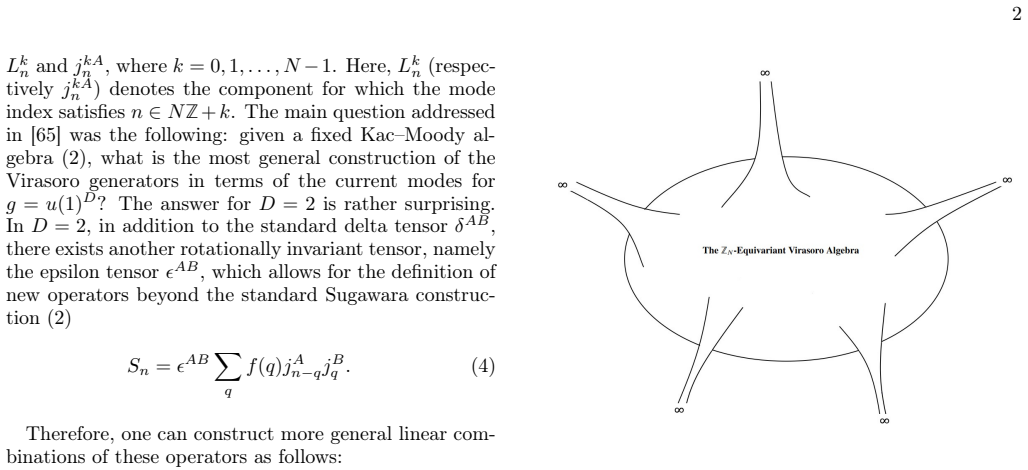
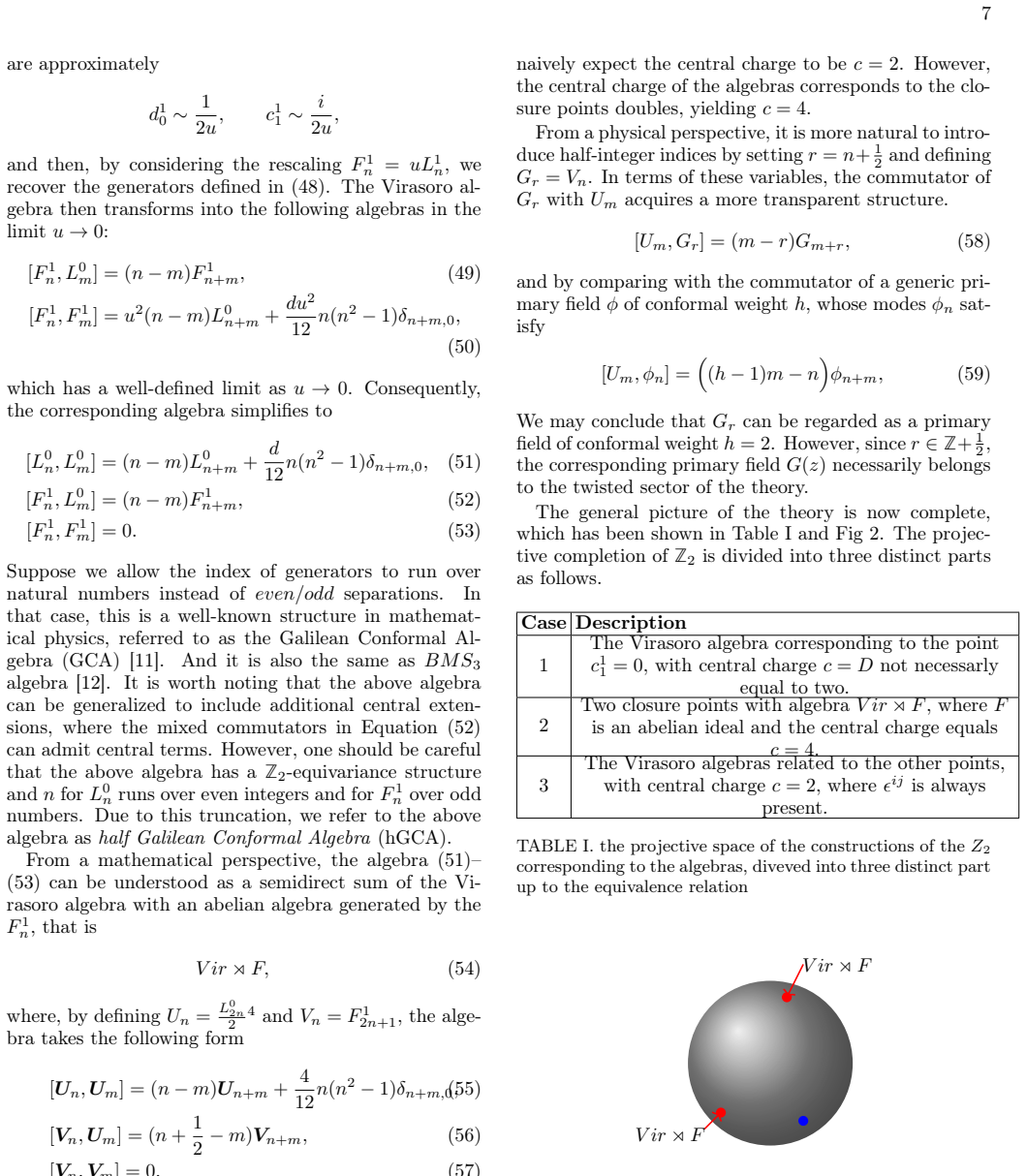
Compactification of the Z_N-graded Sugawara variety for u(1)^2 adds points at infinity that realize generalized BMS3 algebras as Vir ⋊ F with nilpotent F.
A machine-rendered reading of the paper's core claim, the machinery that carries it, and where it could break.
Core claim
The points at infinity in the algebraic variety of Z_N-graded Sugawara constructions for the u(1)^2 Kac-Moody algebra correspond precisely to generalizations of the BMS3 algebra, realized as Vir ⋊ F where F is a nilpotent ideal of depth r less than N for N greater than 2, with the depth equal to the order of the singularity at the point. The polynomials defining the varieties exhibit a factorization into linear factors that classifies all BMS3-like algebras. The central extensions of these algebras are consistent with primary fields of conformal weight h equals 2.
What carries the argument
Compactification of the non-compact algebraic variety of Z_N-graded Sugawara constructions by adding points at infinity, which map to the Vir ⋊ F structure with F a nilpotent ideal whose depth tracks the singularity order.
If this is right
- For N equals 2 the construction recovers the standard BMS3 algebra with F abelian.
- For N greater than 2 the ideal F is nonabelian and nilpotent of depth r less than N.
- The nilpotency depth r of F equals the order of the singularity of the variety at the corresponding point.
- The defining polynomials of the variety factor into linear factors, which would classify all BMS3-like algebras.
- The central extensions of the resulting algebras match the general structure expected for primary fields of weight h equals 2.
Where Pith is reading between the lines
- The depth-singularity link supplies a geometric origin for the nilpotency structure of the generalized BMS3 algebras.
- If the linear factorization holds for arbitrary N then every BMS3-like algebra arises from some point at infinity in these varieties.
- The same compactification method applied to other graded current algebras could generate further families of nilpotent extensions of the Virasoro algebra.
Load-bearing premise
The compactification procedure by adding points at infinity to the non-compact algebraic variety of Z_N-graded Sugawara constructions yields exactly the stated BMS3-like algebras without additional constraints or missing generators.
What would settle it
An explicit computation for N equals 3 that produces either an ideal F with depth not matching the singularity order or extra generators outside the Vir ⋊ F form would disprove the claimed correspondence.
Figures
read the original abstract
The Sugawara construction provides a natural way to construct the Virasoro algebra from a current algebra. It was shown in Ref.~\cite{Ghazi:2025oin} that for the $u(1)^2$ Kac-Moody current algebra, there exist additional constructions that exhibit a $\mathbb{Z}_N$-graded structure. Indeed, the space of such constructions defines a non-compact algebraic variety whose dimension depends on $N$. In this paper, we consider the compactification of these algebraic varieties by adding points at infinity to the non-compact part, and show that these points correspond precisely to generalizations of $BMS_3$-like algebras. More explicitly, for a $\mathbb{Z}_2$ grading, the corresponding algebra coincides with the $BMS_3$ algebra, which takes the form $\mathrm{Vir} \rtimes F$, where $F$ is an infinite abelian ideal of the full algebra. For $N > 2$, we show that there exist generalizations of the standard $BMS_3$ algebra of the form $\mathrm{Vir} \rtimes F$, where $F$ is a nonabelian ideal that forms a nilpotent algebra of depth $r < N$. We further demonstrate that the depth of the algebra is related to the order of the singularity of the algebraic variety at that point. We also show that the polynomials defining the algebraic varieties exhibit a factorization property into linear factors, which, if true, classifies all $BMS_3$-like algebras. Finally, we study the central extensions of these algebras, which are consistent with the general structure of algebras corresponding to primary fields of conformal weight $h = 2$.
Editorial analysis
A structured set of objections, weighed in public.
Referee Report
Summary. The manuscript claims that compactifying the non-compact algebraic varieties of Z_N-graded Sugawara constructions for the u(1)^2 Kac-Moody algebra by adding points at infinity produces generalizations of BMS_3 algebras. These take the form Vir ⋊ F, where F is an infinite abelian ideal for N=2 (recovering the standard BMS_3 algebra) and a nonabelian nilpotent ideal of depth r < N for N>2, with the depth tied to the order of the singularity at the point. The defining polynomials are asserted to factor into linear factors, which—if true—would classify all such BMS_3-like algebras. Central extensions are stated to be consistent with primary fields of conformal weight h=2.
Significance. If the claimed precise correspondence holds without extra constraints or missing generators, the work would link algebraic geometry of Sugawara varieties to the structure of BMS-like algebras, potentially offering a geometric origin for their nilpotency depth and a classification via polynomial factorization. This could be relevant for asymptotic symmetries in 3d gravity. The conditional phrasing of the factorization claim and absence of explicit limiting-current computations, however, leave the central correspondence unverified in the presented material.
major comments (3)
- [Abstract] Abstract (paragraph on compactification): the assertion that points at infinity 'correspond precisely' to Vir ⋊ F with the stated nonabelian nilpotency and depth r < N for N>2 is not supported by any explicit computation showing that the limiting currents satisfy exactly the original variety equations, recover all generators of F, and introduce no additional relations.
- [Abstract] Abstract (factorization sentence): the polynomials are said to 'exhibit a factorization property into linear factors, which, if true, classifies all BMS_3-like algebras'; the qualifier 'if true' indicates the classification is conjectural rather than demonstrated, making the claim load-bearing but unsupported.
- [Abstract] Abstract (N>2 case): no verification is given that the compactification procedure automatically produces the nonabelian structure and the precise relation between singularity order and nilpotency depth without further restrictions on the currents.
minor comments (1)
- [Abstract] The abstract refers to 'the explicit form Vir ⋊ F' without defining the semidirect product action or the explicit generators of F for general N.
Simulated Author's Rebuttal
We thank the referee for the careful reading and constructive comments on our manuscript. We agree that the abstract claims require stronger explicit support and will revise the paper to include the requested computations and clarifications. We address each major comment below.
read point-by-point responses
-
Referee: [Abstract] Abstract (paragraph on compactification): the assertion that points at infinity 'correspond precisely' to Vir ⋊ F with the stated nonabelian nilpotency and depth r < N for N>2 is not supported by any explicit computation showing that the limiting currents satisfy exactly the original variety equations, recover all generators of F, and introduce no additional relations.
Authors: We acknowledge that the abstract statement requires explicit verification. In the revised manuscript we will add a dedicated subsection containing explicit computations of the limiting currents for N>2. These calculations will confirm that the currents continue to satisfy the original variety equations, generate the complete set of generators for the ideal F, and introduce no extraneous relations, thereby substantiating the precise correspondence. revision: yes
-
Referee: [Abstract] Abstract (factorization sentence): the polynomials are said to 'exhibit a factorization property into linear factors, which, if true, classifies all BMS_3-like algebras'; the qualifier 'if true' indicates the classification is conjectural rather than demonstrated, making the claim load-bearing but unsupported.
Authors: The qualifier 'if true' was chosen precisely because the factorization is observed in all computed examples but lacks a general proof. We agree this renders the classification conjectural. In the revision we will rephrase the abstract to present the factorization as a conjecture supported by explicit examples, move the classification statement to a dedicated discussion section, and clearly label it as such. revision: yes
-
Referee: [Abstract] Abstract (N>2 case): no verification is given that the compactification procedure automatically produces the nonabelian structure and the precise relation between singularity order and nilpotency depth without further restrictions on the currents.
Authors: We will include in the revised version explicit examples together with a general argument showing that the compactification procedure yields the nonabelian nilpotent ideal with depth r fixed by the singularity order. These additions will demonstrate that the structure arises directly from the variety without imposing extra restrictions on the currents beyond the defining equations. revision: yes
Circularity Check
Minor self-citation to base varieties; compactification and singularity-depth claims are independent additions
specific steps
-
self citation load bearing
[Abstract]
"It was shown in Ref.~\cite{Ghazi:2025oin} that for the $u(1)^2$ Kac-Moody current algebra, there exist additional constructions that exhibit a $\mathbb{Z}_N$-graded structure. Indeed, the space of such constructions defines a non-compact algebraic variety whose dimension depends on $N$. In this paper, we consider the compactification of these algebraic varieties by adding points at infinity to the non-compact part, and show that these points correspond precisely to generalizations of $BMS_3$-like algebras."
The base variety is taken from self-citation, but the compactification step that produces the BMS_3-like algebras is presented as an independent construction; the citation is not load-bearing for the new identification or the depth-singularity relation.
full rationale
The derivation begins from the non-compact Z_N-graded varieties established in the cited prior work, then performs a new compactification by adding points at infinity and identifies the resulting algebras as Vir ⋊ F with the stated nilpotency and depth properties. The self-citation supplies only the starting algebraic variety; the correspondence, depth-singularity relation, and conditional factorization are developed as separate steps without reducing the new claims to the prior inputs by construction or redefinition. No fitted parameters are renamed as predictions, no uniqueness theorem is imported, and the central compactification argument remains self-contained against the external variety equations.
Axiom & Free-Parameter Ledger
axioms (2)
- domain assumption The space of Z_N-graded Sugawara constructions on u(1)^2 forms a non-compact algebraic variety whose dimension depends on N (from cited prior work).
- standard math Central extensions of the resulting algebras are consistent with primary fields of weight h=2 (standard in CFT).
Reference graph
Works this paper leans on
-
[1]
If we defined 1 0 = X Z andc 1 1 = Y Z, then the points corre- spond precisely to the limitZ→0
Factorization of the closure space The points at infinity have a simple feature. If we defined 1 0 = X Z andc 1 1 = Y Z, then the points corre- spond precisely to the limitZ→0. Geometrically, these are exactly the points that lie in the locusZ= 0in the projective completion with homogeneous coordinates [X:Y:Z]. In this regime, the defining relation (41) s...
-
[2]
In this instance, the structure of the solution space is richer, forming a four-dimensional surface
The Moduli Space of theZ 3-Case TheZ 3 case provides the next simplest example for ex- amining the factorization conjecture and comparing the corresponding space with that of theZ 2 case. In this instance, the structure of the solution space is richer, forming a four-dimensional surface. The constraints (30) determine the following relations betweenc k ω ...
-
[3]
= 1,(64) d1 1d2 1 −c 1 1c2 1 +e 4πi 3 d1 1d2 0 +e 2πi 3 d1 0d2 1 = 0,(65) e 2πi 3 d1 0c2 1 +e 4πi 3 d2 0c1 1 −(d 1 1c2 1 +c 1 1d2
-
[4]
However, we can use Equations (67)–(69) to expressd 2 0,d 2 1, andc 2 1 in terms ofd 1 0,d 1 1, andc 1
= 0(66) (d1 0)2 −e 2πi 3 (d1 1)2 + (c1 1)2 =d 2 0,(67) (d1 1)2 −(c 1 1)2 −e 2πi 3 d1 0d1 1 =d 2 1,(68) −e 2πi 3 d1 0c1 1 −2d 1 1c1 1 =c 2 1,(69) (d2 0)2 −e 4πi 3 (d2 1)2 + (c2 1)2 =d 1 0,(70) −e 4πi 3 d2 0d2 1 + (d2 1)2 −(c 2 1)2 =d 1 1,(71) −e 4πi 3 d2 0c2 1 −2d 2 1c2 1 =c 1 1,(72) (d1 0d2 1 +d 1 1d2 0)(e 4πi 3 −1) + (d 1 1d2 1 −c 1 1c2 1)(e 2πi 3 −e 4πi...
-
[5]
Eliminatingd 2 0,d 2 1, andc 2 1 from the equations then yields the following simplified system: x3 + 2w3 −3ωx(w 2 +y 2)−6wy 2 = 1,(75) Here,ω≡e 2πi 3
To simplify the notation, let us defined1 0 ≡x,d 1 1 ≡w, and c1 1 ≡y. Eliminatingd 2 0,d 2 1, andc 2 1 from the equations then yields the following simplified system: x3 + 2w3 −3ωx(w 2 +y 2)−6wy 2 = 1,(75) Here,ω≡e 2πi 3 . Theaboveequationisanalogoustoequa- tion (41) in theZ2 case. As in the caseZ2, let us define x= X Z,w= W Z andy= Y Z, then the projecti...
-
[6]
Factorization of the closure space The space of solutions to the equation (75) has closure components, which can be identified in the limitZ→0, as follows F(X, W, Y, Z= 0) =X 3 + 2W 3 −3ωX(W 2 +Y 2)−6W Y 2 = (ωX+ 2W)(ωX−W+ √ 3Y)(ωX−W− √ 3Y) = 0, (77) which are the union of threeCP1 inCP 2 [X, W, Y, Z= 0] which is in agreement to the factorization conjectu...
-
[7]
Algebras correspond to the first order singular points A generic pointpof the closure space (77) typically lies on one of the threeCP 1 components, with a first-order vanishing,ord(p) =r= 1. Therefore, if the conjecture of the emergence of nilpotent algebras holds, the cor- responding algebras associated with these points should take the formV ir×F, where...
-
[8]
The corresponding intersection points are pre- cisely given by (81)–(83)
Algebras Correspond to the Singular Points As mentioned earlier, the closure space of theZ3 case in (77) consists of threeCP1 components that intersect pairwise. The corresponding intersection points are pre- cisely given by (81)–(83). Therefore, it is very interest- ing to explore the nature of the closure algebra related to these points for examining th...
-
[9]
However, they can all be reduced to a single independent equation
Factorization of the Closure Space The number of equations in theZ4 case is quite large and is presented in Appendix A. However, they can all be reduced to a single independent equation. The con- straints (30) imply that the coefficients are not indepen- dent, leading to the following relations: d1 3 =id 1 1, d 1 2 = 0, d 2 3 =−d 2 1, d 3 3 =−id 3 1, d 3 ...
-
[10]
Belavin, A
A. Belavin, A. Polyakov, and A. Zamolodchikov, Nuclear Physics B241, 333 (1984)
1984
-
[11]
P.DiFrancesco, P.Mathieu, andD.Senechal,Conformal Field Theory, Graduate Texts in Contemporary Physics (Springer-Verlag, New York, 1997)
1997
-
[12]
Applied Conformal Field Theory
P. Ginsparg, “Applied conformal field theory,” (1988), arXiv:hep-th/9108028 [hep-th]
work page internal anchor Pith review Pith/arXiv arXiv 1988
-
[13]
Polchinski,String theory
J. Polchinski,String theory. Vol. 1: An introduction to 18 the bosonic string, Cambridge Monographs on Mathe- matical Physics (Cambridge University Press, 2007)
2007
-
[14]
Becker, M
K. Becker, M. Becker, and J. H. Schwarz,String The- ory and M-Theory: A Modern Introduction(Cambridge University Press, 2006)
2006
-
[15]
Blumenhagen, D
R. Blumenhagen, D. Lüst, and S. Theisen,Basic con- cepts of string theory, Theoretical and Mathematical Physics (Springer, Heidelberg, Germany, 2013)
2013
-
[16]
Blumenhagen and E
R. Blumenhagen and E. Plauschinn,Introduction to con- formal field theory: with applications to String theory, Vol. 779 (2009)
2009
-
[17]
J. L. Cardy, Nuclear Physics B270, 186 (1986)
1986
-
[18]
J. D. Brown and M. Henneaux, Communications in Mathematical Physics104, 207 (1986)
1986
-
[19]
Bagchi and R
A. Bagchi and R. Gopakumar, Journal of High Energy Physics2009, 037–037 (2009)
2009
-
[20]
Classical central extension for asymptotic symmetries at null infinity in three spacetime dimensions
G. Barnich and G. Compere, Class. Quant. Grav.24, F15 (2007), arXiv:gr-qc/0610130
work page internal anchor Pith review Pith/arXiv arXiv 2007
-
[21]
Serre,Lie Algebras and Lie Groups: 1964 Lectures Given at Harvard University, Lecture Notes in Mathe- matics No
J. Serre,Lie Algebras and Lie Groups: 1964 Lectures Given at Harvard University, Lecture Notes in Mathe- matics No. no. 1500 (Springer, 1992)
1964
-
[22]
Meurant,Introduction to Lie groups and Lie algebras, Pure and Applied Mathematics (Elsevier Science, 1973)
G. Meurant,Introduction to Lie groups and Lie algebras, Pure and Applied Mathematics (Elsevier Science, 1973)
1973
-
[23]
Conformal Field Theory and Statistical Mechanics
J. Cardy, “Conformal field theory and statistical mechan- ics,” (2008), arXiv:0807.3472 [cond-mat.stat-mech]
work page internal anchor Pith review Pith/arXiv arXiv 2008
-
[24]
Lectures on the Quantum Hall Effect
D. Tong, “Lectures on the quantum hall effect,” (2016), arXiv:1606.06687 [hep-th]
work page internal anchor Pith review Pith/arXiv arXiv 2016
-
[25]
Fradkin,Quantum Field Theory: An Integrated Ap- proach(Princeton University Press, 2021)
E. Fradkin,Quantum Field Theory: An Integrated Ap- proach(Princeton University Press, 2021)
2021
-
[26]
Moore and N
G. Moore and N. Read, Nuclear Physics B360, 362 (1991)
1991
-
[27]
R. E. Borcherds, Proceedings of the Na- tional Academy of Sciences83, 3068 (1986), https://www.pnas.org/doi/pdf/10.1073/pnas.83.10.3068
-
[28]
Lepowsky and R
J. Lepowsky and R. L. Wilson, Commun. Math. Phys. 62, 43 (1978)
1978
-
[29]
Witten, Commun
E. Witten, Commun. Math. Phys.121, 351 (1989)
1989
-
[30]
R. E. Borcherds, “Quantum vertex algebras,” (1999), arXiv:math/9903038 [math.QA]
work page internal anchor Pith review Pith/arXiv arXiv 1999
-
[31]
I.Frenkel, J.Lepowsky, andA.Meurman,VERTEX OP- ERATOR ALGEBRAS AND THE MONSTER(1988)
1988
-
[32]
I. B. Frenkel and Y. Zhu, Communications in Mathemat- ical Physics (1992)
1992
-
[33]
I. B. Frenkel and V. G. Kac, Invent. Math.62, 23 (1980)
1980
-
[34]
Goddard, A
P. Goddard, A. Kent, and D. I. Olive, Commun. Math. Phys.103, 105 (1986)
1986
-
[35]
R. V. Moody, Journal of Algebra10, 211 (1968)
1968
-
[36]
Kac,Infinite-Dimensional Lie Algebras, Progress in mathematics (Cambridge University Press, 1990)
V. Kac,Infinite-Dimensional Lie Algebras, Progress in mathematics (Cambridge University Press, 1990)
1990
-
[37]
Verlinde, Nuclear Physics B300, 360 (1988)
E. Verlinde, Nuclear Physics B300, 360 (1988)
1988
-
[38]
G.W.MooreandN.Seiberg,Commun.Math.Phys.123, 177 (1989)
1989
-
[39]
Goddard and D
P. Goddard and D. I. Olive, Int. J. Mod. Phys. A1, 303 (1986)
1986
-
[40]
G. W. Moore and N. Seiberg, Phys. Lett. B220, 422 (1989)
1989
-
[41]
Lectures on the Langlands Program and Conformal Field Theory
E. Frenkel, “Lectures on the langlands program and con- formal field theory,” (2005), arXiv:hep-th/0512172 [hep- th]
work page internal anchor Pith review Pith/arXiv arXiv 2005
-
[42]
Witten, Commun
E. Witten, Commun. Math. Phys.92, 455 (1984)
1984
-
[43]
Gepner and E
D. Gepner and E. Witten, Nuclear Physics B278, 493 (1986)
1986
-
[44]
Sugawara, Phys
H. Sugawara, Phys. Rev.170, 1659 (1968)
1968
-
[45]
A. M. Polyakov, JETP Lett.12, 381 (1970)
1970
-
[46]
Friedan, Z
D. Friedan, Z. Qiu, and S. Shenker, Phys. Rev. Lett.52, 1575 (1984)
1984
-
[47]
V. G. Knizhnik and A. B. Zamolodchikov, Nucl. Phys. B 247, 83 (1984)
1984
-
[48]
V. G. Kac and A. K. Raina,Bombay Lectures on Highest Weight Representations of Infinite Dimensional Lie Al- gebras, Advanced Series in Mathematical Physics, Vol. 2 (World Scientific, Singapore, 1987) p. 145
1987
-
[49]
B. L. Feigin and D. B. Fuchs, Functional Analysis and Its Applications16, 114 (1982)
1982
-
[50]
V. A. Fateev and A. B. Zamolodchikov, Sov. Phys. JETP 62, 215 (1985)
1985
-
[51]
L. J. Dixon, J. A. Harvey, C. Vafa, and E. Witten, Nucl. Phys. B261, 678 (1985)
1985
-
[52]
L. J. Dixon, D. Friedan, E. J. Martinec, and S. H. Shenker, Nuclear Physics B282, 13 (1987)
1987
-
[53]
Dijkgraaf, C
R. Dijkgraaf, C. Vafa, E. Verlinde, and H. Ver- linde, Communications in Mathematical Physics123, 485 (1989)
1989
-
[54]
Kontsevich, Letters in Mathematical Physics66, 157–216 (2003)
M. Kontsevich, Letters in Mathematical Physics66, 157–216 (2003)
2003
-
[55]
J. E. Moyal, Proc. Cambridge Phil. Soc.45, 99 (1949)
1949
-
[56]
H. J. Groenewold, Physica12, 405 (1946)
1946
-
[57]
J. M. Figueroa-O’Farrill, J. Math. Phys.30, 2735 (1989)
1989
-
[58]
Levy-Nahas, Journal of Mathematical Physics8, 1211 (1967)
M. Levy-Nahas, Journal of Mathematical Physics8, 1211 (1967)
1967
-
[59]
S.Majid,JournalofMathematicalPhysics41,3892–3942 (2000)
2000
-
[60]
Arzano and J
M. Arzano and J. Kowalski-Glikman,Deformations of Spacetime Symmetries: Gravity, Group-Valued Mo- menta, and Non-Commutative Fields, Lecture Notes in Physics, Vol. 986 (2021)
2021
-
[61]
Moshayedi, Lect
N. Moshayedi, Lect. Notes Math.2311, pp. (2022)
2022
-
[62]
Curtright, D
T. Curtright, D. Fairlie, and C. Zachos,A Concise Trea- tise On Quantum Mechanics In Phase Space(World Sci- entific Publishing Company, 2013)
2013
-
[63]
Itzykson and J
C. Itzykson and J. M. Drouffe,STATISTICAL FIELD THEORY. VOL. 2: STRONG COUPLING, MONTE CARLO METHODS, CONFORMAL FIELD THEORY, AND RANDOM SYSTEMS, Cambridge Monographs on Mathematical Physics (CUP, 1989)
1989
-
[64]
M. B. Halpern and E. Kiritsis, Mod. Phys. Lett. A4, 1373 (1989)
1989
-
[65]
Halpern and J
M. Halpern and J. P. Yamron, Nuclear Physics B351, 333 (1991)
1991
-
[66]
Halpern and J
M. Halpern and J. P. Yamron, Nuclear Physics B332, 411 (1990)
1990
-
[67]
M. B. Halpern, E. Kiritsis, N. A. Obers, M. Porrati, and J. P. Yamron, Int. J. Mod. Phys. A5, 2275 (1990)
1990
-
[68]
de Boer and M
J. de Boer and M. B. Halpern, International Journal of Modern Physics A12, 1551–1605 (1997)
1997
-
[69]
A. Y. MOROZOV, A. PERELOMOV, A. ROSLY, M. SHIFMAN, and A. TURBINER, International Jour- nal of Modern Physics A05, 803 (1990)
1990
-
[70]
Zumino, J
B. Zumino, J. Math. Phys.3, 1055 (1962)
1962
-
[71]
H. G. Becker, Lett. Nuovo Cim., v. 8, no. 3, pp. 185-188 (1973), 10.1007/BF02906230
-
[72]
Greub,Linear Algebra, Graduate Texts in Mathe- matics (Springer New York, 2012)
W. Greub,Linear Algebra, Graduate Texts in Mathe- matics (Springer New York, 2012)
2012
-
[73]
Thezn equivariant vi- rasoro algebra via alternative sugawara constructions,
A. Ghazi and A. Moradpouri, “Thezn equivariant vi- rasoro algebra via alternative sugawara constructions,” (2025), arXiv:2512.00588 [hep-th]
-
[74]
Schottenloher, ed.,A mathematical introduction to 19 conformal field theory, Vol
M. Schottenloher, ed.,A mathematical introduction to 19 conformal field theory, Vol. 759 (2008)
2008
-
[75]
Bauer and D
M. Bauer and D. Bernard, Physics Reports432, 115–221 (2006)
2006
-
[76]
Entanglement entropy and quantum field theory: a non-technical introduction
P. Calabrese and J. Cardy, “Entanglement entropy and quantum field theory: a non-technical introduction,” (2005), arXiv:quant-ph/0505193 [quant-ph]
work page internal anchor Pith review Pith/arXiv arXiv 2005
-
[77]
Cardy, Annals of Physics318, 81–118 (2005)
J. Cardy, Annals of Physics318, 81–118 (2005)
2005
-
[78]
Felder, J
G. Felder, J. Frohlich, and G. Keller, Commun. Math. Phys.124, 417 (1989)
1989
-
[79]
V. G. Kac and D. A. Kazhdan, Adv. Math.34, 97 (1979)
1979
-
[80]
Friedan and S
D. Friedan and S. H. Shenker, Nucl. Phys. B281, 509 (1987)
1987
discussion (0)
Sign in with ORCID, Apple, or X to comment. Anyone can read and Pith papers without signing in.