Covering the Unseen: Information Demand Coverage Optimization for Retrieval-Augmented Generation
Pith reviewed 2026-06-30 02:27 UTC · model grok-4.3
The pith
GeoRAG recasts RAG context selection as minimizing the Sinkhorn-Wasserstein distance between a multi-dimensional information demand distribution and the coverage provided by selected passages.
A machine-rendered reading of the paper's core claim, the machinery that carries it, and where it could break.
Core claim
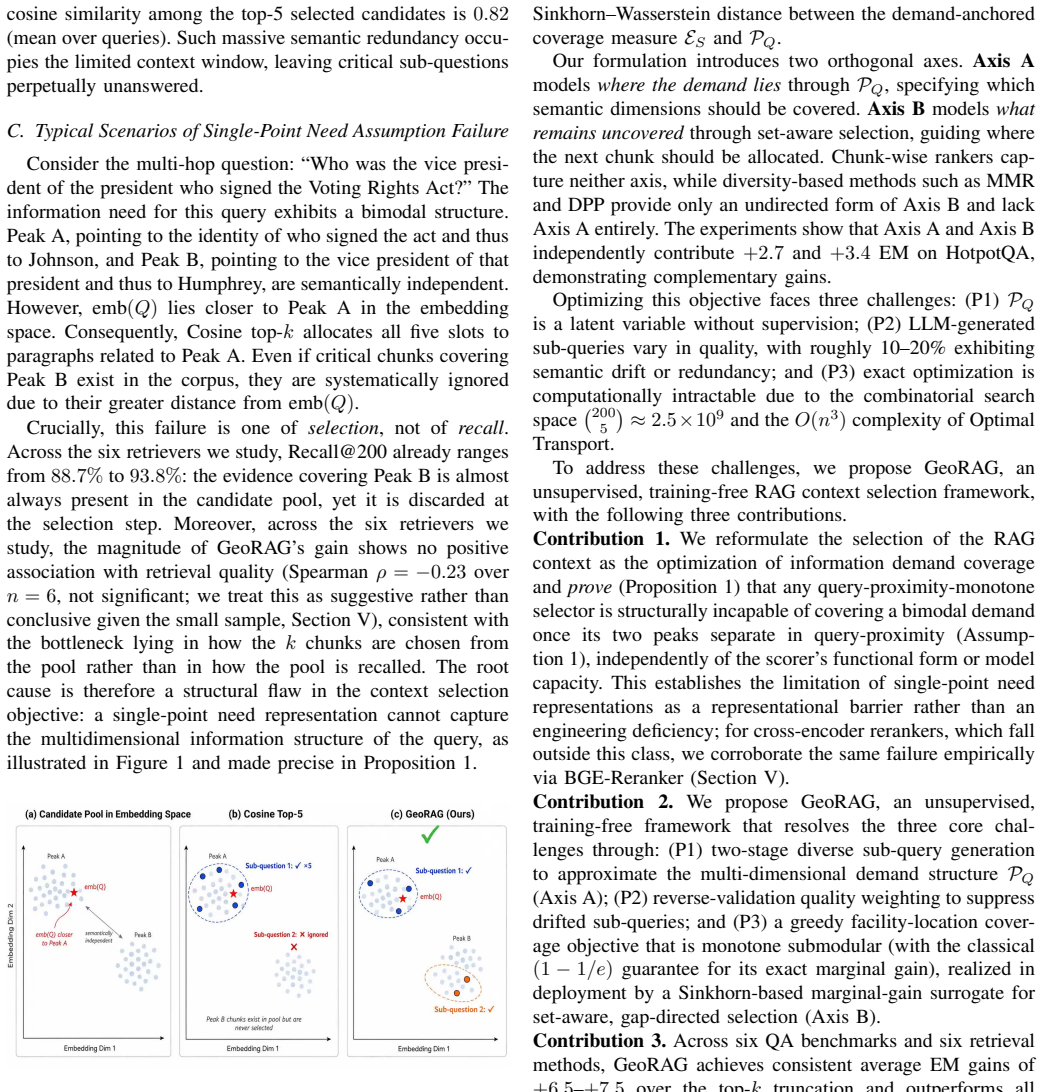
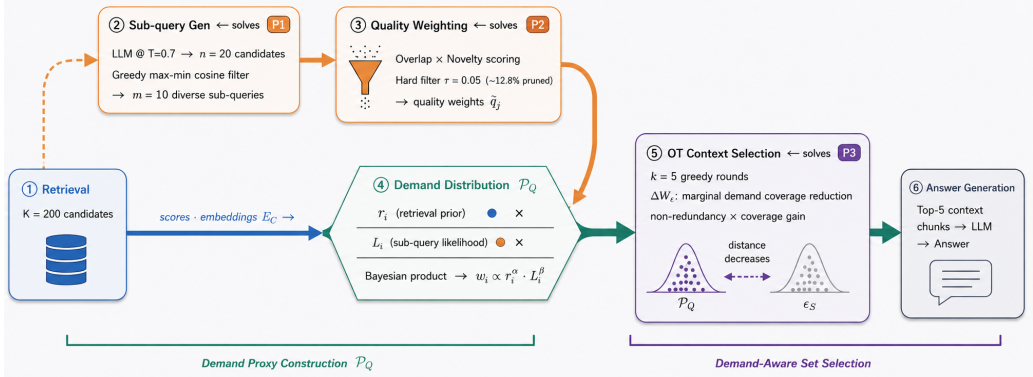
The central discovery is that context selection in retrieval-augmented generation can be formulated as an Information Demand Coverage Optimization problem. By building a demand distribution through sub-query generation and reverse-validation, then minimizing the Sinkhorn-Wasserstein distance to the coverage of the selected set, the method achieves superior performance. The objective is monotone submodular, admitting a greedy approximation with 1-1/e guarantee, and it is shown that single-point query-proximity scorers structurally cannot cover multi-modal demands.
What carries the argument
The demand-weighted facility-location objective minimized via Sinkhorn-Wasserstein distance between the constructed multi-dimensional demand distribution and the selected set's coverage.
If this is right
- The selected context covers multiple semantic aspects of complex queries more effectively than top-k truncation.
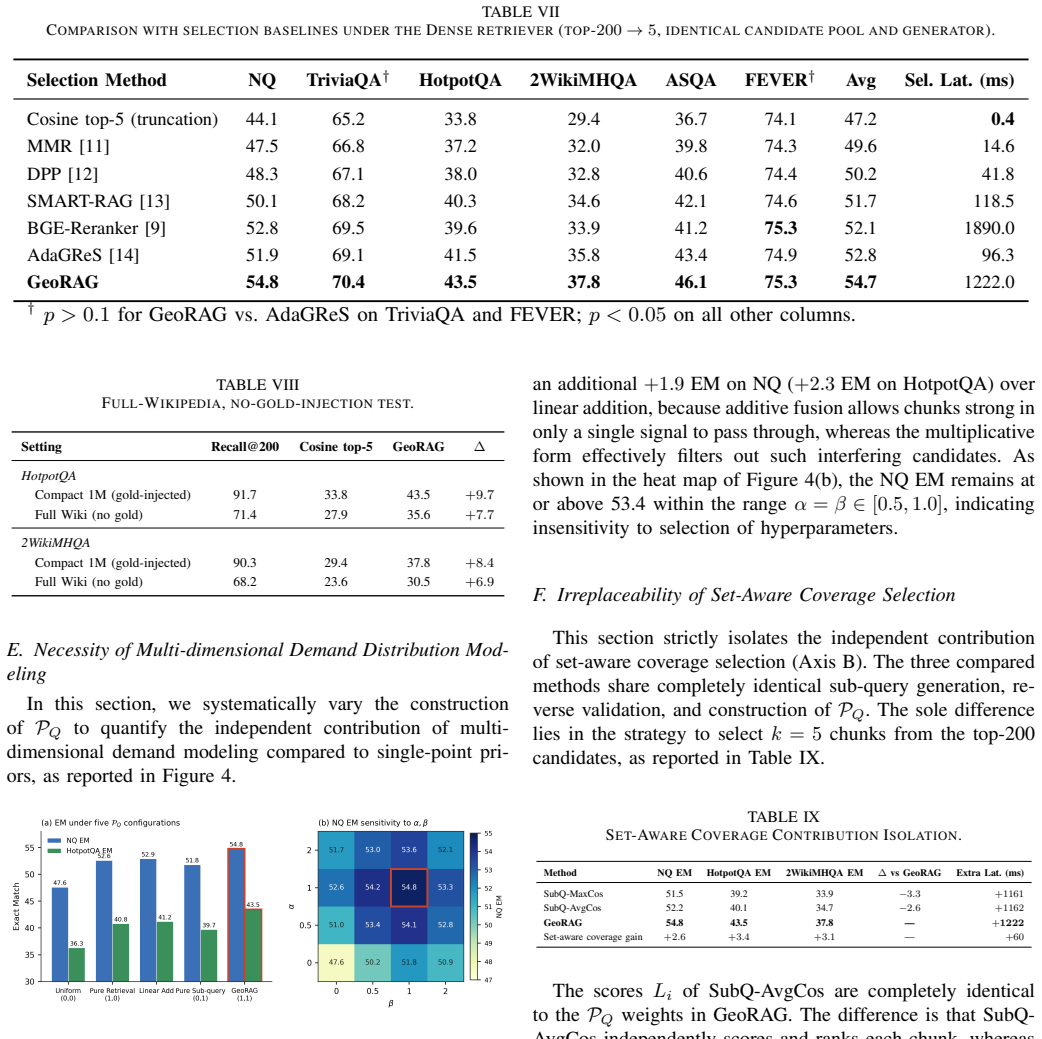
- Performance gains of 6.5 to 7.5 exact match points hold across six benchmarks and various context budgets.
- The approach remains effective without any training and works with different sub-query generators.
- Single-point scorers are provably insufficient for multi-modal information demands.
- The submodular structure allows efficient greedy selection with theoretical guarantees.
Where Pith is reading between the lines
- This formulation might extend to other retrieval settings where queries have latent sub-aspects, such as in recommendation systems.
- Improving the accuracy of the demand distribution construction could further amplify the gains from the coverage optimization.
- Future work could test whether the method scales to very long contexts or real-time applications.
- Comparing the demand distribution to human-annotated sub-questions would validate its fidelity.
Load-bearing premise
The multi-dimensional demand distribution built from sub-queries and reverse-validation accurately represents the true information needs of the query.
What would settle it
An experiment that replaces the learned demand distribution with a deliberately incorrect one (for example, sub-queries that ignore key aspects) and shows that the optimization no longer improves over top-k selection.
Figures


read the original abstract
Retrieval-augmented generation (RAG) typically treats context selection as ranking chunks against a single query embedding. This assumption breaks down for complex queries, such as multi-hop or ambiguous questions, where top-k selection tends to over-cover one semantic aspect while ignoring critical sub-questions. We propose GeoRAG, which recasts context selection as Information Demand Coverage Optimization. GeoRAG builds a multi-dimensional demand distribution through diverse sub-query generation and reverse-validation weighting, then selects context by minimizing the Sinkhorn-Wasserstein distance between this demand distribution and the coverage of the selected set. The resulting demand-weighted facility-location objective is monotone submodular, giving a $1-1/e$ greedy guarantee, which we approximate with a Sinkhorn-based marginal-gain surrogate. The method is unsupervised, training-free, and retrieval-agnostic. We further show that single-point, query-proximity scorers cannot cover multi-modal demands, exposing a structural limit of ranking-based selection. On six open-domain QA benchmarks, GeoRAG improves exact match (EM) by +6.5 to +7.5 points over top-k truncation (up to +9.7 on HotpotQA and ASQA) and outperforms strong baselines including MMR, DPP, BGE-Reranker, SMART-RAG, and AdaGReS, with stable gains across context budgets and sub-query generators.
Editorial analysis
A structured set of objections, weighed in public.
Referee Report
Summary. The paper proposes GeoRAG, which recasts RAG context selection for complex queries as Information Demand Coverage Optimization. It constructs a multi-dimensional demand distribution from diverse sub-query generation with reverse-validation weighting, then selects contexts to minimize the Sinkhorn-Wasserstein distance to the coverage of the selected set. The resulting demand-weighted facility-location objective is shown to be monotone submodular (yielding a 1-1/e greedy guarantee), which is approximated via a Sinkhorn marginal-gain surrogate. The method is unsupervised and retrieval-agnostic. On six open-domain QA benchmarks, it reports EM gains of +6.5 to +7.5 over top-k (up to +9.7 on HotpotQA/ASQA) and outperforms baselines such as MMR, DPP, BGE-Reranker, SMART-RAG, and AdaGReS, with stable performance across context budgets.
Significance. If the demand distribution faithfully captures information needs, the work supplies a principled, submodular formulation that directly addresses the structural limitation of single-embedding ranking for multi-aspect queries, together with an explicit 1-1/e guarantee derived from facility-location theory. The unsupervised, training-free character and retrieval-agnostic design are practical strengths. The reported empirical gains, if robust, would constitute a meaningful advance for complex-query RAG.
major comments (3)
- [§3] §3 (Demand Distribution Construction): The multi-dimensional demand distribution is built from sub-query generation and reverse-validation weighting, yet the manuscript provides no validation (human coverage judgments, oracle comparison, or sensitivity analysis) that this distribution aligns with ground-truth information needs. This is load-bearing for the central claim, because the Sinkhorn-Wasserstein minimization optimizes coverage of the constructed distribution; if it is mis-specified, the observed EM gains could be artifacts of the sub-query generator rather than the coverage optimization.
- [Experimental Results] Experimental Results (Tables reporting EM scores): Concrete EM improvements of +6.5 to +7.5 are stated without error bars, statistical significance tests, or ablations isolating the reverse-validation weighting. This gap prevents attribution of gains specifically to the proposed objective and undermines assessment of robustness across the six benchmarks.
- [§3.3] §3.3 (Sinkhorn marginal-gain surrogate): The approximation of the true submodular marginal gains by the Sinkhorn-Wasserstein surrogate is described at a high level but lacks both implementation details and any analysis of approximation error relative to the exact facility-location objective. This directly affects the practical meaning of the claimed 1-1/e guarantee.
minor comments (2)
- [§2] Notation for the demand distribution P and coverage measure could be introduced with an explicit preliminary definition before the optimization objective is stated.
- [Figures] Figure captions for the demand-coverage diagrams should explicitly label the axes and the role of the Sinkhorn distance.
Simulated Author's Rebuttal
We thank the referee for the constructive feedback. We address each major comment below, agreeing where revisions are warranted and providing the strongest honest defense of the current manuscript.
read point-by-point responses
-
Referee: [§3] §3 (Demand Distribution Construction): The multi-dimensional demand distribution is built from sub-query generation and reverse-validation weighting, yet the manuscript provides no validation (human coverage judgments, oracle comparison, or sensitivity analysis) that this distribution aligns with ground-truth information needs. This is load-bearing for the central claim, because the Sinkhorn-Wasserstein minimization optimizes coverage of the constructed distribution; if it is mis-specified, the observed EM gains could be artifacts of the sub-query generator rather than the coverage optimization.
Authors: We agree that explicit validation of the demand distribution would strengthen the central claim. The manuscript is unsupervised and does not include human coverage judgments or oracle comparisons. However, the consistent EM gains across six benchmarks and multiple sub-query generators provide indirect support that the distribution captures relevant needs; we will add a sensitivity analysis to the revised version to quantify robustness to generator choice and weighting parameters. revision: yes
-
Referee: [Experimental Results] Experimental Results (Tables reporting EM scores): Concrete EM improvements of +6.5 to +7.5 are stated without error bars, statistical significance tests, or ablations isolating the reverse-validation weighting. This gap prevents attribution of gains specifically to the proposed objective and undermines assessment of robustness across the six benchmarks.
Authors: We acknowledge that error bars, significance tests, and targeted ablations are needed for rigorous attribution. The reported gains are point estimates from single runs in the current version. We will add error bars from multiple runs, paired statistical tests, and an ablation isolating reverse-validation weighting in the revised manuscript. revision: yes
-
Referee: [§3.3] §3.3 (Sinkhorn marginal-gain surrogate): The approximation of the true submodular marginal gains by the Sinkhorn-Wasserstein surrogate is described at a high level but lacks both implementation details and any analysis of approximation error relative to the exact facility-location objective. This directly affects the practical meaning of the claimed 1-1/e guarantee.
Authors: Section 3.3 presents the Sinkhorn surrogate at a conceptual level. We will expand it with pseudocode, hyperparameter settings, and an analysis of approximation quality (empirical error on small instances plus discussion of how the guarantee is preserved under the surrogate) in the revised version. revision: yes
Circularity Check
Derivation self-contained with no circular reductions
full rationale
The paper defines the demand distribution via an explicit external procedure (diverse sub-query generation plus reverse-validation weighting) and minimizes a standard Sinkhorn-Wasserstein distance whose submodularity follows from facility-location theory cited as prior mathematics rather than from any quantity fitted inside the paper. No step renames a fitted parameter as a prediction, imports a uniqueness result from the authors' own prior work, or reduces the central objective to a self-definition. The reported EM gains are measured on external benchmarks and therefore remain falsifiable outside the construction itself.
Axiom & Free-Parameter Ledger
axioms (2)
- domain assumption The demand distribution obtained from sub-query generation plus reverse-validation weighting is a faithful representation of query information needs.
- standard math The demand-weighted facility-location objective is monotone submodular.
invented entities (1)
-
Information Demand Coverage Optimization
no independent evidence
Reference graph
Works this paper leans on
-
[1]
Retrieval-augmented generation for knowledge-intensive NLP tasks
P. Lewis, E. Perez, A. Piktus, F. Petroni, V . Karpukhin, N. Goyal, H. K¨uttler, M. Lewis, W.-T. Yih, T. Rockt¨aschel, S. Riedel, and D. Kiela. “Retrieval-augmented generation for knowledge-intensive NLP tasks.” in Advances in Neural Information Processing Systems (NeurIPS), vol. 33, 2020, pp. 9459–9474
2020
-
[2]
Dense passage retrieval for open-domain question an- swering,
V . Karpukhin, B. O ˘guz, S. Min, P. Lewis, L. Wu, S. Edunov, D. Chen, and W.-T. Yih, “Dense passage retrieval for open-domain question an- swering,” inProceedings of the 2020 Conference on Empirical Methods in Natural Language Processing (EMNLP), 2020, pp. 6769–6781
2020
-
[3]
Approximate nearest neighbor negative contrastive learning for dense text retrieval,
L. Xiong, C. Xiong, Y . Li, K.-F. Tang, J. Liu, P. N. Bennett, J. Ahmed, and A. Overwijk, “Approximate nearest neighbor negative contrastive learning for dense text retrieval,” inInternational Conference on Learn- ing Representations (ICLR), 2021
2021
-
[4]
Milvus: A purpose-built vector data management system,
J. Wang, X. Yi, R. Guo, H. Jin, P. Xu, S. Li, X. Wang, X. Guo, C. Li, X. Xu, K. Yu, Y . Yuan, Y . Zou, J. Long, Y . Cai, Z. Li, Z. Zhang, Y . Mo, J. Gu, R. Jiang, Y . Wei, and C. Xie, “Milvus: A purpose-built vector data management system,” inProceedings of the 2021 ACM SIGMOD International Conference on Management of Data (SIGMOD), 2021, pp. 2614–2627
2021
-
[5]
Survey of vector database management systems,
J. J. Pan, J. Wang, and G. Li, “Survey of vector database management systems,”The VLDB Journal, vol. 33, no. 5, pp. 1591–1615, 2024
2024
-
[6]
SeRF: Segment graph for range-filtering approximate nearest neighbor search,
C. Zuo, M. Qiao, W. Zhou, F. Li, and D. Deng, “SeRF: Segment graph for range-filtering approximate nearest neighbor search,”Proceedings of the ACM on Management of Data (SIGMOD), vol. 2, no. 1, art. 69, 2024
2024
-
[7]
Cracking vector search indexes,
V . Mageirakos, B. Wu, and G. Alonso, “Cracking vector search indexes,” Proceedings of the VLDB Endowment (PVLDB), vol. 18, no. 11, pp. 3951–3964, 2025
2025
-
[8]
VDTuner: Automated performance tuning for vector data management systems,
T. Yang, W. Hu, W. Peng, Y . Li, J. Li, G. Wang, and X. Liu, “VDTuner: Automated performance tuning for vector data management systems,” inProceedings of the 40th IEEE International Conference on Data Engineering (ICDE), 2024, pp. 4357–4369
2024
-
[9]
C-Pack: Packed Resources For General Chinese Embeddings
S. Xiao, Z. Liu, P. Zhang, and N. Muennighoff, “C-Pack: Packaged resources to advance general Chinese embedding,”arXiv preprint arXiv:2309.07597, 2023
work page internal anchor Pith review Pith/arXiv arXiv 2023
-
[10]
RankRAG: Unifying context ranking with retrieval- augmented generation in LLMs,
Y . Yu, W. Ping, Z. Liu, B. Wang, J. You, C. Zhang, M. Shoeybi, and B. Catanzaro, “RankRAG: Unifying context ranking with retrieval- augmented generation in LLMs,” inAdvances in Neural Information Processing Systems (NeurIPS), 2024
2024
-
[11]
The use of MMR, diversity-based rerank- ing for reordering documents and producing summaries,
J. Carbonell and J. Goldstein, “The use of MMR, diversity-based rerank- ing for reordering documents and producing summaries,” inProceedings of the 21st Annual International ACM SIGIR Conference on Research and Development in Information Retrieval (SIGIR), 1998, pp. 335–336
1998
-
[12]
Determinantal point processes for machine learning,
A. Kulesza and B. Taskar, “Determinantal point processes for machine learning,”Foundations and Trends in Machine Learning, vol. 5, no. 2–3, pp. 123–286, 2012
2012
-
[13]
Smart-rag: Selection using determinantal matrices for augmented retrieval
J. Gao, L. Li, W. Li, Y . Fu, and B. Dai, “SMART-RAG: Selection using determinantal matrices for augmented retrieval,”arXiv preprint arXiv:2409.13992, 2024
-
[14]
C. Peng, B. Wang, Z. Long, and J. Sheng, “AdaGReS: Adaptive greedy context selection via redundancy-aware scoring for token-budgeted RAG,”arXiv preprint arXiv:2512.25052, 2025
-
[15]
InfoGain-RAG: Boosting retrieval-augmented generation through document information gain-based reranking and filtering,
Z. Wang, Z. Liang, Z. Shao, Y . Ma, H. Dai, B. Chen, L. Mao, C. Lei, Y . Ding, and H. Li, “InfoGain-RAG: Boosting retrieval-augmented generation through document information gain-based reranking and filtering,” inProceedings of the 2025 Conference on Empirical Methods in Natural Language Processing (EMNLP), 2025
2025
-
[16]
Search result diversification,
M. Drosou and E. Pitoura, “Search result diversification,”ACM SIGMOD Record, vol. 39, no. 1, pp. 41–47, 2010
2010
-
[17]
On query result diversifi- cation,
M. R. Vieira, H. L. Razente, M. C. N. Barioni, M. Hadjieleftheriou, D. Srivastava, C. Traina, and V . J. Tsotras, “On query result diversifi- cation,” inProceedings of the 27th IEEE International Conference on Data Engineering (ICDE), 2011, pp. 1163–1174
2011
-
[18]
Diversifying top-kresults,
L. Qin, J. X. Yu, and L. Chang, “Diversifying top-kresults,”Proceedings of the VLDB Endowment (PVLDB), vol. 5, no. 11, pp. 1124–1135, 2012
2012
-
[19]
Scaling DPPs for RAG: Density Meets Diversity
X. Sun, B. Xie, L. Huang, and Q. Gao, “Scaling DPPs for RAG: Density meets diversity,”arXiv preprint arXiv:2604.03240, 2026
work page internal anchor Pith review Pith/arXiv arXiv 2026
-
[20]
Precise zero-shot dense retrieval without relevance labels,
L. Gao, X. Ma, J. Lin, and J. Callan, “Precise zero-shot dense retrieval without relevance labels,” inProceedings of the 61st Annual Meeting of the Association for Computational Linguistics (ACL), 2023, pp. 1762– 1777
2023
-
[21]
Multi-query retrieval,
LangChain, “Multi-query retrieval,” https://python.langchain.com/docs/ how to/MultiQueryRetriever/, 2023
2023
-
[22]
Rag-fusion: a new take on retrieval-augmented generation.arXiv preprint arXiv:2402.03367, 2024
A. H. Raudaschl, “RAG-Fusion: A new take on retrieval-augmented generation,”arXiv preprint arXiv:2402.03367, 2024
-
[23]
OptiSet: Unified Optimizing Set Selection and Ranking for Retrieval-Augmented Generation,
Y . Jiang, S. Zhao, J. Li, B. Hu, Y . Du, H. Wang, and B. Qin, “OptiSet: Unified Optimizing Set Selection and Ranking for Retrieval-Augmented Generation,”arXiv preprint arXiv:2601.05027, 2026
-
[24]
From word embeddings to document distances,
M. J. Kusner, Y . Sun, N. I. Kolkin, and K. Q. Weinberger, “From word embeddings to document distances,” inProceedings of the 32nd International Conference on Machine Learning (ICML), vol. 37, 2015, pp. 957–966
2015
-
[25]
Wass- Rank: Listwise Document Ranking Using Optimal Transport Theory,
H.-T. Yu, A. Jatowt, H. Joho, J. M. Jose, X. Yang, and L. Chen, “Wass- Rank: Listwise Document Ranking Using Optimal Transport Theory,” inProceedings of the Twelfth ACM International Conference on Web Search and Data Mining (WSDM ’19), 2019
2019
-
[26]
Sinkhorn distances: Lightspeed computation of optimal transport,
M. Cuturi, “Sinkhorn distances: Lightspeed computation of optimal transport,” inAdvances in Neural Information Processing Systems (NIPS), vol. 26, 2013, pp. 2292–2300
2013
-
[27]
An analysis of approximations for maximizing submodular set functions—I,
G. L. Nemhauser, L. A. Wolsey, and M. L. Fisher, “An analysis of approximations for maximizing submodular set functions—I,”Mathe- matical Programming, vol. 14, no. 1, pp. 265–294, 1978
1978
-
[28]
From Local to Global: A Graph RAG Approach to Query-Focused Summarization
D. Edge, H. Trinh, N. Cheng, J. Bradley, A. Chao, A. Mody, S. Truitt, D. Metropolitansky, R. O. Ness, and J. Larson, “From local to global: A graph RAG approach to query-focused summarization,”arXiv preprint arXiv:2404.16130, 2024
work page internal anchor Pith review Pith/arXiv arXiv 2024
-
[29]
FlashRAG: A modular toolkit for efficient retrieval-augmented generation research,
J. Jin, Y . Zhu, X. Yang, C. Zhang, and Z. Dou, “FlashRAG: A modular toolkit for efficient retrieval-augmented generation research,” arXiv preprint arXiv:2405.13576, 2024
discussion (0)
Sign in with ORCID, Apple, or X to comment. Anyone can read and Pith papers without signing in.