Quantum Theory of Current-Generating Local Orbital Magnetization
Pith reviewed 2026-06-30 02:23 UTC · model grok-4.3
The pith
A quantum-mechanical formula for local orbital magnetization is derived from the local-flux response of the grand potential.
A machine-rendered reading of the paper's core claim, the machinery that carries it, and where it could break.
Core claim
We derive a quantum-mechanical formula for the local orbital magnetization for non-interacting electrons by considering local-flux response of the grand potential. The local-flux response fixes the formula uniquely in two dimensions, whereas in three dimensions it selects a natural representative within a longitudinal ambiguity. Furthermore, coarse graining yields a natural local marker that generates the current to third-derivative order, and its site-position moment equals the orbital magnetic quadrupole moment of finite-size systems. We illustrate the obtained results with the Haldane model.
What carries the argument
Local-flux response of the grand potential, which fixes the local orbital magnetization generating the equilibrium current density.
If this is right
- In two dimensions the formula is uniquely fixed.
- In three dimensions it selects a natural representative within a longitudinal ambiguity.
- Coarse graining yields a local marker that generates the current to third-derivative order.
- The site-position moment of this marker equals the orbital magnetic quadrupole moment of finite-size systems.
Where Pith is reading between the lines
- This local marker could support calculations of equilibrium currents in mesoscopic heterostructures without assuming global periodicity.
- The third-derivative accuracy suggests the marker may serve as a practical diagnostic for current distributions in finite samples.
- Extensions to weak disorder or finite temperature could test whether the same flux-response definition continues to hold.
Load-bearing premise
The local-flux response of the grand potential is the physically correct and unique way to define a local magnetization that generates the equilibrium current density.
What would settle it
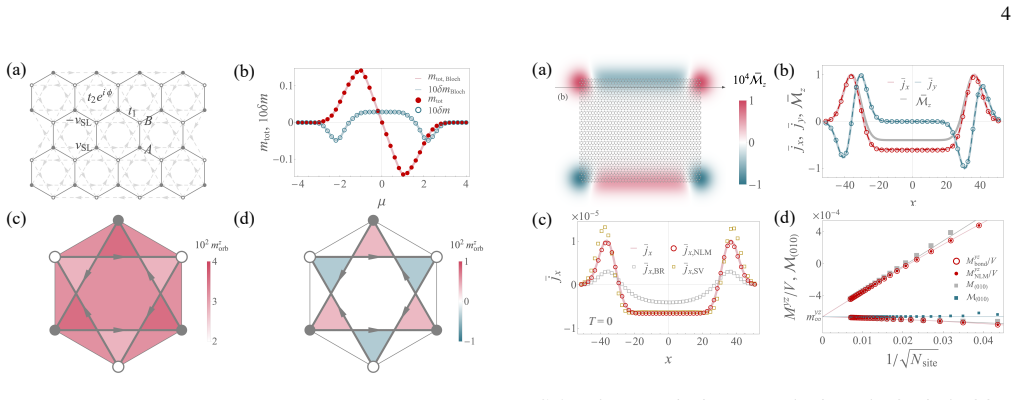
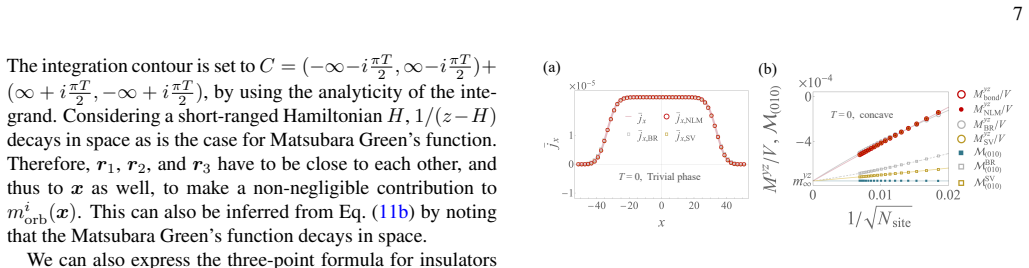
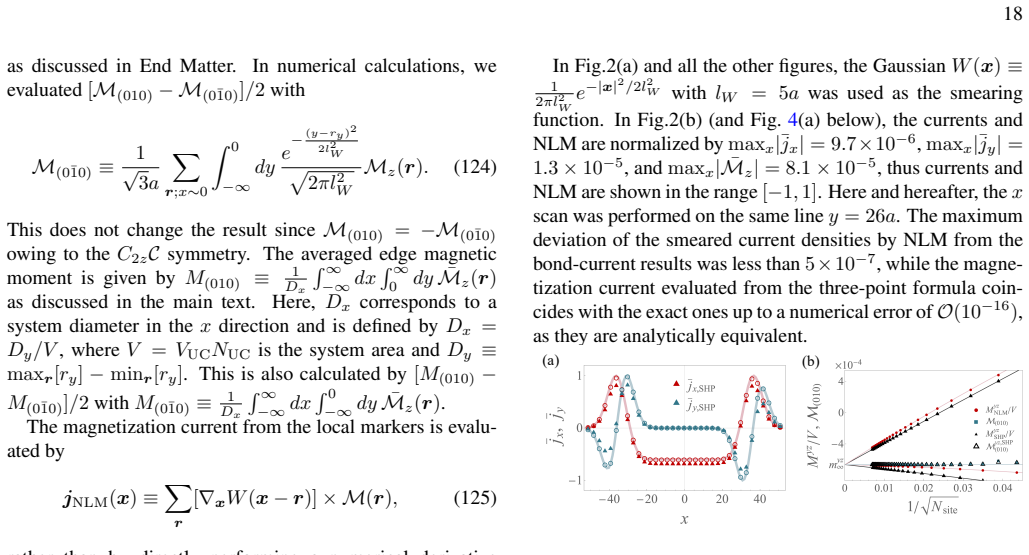
A direct numerical check in the Haldane model computing the current density produced by the derived local magnetization and comparing it to the known equilibrium current.
Figures
read the original abstract
Local orbital magnetization is the field whose rotation generates the equilibrium current density. Unlike spin magnetization, a quantum-mechanical local formula consistent with both this current relation and the modern theory of bulk orbital magnetization has been missing. In this work, we derive a quantum-mechanical formula for the local orbital magnetization for non-interacting electrons by considering local-flux response of the grand potential. The local-flux response fixes the formula uniquely in two dimensions, whereas in three dimensions it selects a natural representative within a longitudinal ambiguity. Furthermore, coarse graining yields a natural local marker that generates the current to third-derivative order, and its site-position moment equals the orbital magnetic quadrupole moment of finite-size systems. We illustrate the obtained results with the Haldane model.
Editorial analysis
A structured set of objections, weighed in public.
Referee Report
Summary. The manuscript derives a quantum-mechanical formula for local orbital magnetization in non-interacting electron systems via the response of the grand potential to a local magnetic flux. This fixes the formula uniquely in 2D and selects a representative within the longitudinal gauge ambiguity in 3D. Coarse-graining produces a local marker that generates the equilibrium current density to third order in spatial derivatives; the first moment of this marker equals the orbital magnetic quadrupole moment of finite systems. The results are illustrated on the Haldane model and shown to be consistent with the modern bulk orbital magnetization theory.
Significance. If the derivation holds, the work supplies the missing local, current-generating orbital magnetization that is consistent with both the equilibrium current relation and the established bulk theory. This would enable quantitative studies of local orbital magnetism in inhomogeneous, finite, and mesoscopic systems, including topological materials. The parameter-free character of the local-flux response and the explicit connection to the quadrupole moment are notable strengths.
minor comments (3)
- [§3] §3 (or equivalent derivation section): the step from the local-flux variation of the grand potential to the explicit operator expression for m(r) should include an intermediate line showing how the position operator is handled inside the trace, to make the uniqueness argument in 2D fully transparent.
- [Figure 2] Figure 2 (Haldane model): the plotted local magnetization should be accompanied by a direct comparison to the numerically computed curl of the current density on the same lattice to verify the current-generation property at the plotted resolution.
- [Eq. (X)] The notation for the longitudinal projector in 3D (Eq. (X)) is introduced without an explicit definition of the gauge choice; a one-sentence reminder of the decomposition would aid readers.
Simulated Author's Rebuttal
We thank the referee for the positive assessment of the manuscript, the recognition of its significance for local orbital magnetism in inhomogeneous systems, and the recommendation for minor revision. No major comments were provided in the report.
Circularity Check
No significant circularity detected in derivation
full rationale
The paper presents a derivation of the local orbital magnetization formula directly from the local-flux response of the grand potential for non-interacting electrons. This response is used to fix the formula uniquely in 2D and select a representative in 3D. No load-bearing steps reduce by construction to inputs, self-citations, fitted parameters renamed as predictions, or ansatzes smuggled via prior work. The abstract and description frame the approach as first-principles, with the physical choice of grand-potential response serving as an external assumption rather than a definitional loop. Coarse-graining and consistency checks are presented as consequences, not circular inputs. This is the normal case of a self-contained derivation.
Axiom & Free-Parameter Ledger
axioms (1)
- domain assumption Non-interacting electrons
Reference graph
Works this paper leans on
-
[1]
C. M. Varma, Non-fermi-liquid states and pairing instability of a general model of copper oxide metals, Phys. Rev. B55, 14554 (1997)
1997
-
[2]
Chakravarty, R
S. Chakravarty, R. B. Laughlin, D. K. Morr, and C. Nayak, Hid- den order in the cuprates, Phys. Rev. B63, 094503 (2001)
2001
-
[3]
Resta, Electrical polarization and orbital magnetization: the modern theories, J
R. Resta, Electrical polarization and orbital magnetization: the modern theories, J. Phys. Condens. Matter22, 123201 (2010)
2010
-
[4]
C. L. Tschirhart, M. Serlin, H. Polshyn, A. Shragai, Z. Xia, J. Zhu, Y . Zhang, K. Watanabe, T. Taniguchi, M. E. Huber, and A. F. Young, Imaging orbital ferromagnetism in a moir ´e chern insulator, Science372, 1323 (2021)
2021
-
[5]
Grover, M
S. Grover, M. Bocarsly, A. Uri, P. Stepanov, G. Di Battista, I. Roy, J. Xiao, A. Y . Meltzer, Y . Myasoedov, K. Pareek, K. Watanabe, T. Taniguchi, B. Yan, A. Stern, E. Berg, D. K. Efetov, and E. Zeldov, Chern mosaic and berry-curvature mag- netism in magic-angle graphene, Nat. Phys.18, 885 (2022)
2022
-
[6]
T. Han, Z. Lu, G. Scuri, J. Sung, J. Wang, T. Han, K. Watanabe, T. Taniguchi, L. Fu, H. Park, and L. Ju, Orbital multiferroicity in pentalayer rhombohedral graphene, Nature623, 41 (2023)
2023
-
[7]
Jiang, J.-X
Y .-X. Jiang, J.-X. Yin, M. M. Denner, N. Shumiya, B. R. Or- tiz, G. Xu, Z. Guguchia, J. He, M. S. Hossain, X. Liu, J. Ruff, L. Kautzsch, S. S. Zhang, G. Chang, I. Belopolski, Q. Zhang, T. A. Cochran, D. Multer, M. Litskevich, Z.-J. Cheng, X. P. Yang, Z. Wang, R. Thomale, T. Neupert, S. D. Wilson, and M. Z. Hasan, Unconventional chiral charge order in kag...
2021
-
[8]
Mielke, 3rd, D
C. Mielke, 3rd, D. Das, J.-X. Yin, H. Liu, R. Gupta, Y .- X. Jiang, M. Medarde, X. Wu, H. C. Lei, J. Chang, P. Dai, Q. Si, H. Miao, R. Thomale, T. Neupert, Y . Shi, R. Khasanov, M. Z. Hasan, H. Luetkens, and Z. Guguchia, Time-reversal symmetry-breaking charge order in a kagome superconductor, Nature602, 245 (2022)
2022
-
[9]
L. L. Hirst, The microscopic magnetization: concept and appli- cation, Rev. Mod. Phys.69, 607 (1997)
1997
-
[10]
Xiao, M.-C
D. Xiao, M.-C. Chang, and Q. Niu, Berry phase effects on elec- tronic properties, Rev. Mod. Phys.82, 1959 (2010)
1959
-
[11]
D. Xiao, J. Shi, and Q. Niu, Berry phase correction to electron density of states in solids, Phys. Rev. Lett.95, 137204 (2005)
2005
-
[12]
Thonhauser, D
T. Thonhauser, D. Ceresoli, D. Vanderbilt, and R. Resta, Or- bital magnetization in periodic insulators, Phys. Rev. Lett.95, 137205 (2005)
2005
-
[13]
Ceresoli, T
D. Ceresoli, T. Thonhauser, D. Vanderbilt, and R. Resta, Or- bital magnetization in crystalline solids: Multi-band insulators, chern insulators, and metals, Phys. Rev. B74, 024408 (2006)
2006
-
[14]
J. Shi, G. Vignale, D. Xiao, and Q. Niu, Quantum theory of orbital magnetization and its generalization to interacting sys- tems, Phys. Rev. Lett.99, 197202 (2007)
2007
-
[15]
M. G. Lopez, D. Vanderbilt, T. Thonhauser, and I. Souza, Wannier-based calculation of the orbital magnetization in crys- tals, Phys. Rev. B85, 014435 (2012)
2012
-
[16]
G. Zhu, S. A. Yang, C. Fang, W. M. Liu, and Y . Yao, Theory of orbital magnetization in disordered systems, Phys. Rev. B86, 214415 (2012)
2012
-
[17]
Nourafkan, G
R. Nourafkan, G. Kotliar, and A.-M. S. Tremblay, Orbital mag- netization of correlated electrons with arbitrary band topology, Phys. Rev. B90, 125132 (2014)
2014
-
[18]
Bianco and R
R. Bianco and R. Resta, Orbital magnetization as a local prop- erty, Phys. Rev. Lett.110, 087202 (2013)
2013
-
[19]
Bianco and R
R. Bianco and R. Resta, Orbital magnetization in insulators: Bulk versus surface, Phys. Rev. B93, 174417 (2016)
2016
-
[20]
Seleznev and D
D. Seleznev and D. Vanderbilt, Towards a theory of surface or- bital magnetization, Phys. Rev. B107, 115102 (2023)
2023
-
[21]
S. A. Saati, K. L. Hur, and F. Pi ´echon, Theory of local orbital magnetization: local berry curvature, arXiv [cond-mat.mes- hall] 10.48550/arXiv.2512.12343 (2025), arXiv:2512.12343 [cond-mat.mes-hall]
-
[22]
P. T. Mahon, J. G. Kattan, and J. E. Sipe, Polarization and or- bital magnetization in chern insulators: A microscopic perspec- tive, Phys. Rev. B107, 115110 (2023)
2023
-
[23]
S. D. Swiecicki and J. E. Sipe, Linear response of crystals to electromagnetic fields: Microscopic charge-current density, po- larization, and magnetization, Phys. Rev. B90, 125115 (2014)
2014
-
[24]
P. T. Mahon, R. A. Muniz, and J. E. Sipe, Microscopic polariza- tion and magnetization fields in extended systems, Phys. Rev. B 99, 235140 (2019)
2019
-
[25]
P. T. Mahon and J. E. Sipe, Electric polarization and magneti- zation in metals,https://scipost.org/preprints/ scipost_202206_00031v3/(2022), accessed: 2026-6-5
2022
-
[26]
See Supplemental Material for more details
-
[27]
parity anomaly
F. D. Haldane, Model for a quantum hall effect without landau levels: Condensed-matter realization of the “parity anomaly”, Phys. Rev. Lett.61, 2015 (1988)
2015
-
[28]
Chen and P
K.-T. Chen and P. A. Lee, Unified formalism for calculating polarization, magnetization, and more in a periodic insulator, Phys. Rev. B84, 205137 (2011)
2011
-
[29]
See End Matter for more details
-
[30]
Forϵ m =ϵ n,F mn/ϵmn ≡∂ ϵm F(ϵ m)
-
[31]
Bianco and R
R. Bianco and R. Resta, Mapping topological order in coordi- nate space, Phys. Rev. B84, 241106 (2011)
2011
-
[32]
P. Zhu, T. L. Hughes, and A. Alexandradinata, Quantized sur- face magnetism and higher-order topology: Application to the hopf insulator, Phys. Rev. B103, 014417 (2021)
2021
-
[33]
J. Gliozzi, M. Lin, and T. L. Hughes, Orbital magnetic quadrupole moment in higher order topological phases, arXiv [cond-mat.mes-hall] 10.48550/arXiv.2211.08438 (2022), arXiv:2211.08438 [cond-mat.mes-hall]
-
[34]
D. Jo, D. Go, G.-M. Choi, and H.-W. Lee, Spintronics meets orbitronics: Emergence of orbital angular momentum in solids, Npj Spintron.2, 19 (2024)
2024
-
[35]
T. P. Cysne, L. M. Canonico, M. Costa, R. B. Muniz, and T. G. Rappoport, Orbitronics in two-dimensional materials, Npj Spintron.3, 39 (2025)
2025
-
[36]
A. M. Essin, A. M. Turner, J. E. Moore, and D. Vanderbilt, Orbital magnetoelectric coupling in band insulators, Phys. Rev. B81, 205104 (2010)
2010
-
[37]
J. M. Luttinger, The effect of a magnetic field on electrons in a periodic potential, Phys. Rev.84, 814 (1951)
1951
-
[38]
Gao and D
Y . Gao and D. Xiao, Orbital magnetic quadrupole moment and nonlinear anomalous thermoelectric transport, Phys. Rev. B98, 060402 (2018)
2018
-
[39]
Shitade, H
A. Shitade, H. Watanabe, and Y . Yanase, Theory of orbital mag- netic quadrupole moment and magnetoelectric susceptibility, Phys. Rev. B98, 020407 (2018). 6 End Matter In this work, we setℏ= 1and−|e|A(x)is replaced with A(x)for simplicity. The electron charge|e|and the Dirac constantℏcan be recovered by multiplying−|e|/ℏto all the magnetization-related fo...
2018
discussion (0)
Sign in with ORCID, Apple, or X to comment. Anyone can read and Pith papers without signing in.