Stabilizer entropy is trustworthy for mixed states
Pith reviewed 2026-06-30 07:35 UTC · model grok-4.3
The pith
Linear stabilizer entropy acts as a non-stabilizerness monotone for mixed states with overwhelming probability under non-adaptive Clifford channels on flat states.
A machine-rendered reading of the paper's core claim, the machinery that carries it, and where it could break.
Core claim
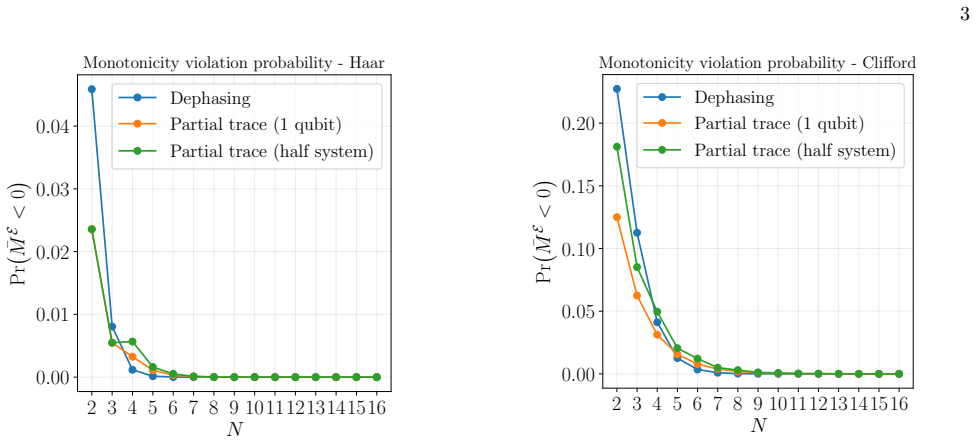
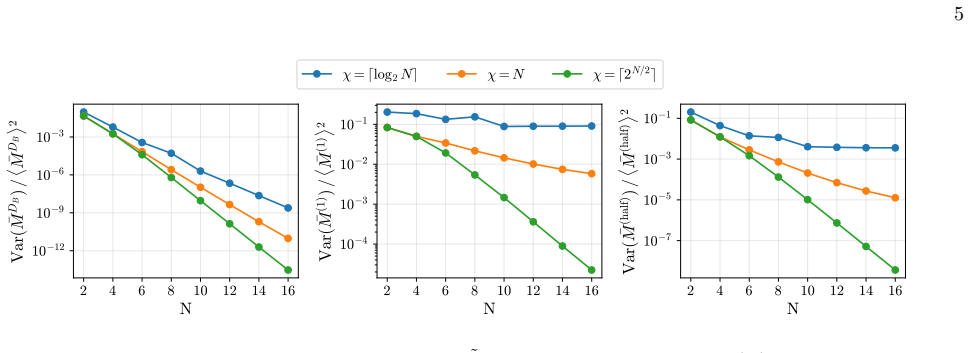
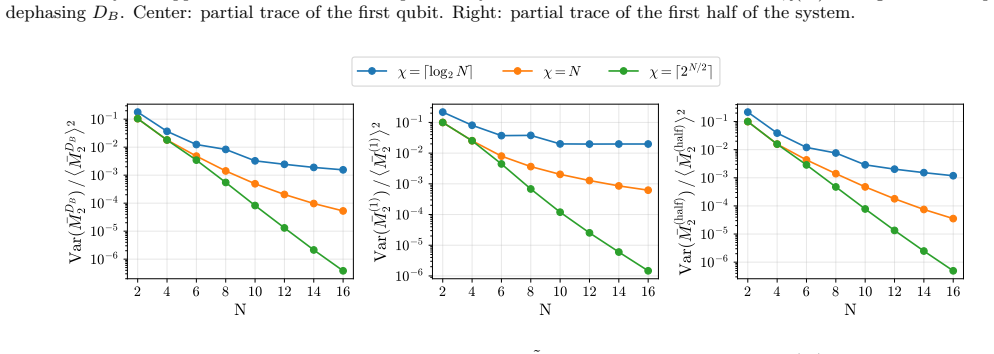
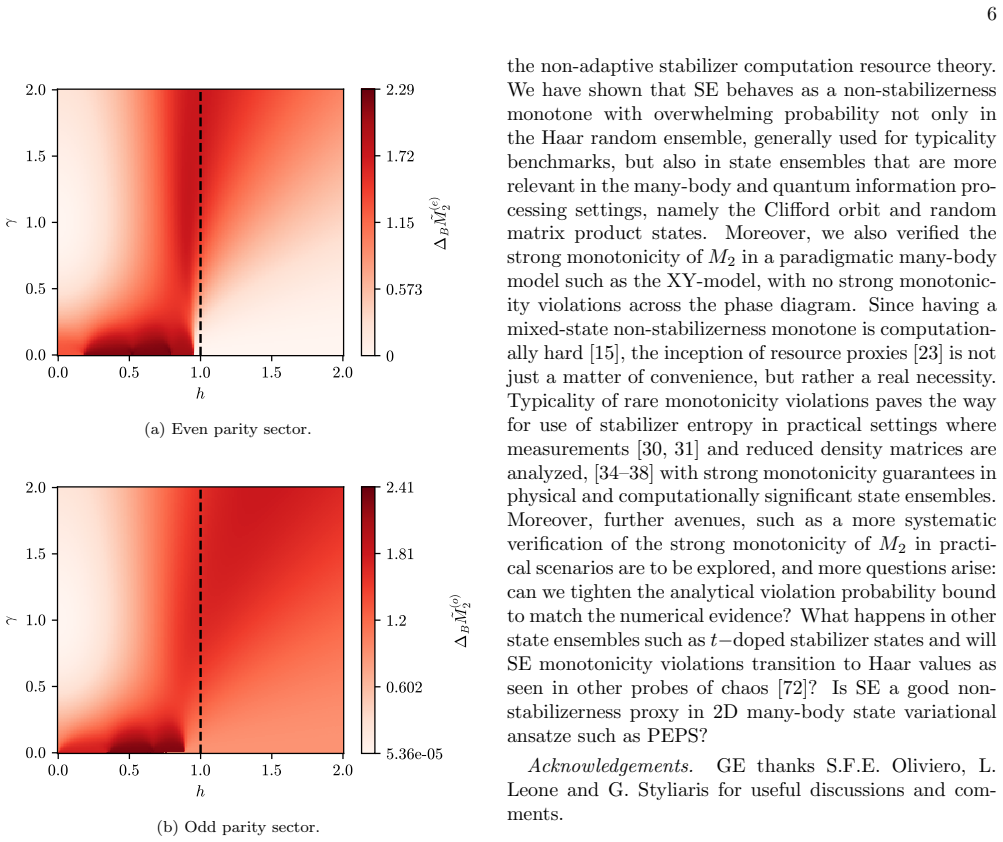
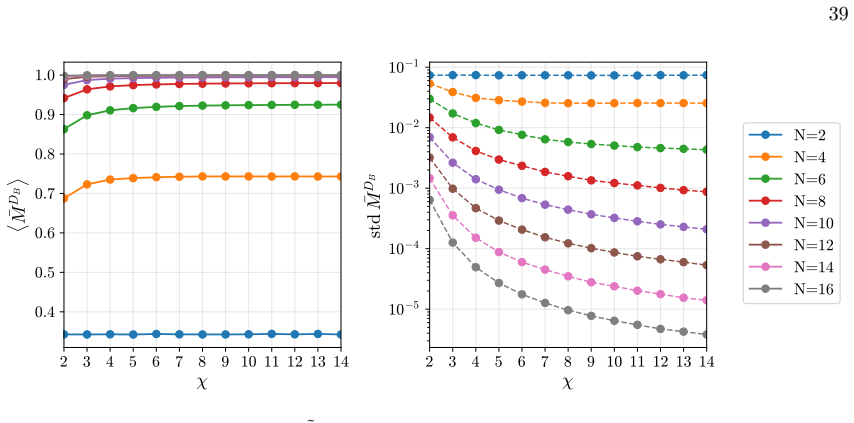
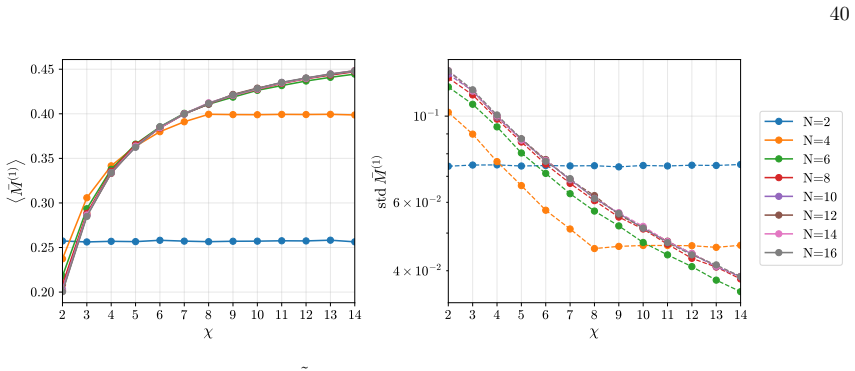
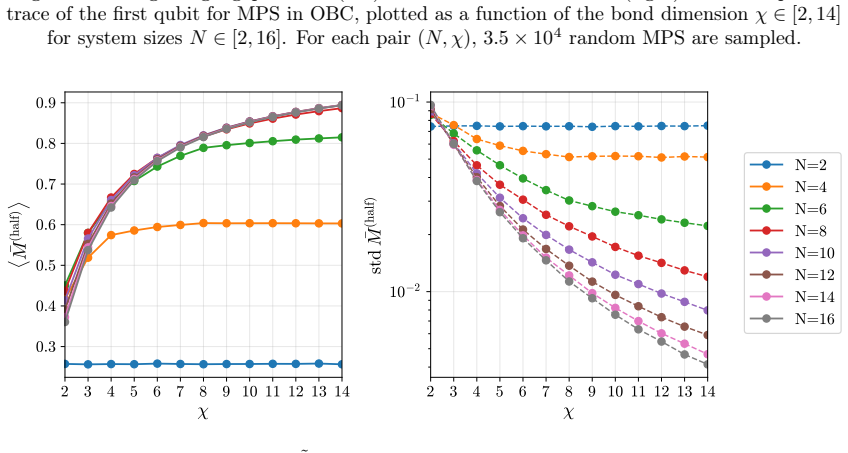
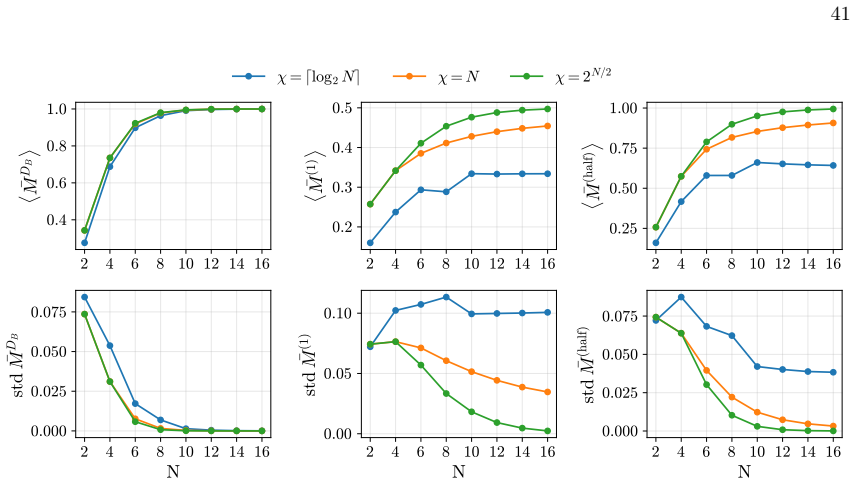
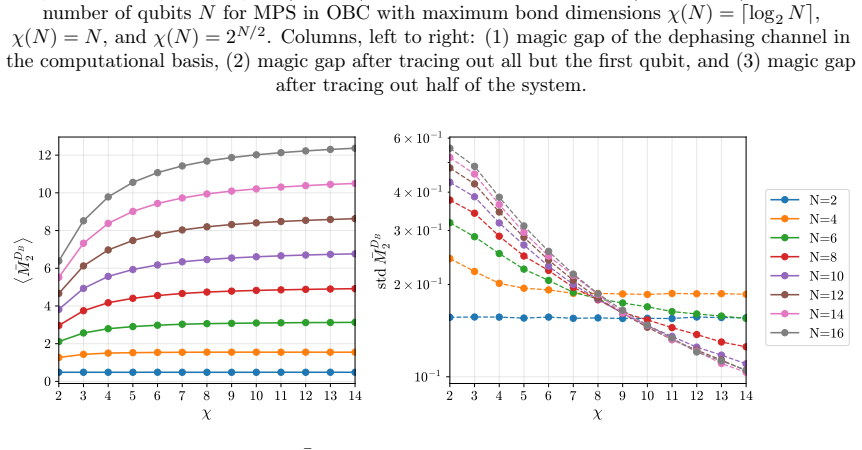
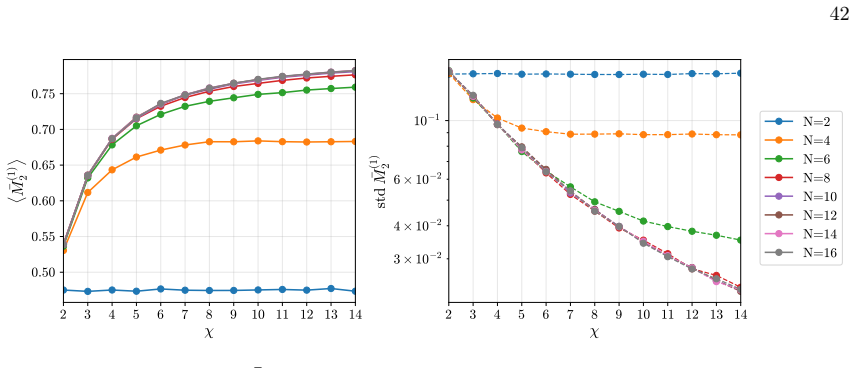
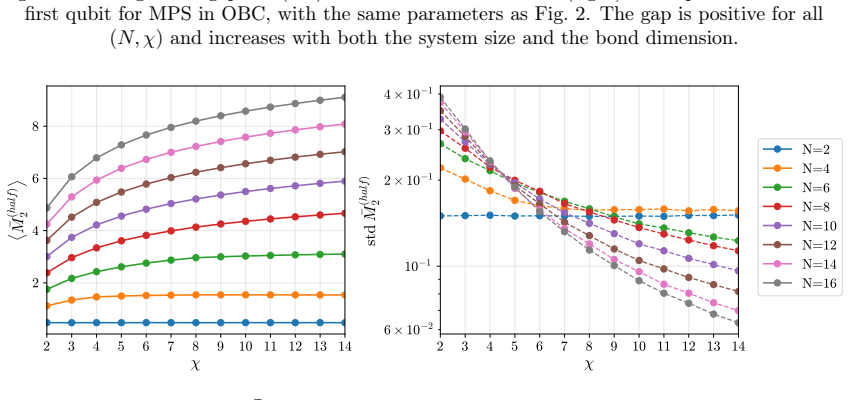
We propose a linear Stabilizer Entropy that acts as a proper non-stabilizerness monotone with overwhelming probability when restricted to non-adaptive Clifford channels acting on flat mixed stabilizer states. Analytical and numerical results for Haar-random states, Clifford orbits, and random matrix product states show that monotonicity violation probabilities decay as exp−ηN. We also prove the validity of Stabilizer Entropy in specific many-body systems undergoing partial measurements, where the amount of resource never increases for each measurement outcome as well as when averaged over outcome probabilities.
What carries the argument
The linear Stabilizer Entropy, an efficiently computable function proposed as a non-stabilizerness monotone that holds with high probability in the restricted setting.
If this is right
- Monotonicity holds with overwhelming probability for Haar-random states.
- The same exponential decay of violations occurs for states in Clifford orbits.
- Random matrix product states exhibit the identical decay behavior.
- In many-body systems, partial measurements leave the stabilizer entropy non-increasing both per outcome and on average.
Where Pith is reading between the lines
- Numerical studies of non-stabilizerness in large mixed-state systems become feasible using this measure where exact monotones cannot be evaluated.
- The distinction between worst-case and typical-case monotonicity may apply to other resource measures in quantum information.
- The result suggests checking whether similar high-probability monotonicity holds when the restriction to flat states is relaxed in controlled ways.
Load-bearing premise
The central claim depends on restricting attention to non-adaptive Clifford channels and flat mixed stabilizer states.
What would settle it
An explicit family of flat mixed stabilizer states and non-adaptive Clifford channels for which the probability of monotonicity violation fails to decay exponentially with system size N.
Figures
read the original abstract
Quantifying non-stabilizerness in mixed states is provably intractable, as any strict monotone requires superexponential time. We propose a linear Stabilizer Entropy that acts as a proper non-stabilizerness monotone with overwhelming probability when restricted to non-adaptive Clifford channels acting on flat mixed stabilizer states. Analytical and numerical results for Haar-random states, Clifford orbits, and random matrix product states show that monotonicity violation probabilities decay as $\exp-\eta N$. We also prove the validity of Stabilizer Entropy in specific many-body systems undergoing partial measurements, where the amount of resource never increases for each measurement outcome as well as when averaged over outcome probabilities. Given the hardness of strict alternatives, Stabilizer Entropy emerges as a practical and theoretically justified resource measure.
Editorial analysis
A structured set of objections, weighed in public.
Referee Report
Summary. The paper proposes a linear Stabilizer Entropy as a practical non-stabilizerness monotone for mixed states. It claims this measure acts as a proper monotone with overwhelming probability when restricted to non-adaptive Clifford channels on flat mixed stabilizer states, supported by analytical and numerical results showing exponential decay (exp(−ηN)) of monotonicity violation probabilities for Haar-random states, Clifford orbits, and random matrix product states. It also proves validity for partial measurements in specific many-body systems, where the resource does not increase for each outcome or on average.
Significance. If the restricted claims hold with the stated exponential bounds, the work supplies a computationally feasible resource quantifier for non-stabilizerness in mixed states, where strict monotones are known to be intractable. The combination of analytical derivations for specific ensembles, numerical verification across multiple state classes, and proofs for measurement scenarios provides concrete evidence that the measure can be trustworthy under the stated operational restrictions, addressing a practical gap in quantum resource theories.
major comments (2)
- [Numerical results and analytical derivations sections] The central claim of trustworthiness 'with overwhelming probability' is explicitly restricted to non-adaptive Clifford channels on flat mixed stabilizer states, yet the exponential decay is shown only for the three listed ensembles (Haar-random, Clifford orbits, random MPS). No argument is supplied that these ensembles are representative or that the bound extends to arbitrary flat mixed stabilizer states under the allowed channels.
- [Partial measurements section] The separate proof that Stabilizer Entropy is non-increasing under partial measurements (both per outcome and averaged) is stated to hold only for 'specific many-body systems.' This limits the scope of the measurement result and leaves open whether the property extends to general flat mixed stabilizer states.
minor comments (1)
- [Title] The title states that Stabilizer Entropy 'is trustworthy for mixed states' without qualification, while the abstract and body heavily restrict the regime; aligning the title with the actual scope would improve clarity.
Simulated Author's Rebuttal
We thank the referee for the careful reading and constructive comments on our manuscript. We address each major comment below, proposing clarifications and partial revisions to better delineate the scope of our results.
read point-by-point responses
-
Referee: [Numerical results and analytical derivations sections] The central claim of trustworthiness 'with overwhelming probability' is explicitly restricted to non-adaptive Clifford channels on flat mixed stabilizer states, yet the exponential decay is shown only for the three listed ensembles (Haar-random, Clifford orbits, random MPS). No argument is supplied that these ensembles are representative or that the bound extends to arbitrary flat mixed stabilizer states under the allowed channels.
Authors: The three ensembles were deliberately chosen as standard, representative classes in quantum information: Haar-random states model generic high-dimensional behavior, Clifford orbits capture structure under the relevant symmetry group, and random MPS represent physically relevant low-entanglement many-body states. The consistent exponential decay across these diverse classes supports the practical trustworthiness claim. We acknowledge that no general proof for every conceivable flat mixed stabilizer state is supplied. We will add a dedicated paragraph in the discussion section explaining the choice of ensembles, their representativeness for typical cases, and explicitly noting that extension to fully arbitrary states remains open. revision: partial
-
Referee: [Partial measurements section] The separate proof that Stabilizer Entropy is non-increasing under partial measurements (both per outcome and averaged) is stated to hold only for 'specific many-body systems.' This limits the scope of the measurement result and leaves open whether the property extends to general flat mixed stabilizer states.
Authors: The analytical proof is restricted to specific many-body systems because these admit explicit calculations based on the stabilizer structure and measurement operators. This provides a concrete demonstration of non-increase (per outcome and on average) in relevant physical settings. We will revise the manuscript to emphasize the restricted scope of this result, clarify that it does not claim generality over all flat mixed stabilizer states, and note the generalization as an interesting direction for future work. revision: partial
Circularity Check
No circularity; proposal verified on restricted ensembles via independent analytics and numerics
full rationale
The paper defines linear Stabilizer Entropy and shows it acts as a monotone with probability 1-exp(-ηN) only under the explicit restriction to non-adaptive Clifford channels on flat mixed stabilizer states. Support comes from direct calculations on Haar-random states, Clifford orbits, random MPS, and a separate proof for partial measurements in specific many-body systems. These are external verifications, not self-definitional fits or predictions that reduce to the definition by construction. No load-bearing self-citations or imported uniqueness theorems appear in the abstract or described chain. The claim is self-contained within its stated narrow regime.
Axiom & Free-Parameter Ledger
Reference graph
Works this paper leans on
-
[1]
(62) we get ∆2 ˜Mlin(ψ) = 96(d−1) (d+ 3) 2(d+ 5)(d+ 6)(d+ 7) =O 1 d4 .(65)
Variance of ˜Mlin(ψ) ∆2 ˜Mlin(ψ)reads ∆2 ˜Mlin(ψ) =E U[(1−SP(ψ U))2]−[E U ˜Mlin(ψU)]2 = 1 +E U[(SP(ψU))2]−2E U(SP(ψU))−[E U ˜Mlin(ψU)]2 = 1 +d 2 Tr (Q⊗Q)E U(ψ⊗8 U ) −2dTr QEU(ψ⊗4 U ) − 1− 4 d+ 3 2 1 +d 2 Tr (Q⊗Q)E U(ψ⊗8 U ) −2dTr QEU(ψ⊗4 U ) −1− 16 (d+ 3) 2 + 8 d+ 3 =d 2 Tr (Q⊗Q)E U(ψ⊗8 U ) − 8 d+ 3 − 16 (d+ 3) 2 + 8 d+ 3 (62) Let us focus on the last ter...
-
[2]
Variance of ˜Mlin(ψA) The variance of ˜Mlin(ψA)reads ∆2( ˜Mlin(ψ)) =E U[(Purψ A −SP(ψ A))2]−E U[Purψ A −SP(ψ A)]2 =E U[Pur2 ψA] +E U[SP(ψA)2]−2E U[SP(ψA) PurψA]− (dA −1)(d A + 1)dB (dAdB + 1)(dAdB + 3) 2 . (66) a Average square purity of reduce density matrix The average value of the square of the reduced density matrix purity reads EU Pur2(ψA U ) =E U Tr...
-
[3]
Covariance between ˜Mlin(ψ)and ˜Mlin(ψA) The covariance reads cov( ˜Mlin(ψ), ˜Mlin(ψA)) =E U[(1−SP(ψ))(Purψ A −SP(ψ A))]−E U[1−SP(ψ)]E U[Purψ A −SP(ψ A)] = (((((((((( EU[Purψ A −SP(ψ A)]−E U[SP(ψ) Purψ A] +E U[SP(ψ) SP(ψA)] − (((((((((( EU[Purψ A −SP(ψ A)] +E U[SP(ψ)(Purψ A −SP(ψ A))] =E U[SP(ψ) SP(ψA)] +E U[SP(ψ)]EU[Purψ A] −E U[SP(ψ) Purψ A]−E U[SP(ψ)]E...
-
[4]
Violation probability of SE under partial trace in Haar ensemble It is possible to obtain violation probability bounds either Chebyshev and/or Lévy typicality arguments, and we now show both concentration results for the SE gap for partial trace in the Haar ensemble. As seen before, the variance of the SE gap is exponentially vanishing asN→ ∞: ∆2 ¯M A =O ...
-
[5]
(92) Again, we split each piece in a separate calculation
Variance of ˜Mlin(DBψ) The variance of the SE of the dephased state reads ∆2 ˜Mlin(DBψ) =E U h ˜Mlin(DBψU)2 i −E U h ˜Mlin(DBψU) i2 =E U Tr (T⊗T)(D Bψ⊗4 U ) +d 2EU Tr (Q⊗Q)(D BψU)⊗8 −2dE U Tr (T⊗Q)(D BψU)⊗6 − d−1 (d+ 1)(d+ 3) 2 . (92) Again, we split each piece in a separate calculation. a Average ofTr (T⊗T)(D Bψ⊗4 U ) We show computation of this object: ...
-
[6]
Final expression of the variance of SE gap for dephasing in the Haar ensemble Putting the pieces together, we finally get the following expression for∆¯M DB: ∆ ¯M DB = 4(d−1) d4 + 33d3 + 59d2 −15d+ 18 (d+ 1) 2(d+ 2)(d+ 3) 2(d+ 5)(d+ 6)(d+ 7) =O 1 d3 (106) F. Violation probability of SE under dephasing in the Haar ensemble Again, to establish monotonicity ...
-
[7]
Average ofPur 2(ψA C) We show computation of the following object: EC Pur2(ψA C) =E C Tr (T⊗2 A ⊗1 ⊗4 B )ψ⊗4 C =αTr (T⊗2 A ⊗1 ⊗4 B )QΠsym +βTr (TA ⊗1 ⊗4 B )Πsym = α 24 X π∈S4 Tr (TA ⊗T A)QATA π Tr QBTB π + β 24 X π∈S4 Tr T⊗2 A TA π Tr TB π (121) and direct evaluation of these traces yields EC Pur2(ψA C) = (d−1) d2 + 3dd2 A +d 4 A +d 2 A + (d2 A −1)(d 2 A ...
-
[8]
Average ofPur(ψ A C) SP(ψA C) We now show computation of the following object: EC[Pur(ψA C) SP(ψA C)] =d AEC Tr{[(QA ⊗T A)⊗1 ⊗6 B ]ψ⊗6 C }.(123) To compute this object, we show the Clifford average of 6 copies of a pure state, shown in [21]: ECψ⊗6 C = X Ω∈P6 pΩ(ψ) ΠsymΩΠsym Tr[ΩΠsym] (124) withP 6 ={Ω (6) 0 ,Ω (6) 1 ,Ω (6) 2 ,Ω (6) 3 }being the set of alg...
-
[9]
Average ofSP 2(ψA C) We now show computations of the following object: EC[SP2(ψA C)] =d 2 AEC Tr (Q⊗2 A ⊗1 ⊗8 B )ψ⊗8 C . (130) To compute this object, we show the Clifford average of 8 copies of a pure state, shown in [21]: ECψ⊗8 C = X Ω∈P8 pΩ(ψ) ΠsymΩΠsym Tr[ΩΠsym] (131) withP 8 ={Ω 0,Ω 1,Ω 2,Ω 3,Ω 4,Ω 5,Ω 6,Ω 7,Ω 8,Ω 9,Ω 10,Ω 11,Ω 12}being set of algebr...
2052
-
[10]
Violation probability of SE under partial trace in the Clifford ensemble Since the Clifford orbit of a quantum state is a discrete set, we are not able to use Lévy lemma to establish typicality, hence we will Chebyshev inequality to bound the probability of violations. This is the reason why we computed the variance of the partial trace SE gap on the Clif...
-
[11]
(150) exploiting the usual properties of factorization, direct evaluation of these traces yield the result: EC[Pur2(DBψC)] = 2(3− ˜Mlin) (d+ 1)(d+ 2) (151)
Average ofPur 2(DBψC) We show computation of the following object: EC[Pur2(DBψC)] =E C Tr T⊗T(D BψC)⊗4 =E C Tr (D⊗4 B T⊗T)ψ ⊗4 C =αTr (D⊗4 B T⊗T)QΠ sym +βTr (D⊗4 B T⊗T)Π sym = α 24 X π∈S4 Tr (D⊗4 B T⊗T)QT π + β 24 X π∈S4 Tr (D⊗4 B T⊗T)T π . (150) exploiting the usual properties of factorization, direct evaluation of these traces yield the result: EC[Pur2(...
-
[12]
Average ofPur(D BψC) SP(DBψC) In this section, we show complete computation of the following object: EC Pur(DBψC) SP(DBψC) =dE C Tr T⊗Q(D BψC)⊗6 =E C Tr (D⊗6 B T⊗Q)ψ ⊗6 C (152) Substituting the expression of the six-copy Clifford average of a state shown in Eq. (124) [21] we get the following: EC Pur(DBψC) SP(DBψC) =d X Ω∈P6 pΩ(ψ) Tr(ΩΠsym) X π,σ∈S 6 Tr (...
-
[13]
(155) 30 Substituting the expression of the 8-copy Clifford average of a pure state shown in Eq
Average ofSP 2(DBψC) In this section we compute the following object: EC SP2(DBψC) =d 2EC Tr Q⊗Q(D BψC)⊗8 =d 2EC Tr (D⊗8 B Q⊗Q)ψ ⊗8 C . (155) 30 Substituting the expression of the 8-copy Clifford average of a pure state shown in Eq. (131) [21], we get EC SP2(DBψC) =d 2 X Ω∈P8 pΩ(ψ) Tr[ΩΠsym] Tr (D⊗8 B Q⊗Q)Π symΩΠsym = d2 8!2 X Ω∈P8 pΩ(ψ) Tr[ΩΠsym] X π,σ∈S...
-
[14]
Final expression of∆ 2 ¯M DB Summing all the elements together yields the final expression of∆2 ¯M DB, which reads ∆2 ¯M DB = (6 + 2d−4d 2)(1− ˜Mlin(ψ))− ˜Mlin(ψ)2 + (−4d−4) SP 3(ψ) + (d+ 1) SP4(ψ) + (d+ 1) Tr Ω8ψ⊗8 (d+ 1) 2(d+ 2) ≤ (−4d2 −2d+ 2(d+ 1) + 2)(1− ˜Mlin(ψ))− ˜Mlin(ψ)2 (d+ 1) 2(d+ 2) =O ˜Mlin(ψ) d ! (158) withSP 3(ψ)andSP 4(ψ)being the stabiliz...
-
[15]
NY s=1 Ais[s] # TrA
Violation probability of SE under dephasing in the Clifford orbit We have seen that ∆2 C ¯M DB =O ˜Mlin(ψ) d ! (159) Hence, using Chebyshev’s inequality, we obtain an upper bound to the probability of violations establishing ˜Mlin as aη−magic proxy for dephasing withη=O(1)in the Clifford orbit. VI. SE as a proxy in random MPS: techniques A. Random MPS Giv...
-
[16]
(183): the operatorial part of this expression is factorized on each qubit, paired with the fact thatQ=Q (1) 1 ⊗ · · · ⊗Q (1) N , with Q(1) i = 1 4 P P∈{1,X,Y,Z} P ⊗4
Average stabilizer purity of random MPS Objective of this section is to show the result of the following computation: Eψ∼χ SP(ψ) := 2N Eψ∼χ Tr Qψ⊗4 (184) 35 We will exploit an important fact about the expression Eq. (183): the operatorial part of this expression is factorized on each qubit, paired with the fact thatQ=Q (1) 1 ⊗ · · · ⊗Q (1) N , with Q(1) i...
-
[17]
Tr h T(2) πNB i Tr h T(χ) πNB T(χ) σNB −1 i W (2χ) πNB ,σNB | {z } ˜W (2) σNB −1 ,σNB × X πNB +1,...,πN W (2χ) πNB +1,σNB +1
Average purity of traced out Random MPS The partial trace of the firstNB of the average2−copy average RMPS reads Eψ∼χψ⊗2 A = TrB Eψ∼χψ⊗2 = 1 N2 X σ1,...,σN X π1,...,πNB Tr h T(2) π1 i Tr h T(χ) π1 T(χ) σN i W (2χ) π1,σ1 | {z } ˜W (2) σN ,σ1 . . . . . .Tr h T(2) πNB i Tr h T(χ) πNB T(χ) σNB −1 i W (2χ) πNB ,σNB | {z } ˜W (2) σNB −1 ,σNB × X πNB +1,...,πN W...
-
[18]
W(2χ) πN ,σN Tr h T(χ) πNB +1T(χ) σNB i
Average stabilizer purity of traced out RMPS By the same procedure utilized in the partial trace of the2−copy average RMPS, the4−copy partial trace of the average RMPS reads TrB Eψ∼χ(ψ⊗4) = 1 N4 X πNB +1,...,πN ,σNB ,...,σN ( ˜W (4))NB σN ,σNB W (2χ) πNB +1,σNB +1 . . . W(2χ) πN ,σN Tr h T(χ) πNB +1T(χ) σNB i . . .Tr h T(χ) πN T(χ) σ1 i (T(2) πNB +1 ⊗ · ·...
-
[19]
Π iN )ψ(Πi1 ⊗
Average purity of dephased RMPS In this section we show how to compute the following object: Eψ∼χ[Pur(DBψ)] =E ψ∼χ Tr T(DBψ)⊗2 (192) Let us first recall the definition of the dephasing channel overNqubits: DBψ= X i1,...iN (Πi1 ⊗. . .Π iN )ψ(Πi1 ⊗. . .Π iN ) = (DB)(1) ⊗. . .⊗(D B)(N) ψ(193) with (DB(·))(k) = 1X ik=0 Πik(·)Πik (194) as we see, the dephasing...
-
[20]
˜W (Q)(DB) σN−1 ,σN = 1 N4 Tr h ( ˜W (Q)(DB))N i (200) E
Average stabilizer purity of dephased RMPS In this section we will show the derivation of the following object: Eψ∼χ[SP(DBψ)] = 2N Eψ∼χ Tr Q(DBψ)⊗4 (199) 38 Again, using the factorization of the dephasing channel and of theQoperator, we get Eψ∼χ[SP(DBψ)] = 2N N4 NY s=1 X πs σs∈S4 W (2χ) πs,σs Tr h T(χ) πs T(χ) σs−1 i Tr h Q(D⊗4 B T(2) πs ) i = 2N N4 NY s=...
-
[21]
Quantum resource theories.Review of Modern Physics, 91:025001– 025001, April 2019
Eric Chitambar and Gilad Gour. Quantum resource theories.Review of Modern Physics, 91:025001– 025001, April 2019. doi:10.1103/RevModPhys.91.025001
-
[22]
Cambridge University Press, 2025
Gilad Gour.Quantum Resource Theories. Cambridge University Press, 2025
2025
-
[23]
Gravitational back-reaction is the Holographic Dual of Magic.arXiv preprint arXiv:2403.07056, 2024
ChunJun Cao, Gong Cheng, Alioscia Hamma, Lorenzo Leone, William Munizzi, and Salva- tore FE Oliviero. Gravitational back-reaction is the Holographic Dual of Magic.arXiv preprint arXiv:2403.07056, 2024
-
[24]
Stabilizer Rényi Entropy.Physical Review Letters, 128(5):050402, 2022
Lorenzo Leone, Salvatore FE Oliviero, and Alioscia Hamma. Stabilizer Rényi Entropy.Physical Review Letters, 128(5):050402, 2022
2022
-
[25]
Vsevolod I. Yashin and Maria A. Elovenkova. Characterization of non-adaptive Clifford channels. Quantum Information Processing, 24(3), March 2025. ISSN 1573-1332. doi:10.1007/s11128-025-04682-
-
[26]
URLhttp://dx.doi.org/10.1007/s11128-025-04682-0
-
[27]
Sandu Popescu, Anthony J. Short, and Andreas Winter. Entanglement and the foundations of statis- tical mechanics.Nature Physics, 2(11):754–758, November 2006. doi:10.1038/nphys444
-
[28]
LorenzoLeone, SalvatoreF.E.Oliviero, YouZhou, andAliosciaHamma. QuantumChaosisQuantum. Quantum, 5:453–453, May 2021. doi:10.22331/q-2021-05-04-453
-
[29]
S. J. van Enk and C. W. J. Beenakker. MeasuringTrρn on single copies ofρusing random mea- surements.Phys. Rev. Lett., 108:110503, Mar 2012. doi:10.1103/PhysRevLett.108.110503. URL https://link.aps.org/doi/10.1103/PhysRevLett.108.110503
-
[30]
Elben, B
A. Elben, B. Vermersch, M. Dalmonte, J. I. Cirac, and P. Zoller. Rényi Entropies from Random Quenches in Atomic Hubbard and Spin Models.Physical Review Letters, 120:050406–050406, February
-
[31]
doi:10.1103/PhysRevLett.120.050406
-
[32]
Rajibul Islam, Ruichao Ma, Philipp M. Preiss, M. Eric Tai, Alexander Lukin, Matthew Rispoli, and Markus Greiner. Measuring entanglement entropy in a quantum many-body system.Nature, 528 (7580):77–83, December 2015. ISSN 1476-4687. doi:10.1038/nature15750
-
[33]
Salvatore F. E. Oliviero, Lorenzo Leone, Alioscia Hamma, and Seth Lloyd. Measuring magic on a quantum processor.npj Quantum Inf, 8(1):1–8, December 2022. ISSN 2056-6387. doi:10.1038/s41534- 022-00666-5
-
[34]
Experimental demonstration of non-local magic in a superconducting quantum processor, 2025
Halima Giovanna Ahmad, Gianluca Esposito, Viviana Stasino, Jovan Odavic, Carlo Cosenza, Alessan- dro Sarno, Pasquale Mastrovito, Michele Viscardi, Stefano Cusumano, Francesco Tafuri, Davide Mas- sarotti, and Alioscia Hamma. Experimental demonstration of non-local magic in a superconducting quantum processor, 2025. URLhttps://arxiv.org/abs/2511.15576
-
[35]
Extractingrandomnessfrommagicquantumstates.Phys
ChristopherVairogsandBinYan. Extractingrandomnessfrommagicquantumstates.Phys. Rev. Res., 7:L022069, Jun 2025. doi:10.1103/3ttm-vhdt. URLhttps://link.aps.org/doi/10.1103/3ttm-vhdt
-
[36]
Stabilizer entropies are monotones for magic-state resource theory
Lorenzo Leone and Lennart Bittel. Stabilizer entropies are monotones for magic-state resource theory. Phys. Rev. A, 110:L040403, Oct 2024. doi:10.1103/PhysRevA.110.L040403. URLhttps://link.aps. org/doi/10.1103/PhysRevA.110.L040403
-
[37]
Andi Gu, Lorenzo Leone, Soumik Ghosh, Jens Eisert, Susanne F. Yelin, and Yihui Quek. Pseudomagic quantum states.Phys. Rev. Lett., 132:210602, May 2024. doi:10.1103/PhysRevLett.132.210602. URL https://link.aps.org/doi/10.1103/PhysRevLett.132.210602
-
[38]
The Clifford group fails gracefully to be a unitary 4-design, September 2016
Huangjun Zhu, Richard Kueng, Markus Grassl, and David Gross. The Clifford group fails gracefully to be a unitary 4-design, September 2016
2016
-
[39]
Don N. Page. Average entropy of a subsystem.Phys. Rev. Lett., 71:1291–1294, Aug 1993. doi: 10.1103/PhysRevLett.71.1291. URLhttps://link.aps.org/doi/10.1103/PhysRevLett.71.1291
-
[40]
Cambridge University Press, 2018
John Watrous.The Theory of Quantum Information. Cambridge University Press, 2018. doi: 10.1017/9781316848142
-
[41]
Patrick Hayden, Debbie W. Leung, and Andreas Winter. Aspects of Generic Entanglement.Communi- cations in Mathematical Physics, 265(1):95–117–95–117, March 2006. doi:10.1007/s00220-006-1535-6
-
[42]
The Clifford group forms a unitary 3-design, 2016
Zak Webb. The Clifford group forms a unitary 3-design, 2016
2016
-
[43]
Lennart Bittel, Jens Eisert, Lorenzo Leone, Antonio A. Mele, and Salvatore F. E. Oliviero. A complete theory of the Clifford commutant, April 2025. URLhttp://arxiv.org/abs/2504.12263. arXiv:2504.12263 [quant-ph]
-
[44]
Operational interpretation of the Stabilizer Entropy
Lennart Bittel and Lorenzo Leone. Operational interpretation of the stabilizer entropy, July 2025. URLhttp://arxiv.org/abs/2507.22883. arXiv:2507.22883 [quant-ph]
work page internal anchor Pith review Pith/arXiv arXiv 2025
-
[45]
Quantifying nonstabilizerness of matrix product states.Phys
Tobias Haug and Lorenzo Piroli. Quantifying nonstabilizerness of matrix product states.Phys. Rev. B, 107(3):035148, January 2023. doi:10.1103/PhysRevB.107.035148. 48
-
[46]
Typicality in random matrix product states
Silvano Garnerone, Thiago R. de Oliveira, and Paolo Zanardi. Typicality in random matrix product states, August 2009. URLhttps://arxiv.org/abs/0908.3877v2
work page internal anchor Pith review Pith/arXiv arXiv 2009
-
[47]
Statistical properties of random matrix product states
Silvano Garnerone, Thiago R. de Oliveira, Stephan Haas, and Paolo Zanardi. Statistical properties of random matrix product states.Physical Review A, 82(5):052312, November 2010. ISSN 1050-2947, 1094-1622. doi:10.1103/PhysRevA.82.052312. arXiv:1003.5253 [quant-ph]
work page internal anchor Pith review Pith/arXiv arXiv doi:10.1103/physreva.82.052312 2010
-
[48]
Garcia, Kaifeng Bu, and Arthur Jaffe
Liyuan Chen, Roy J. Garcia, Kaifeng Bu, and Arthur Jaffe. Magic of random matrix prod- uct states.Physical Review B, 109(17):174207, May 2024. ISSN 2469-9950, 2469-9969. doi: 10.1103/PhysRevB.109.174207. arXiv:2211.10350 [quant-ph]
-
[49]
Quantum state designs with Clifford-enhanced matrix product states.PRX Quantum, 6:010345, Mar 2025
Guglielmo Lami, Tobias Haug, and Jacopo De Nardis. Quantum state designs with Clifford-enhanced matrix product states.PRX Quantum, 6:010345, Mar 2025. doi:10.1103/PRXQuantum.6.010345. URLhttps://link.aps.org/doi/10.1103/PRXQuantum.6.010345
-
[50]
Sequential Generation of Matrix-Product States in Cavity QED
C. Schoen, K. Hammerer, M. M. Wolf, J. I. Cirac, and E. Solano. Sequential generation of matrix- product states in cavity qed.Physical Review A, 75(3):032311, 2007. ISSN 1050-2947, 1094-1622. doi:10.1103/PhysRevA.75.032311. arXiv:quant-ph/0612101
work page internal anchor Pith review Pith/arXiv arXiv doi:10.1103/physreva.75.032311 2007
-
[51]
Random MPS at fixed bond dimension are generated using the ITensor Julia package [36, 37]
Note1. Random MPS at fixed bond dimension are generated using the ITensor Julia package [36, 37]
-
[52]
A fast and exact approach for stabilizer Rényi entropy via the XOR-FWHT algorithm, 2026
Xuyang Huang, Han-Ze Li, Ching Hua Lee, and Jian-Xin Zhong. A fast and exact approach for stabilizer Rényi entropy via the XOR-FWHT algorithm, 2026. URLhttps://arxiv.org/abs/2512. 24685
2026
-
[53]
The cost of computing all thed2 = 22N Pauli strings’ expectation values for a pure state of a system ofNqubits scales asO(2 3N)
Note2. The cost of computing all thed2 = 22N Pauli strings’ expectation values for a pure state of a system ofNqubits scales asO(2 3N)
-
[54]
Nonstabilizerness via perfect Pauli sampling of matrix product states.Physical Review Letters, 131(18):180401, 2023
Guglielmo Lami and Mario Collura. Nonstabilizerness via perfect Pauli sampling of matrix product states.Physical Review Letters, 131(18):180401, 2023
2023
-
[55]
Non- stabilizerness via matrix product states in the pauli basis.Phys
Poetri Sonya Tarabunga, Emanuele Tirrito, Mari Carmen Bañuls, and Marcello Dalmonte. Non- stabilizerness via matrix product states in the pauli basis.Phys. Rev. Lett., 133:010601, Jul 2024. doi:10.1103/PhysRevLett.133.010601. URLhttps://link.aps.org/doi/10.1103/PhysRevLett.133. 010601
-
[56]
Exponentially Accelerated Sampling of Pauli Strings for Nonstabilizerness
Zhenyu Xiao and Shinsei Ryu. Exponentially accelerated sampling of pauli strings for nonstabilizer- ness, 2026. URLhttps://arxiv.org/abs/2601.00761
work page internal anchor Pith review Pith/arXiv arXiv 2026
-
[57]
Computing quantum magic of state vectors,
Piotr Sierant, Jofre Vallès-Muns, and Artur Garcia-Saez. Computing quantum magic of state vectors,
-
[58]
URLhttps://arxiv.org/abs/2601.07824
work page internal anchor Pith review Pith/arXiv arXiv
-
[59]
Matthew Fishman, Steven R. White, and E. Miles Stoudenmire. The ITensor Software Library for Ten- sor Network Calculations.SciPost Phys. Codebases, page 4, 2022. doi:10.21468/SciPostPhysCodeb.4. URLhttps://scipost.org/10.21468/SciPostPhysCodeb.4
-
[60]
Matthew Fishman, Steven R. White, and E. Miles Stoudenmire. Codebase release 0.3 for ITensor. SciPost Phys. Codebases, pages 4–r0.3, 2022. doi:10.21468/SciPostPhysCodeb.4-r0.3. URLhttps: //scipost.org/10.21468/SciPostPhysCodeb.4-r0.3
discussion (0)
Sign in with ORCID, Apple, or X to comment. Anyone can read and Pith papers without signing in.