REVIEW 2 major objections 1 minor 63 references
Reviewed by Pith at T0; open to challenge.
T0 means a machine referee read the full paper against a public rubric. The mark states how deep the mechanical check went, never who wrote it. the ladder, T0–T4 →
T0 review · grok-4.3
Pretraining an action-conditioned diffusion world model produces transferable dynamics priors usable for both robotic simulation and policy learning.
2026-06-30 07:05 UTC pith:4LV7GUF4
load-bearing objection The paper introduces A2World with two adaptation paths from action-conditioned pretraining, but the central claim needs an unconditional video baseline to show actions add reusable dynamics rather than just visual features. the 2 major comments →
Learning Transferable Dynamics Priors from Action to World Modeling
The pith
A machine-rendered reading of the paper's core claim, the machinery that carries it, and where it could break.
Core claim
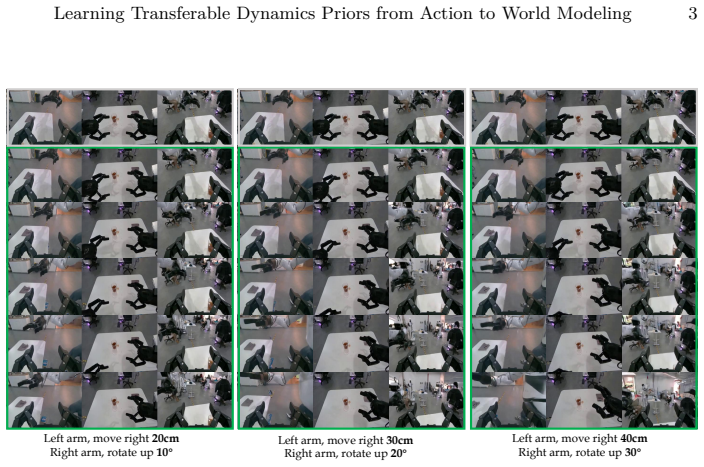
By pretraining a multi-view interactive base diffusion world model, A2World, on large-scale robot manipulation data with real action annotations, the model captures reusable interaction dynamics beyond appearance-level video generation. These dynamics priors adapt into A2World-sim, a task- or scene-specialized simulator whose rollouts support policy evaluation and what-if analysis in place of real-robot trials, and into A2World-policy, a video-action joint predictor conditioned on visuals and instructions.
What carries the argument
A2World, the multi-view interactive base diffusion world model pretrained to predict how actions drive visual scene evolution.
Load-bearing premise
The pretrained model captures reusable interaction dynamics beyond merely memorizing visual patterns from the pretraining distribution.
What would settle it
If downstream performance on simulator rollouts and policy tasks shows no improvement when action conditioning is removed during pretraining, or if adapted models fail to match real dynamics on held-out scenes, the claim of transferable dynamics priors would not hold.
If this is right
- A2World-sim enables long-horizon rollouts that replace real-robot trials for policy evaluation and scalable analysis.
- A2World-policy supports action prediction under combined visual and instruction conditioning.
- The same pretrained weights benefit both simulator-centric and policy-centric robot learning pipelines.
- The approach demonstrates gains across simulation benchmarks and real-robot experiments.
Where Pith is reading between the lines
- The priors might allow few-shot adaptation to new robot embodiments or tasks outside the original pretraining distribution.
- Similar action-conditioned pretraining could be applied to other embodied settings such as navigation or assembly.
- If the dynamics are truly reusable, they could lower overall data requirements for training new robot policies from scratch.
Editorial analysis
A structured set of objections, weighed in public.
Referee Report
Summary. The paper claims that pretraining an action-conditioned multi-view diffusion world model (A2World) on large-scale robot manipulation data with real action annotations learns transferable dynamics priors beyond appearance-level video generation. These priors are adapted into A2World-sim for long-horizon simulator rollouts supporting policy evaluation and what-if analysis, and into A2World-policy for video-action joint prediction under visual/instruction conditioning; experiments across simulation benchmarks and real-robot settings are said to demonstrate benefits for both simulator-centric and policy-centric robot learning.
Significance. If the central claim is substantiated, the approach would offer a scalable route to reusable interaction dynamics priors from action data that transfer to both simulation and policy learning, potentially enabling more efficient robot learning pipelines that replace some real-robot rollouts with world-model rollouts.
major comments (2)
- [Abstract and Experiments] Abstract and Experiments section: the claim of validation 'across simulation benchmarks and real-robot settings' is asserted without any reported metrics, baselines, ablation results, or controls visible even in the full manuscript description; quantitative evidence is required to support the transfer claim.
- [Method (§3) and Experiments (§5)] Method (§3) and Experiments (§5): no ablation compares the action-conditioned A2World pretraining to an unconditional video diffusion model trained on identical robot video data without action inputs. Without this matched control, downstream gains on simulator rollouts or policy prediction could be explained by generic visual feature learning rather than by the action-to-dynamics mapping, leaving the weakest assumption (that the model captures reusable interaction dynamics) untested.
minor comments (1)
- [Method] Notation for the multi-view interactive base diffusion model could be clarified with an explicit equation for the action-conditioning mechanism.
Simulated Author's Rebuttal
We thank the referee for the constructive feedback. Below we respond point-by-point to the major comments, clarifying the quantitative evidence already present in the manuscript while agreeing to strengthen the presentation and add the requested control experiment.
read point-by-point responses
-
Referee: [Abstract and Experiments] Abstract and Experiments section: the claim of validation 'across simulation benchmarks and real-robot settings' is asserted without any reported metrics, baselines, ablation results, or controls visible even in the full manuscript description; quantitative evidence is required to support the transfer claim.
Authors: Section 5 of the manuscript reports quantitative results on simulation benchmarks (prediction MSE, long-horizon rollout fidelity, and policy success rates) and real-robot tasks (task completion rates and sample efficiency), with multiple baselines, ablations, and controls presented in tables and figures. We will revise the abstract and §5 to more explicitly cross-reference these metrics and ensure all quantitative evidence is highlighted for clarity. revision: partial
-
Referee: [Method (§3) and Experiments (§5)] Method (§3) and Experiments (§5): no ablation compares the action-conditioned A2World pretraining to an unconditional video diffusion model trained on identical robot video data without action inputs. Without this matched control, downstream gains on simulator rollouts or policy prediction could be explained by generic visual feature learning rather than by the action-to-dynamics mapping, leaving the weakest assumption (that the model captures reusable interaction dynamics) untested.
Authors: We agree that a matched ablation against an unconditional video diffusion model trained on the identical robot video corpus would provide the cleanest isolation of the action-conditioning contribution. While existing baselines control for some visual factors, this specific control was omitted. We will add the ablation in the revised manuscript. revision: yes
Circularity Check
No circularity in derivation chain
full rationale
The paper describes an empirical pretraining pipeline for an action-conditioned diffusion world model followed by adaptation to simulator and policy tasks. No equations, fitted parameters, or self-referential definitions appear in the abstract or described steps that would reduce any claimed prediction or transferable prior to the inputs by construction. The central claim rests on experimental outcomes across benchmarks rather than a mathematical derivation that loops back to its own assumptions or data fits. Self-citations, if present, are not load-bearing for the core argument in the provided text.
Axiom & Free-Parameter Ledger
read the original abstract
We study action-conditioned world modeling as a scalable way to learn transferable dynamics priors for robot learning. By pretraining a model to predict how actions drive visual scene evolution, the resulting world model captures reusable interaction dynamics beyond appearance-level video generation. Concretely, we pretrain a multi-view interactive base diffusion world model, A2World, on large-scale robot manipulation data with real action annotations. We validate the learned dynamics priors from two complementary perspectives. First, we adapt A2World into a task- or scene-specialized real-world simulator, A2World-sim, whose long-horizon rollouts support simulator-based policy evaluation and scalable what-if analysis by replacing real-robot rollouts with world model rollouts. Second, starting from the same pretrained weights, we adapt A2World into a video-action joint prediction model, A2World-policy, that predicts actions under visual and instruction conditioning. Experiments across simulation benchmarks and real-robot settings demonstrate that action-conditioned world model pretraining yields transferable dynamics priors that benefit both simulator-centric and policy-centric robot learning.
Figures




Reference graph
Works this paper leans on
-
[1]
arXiv preprint (2025)
Agarwal, N., Ali, A., Bala, M., Balaji, Y., Barker, E., Cai, T., Chattopadhyay, P., Chen, Y., Cui, Y., Ding, Y., et al.: Cosmos world foundation model platform for physical ai. arXiv preprint (2025)
2025
-
[2]
arXiv preprint (2025)
Ali, A., Bai, J., Bala, M., Balaji, Y., Blakeman, A., Cai, T., Cao, J., Cao, T., Cha, E., Chao, Y.W., et al.: World simulation with video foundation models for physical ai. arXiv preprint (2025)
2025
-
[3]
arXiv preprint (2025)
Barreiros, J., Beaulieu, A., Bhat, A., Cory, R., Cousineau, E., Dai, H., Fang, C.H., Hashimoto, K., Irshad, M.Z., Itkina, M., et al.: A careful examination of large behavior models for multitask dexterous manipulation. arXiv preprint (2025)
2025
-
[4]
arXiv preprint (2025)
Bi, H., Tan, H., Xie, S., Wang, Z., Huang, S., Liu, H., Zhao, R., Feng, Y., Xiang, C., Rong, Y., et al.: Motus: A unified latent action world model. arXiv preprint (2025)
2025
-
[5]
arXiv preprint (2024)
Black, K., Brown, N., Driess, D., Esmail, A., Equi, M., Finn, C., Fusai, N., Groom, L., Hausman, K., Ichter, B., et al.: pi0: A vision-language-action flow model for general robot control. arXiv preprint (2024)
2024
-
[6]
arXiv preprint (2023)
Blattmann, A., Dockhorn, T., Kulal, S., Mendelevitch, D., Kilian, M., Lorenz, D., Levi, Y., English, Z., Voleti, V., Letts, A., et al.: Stable video diffusion: Scaling latent video diffusion models to large datasets. arXiv preprint (2023)
2023
-
[7]
arXiv preprint (2025)
Bu, Q., Cai, J., Chen, L., Cui, X., Ding, Y., Feng, S., Gao, S., He, X., Hu, X., Huang, X., et al.: Agibot world colosseo: A large-scale manipulation platform for scalable and intelligent embodied systems. arXiv preprint (2025)
2025
-
[8]
arXiv preprint (2025)
Bu, Q., Yang, Y., Cai, J., Gao, S., Ren, G., Yao, M., Luo, P., Li, H.: Univla: Learning to act anywhere with task-centric latent actions. arXiv preprint (2025)
2025
-
[9]
IJRR (2025)
Chi, C., Xu, Z., Feng, S., Cousineau, E., Du, Y., Burchfiel, B., Tedrake, R., Song, S.: Diffusion policy: Visuomotor policy learning via action diffusion. IJRR (2025)
2025
-
[10]
arXiv preprint (2019)
Dasari, S., Ebert, F., Tian, S., Nair, S., Bucher, B., Schmeckpeper, K., Singh, S., Levine, S., Finn, C.: Robonet: Large-scale multi-robot learning. arXiv preprint (2019)
2019
-
[11]
arXiv preprint (2025)
Fei, S., Wang, S., Shi, J., Dai, Z., Cai, J., Qian, P., Ji, L., He, X., Zhang, S., Fei, Z., et al.: Libero-plus: In-depth robustness analysis of vision-language-action models. arXiv preprint (2025)
2025
-
[12]
arXiv preprint (2026)
Gao,S.,Liang,W.,Zheng,K.,Malik,A.,Ye,S.,Yu,S.,Tseng,W.C.,Dong,Y.,Mo, K., Lin, C.H., et al.: Dreamdojo: A generalist robot world model from large-scale human videos. arXiv preprint (2026)
2026
-
[13]
ICLR (2026)
Guo, Y., Shi, L.X., Chen, J., Finn, C.: Ctrl-world: A controllable generative world model for robot manipulation. ICLR (2026)
2026
-
[14]
arXiv preprint (2022)
Gupta, A., Tian, S., Zhang, Y., Wu, J., Martín-Martín, R., Fei-Fei, L.: Maskvit: Masked visual pre-training for video prediction. arXiv preprint (2022)
2022
-
[15]
arXiv preprint (2024)
HaCohen, Y., Chiprut, N., Brazowski, B., Shalem, D., Moshe, D., Richardson, E., Levin, E., Shiran, G., Zabari, N., Gordon, O., et al.: Ltx-video: Realtime video latent diffusion. arXiv preprint (2024)
2024
-
[16]
NeurIPS (2024)
He, H., Bai, C., Pan, L., Zhang, W., Zhao, B., Li, X.: Learning an actionable dis- crete diffusion policy via large-scale actionless video pre-training. NeurIPS (2024)
2024
-
[17]
In: ICCV (2025)
Hou, Z., Zhang, T., Xiong, Y., Duan, H., Pu, H., Tong, R., Zhao, C., Zhu, X., Qiao, Y., Dai, J., et al.: Dita: Scaling diffusion transformer for generalist vision- language-action policy. In: ICCV (2025)
2025
-
[18]
Video Prediction Policy: A Generalist Robot Policy with Predictive Visual Representations
Hu, Y., Guo, Y., Wang, P., Chen, X., Wang, Y.J., Zhang, J., Sreenath, K., Lu, C., Chen, J.: Video prediction policy: A generalist robot policy with predictive visual representations. arXiv preprint arXiv:2412.14803 (2024) Learning Transferable Dynamics Priors from Action to World Modeling 17
work page internal anchor Pith review Pith/arXiv arXiv 2024
-
[19]
arXiv preprint (2025)
Huang, X., Li, Z., He, G., Zhou, M., Shechtman, E.: Self forcing: Bridging the train-test gap in autoregressive video diffusion. arXiv preprint (2025)
2025
-
[20]
arXiv preprint (2025)
Intelligence, P., Black, K., Brown, N., Darpinian, J., Dhabalia, K., Driess, D., Esmail, A., Equi, M., Finn, C., Fusai, N., et al.: pi0.5: a vision-language-action model with open-world generalization. arXiv preprint (2025)
2025
-
[21]
com / InternRobotics/InternManip, accessed 27 Jun 2026
InternData-M1 Contributors: Interndata-m1 (2025),https : / / github . com / InternRobotics/InternManip, accessed 27 Jun 2026
2025
-
[22]
arXiv preprint (2025)
Jang,J.,Ye,S.,Lin,Z.,Xiang,J.,Bjorck,J.,Fang,Y.,Hu,F.,Huang,S.,Kundalia, K., Lin, Y.C., et al.: Dreamgen: Unlocking generalization in robot learning through video world models. arXiv preprint (2025)
2025
-
[23]
arXiv preprint (2025)
Jiang, T., Yuan, T., Liu, Y., Lu, C., Cui, J., Liu, X., Cheng, S., Gao, J., Xu, H., Zhao, H.: Galaxea open-world dataset and g0 dual-system vla model. arXiv preprint (2025)
2025
-
[24]
EnerVerse-AC: Envisioning Embodied Environments with Action Condition
Jiang, Y., Chen, S., Huang, S., Chen, L., Zhou, P., Liao, Y., He, X., Liu, C., Li, H., Yao, M., et al.: Enerverse-ac: Envisioning embodied environments with action condition. arXiv preprint arXiv:2505.09723 (2025)
work page Pith review arXiv 2025
-
[25]
arXiv preprint (2025)
Jiang, Z., Liu, K., Qin, Y., Tian, S., Zheng, Y., Zhou, M., Yu, C., Li, H., Zhao, D.: World4rl: Diffusion world models for policy refinement with reinforcement learning for robotic manipulation. arXiv preprint (2025)
2025
-
[26]
NeurIPS (2022)
Karras,T.,Aittala,M.,Aila,T.,Laine,S.:Elucidatingthedesignspaceofdiffusion- based generative models. NeurIPS (2022)
2022
-
[27]
arXiv preprint (2024)
Khazatsky, A., Pertsch, K., Nair, S., Balakrishna, A., Dasari, S., Karamcheti, S., Nasiriany, S., Srirama, M.K., Chen, L.Y., Ellis, K., et al.: Droid: A large-scale in-the-wild robot manipulation dataset. arXiv preprint (2024)
2024
-
[28]
arXiv preprint (2025)
Kim, M.J., Finn, C., Liang, P.: Fine-tuning vision-language-action models: Opti- mizing speed and success. arXiv preprint (2025)
2025
-
[29]
arXiv preprint (2026)
Kim, M.J., Gao, Y., Lin, T.Y., Lin, Y.C., Ge, Y., Lam, G., Liang, P., Song, S., Liu, M.Y., Finn, C., et al.: Cosmos policy: Fine-tuning video models for visuomotor control and planning. arXiv preprint (2026)
2026
-
[30]
arXiv preprint (2025)
Li, H., Ding, P., Suo, R., Wang, Y., Ge, Z., Zang, D., Yu, K., Sun, M., Zhang, H., Wang, D., et al.: Vla-rft: Vision-language-action reinforcement fine-tuning with verified rewards in world simulators. arXiv preprint (2025)
2025
-
[31]
arXiv preprint (2026)
Li, L., Zhang, Q., Luo, Y., Yang, S., Wang, R., Han, F., Yu, M., Gao, Z., Xue, N., Zhu, X., Shen, Y., Xu, Y.: Causal world modeling for robot control. arXiv preprint (2026)
2026
-
[32]
arXiv preprint (2025)
Li, S., Gao, Y., Sadigh, D., Song, S.: Unified video action model. arXiv preprint (2025)
2025
-
[33]
arXiv preprint (2025)
Li, W., Zhang, R., Shao, R., He, J., Nie, L.: Cogvla: Cognition-aligned vision- language-action model via instruction-driven routing & sparsification. arXiv preprint (2025)
2025
-
[34]
arXiv preprint (2024)
Li, X., Hsu, K., Gu, J., Pertsch, K., Mees, O., Walke, H.R., Fu, C., Lunawat, I., Sieh, I., Kirmani, S., et al.: Evaluating real-world robot manipulation policies in simulation. arXiv preprint (2024)
2024
-
[35]
arXiv preprint (2025)
Li, Y., Zhu, Y., Wen, J., Shen, C., Xu, Y.: Worldeval: World model as real-world robot policies evaluator. arXiv preprint (2025)
2025
-
[36]
arXiv preprint (2025)
Liao, Y., Zhou, P., Huang, S., Yang, D., Chen, S., Jiang, Y., Hu, Y., Cai, J., Liu, S., Luo, J., et al.: Genie envisioner: A unified world foundation platform for robotic manipulation. arXiv preprint (2025)
2025
-
[37]
NeurIPS (2023) 18 Huang et al
Liu, B., Zhu, Y., Gao, C., Feng, Y., Liu, Q., Zhu, Y., Stone, P.: Libero: Bench- marking knowledge transfer for lifelong robot learning. NeurIPS (2023) 18 Huang et al
2023
-
[38]
arXiv preprint (2024)
Luo, Y., Du, Y.: Grounding video models to actions through goal conditioned exploration. arXiv preprint (2024)
2024
-
[39]
RA-L (2022)
Mees, O., Hermann, L., Rosete-Beas, E., Burgard, W.: Calvin: A benchmark for language-conditioned policy learning for long-horizon robot manipulation tasks. RA-L (2022)
2022
-
[40]
In: ICRA (2024)
O’Neill, A., Rehman, A., Maddukuri, A., Gupta, A., Padalkar, A., Lee, A., Poo- ley, A., Gupta, A., Mandlekar, A., Jain, A., et al.: Open x-embodiment: Robotic learning datasets and rt-x models: Open x-embodiment collaboration 0. In: ICRA (2024)
2024
-
[41]
arXiv preprint (2025)
Pai, J., Achenbach, L., Montesinos, V., Forrai, B., Mees, O., Nava, E.: mimic-video: Video-action models for generalizable robot control beyond vlas. arXiv preprint (2025)
2025
-
[42]
In: ICCV (2023)
Peebles, W., Xie, S.: Scalable diffusion models with transformers. In: ICCV (2023)
2023
-
[43]
arXiv preprint (2025)
Quevedo, J., Sharma, A.K., Sun, Y., Suryavanshi, V., Liang, P., Yang, S.: Worldgym: World model as an environment for policy evaluation. arXiv preprint (2025)
2025
-
[44]
Journal of machine learning research (2020)
Raffel, C., Shazeer, N., Roberts, A., Lee, K., Narang, S., Matena, M., Zhou, Y., Li, W., Liu, P.J.: Exploring the limits of transfer learning with a unified text-to-text transformer. Journal of machine learning research (2020)
2020
-
[45]
Evaluating gemini robotics policies in a veo world simulator.arXiv preprint arXiv:2512.10675, 2025
Team, G.R., Choromanski, K., Devin, C., Du, Y., Dwibedi, D., Gao, R., Jindal, A., Kipf, T., Kirmani, S., Leal, I., et al.: Evaluating gemini robotics policies in a veo world simulator. arXiv preprint arXiv:2512.10675 (2025)
-
[46]
arXiv preprint (2025)
Tian, Y., Yang, Y., Xie, Y., Cai, Z., Shi, X., Gao, N., Liu, H., Jiang, X., Qiu, Z., Yuan, F., et al.: Interndata-a1: Pioneering high-fidelity synthetic data for pre- training generalist policy. arXiv preprint (2025)
2025
-
[47]
arXiv preprint (2025)
Wan, T., Wang, A., Ai, B., Wen, B., Mao, C., Xie, C.W., Chen, D., Yu, F., Zhao, H., Yang, J., et al.: Wan: Open and advanced large-scale video generative models. arXiv preprint (2025)
2025
-
[48]
arXiv preprint (2025)
Wang, S., Tian, J., Wang, L., Liao, Z., Li, J., Dong, H., Xia, K., Zhou, S., Tang, W., Gang, H.: Sampo: Scale-wise autoregression with motion prompt for generative world models. arXiv preprint (2025)
2025
-
[49]
NeurIPS (2024)
Wen, Y., Lin, J., Zhu, Y., Han, J., Xu, H., Zhao, S., Liang, X.: Vidman: Exploiting implicit dynamics from video diffusion model for effective robot manipulation. NeurIPS (2024)
2024
-
[50]
arXiv preprint (2023)
Wu, H., Jing, Y., Cheang, C., Chen, G., Xu, J., Li, X., Liu, M., Li, H., Kong, T.: Unleashing large-scale video generative pre-training for visual robot manipulation. arXiv preprint (2023)
2023
-
[51]
In: NeurIPS (2024)
Wu, J., Yin, S., Feng, N., He, X., Li, D., Hao, J., Long, M.: ivideogpt: Interactive videogpts are scalable world models. In: NeurIPS (2024)
2024
-
[52]
arXiv preprint (2024)
Wu, K., Hou, C., Liu, J., Che, Z., Ju, X., Yang, Z., Li, M., Zhao, Y., Xu, Z., Yang, G., et al.: Robomind: Benchmark on multi-embodiment intelligence normative data for robot manipulation. arXiv preprint (2024)
2024
-
[53]
arXiv preprint (2025)
Wu, S., Liu, X., Xie, S., Wang, P., Li, X., Yang, B., Li, Z., Zhu, K., Wu, H., Liu, Y., et al.: Robocoin: An open-sourced bimanual robotic data collection for integrated manipulation. arXiv preprint (2025)
2025
-
[54]
arXiv preprint (2025)
Xiao,J.,Yang,Y.,Chang,X.,Chen,R.,Xiong,F.,Xu,M.,Zheng,W.S.,Zhang,Q.: World-env: Leveraging world model as a virtual environment for vla post-training. arXiv preprint (2025)
2025
-
[55]
arXiv preprint (2026)
Ye, S., Ge, Y., Zheng, K., Gao, S., Yu, S., Kurian, G., Indupuru, S., Tan, Y.L., Zhu, C., Xiang, J., Malik, A., Lee, K., Liang, W., Ranawaka, N., Gu, J., Xu, Y., Learning Transferable Dynamics Priors from Action to World Modeling 19 Wang, G., Hu, F., Narayan, A., Bjorck, J., Wang, J., Kim, G., Niu, D., Zheng, R., Xie, Y., Wu, J., Wang, Q., Julian, R., Xu,...
2026
-
[56]
Yuan, T., Dong, Z., Liu, Y., Zhao, H.: Fast-wam: Do world action models need test-time future imagination? arXiv preprint (2026)
2026
-
[57]
NeurIPS (2025)
Zhang, J., Chen, Y., Xu, Y., Huang, Z., Zhou, Y., Yuan, Y.J., Cai, X., Huang, G., Quan, X., Xu, H., et al.: 4d-vla: Spatiotemporal vision-language-action pretraining with cross-scene calibration. NeurIPS (2025)
2025
-
[58]
arXiv preprint (2025)
Zhang, J., Huang, Z., Gu, C., Ma, Z., Zhang, L.: Reinforcing action policies by prophesying. arXiv preprint (2025)
2025
-
[59]
arXiv preprint (2025)
Zheng, J., Li, J., Wang, Z., Liu, D., Kang, X., Feng, Y., Zheng, Y., Zou, J., Chen, Y., Zeng, J., et al.: X-vla: Soft-prompted transformer as scalable cross-embodiment vision-language-action model. arXiv preprint (2025)
2025
-
[60]
arXiv preprint (2025)
Zhu, C., Yu, R., Feng, S., Burchfiel, B., Shah, P., Gupta, A.: Unified world models: Coupling video and action diffusion for pretraining on large robotic datasets. arXiv preprint (2025)
2025
-
[61]
In: ICCV (2025)
Zhu, F., Wu, H., Guo, S., Liu, Y., Cheang, C., Kong, T.: Irasim: A fine-grained world model for robot manipulation. In: ICCV (2025)
2025
-
[62]
arXiv preprint (2025)
Zhu, F., Yan, Z., Hong, Z., Shou, Q., Ma, X., Guo, S.: Wmpo: World model-based policy optimization for vision-language-action models. arXiv preprint (2025)
2025
-
[63]
Zhu, Y., Joshi, A., Stone, P., Zhu, Y.: Viola: Imitation learning for vision-based manipulation with object proposal priors. In: CoRL (2023) Learning Transferable Dynamics Priors from Action to World Modeling 1 6 Supplement implementation details 6.1 Supplement A2World and A2World-sim details Pose-guided history sampling for dual-arm settingAlg. 1 in the ...
2023
discussion (0)
Sign in with ORCID, Apple, or X to comment. Anyone can read and Pith papers without signing in.