Complete Access to Leading-Twist Λ-Baryon Light-Cone Distribution Amplitudes from Lattice QCD
Pith reviewed 2026-06-30 01:39 UTC · model grok-4.3
The pith
Lattice QCD yields the first complete leading-twist LCDAs for the Lambda baryon as full two-dimensional functions of valence quark momentum fractions.
A machine-rendered reading of the paper's core claim, the machinery that carries it, and where it could break.
Core claim
We report the first complete lattice-QCD determination of the leading-twist light-cone distribution amplitudes (LCDAs) of the λ baryon, obtained as full two-dimensional functions of the valence-quark momentum fractions. The calculation employs large-momentum effective theory to relate the light-cone amplitudes to equal-time nonlocal three-quark matrix elements of boosted λ baryons. Controlled physical extrapolations to the continuum, physical pion mass, and infinite momentum, together with hybrid renormalization, large-λ extrapolation, and perturbative matching, yield the three leading-twist LCDAs V, A, and T. Using the lattice-determined LCDAs in place of the asymptotic form, we find an O(1
What carries the argument
LaMET matching that converts equal-time nonlocal three-quark matrix elements of boosted Lambda baryons into light-cone distribution amplitudes, together with hybrid renormalization and simultaneous extrapolations in lattice spacing, pion mass, and momentum.
If this is right
- The full two-dimensional LCDAs V, A, and T are now available from first principles and must replace asymptotic or moment-only approximations in precision baryon calculations.
- The Lambda electromagnetic form factor receives an O(10%) correction at perturbative scales when the lattice LCDAs are used.
- This calculation supplies the first benchmark complete x-dependent baryon LCDAs for use in other phenomenological applications.
- The companion framework paper together with this work opens lattice access to multi-dimensional baryon structure functions.
Where Pith is reading between the lines
- The same LaMET-plus-extrapolation pipeline could be applied to obtain LCDAs for other octet or decuplet baryons.
- Having the full two-dimensional functions allows direct computation of observables that integrate over specific momentum fractions, such as certain decay amplitudes or generalized parton distributions.
- The ten-percent shift in the form factor indicates that similar corrections may appear in other baryon observables that currently rely on asymptotic LCDAs.
Load-bearing premise
The combination of LaMET matching, hybrid renormalization, large-lambda extrapolation, and simultaneous continuum, physical-pion-mass, and infinite-momentum extrapolations recovers the true light-cone amplitudes without large uncontrolled systematic errors.
What would settle it
An independent non-lattice determination or a precision measurement of the Lambda electromagnetic form factor that agrees with the asymptotic prediction but disagrees with the ten-percent shift obtained from the lattice LCDAs.
Figures
read the original abstract
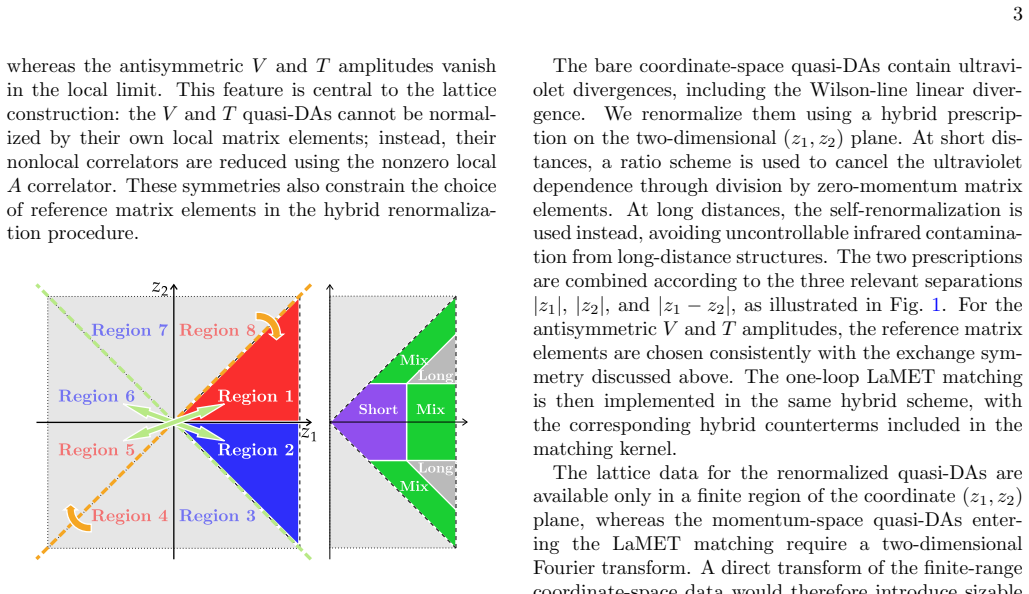
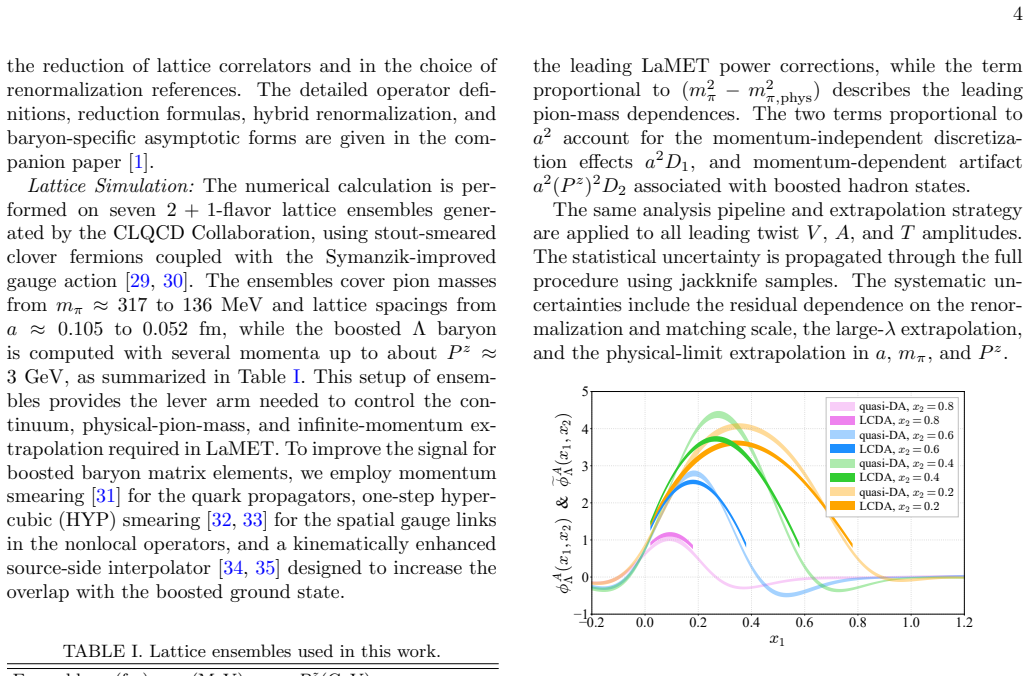
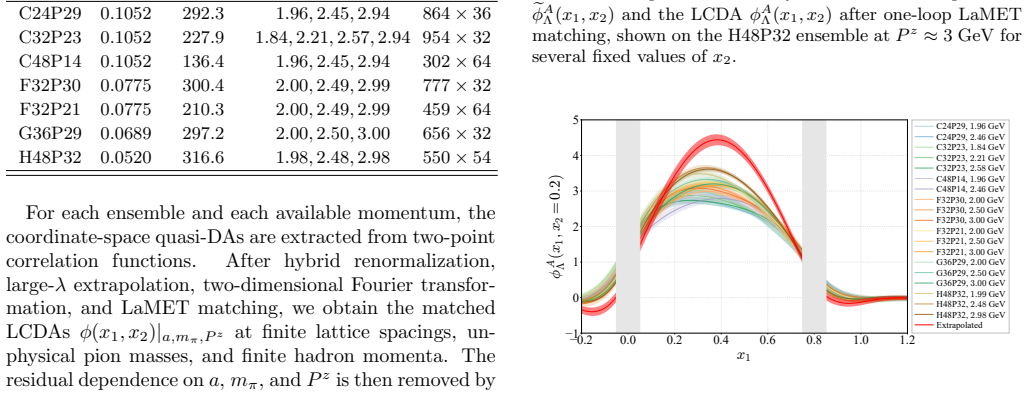
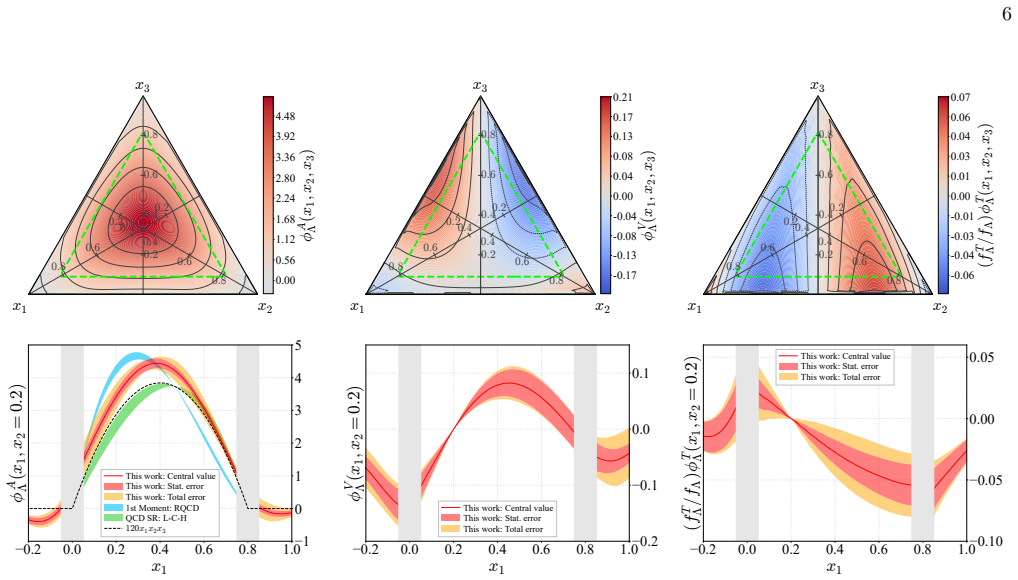
We report the first complete lattice-QCD determination of the leading-twist light-cone distribution amplitudes (LCDAs) of the $\Lambda$ baryon, obtained as full two-dimensional functions of the valence-quark momentum fractions. The calculation employs large-momentum effective theory to relate the light-cone amplitudes to equal-time nonlocal three-quark matrix elements of boosted $\Lambda$ baryons. Controlled physical extrapolations to the continuum, physical pion mass, and infinite momentum, together with hybrid renormalization, large-$\lambda$ extrapolation, and perturbative matching, yield the three leading-twist LCDAs $V$, $A$, and $T$. Using the lattice-determined LCDAs in place of the asymptotic form, we find an $\mathcal{O}(10\%)$ shift in the $\Lambda$ electromagnetic form factor at perturbative scales, demonstrating that the full two-dimensional LCDAs, rather than only their asymptotic shapes or lowest moments, are required for precision baryonic phenomenology. This work, together with the companion paper [1] detailing the baryon-LaMET framework, provides the first complete multi-dimensional $x$-dependent baryon LCDAs from first principles and establishes a benchmark for lattice access to multi-dimensional baryon structure.
Editorial analysis
A structured set of objections, weighed in public.
Referee Report
Summary. The paper claims the first complete lattice-QCD determination of the leading-twist LCDAs (V, A, T) of the Λ baryon as full two-dimensional functions of valence-quark momentum fractions. It employs LaMET to relate these to equal-time nonlocal three-quark matrix elements on boosted baryons, combined with hybrid renormalization, large-λ extrapolation, perturbative matching, and simultaneous extrapolations to the continuum, physical pion mass, and infinite momentum. The resulting LCDAs are shown to produce an O(10%) shift in the Λ electromagnetic form factor relative to the asymptotic form, establishing a benchmark for multi-dimensional baryon structure from first principles.
Significance. If the multi-stage extrapolation and matching pipeline is under control, this constitutes a significant advance by delivering the first first-principles, x-dependent LCDAs for a baryon rather than moments or asymptotic forms. The explicit demonstration of the form-factor correction underscores the phenomenological necessity of the full distributions and provides a concrete benchmark against which future lattice and model calculations can be tested.
major comments (1)
- Abstract and extrapolation sections: the central claim that the combination of LaMET matching, hybrid renormalization, large-λ extrapolation, and simultaneous continuum/physical-pion/infinite-momentum extrapolations recovers the LCDAs without uncontrolled bias is load-bearing, yet the fit forms, covariance matrices, χ²/dof values, and stability tests under variations of the fit ansatz are not reproduced in sufficient detail to verify the asserted control.
Simulated Author's Rebuttal
We thank the referee for the careful reading of our manuscript and the constructive comment. We address the point below and will revise the manuscript to provide the requested details on the extrapolation procedures.
read point-by-point responses
-
Referee: Abstract and extrapolation sections: the central claim that the combination of LaMET matching, hybrid renormalization, large-λ extrapolation, and simultaneous continuum/physical-pion/infinite-momentum extrapolations recovers the LCDAs without uncontrolled bias is load-bearing, yet the fit forms, covariance matrices, χ²/dof values, and stability tests under variations of the fit ansatz are not reproduced in sufficient detail to verify the asserted control.
Authors: We agree that additional documentation of the fit forms, covariance matrices, χ²/dof values, and stability tests is needed to allow full verification of the extrapolation control. The companion paper provides the overall LaMET framework, but the current manuscript's extrapolation sections will be expanded in revision to include the explicit functional forms for the simultaneous continuum, physical-pion-mass, and infinite-momentum extrapolations, the covariance matrices, the χ²/dof for the primary fits, and results from variations of the fit ansatz demonstrating stability. These additions will be placed in the main text or a dedicated appendix. revision: yes
Circularity Check
No significant circularity; result extracted from lattice matrix elements
full rationale
The derivation chain starts from equal-time nonlocal three-quark matrix elements computed on the lattice, applies LaMET matching, hybrid renormalization, and simultaneous extrapolations in continuum, mπ, Pz, and λ to obtain the LCDAs V, A, T as two-dimensional functions. These steps are data-driven extractions rather than self-definitions or re-use of fitted parameters as predictions. The companion paper [1] supplies operator definitions and matching coefficients but does not make the final LCDAs tautological. No load-bearing step reduces by construction to its own inputs; the O(10%) form-factor shift is a downstream application of the extracted functions. This is the normal non-circular outcome for a first-principles lattice determination.
Axiom & Free-Parameter Ledger
axioms (2)
- domain assumption Large-momentum effective theory correctly relates equal-time lattice matrix elements of boosted baryons to light-cone distribution amplitudes after matching and extrapolation.
- domain assumption Hybrid renormalization and perturbative matching introduce no uncontrolled errors at the quoted precision.
Reference graph
Works this paper leans on
-
[1]
Companion Paper: Baryon Light- Cone Distribution Amplitudes from Lattice QCD: For- malism, Renormalization, Extrapolation, and Matching
Mu-Hua Zhang et al. Companion Paper: Baryon Light- Cone Distribution Amplitudes from Lattice QCD: For- malism, Renormalization, Extrapolation, and Matching
-
[2]
Peter Lepage and Stanley J
G. Peter Lepage and Stanley J. Brodsky. Exclusive Pro- cesses in Perturbative Quantum Chromodynamics.Phys. Rev. D, 22:2157, 1980
1980
-
[3]
A. V. Efremov and A. V. Radyushkin. Asymptotical Behavior of Pion Electromagnetic Form-Factor in QCD. Theor. Math. Phys., 42:97–110, 1980
1980
-
[4]
V. L. Chernyak, A. A. Ogloblin, and I. R. Zhitnitsky. Wave Functions of Octet Baryons.Yad. Fiz., 48:1410– 1422, 1988
1988
-
[5]
Next-to-Leading-Order QCD Corrections to Nucleon Dirac Form Factors.Phys
Long-Bin Chen, Wen Chen, Feng Feng, Siwei Hu, and Yu Jia. Next-to-Leading-Order QCD Corrections to Nucleon Dirac Form Factors.Phys. Rev. Lett., 135(13):131903, 2025
2025
-
[6]
Next-to-Leading-Order QCD Predic- tions for the Nucleon Form Factors.Phys
Yong-Kang Huang, Bo-Xuan Shi, Yu-Ming Wang, and Xue-Chen Zhao. Next-to-Leading-Order QCD Predic- tions for the Nucleon Form Factors.Phys. Rev. Lett., 135(6):061901, 2025
2025
-
[7]
Observation of charge–parity symmetry breaking in baryon decays.Nature, 643(8074):1223–1228, 2025
Roel Aaij et al. Observation of charge–parity symmetry breaking in baryon decays.Nature, 643(8074):1223–1228, 2025
2025
-
[8]
Aaij et al
R. Aaij et al. Study of Λb0 and Ξb0 Decays to Λh+h’- and Evidence for CP Violation in Λb0→ΛK+K- Decays. Phys. Rev. Lett., 134(10):101802, 2025
2025
-
[9]
Establish- ing CP Violation in b-Baryon Decays.Phys
Jia-Jie Han, Ji-Xin Yu, Ya Li, Hsiang-nan Li, Jian-Peng Wang, Zhen-Jun Xiao, and Fu-Sheng Yu. Establish- ing CP Violation in b-Baryon Decays.Phys. Rev. Lett., 134(22):221801, 2025
2025
-
[10]
CP violation in two-body hadronic Λb decays in the PQCD approach
Jia-Jie Han, Ji-Xin Yu, Ya Li, Hsiang-nan Li, Jian-Peng Wang, Zhen-Jun Xiao, and Fu-Sheng Yu. CP violation in two-body hadronic Λb decays in the PQCD approach. 9 Phys. Rev. D, 112(5):053007, 2025
2025
-
[11]
Perturbative QCD Prediction of the Hyperon Electric Dipole Moment from CP-Violating Dipole Inter- actions.Phys
Kai-Bao Chen, Xiao-Gang He, Jian-Ping Ma, and Xuan- Bo Tong. Perturbative QCD Prediction of the Hyperon Electric Dipole Moment from CP-Violating Dipole Inter- actions.Phys. Rev. Lett., 136(5):051902, 2026
2026
-
[12]
V. L. Chernyak and I. R. Zhitnitsky. Nucleon Wave Func- tion and Nucleon Form-Factors in QCD.Nucl. Phys. B, 246:52–74, 1984
1984
-
[13]
I. D. King and Christopher T. Sachrajda. Nucleon Wave Functions and QCD Sum Rules.Nucl. Phys. B, 279:785– 803, 1987
1987
-
[14]
Higher order light-cone distribution amplitudes of the Lambda baryon.Eur
Yong-Lu Liu, Chun-Yu Cui, and Ming-Qiu Huang. Higher order light-cone distribution amplitudes of the Lambda baryon.Eur. Phys. J. C, 74:3041, 2014
2014
-
[15]
V. M. Braun, A. Lenz, and M. Wittmann. Nucleon Form Factors in QCD.Phys. Rev. D, 73:094019, 2006
2006
-
[16]
Bali et al
Gunnar S. Bali et al. Light-cone distribution amplitudes of the baryon octet.JHEP, 02:070, 2016
2016
-
[17]
Bali et al
Gunnar S. Bali et al. Light-cone distribution amplitudes of octet baryons from lattice QCD.Eur. Phys. J. A, 55(7):116, 2019
2019
-
[18]
G. S. Bali, V. M. Braun, S. B¨ urger, M. G¨ ockeler, M. Gru- ber, F. Kaiser, B. A. Kniehl, O. L. Veretin, and P. Wein. Updated determination of light-cone distribution ampli- tudes of octet baryons in lattice QCD.Phys. Rev. D, 111(9):094517, 2025
2025
-
[19]
Parton Physics on a Euclidean Lattice
Xiangdong Ji. Parton Physics on a Euclidean Lattice. Phys. Rev. Lett., 110:262002, 2013
2013
-
[20]
Large-momentum effective the- ory.Rev
Xiangdong Ji, Yu-Sheng Liu, Yizhuang Liu, Jian-Hui Zhang, and Yong Zhao. Large-momentum effective the- ory.Rev. Mod. Phys., 93(3):035005, 2021
2021
-
[21]
Light-cone distribution amplitudes of a light baryon in large-momentum effective theory.JHEP, 07:191, 2023
Zhi-Fu Deng, Chao Han, Wei Wang, Jun Zeng, and Jia-Lu Zhang. Light-cone distribution amplitudes of a light baryon in large-momentum effective theory.JHEP, 07:191, 2023
2023
-
[22]
Hybrid renormalization for quasi distribution amplitudes of a light baryon.JHEP, 12:044, 2023
Chao Han, Yushan Su, Wei Wang, and Jia-Lu Zhang. Hybrid renormalization for quasi distribution amplitudes of a light baryon.JHEP, 12:044, 2023
2023
-
[23]
Lightcone and quasi distribution amplitudes for light octet and decuplet baryons.JHEP, 07:019, 2024
Chao Han, Wei Wang, Jun Zeng, and Jia-Lu Zhang. Lightcone and quasi distribution amplitudes for light octet and decuplet baryons.JHEP, 07:019, 2024
2024
-
[24]
Hybrid renormaliza- tion with gradient flow for baryon quasidistribution am- plitudes.Phys
Jia-lu Zhang and Mu-Hua Zhang. Hybrid renormaliza- tion with gradient flow for baryon quasidistribution am- plitudes.Phys. Rev. D, 113(1):014501, 2026
2026
-
[25]
Light cone distribution ampli- tude for the Λ baryon from lattice QCD.Phys
Min-Huan Chu et al. Light cone distribution ampli- tude for the Λ baryon from lattice QCD.Phys. Rev. D, 111(3):034510, 2025
2025
-
[26]
Hybrid renormalization for distri- bution amplitude of a light baryon in large momentum effective theory.Phys
Haoyang Bai et al. Hybrid renormalization for distri- bution amplitude of a light baryon in large momentum effective theory.Phys. Rev. D, 112(11):114515, 2025
2025
-
[27]
Braun, Sergey E
Vladimir M. Braun, Sergey E. Derkachov, G. P. Ko- rchemsky, and A. N. Manashov. Baryon distribution am- plitudes in QCD.Nucl. Phys. B, 553:355–426, 1999
1999
-
[28]
Asymp- totic Long-Distance Expansion of Euclidean Correlators in Lattice Parton Applications
Xiangdong Ji, Yizhuang Liu, and Yushan Su. Asymp- totic Long-Distance Expansion of Euclidean Correlators in Lattice Parton Applications. 1 2026
2026
-
[29]
Quark masses and low-energy con- stants in the continuum from the tadpole-improved clover ensembles.Phys
Zhi-Cheng Hu et al. Quark masses and low-energy con- stants in the continuum from the tadpole-improved clover ensembles.Phys. Rev. D, 109(5):054507, 2024
2024
-
[30]
Charmed meson masses and decay constants in the continuum limit from the tadpole im- proved clover ensembles.Phys
Hai-Yang Du et al. Charmed meson masses and decay constants in the continuum limit from the tadpole im- proved clover ensembles.Phys. Rev. D, 111(5):054504, 2025
2025
-
[31]
Bali, Bernhard Lang, Bernhard U
Gunnar S. Bali, Bernhard Lang, Bernhard U. Musch, and Andreas Sch¨ afer. Novel quark smearing for hadrons with high momenta in lattice QCD.Phys. Rev. D, 93(9):094515, 2016
2016
-
[32]
Flavor sym- metry and the static potential with hypercubic blocking
Anna Hasenfratz and Francesco Knechtli. Flavor sym- metry and the static potential with hypercubic blocking. Phys. Rev. D, 64:034504, 2001
2001
-
[33]
DeGrand, Anna Hasenfratz, and Tamas G
Thomas A. DeGrand, Anna Hasenfratz, and Tamas G. Kovacs. Improving the chiral properties of lattice fermions.Phys. Rev. D, 67:054501, 2003
2003
-
[34]
Grebe, Daniel C
Rui Zhang, Anthony V. Grebe, Daniel C. Hackett, Michael L. Wagman, and Yong Zhao. Kinematically enhanced interpolating operators for boosted hadrons. Phys. Rev. D, 112(5):L051502, 2025
2025
-
[35]
Kinematic enhancement for nu- cleon interpolators
Daniel Reitinger, Tobias Sizmann, Andreas Sch¨ afer, Rui Zhang, and Yong Zhao. Kinematic enhancement for nu- cleon interpolators. 6 2026
2026
-
[36]
V. M. Braun, A. N. Manashov, and J. Rohrwild. Baryon Operators of Higher Twist in QCD and Nucleon Distri- bution Amplitudes.Nucl. Phys. B, 807:89–137, 2009
2009
-
[37]
Two-Loop Renormalization-Group Evolution for the Nucleon Distribution Amplitude
Yong-Kang Huang, Yao Ji, Bo-Xuan Shi, and Yu-Ming Wang. Two-Loop Renormalization-Group Evolution for the Nucleon Distribution Amplitude. 12 2025. [38]Supplemental Material
2025
-
[38]
Use QUDA for lattice QCD calculation with Python
Xiangyu Jiang, Chunjiang Shi, Ying Chen, Ming Gong, and Yi-Bo Yang. Use QUDA for lattice QCD calculation with Python. 11 2024
2024
-
[39]
M. A. Clark, R. Babich, K. Barros, R. C. Brower, and C. Rebbi. Solving Lattice QCD systems of equations using mixed precision solvers on GPUs.Comput. Phys. Commun., 181:1517–1528, 2010
2010
-
[40]
Babich, M
R. Babich, M. A. Clark, B. Joo, G. Shi, R. C. Brower, and S. Gottlieb. Scaling lattice QCD beyond 100 GPUs. InInternational Conference for High Performance Com- puting, Networking, Storage and Analysis, 9 2011
2011
-
[41]
M. A. Clark, B´ alint Jo´ o, Alexei Strelchenko, Michael Cheng, Arjun Gambhir, and Richard. C. Brower. Ac- celerating lattice QCD multigrid on GPUs using fine- grained parallelization. InInternational Conference for High Performance Computing, Networking, Storage and Analysis, 12 2016
2016
-
[42]
Lattice QCD pack- age GWU-code and QUDA with HIP.PoS, LAT- TICE2019:286, 2020
Yu-Jiang Bi, Yi Xiao, Wei-Yi Guo, Ming Gong, Peng Sun, Shun Xu, and Yi-Bo Yang. Lattice QCD pack- age GWU-code and QUDA with HIP.PoS, LAT- TICE2019:286, 2020
2020
discussion (0)
Sign in with ORCID, Apple, or X to comment. Anyone can read and Pith papers without signing in.