Ferron Hall effect: Transverse accumulation of polarization driven by thermal gradients in ferroelectrics
Pith reviewed 2026-06-30 05:37 UTC · model grok-4.3
The pith
Ferrons deflected by magnetic fields accumulate electric polarization transversely in ferroelectrics under thermal gradients.
A machine-rendered reading of the paper's core claim, the machinery that carries it, and where it could break.
Core claim
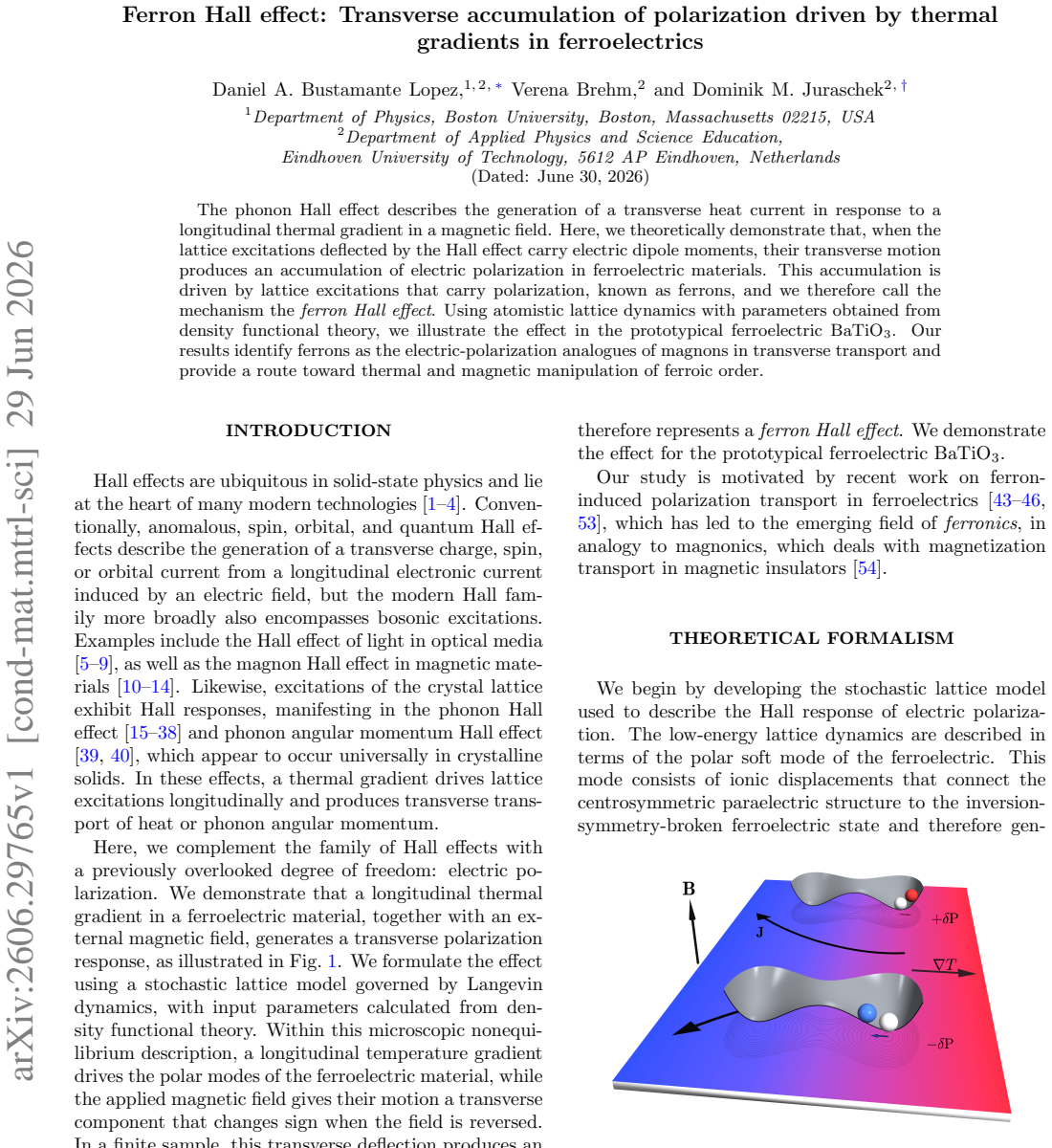
The phonon Hall effect describes the generation of a transverse heat current in response to a longitudinal thermal gradient in a magnetic field. When the lattice excitations deflected by the Hall effect carry electric dipole moments, their transverse motion produces an accumulation of electric polarization in ferroelectric materials. This accumulation is driven by lattice excitations that carry polarization, known as ferrons, and we therefore call the mechanism the ferron Hall effect. Using atomistic lattice dynamics with parameters obtained from density functional theory, we illustrate the effect in the prototypical ferroelectric BaTiO3. Our results identify ferrons as the electric-polariza
What carries the argument
The ferron Hall effect, in which ferrons (lattice excitations carrying electric polarization) undergo transverse deflection under a magnetic field and thermal gradient, producing net polarization accumulation.
If this is right
- Polarization accumulates transversely due to ferron deflection in response to longitudinal thermal gradients in a magnetic field.
- Ferrons function as the electric-polarization analogues of magnons for transverse transport phenomena.
- The mechanism supplies a route to manipulate ferroic order through thermal and magnetic means in materials like BaTiO3.
- Atomistic lattice dynamics simulations can quantify the polarization buildup using density functional theory parameters.
Where Pith is reading between the lines
- The same deflection principle may operate in other ferroelectrics or multiferroics where lattice modes carry both polarization and other orders.
- Device concepts could exploit the effect for thermal sensing or control of polarization without electrodes.
- Thin-film geometries might amplify the accumulation signal for experimental detection via local probes.
Load-bearing premise
Lattice excitations in ferroelectrics carry electric dipole moments that undergo transverse deflection analogous to phonons in the phonon Hall effect.
What would settle it
Absence of measurable transverse polarization accumulation in BaTiO3 under an applied longitudinal thermal gradient and perpendicular magnetic field would falsify the predicted effect.
Figures


read the original abstract
The phonon Hall effect describes the generation of a transverse heat current in response to a longitudinal thermal gradient in a magnetic field. Here, we theoretically demonstrate that, when the lattice excitations deflected by the Hall effect carry electric dipole moments, their transverse motion produces an accumulation of electric polarization in ferroelectric materials. This accumulation is driven by lattice excitations that carry polarization, known as ferrons, and we therefore call the mechanism the ferron Hall effect. Using atomistic lattice dynamics with parameters obtained from density functional theory, we illustrate the effect in the prototypical ferroelectric BaTiO3. Our results identify ferrons as the electric-polarization analogues of magnons in transverse transport and provide a route toward thermal and magnetic manipulation of ferroic order.
Editorial analysis
A structured set of objections, weighed in public.
Referee Report
Summary. The manuscript claims that in ferroelectrics, lattice excitations carrying electric dipole moments (termed ferrons) experience transverse deflection under the phonon Hall effect induced by an external magnetic field and longitudinal thermal gradient, resulting in net accumulation of electric polarization. This is illustrated via atomistic lattice dynamics simulations parameterized by density functional theory calculations for the prototypical ferroelectric BaTiO3, positioning ferrons as the electric-polarization analogues of magnons in transverse transport.
Significance. If the central mechanism holds, the work identifies a new route for thermal and magnetic manipulation of ferroic order in materials like BaTiO3. The use of DFT-derived force constants for material-specific atomistic modeling is a strength, providing concrete predictions rather than purely phenomenological arguments.
major comments (2)
- [Methods (atomistic lattice dynamics)] Methods section on atomistic lattice dynamics: the implementation of the phonon Hall deflection for dipole-carrying modes is not derived from the dynamical matrix; standard DFT force constants for BaTiO3 contain no magnetic ions or explicit vector-potential/spin-phonon terms, so it is unclear whether the transverse velocity or Berry-curvature shift emerges from the model or is inserted by hand, making the polarization accumulation potentially an input rather than an output.
- [Results (BaTiO3 illustration)] Results for BaTiO3: the reported polarization accumulation assumes ferrons undergo identical Hall deflection as neutral phonons, but the manuscript does not address how additional electric restoring forces or screening in the ferroelectric lattice alter the Hall angle relative to the phonon case; a quantitative test or sensitivity analysis of this assumption is required to support the central claim.
minor comments (1)
- [Introduction] The introduction of the term 'ferrons' would benefit from a one-sentence definition on first use to improve accessibility for readers unfamiliar with the analogy to magnons.
Simulated Author's Rebuttal
We thank the referee for their careful reading and constructive comments, which help clarify key aspects of our work. We address each major comment below and will revise the manuscript accordingly.
read point-by-point responses
-
Referee: [Methods (atomistic lattice dynamics)] Methods section on atomistic lattice dynamics: the implementation of the phonon Hall deflection for dipole-carrying modes is not derived from the dynamical matrix; standard DFT force constants for BaTiO3 contain no magnetic ions or explicit vector-potential/spin-phonon terms, so it is unclear whether the transverse velocity or Berry-curvature shift emerges from the model or is inserted by hand, making the polarization accumulation potentially an input rather than an output.
Authors: We appreciate the referee for raising this point. The phonon Hall deflection is incorporated via an effective model drawn from the established phonon Hall effect literature, using a Berry-curvature or Lorentz-force analogy applied to the mode velocities obtained from the DFT dynamical matrix. Because standard DFT force constants for BaTiO3 lack magnetic terms, the transverse component is added phenomenologically rather than emerging directly from the matrix. We will revise the Methods section to explicitly describe this implementation, including the relevant equations and literature references, to clarify that the polarization accumulation arises as an output from the transverse motion of dipole-carrying modes. revision: yes
-
Referee: [Results (BaTiO3 illustration)] Results for BaTiO3: the reported polarization accumulation assumes ferrons undergo identical Hall deflection as neutral phonons, but the manuscript does not address how additional electric restoring forces or screening in the ferroelectric lattice alter the Hall angle relative to the phonon case; a quantitative test or sensitivity analysis of this assumption is required to support the central claim.
Authors: We thank the referee for this observation. The assumption of identical Hall deflection follows from treating the Hall effect as a property of phonon propagation under the magnetic field, with the electric dipole serving only to convert the transverse flux into polarization accumulation. We acknowledge that ferroelectric-specific effects such as Coulomb interactions and screening could modify the effective Hall angle. We will add a sensitivity analysis in the revised Results section, varying the Hall angle over a physically motivated range and showing the resulting polarization accumulation, to quantitatively support the robustness of the central claim. revision: yes
Circularity Check
No significant circularity detected
full rationale
The paper extends the established phonon Hall effect to polarization-carrying lattice modes (ferrons) in ferroelectrics and illustrates the resulting transverse polarization accumulation using atomistic lattice dynamics with DFT-derived parameters for BaTiO3. No self-definitional loops, fitted inputs renamed as predictions, or load-bearing self-citations appear in the provided text. The computational framework relies on standard external DFT force constants and lattice-dynamics methods, rendering the central demonstration independent of the target result by construction.
Axiom & Free-Parameter Ledger
invented entities (1)
-
ferrons
no independent evidence
Reference graph
Works this paper leans on
-
[1]
Nagaosa, J
N. Nagaosa, J. Sinova, S. Onoda, A. H. MacDonald, and N. P. Ong, Rev. Mod. Phys.82, 1539 (2010)
2010
-
[2]
Sinova, S
J. Sinova, S. O. Valenzuela, J. Wunderlich, C. H. Back, and T. Jungwirth, Rev. Mod. Phys.87, 1213 (2015)
2015
-
[3]
von Klitzing, T
K. von Klitzing, T. Chakraborty, P. Kim, V. Madhavan, X. Dai, J. McIver, Y. Tokura, L. Savary, D. Smirnova, A. M. Rey, C. Felser, J. Gooth, and X. Qi, Nature Re- views Physics2, 397 (2020)
2020
-
[4]
S. Fukami, K.-J. Lee, and M. Kl¨ aui, Nature Physics 10.1038/s41567-025-03143-w (2025)
-
[5]
Onoda, S
M. Onoda, S. Murakami, and N. Nagaosa, Physical Re- view Letters93, 083901 (2004)
2004
-
[6]
A. V. Kavokin, G. Malpuech, and M. M. Glazov, Physical Review Letters95, 136601 (2005)
2005
-
[7]
Leyder, M
C. Leyder, M. Romanelli, J. P. Karr, E. Giacobino, T. C. H. Liew, M. M. Glazov, A. V. Kavokin, G. Malpuech, and A. Bramati, Nature Physics3, 628 (2007)
2007
-
[8]
Hosten and P
O. Hosten and P. Kwiat, Science319, 787 (2008)
2008
-
[9]
K. Y. Bliokh, D. Smirnova, and F. Nori, Science348, 1448 (2015)
2015
-
[10]
Onose, T
Y. Onose, T. Ideue, H. Katsura, Y. Shiomi, N. Nagaosa, and Y. Tokura, Science329, 297 (2010)
2010
-
[11]
Ideue, Y
T. Ideue, Y. Onose, H. Katsura, Y. Shiomi, S. Ishiwata, N. Nagaosa, and Y. Tokura, Phys. Rev. B85, 134411 (2012)
2012
-
[12]
Mochizuki, X
M. Mochizuki, X. Z. Yu, S. Seki, N. Kanazawa, W. Koshibae, J. Zang, M. Mostovoy, Y. Tokura, and N. Nagaosa, Nature Materials13, 241 (2014)
2014
-
[13]
A. Mook, J. Henk, and I. Mertig, Phys. Rev. B89, 134409 (2014)
2014
-
[14]
Matsumoto, R
R. Matsumoto, R. Shindou, and S. Murakami, Phys. Rev. B89, 054420 (2014)
2014
-
[15]
Strohm, G
C. Strohm, G. L. J. A. Rikken, and P. Wyder, Phys. Rev. Lett.95, 155901 (2005)
2005
-
[16]
Sheng, D
L. Sheng, D. N. Sheng, and C. S. Ting, Phys. Rev. Lett. 96, 155901 (2006)
2006
-
[17]
A. V. Inyushkin and A. N. Taldenkov, JETP Letters86, 379 (2007)
2007
-
[18]
Kagan and L
Y. Kagan and L. A. Maksimov, Phys. Rev. Lett.100, 145902 (2008)
2008
-
[19]
Zhang, J
L. Zhang, J. Ren, J.-S. Wang, and B. Li, Phys. Rev. Lett. 105, 225901 (2010)
2010
-
[20]
T. Qin, J. Zhou, and J. Shi, Phys. Rev. B86, 104305 (2012)
2012
-
[21]
Barkeshli, S
M. Barkeshli, S. B. Chung, and X.-L. Qi, Phys. Rev. B 85, 245107 (2012)
2012
-
[22]
M. Mori, A. Spencer-Smith, O. P. Sushkov, and S. Maekawa, Phys. Rev. Lett.113, 265901 (2014)
2014
-
[23]
Grissonnanche, A
G. Grissonnanche, A. Legros, S. Badoux, E. Lefran¸ cois, V. Zatko, M. Lizaire, F. Lalibert´ e, A. Gourgout, J.- S. Zhou, S. Pyon, T. Takayama, H. Takagi, S. Ono, N. Doiron-Leyraud, and L. Taillefer, Nature571, 376 (2019)
2019
-
[24]
Saito, K
T. Saito, K. Misaki, H. Ishizuka, and N. Nagaosa, Phys. Rev. Lett.123, 255901 (2019)
2019
-
[25]
Grissonnanche, S
G. Grissonnanche, S. Th´ eriault, A. Gourgout, M.-E. Boulanger, E. Lefran¸ cois, A. Ataei, F. Lalibert´ e, M. Dion, J.-S. Zhou, S. Pyon, T. Takayama, H. Takagi, N. Doiron- 6 Leyraud, and L. Taillefer, Nat. Phys.16, 1108 (2020)
2020
-
[26]
Boulanger, G
M.-E. Boulanger, G. Grissonnanche, S. Badoux, A. Al- laire, ´Etienne Lefran¸ cois, A. Legros, A. Gourgout, M. Dion, C. H. Wang, X. H. Chen, R. Liang, W. N. Hardy, D. A. Bonn, and L. Taillefer, Nature Communi- cations11, 5325 (2020)
2020
-
[27]
X. Li, B. Fauqu´ e, Z. Zhu, and K. Behnia, Phys. Rev. Lett.124, 105901 (2020)
2020
-
[28]
J.-Y. Chen, S. A. Kivelson, and X.-Q. Sun, Phys. Rev. Lett.124, 167601 (2020)
2020
-
[29]
Guo and S
H. Guo and S. Sachdev, Phys. Rev. B103, 205115 (2021)
2021
-
[30]
Lefran¸ cois, G
E. Lefran¸ cois, G. Grissonnanche, J. Baglo, P. Lampen- Kelley, J.-Q. Yan, C. Balz, D. Mandrus, S. E. Nagler, S. Kim, Y.-J. Kim, N. Doiron-Leyraud, and L. Taillefer, Physical Review X12, 021025 (2022)
2022
-
[31]
J. Im, C. H. Kim, and H. Jin, Nano Letters22, 8281 (2022)
2022
-
[32]
Chen, M.-E
L. Chen, M.-E. Boulanger, Z.-C. Wang, F. Tafti, and L. Taillefer, PNAS119, e2208016119 (2022)
2022
-
[33]
Flebus and A
B. Flebus and A. H. MacDonald, Phys. Rev. B105, L220301 (2022)
2022
-
[34]
Flebus and A
B. Flebus and A. H. MacDonald, Phys. Rev. Lett.131, 236301 (2023)
2023
-
[35]
X. Li, Y. Machida, A. Subedi, Z. Zhu, L. Li, and K. Behnia, Nature Communications14, 1027 (2023)
2023
-
[36]
Oh and N
T. Oh and N. Nagaosa, Phys. Rev. X15, 11036 (2024)
2024
-
[37]
Chen, ´E
L. Chen, ´E. Lefran¸ cois, A. Vallipuram, Q. Barth´ elemy, A. Ataei, W. Yao, Y. Li, and L. Taillefer, Nature Com- mun.15, 3513 (2024)
2024
-
[38]
X. B. Jin, X. Zhang, W. B. Wan, H. R. Wang, Y. H. Jiao, and S. Y. Li, Phys. Rev. Lett.135, 196302 (2025)
2025
-
[39]
Park and B.-J
S. Park and B.-J. Yang, Nano Letters20, 7694 (2020)
2020
- [40]
-
[42]
X.-H. Zhou, C. Cai, P. Tang, R. L. Rodr´ ıguez-Su´ arez, S. M. Rezende, G. E. W. Bauer, and T. Yu, Chinese Phys. Lett.40, 087103 (2023)
2023
-
[43]
Bauer, P
G. Bauer, P. Tang, R. Iguchi, J. Xiao, K. Shen, Z. Zhong, T. Yu, S. Rezende, J. Heremans, and K. Uchida, Phys. Rev. Appl.20, 050501 (2023)
2023
-
[44]
Tang and G
P. Tang and G. E. W. Bauer, Phys. Rev. B109, L060301 (2024)
2024
- [45]
-
[46]
G. D. Zhao, F. Yang, and L. Q. Chen, Phys. Rev. B112, 014115 (2025)
2025
-
[47]
A. N. Morozovska, E. A. Eliseev, O. V. Bereznikov, M. Y. Yelisieiev, G.-D. Zhao, Y. Zhu, V. Gopalan, L.-Q. Chen, J.-M. Hu, and Y. M. Vysochanskii, Phys. Rev. B112, 014110 (2025)
2025
-
[48]
J. Choe, T. Handa, C.-Y. Huang, A. K. Liston, J. Cox, J. Stensberg, Y. Hong, D. G. Chica, D. Xu, F. Tay, S. Husremovic, V. da Silveira Lanza Avelar, E. A. Arsenault, Z. Zhang, J. McIver, D. N. Basov, M. Delor, X. Roy, and X.-Y. Zhu, Nature Materials 10.1038/s41563-026-02597-4 (2026)
-
[49]
S. Jana, B. Zhang, S. S. Mishra, T. C. Tan, A. Chaturvedi, E. H. T. Teo, and R. Singh, Nature Com- munications 10.1038/s41467-026-73771-0 (2026)
-
[50]
Tang and G
P. Tang and G. E. W. Bauer, Phys. Rev. Lett.136, 176702 (2026)
2026
-
[51]
M. Pols, C. P. Romao, and D. M. Juraschek, Phys. Rev. Lett.136, 166801 (2026)
2026
- [52]
-
[53]
G. E. W. Bauer, R. Iguchi, and K.-i. Uchida, Phys. Rev. Lett.126, 187603 (2021)
2021
-
[54]
G. E. W. Bauer, P. Tang, R. Iguchi, and K.-i. Uchida, J. Magn. Magn. Mater.541, 168468 (2022)
2022
-
[55]
P. Tang, R. Iguchi, K.-i. Uchida, and G. E. W. Bauer, Phys. Rev. B106, L081105 (2022)
2022
- [56]
-
[57]
See Supplemental Material for detailed derivations of the stochastic atomistic lattice model and computational de- tails
-
[58]
Zhong, D
W. Zhong, D. Vanderbilt, and K. M. Rabe, Phys. Rev. Lett.73, 1861 (1994)
1994
-
[59]
Zhong, D
W. Zhong, D. Vanderbilt, and K. M. Rabe, Physical Re- view B52, 6301 (1995)
1995
-
[60]
Ghosez, X
P. Ghosez, X. Gonze, and J.-P. Michenaud, Ferroelectrics 206, 205 (1998)
1998
-
[61]
D. M. Juraschek, Q. N. Meier, and P. Narang, Phys. Rev. Lett.124, 117401 (2020)
2020
-
[62]
Caprini, H
L. Caprini, H. L¨ owen, and R. M. Geilhufe, Nature Com- munications15, 94 (2024)
2024
-
[63]
Zhong, R
W. Zhong, R. D. King-Smith, and D. Vanderbilt, Physi- cal Review Letters72, 3618 (1994)
1994
-
[64]
Ghosez, J.-P
P. Ghosez, J.-P. Michenaud, and X. Gonze, Physical Re- view B58, 6224 (1998)
1998
-
[65]
Bistoni, F
O. Bistoni, F. Mauri, and M. Calandra, Phys. Rev. Lett. 126, 225703 (2021)
2021
-
[66]
R. M. Geilhufe, Phys. Rev. Research4, L012004 (2022)
2022
-
[67]
Saparov, B
D. Saparov, B. Xiong, Y. Ren, and Q. Niu, Phys. Rev. B 105, 064303 (2022)
2022
-
[68]
D. M. Juraschek, T. Neuman, and P. Narang, Phys. Rev. Research4, 013129 (2022)
2022
-
[69]
Bonini, S
J. Bonini, S. Ren, D. Vanderbilt, M. Stengel, C. E. Dreyer, and S. Coh, Phys. Rev. Lett.130, 086701 (2023)
2023
-
[70]
S. Ren, J. Bonini, M. Stengel, C. E. Dreyer, and D. Van- derbilt, Phys. Rev. X14, 011041 (2024)
2024
-
[71]
Chaudhary, D
S. Chaudhary, D. M. Juraschek, M. Rodriguez-Vega, and G. A. Fiete, Phys. Rev. B110, 094401 (2024)
2024
-
[72]
General ab initio framework for electronic-order-induced lattice-dynamics symmetry breaking
S. Zhang, M. Wang, and T. Zhang, arXiv:2509.09253 (2025)
work page internal anchor Pith review Pith/arXiv arXiv 2025
-
[73]
Strang, SIAM Journal on Numerical Analysis5, 506 (1968)
G. Strang, SIAM Journal on Numerical Analysis5, 506 (1968)
1968
-
[74]
D. T. Gillespie, Physical Review E54, 2084 (1996)
2084
-
[75]
Leimkuhler and C
B. Leimkuhler and C. Matthews, The Journal of Chem- ical Physics138, 174102 (2013)
2013
-
[76]
Leimkuhler and C
B. Leimkuhler and C. Matthews,Molecular Dynamics: With Deterministic and Stochastic Numerical Methods (Springer, Cham, 2015)
2015
-
[77]
Catalan, J
G. Catalan, J. Seidel, R. Ramesh, and J. F. Scott, Re- views of Modern Physics84, 119 (2012)
2012
-
[78]
S. V. Kalinin, Y. Kim, D. D. Fong, and A. N. Morozovska, Reports on Progress in Physics81, 036502 (2018)
2018
-
[79]
Bulanadi, K
R. Bulanadi, K. Cordero-Edwards, P. T¨ uckmantel, S. Saremi, G. Morpurgo, Q. Zhang, L. W. Martin, V. Na- 7 garajan, and P. Paruch, Physical Review Letters133, 106801 (2024)
2024
-
[80]
He and T
J. He and T. M. Tritt, Science357, eaak9997 (2017)
2017
-
[81]
Lubomirsky and O
I. Lubomirsky and O. Stafsudd, Review of Scientific In- struments83, 051101 (2012)
2012
discussion (0)
Sign in with ORCID, Apple, or X to comment. Anyone can read and Pith papers without signing in.