GLTCAM: Concept of Multi-color Millimeter and Submillimeter Camera for the Greenland Telescope
Pith reviewed 2026-06-30 04:39 UTC · model grok-4.3
The pith
GLTCAM optical design packs six-band millimeter and submillimeter imaging into the Greenland Telescope cabin with diffraction-limited performance over an 18 arcminute field of view.
A machine-rendered reading of the paper's core claim, the machinery that carries it, and where it could break.
Core claim
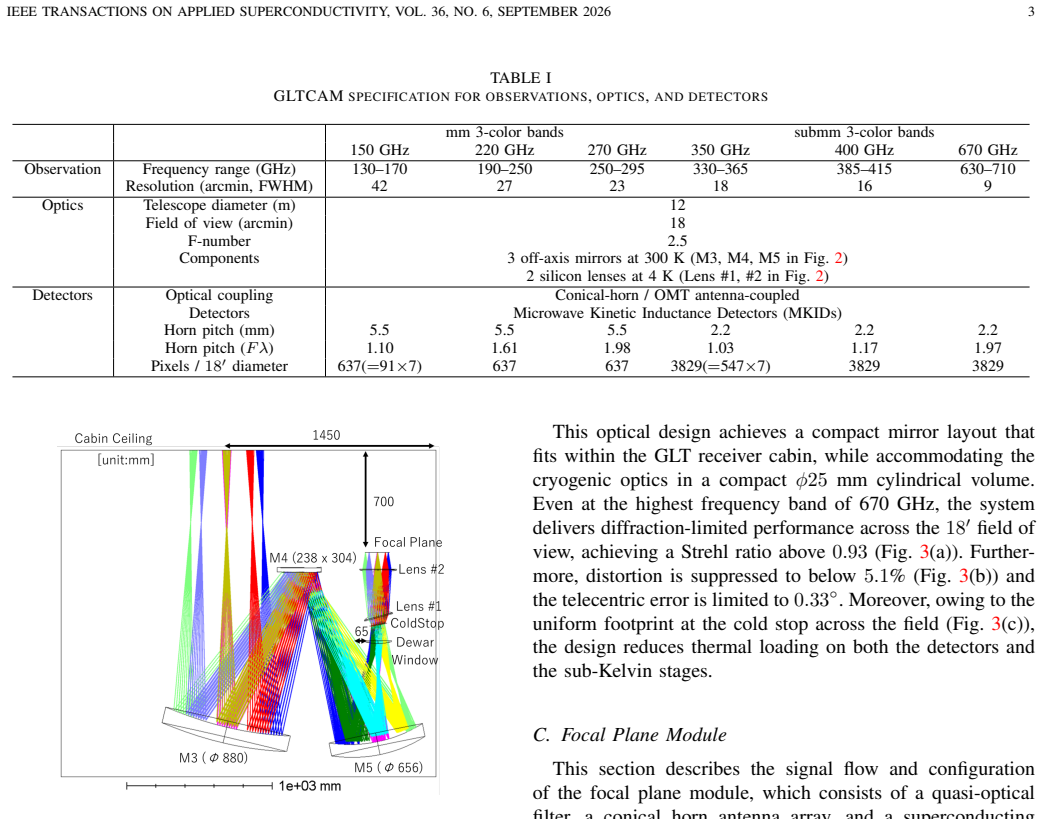
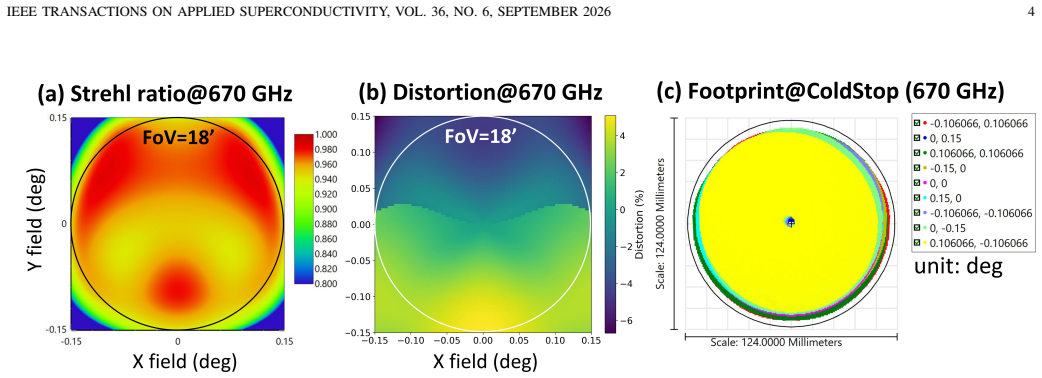
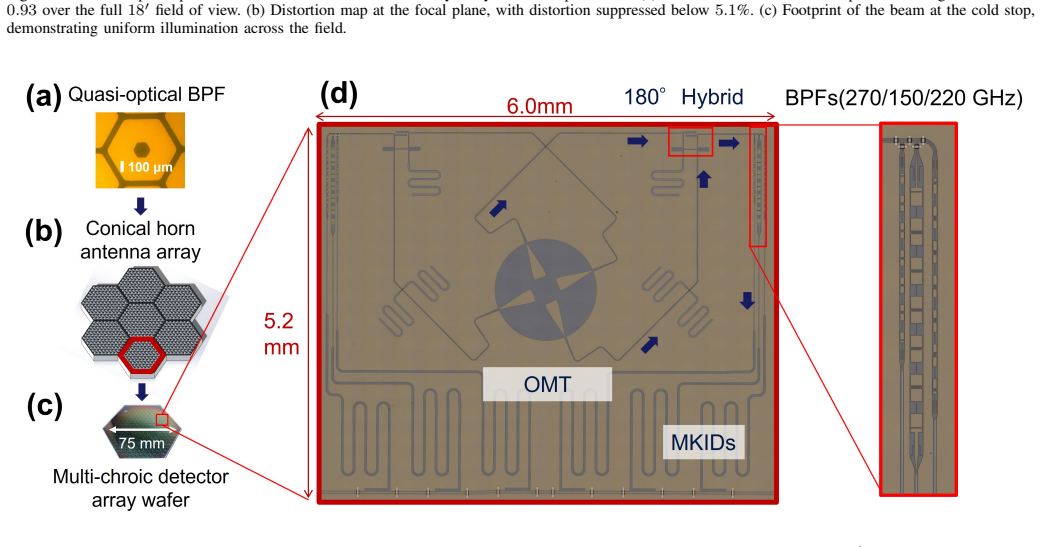
The optical design provides a compact configuration that fits within the GLT receiver cabin, while delivering diffraction-limited performance over an 18' field of view with minimal telecentricity error and distortion, with uniform illumination footprint at the cold stop to minimize thermal loading. The focal plane uses a quasi-optical bandpass filter, conical horn array coupled with planar OMTs, and a superconducting multi-color MKID array built on single-layer CPW lines that simplify fabrication.
What carries the argument
The compact optical train that produces uniform cold-stop illumination together with the single-layer CPW MKID architecture that enables scalable multi-color detector arrays.
If this is right
- Simultaneous coverage in three millimeter and three submillimeter bands becomes possible on a single telescope visit.
- Thermal load on the cryogenic stages and detectors is reduced by the uniform cold-stop illumination.
- Fabrication of large-format arrays is simplified by the single-layer CPW detector layout.
- The instrument serves as a pathfinder for wide-field multi-color cameras on future submillimeter telescopes.
- Early three-color millimeter-wave modules can be deployed while submillimeter channels are developed.
Where Pith is reading between the lines
- Multi-band data from the same pointing could tighten constraints on dust spectral indices or separate cluster signals from foregrounds without separate observing runs.
- The compact cabin fit may allow GLTCAM to share the receiver with other instruments or to be swapped quickly between campaigns.
- If the MKID array scales as claimed, similar single-layer CPW designs could be adapted for other telescopes facing similar space and cooling constraints.
- Routine 18-arcmin multi-color mapping would increase the number of galaxy clusters with resolved submillimeter photometry by a large factor compared with single-band or narrow-field instruments.
Load-bearing premise
The quasi-optical filter, horn array with planar OMTs, and multi-color MKID array can be integrated and fabricated to meet the stated performance targets.
What would settle it
A prototype measurement or ray-trace result that shows the illumination footprint at the cold stop varying by more than a few percent across the 18 arcmin field, or that telecentricity error exceeds the design tolerance, would falsify the thermal-loading and image-quality claims.
Figures
read the original abstract
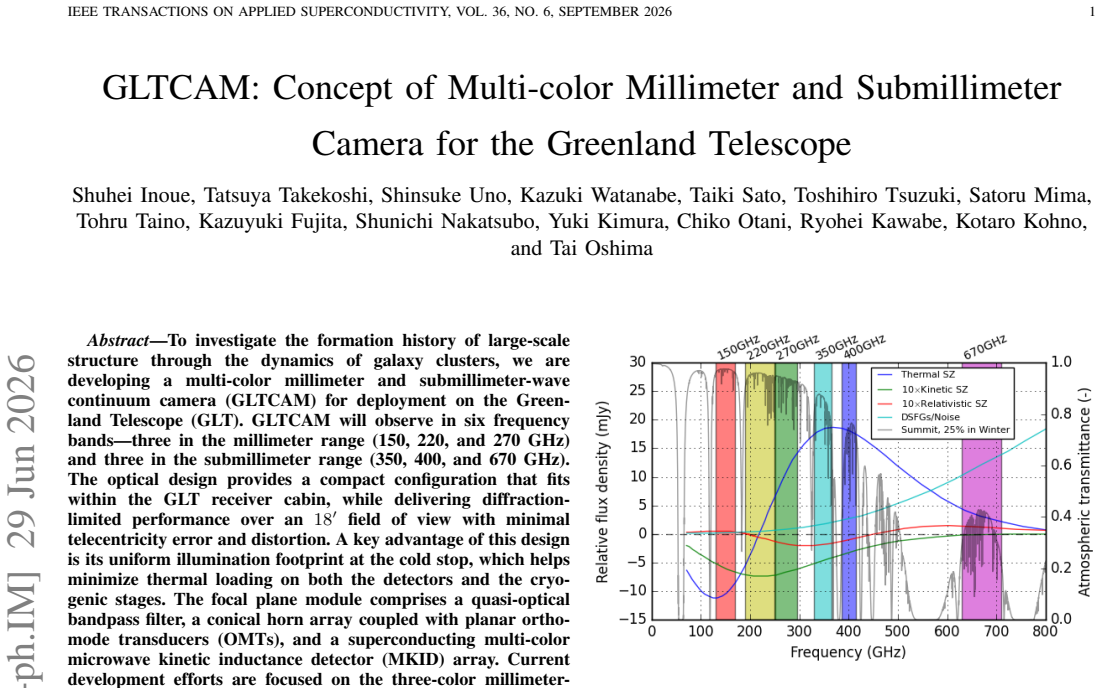
To investigate the formation history of large-scale structure through the dynamics of galaxy clusters, we are developing a multi-color millimeter and submillimeter-wave continuum camera (GLTCAM) for deployment on the Green-land Telescope (GLT). GLTCAM will observe in six frequency bands - three in the millimeter range (150, 220, and 270 GHz) and three in the submillimeter range (350, 400, and 670 GHz). The optical design provides a compact configuration that fits within the GLT receiver cabin, while delivering diffraction-limited performance over an $18'$ field of view with minimal telecentricity error and distortion. A key advantage of this design is its uniform illumination footprint at the cold stop, which helps minimize thermal loading on both the detectors and the cryogenic stages. The focal plane module comprises a quasi-optical bandpass filter, a conical horn array coupled with planar ortho mode transducers (OMTs), and a superconducting multi-color microwave kinetic inductance detector (MKID) array. Current development efforts are focused on the three-color millimeter-wave module. The detector array employs a single-layer coplanar waveguide (CPW) architecture, which simplifies fabrication and enables scalability to large-format arrays. GLTCAM aims for the early realization of next-generation wide-field, multi-color observations as a pathfinder for future large submillimeter telescopes.
Editorial analysis
A structured set of objections, weighed in public.
Referee Report
Summary. The manuscript presents the concept for GLTCAM, a six-band (150, 220, 270, 350, 400, 670 GHz) millimeter and submillimeter continuum camera for the Greenland Telescope. It describes a compact optical design that fits in the GLT receiver cabin, providing diffraction-limited performance over an 18 arcmin field of view with minimal telecentricity error and distortion, and uniform illumination at the cold stop to reduce thermal loading. The focal plane uses a quasi-optical bandpass filter, conical horn array with planar OMTs, and a superconducting multi-color MKID array, with development focused on a three-color millimeter-wave module using single-layer CPW architecture for scalability.
Significance. If the described optical and detector integration can be realized, GLTCAM would enable early wide-field multi-color observations in mm/submm bands as a pathfinder for future large submillimeter telescopes, addressing galaxy cluster dynamics and large-scale structure formation.
major comments (2)
- [Abstract] Abstract: the claims that the optical design delivers diffraction-limited performance over an 18' FOV with uniform cold-stop illumination to minimize thermal loading are presented without any supporting ray-tracing results, coupling-efficiency calculations, or thermal-loading estimates.
- [Abstract] Abstract: the integration and performance of the quasi-optical bandpass filter, conical horn array coupled with planar OMTs, and superconducting multi-color MKID array are stated as a development focus, but no quantitative feasibility analysis, fabrication details, or expected performance metrics for the six bands are provided to support the multi-color scalability claim.
minor comments (2)
- [Abstract] The telescope name is written as 'Green-land Telescope'; this should be corrected to 'Greenland Telescope'.
- The manuscript would benefit from inclusion of at least preliminary optical design parameters or a schematic to illustrate the compact configuration.
Simulated Author's Rebuttal
We thank the referee for the constructive comments and the recommendation for major revision. We address each point below and will revise the manuscript accordingly.
read point-by-point responses
-
Referee: [Abstract] Abstract: the claims that the optical design delivers diffraction-limited performance over an 18' FOV with uniform cold-stop illumination to minimize thermal loading are presented without any supporting ray-tracing results, coupling-efficiency calculations, or thermal-loading estimates.
Authors: We agree that the abstract states these performance characteristics without explicit supporting calculations. The manuscript describes a compact optical design intended to achieve diffraction-limited performance and uniform illumination. We will revise the abstract to qualify these as design goals based on the presented configuration and add references to any optical analysis in the body of the paper. If detailed ray-tracing or thermal estimates are not present, we will either include preliminary results or adjust the language to reflect that these are expected outcomes of the design. revision: yes
-
Referee: [Abstract] Abstract: the integration and performance of the quasi-optical bandpass filter, conical horn array coupled with planar OMTs, and superconducting multi-color MKID array are stated as a development focus, but no quantitative feasibility analysis, fabrication details, or expected performance metrics for the six bands are provided to support the multi-color scalability claim.
Authors: The manuscript correctly notes that current efforts focus on the three-color millimeter-wave module using single-layer CPW architecture for scalability. We will revise the abstract to emphasize this focus and clarify that the submillimeter bands represent planned extensions. No quantitative metrics for all six bands are available at this conceptual stage. revision: partial
- No quantitative feasibility analysis, fabrication details, or expected performance metrics for the full six bands are available in the manuscript, as development is limited to the three-color millimeter module.
Circularity Check
No derivations or predictions present; concept description is self-contained
full rationale
The manuscript is a forward-looking instrument concept paper. It states design goals (compact fit, diffraction-limited 18' FOV, uniform cold-stop illumination) and component choices (quasi-optical filter, conical horn array with planar OMTs, single-layer CPW MKID array) but supplies no equations, fitted parameters, or quantitative predictions. No step reduces a claimed result to its own inputs by construction, self-citation, or renaming. The reader's assessment of zero circularity is confirmed by direct inspection of the provided text.
Axiom & Free-Parameter Ledger
Reference graph
Works this paper leans on
-
[1]
A. V . Kravtsov and S. Borgani, “Formation of Galaxy Clusters,”Annual Review of Astronomy and Astrophysics, vol. 50, no. V olume 50, 2012, pp. 353–409, 2012. [Online]. Available: https://www.annualreviews.org/ content/journals/10.1146/annurev-astro-081811-125502
-
[2]
HYDRODYNAMIC SIMULATION OF NON-THERMAL PRESSURE PROFILES OF GALAXY CLUSTERS,
K. Nelson, E. T. Lau, and D. Nagai, “HYDRODYNAMIC SIMULATION OF NON-THERMAL PRESSURE PROFILES OF GALAXY CLUSTERS,”The Astrophysical Journal, vol. 792, no. 1, p. 25, aug 2014. [Online]. Available: https://dx.doi.org/10.1088/0004-637X/792/1/25
-
[3]
Optimizing measurements of cluster velocities and temperatures for CCAT- prime and future surveys,
A. Mittal, F. de Bernardis, and M. D. Niemack, “Optimizing measurements of cluster velocities and temperatures for CCAT- prime and future surveys,”Journal of Cosmology and Astroparticle Physics, vol. 2018, no. 02, p. 032, feb 2018. [Online]. Available: https://dx.doi.org/10.1088/1475-7516/2018/02/032
-
[4]
3.5 Year Monitoring of 225 GHz Opacity at the Summit of Greenland,
S. Matsushita, K. Asada, P. L. Martin-Cocher, M.-T. Chen, P. T. P. Ho, M. Inoue, P. M. Koch, S. N. Paine, and D. D. Turner, “3.5 Year Monitoring of 225 GHz Opacity at the Summit of Greenland,”Publications of the Astronomical Society of the Pacific, vol. 129, no. 972, p. 025001, dec 2016. [Online]. Available: https://dx.doi.org/10.1088/1538-3873/129/972/025001
-
[5]
S. Paine, “The am atmospheric model,” Sep. 2024. [Online]. Available: https://doi.org/10.5281/zenodo.13748391
-
[6]
Cosmological and astrophysical implications of the Sunyaev–Zel’dovich effect,
T. Kitayama, “Cosmological and astrophysical implications of the Sunyaev–Zel’dovich effect,”Progress of Theoretical and Experimental Physics, vol. 2014, no. 6, p. 06B111, 06 2014. [Online]. Available: https://doi.org/10.1093/ptep/ptu055
-
[7]
Astrophysics with the Spatially and Spectrally Resolved Sunyaev-Zeldovich Effects,
T. Mroczkowski, D. Nagai, K. Basu, J. Chluba, J. Sayers, R. Adam, E. Churazov, A. Crites, L. Di Mascolo, D. Eckert, J. Macias-Perez, F. Mayet, L. Perotto, E. Pointecouteau, C. Romero, F. Ruppin, E. Scannapieco, and J. ZuHone, “Astrophysics with the Spatially and Spectrally Resolved Sunyaev-Zeldovich Effects,”Space Science Reviews, vol. 215, no. 1, p. 17, ...
-
[8]
Modeling the evolution of infrared galaxies: a parametric backward evolution model,
B ´ethermin, M., Dole, H., Lagache, G., Le Borgne, D., and Penin, A., “Modeling the evolution of infrared galaxies: a parametric backward evolution model,”A&A, vol. 529, p. A4, 2011. [Online]. Available: https://doi.org/10.1051/0004-6361/201015841
-
[9]
Low-resolution spectroscopy of the Sunyaev-Zel’dovich effect and estimates of cluster parameters,
de Bernardis, P., Colafrancesco, S., D’Alessandro, G., Lamagna, L., Marchegiani, P., Masi, S., and Schillaci, A., “Low-resolution spectroscopy of the Sunyaev-Zel’dovich effect and estimates of cluster parameters,”A&A, vol. 538, p. A86, 2012. [Online]. Available: https://doi.org/10.1051/0004-6361/201118062
-
[10]
Mapping the kinetic Sunyaev-Zel’dovich effect toward MACS J0717.5+3745 with NIKA ,
Adam, R., Bartalucci, I., Pratt, G. W., Ade, P., Andr ´e, P., Arnaud, M., Beelen, A., Beno ˆıt, A., Bideaud, A., Billot, N., Bourdin, H., Bourrion, O., Calvo, M., Catalano, A., Coiffard, G., Comis, B., D’Addabbo, A., De Petris, M., D ´emocl`es, J., D ´esert, F.-X., Doyle, S., Egami, E., Ferrari, C., Goupy, J., Kramer, C., Lagache, G., Leclercq, S., Mac ´ı...
-
[11]
Multiple-component Decomposition from Millimeter Single-channel Data,
I. Rodr ´ıguez-Montoya, D. S´anchez-Arg¨uelles, I. Aretxaga, E. Bertone, M. Ch ´avez-Dagostino, D. H. Hughes, A. Monta ˜na, G. W. Wilson, and M. Zeballos, “Multiple-component Decomposition from Millimeter Single-channel Data,”The Astrophysical Journal Supplement Series, vol. 235, no. 1, p. 12, mar 2018. [Online]. Available: https: //dx.doi.org/10.3847/153...
-
[12]
M.-T. Chen, K. Asada, S. Matsushita, P. Raffin, M. Inoue, P. T. P. Ho, C.-C. Han, D. Kubo, T. Norton, N. A. Patel, G. Nystrom, C.-W. L. Huang, P. Martin-Cocher, J. Yi Koay, C. Romero-Ca ˜nizales, C.-T. Liu, T. Huang, K.-Y . Liu, T. Wei, S.-H. Chang, R. Chilson, P. Oshiro, H. Jiang, C.-T. Li, G. Bower, P. Shaw, H. Nishioka, P. M. Koch, C.-C. Chen, R. Srini...
-
[13]
An antenna-coupled bolometer with an integrated microstrip bandpass filter,
M. J. Myers, W. Holzapfel, A. T. Lee, R. O’Brient, P. L. Richards, H. T. Tran, P. Ade, G. Engargiola, A. Smith, and H. Spieler, “An antenna-coupled bolometer with an integrated microstrip bandpass filter,”Applied Physics Letters, vol. 86, no. 11, p. 114103, 03 2005. [Online]. Available: https://doi.org/10.1063/1.1879115
-
[14]
A dual-polarized broadband planar antenna and channelizing filter bank for millimeter wavelengths,
R. O’Brient, P. Ade, K. Arnold, J. Edwards, G. Engargiola, W. L. Holzapfel, A. T. Lee, M. J. Myers, E. Quealy, G. Rebeiz, P. Richards, and A. Suzuki, “A dual-polarized broadband planar antenna and channelizing filter bank for millimeter wavelengths,”Applied Physics Letters, vol. 102, no. 6, p. 063506, 02 2013. [Online]. Available: https://doi.org/10.1063/...
-
[15]
First light demonstration of the integrated superconducting spectrometer,
A. Endo, K. Karatsu, Y . Tamura, T. Oshima, A. Taniguchi, T. Takekoshi, S. Asayama, T. J. L. C. Bakx, S. Bosma, J. Bueno, K. W. Chin, Y . Fujii, K. Fujita, R. Huiting, S. Ikarashi, T. Ishida, S. Ishii, R. Kawabe, T. M. Klapwijk, K. Kohno, A. Kouchi, N. Llombart, J. Maekawa, V . Murugesan, S. Nakatsubo, M. Naruse, K. Ohtawara, A. Pascual Laguna, J. Suzuki,...
-
[16]
CMB-S4 Technology Book, First Edition,
M. H. Abitbol, A. Zeeshan, B. Darcy, R. Basu Thakur, A. N. Bender, B. A. Benson, C. A. Bischoff, S. A. Bryan, J. E. Carlstrom, C. L. Changet al., “CMB-S4 Technology Book, First Edition,” Michigan U.; Lawrence Berkeley National Laboratory (LBNL), Berkeley, CA (United States); Cornell U.; UC, Berkeley; Brown U.; NASA, Goddard; Minnesota U.; Villanova U.; Mc...
arXiv 2017
-
[17]
The Relative performance of filled and feedhorn-coupled focal-plane architectures,
M. J. Griffin, J. J. Bock, and W. K. Gear, “The Relative performance of filled and feedhorn-coupled focal-plane architectures,”Appl. Opt., vol. 41, p. 6543, 2002
2002
-
[18]
A Sunyaev-Zel’dovich Effect Survey with the APEX Telescope,
N. Halverson, “A Sunyaev-Zel’dovich Effect Survey with the APEX Telescope,” https://online.kitp.ucsb.edu/online/cmb c02/minisession1/ pdf0/Halverson2.pdf, 2002, accessed: Aug. 08, 2025
2002
-
[19]
Mapping speed for an array of corrugated horns,
S. Padin, “Mapping speed for an array of corrugated horns,”Appl. Opt., vol. 49, no. 3, pp. 479–483, Jan 2010. [Online]. Available: https://opg.optica.org/ao/abstract.cfm?URI=ao-49-3-479
2010
-
[20]
Broadband anti-reflection coating for sub-terahertz optics using dielectric multilayers,
T. Naganuma, S. Uno, S. Inoue, K. Watanabe, T. Takekoshi, T. Sakai, and T. Oshima, “Broadband anti-reflection coating for sub-terahertz optics using dielectric multilayers,” 2026, in press atAppl. Opt
2026
-
[21]
Demonstration of wideband metal mesh filters for submillimeter astrophysics using flexible printed circuits,
S. Uno, T. Takekoshi, T. Oshima, K. Yoshioka, K. W. Chin, and K. Kohno, “Demonstration of wideband metal mesh filters for submillimeter astrophysics using flexible printed circuits,”Appl. Opt., vol. 59, no. 13, pp. 4143–4150, May 2020. [Online]. Available: https://opg.optica.org/ao/abstract.cfm?URI=ao-59-13-4143
2020
-
[22]
T. Takekoshi, K. Lee, K. W. Chin, S. Uno, T. Naganuma, S. Inoue, Y . Niwa, K. Fujita, A. Kouchi, S. Nakatsubo, S. Mima, and T. Oshima, “Material Properties of a Low Contraction and Resistivity Silicon–Aluminum Composite for Cryogenic Detectors,”Journal of Low Temperature Physics, vol. 209, no. 5, pp. 1143–1150, Dec 2022. [Online]. Available: https://doi.o...
-
[23]
Wideband Multichroic Detector Architecture for Millimeter and Submillimeter Imaging Observations,
S. Uno, “Wideband Multichroic Detector Architecture for Millimeter and Submillimeter Imaging Observations,” Ph.D. dissertation, University of Tokyo, Tokyo, Japan, 2024
2024
-
[24]
S. Inoue, K. W. Chin, S. Uno, K. Kohno, Y . Niwa, T. Naganuma, R. Yamamura, K. Watanabe, T. Takekoshi, and T. Oshima, “A Design Method of an Ultra-Wideband and Easy-to-Array Magic-T: A 6-14 GHz Scaled Model for a mm/submm Camera,”Journal of Low Temperature Physics, vol. 216, no. 1, pp. 378–385, Jul 2024. [Online]. Available: https://doi.org/10.1007/s10909...
-
[25]
Design Method of Quasi- Lumped Element Bandpass Filters Using Superconducting Coplanar Waveguide for Millimeter-Wave Multichroic Imaging,
S. Uno, K. W. Chin, T. Oshima, S. Ono, T. Sakai, K. Watanabe, S. Inoue, T. Takekoshi, and K. Kohno, “Design Method of Quasi- Lumped Element Bandpass Filters Using Superconducting Coplanar Waveguide for Millimeter-Wave Multichroic Imaging,” 2025, submitted toIEEE Transactions on Applied Superconductivity
2025
-
[26]
S. J. C. Yates, J. J. A. Baselmans, A. Endo, R. M. J. Janssen, L. Ferrari, P. Diener, and A. M. Baryshev, “Photon noise limited radiation detection with lens-antenna coupled microwave kinetic inductance detectors,”Applied Physics Letters, vol. 99, no. 7, p. 073505, 08 2011. [Online]. Available: https://doi.org/10.1063/1.3624846
-
[27]
R. M. J. Janssen, J. J. A. Baselmans, A. Endo, L. Ferrari, S. J. C. Yates, A. M. Baryshev, and T. M. Klapwijk, “High optical efficiency and photon noise limited sensitivity of microwave kinetic inductance detectors using phase readout,”Applied Physics Letters, vol. 103, no. 20, p. 203503, 11 2013. [Online]. Available: https://doi.org/10.1063/1.4829657
-
[28]
Multiplexed Readout for 1000-Pixel Arrays of Microwave Kinetic Inductance Detectors,
J. van Rantwijk, M. Grim, D. van Loon, S. Yates, A. Baryshev, and J. Baselmans, “Multiplexed Readout for 1000-Pixel Arrays of Microwave Kinetic Inductance Detectors,”IEEE Transactions on Mi- crowave Theory and Techniques, vol. 64, no. 6, pp. 1876–1883, 2016
2016
-
[29]
MKIDGen3: Energy-resolving, single-photon-counting microwave kinetic inductance detector readout on a radio frequency system-on- chip,
J. P. Smith, I. Bailey, John I., A. Cuda, N. Zobrist, and B. A. Mazin, “MKIDGen3: Energy-resolving, single-photon-counting microwave kinetic inductance detector readout on a radio frequency system-on- chip,”Review of Scientific Instruments, vol. 95, no. 11, p. 114705, 11
-
[30]
Available: https://doi.org/10.1063/5.0225768
[Online]. Available: https://doi.org/10.1063/5.0225768
-
[31]
New 50-m-class single-dish telescope: Large Submillimeter Telescope (LST),
R. Kawabe, K. Kohno, Y . Tamura, T. Takekoshi, T. Oshima, and S. Ishii, “New 50-m-class single-dish telescope: Large Submillimeter Telescope (LST),” inGround-based and Airborne Telescopes VI, H. J. Hall, R. Gilmozzi, and H. K. Marshall, Eds., vol. 9906, International Society for Optics and Photonics. SPIE, 2016, p. 990626. [Online]. Available: https://doi...
-
[32]
The conceptual design of the 50-meter Atacama Large Aperture Submillimeter Telescope (AtLAST),
Mroczkowski, Tony, Gallardo, Patricio A., Timpe, Martin, Kiselev, Aleksej, Groh, Manuel, Kaercher, Hans, Reichert, Matthias, Cicone, Claudia, Puddu, Roberto, Dubois-dit-Bonclaude, Pierre, Bok, Daniel, Dahl, Erik, Macintosh, Mike, Dicker, Simon, Viole, Isabelle, Sartori, Sabrina, Valenzuela Venegas, Guillermo Andr ´es, Zeyringer, Marianne, Niemack, Michael...
discussion (0)
Sign in with ORCID, Apple, or X to comment. Anyone can read and Pith papers without signing in.