Light Neutralino Dark Matter in a Supersymmetric Pati-Salam Framework
Pith reviewed 2026-06-30 05:44 UTC · model grok-4.3
The pith
A supersymmetric Pati-Salam model permits a bino-like neutralino to act as dark matter with mass up to 110 GeV alongside a light right-handed stau, satisfying all constraints for both signs of mu.
A machine-rendered reading of the paper's core claim, the machinery that carries it, and where it could break.
Core claim
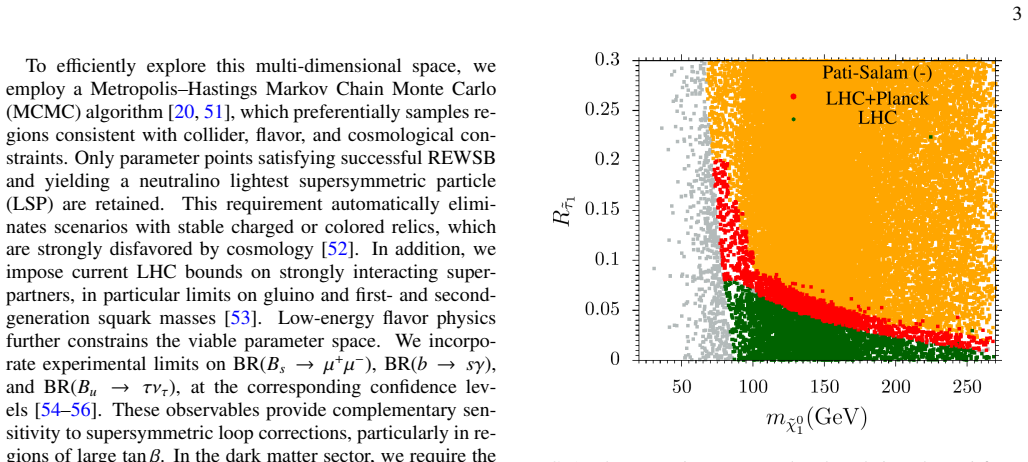
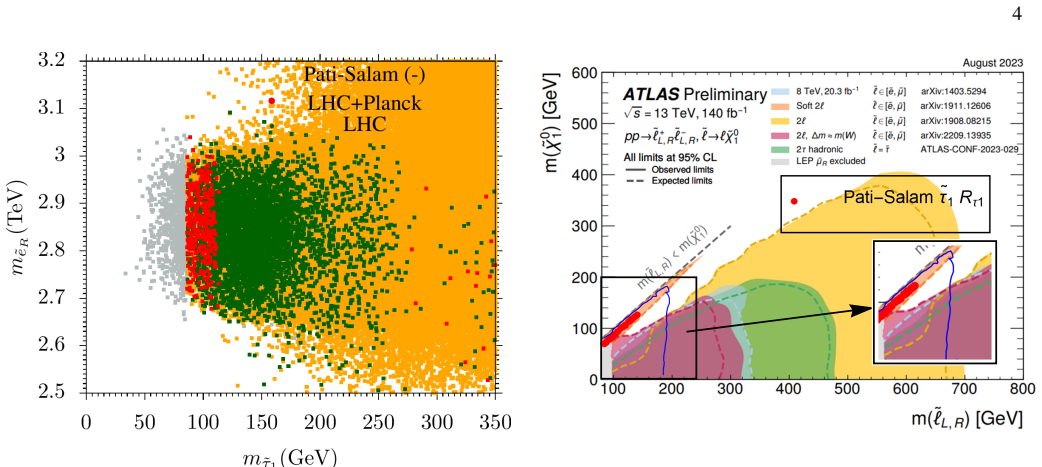
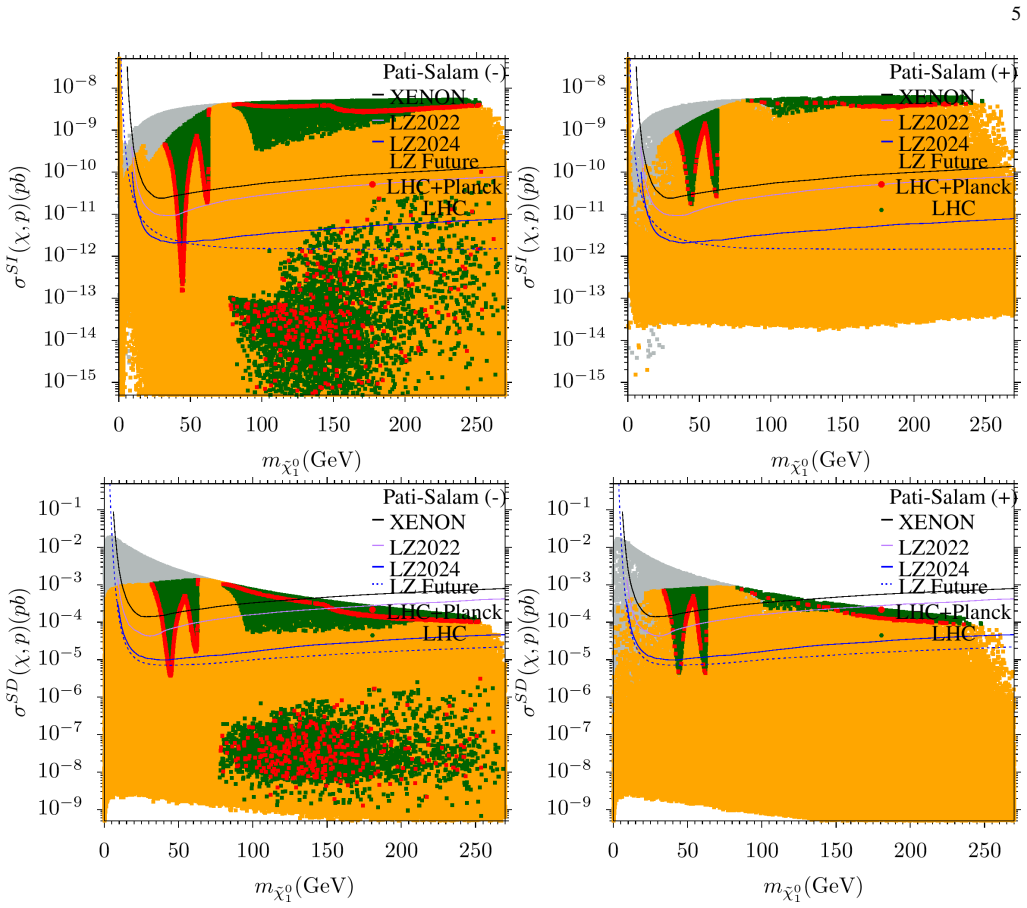
We identify a viable bulk region with a bino-like LSP and a light right-handed stau NLSP. These solutions satisfy all experimental constraints, including LHC searches, flavor observables, and the Planck 2018 relic density, predicting upper bounds m_χ̃₁⁰ ≲ 110 GeV and m_τ̃₁ ≲ 120 GeV. For μ<0, destructive interference in Higgs-mediated scattering suppresses the direct-detection cross section, allowing a viable Z-funnel region to survive below the projected LZ 1000-day sensitivity.
What carries the argument
The mass-splitting condition R_φ̃ ≳ 10 percent that isolates genuine bulk annihilation from coannihilation in the bino-like neutralino plus right-handed stau sector.
If this is right
- The viable parameter space lies inside the projected sensitivity of CEPC and FCC-ee lepton colliders.
- Positive-mu Higgs-funnel points are already excluded or tightly constrained by existing direct-detection data.
- Negative-mu Z-funnel points remain allowed even after projected LZ 1000-day limits.
- Upper bounds of 110 GeV on the neutralino and 120 GeV on the stau follow directly from the relic-density and collider constraints.
Where Pith is reading between the lines
- Confirmation would imply that Pati-Salam boundary conditions at high scale naturally produce light neutralino dark matter accessible to near-term experiments without additional tuning.
- One could search for correlated signals in flavor observables and missing-energy channels at the same colliders to cross-check the stau-neutralino mass relation.
- The destructive-interference mechanism for negative mu might generalize to other supersymmetric constructions that contain right-handed sleptons.
Load-bearing premise
That requiring a 10 percent mass gap to the next-to-lightest particle plus a broad parameter scan that enforces radiative electroweak symmetry breaking and neutralino LSP is enough to capture the true relic density without hidden coannihilation or other model effects altering the result.
What would settle it
Absence of any light stau or neutralino signals at CEPC or FCC-ee combined with a null result from the LZ 1000-day direct-detection run would rule out the reported viable bulk and Z-funnel regions.
Figures
read the original abstract
We investigate the low-energy phenomenology of the MSSM arising from the supersymmetric $SU(4)_C \times SU(2)_L \times SU(2)_R$ Pati-Salam framework, focusing on neutralino dark matter in bulk annihilation and Higgs/Z-funnel regions. Using a comprehensive parameter scan consistent with radiative electroweak symmetry breaking and a neutralino LSP, we analyze collider, flavor, and dark matter constraints for both signs of {\mu}. To isolate genuine bulk annihilation from coannihilation, we impose the mass-splitting condition $\mathcal{R}_{\tilde{\phi}} \equiv (m_{\tilde{\phi}}-m_{\tilde{\chi}_1^0})/m_{\tilde{\chi}_1^0}\gtrsim 10\%$. We identify a viable bulk region with a bino-like LSP and a light right-handed stau NLSP. These solutions satisfy all experimental constraints, including LHC searches, flavor observables, and the Planck 2018 relic density, predicting upper bounds $m_{\tilde{\chi}_1^0}\lesssim 110~{\rm GeV}$ and $m_{\tilde{\tau}_1}\lesssim 120~{\rm GeV}$. This parameter space lies within the reach of future CEPC and FCC-ee colliders. We also analyze Higgs- and Z-funnel regions. Current direct-detection limits strongly constrain light Higgsino-assisted resonances for {\mu}>0. Conversely, for {\mu}<0, destructive interference in Higgs-mediated scattering suppresses the direct-detection cross section, allowing a viable Z-funnel region to survive below the projected LZ 1000-day sensitivity. These results highlight the negative-{\mu} Pati-Salam framework as a predictive, testable scenario for upcoming dark matter and lepton collider experiments
Editorial analysis
A structured set of objections, weighed in public.
Referee Report
Summary. The paper investigates neutralino dark matter phenomenology in the MSSM from a supersymmetric Pati-Salam SU(4)_C × SU(2)_L × SU(2)_R framework. It performs parameter scans enforcing radiative electroweak symmetry breaking and neutralino LSP, identifies a viable bino-like bulk annihilation region with light right-handed stau NLSP after imposing R_φ̃ ≳ 10% mass splitting to exclude coannihilation, reports that these points satisfy LHC, flavor, and Planck 2018 relic density constraints with upper bounds m_χ̃₁⁰ ≲ 110 GeV and m_τ̃₁ ≲ 120 GeV, and discusses Higgs/Z-funnel regions with mu-sign dependence allowing a viable Z-funnel for μ<0 below projected LZ sensitivity. The space is claimed testable at CEPC/FCC-ee.
Significance. If the central results hold, the work provides a concrete, testable realization of light bino-like neutralino DM in a motivated GUT framework, with explicit mass upper bounds and collider reach predictions. The explicit treatment of both μ signs and the resulting destructive interference in direct detection for μ<0 is a useful observation. The enforcement of radiative EWSB plus neutralino LSP in the scan is a methodological strength that grounds the solutions in consistent model building.
major comments (1)
- [Methodology (R_φ̃ cut and bulk region)] Methodology section (description of bulk region selection and the R_φ̃ condition): The central claim of a viable 'genuine bulk annihilation' region with bino-like LSP and right-handed stau NLSP rests on the R_φ̃ ≳ 10% cut being sufficient to render stau coannihilation negligible in the relic-density calculation. For a bino LSP the t-channel slepton-exchange amplitude remains large even at ~10% splitting, so the Boltzmann equation can receive O(10-30%) corrections from coannihilation; without an explicit demonstration (e.g., a plot or table comparing Ωh² with and without the coannihilation term at the boundary of the cut) the reported Planck agreement and the mass bounds m_χ̃₁⁰ ≲ 110 GeV, m_τ̃₁ ≲ 120 GeV cannot be taken as robustly bulk-dominated.
minor comments (1)
- [Parameter scan description] The abstract and text refer to a 'comprehensive parameter scan' but do not specify the sampling method, prior ranges, or number of points generated; adding a short table or paragraph with these details would improve reproducibility.
Simulated Author's Rebuttal
We thank the referee for the careful review and constructive comment on our manuscript. We address the major comment below and will revise the paper accordingly to strengthen the presentation of the bulk region.
read point-by-point responses
-
Referee: Methodology section (description of bulk region selection and the R_φ̃ condition): The central claim of a viable 'genuine bulk annihilation' region with bino-like LSP and right-handed stau NLSP rests on the R_φ̃ ≳ 10% cut being sufficient to render stau coannihilation negligible in the relic-density calculation. For a bino LSP the t-channel slepton-exchange amplitude remains large even at ~10% splitting, so the Boltzmann equation can receive O(10-30%) corrections from coannihilation; without an explicit demonstration (e.g., a plot or table comparing Ωh² with and without the coannihilation term at the boundary of the cut) the reported Planck agreement and the mass bounds m_χ̃₁⁰ ≲ 110 GeV, m_τ̃₁ ≲ 120 GeV cannot be taken as robustly bulk-dominated.
Authors: We thank the referee for highlighting this point. Our relic density is computed throughout with micrOMEGAs, which solves the full Boltzmann equation including all coannihilation channels. The ℛ_φ̃ ≳ 10% cut is imposed after the scan to isolate points in which bulk annihilation dominates, consistent with common practice in the literature for defining bulk regions. Nevertheless, we agree that an explicit validation of the cut would make the claim more robust. In the revised manuscript we will add a supplementary figure (or table) in the methodology section that compares the relic density computed with and without the stau coannihilation term for representative points lying at the ℛ_φ̃ = 10% boundary. This will quantify the size of any residual correction and confirm that it remains small enough not to affect the Planck compatibility or the reported mass upper bounds. revision: yes
Circularity Check
No significant circularity; derivation relies on external benchmarks
full rationale
The paper defines the bulk region via an explicit input cut R_φ̃ ≳ 10% on mass splitting, then scans parameters subject to radiative EWSB, neutralino LSP, and external constraints (Planck 2018 relic density, LHC searches, flavor observables). The reported upper bounds on m_χ̃₁⁰ and m_τ̃₁ emerge as scan outputs against those external data, not as quantities fitted or defined in terms of themselves. No self-citation chain, ansatz smuggling, or renaming of known results is present in the provided text; the μ-sign dependence is a model choice, not a derived output. The derivation chain is therefore self-contained against independent benchmarks.
Axiom & Free-Parameter Ledger
free parameters (2)
- mu sign
- R_φ̃ threshold (10%)
axioms (2)
- domain assumption Radiative electroweak symmetry breaking occurs and produces a neutralino LSP
- domain assumption Planck 2018 relic density, LHC searches, and flavor observables are the complete set of external constraints
Reference graph
Works this paper leans on
-
[1]
Witten, Nucl
E. Witten, Nucl. Phys. B188, 513 (1981)
1981
-
[2]
Dimopoulos, S
S. Dimopoulos, S. Raby, and F. Wilczek, Phys. Rev. D24, 1681 (1981)
1981
-
[3]
Amaldi, W
U. Amaldi, W. de Boer, and H. Furstenau, Phys. Lett. B260, 447 (1991)
1991
-
[4]
J. R. Ellis, S. Kelley, and D. V . Nanopoulos, Phys. Lett. B260, 131 (1991)
1991
-
[5]
G. Jungman, M. Kamionkowski, and K. Griest, Phys. Rept.267, 195 (1996), arXiv:hep-ph/9506380
work page internal anchor Pith review Pith/arXiv arXiv 1996
-
[6]
K. A. Olive, inTheoretical Advanced Study Institute in Elemen- tary Particle Physics (TASI 2002): Particle Physics and Cos- mology: The Quest for Physics Beyond the Standard Model(s) (2003) pp. 797–851, arXiv:astro-ph/0301505
work page internal anchor Pith review Pith/arXiv arXiv 2002
- [7]
-
[8]
P. Slavichet al., Eur. Phys. J. C81, 450 (2021), arXiv:2012.15629 [hep-ph]
-
[9]
G. Aadet al.(ATLAS), Phys. Lett. B716, 1 (2012), arXiv:1207.7214 [hep-ex]
work page internal anchor Pith review Pith/arXiv arXiv 2012
-
[10]
Observation of a new boson at a mass of 125 GeV with the CMS experiment at the LHC
S. Chatrchyanet al.(CMS), Phys. Lett. B716, 30 (2012), arXiv:1207.7235 [hep-ex]
work page internal anchor Pith review Pith/arXiv arXiv 2012
-
[11]
Interacting Topological Insulator and Emergent Grand Unified Theory
Y .-Z. You and C. Xu, Phys. Rev. B91, 125147 (2015), arXiv:1412.4784 [cond-mat.str-el]
work page internal anchor Pith review Pith/arXiv arXiv 2015
-
[12]
Ananthanarayan, G
B. Ananthanarayan, G. Lazarides, and Q. Shafi, Phys. Lett. B 300, 245 (1993)
1993
-
[13]
Shafi and B
Q. Shafi and B. Ananthanarayan, inSummer School in High- energy Physics and Cosmology(1991) pp. 233–244
1991
-
[14]
L. J. Hall, R. Rattazzi, and U. Sarid, Phys. Rev. D50, 7048 (1994), arXiv:hep-ph/9306309
work page internal anchor Pith review Pith/arXiv arXiv 1994
-
[15]
Zeroing In On the Top Quark, LSP and Scalar Higgs Masses
B. Ananthanarayan, Q. Shafi, and X. M. Wang, Phys. Rev. D 50, 5980 (1994), arXiv:hep-ph/9311225
work page internal anchor Pith review Pith/arXiv arXiv 1994
-
[16]
The Unified Minimal Supersymmetric Model with Large Yukawa Couplings
R. Rattazzi and U. Sarid, Phys. Rev. D53, 1553 (1996), arXiv:hep-ph/9505428
work page internal anchor Pith review Pith/arXiv arXiv 1996
-
[17]
A Global chi^2 Analysis of Electroweak Data in SO(10) SUSY GUTs
T. Blazek, M. Carena, S. Raby, and C. E. M. Wagner, Phys. Rev. D56, 6919 (1997), arXiv:hep-ph/9611217
work page internal anchor Pith review Pith/arXiv arXiv 1997
-
[18]
J. L. Chkareuli and I. G. Gogoladze, Phys. Rev. D58, 055011 (1998), arXiv:hep-ph/9803335
work page internal anchor Pith review Pith/arXiv arXiv 1998
-
[19]
H. Baer, M. Brhlik, M. A. Diaz, J. Ferrandis, P. Mercadante, P. Quintana, and X. Tata, Phys. Rev. D63, 015007 (2000), arXiv:hep-ph/0005027
work page internal anchor Pith review Pith/arXiv arXiv 2000
-
[20]
H. Baer, S. Kraml, A. Lessa, S. Sekmen, and X. Tata, JHEP10 (10), 018, arXiv:1007.3897 [hep-ph]
work page internal anchor Pith review Pith/arXiv arXiv
-
[21]
M. A. Ajaib, I. Gogoladze, and Q. Shafi, Phys. Rev. D88, 095019 (2013), arXiv:1307.4882 [hep-ph]
work page internal anchor Pith review Pith/arXiv arXiv 2013
-
[22]
M. A. Ajaib, I. Gogoladze, Q. Shafi, and C. S. Un, inSnowmass 2013: Snowmass on the Mississippi(2013) arXiv:1308.4652 [hep-ph]. 8
work page internal anchor Pith review Pith/arXiv arXiv 2013
-
[23]
Yukawa Unification and Neutralino Dark Matter in SU(4)_c \times SU(2)_L \times SU(2)_R
I. Gogoladze, R. Khalid, and Q. Shafi, Phys. Rev. D79, 115004 (2009), arXiv:0903.5204 [hep-ph]
work page internal anchor Pith review Pith/arXiv arXiv 2009
-
[24]
Coannihilation Scenarios and Particle Spectroscopy in SU(4)_c x SU(2)_L x SU(2)_R
I. Gogoladze, R. Khalid, and Q. Shafi, Phys. Rev. D80, 095016 (2009), arXiv:0908.0731 [hep-ph]
work page internal anchor Pith review Pith/arXiv arXiv 2009
-
[25]
t-b-tau Yukawa unification for mu < 0 with a sub-TeV sparticle spectrum
I. Gogoladze, R. Khalid, S. Raza, and Q. Shafi, JHEP12(12), 055, arXiv:1008.2765 [hep-ph]
work page internal anchor Pith review Pith/arXiv arXiv
- [26]
-
[27]
A. Djouadi, R. Fonseca, R. Ouyang, and M. Raidal, Eur. Phys. J. C83, 529 (2023), arXiv:2212.11315 [hep-ph]
-
[28]
Note (2019)
ATLAS Collaboration (ATLAS), ATLAS Conf. Note (2019)
2019
-
[29]
G. Aadet al.(ATLAS), Eur. Phys. J. C80, 737 (2020), arXiv:2004.14060 [hep-ex]
-
[30]
Aadet al.(ATLAS), JHEP12(12), 060, arXiv:1908.03122 [hep-ex]
G. Aadet al.(ATLAS), JHEP12(12), 060, arXiv:1908.03122 [hep-ex]
-
[32]
CMS Collaboration (CMS), CMS PAS (2019)
2019
-
[33]
The Neutralino Relic Density in Minimal N=1 Supergravity
M. Drees and M. M. Nojiri, Phys. Rev. D47, 376 (1993), arXiv:hep-ph/9207234
work page internal anchor Pith review Pith/arXiv arXiv 1993
- [34]
- [35]
- [36]
-
[37]
E. Aprileet al.(XENON), Phys. Rev. Lett.131, 041003 (2023), arXiv:2303.14729 [hep-ex]
- [38]
-
[39]
First Dark Matter Search Results from the LUX-ZEPLIN (LZ) Experiment
J. Aalberset al.(LZ), Phys. Rev. Lett.131, 041002 (2023), arXiv:2207.03764 [hep-ex]
work page internal anchor Pith review Pith/arXiv arXiv 2023
-
[40]
Dark Matter Search Results from 4.2 Tonne-Years of Exposure of the LUX-ZEPLIN (LZ) Experiment
J. Aalberset al.(LZ), Phys. Rev. Lett.135, 011802 (2025), arXiv:2410.17036 [hep-ex]
work page internal anchor Pith review Pith/arXiv arXiv 2025
-
[41]
J. R. Ellis, A. Ferstl, and K. A. Olive, Phys. Lett. B481, 304 (2000), arXiv:hep-ph/0001005
work page internal anchor Pith review Pith/arXiv arXiv 2000
-
[42]
H. Baer, C. Balazs, A. Belyaev, and J. O’Farrill, JCAP09, 007, arXiv:hep-ph/0305191
work page internal anchor Pith review Pith/arXiv arXiv
-
[43]
Abadaet al.(FCC), Eur
A. Abadaet al.(FCC), Eur. Phys. J. C79, 474 (2019)
2019
-
[44]
Abadaet al.(FCC), Eur
A. Abadaet al.(FCC), Eur. Phys. J. ST228, 261 (2019)
2019
-
[45]
CEPC Conceptual Design Report: Volume 2 - Physics & Detector
M. Donget al.(CEPC Study Group), arXiv preprint (2018), arXiv:1811.10545 [hep-ex]
work page internal anchor Pith review Pith/arXiv arXiv 2018
-
[46]
H. Baer, F. E. Paige, S. D. Protopopescu, and X. Tata, arXiv preprint (1999), arXiv:hep-ph/0001086
work page internal anchor Pith review Pith/arXiv arXiv 1999
-
[47]
Nucleon Decay in the Minimal Supersymmetric $SU(5)$ Grand Unification
J. Hisano, H. Murayama, and T. Yanagida, Nucl. Phys. B402, 46 (1993), arXiv:hep-ph/9207279
work page internal anchor Pith review Pith/arXiv arXiv 1993
-
[48]
Yamada, Z
Y . Yamada, Z. Phys. C60, 83 (1993)
1993
-
[49]
F. E. Paige, S. D. Protopopescu, H. Baer, and X. Tata, arXiv preprint (2003), arXiv:hep-ph/0312045
work page internal anchor Pith review Pith/arXiv arXiv 2003
-
[50]
H. Baer, V . Barger, J. S. Gainer, P. Huang, M. Savoy, D. Sengupta, and X. Tata, Eur. Phys. J. C77, 499 (2017), arXiv:1612.00795 [hep-ph]
work page internal anchor Pith review Pith/arXiv arXiv 2017
-
[51]
B. C. Allanachet al., in4th Les Houches Workshop on Physics at TeV Colliders(2006) arXiv:hep-ph/0602198
work page internal anchor Pith review Pith/arXiv arXiv 2006
-
[52]
Beringeret al.(Particle Data Group), Phys
J. Beringeret al.(Particle Data Group), Phys. Rev. D86, 010001 (2012)
2012
-
[53]
K. A. Oliveet al.(Particle Data Group), Chin. Phys. C38, 090001 (2014)
2014
-
[54]
First evidence for the decay Bs -> mu+ mu-
R. Aaijet al.(LHCb), Phys. Rev. Lett.110, 021801 (2013), arXiv:1211.2674 [hep-ex]
work page internal anchor Pith review Pith/arXiv arXiv 2013
-
[55]
Averages of b-hadron, c-hadron, and tau-lepton properties as of early 2012
Y . Amhiset al.(HFLA V), arXiv preprint (2012), arXiv:1207.1158 [hep-ex]
work page internal anchor Pith review Pith/arXiv arXiv 2012
-
[56]
Averages of b-hadron, c-hadron, and tau-lepton Properties
D. Asneret al.(HFLA V), arXiv preprint (2010), arXiv:1010.1589 [hep-ex]
work page internal anchor Pith review Pith/arXiv arXiv 2010
-
[57]
Planck 2018 results. I. Overview and the cosmological legacy of Planck
N. Aghanimet al.(Planck), Astron. Astrophys.641, A1 (2020), arXiv:1807.06205 [astro-ph.CO]
work page internal anchor Pith review Pith/arXiv arXiv 2020
-
[58]
Goldberg, Phys
H. Goldberg, Phys. Rev. Lett.50, 1419 (1983), [Erratum: Phys.Rev.Lett. 103, 099905 (2009)]
1983
-
[59]
J. R. Ellis, J. S. Hagelin, D. V . Nanopoulos, K. A. Olive, and M. Srednicki, Nucl. Phys. B238, 453 (1984)
1984
- [60]
-
[61]
J. L. Feng, Ann. Rev. Astron. Astrophys.48, 495 (2010), arXiv:1003.0904 [astro-ph.CO]
work page internal anchor Pith review Pith/arXiv arXiv 2010
-
[62]
Note (2023)
ATLAS Collaboration (ATLAS), ATLAS Publ. Note (2023)
2023
-
[63]
G. Aadet al.(ATLAS), JHEP05(05), 071, arXiv:1403.5294 [hep-ex]
work page internal anchor Pith review Pith/arXiv arXiv
-
[64]
G. Aadet al.(ATLAS), Phys. Rev. D101, 052005 (2020), arXiv:1911.12606 [hep-ex]
-
[65]
G. Aadet al.(ATLAS), Eur. Phys. J. C80, 123 (2020), arXiv:1908.08215 [hep-ex]
-
[66]
Aadet al.(ATLAS), JHEP06(06), 031, arXiv:2209.13935 [hep-ex]
G. Aadet al.(ATLAS), JHEP06(06), 031, arXiv:2209.13935 [hep-ex]
-
[67]
Note (2023)
ATLAS Collaboration, ATLAS Conf. Note (2023)
2023
-
[68]
Aadet al.(ATLAS), JHEP02(02), 143, arXiv:2010.14293 [hep-ex]
G. Aadet al.(ATLAS), JHEP02(02), 143, arXiv:2010.14293 [hep-ex]
-
[69]
G. Aadet al.(ATLAS), Phys. Rev. D103, 112006 (2021), arXiv:2102.10874 [hep-ex]
- [70]
-
[71]
Note (2018)
ATLAS Collaboration (ATLAS), ATLAS Publ. Note (2018)
2018
-
[72]
CMS Collaboration (CMS), CMS PAS (2018)
2018
-
[73]
Cid Vidalet al., CERN Yellow Rep
X. Cid Vidalet al., CERN Yellow Rep. Monogr.7, 585 (2019), arXiv:1812.07831 [hep-ph]
-
[74]
H. Baer, C. Balazs, and A. Belyaev, JHEP03(03), 042, arXiv:hep-ph/0202076
work page internal anchor Pith review Pith/arXiv arXiv
discussion (0)
Sign in with ORCID, Apple, or X to comment. Anyone can read and Pith papers without signing in.