Field-induced topological Hall effect and butterfly-shaped magnetoresistance in the centrosymmetric antiferromagnet EuAuAs
Pith reviewed 2026-06-30 05:33 UTC · model grok-4.3
The pith
In EuAuAs a topological Hall effect appears in the antiferromagnetic state when the field lies in the ab plane and current flows along c.
A machine-rendered reading of the paper's core claim, the machinery that carries it, and where it could break.
Core claim
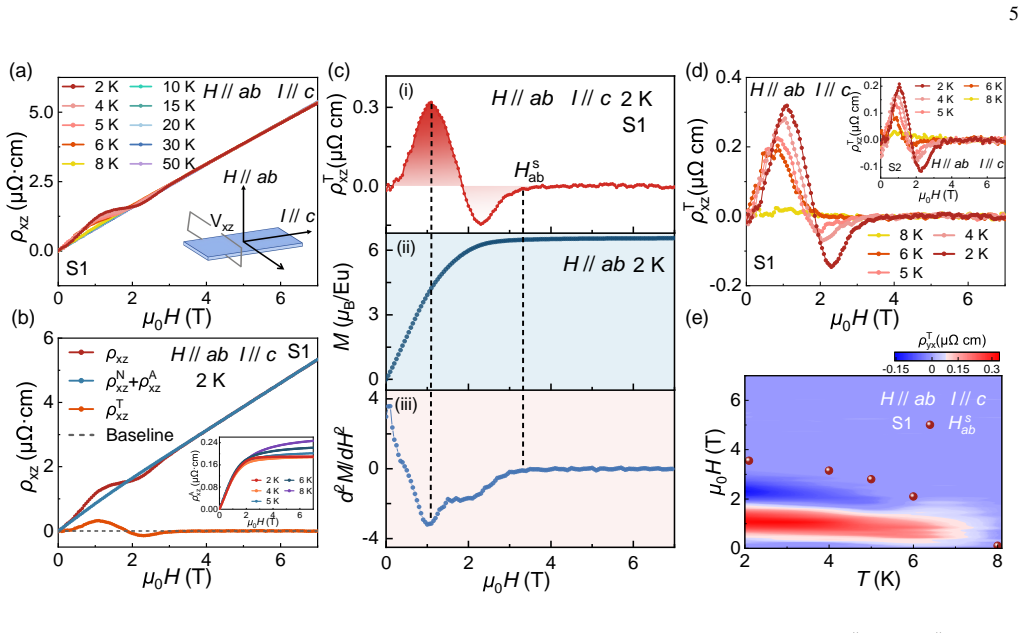
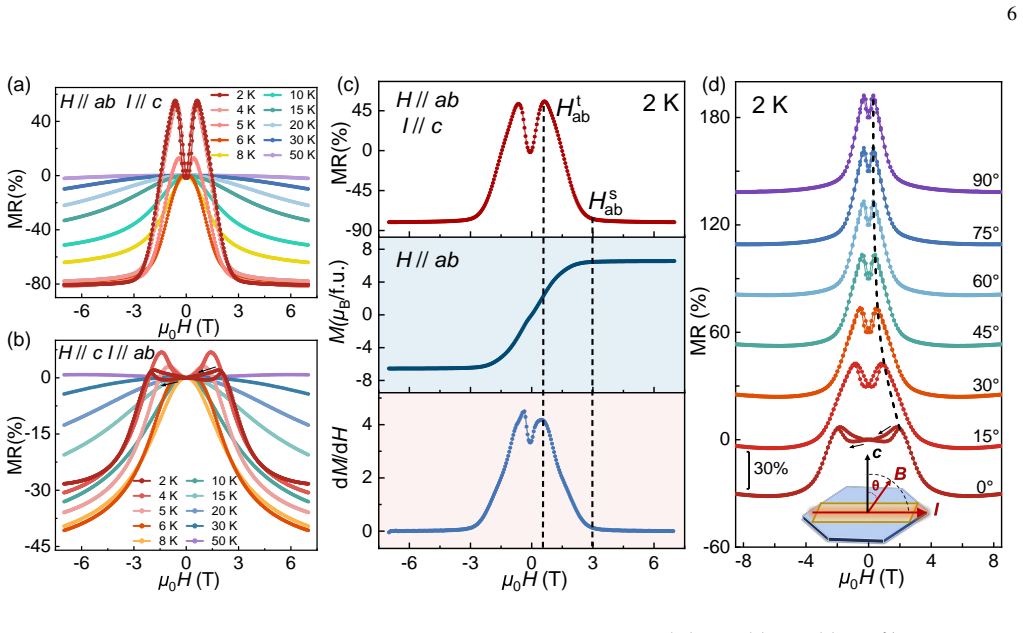
Electrical transport measurements reveal a pronounced topological Hall effect in the antiferromagnetic state with H ∥ ab and I ∥ c, which may be attributed to finite scalar spin chirality. Furthermore, the magnetoresistance exhibits butterfly-shaped hysteresis and strong angular dependence, which are likely associated with spin-dependent electron scattering, magnetic-domain evolution, and domain-wall pinning.
What carries the argument
Field-induced finite scalar spin chirality that produces a real-space Berry phase and thereby a topological contribution to the Hall resistivity.
If this is right
- Field-induced spin textures dominate magnetotransport in this centrosymmetric antiferromagnet.
- The observed metamagnetic transition correlates with the onset of the topological Hall signal.
- Butterfly-shaped magnetoresistance hysteresis tracks the evolution and pinning of magnetic domains.
- Angular dependence of both Hall and magnetoresistance signals reflects the underlying magnetic anisotropy.
Where Pith is reading between the lines
- Centrosymmetric antiferromagnets without built-in Dzyaloshinskii-Moriya interaction can still generate topological Hall signals once an external field creates non-coplanar spin arrangements.
- The same field-induced chirality mechanism may operate in other layered europium-based antiferromagnets with similar crystal symmetry.
- Systematic variation of current and field directions could map out the full angular landscape of the topological Hall response.
Load-bearing premise
The extra Hall resistivity component is produced by scalar spin chirality rather than by ordinary Hall, anomalous Hall, or measurement artifacts.
What would settle it
Subtracting the ordinary and anomalous Hall contributions from the measured Hall resistivity leaves no residual signal, or neutron diffraction shows only collinear spins with no non-coplanar textures under the same field conditions.
Figures
read the original abstract
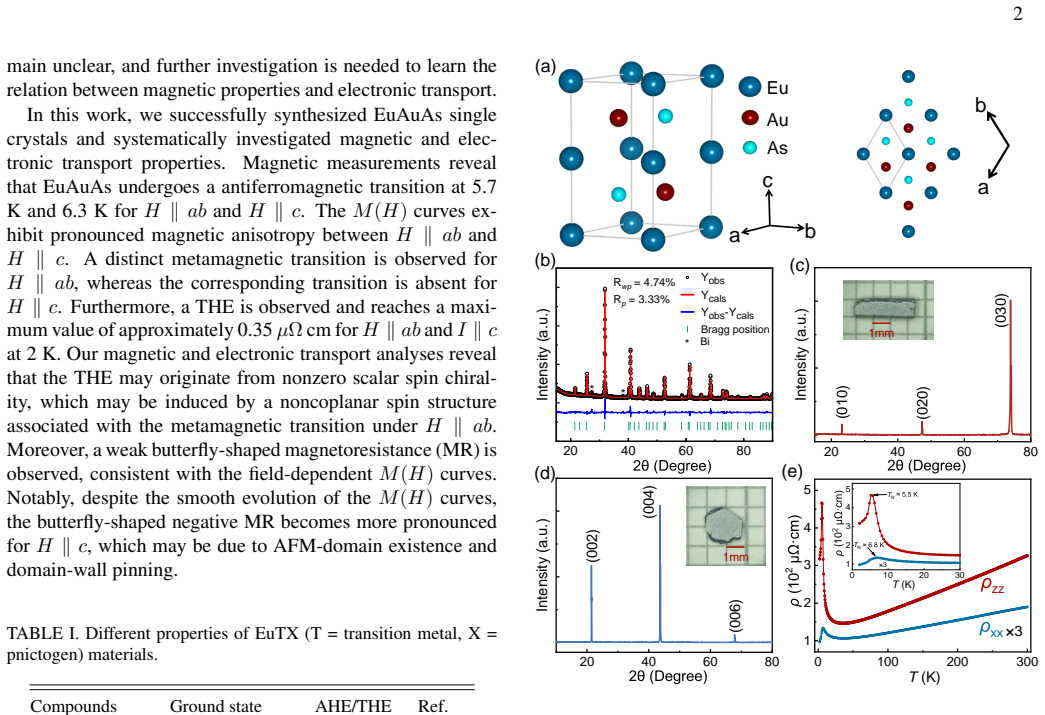
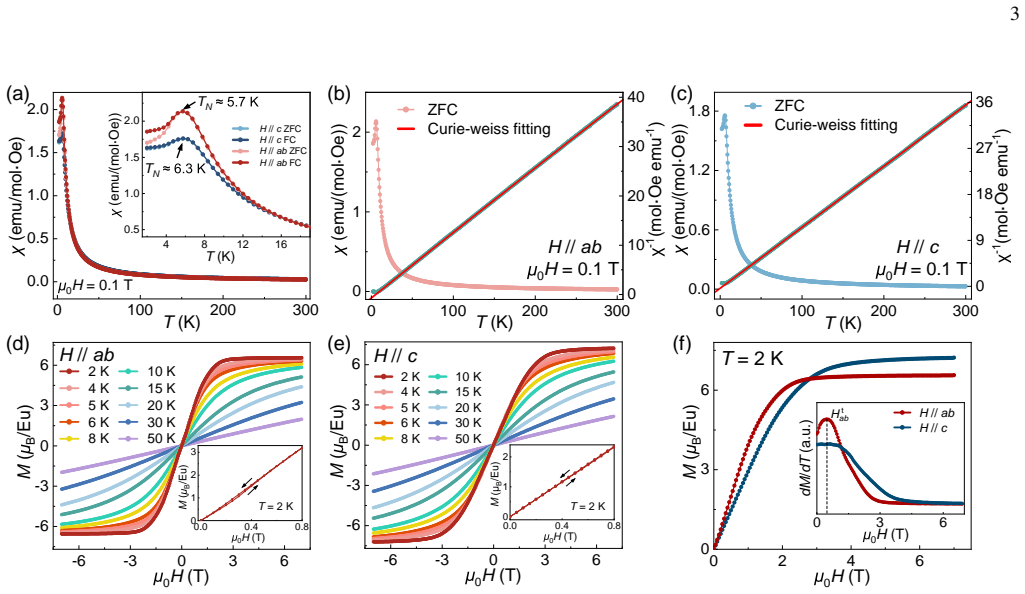
The coupling between magnetic and electronic degrees of freedom gives rise to a variety of intriguing transport phenomena. Among them, the topological Hall effect, originating from the real-space Berry phase associated with nontrivial magnetic textures, has attracted considerable attention. Here, we systematically investigate the magnetic and transport properties of antiferromagnet EuAuAs. Magnetic characterizations reveal antiferromagnetic transition at 5.7 K and 6.3 K for $H \parallel ab$ and $H \parallel c$, accompanied by metamagnetic transition and small hysteresis for $H \parallel ab$. Electrical transport measurements reveal a pronounced topological Hall effct in the antiferromagnetic state with $H \parallel ab$ and $I \parallel c$, which may be attributed to finite scalar spin chirality. Furthermore, the magnetoresistance exhibits butterfly-shaped hysteresis and strong angular dependence, which are likely associated with spin-dependent electron scattering, magnetic-domain evolution, and domain-wall pinning. Our results suggest that field-induced spin textures play an important role in the magnetotransport properties and provide insights into the interplay between magnetic textures and electronic transport in centrosymmetric antiferromagnets.
Editorial analysis
A structured set of objections, weighed in public.
Referee Report
Summary. The manuscript reports magnetic and transport properties of the centrosymmetric antiferromagnet EuAuAs. Magnetic data show AFM transitions at 5.7 K (H ∥ ab) and 6.3 K (H ∥ c), with metamagnetic transitions and small hysteresis for H ∥ ab. Transport measurements identify a pronounced topological Hall effect in the AFM state for H ∥ ab and I ∥ c, interpreted as arising from finite scalar spin chirality; magnetoresistance displays butterfly-shaped hysteresis with strong angular dependence, attributed to spin-dependent scattering, domain evolution, and domain-wall pinning. The work concludes that field-induced spin textures are important for magnetotransport in this system.
Significance. Confirmation of a field-induced topological Hall effect arising from scalar spin chirality in a centrosymmetric antiferromagnet would be of interest for understanding real-space Berry phase effects in systems lacking Dzyaloshinskii-Moriya interaction. The angular-dependent magnetoresistance data provide additional experimental constraints on domain-related scattering mechanisms.
major comments (2)
- [Electrical transport measurements (results and discussion sections)] The central interpretation that the observed Hall signal is topological and due to finite scalar spin chirality requires an explicit subtraction protocol (ordinary Hall linear in H plus any anomalous Hall from canted Eu moments) that demonstrably does not absorb the putative topological term. No such equations or step-by-step procedure are provided, leaving open the possibility that the residual is conventional or artifactual.
- [Discussion of topological Hall effect] Independent verification of the proposed non-coplanar spin texture (required for nonzero scalar spin chirality) at the fields and temperatures where the Hall signal appears is absent; neither neutron diffraction nor Berry-curvature calculations are presented to support the attribution beyond the transport data alone.
minor comments (2)
- [Abstract] Abstract contains a typo: 'effct' should read 'effect'.
- [Figure captions] Figure labels and captions should explicitly state the current and field directions (H ∥ ab, I ∥ c) for each panel to improve clarity of the angular-dependence data.
Simulated Author's Rebuttal
We thank the referee for their careful reading and constructive comments. We address the major comments point by point below.
read point-by-point responses
-
Referee: [Electrical transport measurements (results and discussion sections)] The central interpretation that the observed Hall signal is topological and due to finite scalar spin chirality requires an explicit subtraction protocol (ordinary Hall linear in H plus any anomalous Hall from canted Eu moments) that demonstrably does not absorb the putative topological term. No such equations or step-by-step procedure are provided, leaving open the possibility that the residual is conventional or artifactual.
Authors: We agree that an explicit subtraction protocol is necessary. In the revised manuscript we will add a detailed description of the procedure, including the decomposition ρ_xy = ρ_xy^O + ρ_xy^A + ρ_xy^T, the method used to determine the ordinary (linear-in-H) and anomalous contributions, and explicit demonstration that the residual Hall resistivity cannot be absorbed by adjustments to the conventional terms. revision: yes
-
Referee: [Discussion of topological Hall effect] Independent verification of the proposed non-coplanar spin texture (required for nonzero scalar spin chirality) at the fields and temperatures where the Hall signal appears is absent; neither neutron diffraction nor Berry-curvature calculations are presented to support the attribution beyond the transport data alone.
Authors: The manuscript does not contain neutron diffraction data or Berry-curvature calculations. The attribution rests on the observed field and temperature dependence of the Hall signal coinciding with the metamagnetic transition in the AFM state. We will revise the discussion to state this basis more explicitly and to note the absence of direct structural or computational confirmation as a limitation of the present transport-focused study. revision: no
Circularity Check
No circularity: purely experimental report with no derivations or self-referential claims
full rationale
The manuscript presents magnetic and electrical transport measurements on EuAuAs, reporting transitions, hysteresis, and a Hall signal interpreted as possibly topological. No equations, derivations, fitted parameters renamed as predictions, or load-bearing self-citations appear in the provided text or abstract. The attribution to scalar spin chirality is stated as a possible interpretation ('may be attributed') rather than a result derived from any internal chain. This is a standard experimental paper whose central claims rest on data rather than any reduction to inputs by construction.
Axiom & Free-Parameter Ledger
axioms (1)
- domain assumption EuAuAs undergoes antiferromagnetic transitions at 5.7 K (H ∥ ab) and 6.3 K (H ∥ c) with accompanying metamagnetic transitions.
invented entities (1)
-
finite scalar spin chirality
no independent evidence
Reference graph
Works this paper leans on
-
[1]
Notably,ρ T xz changes sign from 0.32µΩcm at 1.1 T to -0.15µΩcm at 2.2 T, and van- ishes at the saturation field (H s ab) 3.35 T
and FeGe thin films [51]. Notably,ρ T xz changes sign from 0.32µΩcm at 1.1 T to -0.15µΩcm at 2.2 T, and van- ishes at the saturation field (H s ab) 3.35 T. Comparison among Fig. 3(c)(i)–(iii) reveal that the field-dependent evolution of ρT xz,M(H), and its second derivative are all consistent. The peak appears exclusively in the range 0< µ 0H < H s ab, su...
-
[2]
Nagaosa, J
N. Nagaosa, J. Sinova, S. Onoda, A. H. MacDonald, and N. P. Ong, Anomalous Hall effect, Rev. Mod. Phys.82, 1539 (2010)
2010
-
[3]
Karplus and J
R. Karplus and J. M. Luttinger, Hall Effect in Ferromagnetics, Phys. Rev.95, 1154 (1954)
1954
-
[4]
C. Zeng, Y . Yao, Q. Niu, and H. H. Weitering, Linear Mag- netization Dependence of the Intrinsic Anomalous Hall Effect, Phys. Rev. Lett.96, 037204 (2006)
2006
-
[5]
Nakatsuji, N
S. Nakatsuji, N. Kiyohara, and T. Higo, Large anomalous Hall effect in a non-collinear antiferromagnet at room temperature, Nature527, 212 (2015)
2015
-
[6]
A. K. Nayak, J. E. Fischer, Y . Sun, B. Yan, J. Karel, A. C. Ko- marek, C. Shekhar, N. Kumar, W. Schnelle, J. K¨ubler, C. Felser, and S. S. P. Parkin, Large anomalous Hall effect driven by a nonvanishing Berry curvature in the noncolinear antiferromag- net Mn3Ge, Sci. Adv.2, e1501870 (2016)
2016
-
[7]
Berger, Side-Jump Mechanism for the Hall Effect of Ferro- magnets, Phys
L. Berger, Side-Jump Mechanism for the Hall Effect of Ferro- magnets, Phys. Rev. B2, 4559 (1970)
1970
-
[8]
Smit, The spontaneous Hall effect in Ferromagnetics I, Phys- ica21, 877 (1955)
J. Smit, The spontaneous Hall effect in Ferromagnetics I, Phys- ica21, 877 (1955)
1955
-
[9]
Smit, The Spontaneous Hall Effect in Ferromagnetics II, Physica24, 39 (1958)
J. Smit, The Spontaneous Hall Effect in Ferromagnetics II, Physica24, 39 (1958)
1958
-
[10]
Z. Fang, N. Nagaosa, K. S. Takahashi, A. Asamitsu, R. Math- ieu, T. Ogasawara, H. Yamada, M. Kawasaki, Y . Tokura, and K. Terakura, The Anomalous Hall Effect and Magnetic Monopoles in Momentum Space, Science302, 92 (2003)
2003
-
[11]
Xiao, M.-C
D. Xiao, M.-C. Chang, and Q. Niu, Berry phase effects on electronic properties, Rev. Mod. Phys.82, 1959 (2010)
1959
-
[12]
Bruno, V
P. Bruno, V . K. Dugaev, and M. Taillefumier, Topological Hall Effect and Berry Phase in Magnetic Nanostructures, Phys. Rev. Lett.93, 096806 (2004)
2004
-
[13]
Kimbell, C
G. Kimbell, C. Kim, W. Wu, M. Cuoco, and J. W. A. Robinson, Challenges in identifying chiral spin textures via the topological Hall effect, Commun. Mater.3, 19 (2022)
2022
-
[14]
H. Wang, Y . Dai, G.-M. Chow, and J. Chen, Topological hall transport: Materials, mechanisms and potential applications, Prog. Mater. Sci.130, 100971 (2022)
2022
-
[15]
X. G. Wen, F. Wilczek, and A. Zee, Chiral spin states and su- perconductivity, Phys. Rev. B39, 11413 (1989)
1989
-
[16]
Taguchi, Y
Y . Taguchi, Y . Oohara, H. Yoshizawa, N. Nagaosa, and Y . Tokura, Spin Chirality, Berry Phase, and Anomalous Hall Effect in a Frustrated Ferromagnet, Science291, 2573 (2001)
2001
-
[17]
Kanazawa, Y
N. Kanazawa, Y . Onose, T. Arima, D. Okuyama, K. Ohoyama, S. Wakimoto, K. Kakurai, S. Ishiwata, and Y . Tokura, Large Topological Hall Effect in a Short-Period Helimagnet MnGe, Phys. Rev. Lett.106, 156603 (2011)
2011
-
[18]
Y . Wang, J. Yan, J. Li, S. Wang, M. Song, J. Song, Z. Li, K. Chen, Y . Qin, L. Ling, H. Du, L. Cao, X. Luo, Y . Xiong, and Y . Sun, Magnetic anisotropy and topological Hall effect in the trigonal chromium tellurides Cr5Te8, Phys. Rev. B100, 024434 (2019)
2019
-
[19]
Z. Meng, W. Lin, Z. Zhao, B. Zhang, B. Li, Y . Lv, G. Han, S. Li, Y . Cai, F. Jin, Y . Zhang, D. Xiao, T. Yang, L. Peng, and Y . Hou, Spontaneous Topological Hall Effect in Intercalated Co1/3TaS2 Nanoflakes with Non-Coplanar Antiferromagnetic Order, Adv. Funct. Mater.35, 2502016 (2025)
2025
-
[20]
Ishizuka and N
H. Ishizuka and N. Nagaosa, Spin chirality induced skew scat- tering and anomalous Hall effect in chiral magnets, Sci. Adv.4, eaap9962 (2018)
2018
-
[21]
Shiomi, M
Y . Shiomi, M. Mochizuki, Y . Kaneko, and Y . Tokura, Hall Ef- fect of Spin-Chirality Origin in a Triangular-Lattice Helimagnet 8 Fe1.3Sb, Phys. Rev. Lett.108, 056601 (2012)
2012
-
[22]
Neubauer, C
A. Neubauer, C. Pfleiderer, B. Binz, A. Rosch, R. Ritz, P. G. Niklowitz, and P. B ¨oni, Topological Hall Effect in theAPhase of MnSi, Phys. Rev. Lett.102, 186602 (2009)
2009
-
[23]
S. X. Huang and C. L. Chien, Extended Skyrmion Phase in EpitaxialFeGe(111)Thin Films, Phys. Rev. Lett.108, 267201 (2012)
2012
-
[24]
Takashi, N
K. Takashi, N. Taro, H. Max, K. Akiko, Y . Yuichi, S. Ha- jime, N. Hironori, T. Yasujiro, A. Taka-hisa, and T. Yoshinori, Skyrmion lattice with a giant topological Hall effect in a frus- trated triangular-lattice magnet, Science365, 914 (2019)
2019
-
[25]
H. Li, B. Ding, J. Chen, Z. Li, Z. Hou, E. Liu, H. Zhang, X. Xi, G. Wu, and W. Wang, Large topological Hall effect in a geo- metrically frustrated kagome magnet Fe3Sn2, Appl. Phys. Lett. 114, 192408 (2019)
2019
-
[26]
W. Wang, Y . Zhang, G. Xu, L. Peng, B. Ding, Y . Wang, Z. Hou, X. Zhang, X. Li, E. Liu, S. Wang, J. Cai, F. Wang, J. Li, F. Hu, G. Wu, B. Shen, and X.-X. Zhang, A Centrosymmet- ric Hexagonal Magnet with Superstable Biskyrmion Magnetic Nanodomains in a Wide Temperature Range of 100–340 K, Adv. Mater.28, 6887 (2016)
2016
-
[27]
A. Laha, R. Singha, S. Mardanya, B. Singh, A. Agarwal, P. Mandal, and Z. Hossain, Topological Hall effect in the an- tiferromagnetic Dirac semimetal EuAgAs, Phys. Rev. B103, L241112 (2021)
2021
-
[28]
Roychowdhury, K
S. Roychowdhury, K. Samanta, P. Yanda, B. Malaman, M. Yao, W. Schnelle, E. Guilmeau, P. Constantinou, S. Chandra, H. Bor- rmann, M. G. Vergniory, V . Strocov, C. Shekhar, and C. Felser, Interplay between Magnetism and Topology: Large Topologi- cal Hall Effect in an Antiferromagnetic Topological Insulator, EuCuAs, J. Am. Chem. Soc.145, 12920 (2023)
2023
-
[29]
J. Wang, Y . Wang, X. Wang, J. Shen, E. Liu, and X. Xu, Large topological Hall effect induced by a field-driven metamagnetic transition in a centrosymmetric antiferromagnetic EuCuSb sin- gle crystal, Phys. Rev. B111, 054428 (2025)
2025
-
[30]
Malick, J
S. Malick, J. Singh, A. Laha, V . Kanchana, Z. Hossain, and D. Kaczorowski, Electronic structure and physical properties of EuAuAs single crystal, Phys. Rev. B105, 045103 (2022)
2022
-
[31]
S. Roy, B. Das, A. Ghosh, A. Bera, C. K. Barman, M. Mondal, A. Alam, and P. Mandal, Chiral anomaly and weak antilocal- ization effects in the Weyl semimetal EuAuSb, Phys. Rev. B 110, 085145 (2024)
2024
-
[32]
D. Ram, J. Singh, S. Banerjee, A. Sundaresan, D. Samal, V . Kanchana, and Z. Hossain, Magnetotransport and electronic structure of EuAuSb: A candidate antiferromagnetic Dirac semimetal, Phys. Rev. B109, 155152 (2024)
2024
-
[33]
H. Yin, M. He, Y . Qin, Q. Feng, L. Cao, W. Gao, H. Xu, L. Ling, W. Tong, H. Zhang, X. Kan, Y . Han, and L. Pi, Magnetism and anomalous Hall effect in the antiferromagnetic semimetal EuAgSb, J. Alloys Compd.1010, 178172 (2025)
2025
-
[34]
Takahashi, K
H. Takahashi, K. Aono, Y . Nambu, R. Kiyanagi, T. Nomoto, M. Sakano, K. Ishizaka, R. Arita, and S. Ishiwata, Compet- ing spin modulations in the magnetically frustrated semimetal EuCuSb, Phys. Rev. B102, 174425 (2020)
2020
-
[35]
Singh, A
Lipika, S. Singh, A. Saraswati, V . Chahar, Y . Sun, P. Manuel, D. Adroja, W. Schnelle, N. Kumar, J. Sannigrahi, and K. Manna, Complex spin dynamics induced metamagnetic phase transitions in Dirac semimetal EuAuBi, Phys. Rev. B113, 104406 (2026)
2026
-
[36]
S. Singh, R. Koban, W. Schnelle, and K. Manna, Intrinsic mag- netotransport and orientation dependent topological Hall effect in EuAuBi, arXiv preprint arXiv:2604.25365 (2026)
Pith/arXiv arXiv 2026
-
[37]
X. Wang, Z. Song, W. Li, Y . Pan, B. Jiang, C. Liu, J. Liu, Y . Wang, K. Liao, Y . Yu, C. Li, T. Qian, H. Weng, and G. Wang, Effect of symmetry breaking on Dirac points in topological semimetal EuAgBi, Innovation (Camb)3, 100171 (2025)
2025
-
[38]
X. Wang, B. Li, L. Zhou, L. Chen, Y . Wang, Y . Yang, Y . Zhou, K. Liao, H. Weng, and G. Wang, Structure, physical properties, and magnetically tunable topological phases in the topological semimetal EuCuBi, Phys. Rev. B108, 115126 (2023)
2023
-
[39]
Michels, S
G. Michels, S. Junk, W. Schlabitz, E. Holland-Moritz, M. M. Abd-Elmeguid, J. Dunner, and A. Mewis, Final-state effects in divalent Eu pnictides, J Phys Condens Matter6, 1769 (1994)
1994
-
[40]
Chi and G
S. Chi and G. Xu, Electronic and topological characters of the ideal magnetic topological materials EuAuX with X = P, As, Sb, and Bi, COMMT4, 100022 (2024)
2024
-
[41]
Q. Zhao, K. Sun, S. Wu, and H.-F. Li, Crystal, ferromagnetism, and magnetoresistance with sign reversal in a EuAgP semicon- ductor, J. Materiomics11, 100853 (2025)
2025
-
[42]
Y . Ge, Y . Jin, and Z. Zhu, Ferromagnetic Weyl metal in EuAgP, Mater. Today Phys.22, 100570 (2022)
2022
-
[43]
J. Wang, J. Shen, Y . Wang, T. Liang, X. Wang, R. Zu, S. Zhang, Q. Zeng, E. Liu, and X. Xu, Anisotropic magneto-transport behavior in a hexagonal ferromagnetic EuCuP single crystal, J. Alloys Compd.947, 169620 (2023)
2023
-
[44]
J. Yuan, X. Shi, H. Du, W. Xia, X. Wang, J. Cheng, B. Wang, R. Zhong, S. Zhang, and Y . Guo, Magnetization dependent anisotropic topological properties in EuCuP, Phys. Rev. Mater. 8, 094202 (2024)
2024
-
[45]
Blundell,Magnetism in Condensed Matter(Oxford Univer- sity Press, 2001)
S. Blundell,Magnetism in Condensed Matter(Oxford Univer- sity Press, 2001)
2001
-
[46]
Mugiraneza and A
S. Mugiraneza and A. M. Hallas, Tutorial: a beginner’s guide to interpreting magnetic susceptibility data with the Curie-Weiss law, Commun. Phys.5, 95 (2022)
2022
-
[47]
Z.-C. Wang, E. Been, J. Gaudet, G. M. A. Alqasseri, K. Fruh- ling, X. Yao, U. Stuhr, Q. Zhu, Z. Ren, Y . Cui, C. Jia, B. Moritz, S. Chowdhury, T. Devereaux, and F. Tafti, Anisotropy of the magnetic and transport properties of EuZn 2As2, Phys. Rev. B 105, 165122 (2022)
2022
-
[48]
T. Jun, P. Jim, T. Qian, C. Guang-Han, X. Zhu-An, and Z. Hao, Magnetic properties of EuCuAs single crystal, J. Al- loys Compd.602, 26 (2014)
2014
-
[49]
Suzuki, R
T. Suzuki, R. Chisnell, A. Devarakonda, Y . T. Liu, W. Feng, D. Xiao, J. W. Lynn, and J. G. Checkelsky, Large anomalous Hall effect in a half-Heusler antiferromagnet, Nat. Phys.12, 1119 (2016)
2016
-
[50]
Roychowdhury, M
S. Roychowdhury, M. Yao, K. Samanta, S. Bae, D. Chen, S. Ju, A. Raghavan, N. Kumar, P. Constantinou, S. N. Guin, N. C. Plumb, M. Romanelli, H. Borrmann, M. G. Vergniory, V . N. Strocov, V . Madhavan, C. Shekhar, and C. Felser, Anoma- lous Hall Conductivity and Nernst Effect of the Ideal Weyl Semimetallic Ferromagnet EuCd 2As2, Adv. Sci.10, 2207121 (2023)
2023
-
[51]
Y . Xu, L. Das, J. Z. Ma, C. J. Yi, S. M. Nie, Y . G. Shi, A. Ti- wari, S. S. Tsirkin, T. Neupert, M. Medarde, M. Shi, J. Chang, and T. Shang, Unconventional Transverse Transport above and below the Magnetic Transition Temperature in Weyl Semimetal EuCd2As2, Phys. Rev. Lett.126, 076602 (2021)
2021
-
[52]
J. C. Gallagher, K. Y . Meng, J. T. Brangham, H. L. Wang, B. D. Esser, D. W. McComb, and F. Y . Yang, Robust Zero-Field Skyrmion Formation in FeGe Epitaxial Thin Films, Phys. Rev. Lett.118, 027201 (2017)
2017
-
[53]
H. Li, B. Ding, J. Chen, Z. Li, E. Liu, X. Xi, G. Wu, and W. Wang, Large anisotropic topological Hall effect in a hexago- nal non-collinear magnet Fe5Sn3, Appl. Phys. Lett.116(2020)
2020
-
[54]
Dhakal, F
G. Dhakal, F. Cheenicode Kabeer, A. K. Pathak, F. Kabir, N. Poudel, R. Filippone, J. Casey, A. Pradhan Sakhya, S. Regmi, C. Sims, K. Dimitri, P. Manfrinetti, K. Gofryk, P. M. 9 Oppeneer, and M. Neupane, Anisotropically large anomalous and topological Hall effect in a kagome magnet, Phys. Rev. B 104, L161115 (2021)
2021
-
[55]
S. H. Lee, Y . Zhu, Y . Wang, L. Miao, T. Pillsbury, H. Yi, S. Kempinger, J. Hu, C. A. Heikes, P. Quarterman, W. Rat- cliff, J. A. Borchers, H. Zhang, X. Ke, D. Graf, N. Alem, C.- Z. Chang, N. Samarth, and Z. Mao, Spin scattering and non- collinear spin structure-induced intrinsic anomalous Hall ef- fect in antiferromagnetic topological insulator MnBi2Te4...
2019
-
[56]
Zhang and C
Y . Zhang and C. Uher, Magnetic and transport properties of Fe-doped Weyl semimetal Co 3Sn2S2, J. Alloys Compd.911, 165089 (2022)
2022
-
[57]
C. Liu, Y . Wang, H. Li, Y . Wu, Y . Li, J. Li, K. He, Y . Xu, J. Zhang, and Y . Wang, Robust axion insulator and Chern insu- lator phases in a two-dimensional antiferromagnetic topological insulator, Nat. Mater.19, 522 (2020)
2020
-
[58]
D. R. Klein, D. MacNeill, J. L. Lado, D. Soriano, E. Navarro- Moratalla, K. Watanabe, T. Taniguchi, S. Manni, P. Canfield, J. Fern ´andez-Rossier, and P. Jarillo-Herrero, Probing mag- netism in 2D van der Waals crystalline insulators via electron tunneling, Science360, 1218 (2018)
2018
-
[59]
N. Wang, H. Tang, M. Shi, H. Zhang, W. Zhuo, D. Liu, F. Meng, L. Ma, J. Ying, L. Zou, Z. Sun, and X. Chen, Transition from Ferromagnetic Semiconductor to Ferromagnetic Metal with En- hanced Curie Temperature in Cr2Ge2Te6 via Organic Ion Inter- calation, J. Am. Chem. Soc.141, 17166 (2019)
2019
-
[60]
Yamasaki, R
Y . Yamasaki, R. Moriya, M. Arai, S. Masubuchi, S. Pyon, T. Tamegai, K. Ueno, and T. Machida, Exfoliation and van der Waals heterostructure assembly of intercalated ferromagnet Cr1/3TaS2, 2D Mater.4, 041007 (2017)
2017
discussion (0)
Sign in with ORCID, Apple, or X to comment. Anyone can read and Pith papers without signing in.