RainODE: Continuous-Time Precipitation Forecasting with Latent Neural ODEs
Pith reviewed 2026-06-30 06:37 UTC · model grok-4.3
The pith
RainODE models precipitation evolution in latent space with a Neural ODE for advective motion plus Brownian Bridge refinement for residuals, enabling sharp forecasts at any time interval.
A machine-rendered reading of the paper's core claim, the machinery that carries it, and where it could break.
Core claim
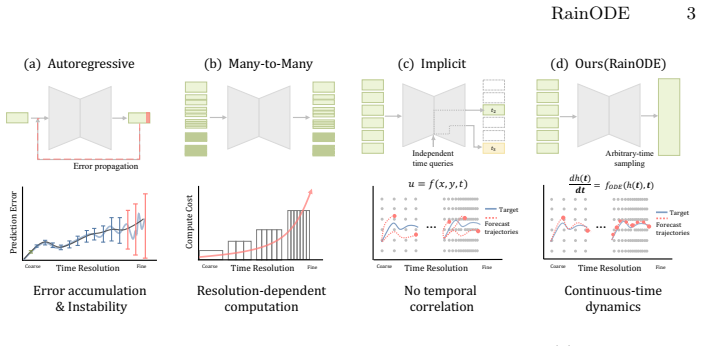
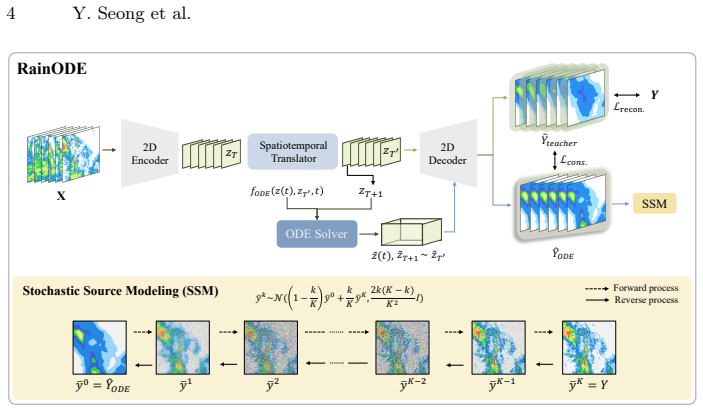
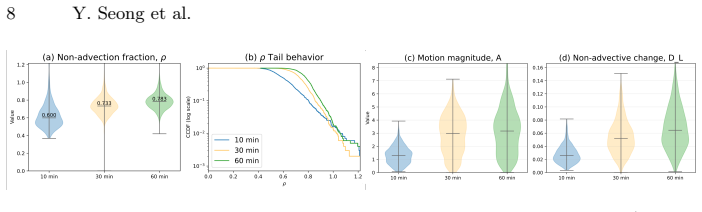
Precipitation forecasting is reformulated as a continuous-time dynamical system and modeled in latent space using a Neural ODE that captures the dominant large-scale advective motion of precipitation systems. A purely deterministic ODE struggles with non-advective intensity changes such as localized growth, decay, and sub-grid variability, leading to over-smoothed predictions, so a stochastic source modeling module based on a Brownian Bridge formulation is introduced to refine residual intensity variations while preserving advective consistency. By combining deterministic continuous dynamics with stochastic refinement, the framework enables arbitrary-time inference while maintaining sharp pr
What carries the argument
Latent Neural ODE for deterministic advective dynamics combined with Brownian Bridge stochastic source modeling module for residual intensity variations
If this is right
- Forecasts become possible at arbitrary time intervals without requiring dense discrete modeling or post-hoc interpolation.
- Advective consistency is preserved while fine-grained structures are restored through stochastic refinement.
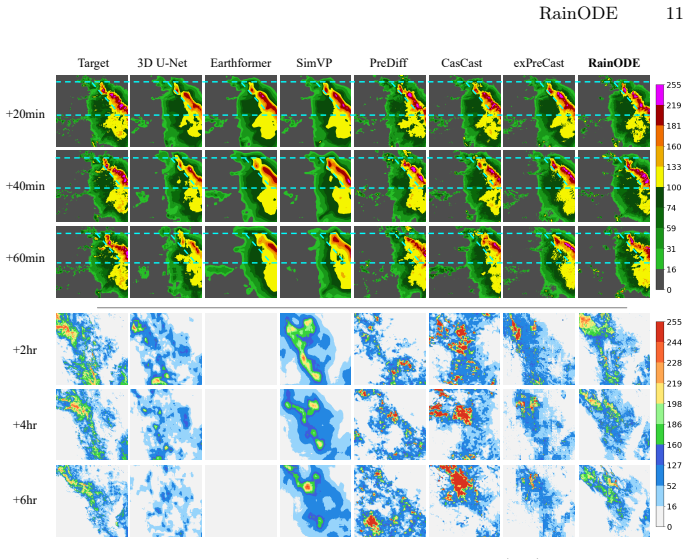
- Performance improves consistently across multiple temporal intervals and precipitation regimes on SEVIR and RAPID.
- The approach addresses both accuracy and temporal flexibility constraints in radar-based precipitation nowcasting.
Where Pith is reading between the lines
- The latent continuous formulation could support fusion with irregularly sampled satellite observations at varying intervals.
- Similar ODE-plus-stochastic refinement structures might apply to other advection-dominated fields like cloud motion or pollutant transport.
- Operating in latent space could lower the cost of generating high-resolution forecasts compared to full-grid discrete simulations.
Load-bearing premise
Dominant precipitation evolution is advective and can be captured by a deterministic latent ODE, with residuals adequately modeled by a Brownian Bridge that does not break the advective consistency.
What would settle it
If removing the Brownian Bridge module produces no measurable loss in sharpness or accuracy at intermediate times between radar observations on the RAPID dataset, while the full model fails to outperform standard interpolation baselines.
Figures
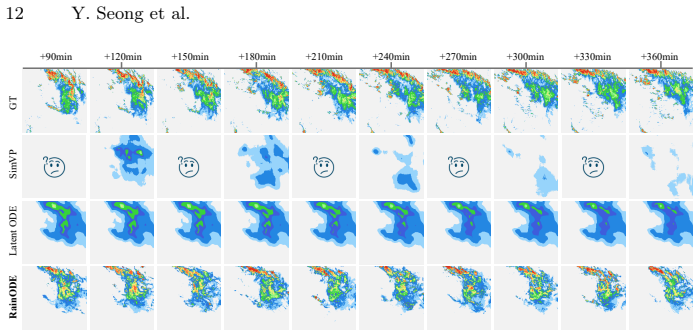
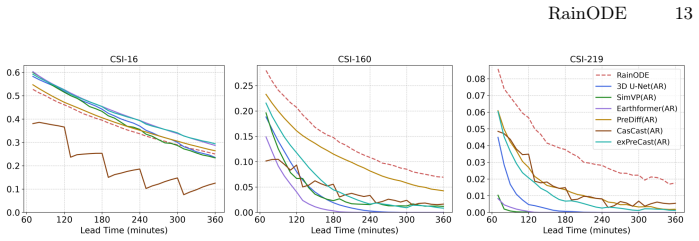
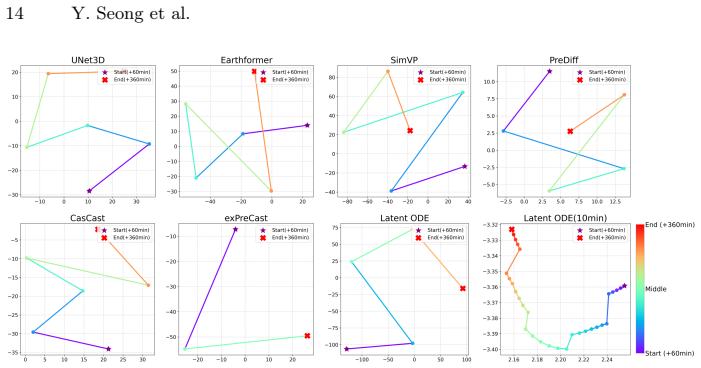
read the original abstract
In precipitation forecasting, not only accuracy but also temporal resolution is critical. However, increasing temporal resolution is constrained by observational limitations and the computational cost of dense discrete modeling. To overcome this limitation, we reformulate precipitation forecasting as a continuous-time dynamical system and propose RainODE, a framework that models precipitation evolution in latent space using a Neural ODE. This formulation enables derivative-consistent temporal dynamics and captures the dominant large-scale advective motion of precipitation systems. Nevertheless, a purely deterministic ODE struggles to represent non-advective intensity changes such as localized growth, decay, and sub-grid variability, often leading to over-smoothed predictions. To address this issue, we introduce a stochastic source modeling module based on a Brownian Bridge formulation, which refines residual intensity variations and restores fine-grained structures while preserving advective consistency. By combining deterministic continuous dynamics with stochastic refinement, RainODE enables arbitrary-time inference while maintaining sharp predictions. Experiments on SEVIR and the newly introduced Radar-based Precipitation Integrated Dataset (RAPID) demonstrate consistent improvements across multiple temporal intervals and precipitation regimes. The code is available at https://github.com/SeongYE/RainODE.
Editorial analysis
A structured set of objections, weighed in public.
Referee Report
Summary. The paper claims to reformulate precipitation forecasting as a continuous-time dynamical system via a latent Neural ODE that captures dominant advective motion, augmented by a Brownian Bridge stochastic source module to model non-advective residuals (growth/decay, sub-grid variability) without breaking consistency; this enables arbitrary-time inference with sharp predictions and yields consistent gains over discrete baselines on SEVIR and the new RAPID dataset.
Significance. If the deterministic-stochastic separation holds and the Brownian Bridge integrates without perturbing advective trajectories or derivative consistency, the framework would meaningfully advance continuous-time nowcasting by relaxing the need for dense discrete sampling while preserving fine structures. The public code release and introduction of the RAPID dataset are concrete strengths that support reproducibility and further work in the area.
major comments (1)
- [Abstract] Abstract: the central claim that the stochastic module 'restores fine-grained structures while preserving advective consistency' is load-bearing for arbitrary-time inference, yet the description provides no derivation or integration scheme showing how the Brownian Bridge is added to the Neural ODE without coupling back into the latent trajectory or violating the advective assumption; this separation must be demonstrated explicitly (e.g., via ablation on derivative consistency or trajectory smoothness) for the claimed benefits to follow.
Simulated Author's Rebuttal
We thank the referee for the careful reading and for identifying the need to make the separation between the deterministic Neural ODE and stochastic module fully explicit. We address the single major comment below.
read point-by-point responses
-
Referee: [Abstract] Abstract: the central claim that the stochastic module 'restores fine-grained structures while preserving advective consistency' is load-bearing for arbitrary-time inference, yet the description provides no derivation or integration scheme showing how the Brownian Bridge is added to the Neural ODE without coupling back into the latent trajectory or violating the advective assumption; this separation must be demonstrated explicitly (e.g., via ablation on derivative consistency or trajectory smoothness) for the claimed benefits to follow.
Authors: We agree that the abstract does not contain an explicit derivation or integration scheme, and that an ablation on derivative consistency and trajectory smoothness would strengthen the central claim. In the manuscript the Brownian Bridge is introduced as an additive stochastic source applied after latent ODE integration and decoding (Section 3), so that it does not enter the latent dynamics or the ODE solver. Nevertheless, the current text does not provide the requested quantitative verification of non-coupling. We will therefore (i) revise the abstract to reference the post-integration placement, (ii) add a short derivation of the integration scheme in Section 3, and (iii) include an ablation measuring the norm of dz/dt differences and trajectory smoothness with/without the bridge. These changes will appear in the revised version. revision: yes
Circularity Check
No significant circularity detected
full rationale
The paper introduces RainODE as a modeling framework that uses a Neural ODE to capture deterministic latent dynamics for advective precipitation motion and augments it with a Brownian Bridge module for residual non-advective variations. This separation is asserted as a design choice to enable continuous-time inference, without any equations or claims in the provided text reducing the central result to a self-referential fit, parameter renaming, or load-bearing self-citation. The derivation relies on standard Neural ODE and stochastic process components with external dataset validation, remaining self-contained.
Axiom & Free-Parameter Ledger
axioms (2)
- domain assumption Precipitation evolution is dominated by large-scale advective motion that can be represented in latent space by a Neural ODE.
- domain assumption Non-advective intensity changes can be modeled as residual stochastic processes without violating advective consistency.
Reference graph
Works this paper leans on
-
[1]
Expert Systems with Applications268, 126301 (2025)
An, S., Oh, T.J., Sohn, E., Kim, D.: Deep learning for precipitation nowcasting: A survey from the perspective of time series forecasting. Expert Systems with Applications268, 126301 (2025)
2025
-
[2]
Deep learning for day forecasts from sparse observa- tions.arXiv preprint arXiv:2306.06079, 2023
Andrychowicz, M., Espeholt, L., Li, D., Merchant, S., Merose, A., Zyda, F., Agrawal, S., Kalchbrenner, N.: Deep learning for day forecasts from sparse ob- servations. arXiv preprint arXiv:2306.06079 (2023)
-
[3]
IEEE Geoscience and Remote Sensing Letters19, 1–5 (2022)
Bai, C., Sun, F., Zhang, J., Song, Y., Chen, S.: Rainformer: Features extraction balanced network for radar-based precipitation nowcasting. IEEE Geoscience and Remote Sensing Letters19, 1–5 (2022)
2022
-
[4]
In: Proceedings of the AAAI Conference on Artificial Intelligence (AAAI)
Chen, L., Du, F., Hu, Y., Wang, Z., Wang, F.: Swinrdm: integrate swinrnn with diffusion model towards high-resolution and high-quality weather forecasting. In: Proceedings of the AAAI Conference on Artificial Intelligence (AAAI). vol. 37, pp. 322–330 (2023)
2023
-
[5]
Advances in Neural Information Processing Systems (NeurIPS) 31(2018)
Chen, R.T., Rubanova, Y., Bettencourt, J., Duvenaud, D.K.: Neural ordinary dif- ferential equations. Advances in Neural Information Processing Systems (NeurIPS) 31(2018)
2018
-
[6]
International Conference on Learning Representations (ICLR) 2023 Workshop on Tackling Climate Change with Machine Learning (2023)
Demiray, B.Z., Sit, M., Demir, I.: Efficienttempnet: Temporal super-resolution of radar rainfall. International Conference on Learning Representations (ICLR) 2023 Workshop on Tackling Climate Change with Machine Learning (2023)
2023
-
[7]
Nature communications13(1), 5145 (2022)
Espeholt,L.,Agrawal,S.,Sønderby,C.,Kumar,M.,Heek,J.,Bromberg,C.,Gazen, C., Carver, R., Andrychowicz, M., Hickey, J., et al.: Deep learning for twelve hour precipitation forecasts. Nature communications13(1), 5145 (2022)
2022
-
[8]
In: Proceedings of the International Con- ference on Machine Learning (ICML) (2025)
Feng, W., Li, X., Wu, Z., Lin, K., Yu, D., Ye, Y., Wang, Y.: Perceptually con- strained precipitation nowcasting model. In: Proceedings of the International Con- ference on Machine Learning (ICML) (2025)
2025
-
[9]
In: Proceedings of the IEEE/CVF Conference on Computer Vision and Pattern Recognition (CVPR)
Gao, Z., Tan, C., Wu, L., Li, S.Z.: Simvp: Simpler yet better video prediction. In: Proceedings of the IEEE/CVF Conference on Computer Vision and Pattern Recognition (CVPR). pp. 3170–3180 (2022)
2022
-
[10]
Advances in Neural Information Processing Systems (NeurIPS)36, 78621–78656 (2023)
Gao, Z., Shi, X., Han, B., Wang, H., Jin, X., Maddix, D., Zhu, Y., Li, M., Wang, Y.B.: Prediff: Precipitation nowcasting with latent diffusion models. Advances in Neural Information Processing Systems (NeurIPS)36, 78621–78656 (2023)
2023
-
[11]
Gao, Z., Shi, X., Wang, H., Zhu, Y., Wang, Y.B., Li, M., Yeung, D.Y.: Earthformer: Exploringspace-timetransformersforearthsystemforecasting.AdvancesinNeural Information Processing Systems (NeurIPS)35, 25390–25403 (2022)
2022
-
[12]
In: Proceedings of the International Conference on Machine Learning (ICML) (2024)
Gong, J., Bai, L., Ye, P., Xu, W., Liu, N., Dai, J., Yang, X., Ouyang, W.: Cas- cast: Skillful high-resolution precipitation nowcasting via cascaded modelling. In: Proceedings of the International Conference on Machine Learning (ICML) (2024)
2024
-
[13]
In: Proceedings of the IEEE/CVF Conference on Computer Vision and Pattern Recognition (CVPR)
Guen, V.L., Thome, N.: Disentangling physical dynamics from unknown factors for unsupervised video prediction. In: Proceedings of the IEEE/CVF Conference on Computer Vision and Pattern Recognition (CVPR). pp. 11474–11484 (2020)
2020
-
[14]
arXiv preprint arXiv:2406.04678 (2024)
Kim, D., Seo, M., Choi, Y.: Ace metric: Advection and convection evaluation for accurate weather forecasting. arXiv preprint arXiv:2406.04678 (2024)
-
[15]
arXiv preprint arXiv:2409.20117 (2024)
Kim, D., Seo, M., Lee, H., Seo, J.: Masked autoregressive model for weather fore- casting. arXiv preprint arXiv:2409.20117 (2024)
-
[16]
Technical Report (2020),https://meteofrance.github.io/meteonet/ RainODE 17
Larvor, G., Berthomier, L., Chabot, V., Le Pape, B., Pradel, B., Perez, L.: Me- teonet, an open reference weather dataset by meteo france. Technical Report (2020),https://meteofrance.github.io/meteonet/ RainODE 17
2020
-
[17]
In: Proceedings of the IEEE/CVF Conference on Computer Vision and Pattern Recognition (CVPR)
Li, B., Xue, K., Liu, B., Lai, Y.K.: Bbdm: Image-to-image translation with brow- nian bridge diffusion models. In: Proceedings of the IEEE/CVF Conference on Computer Vision and Pattern Recognition (CVPR). pp. 1952–1961 (2023)
1952
-
[18]
In: Proceed- ings of the IEEE/CVF Conference on Computer Vision and Pattern Recognition (CVPR)
Lin, K., Zhang, B., Yu, D., Feng, W., Chen, S., Gao, F., Li, X., Ye, Y.: Alphapre: Amplitude-phase disentanglement model for precipitation nowcasting. In: Proceed- ings of the IEEE/CVF Conference on Computer Vision and Pattern Recognition (CVPR). pp. 17841–17850 (2025)
2025
-
[19]
In: Proceedings of the International Conference on Machine Learning (ICML) (2023)
Liu, G.H., Vahdat, A., Huang, D.A., Theodorou, E.A., Nie, W., Anandkumar, A.: I2sb: Image-to-image schrodinger bridge. In: Proceedings of the International Conference on Machine Learning (ICML) (2023)
2023
-
[20]
arXiv preprint arXiv:2410.06560 (2024)
Liu, P., Zhou, T., Sun, L., Jin, R.: Mitigating time discretization challenges with weatherode: A sandwich physics-driven neural ode for weather forecasting. arXiv preprint arXiv:2410.06560 (2024)
-
[21]
In: Proceedings of the AAAI Conference on Artificial Intelligence (AAAI)
Ning,S.,Lan,M.,Li,Y.,Chen,C.,Chen,Q.,Chen,X.,Han,X.,Cui,S.:Mimoisall you need: A strong multi-in-multi-out baseline for video prediction. In: Proceedings of the AAAI Conference on Artificial Intelligence (AAAI). vol. 37, pp. 1975–1983 (2023)
1975
-
[22]
Weather and Forecasting31(1), 329–340 (2016)
Otsuka, S., Tuerhong, G., Kikuchi, R., Kitano, Y., Taniguchi, Y., Ruiz, J.J., Satoh, S., Ushio, T., Miyoshi, T.: Precipitation nowcasting with three-dimensional space– time extrapolation of dense and frequent phased-array weather radar observations. Weather and Forecasting31(1), 329–340 (2016)
2016
-
[23]
In: International Conference on Learning Representations (ICLR) (2026)
Ribeiro, B.P., Pucer, J.F.: Flowcast: Advancing precipitation nowcasting with con- ditional flow matching. In: International Conference on Learning Representations (ICLR) (2026)
2026
-
[24]
Mathema- tische Annalen46(2), 167–178 (1895)
Runge, C.: Über die numerische auflösung von differentialgleichungen. Mathema- tische Annalen46(2), 167–178 (1895)
-
[25]
In: International Conference on Learning Representations (ICLR) (2026)
Sarabia, R.P., Nyborg, J., Birk, M., Sjørup, J.L., Vesterholt, A.L., Assent, I.: Rainpro-8: An efficient deep learning model to estimate rainfall probabilities over 8 hours. In: International Conference on Learning Representations (ICLR) (2026)
2026
-
[26]
Advances in Neural Information Processing Systems (NeurIPS)28(2015)
Shi, X., Chen, Z., Wang, H., Yeung, D.Y., Wong, W.K., Woo, W.c.: Convolutional lstm network: A machine learning approach for precipitation nowcasting. Advances in Neural Information Processing Systems (NeurIPS)28(2015)
2015
-
[27]
Advances in Neural Information Processing Systems (NeurIPS)30(2017)
Shi, X., Gao, Z., Lausen, L., Wang, H., Yeung, D.Y., Wong, W.k., Woo, W.c.: Deep learning for precipitation nowcasting: A benchmark and a new model. Advances in Neural Information Processing Systems (NeurIPS)30(2017)
2017
-
[28]
arXiv preprint arXiv:2003.12140 (2020)
Sønderby, C.K., Espeholt, L., Heek, J., Dehghani, M., Oliver, A., Salimans, T., Agrawal, S., Hickey, J., Kalchbrenner, N.: Metnet: A neural weather model for precipitation forecasting. arXiv preprint arXiv:2003.12140 (2020)
-
[29]
In: International Conference on Learning Representations (ICLR) (2026)
Song, C., Chang, T.Y., Hong, Y.: Extreme weather nowcasting via local precipita- tion pattern prediction. In: International Conference on Learning Representations (ICLR) (2026)
2026
-
[30]
arXiv preprint arXiv:2601.20342 (2026)
Sun, H., Yang, Y., Han, W., Huang, W., Chen, H., Gao, Z., Li, Z., Huo, Z., Niu, Z.: Stormdit: A generative ai model bridges the 2-6 hour’gray zone’in precipitation nowcasting. arXiv preprint arXiv:2601.20342 (2026)
-
[31]
IEEE Transactions on Multimedia (2025)
Tan, C., Gao, Z., Li, S., Li, S.Z.: Simvpv2: Towards simple yet powerful spatiotem- poral predictive learning. IEEE Transactions on Multimedia (2025)
2025
-
[32]
Transactions on Machine Learning Research (2026) 18 Y
Tang, Y., Qi, L., Xie, F., Li, X., Ma, C., Yang, M.H.: Video prediction transformers without recurrence or convolution. Transactions on Machine Learning Research (2026) 18 Y. Seong et al
2026
-
[33]
In: IEEE International Conference on Acoustics, Speech and Signal Processing (ICASSP)
Tatsubori, M., Moriyama, T., Ishikawa, T., Fraccaro, P., Jones, A., Edwards, B., Kuehnert,J.,Remy,S.L.:Deeptemporalinterpolationofradar-basedprecipitation. In: IEEE International Conference on Acoustics, Speech and Signal Processing (ICASSP). pp. 1685–1689. IEEE (2022)
2022
-
[34]
Advances in Neural Information Processing Systems (NeurIPS)33, 22009–22019 (2020)
Veillette, M., Samsi, S., Mattioli, C.: Sevir: A storm event imagery dataset for deep learning applications in radar and satellite meteorology. Advances in Neural Information Processing Systems (NeurIPS)33, 22009–22019 (2020)
2020
-
[35]
In: International Conference on Learning Rep- resentations (ICLR) (2024)
Verma, Y., Heinonen, M., Garg, V.: Climode: Climate and weather forecasting with physics-informed neural odes. In: International Conference on Learning Rep- resentations (ICLR) (2024)
2024
-
[36]
Expert Systems with Applications p
Wang, H., Zeng, Q., Wang, H., He, J., Yu, T., Liu, G.: Temporal super-resolution reconstruction of weather radar echoes using a deep learning approach. Expert Systems with Applications p. 130189 (2025)
2025
-
[37]
In: Proceed- ings of the International Conference on Machine Learning (ICML)
Wang, Y., Gao, Z., Long, M., Wang, J., Yu, P.S.: Predrnn++: Towards a resolution of the deep-in-time dilemma in spatiotemporal predictive learning. In: Proceed- ings of the International Conference on Machine Learning (ICML). pp. 5123–5132 (2018)
2018
-
[38]
In: International Conference on Learning Representations (ICLR) (2019)
Wang, Y., Jiang, L., Yang, M.H., Li, L.J., Long, M., Fei-Fei, L.: Eidetic 3d lstm: A model for video prediction and beyond. In: International Conference on Learning Representations (ICLR) (2019)
2019
-
[39]
In: Advances in Neural Information Processing Systems (NeurIPS)
Wang, Y., Long, M., Wang, J., Gao, Z., Yu, P.S.: Predrnn: Recurrent neural net- works for predictive learning using spatiotemporal lstms. In: Advances in Neural Information Processing Systems (NeurIPS). vol. 30 (2017)
2017
-
[40]
In: Proceedings of the IEEE/CVF Conference on Computer Vision and Pattern Recognition (CVPR)
Wang, Y., Zhang, J., Zhu, H., Long, M., Wang, J., Yu, P.S.: Memory in memory: A predictive neural network for learning higher-order non-stationarity from spa- tiotemporal dynamics. In: Proceedings of the IEEE/CVF Conference on Computer Vision and Pattern Recognition (CVPR). pp. 9154–9162 (2019)
2019
-
[41]
Wen, Y., Schuur, T., Vergara, H., Kuster, C.: Effect of precipitation sampling error on flash flood monitoring and prediction: Anticipating operational rapid-update polarimetricweatherradars.JournalofHydrometeorology22(7),1913–1929(2021)
1913
-
[42]
Advances in Neural Information Processing Systems (NeurIPS) 37, 100007–100041 (2024)
Yan, C.W., Foo, S.Q., Trinh, V.H., Yeung, D.Y., Wong, K.H., Wong, W.K.: Fourier amplitude and correlation loss: Beyond using l2 loss for skillful precipi- tation nowcasting. Advances in Neural Information Processing Systems (NeurIPS) 37, 100007–100041 (2024)
2024
-
[43]
Yoon, D., Seo, M., Kim, D., Choi, Y., Cho, D.: Probabilistic weather forecasting withdeterministicguidance-baseddiffusionmodel.In:ProceedingsoftheEuropean Conference on Computer Vision (ECCV). pp. 108–124. Springer (2024)
2024
-
[44]
In: Proceed- ings of the IEEE/CVF Conference on Computer Vision and Pattern Recognition (CVPR)
Yu, D., Li, X., Ye, Y., Zhang, B., Luo, C., Dai, K., Wang, R., Chen, X.: Diffcast: A unified framework via residual diffusion for precipitation nowcasting. In: Proceed- ings of the IEEE/CVF Conference on Computer Vision and Pattern Recognition (CVPR). pp. 27758–27767 (2024)
2024
-
[45]
In: International Conference on Learning Rep- resentations (ICLR) (2020)
Yu, W., Lu, Y., Easterbrook, S., Fidler, S.: Efficient and information-preserving future frame prediction and beyond. In: International Conference on Learning Rep- resentations (ICLR) (2020)
2020
-
[46]
Scientific Reports14(1), 19024 (2024)
Zhao, Z., Wang, Z., Zhao, G., Zhao, J.: A new strong convective precipitation forecasting method based on attention mechanism and spatio-temporal reasoning. Scientific Reports14(1), 19024 (2024)
2024
discussion (0)
Sign in with ORCID, Apple, or X to comment. Anyone can read and Pith papers without signing in.