Photon Motion and Shadows of Rotating Black Holes with Nonlinear Electromagnetic and Anisotropic Matter Fields
Pith reviewed 2026-06-30 05:37 UTC · model grok-4.3
The pith
Anisotropic matter fields affect rotating black hole shadow size more strongly than shape.
A machine-rendered reading of the paper's core claim, the machinery that carries it, and where it could break.
Core claim
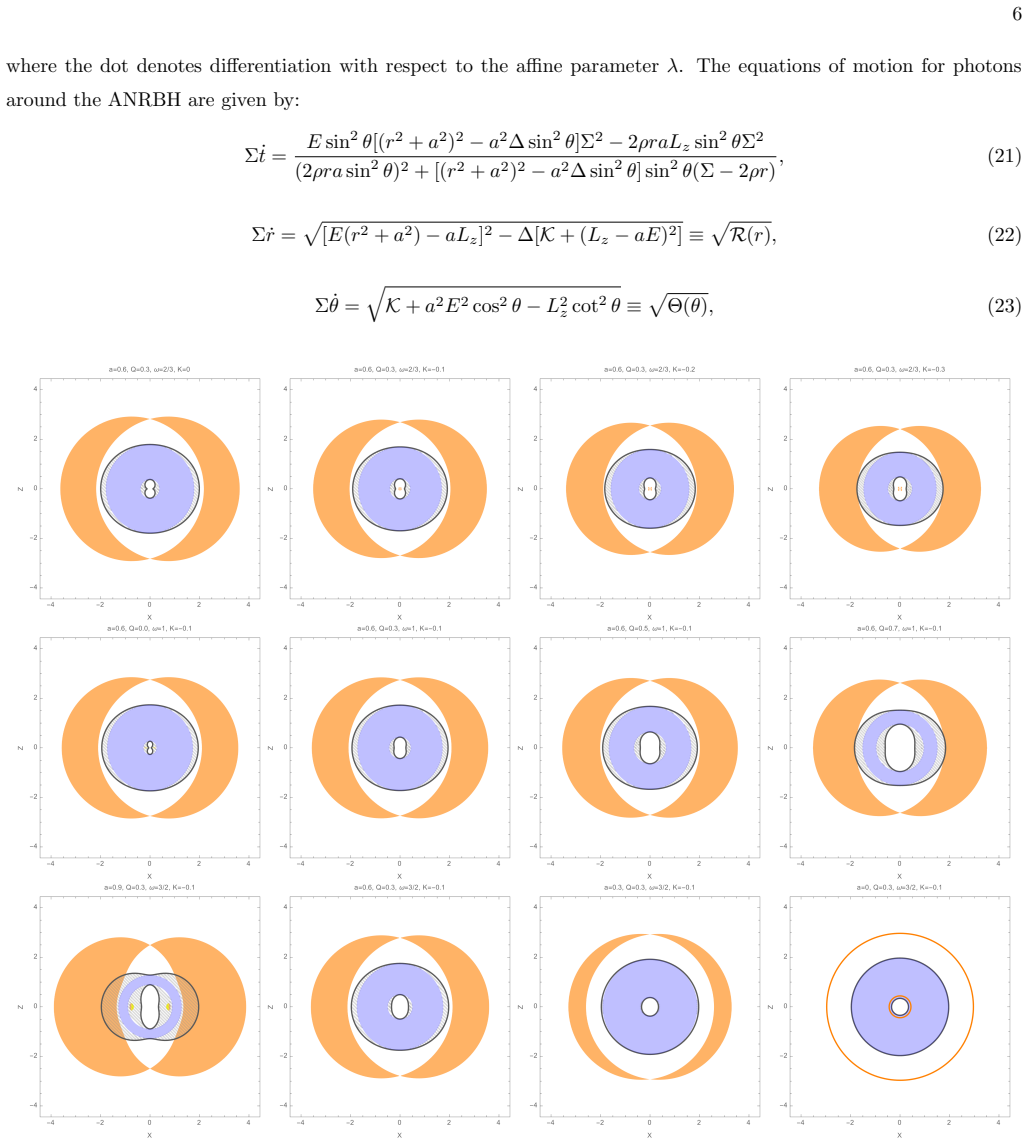
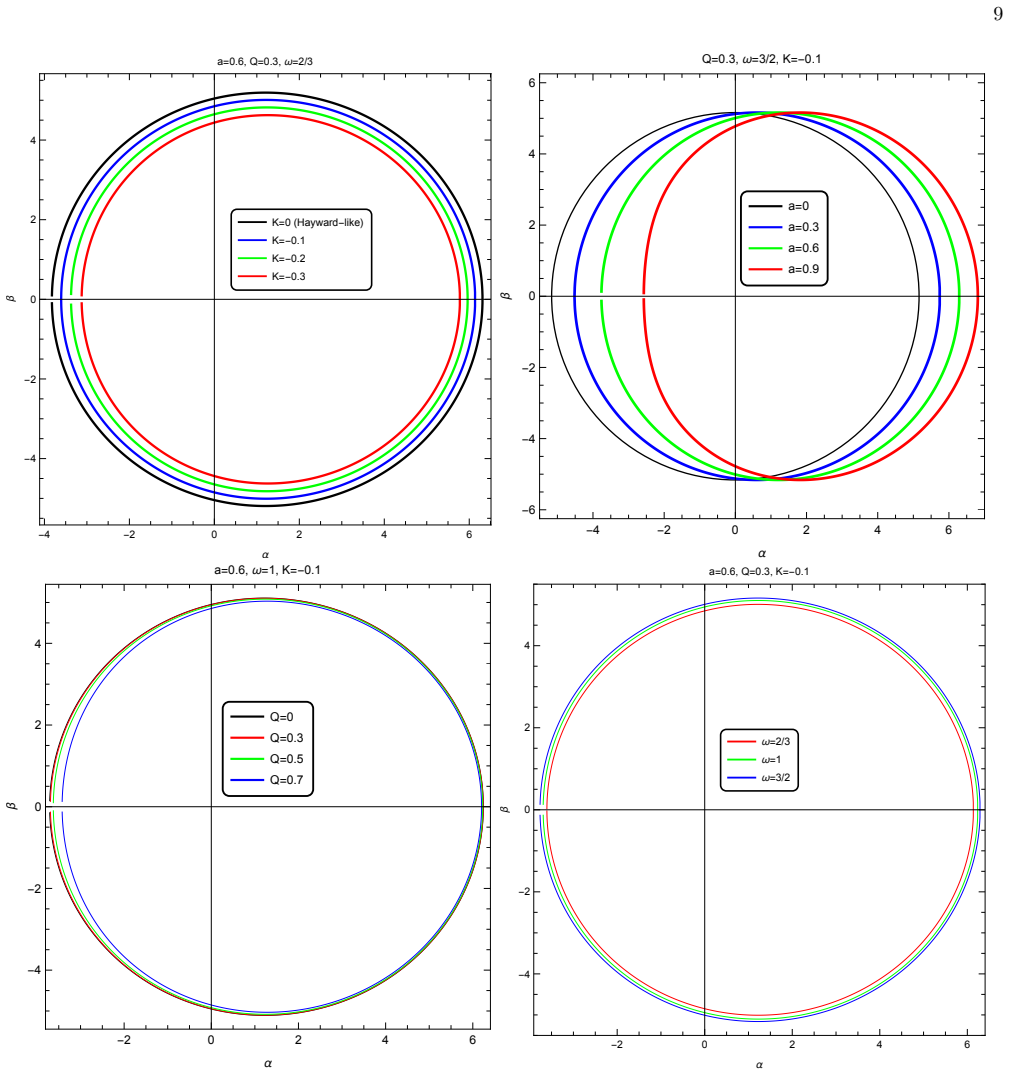
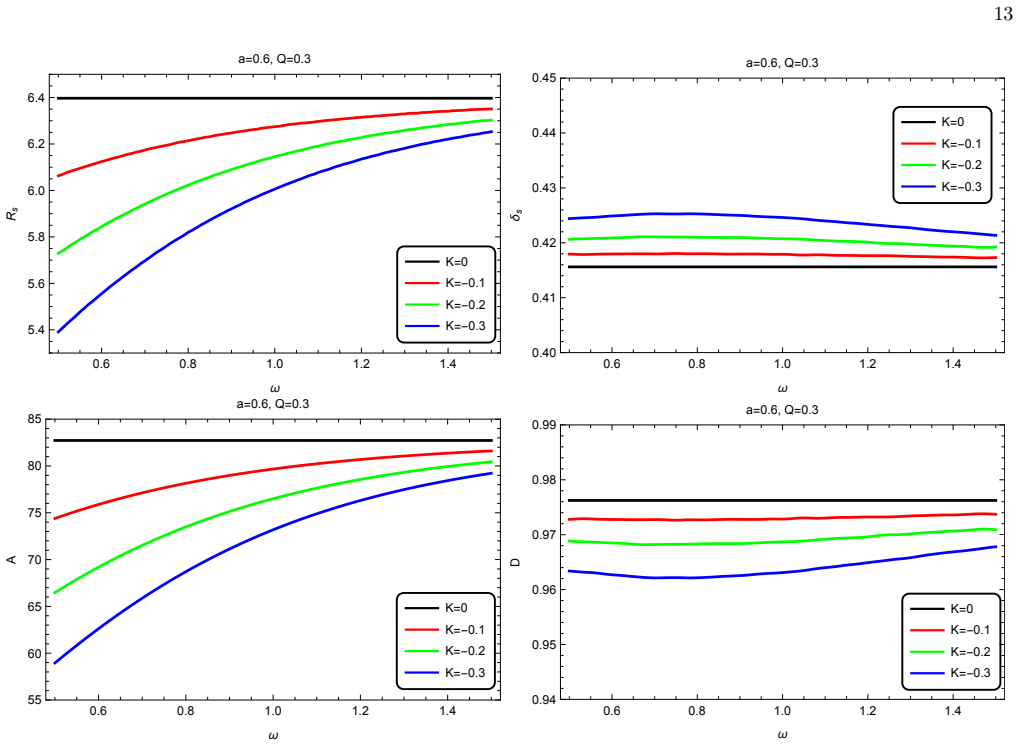
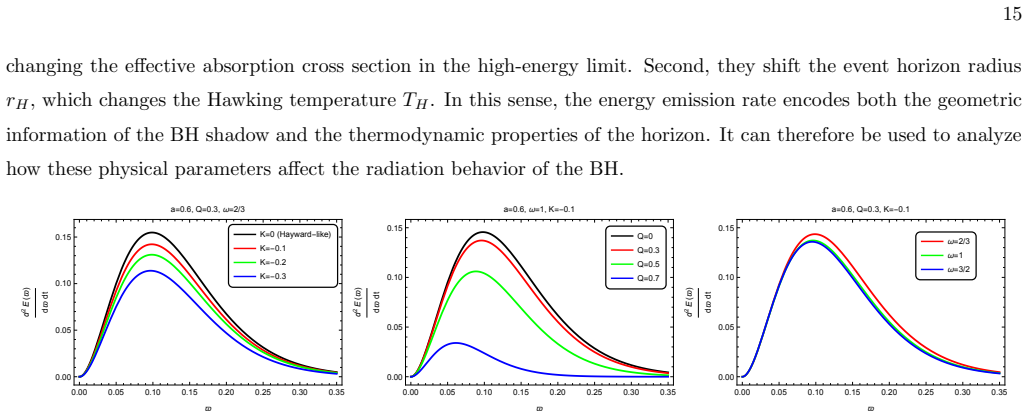
Using the Hamilton-Jacobi formalism, the photon motion equations are derived for the rotating black hole metric with nonlinear electromagnetic and anisotropic matter fields. The anisotropic matter field parameters affect the size and shape of the photon region outside the event horizon more significantly than the nonlinear electromagnetic field parameter. As K decreases, the unstable photon region expands and flattens. Shadow observables show the anisotropic matter affects shadow size more than shape, with radius and area decreasing as K decreases and increasing as ω increases. The energy emission rate peak is suppressed by decreasing K or increasing Q.
What carries the argument
Hamilton-Jacobi formalism for deriving photon geodesic equations in the spacetime metric that includes nonlinear electromagnetic and anisotropic matter fields, followed by construction of shadows in celestial coordinates using backward ray tracing.
If this is right
- As K decreases, the shadow radius and area decrease significantly while the photon region expands and flattens.
- As ω increases, the shadow radius and area increase markedly.
- The anisotropic matter field influences shadow size more than shape compared to the nonlinear electromagnetic parameter.
- Decreasing K or increasing Q suppresses the peak of the black hole's energy emission rate.
Where Pith is reading between the lines
- High-precision shadow observations could constrain the value of the anisotropic matter parameter K through size measurements alone.
- The comparatively mild effect of ω on energy emission suggests that shadow imaging and emission spectra provide complementary probes of the matter field.
- These dependencies might allow observers to separate the effects of anisotropic matter from those of nonlinear electromagnetism in real data.
Load-bearing premise
The spacetime is described by a rotating black hole metric incorporating nonlinear electromagnetic and anisotropic matter fields that allows separation via the Hamilton-Jacobi formalism for photon motion.
What would settle it
A black hole shadow whose radius does not decrease when the anisotropic matter parameter K is smaller, or whose area does not increase when ω is larger.
Figures
read the original abstract
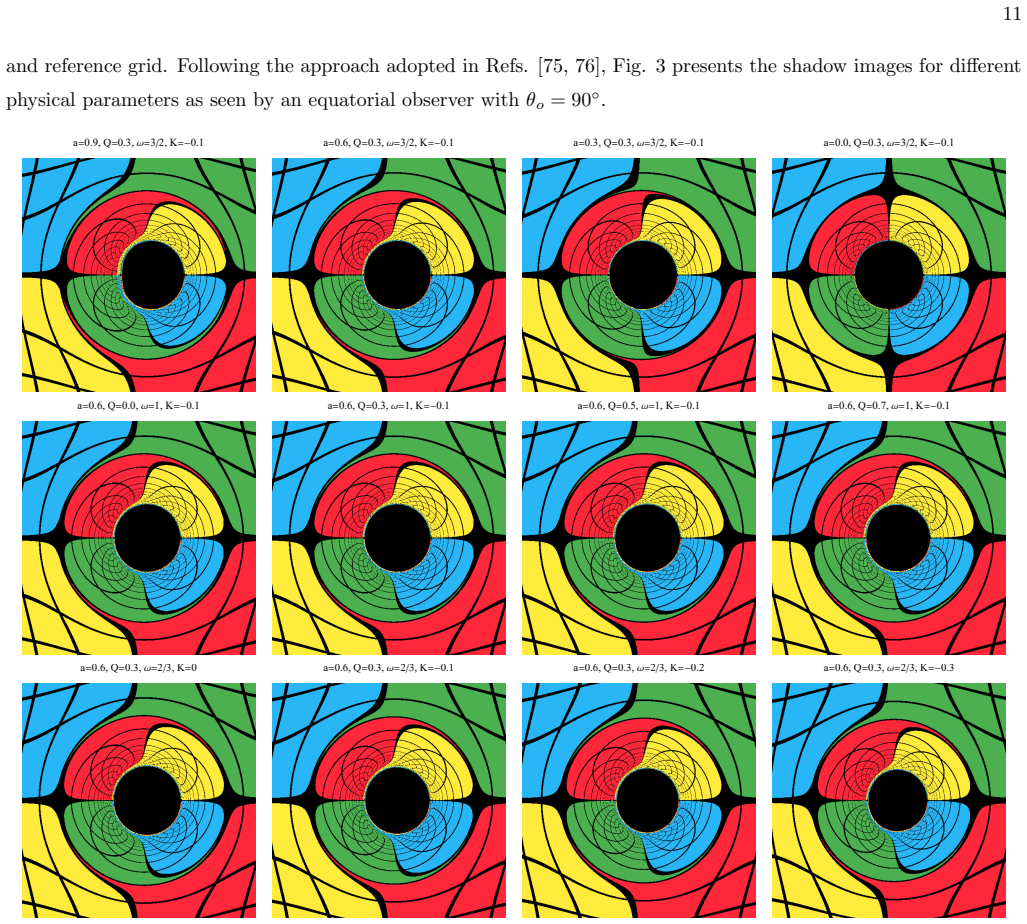
This paper investigates the effects of the nonlinear electromagnetic field and the anisotropic matter field on photon motion, shadow structures, and the energy emission rate of a rotating black hole (BH). Using the Hamilton-Jacobi formalism, we derive the photon motion equations and analyze the distribution and stability of photon regions. The results show that the anisotropic matter field parameters affect the size and shape of the photon region outside the event horizon more significantly than the nonlinear electromagnetic field parameter. As the anisotropic matter field parameter $K$ decreases, the unstable photon region outside the BH gradually expands and becomes increasingly flattened. Furthermore, we construct the BH shadow in terms of the celestial coordinates and obtain the corresponding shadow images by backward ray tracing. Several shadow observables, including the shadow radius, distortion parameter, shadow area, and oblateness, are also analyzed. The results indicate that the anisotropic matter field affects the shadow size more strongly than the shadow shape. Specifically, the shadow radius and area both decrease significantly as the parameter $K$ decreases, but increase markedly as the anisotropic matter state parameter $\omega$ increases. In addition, we analyze the energy emission rate of the BH and find that decreasing $K$ or increasing magnetic charge $Q$ suppresses its peak value, while the influence of $\omega$ remains comparatively mild. These results provide a useful reference for understanding the effects of nonlinear electromagnetic and anisotropic matter fields on rotating BH shadows and related observational signatures.
Editorial analysis
A structured set of objections, weighed in public.
Referee Report
Summary. The manuscript investigates photon motion, photon regions, black hole shadows, and energy emission rates for a rotating black hole metric sourced by nonlinear electromagnetic fields (parameter Q) and anisotropic matter (parameters K and ω). Using the Hamilton-Jacobi formalism, it derives geodesic equations, analyzes the unstable photon region, constructs shadows via celestial coordinates and ray tracing, computes observables (radius, distortion, area, oblateness), and examines energy emission, concluding that anisotropic matter parameters affect shadow size more strongly than shape, with radius and area decreasing as K decreases and increasing as ω increases.
Significance. If the metric is valid and the geodesic analysis holds, the work provides concrete trends for how anisotropic matter and nonlinear electrodynamics modify observable black hole signatures, which could be relevant for testing such models against EHT or future shadow data. The inclusion of multiple observables and energy emission analysis adds breadth, but the significance is limited by the lack of demonstrated separability.
major comments (2)
- [Photon motion and photon region analysis] The Hamilton-Jacobi formalism section assumes separability of the radial and angular equations to obtain the photon motion equations and locate the unstable photon region, but the anisotropic stress-energy tensor with state parameter ω breaks the Killing tensor symmetry that enables the Carter constant in Kerr spacetime; no explicit verification or proof of separability is provided for this sourced metric.
- [Shadow construction and observables] All reported trends on shadow size (radius and area decreasing as K decreases, increasing as ω increases) and the claim that anisotropic matter affects size more than shape rest on the photon sphere calculation; if separability fails, these results and the comparison to the nonlinear electromagnetic parameter Q are invalid.
minor comments (2)
- [Abstract] The abstract states results on energy emission suppression by decreasing K or increasing Q but provides no quantitative details or comparison baselines.
- [Metric and field equations] Notation for the metric functions and the definitions of K, ω, and Q should be introduced earlier with explicit expressions for the stress-energy components.
Simulated Author's Rebuttal
We thank the referee for their thorough review and valuable feedback on our work concerning photon motion and shadows of rotating black holes with nonlinear electromagnetic and anisotropic matter fields. We respond to the major comments point by point below.
read point-by-point responses
-
Referee: The Hamilton-Jacobi formalism section assumes separability of the radial and angular equations to obtain the photon motion equations and locate the unstable photon region, but the anisotropic stress-energy tensor with state parameter ω breaks the Killing tensor symmetry that enables the Carter constant in Kerr spacetime; no explicit verification or proof of separability is provided for this sourced metric.
Authors: We agree that the manuscript does not include an explicit proof or verification of the separability of the Hamilton-Jacobi equation for this particular metric. The analysis relies on the assumption that a Carter constant exists due to the stationarity and axisymmetry of the spacetime, allowing separation into radial and angular parts. This is a common approach in the literature for similar metrics. However, to strengthen the paper, we will add an appendix or subsection that explicitly demonstrates the separation of variables for the given metric, confirming the existence of the separation constant. revision: yes
-
Referee: All reported trends on shadow size (radius and area decreasing as K decreases, increasing as ω increases) and the claim that anisotropic matter affects size more than shape rest on the photon sphere calculation; if separability fails, these results and the comparison to the nonlinear electromagnetic parameter Q are invalid.
Authors: The trends in shadow size and shape, as well as the comparisons involving the parameter Q, are indeed derived from the photon sphere radii obtained via the separable equations. Should separability not hold, these would need to be recomputed numerically. We will revise the manuscript to include a discussion of the separability assumption and its justification, along with the verification mentioned above. This will ensure the reported effects of K and ω are on solid ground. revision: partial
Circularity Check
No significant circularity; standard geodesic analysis in given metric
full rationale
The paper constructs or adopts a rotating metric sourced by nonlinear electrodynamics plus an anisotropic fluid, then applies the Hamilton-Jacobi formalism to obtain null geodesic equations, locates the unstable photon region, and computes shadow observables (radius, area, distortion, oblateness) and energy emission rate as explicit functions of the free parameters K, ω and Q. No parameter is fitted to a data subset and then relabeled a prediction; no self-citation supplies a uniqueness theorem or separability proof that is itself unverified; the reported trends are direct numerical or analytic consequences of the geodesic equations inside the stated spacetime. The derivation therefore remains self-contained against external benchmarks and does not reduce to any of the enumerated circular patterns.
Axiom & Free-Parameter Ledger
free parameters (3)
- K
- ω
- Q
axioms (1)
- domain assumption The spacetime metric is a solution to Einstein equations with nonlinear EM and anisotropic matter stress-energy tensors.
Forward citations
Cited by 1 Pith paper
-
Chaotic behaviors of particles around the black hole with an anisotropic matter immersed in a magnetic field
Exact black hole solution with anisotropic matter and magnetic field shows the matter parameter reduces local chaos (Lyapunov exponent) while the magnetic field drives qualitative shifts in global chaos (Poincaré sections).
Reference graph
Works this paper leans on
-
[1]
Perturbations of black holes surrounded by anisotropic matter field[J]
Karthik R, Hegde K, Ajith K M, et al. Perturbations of black holes surrounded by anisotropic matter field[J]. Physical Review D, 2025, 111(6): 064034
2025
-
[2]
Shadow cast by a rotating black hole with anisotropic matter[J]
Lee B H, Lee W, Myung Y S. Shadow cast by a rotating black hole with anisotropic matter[J]. Physical Review D, 2021, 103(6): 064026
2021
-
[3]
Fluid black holes with electric field[J]
Cho I. Fluid black holes with electric field[J]. The European Physical Journal C, 2019, 79(1): 42
2019
-
[4]
Static-fluid black holes[J]
Cho I, Kim H C. Static-fluid black holes[J]. Physical Review D, 2017, 95(8): 084052
2017
-
[5]
Relativistic stars in de Rham-Gabadadze-Tolley massive gravity[J]
Katsuragawa T, Nojiri S, Odintsov S D, et al. Relativistic stars in de Rham-Gabadadze-Tolley massive gravity[J]. Physical Review D, 2016, 93(12): 124013
2016
-
[6]
Neutron stars structure in the context of massive gravity[J]
Hendi S H, Bordbar G H, Panah B E, et al. Neutron stars structure in the context of massive gravity[J]. Journal of Cosmology and Astroparticle Physics, 2017, 2017(07): 004-004
2017
-
[7]
Holographical aspects of dyonic black holes: massive gravity generalization[J]
Hendi S H, Riazi N, Panahiyan S. Holographical aspects of dyonic black holes: massive gravity generalization[J]. Annalen der Physik, 2018, 530(2): 1700211
2018
-
[8]
Local anisotropy in self-gravitating systems[J]
Herrera L, Santos N O. Local anisotropy in self-gravitating systems[J]. Physics Reports, 1997, 286(2): 53-130
1997
-
[9]
Anisotropic spheres in general relativity[J]
Bowers R L, Liang E P T. Anisotropic spheres in general relativity[J]. Astrophysical Journal, Vol. 188, p. 657 (1974), 1974, 188: 657
1974
-
[10]
Anisotropic stars in general relativity[J]
Mak M K, Harko T. Anisotropic stars in general relativity[J]. Proceedings of the Royal Society of London. Series A: Mathematical, Physical and Engineering Sciences, 2003, 459(2030): 393-408
2003
-
[11]
Anisotropic stars: exact solutions[J]
Dev K, Gleiser M. Anisotropic stars: exact solutions[J]. General relativity and gravitation, 2002, 34(11): 1793-1818
2002
-
[12]
Rotating black holes with an anisotropic matter field[J]
Kim H C, Lee B H, Lee W, et al. Rotating black holes with an anisotropic matter field[J]. Physical Review D, 2020, 101(6): 064067
2020
-
[13]
Simple black holes with anisotropic fluid[J]
Cho I, Kim H C. Simple black holes with anisotropic fluid[J]. Chinese Physics C, 2019, 43(2): 025101
2019
-
[14]
Introductory Notes on Non-linear Electrodynamics and its Applications[J]
Sorokin D P. Introductory Notes on Non-linear Electrodynamics and its Applications[J]. Fortschritte der Physik, 2022, 70(7-8): 2200092
2022
-
[15]
Non-singular general relativistic gravitational collapse[C]//Proceedings of the 5th International Conference on Gravitation and the Theory of Relativity
Bardeen J. Non-singular general relativistic gravitational collapse[C]//Proceedings of the 5th International Conference on Gravitation and the Theory of Relativity. 1968: 87
1968
-
[16]
The Bardeen model as a nonlinear magnetic monopole[J]
Ay´ on-Beato E, Garc´ ıa A. The Bardeen model as a nonlinear magnetic monopole[J]. Physics Letters B, 2000, 493(1-2): 149-152
2000
-
[17]
Regular black hole in general relativity coupled to nonlinear electrodynamics[J]
Ay´ on-Beato E, Garc´ ıa A. Regular black hole in general relativity coupled to nonlinear electrodynamics[J]. Physical review letters, 1998, 80(23): 5056
1998
-
[18]
Formation and evaporation of nonsingular black holes[J]
Hayward S A. Formation and evaporation of nonsingular black holes[J]. Physical review letters, 2006, 96(3): 031103
2006
-
[19]
Regular black holes in quadratic gravity[J]
Berej W, Matyjasek J, Tryniecki D, et al. Regular black holes in quadratic gravity[J]. General Relativity and Gravitation, 2006, 38(5): 885-906
2006
-
[20]
Rotating and non-linear magnetic-charged black hole with an anisotropic matter field[J]
Li Q Q, Zhang Y, Iminniyaz H. Rotating and non-linear magnetic-charged black hole with an anisotropic matter field[J]. Chinese Physics C, 2025, 49(10): 105106
2025
-
[21]
K., Britzen S., et al
Azulay R., Baczko A. K., Britzen S., et al. First M87 Event Horizon Telescope Results. I. The Shadow of the Supermassive Black Hole. apjl, 2019, 875(1): L1. 18
2019
-
[22]
First M87 event horizon telescope results
Akiyama K., Alberdi A., Alef W., et al. First M87 event horizon telescope results. IV. Imaging the central supermassive black hole. The Astrophysical Journal Letters, 2019, 875(1): L4
2019
-
[23]
First Sagittarius A* Event Horizon Telescope results
Akiyama K., Alberdi A., Alef W., et al. First Sagittarius A* Event Horizon Telescope results. I. The shadow of the supermassive black hole in the center of the Milky Way. The Astrophysical Journal Letters, 2022, 930(2): L12
2022
-
[24]
X., Yang C
Zeng X. X., Yang C. Y., Yu H. Optical characteristics of the Kerr–Bertotti–Robinson black hole. The European Physical Journal C, 2025, 85(11): 1242
2025
-
[25]
Particle dynamics and optical appearance of charged spherically symmetric black holes in bumblebee gravity
Xu M., Lu J., Li R., et al. Particle dynamics and optical appearance of charged spherically symmetric black holes in bumblebee gravity. Classical and Quantum Gravity, 2025
2025
-
[26]
Shadow of rotating regular black holes
Abdujabbarov A., Amir M., Ahmedov B., et al. Shadow of rotating regular black holes. Physical Review D, 2016, 93(10): 104004
2016
-
[27]
Ling Y., Wu M. H. The shadows of regular black holes with asymptotic Minkowski cores. Symmetry, 2022, 14(11): 2415
2022
- [28]
-
[29]
X., Liang E
Guo S., Huang Y. X., Liang E. W., et al. Image of the Kerr–Newman black hole surrounded by a thin accretion disk. The Astrophysical Journal, 2024, 975(2): 237
2024
-
[30]
Synge J. L. The escape of photons from gravitationally intense stars. Monthly Notices of the Royal Astronomical Society, 1966, 131(3): 463-466
1966
-
[31]
M., DeWitt C., DeWitt B
Bardeen J. M., DeWitt C., DeWitt B. S. Black holes (Les astres occlus). 1973
1973
-
[32]
Measurement of the Kerr spin parameter by observation of a compact object’s shadow[J]
Hioki K, Maeda K. Measurement of the Kerr spin parameter by observation of a compact object’s shadow[J]. Physical Review D—Particles, Fields, Gravitation, and Cosmology, 2009, 80(2): 024042
2009
-
[33]
Gravitational Lensing from a Spacetime Perspective[J]
Volker P. Gravitational Lensing from a Spacetime Perspective[J]. Living Reviews in Relativity, 2004, 7(1)
2004
-
[34]
Viewing the shadow of the black hole at the galactic center[J]
Falcke H, Melia F, Agol E. Viewing the shadow of the black hole at the galactic center[J]. The Astrophysical Journal Letters, 2000, 528(1): L13-L16
2000
-
[35]
E., Holz D
Gralla S. E., Holz D. E., Wald R. M. Black hole shadows, photon rings, and lensing rings. Physical Review D, 2019, 100(2): 024018
2019
-
[36]
L., et al
Chen S., Jing J., Qian W. L., et al. Black hole images: A review. Science China Physics, Mechanics & Astronomy, 2023, 66(6): 260401
2023
-
[37]
J., Kuang X
Wang X. J., Kuang X. M., Meng Y., et al. Rings and images of Horndeski hairy black hole illuminated by various thin accretions. Physical Review D, 2023, 107(12): 124052
2023
-
[38]
Z., Guo W
Liu J. Z., Guo W. D., Wei S. W., et al. Charged spherically symmetric and slowly rotating charged black hole solutions in bumblebee gravity. The European Physical Journal C, 2025, 85(2): 145
2025
-
[39]
Investigating the shadows of new regular black holes with a Minkowski core: Effects of spherical accretion and core type differences
Xiong Y., Pu J., Ling Y., et al. Investigating the shadows of new regular black holes with a Minkowski core: Effects of spherical accretion and core type differences. Chinese Physics C, 2025
2025
-
[40]
Influences of tilted thin accretion disks on the observational appearance of hairy black holes in Horndeski gravity
Hu S., Li D., Deng C., et al. Influences of tilted thin accretion disks on the observational appearance of hairy black holes in Horndeski gravity. Journal of Cosmology and Astroparticle Physics, 2024, 2024(04): 089
2024
-
[41]
Kerr-MOG-(A) dS black hole and its shadow in scalar-tensor-vector gravity theory
Liu W., Wu D., Fang X., et al. Kerr-MOG-(A) dS black hole and its shadow in scalar-tensor-vector gravity theory. Journal of Cosmology and Astroparticle Physics, 2024, 2024(08): 035
2024
-
[42]
Optical appearance and shadow of Kalb–Ramond black hole: effects of plasma and accretion models
Xu M., Li R., Lu J., et al. Optical appearance and shadow of Kalb–Ramond black hole: effects of plasma and accretion models. The European Physical Journal C, 2025, 85(6): 676
2025
-
[43]
Spinning black holes in astrophysical environments[J]
Fernandes P G S, Cardoso V. Spinning black holes in astrophysical environments[J]. Physical Review Letters, 2025, 135(21): 211403
2025
-
[44]
Black hole in a generalized Chaplygin–Jacobi dark fluid: Shadow and light deflection angle[J]
Fathi M, Villanueva J R, Aguilar-P´ erez G, et al. Black hole in a generalized Chaplygin–Jacobi dark fluid: Shadow and light deflection angle[J]. Physics of the Dark Universe, 2024, 46: 101598. 19
2024
-
[45]
Effects of matter with anisotropic pressure on the Fan–Wang regular black hole shadows[J]
Kurmanov Y, Luongo O, Berkimbayev D, et al. Effects of matter with anisotropic pressure on the Fan–Wang regular black hole shadows[J]. The European Physical Journal Plus, 2026, 141(4): 436
2026
-
[46]
Influence of an anisotropic matter field on the shadow of a rotating black hole[J]
Bad´ ıa J, Eiroa E F. Influence of an anisotropic matter field on the shadow of a rotating black hole[J]. Physical Review D, 2020, 102(2): 024066
2020
-
[47]
J., Sui T
Gao X. J., Sui T. T., Zeng X. X., et al. Investigating shadow images and rings of the charged Horndeski black hole illuminated by various thin accretions. The European Physical Journal C, 2023, 83(11): 1052
2023
-
[48]
Y., Liu X
Li L. Y., Liu X. Y., Cai R. G., et al. Images and photo regions of continuous photon sphere spacetime. Physics of the Dark Universe, 2025: 102209
2025
-
[49]
D., Wei S
Guo W. D., Wei S. W., Liu Y. X. Shadow of a charged black hole with scalar hair. The European Physical Journal C, 2023, 83(3): 197
2023
-
[50]
M., Wei S
Wang H. M., Wei S. W. Shadow cast by Kerr-like black hole in the presence of plasma in Einstein-bumblebee gravity. The European Physical Journal Plus, 2022, 137(5): 1-17
2022
-
[51]
On quasinormal modes in 4D black hole solutions in the model with anisotropic fluid[J]
Bolokhov S V, Ivashchuk V D. On quasinormal modes in 4D black hole solutions in the model with anisotropic fluid[J]. The European Physical Journal C, 2022, 82(7): 624
2022
-
[52]
Shadows of black hole surrounded by anisotropic fluid in Rastall theory[J]
Kumar R, Singh B P, Ali M S, et al. Shadows of black hole surrounded by anisotropic fluid in Rastall theory[J]. Physics of the Dark Universe, 2021, 34: 100881
2021
-
[53]
Rotating black hole with an anisotropic matter field as a particle accelerator[J]
Ahmed Rizwan C L, Naveena Kumara A, Hegde K, et al. Rotating black hole with an anisotropic matter field as a particle accelerator[J]. Classical and Quantum Gravity, 2021, 38(7): 075030
2021
-
[54]
Spherically symmetric wormholes with anisotropic matter[J]
Kim H C, Lee Y. Spherically symmetric wormholes with anisotropic matter[J]. Journal of Cosmology and Astroparticle Physics, 2019, 2019(09): 001-001
2019
-
[55]
Dyadosphere bending of light[J]
De Lorenci V A, Figueiredo N, Fliche H H, et al. Dyadosphere bending of light[J]. Astronomy & Astrophysics, 2001, 369(2): 690-693
2001
-
[56]
On non-linear magnetic-charged black hole surrounded by quintessence[J]
Nam C H. On non-linear magnetic-charged black hole surrounded by quintessence[J]. General Relativity and Gravitation, 2018, 50(6): 57
2018
-
[57]
Rotating and nonlinear magnetic-charged black hole surrounded by quintessence[J]
Benavides-Gallego C A, Abdujabbarov A, Bambi C. Rotating and nonlinear magnetic-charged black hole surrounded by quintessence[J]. Physical Review D, 2020, 101(4): 044038
2020
-
[58]
Spherical photon orbits around a Kerr black hole[J]
Teo E. Spherical photon orbits around a Kerr black hole[J]. General Relativity and Gravitation, 2003, 35(11): 1909-1926
2003
-
[59]
The nature of black hole shadows[J]
Bronzwaer T, Falcke H. The nature of black hole shadows[J]. The Astrophysical Journal, 2021, 920(2): 155
2021
-
[60]
Metamorphoses of a photon sphere[J]
Shoom A A. Metamorphoses of a photon sphere[J]. Physical Review D, 2017, 96(8): 084056
2017
-
[61]
Photon regions and shadows of Kerr-Newman-NUT black holes with a cosmo- logical constant[J]
Grenzebach A, Perlick V, L¨ ammerzahl C. Photon regions and shadows of Kerr-Newman-NUT black holes with a cosmo- logical constant[J]. Physical Review D, 2014, 89(12): 124004
2014
-
[62]
Photon regions and shadows of accelerated black holes[J]
Grenzebach A, Perlick V, L¨ ammerzahl C. Photon regions and shadows of accelerated black holes[J]. International Journal of Modern Physics D, 2015, 24(09): 1542024
2015
-
[63]
Ray Optics, Fermat’s Principle, and Applications to General Relatively
Perlick V. Ray Optics, Fermat’s Principle, and Applications to General Relatively. Berlin, Heidelberg: Springer Berlin Heidelberg, 2002
2002
-
[64]
The mathematical theory of black holes
Chandrasekhar S. The mathematical theory of black holes. Oxford university press, 1998
1998
-
[65]
Spherical orbits around a Kerr black hole
Teo E. Spherical orbits around a Kerr black hole. General Relativity and Gravitation, 2021, 53(1): 10
2021
-
[66]
Calculating black hole shadows: Review of analytical studies[J]
Perlick V, Tsupko O Y. Calculating black hole shadows: Review of analytical studies[J]. Physics Reports, 2022, 947: 1-39
2022
-
[67]
Black hole surrounded by a dark matter halo in the M87 galactic center and its identification with shadow images[J]
Jusufi K, Jamil M, Salucci P, et al. Black hole surrounded by a dark matter halo in the M87 galactic center and its identification with shadow images[J]. Physical Review D, 2019, 100(4): 044012
2019
-
[68]
Rotating charged black holes in EMS theory: shadow studies and constraints from EHT observations[J]
Yunusov O, Rayimbaev J, Sarikulov F, et al. Rotating charged black holes in EMS theory: shadow studies and constraints from EHT observations[J]. The European Physical Journal C, 2024, 84(12): 1240
2024
-
[69]
M., Press W
Bardeen J. M., Press W. H., Teukolsky S. A. Rotating black holes: locally nonrotating frames, energy extraction, and 20 scalar synchrotron radiation. Astrophysical Journal, 1972, 178: 347-370
1972
-
[70]
Rotating black hole shadow in perfect fluid dark matter[J]
Hou X, Xu Z, Wang J. Rotating black hole shadow in perfect fluid dark matter[J]. Journal of Cosmology and Astroparticle Physics, 2018, 2018(12): 040-040
2018
-
[71]
Rotating charged black hole in 4D Einstein–Gauss–Bonnet gravity: Photon motion and its shadow[J]
Papnoi U, Atamurotov F. Rotating charged black hole in 4D Einstein–Gauss–Bonnet gravity: Photon motion and its shadow[J]. Physics of the Dark Universe, 2022, 35: 100916
2022
-
[72]
Shadow and deflection angle of rotating black holes in perfect fluid dark matter with a cosmological constant[J]
Haroon S, Jamil M, Jusufi K, et al. Shadow and deflection angle of rotating black holes in perfect fluid dark matter with a cosmological constant[J]. Physical Review D, 2019, 99(4): 044015
2019
-
[73]
Light rings and shadows of static black holes in effective quantum gravity[J]
Liu W, Wu D, Wang J. Light rings and shadows of static black holes in effective quantum gravity[J]. Physics Letters B, 2024, 858: 139052
2024
-
[74]
QED effect on a black hole shadow[J]
Hu Z, Zhong Z, Li P C, et al. QED effect on a black hole shadow[J]. Physical Review D, 2021, 103(4): 044057
2021
-
[75]
QED effects on Kerr black hole shadows immersed in uniform magnetic fields[J]
Zhong Z, Hu Z, Yan H, et al. QED effects on Kerr black hole shadows immersed in uniform magnetic fields[J]. Physical Review D, 2021, 104(10): 104028
2021
-
[76]
Shadow of slowly rotating Kalb-Ramond black holes[J]
Liu W, Wu D, Wang J. Shadow of slowly rotating Kalb-Ramond black holes[J]. Journal of Cosmology and Astroparticle Physics, 2025, 2025(05): 017
2025
-
[77]
M., Wei S
Fu Q. M., Wei S. W., Zhao L., et al. Shadow and weak deflection angle of a black hole in nonlocal gravity. Universe, 2022, 8(7): 341
2022
-
[78]
Lorentz violation signatures in the low-energy sector of Horava gravity from black hole shadow observations[J]
Liu W, Huang H, Wu D, et al. Lorentz violation signatures in the low-energy sector of Horava gravity from black hole shadow observations[J]. Physics Letters B, 2025: 139812
2025
-
[79]
Kumar R., Ghosh S. G. Black hole parameter estimation from its shadow. The Astrophysical Journal, 2020, 892(2): 78
2020
-
[80]
Tsupko O. Y. Analytical calculation of black hole spin using deformation of the shadow. Physical Review D, 2017, 95(10): 104058
2017
discussion (0)
Sign in with ORCID, Apple, or X to comment. Anyone can read and Pith papers without signing in.