The exact region between Chatterjee's xi and Blomqvist's β
Pith reviewed 2026-06-30 04:05 UTC · model grok-4.3
The pith
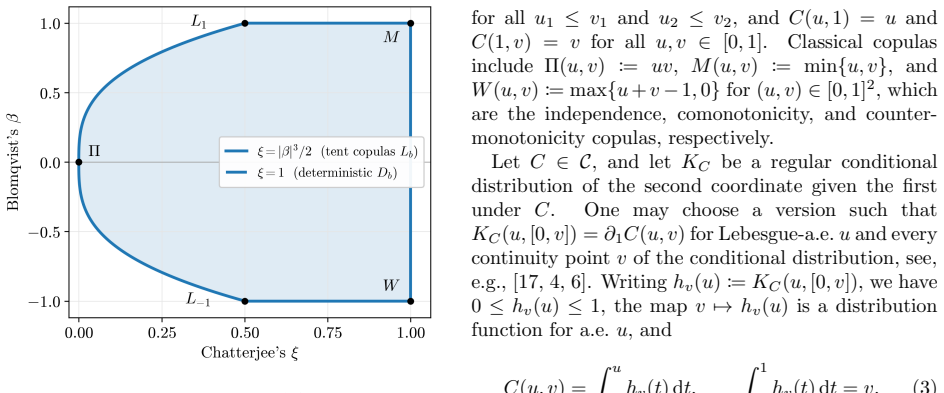
Chatterjee's ξ and Blomqvist's β for any bivariate copula satisfy exactly |β|^3 ≤ 2ξ.
A machine-rendered reading of the paper's core claim, the machinery that carries it, and where it could break.
Core claim
We determine the exact attainable region of the pair (ξ(C),β(C)) formed by Chatterjee's rank correlation ξ and Blomqvist's β over the class of all bivariate copulas and show that it is given by {(x,y)∈[0,1]×[-1,1]: |y|^3≤2x}. The left boundary ξ=|β|^3/2 is attained by an explicit two-strip family (L_b) obtained by perturbing independence with a signed tent function g_b centered at the median. The right boundary ξ=1 is attained for every admissible value of β by deterministic measure-preserving copulas, and the full region is obtained by taking convex mixtures of the left- and right-boundary copulas with fixed β and using the continuity of ξ along these mixtures.
What carries the argument
The two-strip family (L_b) of copulas, formed by perturbing the independence copula with a signed tent function g_b centered at the median, which attains the left boundary ξ = |β|^3/2.
If this is right
- The left boundary ξ = |β|^3/2 is attained exactly by the explicit two-strip family L_b.
- Deterministic measure-preserving copulas attain ξ = 1 for every admissible value of β.
- Convex mixtures of left- and right-boundary copulas with the same β fill the interior of the region.
- The density, rank correlations, and positive/negative dependence properties of the L_b family are given by explicit formulas.
- Exact attainable regions are also recorded for several natural subclasses of copulas.
Where Pith is reading between the lines
- The cubic boundary may guide construction of new dependence measures whose joint range is easier to characterize.
- Similar mixture arguments could determine attainable regions for other pairs of rank correlations such as Spearman's rho paired with β.
- In applications, observed pairs (ξ̂, β̂) lying outside the region would indicate either estimation error or model misspecification.
- The continuity of ξ under convex mixing suggests that the map from copulas to (ξ, β) is continuous in the weak topology for fixed β.
Load-bearing premise
The continuity of ξ along convex mixtures of the left-boundary family and right-boundary deterministic copulas with fixed β.
What would settle it
A single bivariate copula C for which |β(C)|^3 > 2 ξ(C), or a point inside |y|^3 < 2x shown to be unattainable by any copula.
Figures

read the original abstract
We determine the exact attainable region of the pair $(\xi(C),\beta(C))$ formed by Chatterjee's rank correlation $\xi$ and Blomqvist's $\beta$ over the class of all bivariate copulas and show that it is given by $\{(x,y)\in[0,1]\times[-1,1]: |y|^3\le 2x\}.$ The left boundary $\xi=|\beta|^3/2$ is attained by an explicit two-strip family $(L_b)_{b\in[-1,1]}$ obtained by perturbing independence with a signed tent function $g_b$ centered at the median. We derive several properties of this copula family including the formulas for its density and rank correlation measures, as well as positive and negative dependence properties. The right boundary $\xi=1$ is attained for every admissible value of $\beta$ by deterministic measure-preserving copulas, and the full region is obtained by taking convex mixtures of the left- and right-boundary copulas with fixed $\beta$ and using the continuity of $\xi$ along these mixtures. We also record the exact regions in several natural subclasses of copulas.
Editorial analysis
A structured set of objections, weighed in public.
Referee Report
Summary. The paper determines the exact attainable region of the pair (Chatterjee's ξ(C), Blomqvist's β(C)) over all bivariate copulas C, showing that it equals the set {(x,y) ∈ [0,1] × [-1,1] : |y|^3 ≤ 2x}. The left boundary ξ = |β|^3/2 is attained by an explicit two-strip family (L_b) obtained by perturbing independence with a signed tent function g_b centered at the median; the right boundary ξ=1 is attained for each admissible β by deterministic measure-preserving copulas; the interior is filled by convex mixtures of these families (with fixed β) together with a continuity argument for ξ along the mixture paths.
Significance. If the central claim holds, the result supplies a sharp, explicit description of the joint range of two well-known rank correlations, clarifying their relationship in a way that is useful for theoretical work on dependence measures and for interpreting empirical values. The explicit construction of the boundary families, the derivation of their densities and rank-correlation formulas, and the recording of attainable regions within natural subclasses (e.g., absolutely continuous copulas) constitute concrete, reusable contributions.
major comments (1)
- [abstract (final sentence of main-result paragraph) / section describing the mixtures] The exact-region claim rests on the assertion that, for each fixed b, the convex path C_t = (1-t) L_b + t D_b (t ∈ [0,1]) produces ξ(C_t) values that continuously fill the entire interval [|b|^3/2, 1]. The abstract invokes continuity of ξ along these mixtures to conclude that the region is filled, but the justification (direct verification of the integral expression for ξ under the mixture measure, or an appeal to dominated convergence or uniform continuity) is load-bearing; if this step is only sketched, the attainable set could be strictly smaller than claimed.
Simulated Author's Rebuttal
We thank the referee for the careful reading and for highlighting the need for a fully rigorous justification of the continuity step. We address the single major comment below and will incorporate the requested detail in the revision.
read point-by-point responses
-
Referee: [abstract (final sentence of main-result paragraph) / section describing the mixtures] The exact-region claim rests on the assertion that, for each fixed b, the convex path C_t = (1-t) L_b + t D_b (t ∈ [0,1]) produces ξ(C_t) values that continuously fill the entire interval [|b|^3/2, 1]. The abstract invokes continuity of ξ along these mixtures to conclude that the region is filled, but the justification (direct verification of the integral expression for ξ under the mixture measure, or an appeal to dominated convergence or uniform continuity) is load-bearing; if this step is only sketched, the attainable set could be strictly smaller than claimed.
Authors: We agree that an explicit verification of continuity is load-bearing and should be expanded. In the revised manuscript we will add a short subsection that writes the integral formula for ξ(C) (the one appearing in Chatterjee (2021) or the equivalent expression in terms of the copula measure) and applies the dominated-convergence theorem directly to the mixture densities. Because the densities of L_b and D_b are bounded and the mixture densities converge pointwise and are dominated by an integrable function independent of t, ξ(C_t) is continuous in t. Combined with the already-established endpoint values ξ(L_b)=|b|^3/2 and ξ(D_b)=1, the intermediate-value theorem then guarantees that the image is the full interval. This change removes any ambiguity about whether the attainable set might be strictly smaller. revision: yes
Circularity Check
No significant circularity; explicit constructions and continuity argument
full rationale
The derivation constructs an explicit left-boundary family L_b via signed tent perturbation of independence, attains the right boundary ξ=1 via deterministic copulas, and fills the region via convex mixtures C_t = (1-t)L_b + t D_b while invoking continuity of ξ along these paths. All steps rely on direct copula definitions, density formulas, and measure-theoretic continuity rather than any self-definition, fitted-parameter renaming, or load-bearing self-citation. The argument is self-contained and does not reduce the target region to quantities defined in terms of itself.
Axiom & Free-Parameter Ledger
axioms (1)
- standard math Standard properties of bivariate copulas (grounded, 2-increasing, uniform margins)
invented entities (1)
-
two-strip family (L_b) with signed tent perturbation g_b
no independent evidence
Reference graph
Works this paper leans on
-
[1]
The ex- act region and an inequality between Chatterjee’s and Spearman’s rank correlations.J
Jonathan Ansari and Marcus Rockel. The ex- act region and an inequality between Chatterjee’s and Spearman’s rank correlations.J. Multivari- ate Anal., page 105630, 2026
2026
-
[2]
On a measure of dependence be- tween two random variables.Ann
Nils Blomqvist. On a measure of dependence be- tween two random variables.Ann. Math. Stat., 21(4):593–600, 1950
1950
-
[3]
A new coefficient of correla- tion.J
Sourav Chatterjee. A new coefficient of correla- tion.J. Am. Statist. Assoc., 116(536):2009–2022, 2021
2009
-
[4]
Darsow, Bao Nguyen, and Elwood T
William F. Darsow, Bao Nguyen, and Elwood T. Olsen. Copulas and Markov processes.Illinois J. Math., 36(4):600–642, 1992
1992
-
[5]
Siburg, and Pavel A
Holger Dette, Karl F. Siburg, and Pavel A. Stoimenov. A copula-based non-parametric mea- sure of regression dependence.Scand. J. Stat., 40 (1):21–41, 2013
2013
-
[6]
Boca Raton, FL: CRC Press, 2016
Fabrizio Durante and Carlo Sempi.Principles of Copula Theory. Boca Raton, FL: CRC Press, 2016
2016
-
[7]
Fuchs and M
S. Fuchs and M. Tschimpke. Total positivity of copulas from a Markov kernel perspective. J. Math. Anal. Appl., 518(1):21, 2023. Id/No 126629
2023
-
[8]
Chapman & Hall, Lon- don, 1997
Harry Joe.Multivariate Models and Dependence Concepts, volume 73 ofMonographs on Statistics and Applied Probability. Chapman & Hall, Lon- don, 1997
1997
-
[9]
Samuel Karlin.Total Positivity. Vol. I. Stanford University Press, Stanford, Calif., 1968
1968
-
[10]
Classes of order- ings of measures and related correlation inequali- ties
Samuel Karlin and Yosef Rinott. Classes of order- ings of measures and related correlation inequali- ties. I: Multivariate totally positive distributions. J. Multivariate Anal., 10(4):467–498, 1980
1980
-
[11]
Classes of order- ings of measures and related correlation inequali- ties
Samuel Karlin and Yosef Rinott. Classes of order- ings of measures and related correlation inequali- ties. II: Multivariate reverse rule distributions.J. Multivariate Anal., 10(4):499–516, 1980
1980
-
[12]
On the exact region determined by Spearman’s footrule and Gini’s gamma.J
Damjana Kokol Bukovˇ sek and Blaˇ z Mojˇ skerc. On the exact region determined by Spearman’s footrule and Gini’s gamma.J. Comput. Appl. Math., 410:13, 2022. Id/No 114212
2022
-
[13]
The exact region determined by Blomqvist’s beta, Spearman’s footrule and Gini’s gamma.J
Damjana Kokol Bukovˇ sek and Blaˇ z Mojˇ skerc. The exact region determined by Blomqvist’s beta, Spearman’s footrule and Gini’s gamma.J. Com- put. Appl. Math., 473:13, 2026. Id/No 116861
2026
-
[14]
On the exact regions determined by Kendall’s tau and other concordance measures.Mediterr
Damjana Kokol Bukovˇ sek and Nik Stopar. On the exact regions determined by Kendall’s tau and other concordance measures.Mediterr. J. Math., 20(3):16, 2023
2023
-
[15]
Spearman’s footrule and Gini’s gamma: local bounds for bi- variate copulas and the exact region with respect to Blomqvist’s beta.J
Damjana Kokol Bukovˇ sek, Tomaˇ z Koˇ sir, Blaˇ z Mojˇ skerc, and Matjaˇ z Omladiˇ c. Spearman’s footrule and Gini’s gamma: local bounds for bi- variate copulas and the exact region with respect to Blomqvist’s beta.J. Comput. Appl. Math., 390:24, 2021. Id/No 113385
2021
-
[16]
E. L. Lehmann. Some concepts of dependence. Ann. Math. Stat., 37(5):1137–1153, 1966
1966
-
[17]
Nelsen.An Introduction to Copulas
Roger B. Nelsen.An Introduction to Copulas. 2nd ed.New York, NY: Springer, 2006
2006
-
[18]
On measures of dependence.Acta Math
Alfr´ ed R´ enyi. On measures of dependence.Acta Math. Acad. Sci. Hung., 10:441–451, 1959
1959
-
[19]
On measures of concordance
Marco Scarsini. On measures of concordance. Stochastica, 8:201–218, 1984
1984
-
[20]
On the exact region determined by Kendall’sτand spearman’sρ.J
Manuela Schreyer, Roland Paulin, and Wolfgang Trutschnig. On the exact region determined by Kendall’sτand spearman’sρ.J. R. Stat. Soc., Ser. B, Stat. Methodol., 79(2):613–633, 2017
2017
-
[21]
Schweizer and E
B. Schweizer and E. F. Wolff. On nonparamet- ric measures of dependence for random variables. Ann. Stat., 9(4):879–885, 1981
1981
-
[22]
George Shanthikumar
Moshe Shaked and J. George Shanthikumar. Stochastic Orders. Springer Series in Statistics. Springer, New York, 2007
2007
-
[23]
M. Sklar. Fonctions de r´ epartition ` andimensions et leur marges.Publ. Inst. Stat. Univ. Paris, 8: 229–231, 1960. 7
1960
discussion (0)
Sign in with ORCID, Apple, or X to comment. Anyone can read and Pith papers without signing in.