Kinetic energy from the cubic sum rule of the dynamic structure factor
Pith reviewed 2026-06-30 04:02 UTC · model grok-4.3
The pith
The third frequency moment sum rule of the dynamic structure factor provides an alternative estimator for the kinetic energy of quantum many-body systems.
A machine-rendered reading of the paper's core claim, the machinery that carries it, and where it could break.
Core claim
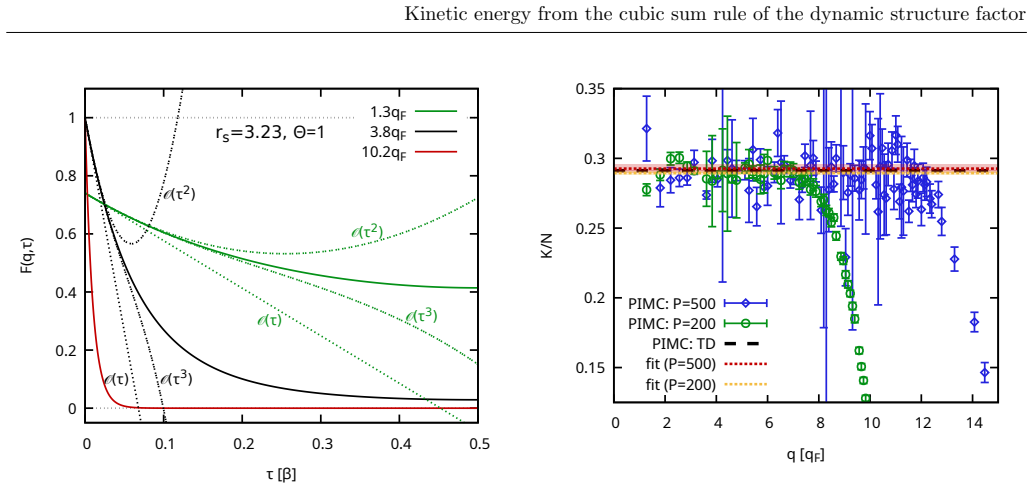
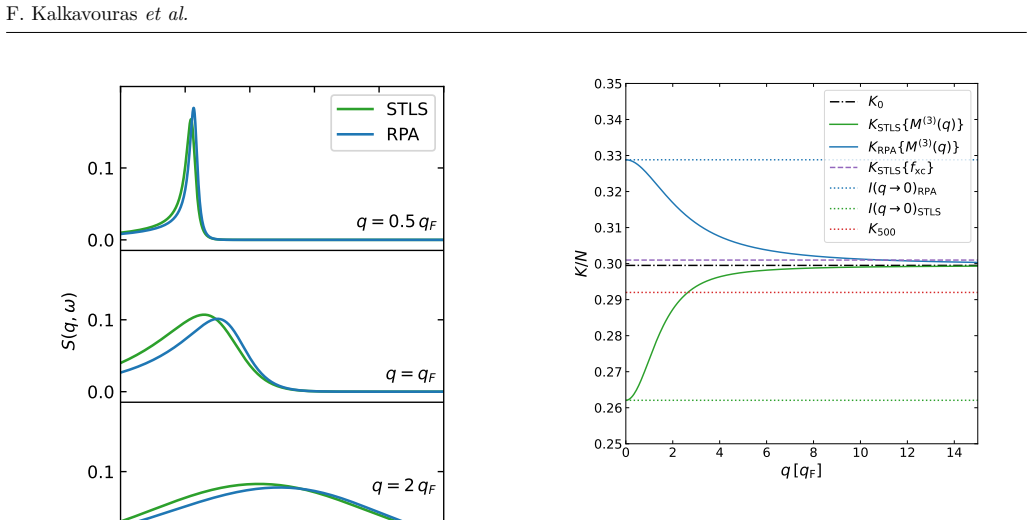
The authors establish that the cubic sum rule, corresponding to the third frequency moment of S(q,ω), serves as an estimator for the kinetic energy K. In quasi-exact path integral Monte Carlo computations of the imaginary-time density-density correlation function for the uniform electron gas under warm dense matter conditions, the resulting K is wave-number independent and agrees with the value obtained by thermodynamic differentiation. When the same sum rule is applied to S(q,ω) obtained from common dielectric approximations, the extracted K exhibits an unphysical dependence on wave number and deviates from the correct short-wavelength limit.
What carries the argument
The third frequency moment sum rule of the dynamic structure factor S(q,ω) as an estimator for kinetic energy K
If this is right
- Extraction from exact imaginary-time data yields wave-number independent kinetic energy consistent with thermodynamics.
- Dielectric approximations must reproduce the correct high-frequency moments to avoid artifacts in kinetic energy estimates.
- X-ray Thomson scattering experiments could provide model-free access to the electronic equation of state.
- The method applies to time-dependent density functional theory and warm dense matter modeling.
Where Pith is reading between the lines
- This sum rule approach might be tested in other quantum fluids to see if it generalizes beyond the electron gas.
- If successful, it could reduce reliance on multiple computational routes for thermodynamic properties.
- Experimental resolution improvements might allow direct measurement of the third moment for kinetic energy determination.
Load-bearing premise
That applying the third frequency moment sum rule to exact data produces a kinetic energy independent of wave number that agrees with the thermodynamic differentiation method.
What would settle it
Observing a wave-number dependence in the kinetic energy extracted via the third moment sum rule from quasi-exact path integral Monte Carlo data for the uniform electron gas would falsify the central claim.
Figures
read the original abstract
The third frequency moment sum rule of the dynamic structure factor $S(\mathbf{q},\omega)$ is explored for the first time as an alternative estimator of the kinetic energy $K$ of quantum many-body systems. As a practical example, the uniform electron gas at warm dense matter conditions is considered. First, $K$ is extracted from quasi-exact \emph{ab initio} path integral Monte Carlo results for the imaginary-time density--density correlation function $F(\mathbf{q},\tau)$ and the expected excellent self-consistency with the thermodynamic differentiation route is confirmed. Second, $K$ is extracted from approximate dielectric formalism results for $S(\mathbf{q},\omega)$ and it is observed that common semi-classical approximations lead to a wave-number dependent $K$ with an incorrect short-wavelength limit. Our results are expected to be of broad interest for a great variety of applications, including time-dependent density functional theory, dielectric formalism schemes and warm dense matter models, as well as for the design of dedicated x-ray Thomson scattering experiments with the potential to provide model-free access to the full electronic equation of state.
Editorial analysis
A structured set of objections, weighed in public.
Referee Report
Summary. The manuscript explores the third frequency moment sum rule of the dynamic structure factor S(q,ω) for the first time as an estimator of the kinetic energy K in quantum many-body systems. Using the uniform electron gas at warm dense matter conditions as example, K is extracted from quasi-exact PIMC data for the imaginary-time density-density correlation function F(q,τ) and shown to be self-consistent with the thermodynamic differentiation route; the same extraction applied to approximate dielectric models for S(q,ω) yields a wave-number dependent K with an incorrect short-wavelength limit. The results are positioned as relevant to TDDFT, dielectric schemes, WDM modeling, and x-ray Thomson scattering experiments.
Significance. If the central claim holds, the work supplies a new, internally consistent route to K that is independent of model assumptions when applied to exact input data and directly falsifies the high-q behavior of common semi-classical dielectric approximations. This strengthens the case for using higher-moment sum rules in scattering diagnostics and provides a concrete benchmark against which future approximations can be tested.
minor comments (2)
- The abstract states that the extraction from PIMC data confirms 'excellent self-consistency,' but the manuscript should explicitly state the numerical tolerance (e.g., relative deviation in K) and the q-range over which constancy is observed.
- Notation for the third-moment sum rule and its relation to the kinetic energy should be written out once in the main text (even if standard) to aid readers who are not specialists in the dynamic structure factor.
Simulated Author's Rebuttal
We thank the referee for their positive assessment of the manuscript, including the summary of our exploration of the third frequency moment sum rule as a kinetic energy estimator and the significance statement highlighting its potential for falsifying semi-classical approximations. The recommendation for minor revision is noted. No specific major comments were provided in the report.
Circularity Check
No significant circularity identified
full rationale
The derivation applies the established third frequency moment sum rule of S(q,ω) to extract K from independent quasi-exact PIMC data for F(q,τ), then directly compares the result to the separate thermodynamic differentiation route; both routes are external to each other and to any fitted parameters within the paper. No load-bearing step reduces by construction to a self-citation, ansatz, or renamed input, and the reported self-consistency is an empirical check rather than a definitional identity. The manuscript therefore remains self-contained against external benchmarks.
Axiom & Free-Parameter Ledger
axioms (1)
- standard math The third frequency moment sum rule holds exactly for the dynamic structure factor of quantum many-body systems.
Reference graph
Works this paper leans on
-
[1]
Giuliani G and Vignale G 2008Quantum Theory of the Electron Liquid(Cambridge: Cambridge University Press)
-
[2]
Mahan G 2000Many-Particle Physics(New York: Kluwer)
-
[3]
Nolting W and Brewer W D 2009Fundamentals of Many-body Physics: Principles and Methods(Heidelberg: Springer)
-
[4]
Vorberger Jet al.2025 Roadmap for warm dense matter physics (Preprint2505.02494)
arXiv 2025
-
[5]
Rev.85338
Bohm D and D Pines A 1952Phys. Rev.85338
-
[6]
Pines D and Nozieres P 2018The theory of quantum liq- uids I: Normal Fermi liquids(Boca Raton: CRC Press)
-
[7]
Bonitz M 2016Quantum kinetic theory(Heidelberg: Springer)
-
[8]
Dornheim T, Groth S, Vorberger J and Bonitz M 2018 Phys. Rev. Lett.121255001
2018
-
[9]
Phys.5304
Dornheim T, Moldabekov Z, Vorberger J, K¨ ahlert H and Bonitz M 2022Commun. Phys.5304
-
[10]
Koskelo J, Reining L and Gatti M 2025Phys. Rev. Lett. 134046402
-
[11]
Jones R O 2015Rev. Mod. Phys.87(3) 897–923
-
[12]
Marques M, Maitra N, Nogueira F, Gross E and Rubio A 2012Fundamentals of Time-Dependent Density Func- tional Theory(Heidelberg: Springer)
-
[13]
Runge E and Gross E K U 1984Phys. Rev. Lett.52(12) 997–1000
-
[14]
Gross E K U and Kohn W 1985Phys. Rev. Lett552850
-
[15]
Foulkes W M C, Mitas L, Needs R J and Rajagopal G 2001Rev. Mod. Phys.73(1) 33–83
-
[16]
Anderson J 2007Quantum Monte Carlo: Origins, Devel- opment, Applications(US: Oxford University Press)
-
[17]
Ceperley D M 1995Rev. Mod. Phys67279
-
[18]
Sheffield J, Froula D, Glenzer S and Luhmann N 2010 Plasma Scattering of Electromagnetic Radiation: Theory and Measurement Techniques(Elsevier Science)
2010
-
[19]
Hansen J and McDonald I 2013Theory of simple liquids with applications to soft matter(Amsterdam: Academic Press)
-
[20]
Ott T, Thomsen H, Abraham J W, Dornheim T and Bonitz M 2018Eur. Phys. J. D7284
-
[21]
Filinov A and Bonitz M 2012Phys. Rev. A86(4) 043628
-
[22]
Rep.12708
Dornheim T, Moldabekov Z A, Vorberger J and Militzer B 2022Sci. Rep.12708
-
[23]
Ferr´ e G and Boronat J 2016Phys. Rev. B93(10) 104510
-
[24]
Godfrin H, Meschke M, Lauter H J, Sultan A, B¨ ohm H M, Krotscheck E and Panholzer M 2012Nature483576–579
-
[25]
Weissker H C, Serrano J, Huotari S, Luppi E, Cazzaniga Met al.2010Phys. Rev. B81(8) 085104
-
[26]
Sch¨ ulke W, Schmitz J R, Schulte-Schrepping H and Kaprolat A 1995Phys. Rev. B52(16) 11721–11732
-
[27]
Sturm K, Sch¨ ulke W and Schmitz J R 1992Phys. Rev. Lett.68(2) 228–231
-
[28]
Glenzer S H and Redmer R 2009Rev. Mod. Phys811625
-
[29]
D¨ oppner Tet al.2023Nature618270–275
-
[30]
Commun.165103
Dornheim Tet al.2025Nat. Commun.165103
-
[31]
Dornheim T, Bellenbaum H, Gawne T, Vorberger J and Gericke D O 2026 Overview of x-ray thomson scatter- ing measurements of extreme states of matter (Preprint 2604.23687)
Pith/arXiv arXiv 2026
-
[32]
Fletcher L Bet al.2015Nature Photonics9274–279
-
[33]
Chihara J 1987J. Phys. F: Metal Phys.17295–304
-
[34]
Bellenbaum H Met al.2026 X-ray diagnostics analysis verification and exploration (xdave) code for the predic- tion and interpretation of x-ray thomson scattering ex- periments (Preprint2604.27237)
Pith/arXiv arXiv 2026
-
[35]
Baczewski A D, Shulenburger L, Desjarlais M P, Hansen S B and Magyar R J 2016Phys. Rev. Lett116115004
-
[36]
Moldabekov Z A, Schwalbe S, Gawne T, Preston T R, Vorberger J and Dornheim T 2025Matter Rad. Extrem. 10
-
[37]
Bespalov D Set al.2026Phys. Rev. Lett.136(24) 245102
-
[38]
Com- mun.137911
Dornheim T, B¨ ohme M, Kraus D, D¨ oppner T, Preston T R, Moldabekov Z A and Vorberger J 2022Nat. Com- mun.137911
-
[39]
Gawne T, Vorberger J, Moldabekov Z, Bellenbaum H and Dornheim T 2026 Model-free interpretation of x-ray thomson scattering measurements (Preprint2604.25735)
Pith/arXiv arXiv 2026
-
[40]
Plasmas30042707
Dornheim Tet al.2023Phys. Plasmas30042707
-
[41]
Extrem.8056601
Dornheim T, Moldabekov Z, Tolias P, B¨ ohme M and Vor- berger J 2023Matter Radiat. Extrem.8056601
-
[42]
Rep.269133–195
Jarrell M and Gubernatis J 1996Phys. Rep.269133–195
-
[43]
Chuna T, Barnfield N, Dornheim T, Friedlander M P and Hoheisel T 2025J. Phys. A: Math. Theor.58335203
-
[44]
Plasmas30032705
Dornheim Tet al.2023Phys. Plasmas30032705
-
[45]
Sjostrom T and Dufty J 2013Phys. Rev. B88115123
-
[46]
Rep.744 1–86
Dornheim T, Groth S and Bonitz M 2018Phys. Rep.744 1–86
-
[47]
Gupta U and Rajagopal A K 1980Phys. Rev. A222792
-
[48]
Perrot F and Dharma-wardana M W C 1984Phys. Rev. A302619
-
[49]
Rev176589
Singwi K S, Tosi M P, Land R H and Sj¨ olander A 1968 Phys. Rev176589
1968
-
[50]
Tanaka S and Ichimaru S 1986J. Phys. Soc. Jpn552278– 2289
-
[51]
Dornheim Tet al.2023Phys. Rev. B107(15) 155148
-
[52]
Plasma Phys.e70090
Tolias P, Dornheim T and Vorberger J 2026Contrib. Plasma Phys.e70090
-
[53]
Plas- mas32082704
Tolias P, Vorberger J and Dornheim T 2025Phys. Plas- mas32082704
-
[54]
Rev.137(2A) A406–A416 p-6 Kinetic energy from the cubic sum rule of the dynamic structure factor
Puff R D 1965Phys. Rev.137(2A) A406–A416 p-6 Kinetic energy from the cubic sum rule of the dynamic structure factor
-
[55]
Pathak K N and Vashishta P 1973Phys. Rev. B7(8) 3649–3656
-
[56]
Dornheim T, B¨ ohme M, Militzer B and Vorberger J 2021 Phys. Rev. B103(20) 205142
2021
-
[57]
Dornheim T, B¨ ohme M and Schwalbe S 2024 ISHTAR - Imaginary-time Stochastic High- performance Tool for Ab initio Research URLhttps://doi.org/10.5281/zenodo. 10497098
-
[58]
A link to a repository containing all PIMC raw data will be made available upon publication
-
[59]
Zastrau Uet al.2014Phys. Rev. Lett112105002
-
[60]
Phys.10838524
Fletcher L Bet al.2022Front. Phys.10838524
-
[61]
Dornheim T, Vorberger J, Moldabekov Z A and B¨ ohme M 2023Phil. Trans. R. Soc. A38120220217
-
[62]
Janke W and Sauer T 1997J. Chem. Phys.1075821– 5839
-
[63]
See Supplemental Material for additional details
-
[64]
Tolias P, Lucco Castello F, Kalkavouras F and Dornheim T 2024Phys. Rev. B109(12) 125134
-
[65]
Tolias P, Kalkavouras F and Dornheim T 2024J. Chem. Phys.160181102
-
[66]
Dornheim T, Tolias P, Kalkavouras F, Moldabekov Z A and Vorberger J 2024Phys. Rev. B110(7) 075137
-
[67]
Plasma Phys.65e70014
Tolias P, Kalkavouras F, Dornheim T and Lucco Castello F 2025Contrib. Plasma Phys.65e70014
-
[68]
Hamann P, Bonitz M, Vorberger J and Dornheim T 2026 Ab initio path-integral monte carlo results for the one- particle spectral function of the warm dense electron gas (Preprint2601.14992)
arXiv 2026
-
[69]
Kraeft W D, Schlanges M, Vorberger J and DeWitt H E 2002Phys. Rev. E66(4) 046405
-
[70]
Tolias P, Lucco Castello F and Dornheim T 2021J. Chem. Phys.155134115
-
[71]
Tolias P, Lucco Castello F and Dornheim T 2023J. Chem. Phys.158141102
-
[72]
Extrem.11025401
Moldabekov Z A, Shao X, Bellenbaum H M, Ma C, Mi W, Schwalbe S, Vorberger J and Dornheim T 2025Matter Rad. Extrem.11025401
-
[73]
B¨ ohme M Pet al.2023 Evidence of free-bound transitions in warm dense matter and their impact on equation-of- state measurements (Preprint2306.17653)
arXiv 2023
-
[74]
Rep.1414377
Dornheim Tet al.2024Sci. Rep.1414377
-
[75]
Control Fusion61 014015
Kraus Det al.2019Plasma Phys. Control Fusion61 014015
-
[76]
Sperling P, Gamboa E J, Lee H J, Chung H K, Galtier E, Omarbakiyeva Y, Reinholz H, R¨ opke G, Zastrau U, Hastings J, Fletcher L B and Glenzer S H 2015Phys. Rev. Lett.115(11) 115001 URLhttps://link.aps.org/ doi/10.1103/PhysRevLett.115.115001
-
[77]
Mason P, Banerjee S, Smith J, Butcher T, Phillips J, H¨ oppner H, M¨ oller D, Ertel K, De Vido M, Hollingham I and et al 2018High Power Laser Science and Engineering 6e65
-
[78]
Low Temp
Boninsegni M and Ceperley D M 1996J. Low Temp. Phys. 104339–357
-
[79]
Saccani S, Moroni S and Boninsegni M 2012Phys. Rev. Lett.108(17) 175301
-
[80]
Commun.67046 p-7
Landig R, Brennecke F, Mottl R, Donner T and Esslinger T 2015Nat. Commun.67046 p-7
discussion (0)
Sign in with ORCID, Apple, or X to comment. Anyone can read and Pith papers without signing in.