Charge sharing and alignment performance of bent ALPIDEs measured with low-energy protons
Pith reviewed 2026-06-30 03:40 UTC · model grok-4.3
The pith
Bent ALPIDE chips show no change in cluster size from curvature and reach simulated resolutions in low-energy proton tests.
A machine-rendered reading of the paper's core claim, the machinery that carries it, and where it could break.
Core claim
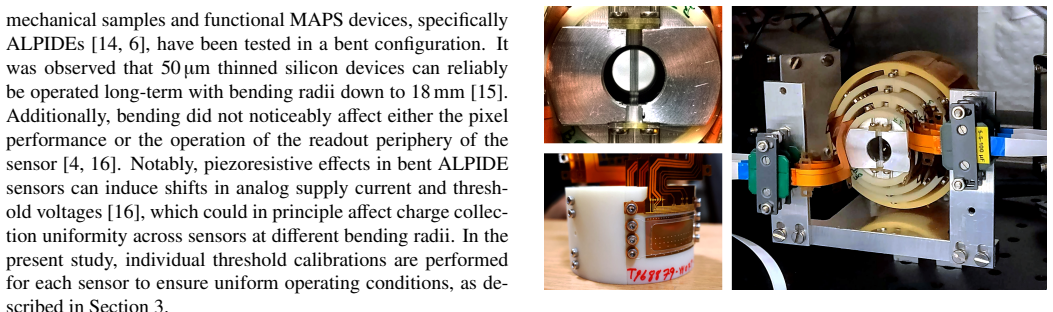
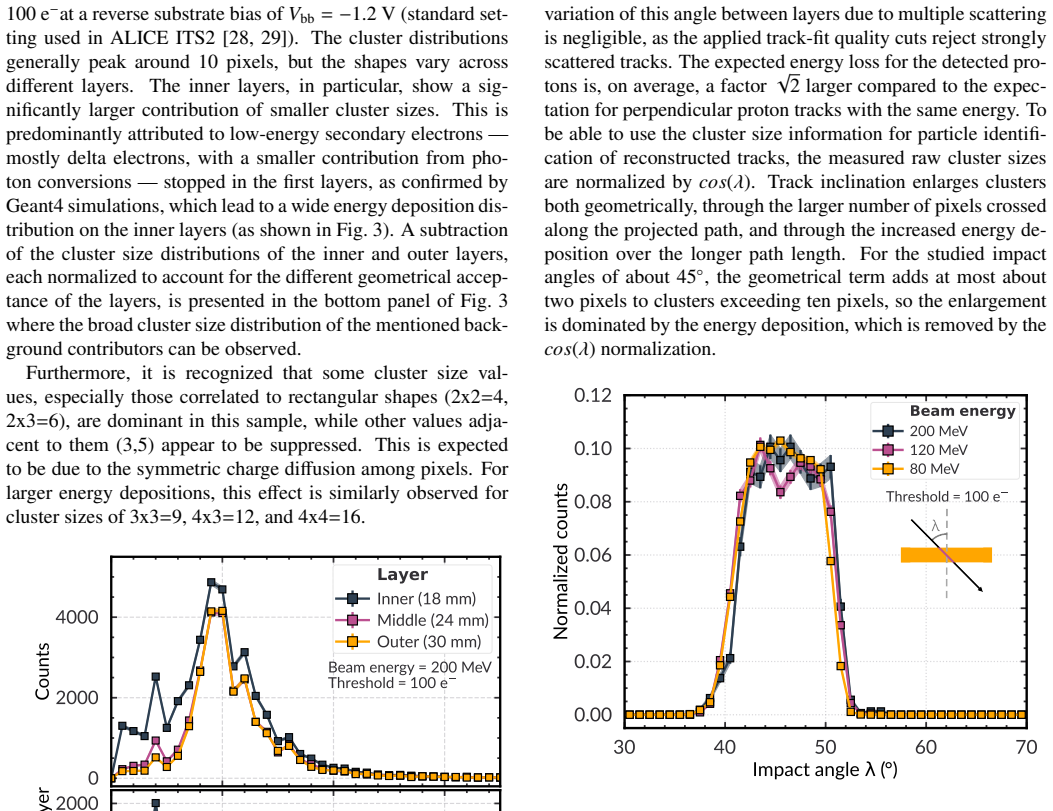
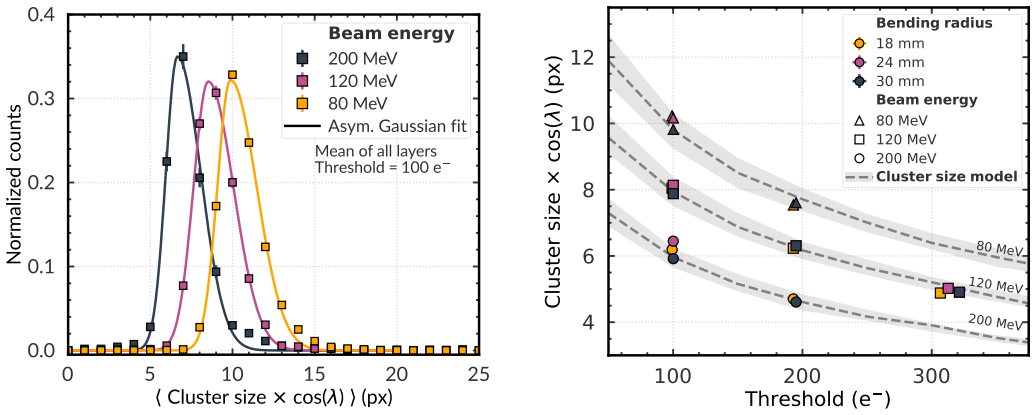
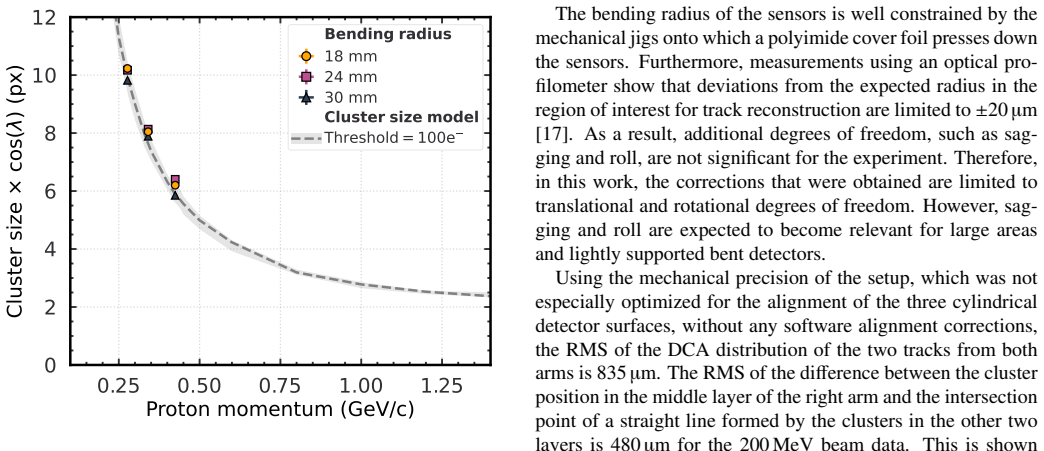
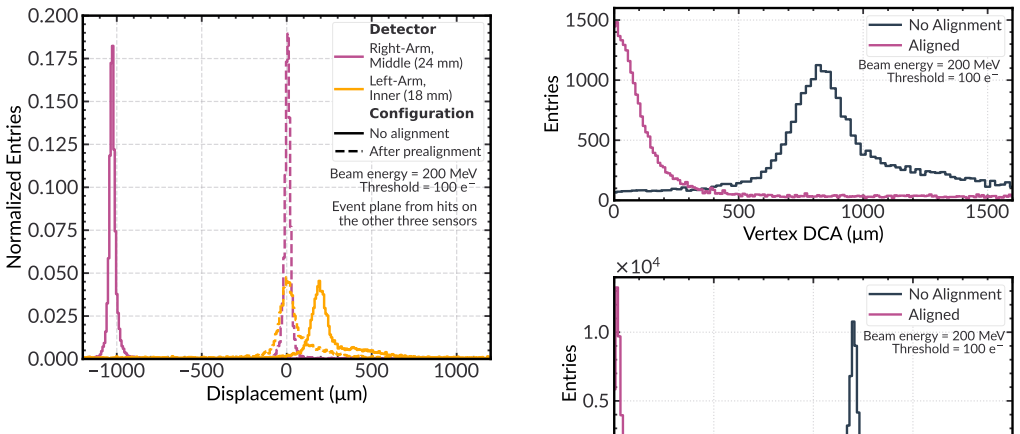
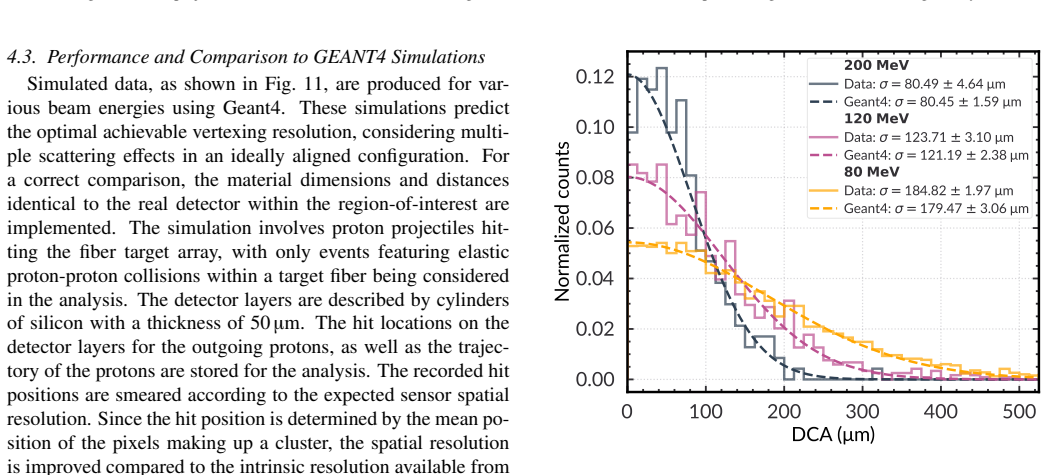
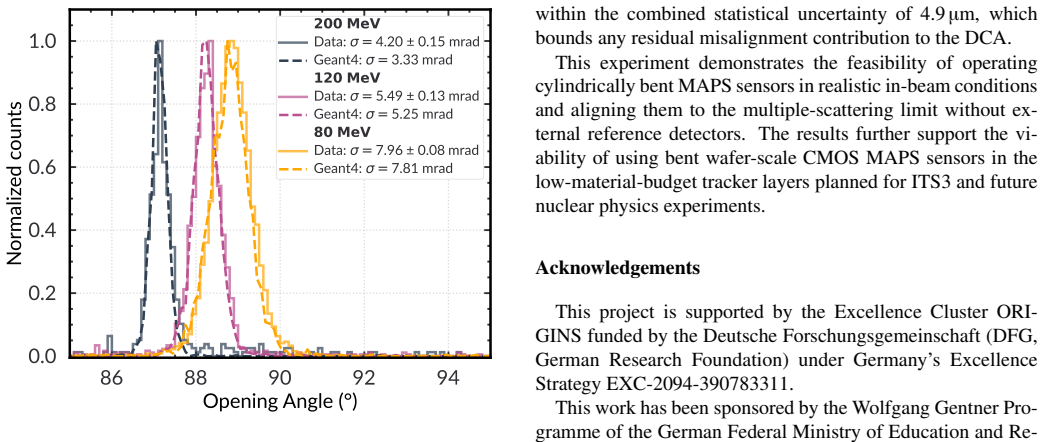
Bending the ALPIDE sensors produces no measurable effect on cluster size distributions under the high dE/dx conditions provided by the low-momentum protons; the alignment residuals obtained from DCA and opening-angle observables match the values predicted by simulation, thereby validating the use of bent wafer-scale MAPS for future tracking systems.
What carries the argument
Cluster-size histograms and the distance-of-closest-approach plus opening-angle benchmarks extracted from two-arm proton-track reconstructions.
If this is right
- Bending radii down to 18 mm can be adopted without redesign of the front-end electronics or clustering algorithms.
- Existing alignment procedures developed for flat ALPIDE planes remain applicable once the sensor curvature is accounted for in the geometry model.
- The same proton-scattering setup can serve as a calibration source for other bent MAPS prototypes.
- Charge-sharing behavior in bent sensors is sufficiently stable to support the target position resolution of the ITS3 innermost layers.
Where Pith is reading between the lines
- The absence of bending-induced cluster-size changes suggests that mechanical stress does not alter the epitaxial-layer electric-field configuration at the tested radii.
- Similar tests with higher-momentum particles or different sensor thicknesses would further constrain any residual curvature dependence.
- The demonstrated alignment precision supports extending the approach to full-wafer-scale bent sensors in other collider or fixed-target experiments.
Load-bearing premise
The low-momentum protons produced by elastic scattering on the polypropylene fiber reproduce the high-energy-loss and alignment conditions that will exist inside the bent ITS3 layers.
What would settle it
A statistically significant difference in measured cluster sizes between bent and flat sensors, or alignment resolutions that deviate from the simulated expectations by more than the reported uncertainties.
Figures

read the original abstract
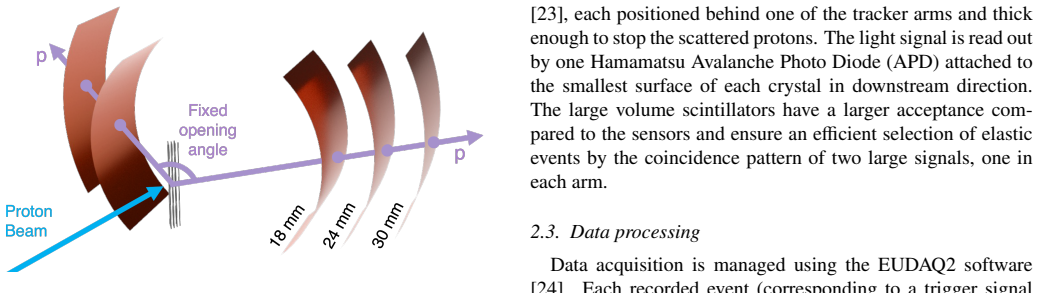
The upgrade of the ALICE experiments Inner Tracking System (ITS3) aims to replace its innermost detection layers with bent wafer-scale CMOS MAPS sensors. This study examines the performance of ALPIDE chips, currently used in the ALICE ITS2, when operated in a bent configuration under realistic experimental conditions. Proton beams with energies of 80 MeV, 120 MeV and 200 MeV were used to study proton-proton elastic scattering on a polypropylene fiber target reconstructed using two opposing arms of trackers with sensors bent to radii of 18 mm, 24 mm and 30 mm. The measured low-momentum protons provided a testbed for investigating clustering behavior in high-energy loss events, where no significant impact of bending was observed on cluster size. Additionally, alignment strategies for bent detectors were evaluated using the distance of closest approach (DCA) and opening angle between scattered proton tracks as benchmarks. The achieved resolution matches expectations from simulations, confirming the suitability of bent MAPS sensors for future high-energy and nuclear physics applications.
Editorial analysis
A structured set of objections, weighed in public.
Referee Report
Summary. The manuscript reports measurements of ALPIDE sensors bent to radii of 18 mm, 24 mm and 30 mm using 80–200 MeV protons from elastic scattering on a polypropylene fiber target. It finds no significant change in cluster size due to bending for these high-dE/dx events and reports that alignment performance, benchmarked via distance of closest approach and opening angle, matches simulation expectations, concluding that bent MAPS sensors are suitable for ITS3 and similar applications.
Significance. If the central measurements hold, the work supplies direct experimental data on charge-sharing behavior and alignment in bent wafer-scale sensors under high ionization density, which is useful for nuclear-physics tracking. The significance for the ITS3 upgrade is more limited, however, because the test particles are not minimum-ionizing and the paper provides no evidence that bending-induced charge-sharing effects are independent of dE/dx.
major comments (1)
- [Abstract and final section] Abstract and final section: the claim that the results 'confirm the suitability of bent MAPS sensors for future high-energy and nuclear physics applications' is load-bearing for the paper's motivation yet rests on an untested extrapolation. The measurements use protons whose dE/dx is far above minimum-ionizing; no data, scaling argument, or simulation comparison is supplied to show that the observed null result on cluster size would persist for MIPs that dominate ITS3 tracking.
Simulated Author's Rebuttal
We thank the referee for the constructive feedback. We address the single major comment below and agree that a revision to the scope of the conclusions is warranted.
read point-by-point responses
-
Referee: [Abstract and final section] Abstract and final section: the claim that the results 'confirm the suitability of bent MAPS sensors for future high-energy and nuclear physics applications' is load-bearing for the paper's motivation yet rests on an untested extrapolation. The measurements use protons whose dE/dx is far above minimum-ionizing; no data, scaling argument, or simulation comparison is supplied to show that the observed null result on cluster size would persist for MIPs that dominate ITS3 tracking.
Authors: We agree that the measurements were performed exclusively with 80–200 MeV protons (high dE/dx) and that no direct data, scaling argument, or MIP-specific simulation is presented to demonstrate that the null result on bending-induced cluster-size change holds for minimum-ionizing particles. The experiment was designed to study charge-sharing behavior under high ionization density, which is relevant for certain nuclear-physics use cases. Alignment performance was benchmarked against simulation and found to agree, independent of the dE/dx regime. To address the concern, we will revise the abstract and concluding section to remove the broad claim of suitability for high-energy physics applications and instead state that the results support the use of bent MAPS for tracking in high-dE/dx environments while noting that MIP-specific validation remains desirable. revision: yes
Circularity Check
No circularity in experimental measurement and simulation comparison
full rationale
This is a direct experimental study reporting measurements of cluster size, alignment metrics (DCA, opening angle), and resolution for bent ALPIDE sensors using low-energy proton beams. No derivations, equations, fitted parameters renamed as predictions, or self-citation chains are present in the provided text or abstract. Claims rest on observed data compared to external simulations, with no reduction of results to the paper's own inputs by construction. The derivation chain is self-contained.
Axiom & Free-Parameter Ledger
axioms (1)
- domain assumption Proton-proton elastic scattering on polypropylene provides a suitable testbed for high-energy-loss clustering and alignment benchmarks representative of ITS3 conditions.
Reference graph
Works this paper leans on
-
[1]
D. Colella, Upgrade of the ALICE experiment beyond LHC Run 3, International Journal of Modern Physics E-nuclear Physics (2022). doi:10.1142/s021830132240002x
-
[2]
P. G. Kuijer, The alice experiment at the CERN LHC, null (2003). doi:10.1016/s0920-5632(03)90488-9
-
[3]
A. Kluge, et al., ALICE – ITS3 — A bent, wafer-scale CMOS de- tector, Nuclear Instruments and Methods in Physics Research (2022). doi:10.1016/j.nima.2022.167315
-
[4]
rep., CERN, Geneva, co-project Manager: Magnus Mager, mag- nus.mager@cern.chds (2024)
ALICE Collaboration, Technical Design report for the ALICE Inner Tracking System 3 - ITS3 ; A bent wafer-scale monolithic pixel detector, Tech. rep., CERN, Geneva, co-project Manager: Magnus Mager, mag- nus.mager@cern.chds (2024). URLhttps://cds.cern.ch/record/2890181
arXiv 2024
-
[7]
F. Reidt, Upgrade of the ALICE ITS detector, Nuclear Instru- ments and Methods in Physics Research Section A : Accelera- tors, Spectrometers, Detectors and Associated Equipment (2021). doi:10.1016/j.nima.2022.166632
-
[8]
H. Hillemanns, ALICE ITS3: Technology Qualification Results on Prototype Sensor Structures of Novel Bent Wafer Scale 65nm CMOS Sensors, 2023 IEEE Nuclear Science Symposium, Medi- cal Imaging Conference and International Symposium on Room- Temperature Semiconductor Detectors (NSS MIC RTSD) (2023). doi:10.1109/nssmicrtsd49126.2023.10338255
-
[9]
Aumann, Prospects of nuclear structure at the future GSI accelerators, Progress in Particle and Nuclear Physics 59 (1) (2007) 3–21
T. Aumann, Prospects of nuclear structure at the future GSI accelerators, Progress in Particle and Nuclear Physics 59 (1) (2007) 3–21
2007
-
[10]
Belias, FAIR status and the PANDA experiment, Journal of Instrumen- tation 15 (10) (2020) C10001
A. Belias, FAIR status and the PANDA experiment, Journal of Instrumen- tation 15 (10) (2020) C10001
2020
-
[11]
Kobayashi, N
T. Kobayashi, N. Chiga, T. Isobe, Y . Kondo, T. Kubo, K. Kusaka, T. Mo- tobayashi, T. Nakamura, J. Ohnishi, H. Okuno, et al., SAMURAI spec- trometer for RI beam experiments, Nuclear Instruments and Methods in Physics Research Section B: Beam Interactions with Materials and Atoms 317 (2013) 294–304. 9
2013
-
[12]
M. Duer, T. Aumann, R. Gernh ¨auser, V . Panin, S. Paschalis, D. Rossi, N. Achouri, D. Ahn, H. Baba, C. Bertulani, et al., Observation of a corre- lated free four-neutron system, Nature 606 (7915) (2022) 678–682
2022
-
[13]
M. Borri, P. Booker, M. Buckland, et al., FAIR R3B-TRT: a MAPS-based Si-tracker, in: 2024 IEEE Nuclear Science Sympo- sium (NSS), Medical Imaging Conference (MIC) and Room Tem- perature Semiconductor Detector Conference (RTSD), 2024, pp. 1–1. doi:10.1109/NSS/MIC/RTSD57108.2024.10656696
-
[14]
M. Mager, ALPIDE, the Monolithic Active Pixel Sensor for the ALICE ITS upgrade, Nuclear Instruments & Methods in Physics Research Sec- tion A-accelerators Spectrometers Detectors and Associated Equipment (2016). doi:10.1016/j.nima.2015.09.057
-
[15]
doi:https://doi.org/10.1016/j.nima.2021.166280
ALICE ITS project, First demonstration of in-beam performance of bent Monolithic Active Pixel Sensors, Nuclear Instruments and Methods in Physics Research Section A: Accelerators, Spectrom- eters, Detectors and Associated Equipment 1028 (2022) 166280. doi:https://doi.org/10.1016/j.nima.2021.166280. URLhttps://www.sciencedirect.com/science/article/pii/ S01...
-
[16]
M. Rossewij, E. Okkinga, H. Naqvi, et al., Electrical/piezoresistive effects in bent Alpide MAPS, Journal of Instrumentation (2024). doi:10.1088/1748-0221/19/04/c04057
-
[17]
A. Andronic, P. Becht, M. Blidaru, et al., Detection efficiency and spa- tial resolution of Monolithic Active Pixel Sensors bent to different radii, Nuclear Instruments and Methods in Physics Research Section A: Accel- erators, Spectrometers, Detectors and Associated Equipment 1083 (2025) 171131. doi:10.1016/j.nima.2025.171131
-
[18]
URLhttps://ccb.ifj.edu.pl/pl
Cyclotron Centre Bronowice, Centrum Cyklotronowe Bronowice - IFJ PAN, accessed: 2024-11-08 (2024). URLhttps://ccb.ifj.edu.pl/pl
2024
-
[19]
G. A. Rinella, The ALPIDE pixel sensor chip for the upgrade of the AL- ICE Inner Tracking System, Nuclear Instruments & Methods in Physics Research Section A-accelerators Spectrometers Detectors and Associated Equipment (2017). doi:10.1016/j.nima.2016.05.016
-
[20]
S. Siddhanta, D. Marras, C. Puggioni, et al., A Readout System for single ALPIDE sensors of the ALICE Inner Tracking System Upgrade, in: 2020 IEEE Nuclear Science Symposium and Medical Imaging Conference (NSS/MIC), 2020, pp. 1–3. doi:10.1109/NSS/MIC42677.2020.9508095
-
[21]
Jacob, T
G. Jacob, T. A. Maris, Quasi-free scattering and nuclear structure, Re- views of Modern Physics 38 (1) (1966) 121
1966
-
[22]
E. J. Moniz, I. Sick, R. R. Whitney, et al., Nuclear Fermi Momenta from Quasielastic Electron Scattering, Phys. Rev. Lett. 26 (1971) 445–448. doi:10.1103/PhysRevLett.26.445. URLhttps://link.aps.org/doi/10.1103/PhysRevLett.26. 445
-
[23]
Cortina-Gil, H
D. Cortina-Gil, H. Alvarez-Pol, T. Aumann, M. B ¨ohmer, et al., CAL- IFA, a Dedicated Calorimeter for the R3B/FAIR, Nuclear Data Sheets 120 (2014) 99–101
2014
-
[24]
Y . Liu, M. Amjad, P. Baesso, D. Cussans, J. Dreyling-Eschweiler, R. Ete, I. Gregor, L. Huth, A. Irles, H. Jansen, et al., EUDAQ2—A flexible data acquisition software framework for common test beams, Journal of In- strumentation 14 (10) (2019) P10033
2019
-
[25]
Dannheim, K
D. Dannheim, K. Dort, L. Huth, J. Kr ¨oger, M. Munker, F. Pitters, P. Sch¨utze, S. Spannagel, et al., Corryvreckan: a modular 4D track re- construction and analysis software for test beam data, Journal of Instru- mentation 16 (03) (2021) P03008
2021
-
[26]
Ulukutlu, uITS3 Krakow Software Repository,https://github
B. Ulukutlu, uITS3 Krakow Software Repository,https://github. com/bulukutlu/uits3_krakow22, gitHub repository, accessed: 2026- 06-22 (2022)
2026
-
[27]
R. Brun, F. Rademakers, ROOT: An object oriented data analysis frame- work, Nucl. Instrum. Meth. A 389 (1997) 81–86. doi:10.1016/S0168- 9002(97)00048-X
-
[28]
Isakov, ALICE ITS2: overview and performance, Journal of Instrumentation 20 (07) (2025) C07026
A. Isakov, ALICE ITS2: overview and performance, Journal of Instrumentation 20 (07) (2025) C07026. doi:10.1088/1748- 0221/20/07/C07026
-
[29]
ALICE Collaboration, Sensor operating point calibration and monitor- ing of the ALICE Inner Tracking System during LHC Run 3, Nu- clear Instruments and Methods in Physics Research Section A: Ac- celerators, Spectrometers, Detectors and Associated Equipment (2026) 171354doi:10.1016/j.nima.2026.171354
-
[30]
Akiba, S
T. Akiba, S. Sano, T. Yanase, et al., Optuna: A Next-generation Hyper- parameter Optimization Framework, in: Proceedings of the 25th ACM SIGKDD International Conference on Knowledge Discovery and Data Mining, 2019, pp. 2623–2631. 10
2019
discussion (0)
Sign in with ORCID, Apple, or X to comment. Anyone can read and Pith papers without signing in.