Precision measurement of radiative neutron b{eta}-decay: methodology and systematic effects
Pith reviewed 2026-06-30 03:25 UTC · model grok-4.3
The pith
Analysis of radiative neutron beta decay determines systematic corrections via Monte Carlo spectrum comparisons.
A machine-rendered reading of the paper's core claim, the machinery that carries it, and where it could break.
Core claim
In the Standard Model the free neutron decays to a proton, an electron, and an antineutrino along with a continuous spectrum of photons. The paper provides the full methodology for the 2016 RDK II experiment, including how systematic corrections and uncertainties were extracted and how the observed spectra align with Monte Carlo simulations of detector response and backgrounds.
What carries the argument
Coincidence detection of radiative photons with decay electrons and protons, using Monte Carlo simulations to derive systematic corrections and validate energy spectra.
If this is right
- The branching ratio and spectrum measurements gain quantified uncertainty budgets from the corrections.
- Future runs can target higher precision by addressing the identified improvement approaches.
- The validated simulation framework supports extraction of additional observables from the same dataset.
Where Pith is reading between the lines
- This analysis framework could extend to other neutron decay channels involving photons or rare modes.
- Refined radiative corrections from such measurements may tighten constraints on Standard Model parameters like the axial-vector coupling.
- Cross-checks with independent detector technologies would test the robustness of the Monte Carlo validation step.
Load-bearing premise
The Monte Carlo simulations accurately capture all relevant detector responses, backgrounds, and physics processes in the experiment.
What would settle it
Observation of a statistically significant mismatch between measured spectra and Monte Carlo predictions that cannot be resolved by the reported systematic uncertainties.
Figures
read the original abstract
In the Standard Model the free neutron decays to a proton, an electron, and an antineutrino along with a continuous spectrum of photons. In 2016 the RDK II collaboration reported on a measurement of the photon energy spectrum and branching ratio over the range of 0.4 keV to the 782 keV endpoint using two different detector arrays. In the experiment, the radiative decay photons were observed in coincidence with the decay electrons and protons. In this paper, we present details of the analysis, including the determination of the systematic corrections and uncertainties and comparison of measured particle and photon energy spectra to Monte Carlo simulations. We conclude with approaches to improving the precision of these measurements.
Editorial analysis
A structured set of objections, weighed in public.
Referee Report
Summary. The manuscript presents the analysis methodology for the RDK II experiment on radiative neutron beta decay, focusing on the determination of systematic corrections and uncertainties for the photon energy spectrum (0.4 keV to 782 keV) and branching ratio. It includes comparisons of measured particle and photon energy spectra to Monte Carlo simulations and concludes with approaches to improve measurement precision.
Significance. If the Monte Carlo simulations are independently validated, the detailed treatment of systematic effects would strengthen the reliability of the 2016 RDK II photon spectrum and branching ratio results, providing a useful reference for future precision neutron decay experiments testing Standard Model predictions.
major comments (2)
- [Abstract] Abstract and analysis description: the systematic corrections and spectrum comparisons rest on the assumption that Monte Carlo simulations accurately model photon detection efficiency, energy response, backgrounds, and coincidence acceptance from 0.4 keV upward, yet no independent validation (control samples, external calibrations, or parameter-variation studies) is described to confirm the simulation is not tuned to the same dataset.
- [Analysis methodology] The central deliverable (extracted radiative photon spectrum and branching ratio) depends on background subtraction and efficiency corrections derived from MC comparisons; without explicit tests that these corrections are robust to plausible variations in low-energy photon processes or detector response, the claimed precision cannot be assessed.
minor comments (2)
- [Abstract] The abstract refers to 'two different detector arrays' from the 2016 report but does not specify how the current analysis combines or cross-checks data from each array.
- Notation for energy spectra and coincidence timing should be defined explicitly when first introduced to aid readability.
Simulated Author's Rebuttal
We thank the referee for their careful reading and for highlighting the importance of demonstrating that the Monte Carlo simulations are not tuned to the radiative-decay data set. We address each major comment below and will revise the manuscript to make the validation procedures more explicit.
read point-by-point responses
-
Referee: [Abstract] Abstract and analysis description: the systematic corrections and spectrum comparisons rest on the assumption that Monte Carlo simulations accurately model photon detection efficiency, energy response, backgrounds, and coincidence acceptance from 0.4 keV upward, yet no independent validation (control samples, external calibrations, or parameter-variation studies) is described to confirm the simulation is not tuned to the same dataset.
Authors: The Monte Carlo model parameters for detector response, photon attenuation, and coincidence timing were fixed using separate calibration data sets acquired with radioactive sources (55Fe, 109Cd) and electron beams prior to the radiative-decay runs; these calibrations are referenced in the 2016 RDK II publications but will be summarized in a new dedicated subsection. The spectrum comparisons shown in the manuscript (background-dominated regions below 100 keV and the high-energy tail) serve as an a-posteriori consistency check rather than a fit. To satisfy the referee’s request for explicit independent validation, we will add parameter-variation studies (varying low-energy photon cross sections within their uncertainties and re-deriving efficiencies) and report the resulting changes to the extracted spectrum and branching ratio. revision: yes
-
Referee: [Analysis methodology] The central deliverable (extracted radiative photon spectrum and branching ratio) depends on background subtraction and efficiency corrections derived from MC comparisons; without explicit tests that these corrections are robust to plausible variations in low-energy photon processes or detector response, the claimed precision cannot be assessed.
Authors: We agree that robustness tests against variations in low-energy photon processes were only implicit in the original text. In the revised manuscript we will include a new table and accompanying text that quantifies the effect on the extracted spectrum when the photon interaction model (photoelectric vs. Compton dominance below 50 keV) and detector threshold parameters are varied within their calibration uncertainties. These studies confirm that the systematic uncertainty assigned in the 2016 result already encompasses the observed variations; the additional material will make this assessment transparent. revision: yes
Circularity Check
No circularity: experimental analysis relies on data-MC comparison without self-referential reduction
full rationale
This is an experimental methodology paper describing coincidence measurements, systematic corrections, and spectrum comparisons to Monte Carlo. No derivation chain, fitted parameter renamed as prediction, self-citation load-bearing premise, or ansatz smuggled via prior work exists. The MC comparisons are presented as validation tools rather than a closed loop where outputs are forced by construction from the same inputs. The abstract and described content contain no equations or steps that reduce to self-definition or renaming of known results.
Axiom & Free-Parameter Ledger
axioms (1)
- domain assumption The free neutron decays to a proton, an electron, an antineutrino, and a continuous spectrum of photons.
Reference graph
Works this paper leans on
-
[1]
The simulation requires a neutron decay generator, decay product transport, and a detailed geometric description of the relevant parts of the apparatus
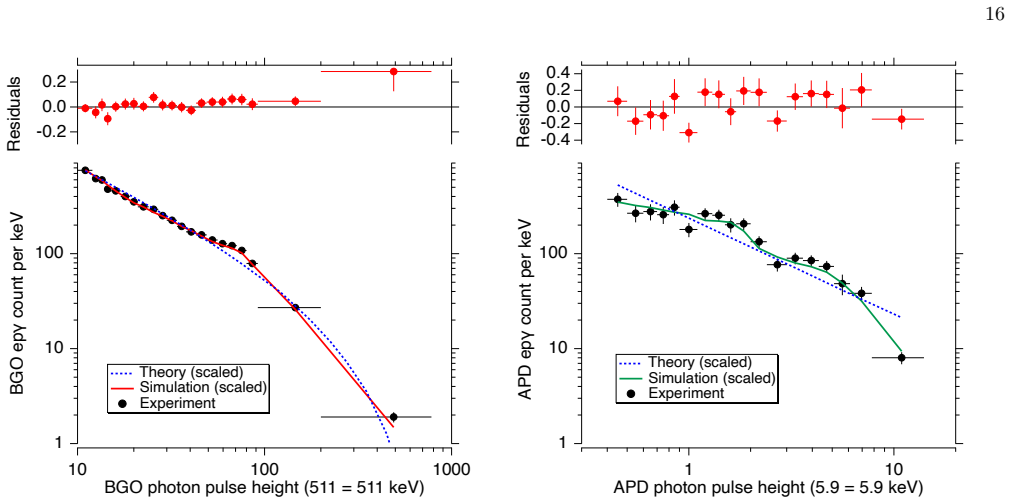
Simulations To compare the experimental data with the results from QED calculations, it was necessary to use a detailed simulation to model both the complex geometry and the nonlinear energy response of the photon detectors. The simulation requires a neutron decay generator, decay product transport, and a detailed geometric description of the relevant par...
-
[2]
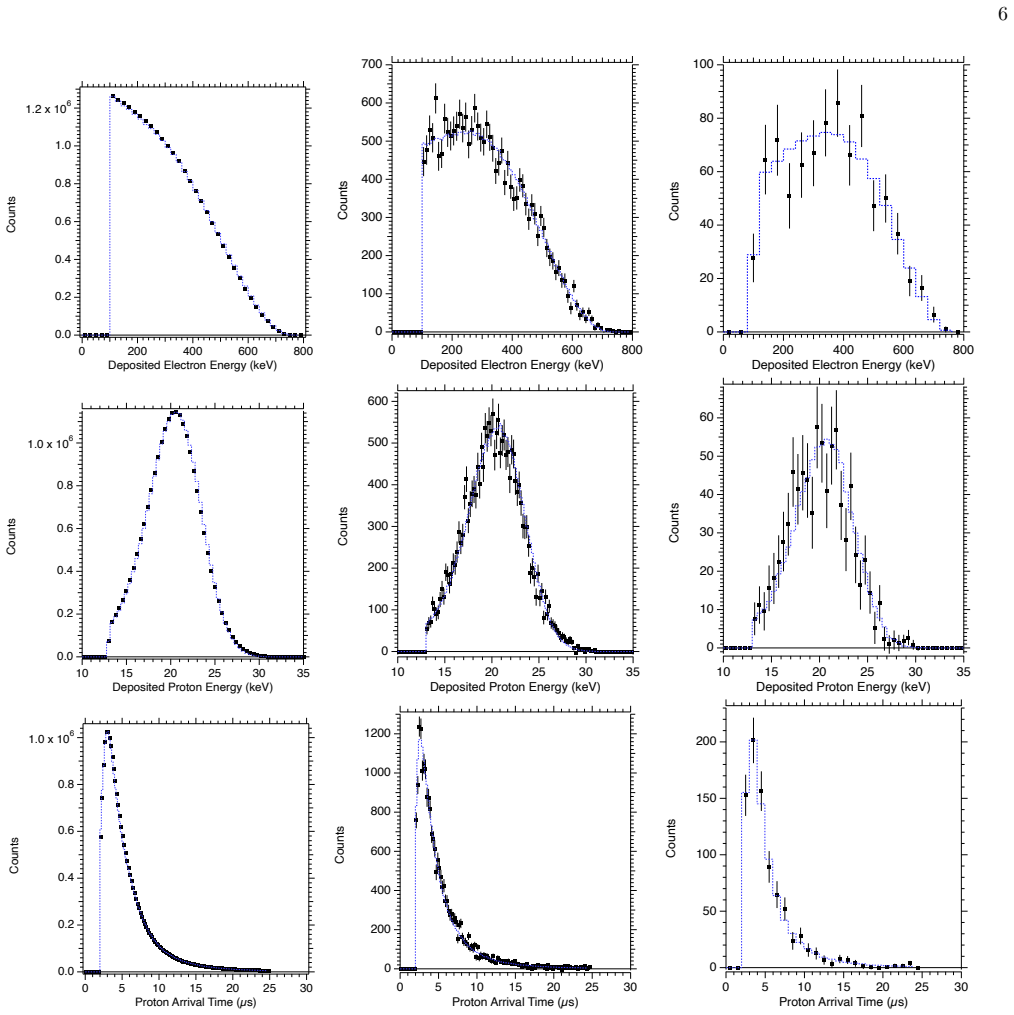
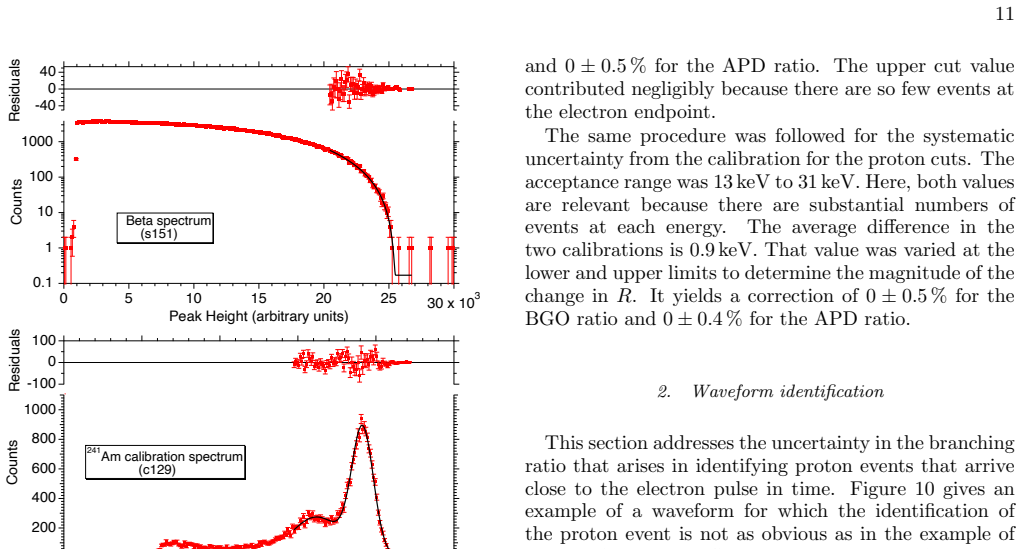
Comparison with data Benchmarking the MC against measurable quantities from the apparatus demonstrates the validity of many aspects of the MC. In addition to the photon energy (a goal of the experiment), three of the key measurable quantities are the electron energy spectrum, the proton energy spectrum, and the arrival time of a proton after an electron t...
-
[3]
During online data acquisition, the DAQ could be placed in a mode to collect calibration data
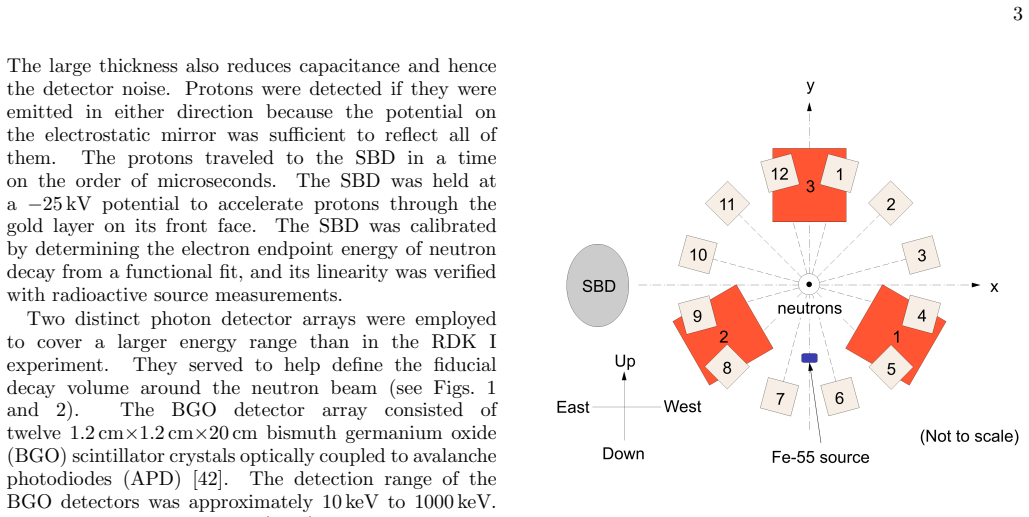
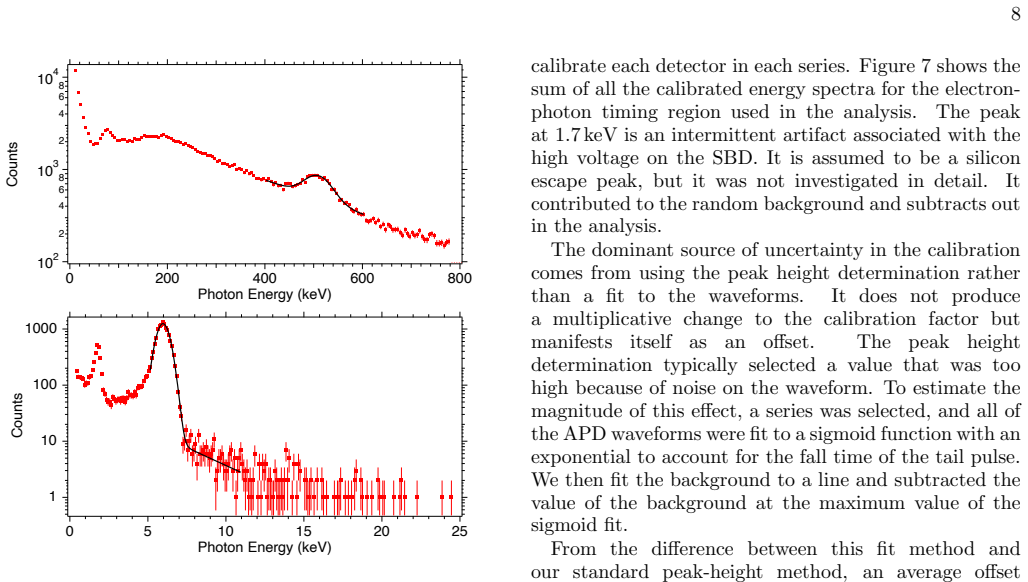
Photon energy calibration a.BGOCalibrations and studies of the BGO and APD detectors were performed both online and offline. During online data acquisition, the DAQ could be placed in a mode to collect calibration data. At the beginning of each run and every twelve hours thereafter, calibration data were acquired for 30 minutes while the beam shutter was ...
-
[4]
Nonproportionality refers to the phenomenon where a scintillator’s light output is not directly proportional to the energy deposited
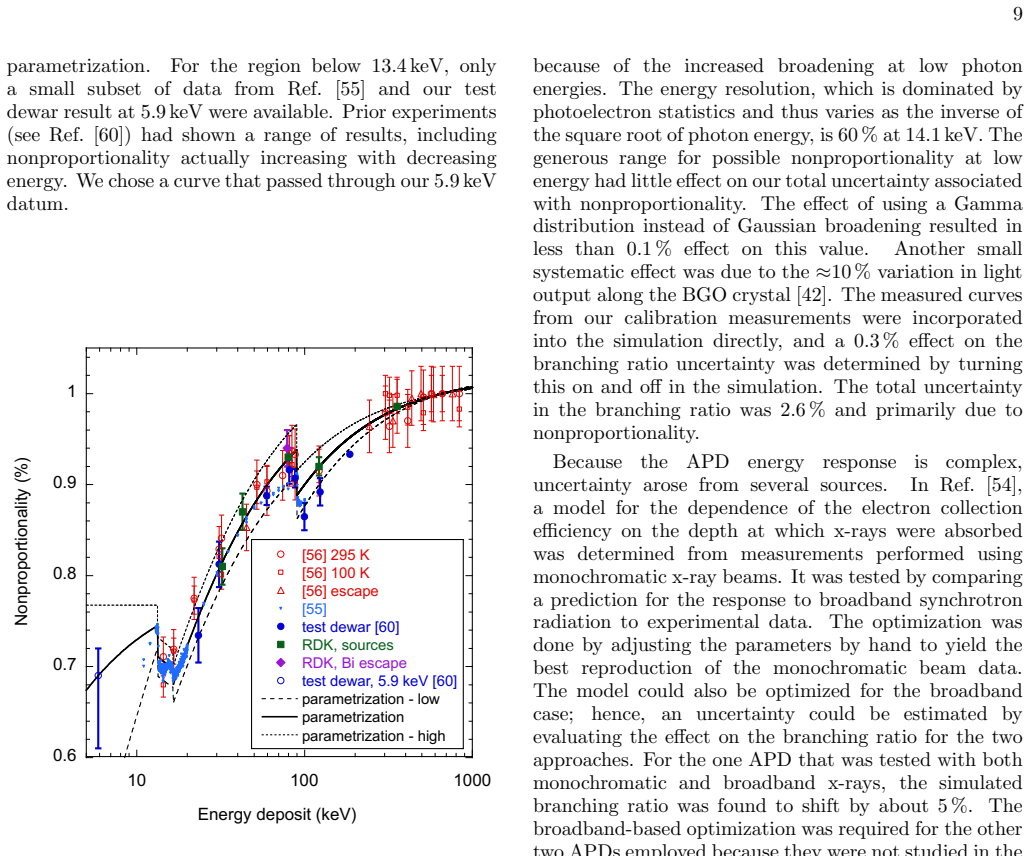
Energy response The uncertainty due to the energy response of the BGO detector was dominated by uncertainty in the nonproportional response of BGO [55–59]. Nonproportionality refers to the phenomenon where a scintillator’s light output is not directly proportional to the energy deposited. The nonproportionality was modeled by applying the results of a par...
-
[5]
high” and “low
295 K[56] 100 K[56] escape[55]test dewar [60]RDK, sourcesRDK, Bi escapetest dewar, 5.9 keV [60]parametrization - lowparametrizationparametrization - high Nonproportionality (%) E nergy deposit (keV) FIG. 8. Parametrization employed for BGO nonproportionality, which is based on the data sets in the plot. The form is discussed in the text. The curves labele...
-
[6]
In some instances, both types of events happen by random coincidence in the same BGO trace producing pulse pileup
Multiple photons In the photon detectors, there are the true coincident epγevents but alsoepγevents where the photon is from a background that is independent of the neutron decay process. In some instances, both types of events happen by random coincidence in the same BGO trace producing pulse pileup. Systematic errors can be introduced by both adding mis...
-
[7]
The electrons and protons were detected by the same SBD, and thus their calibrations were determined in the same manner
Electron and proton energy calibration Because the branching ratio depends on Monte Carlo simulation, the electron and proton calibrations are important and do not drop out in the ratio. The electrons and protons were detected by the same SBD, and thus their calibrations were determined in the same manner. SBDs are sensitive to gamma rays, and we presume ...
-
[8]
Figure 10 gives an example of a waveform for which the identification of the proton event is not as obvious as in the example of Fig
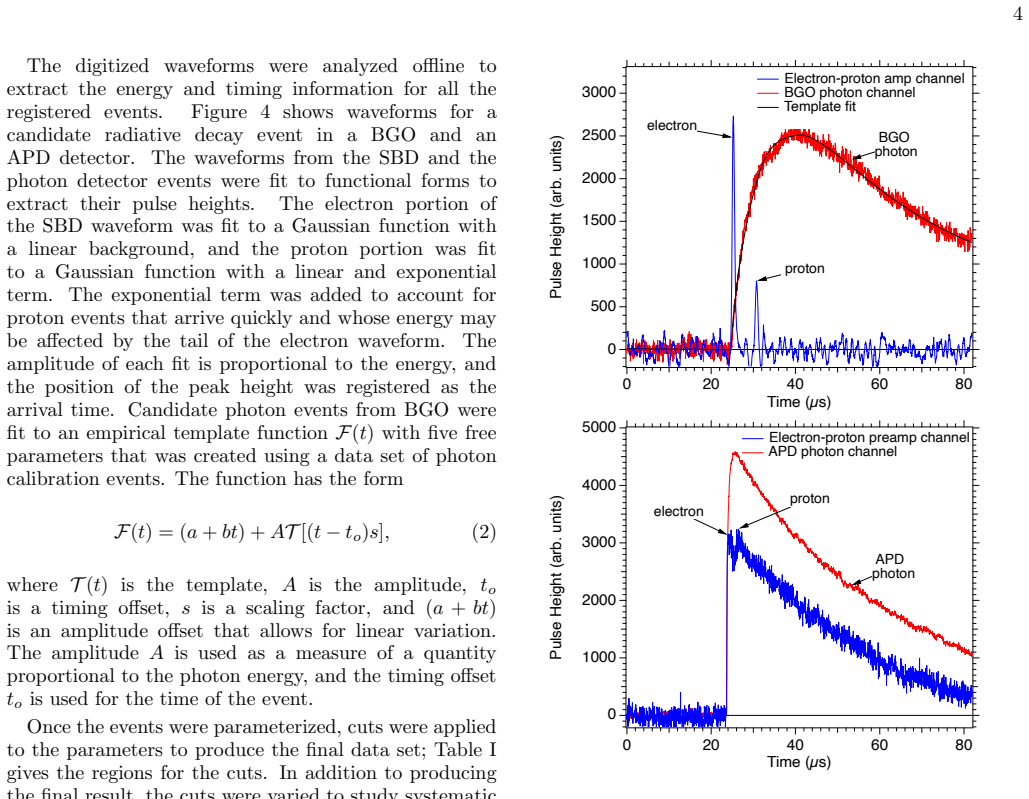
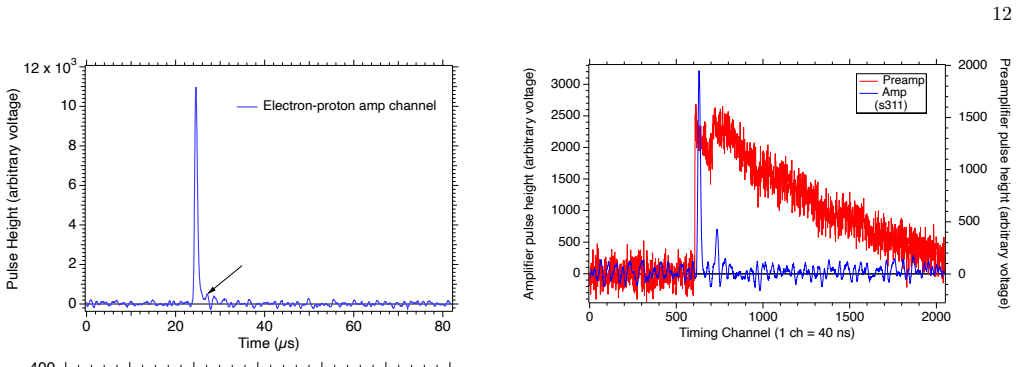
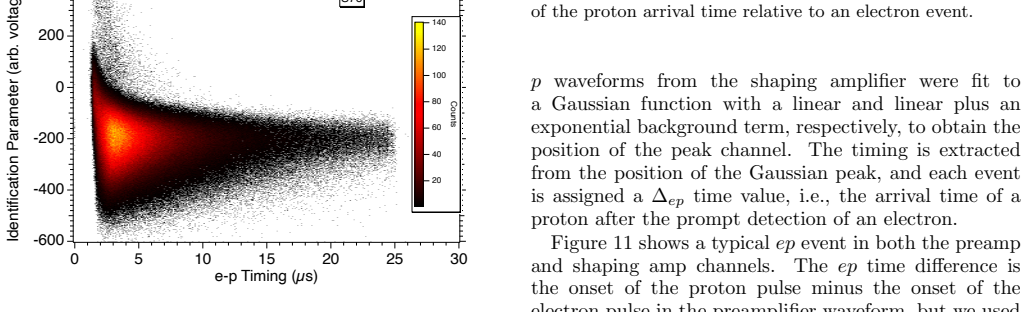
Waveform identification This section addresses the uncertainty in the branching ratio that arises in identifying proton events that arrive close to the electron pulse in time. Figure 10 gives an example of a waveform for which the identification of the proton event is not as obvious as in the example of Fig. 4. One must differentiate true protons from noi...
-
[9]
For the conversion to time, the board digitization of one channel corresponding to 1/(25 MHz) (i.e.,40 ns) was used
Electron-proton timing Theeptiming cut is from 2µs to 25µs, or 50 to 625 in digitizer channels. For the conversion to time, the board digitization of one channel corresponding to 1/(25 MHz) (i.e.,40 ns) was used. To quantify the uncertainty arising from the cut, one must understand the uncertainty in determining the time difference between the electron an...
-
[10]
There are three relevant regions: the prepeak background, the peak, and the postpeak background
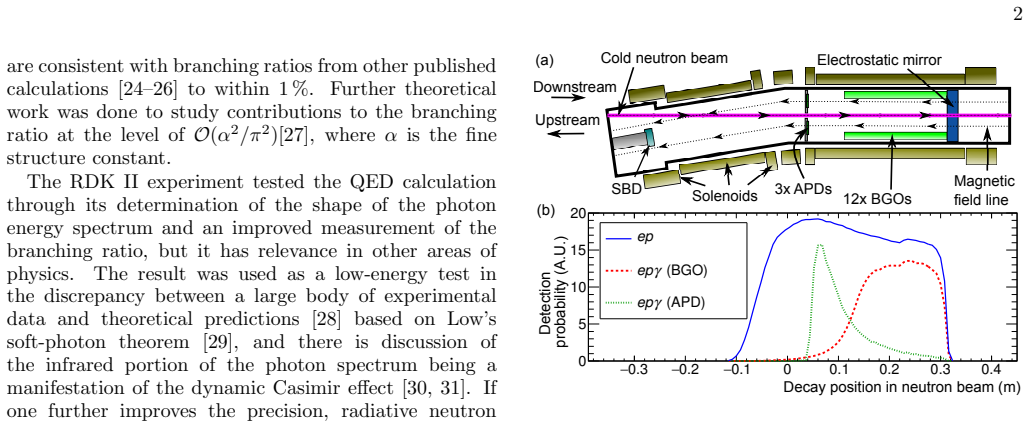
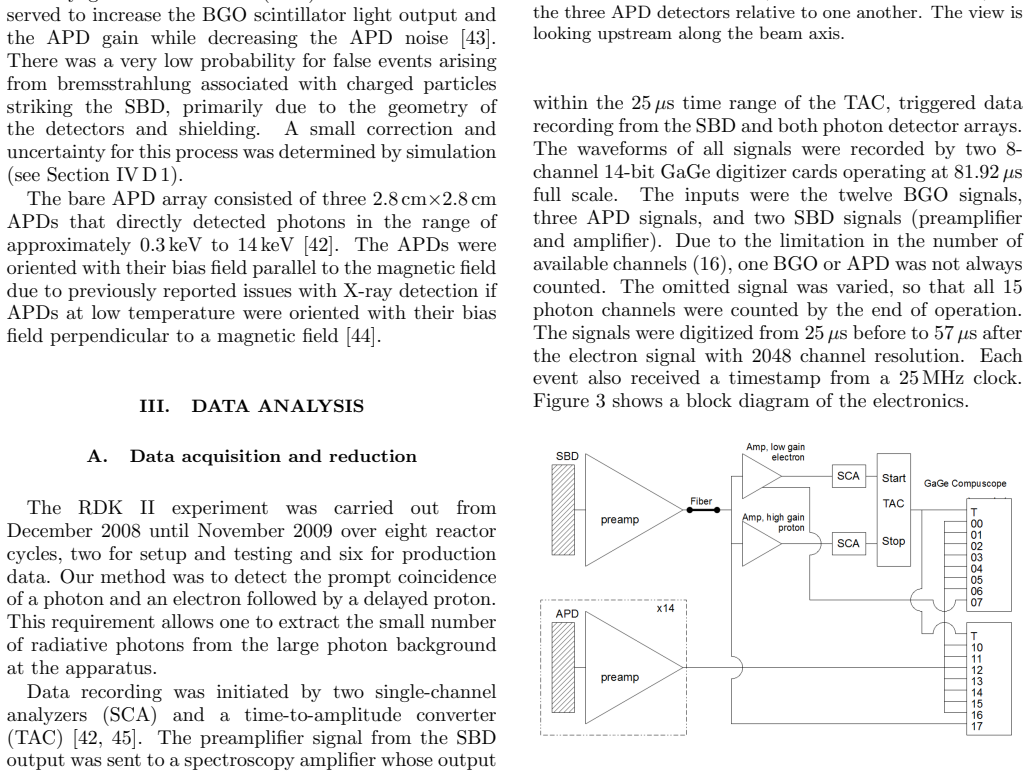
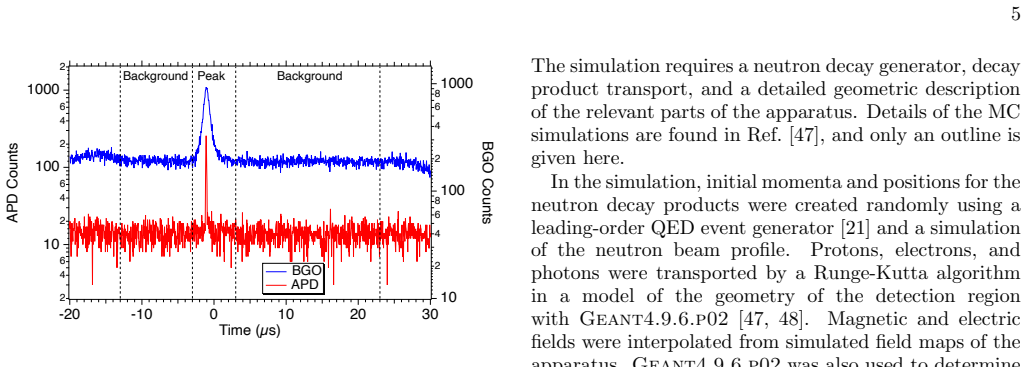
Electron-photon timing Figure 5 shows the histogram for the time difference between the electron and photon events for both the BGO and APD detectors. There are three relevant regions: the prepeak background, the peak, and the postpeak background. The two background regions were weighted by their size to obtain the background correction. The background co...
-
[11]
Such events were rare due to the geometry of the detectors; the BGO and APD presented a small solid angle from the SBD and were shielded where possible (see Fig
Electron bremsstrahlung The bremsstrahlung of electrons that lose energy in the SBD could strike a BGO crystal and induce anepγ signal that is indistinguishable in the analysis from a true radiative decay event. Such events were rare due to the geometry of the detectors; the BGO and APD presented a small solid angle from the SBD and were shielded where po...
-
[12]
turn off
Non-decay backgrounds In addition to electron bremsstrahlung causing a correlated background in the timing spectrum, it is also possible for correlated events unrelated to radiative neutron decay to survive all of the cuts and appear in the timing spectrum. The origin of any given correlated event is difficult to discern, but it is believed that they can ...
-
[13]
HV = 0 (S97): 6 events/0.93 d = 6.4/d 2a) B=0 (S98): 5.2 events/0.95 d = 5.5/d 2b) B=0 (S99): 2.8 events/0.50 d = 5.6/d
-
[14]
The uncertainty includes the small background subtraction
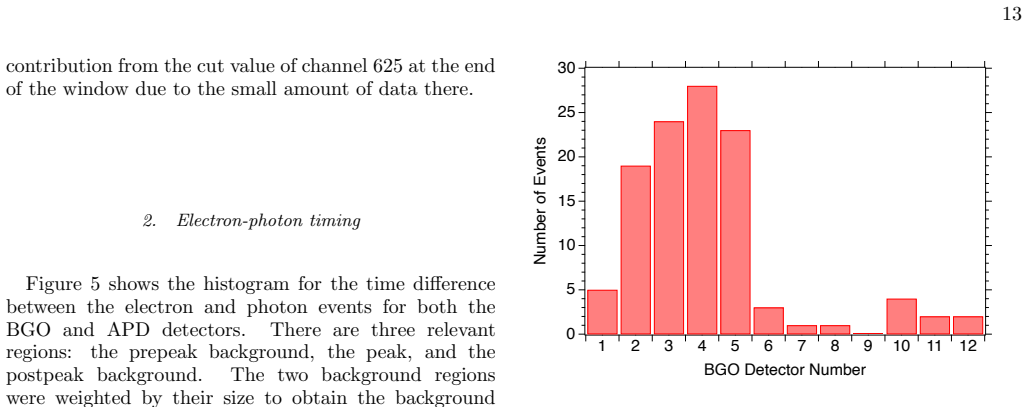
beam off (S100): 12.8 events/3.5 d = 3.7/d The total number of events for the above series is (26.8±5.4) events in 5.9 d, or (4.5±0.9)/d. The uncertainty includes the small background subtraction. Full production running (reactor cycles 3 through 8) for the BGO detectors operated for 85.8 days and registered about 44600 events. Comparing these test runs a...
-
[15]
Detector
Model registration Because the branching ratio is formed as a ratio of the experimental to the MC simulation, the fidelity of the input to the MC is critical. The relative positions of detectors, magnetic field, and beam with respect to each other were of particular importance. Care was taken to physically measure and map their positions in the apparatus....
-
[16]
For the −25 keV incident protons that backscatter, some may return to the detector and be registered (but with a reduced energy), and others may be completely lost
Charged particle backscattering A small fraction of the protons and electrons striking the surface of the SBD will backscatter. For the −25 keV incident protons that backscatter, some may return to the detector and be registered (but with a reduced energy), and others may be completely lost. In either case, proton backscattering would affect the overall e...
-
[17]
Dubbers and M
D. Dubbers and M. G. Schmidt, Rev. Mod. Phys.83 (2011)
2011
-
[18]
Baeßler, J
S. Baeßler, J. D. Bowman, S. Penttil¨ a, and D. Poˇ cani´ c, J. Phys. G: Nucl. Part. Phys.41, 114003 (2014)
2014
-
[19]
K. K. Vos, H. W. Wilschut, and R. G. E. Timmermans, Rev. Mod. Phys.87, 1483 (2015)
2015
-
[20]
Gorchtein and C.-Y
M. Gorchtein and C.-Y. Seng, Universe9, 422 (2023)
2023
-
[21]
Hayen, Annu
L. Hayen, Annu. Rev. Nucl. Part. Sci.74, 497 (2024)
2024
-
[22]
F. E. Wietfeldt and G. L. Greene, Rev. Mod. Phys.83, 1173 (2011)
2011
-
[23]
Navaset al.(Particle Data Group), Phys
S. Navaset al.(Particle Data Group), Phys. Rev. D110, 030001 (2024)
2024
-
[24]
Musedinovic, L
R. Musedinovic, L. S. Blokland, C. B. Cude-Woods, M. Singh, M. A. Blatnik, N. Callahan, J. H. Choi, S. M. Clayton, B. W. Filippone, W. R. Fox, E. Fries, P. Geltenbort, F. M. Gonzalez, L. Hayen, K. P. Hickerson, A. T. Holley, T. M. Ito, A. Komives, S. Lin, C.-Y. Liu, M. F. Makela, C. M. O’Shaughnessy, R. W. Pattie, J. C. Ramsey, D. J. Salvat, A. Saunders, ...
2025
-
[25]
D. Mund, B. M¨ arkisch, M. Deissenroth, J. Krempel, M. Schumann, H. Abele, A. Petoukhov, and T. Soldner, Phys. Rev. Lett.110, 172502 (2013)
2013
-
[26]
M. P. Mendenhall, R. W. Pattie, Jr., Y. Bagdasarova, D. B. Berguno, L. J. Broussard, R. Carr, S. Currie, X. Ding, B. W. Filippone, A. Garcia, P. Geltenbort, K. P. Hickerson, J. Hoagland, A. T. Holley, R. Hong, T. M. Ito, A. Knecht, C. Y. Liu, J. L. Liu, M. Makela, R. R. Mammei, J. W. Martin, D. Melconian, S. D. Moore, C. L. Morris, A. P. Galvan, R. Picker...
2013
-
[27]
M. A.-P. Brown, E. B. Dees, E. Adamek, B. Allgeier, M. Blatnik, T. J. Bowles, L. J. Broussard, R. Carr, S. Clayton, C. Cude-Woods, S. Currie, X. Ding, B. W. Filippone, A. Garc´ ıa, P. Geltenbort, S. Hasan, K. P. Hickerson, J. Hoagland, R. Hong, G. E. Hogan, A. T. Holley, T. M. Ito, A. Knecht, C.-Y. Liu, J. Liu, M. Makela, J. W. Martin, D. Melconian, M. P....
2018
-
[28]
J. C. Hardy and I. S. Towner, Phys. Rev. C102, 045501 (2020)
2020
-
[29]
A. N. Ivanov, R. H¨ ollwieser, N. I. Troitskaya, M. Wellenzohn, and Y. A. Berdnikov, Int. J. Mod. Phys. A34, 1950010 (2019)
2019
-
[30]
J. D. Jackson,Classical Electrodynamics(Wiley, New York, NY, 1999)
1999
-
[31]
Y. V. Gaponov and R. U. Khafizov, Phys. Atom. Nucl. 59, 1213 (1996)
1996
-
[32]
Gaponov and R
Y. Gaponov and R. Khafizov, Phys. Lett. B379, 7 (1996)
1996
-
[33]
M. Beck, J. Byrne, R. Khafizov, V. Kozlov, Y. Mostovoi, O. Rozhnov, N. Severijns, and V. Solovei, JETP Lett. 76, 332 (2002)
2002
-
[34]
J. S. Nico, M. S. Dewey, T. R. Gentile, H. P. Mumm, A. K. Thompson, B. M. Fisher, I. Kremsky, F. E. Wietfeldt, T. E. Chupp, R. L. Cooper, E. J. Beise, K. G. Kiriluk, J. Byrne, and K. J. Coakley, Nature444, 1059 (2006)
2006
-
[35]
R. L. Cooper, T. E. Chupp, M. S. Dewey, T. R. Gentile, H. P. Mumm, J. S. Nico, A. K. Thompson, B. M. Fisher, I. Kremsky, F. E. Wietfeldt, E. J. Beise, K. G. Kiriluk, J. Byrne, K. J. Coakley, and C. Fu, Phys. Rev. C81 (2010)
2010
-
[36]
M. J. Bales, R. Alarcon, C. D. Bass, E. J. Beise, H. Breuer, J. Byrne, T. E. Chupp, K. J. Coakley, R. L. Cooper, M. S. Dewey, S. Gardner, T. R. Gentile, D. He, H. P. Mumm, J. S. Nico, B. O’Neill, A. K. Thompson, and F. E. Wietfeldt (RDK II Collaboration), Phys. Rev. Lett.116, 242501 (2016)
2016
-
[37]
R. L. Cooper,The Radiative Decay Mode of the Free 18 Neutron, Ph.D. dissertation, University of Michigan, Department of Physics (2008)
2008
-
[38]
Wilkinson, Nucl
D. Wilkinson, Nucl. Phys. A377, 474 (1982)
1982
-
[39]
He,Investigation of Spin-Independent CP Violation in Neutron and Nuclear RadiativeβDecays, Ph.D
D. He,Investigation of Spin-Independent CP Violation in Neutron and Nuclear RadiativeβDecays, Ph.D. dissertation, University of Kentucky, Department of Physics (2013)
2013
-
[40]
Gaponov and R
Y. Gaponov and R. Khafizov, Nucl. Instrum. Meth. A 440, 557 (2000)
2000
-
[41]
Bernard, S
V. Bernard, S. Gardner, U.-G. Meißner, and C. Zhang, Phys. Lett. B593, 105 (2004)
2004
-
[42]
A. N. Ivanov, M. Pitschmann, and N. I. Troitskaya, Phys. Rev. D88, 073002 (2013)
2013
-
[43]
A. N. Ivanov, R. H¨ ollwieser, N. I. Troitskaya, M. Wellenzohn, and Y. A. Berdnikov, Phys. Rev. D95, 113006 (2017)
2017
-
[44]
Bailhache, D
R. Bailhache, D. Bonocore, P. Braun-Munzinger, X. Feal, S. Floerchinger, J. Klein, K. K¨ ohler, P. Lebiedowicz, C. Peter, R. Rapp, K. Reygers, W. Sch¨ afer, H. Scheid, K. Schweda, J. Stachel, H. van Hees, C. van Veen, and M. V¨ olkl, Phys. Rep.1097, 1 (2024)
2024
-
[45]
F. E. Low, Phys. Rev.96, 1428 (1954)
1954
-
[46]
M. H. Lynch, E. Ievlev, and M. R. R. Good, Prog. Theor. Exp. Phys.2024, 023D01 (2024)
2024
-
[47]
Ievlev and M
E. Ievlev and M. R. R. Good, Prog. Theor. Exp. Phys. 2024(2024)
2024
-
[48]
Gardner and D
S. Gardner and D. He, Phys. Rev. D86, 016003 (2012)
2012
-
[49]
Gardner and D
S. Gardner and D. He, Phys. Rev. D87, 116012 (2013)
2013
-
[50]
J. S. Nico, M. Arif, M. S. Dewey, T. R. Gentile, D. M. Gilliam, P. R. Huffman, D. L. Jacobson, and A. K. Thompson, J. Res. Natl. Inst. Stand. Technol.110, 137 (2005)
2005
-
[51]
A. T. Yue, M. S. Dewey, D. M. Gilliam, G. L. Greene, A. B. Laptev, J. S. Nico, W. M. Snow, and F. E. Wietfeldt, Phys. Rev. Lett.111, 222501 (2013)
2013
-
[52]
A. T. Yue, E. S. Anderson, M. S. Dewey, D. M. Gilliam, G. L. Greene, A. B. Laptev, J. S. Nico, and W. M. Snow, Metrologia55, 460 (2018)
2018
-
[53]
Byrne, P
J. Byrne, P. G. Dawber, J. A. Spain, A. P. Williams, M. S. Dewey, D. M. Gilliam, G. L. Greene, G. P. Lamaze, R. D. Scott, J. Pauwels, R. Eykens, and A. Lamberty, Phys. Rev. Lett.65, 289 (1990)
1990
-
[54]
Byrne, P
J. Byrne, P. Dawber, M. van der Grinten, C. Habeck, F. Shaikh, J. Spain, R. Scott, C. Baker, K. Green, and O. Zimmer, J. Phys. G28, 1325 (2002)
2002
-
[55]
M. S. Dewey, D. M. Gilliam, J. S. Nico, F. E. Wietfeldt, X. Fei, W. M. Snow, G. L. Greene, J. Pauwels, R. Eykens, A. Lamberty, and J. Van Gestel, Phys. Rev. Lett.91, 152302 (2003)
2003
-
[56]
G. F. Knoll,Radiation detection and measurement, 2nd ed(John Wiley and Sons Inc.,New York, NY, 1988)
1988
-
[57]
com/products/radiation-detectors/ silicon-charged-particle-radiation-detectors (2026), accessed: 2026-01-20
Ortec, Review of the physics of semiconductor detectors,https://www.ortec-online. com/products/radiation-detectors/ silicon-charged-particle-radiation-detectors (2026), accessed: 2026-01-20
2026
-
[58]
R. L. Cooper, R. Alarcon, M. J. Bales, C. D. Bass, E. J. Beise, H. Breuer, J. Byrne, T. E. Chupp, K. J. Coakley, M. S. Dewey, C. Fu, T. R. Gentile, H. P. Mumm, J. S. Nico, B. O’Neill, K. Pulliam, A. K. Thompson, and F. E. Wietfeldt, Nucl. Instrum. Meth. A691, 64 (2012)
2012
-
[59]
T. R. Gentile, M. S. Dewey, H. P. Mumm, J. S. Nico, A. K. Thompson, T. E. Chupp, R. L. Cooper, B. M. Fisher, I. Kremsky, F. E. Wietfeldt, K. G. Kiriluk, and E. J. Beise, Nucl. Instrum. Meth. A579, 447 (2007)
2007
-
[60]
T. R. Gentile, C. D. Bass, J. S. Nico, H. Breuer, and R. Farrell, Nucl. Instrum. Meth. A652, 520 (2011)
2011
-
[61]
O’Neill,Precision Measurement of the Radiative Decay Mode of the Free Neutron, Ph.D
B. O’Neill,Precision Measurement of the Radiative Decay Mode of the Free Neutron, Ph.D. dissertation, Arizona State University, Department of Physics (2012)
2012
-
[62]
H. P. Mumm, T. E. Chupp, R. L. Cooper, K. P. Coulter, S. J. Freedman, B. K. Fujikawa, A. Garc´ ıa, G. L. Jones, J. S. Nico, A. K. Thompson, C. A. Trull, J. F. Wilkerson, and F. E. Wietfeldt, Phys. Rev. Lett.107, 102301 (2011)
2011
-
[63]
M. J. Bales,Precision Measurement of Radiative Neutron Decay, Ph.D. dissertation, University of Michigan (2014)
2014
-
[64]
Agostinelliet al., Nucl
S. Agostinelliet al., Nucl. Instrum. Meth. A506, 250 (2003)
2003
-
[65]
BiotSavart,https://www.ripplon.com/BiotSavart/ (2014), accessed: June 2014
2014
-
[66]
(2025), Identification of a product herein is for documentation purposes only, and does not imply recommendation or endorsement by NIST, nor does it imply that this product is necessarily the best available for the purpose
2025
-
[67]
J. Nico, M. Dewey, D. Gilliam, F. Wietfeldt, X. Fei, W. Snow, G. Greene, J. Pauwels, R. Eykens, A. Lamberty, J. Gestel, and R. Scott, Phys. Rev. C71 (2005)
2005
-
[68]
Igor Pro,https://www.wavemetrics.com/(2014), accessed: June 2014
2014
-
[69]
4.3b,https://www.comsol
COMSOL Multiphysics v. 4.3b,https://www.comsol. com/(2014), accessed: June 2014
2014
-
[70]
T. R. Gentile, M. Bales, U. Arp, B. Dong, and R. Farrell, Rev. Sci. Instrum.83(2012)
2012
-
[71]
I. V. Khodyuk and P. Dorenbos, IEEE Trans. Nucl. Sci. 59, 3320 (2012)
2012
-
[72]
Moszynski, M
M. Moszynski, M. Balcerzyk, W. Czarnacki, M. Kapusta, W. Klamra, A. Syntfeld, and M. Szawlowski, IEEE Trans. Nucl. Sci.51, 1074 (2004)
2004
-
[73]
M. A. Verdier, P. C. F. Di Stefano, P. Nadeau, C. Behan, M. Clavel, and C. Dujardin, Phys. Rev. B84(2011)
2011
-
[74]
Sysoeva, O
E. Sysoeva, O. Zelenskaya, and E. Sysoeva, IEEE Trans. Nucl. Sci.43, 1282 (1996)
1996
-
[75]
V. V. Averkiev, V. K. Lyapidevskii, and G. K. Salakhutdinov, Prib. Tekh. E ksp. [Instrum. Exp. Tech. (USSR)]33, 80 (1990)
1990
-
[76]
T. R. Gentile, M. J. Bales, H. Breuer, T. E. Chupp, K. J. Coakley, R. L. Cooper, J. S. Nico, and B. O’Neill, Nucl. Instrum. Meth. A784, 88 (2015)
2015
-
[77]
BL3 Collaboration, BL3 Project Conceptual Design Report, unpublished (2021), accessed: 2026-01-20
2021
-
[78]
L. J. Lising, S. R. Hwang, J. M. Adams, T. J. Bowles, M. C. Browne, T. E. Chupp, K. P. Coulter, M. S. Dewey, S. J. Freedman, B. K. Fujikawa, A. Garcia, G. L. Greene, G. L. Jones, H. P. Mumm, J. S. Nico, J. M. Richardson, R. G. H. Robertson, T. D. Steiger, W. A. Teasdale, A. K. Thompson, E. G. Wasserman, F. E. Wietfeldt, R. C. Welsh, and J. F. Wilkerson (T...
2000
-
[79]
Kozela, G
A. Kozela, G. Ban, A. Bia lek, K. Bodek, P. Gorel, K. Kirch, S. Kistryn, M. Ku´ zniak, O. Naviliat-Cuncic, J. Pulut, N. Severijns, E. Stephan, and J. Zejma, Phys. Rev. Lett.102, 172301 (2009)
2009
discussion (0)
Sign in with ORCID, Apple, or X to comment. Anyone can read and Pith papers without signing in.