REVIEW 3 major objections 2 minor 16 references
Bayesian model comparison of type-I and type-II ultrafast demagnetization dynamics
T0 review · 3 major / 2 minor · reviewed 2026-06-30 · grok-4.3
Pith's one-line read Convolution with instrumental response makes type-I and type-II demagnetization dynamics hard to distinguish.
desk verdict Convolution with the instrumental response creates wide inconclusive regimes for BIC discrimination of type-I versus type-II demagnetization. read the letter →
The pith
A machine-rendered reading of the paper's core claim, the machinery that carries it, and where it could break.
The reading
What carries the argument
Gaussian-convolved phenomenological models compared via Bayesian information criterion
What would settle it
An experimental trace where BIC still strongly favors one model over the other after convolution and noise matching, or identification of an additional response mechanism that yields indistinguishable convolved signals.
Extended reading notes
Core claim
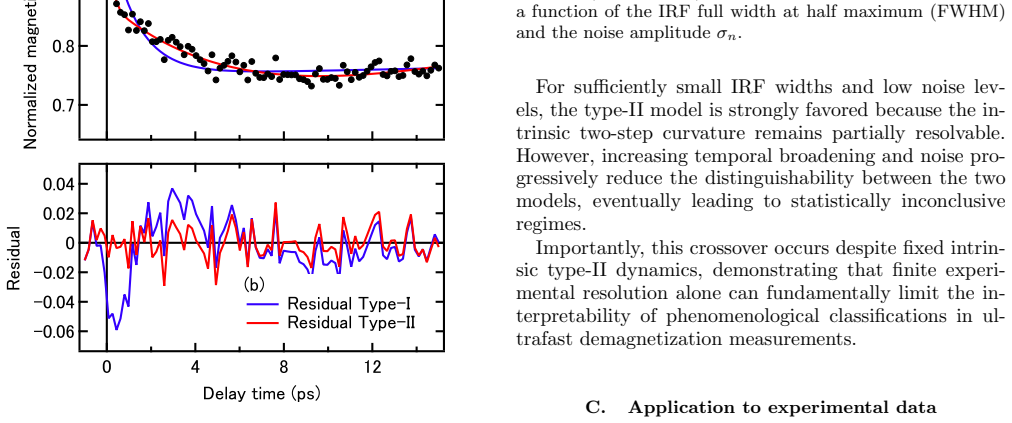
Convolution with the instrumental response function significantly reduces the observable differences between the intrinsic responses, thereby producing broad regimes in which model discrimination becomes statistically inconclusive.
Load-bearing premise
The two chosen phenomenological functional forms for type-I and type-II responses fully capture possible intrinsic dynamics without other mechanisms producing similar blurred signatures.
Editorial extensions
If this is right
- Discrimination fails across wide ranges of temporal resolution and noise typical of current experiments.
- The inconclusive regime grows as resolution worsens or noise increases.
- NiCo2O4 data analyzed in the paper falls inside the inconclusive regime.
- Classification outcomes depend on the chosen resolution, noise level, and statistical criterion.
Reading between the lines
- Reprocessing earlier ultrafast demagnetization datasets with this convolution-plus-BIC approach could alter some type assignments.
- Future experiments seeking clear classification would benefit from quantifying the minimum resolution needed for their specific timescales.
- The method supplies a quantitative test for whether any new phenomenological form can be told apart from the existing two under realistic conditions.
Signed reviews
Editorial analysis
A structured set of objections, weighed in public.
Referee Report
Summary. The manuscript develops a Bayesian model comparison approach based on the Bayesian information criterion (BIC) to assess the distinguishability of type-I and type-II ultrafast demagnetization responses. It employs Gaussian convolution to model finite instrumental temporal resolution and generates synthetic datasets across ranges of resolution and noise levels to map regimes where the two classes become statistically indistinguishable. The framework is then applied to experimental time-resolved magneto-optical Kerr effect data from NiCo2O4 thin films. The central result is that IRF convolution substantially attenuates observable differences between the intrinsic phenomenological forms, producing broad inconclusive regimes.
Significance. If the central claim holds, the work provides a practical, quantitative cautionary framework for interpreting ultrafast demagnetization classifications in the presence of realistic experimental constraints. The systematic use of synthetic data to delineate resolution-noise boundaries is a clear methodological strength, as is the direct application to a representative experimental dataset. The approach could help reconcile apparent discrepancies across the literature that arise from differing instrumental responses rather than intrinsic physics.
major comments (3)
- [Model definitions (likely §2 or §3)] The explicit functional forms and parameter ranges for the intrinsic (pre-convolution) type-I and type-II responses are not stated. Without these equations the claim that convolution produces broad inconclusive regimes cannot be independently verified or generalized beyond the specific phenomenological choices.
- [Synthetic data analysis (likely §4)] No quantitative discrimination thresholds (e.g., minimum ΔBIC, posterior odds, or false-positive rates) are supplied for declaring a regime 'inconclusive.' The synthetic-data results therefore remain qualitative, weakening the assertion of 'broad regimes' in the abstract and conclusion.
- [Experimental application (likely §5)] Error propagation from the fitted parameters through the convolution and BIC calculation is not described. This omission affects the reliability of the model-comparison outcome reported for the NiCo2O4 dataset.
minor comments (2)
- [Figures] Figure captions should explicitly state the IRF width, noise amplitude, and number of synthetic realizations used for each panel to allow direct reproduction of the inconclusive-regime boundaries.
- [Results] The manuscript would benefit from a short table summarizing the BIC differences obtained for the experimental NiCo2O4 traces under the two model classes.
Simulated Author's Rebuttal
We thank the referee for their thorough review and constructive feedback on our manuscript. The comments highlight important aspects of clarity and rigor that we will address in the revision. Below we respond point-by-point to the major comments.
read point-by-point responses
-
Referee: The explicit functional forms and parameter ranges for the intrinsic (pre-convolution) type-I and type-II responses are not stated. Without these equations the claim that convolution produces broad inconclusive regimes cannot be independently verified or generalized beyond the specific phenomenological choices.
Authors: We agree that the explicit functional forms and parameter ranges must be stated explicitly to enable independent verification. In the revised manuscript we will add the full mathematical expressions for the intrinsic (pre-convolution) type-I and type-II phenomenological responses, together with the numerical parameter ranges used throughout the synthetic-data study, in Section 2. revision: yes
-
Referee: No quantitative discrimination thresholds (e.g., minimum ΔBIC, posterior odds, or false-positive rates) are supplied for declaring a regime 'inconclusive.' The synthetic-data results therefore remain qualitative, weakening the assertion of 'broad regimes' in the abstract and conclusion.
Authors: We acknowledge that the current synthetic-data analysis relies on visual inspection of ΔBIC maps without explicit numerical thresholds. In the revision we will introduce quantitative criteria based on standard BIC interpretation guidelines (e.g., ΔBIC > 10 indicating strong evidence against a model) and recompute the resolution-noise boundaries using these thresholds, thereby converting the delineation of inconclusive regimes into a quantitative result. revision: yes
-
Referee: Error propagation from the fitted parameters through the convolution and BIC calculation is not described. This omission affects the reliability of the model-comparison outcome reported for the NiCo2O4 dataset.
Authors: We thank the referee for identifying this omission. The revised manuscript will include an explicit description of the error-propagation procedure, detailing how uncertainties in the fitted parameters are propagated through the Gaussian convolution step and into the BIC values for the experimental NiCo2O4 dataset. revision: yes
Circularity Check
No circularity: models and BIC comparison are externally defined
full rationale
The derivation applies standard Gaussian convolution to externally specified phenomenological forms for type-I and type-II responses, then performs BIC-based model comparison on both synthetic and experimental data. No equation reduces a claimed prediction to a fitted parameter defined from the same data, no uniqueness theorem is imported via self-citation, and the central claim about inconclusive regimes follows directly from the convolution operation applied to the stated functional forms. The analysis is therefore self-contained against external benchmarks.
Assumptions & free parameters
free parameters (1)
- phenomenological model parameters
assumptions (1)
- domain assumption Type-I and type-II responses are adequately described by the chosen phenomenological functional forms.
Cite this review
Pith. "Pith review of Bayesian model comparison of type-I and type-II ultrafast demagnetization dynamics." pith.science (2026). https://pith.science/paper/M7HF4R2N
@misc{pith2026260630334,
  author       = {Pith},
  title        = {Pith review of: Bayesian model comparison of type-I and type-II ultrafast demagnetization dynamics},
  year         = {2026},
  howpublished = {\url{https://pith.science/paper/M7HF4R2N}},
  note         = {Machine review of arXiv:2606.30334}
}
read the original abstract
Ultrafast demagnetization dynamics are often phenomenologically classified into type-I and type-II responses according to their temporal evolution following femtosecond laser excitation. However, finite experimental temporal resolution and noise can substantially obscure the intrinsic dynamics and complicate this classification. In this work, we investigate the distinguishability of type-I and type-II demagnetization dynamics using Gaussian-convolved phenomenological models and Bayesian information criterion-based statistical model comparison. Synthetic datasets with varying temporal resolution and noise levels are first analyzed to evaluate the conditions under which the two classes can be reliably discriminated. We show that convolution with the instrumental response function significantly reduces the observable differences between the intrinsic responses, thereby producing broad regimes in which model discrimination becomes statistically inconclusive. The applicability of the framework is further demonstrated through analysis of representative experimental ultrafast demagnetization data from NiCo2O4 thin films. These results suggest that the apparent classification of ultrafast demagnetization dynamics can be highly sensitive to experimental resolution, noise level, and analysis methodology.
Figures


Figures from the paper (1 more)

Reference graph
Works this paper leans on
-
[1]
Ultrafast Spin Dynamics in Ferromagnetic Nickel,
E. Beaurepaire, J.-C. Merle, A. Daunois, and J.-Y. Bigot, “Ultrafast Spin Dynamics in Ferromagnetic Nickel,” Phys. Rev. Lett.76, 4250 (1996)
1996
-
[2]
Ultrafast op- tical manipulation of magnetic order,
A. Kirilyuk, A. V. Kimel, and T. Rasing, “Ultrafast op- tical manipulation of magnetic order,” Rev. Mod. Phys. 82, 2731 (2010)
2010
-
[3]
Explaining the paradoxical diversity of ultrafast laser- induced demagnetization
B. Koopmans, G. Malinowski, F. D. Longa, D. Steiauf, M. Fahnle, T. Roth, M. Cinchetti, and M. Aeschlimann, “Explaining the paradoxical diversity of ultrafast laser- induced demagnetization”, Nat. Mater.9, 259 (2010)
2010
-
[4]
Comparing Ultra- fast Demagnetization Rates Between Competing Mod- els,
A. J. Schellekens and B. Koopmans, “Comparing Ultra- fast Demagnetization Rates Between Competing Mod- els,” Phys. Rev. Lett.110, 217204 (2013)
2013
-
[5]
Superdif- fusive Spin Transport as a Mechanism of Ultrafast De- magnetization,
M. Battiato, K. Carva, and P. M. Oppeneer, “Superdif- fusive Spin Transport as a Mechanism of Ultrafast De- magnetization,” Phys. Rev. Lett.105, 027203 (2010)
2010
-
[6]
Ultrafast Spin Dynamics in Multisub- lattice Magnets,
J. H. Mentink, J. Hellsvik, D. V. Afanasiev, B. A. Ivanov, A. Kirilyuk, A. V. Kimel, O. Eriksson, M. I. Katsnelson, and Th. Rasing, “Ultrafast Spin Dynamics in Multisub- lattice Magnets,” Phys. Rev. Lett. 108, 057202 (2012)
2012
-
[7]
Estimating the Dimension of a Model,
G. Schwarz, “Estimating the Dimension of a Model,” Ann. Statist.6, 461 (1978)
1978
-
[8]
D. J. C. MacKay, Information Theory, Inference, and Learning Algorithms (Cambridge University Press, Cam- bridge, England, 2003)
2003
Show all 16 references
-
[9]
Ultrafast de- magnetization in NiCo 2O4 thin films probed by time- resolved microscopy,
R. Takahashi, Y. Tani, H. Abe, M. Yamasaki, I. Suzuki, D. Kan, Y. Shimakawa, and H. Wadati, “Ultrafast de- magnetization in NiCo 2O4 thin films probed by time- resolved microscopy,” Appl. Phys. Lett.119, 102404 (2021)
2021
-
[10]
Optically induced magnetization switching in NiCo2O4 thin films using ultrafast lasers
R. Takahashi, T. Ohkochi, D. Kan, Y. Shimakawa, and H. Wadati, “Optically induced magnetization switching in NiCo2O4 thin films using ultrafast lasers”, ACS Appl. Electron. Mater.5, 748 (2023)
2023
-
[11]
All-optical helicity- dependent switching in NiCo2O4 thin films
R. Takahashi, Y. Le Guen, S. Nakata, J. Igarashi, J. Hohlfeld, G. Malinowski, L. Xie, D. Kan, Y. Shi- 8 makawa, S. Mangin, and H. Wadati, “All-optical helicity- dependent switching in NiCo2O4 thin films”, Appl. Phys. Lett.126, 212405 (2025)
2025
-
[12]
Type-II-like ultrafast demagnetization behavior in NiCo2O4 thin films
R. Takahashi, K. Yamada, H. Singh, K. Watanabe, J. Igarashi, J. Hohlfeld, J. Gorchon, G. Malinowski, D. Kan, Y. Shimakawa, T. Ishibashi, S. Mangin, and H. Wa- dati, “Type-II-like ultrafast demagnetization behavior in NiCo2O4 thin films”, arXiv:2604.17916v1
-
[13]
C. M. Bishop, Pattern Recognition and Machine Learn- ing, Springer (2006)
2006
-
[14]
Development of spectral decomposition based on Bayesian information criterion with estimation of confidence interval
H. Shinotsuka, K. Nagata, H. Yoshikawa, Y. Mototake, H. Shouno, and M. Okada, “Development of spectral decomposition based on Bayesian information criterion with estimation of confidence interval”, Sci. Technol. Adv. Mater.21, 402 (2020)
2020
-
[15]
A. R. Liddle, ”Information criteria for astrophysical model selection”, Mon. Not. R. Astron. Soc.377, L74 (2007)
2007
-
[16]
J. K. Webb, C.-C. Lee, R. F. Carswell and D. Milakovi´ c, ”Getting the model right: an information criterion for spectroscopy”, Mon. Not. Roy. Astron. Soc.501, 2268 (2021)
2021
Reviewed June 30, 2026 · model on record in the stance chip above.
Discussion (0). Continue with ORCID to comment.