Lossy Compression for Sparse Aggregation
Pith reviewed 2026-06-30 03:26 UTC · model grok-4.3
The pith
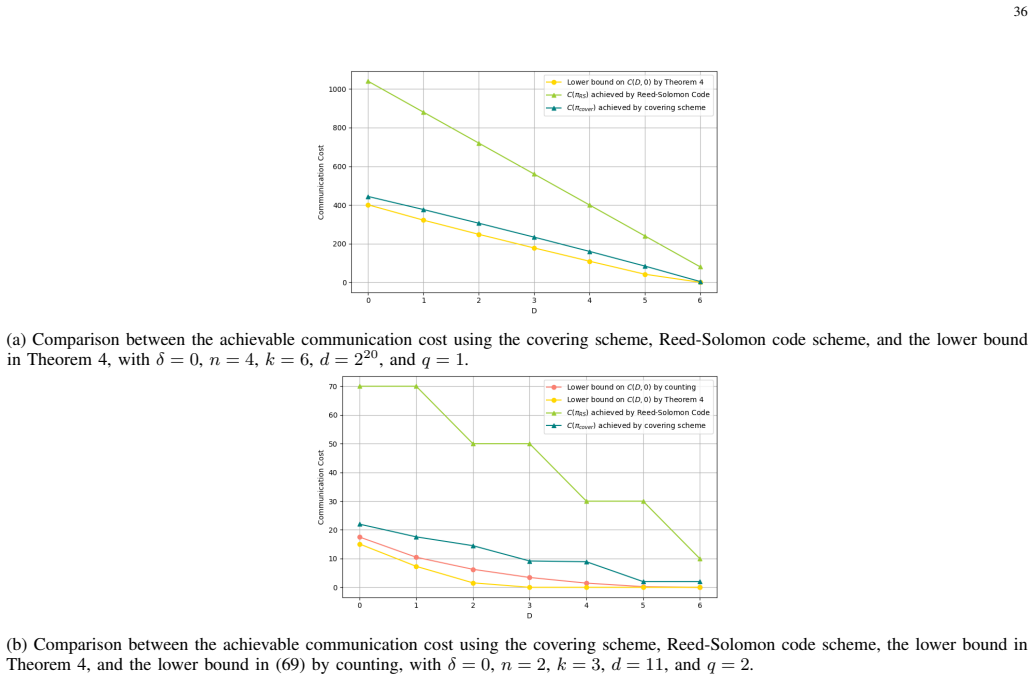
A covering-plus-sketching scheme and an f-divergence converse bound the communication cost for accurate aggregation of k-sparse local models.
A machine-rendered reading of the paper's core claim, the machinery that carries it, and where it could break.
Core claim
For the frequency estimation problem in which each coordinate belongs to a binary alphabet, the f-divergence lower bound is tight and is achieved by the covering-plus-sketching compression scheme.
What carries the argument
Concatenation of a covering code that identifies the k-support locations followed by a sketching matrix that compresses the nonzero values, paired with an f-divergence functional that lower-bounds the mutual information between the sparse vector and its compressed version.
If this is right
- When coordinates are binary the communication cost required for a target aggregation error is exactly characterized.
- The covering-sketching construction gives an explicit achievable rate for any finite alphabet.
- Any future scheme must respect the f-divergence lower bound even when the alphabet is larger than binary.
- The server can form the global model by simple averaging once the compressed vectors arrive.
Where Pith is reading between the lines
- The same f-divergence technique could be applied to other linear aggregation tasks that are not strictly sparse.
- If the support size k is unknown rather than fixed, an outer layer that estimates k would be needed before the covering step.
- Practical federated-learning deployments could measure the gap between the binary-optimal rate and the rate observed on real-valued gradients.
Load-bearing premise
The local models are exactly k-sparse with known support size k and the server performs direct summation of the received compressed vectors.
What would settle it
A direct computation of the minimal communication rate needed to recover the sum to a given accuracy when the alphabet size is three, compared against both the covering-sketching rate and the f-divergence lower bound.
Figures


read the original abstract
We consider the problem of transmitting sparse local updates to the server in a distributed learning system. Specifically, the system consists of $n$ clients, each possessing a $k$-sparse $d$-dimensional local model, and a central server responsible for aggregating the clients' models into a global model. The goal is to characterize the tradeoff between the communication cost in the transmission from the clients to the server and the accuracy in aggregating the global model. We propose a compression scheme for sparse local models by concatenating a covering method and a sketching method. We also present a converse based on f-divergence, which strengthens the conventional Fano-type lower bounds. The proposed lower bound is tight for the frequency estimation case, that is, each coordinate takes values in a binary alphabet. For general alphabets, the proposed achievable schemes remain suboptimal relative to the converse bounds, indicating that a complete characterization of the communication-accuracy tradeoff requires further investigation.
Editorial analysis
A structured set of objections, weighed in public.
Referee Report
Summary. The manuscript studies the communication-accuracy tradeoff when n clients each hold a k-sparse d-dimensional local model and transmit compressed versions to a server that aggregates them by summation or averaging. It proposes an achievable scheme that concatenates a covering code with a sketching method, and derives a converse bound via f-divergence that strengthens standard Fano-type arguments. The converse is shown to be tight for the binary-alphabet frequency-estimation case; the authors explicitly note that the achievable schemes remain suboptimal for general alphabets.
Significance. If the stated tightness result holds, the f-divergence converse supplies a strictly stronger lower bound than conventional Fano arguments for the sparse-aggregation problem and gives a clean characterization on binary alphabets. The explicit acknowledgment that the general-alphabet case remains open is a strength, as it correctly identifies the scope of the contribution.
minor comments (2)
- The abstract states that the converse is tight on binary alphabets but does not indicate whether the tightness proof appears in a dedicated theorem or is obtained as a corollary of the general f-divergence bound; a pointer to the relevant result would help readers locate the argument.
- The description of the server aggregation step (direct summation versus averaging) is mentioned only briefly; clarifying whether the distortion metric is defined on the summed vector or the averaged vector would remove ambiguity in the rate-distortion statements.
Simulated Author's Rebuttal
We thank the referee for the positive evaluation of our manuscript, the recognition of the strengthened converse via f-divergence, and the explicit note on the tightness for binary alphabets. We appreciate the recommendation for minor revision and the acknowledgment that the general-alphabet gap is correctly identified as open.
Circularity Check
No significant circularity
full rationale
The paper derives an achievable scheme by explicit concatenation of a covering method and a sketching method, and a converse via f-divergence that strengthens conventional Fano bounds. Tightness is asserted only for the binary frequency-estimation case as an outcome of the analysis, not by fitting a parameter to the target quantity or by self-definition. No load-bearing self-citations, uniqueness theorems imported from the same authors, or ansatzes smuggled via prior work appear in the abstract or described claims. The explicit acknowledgment of suboptimality for general alphabets further indicates that the central tradeoff characterization retains independent content and is not forced by construction from its inputs.
Axiom & Free-Parameter Ledger
axioms (1)
- domain assumption Local models are exactly k-sparse with coordinates drawn from a finite alphabet whose size is known to the compressor.
Reference graph
Works this paper leans on
-
[1]
Federated learning with local differential privacy: Trade-offs between privacy, utility, and communication,
M. Kim, O. G ¨unl¨u, and R. F. Schaefer, “Federated learning with local differential privacy: Trade-offs between privacy, utility, and communication,” in ICASSP 2021-2021 IEEE International Conference on Acoustics, Speech and Signal Processing (ICASSP). IEEE, 2021, pp. 2650–2654
2021
-
[2]
Advances and open problems in federated learning,
P. Kairouz, H. B. McMahan, B. Avent, A. Bellet, M. Bennis, A. N. Bhagoji, K. Bonawitz, Z. Charles, G. Cormode, R. Cummingset al., “Advances and open problems in federated learning,”Foundations and trends® in machine learning, vol. 14, no. 1–2, pp. 1–210, 2021
2021
-
[3]
Eden: Communication-efficient and robust distributed mean estimation for federated learning,
S. Vargaftik, R. B. Basat, A. Portnoy, G. Mendelson, Y . B. Itzhak, and M. Mitzenmacher, “Eden: Communication-efficient and robust distributed mean estimation for federated learning,” inInternational Conference on Machine Learning. PMLR, 2022, pp. 21 984–22 014
2022
-
[4]
vqsgd: Vector quantized stochastic gradient descent,
V . Gandikota, D. Kane, R. K. Maity, and A. Mazumdar, “vqsgd: Vector quantized stochastic gradient descent,”IEEE Transactions on Information Theory, vol. 68, no. 7, pp. 4573–4587, 2022
2022
-
[5]
Communication-efficient learning of deep networks from decentralized data,
B. McMahan, E. Moore, D. Ramage, S. Hampson, and B. A. y Arcas, “Communication-efficient learning of deep networks from decentralized data,” in Artificial intelligence and statistics. PMLR, 2017, pp. 1273–1282
2017
-
[6]
Diat: A scalable distributed architecture for iot,
C. Sarkar, A. U. N. SN, R. V . Prasad, A. Rahim, R. Neisse, and G. Baldini, “Diat: A scalable distributed architecture for iot,”IEEE Internet of Things journal, vol. 2, no. 3, pp. 230–239, 2014
2014
-
[7]
Scalable distributed DNN training using commodity GPU cloud computing,
N. Strom, “Scalable distributed DNN training using commodity GPU cloud computing,” in16th Annual Conference of the International Speech Communication Association, INTERSPEECH 2015, Dresden, Germany, September 6-10, 2015. ISCA, 2015, pp. 1488–1492
2015
-
[8]
Sparse communication for distributed gradient descent,
A. F. Aji and K. Heafield, “Sparse communication for distributed gradient descent,” inProceedings of the 2017 Conference on Empirical Methods in Natural Language Processing, 2017, pp. 440–445
2017
-
[9]
Sparse binary compression: Towards distributed deep learning with minimal communication,
F. Sattler, S. Wiedemann, K.-R. M ¨uller, and W. Samek, “Sparse binary compression: Towards distributed deep learning with minimal communication,” in2019 International Joint Conference on Neural Networks (IJCNN). IEEE, 2019, pp. 1–8
2019
-
[10]
Communication-efficient federated learning based on compressed sensing,
C. Li, G. Li, and P. K. Varshney, “Communication-efficient federated learning based on compressed sensing,”IEEE Internet of Things Journal, vol. 8, no. 20, pp. 15 531–15 541, 2021
2021
-
[11]
Fetchsgd: Communication-efficient federated learning with sketching,
D. Rothchild, A. Panda, E. Ullah, N. Ivkin, I. Stoica, V . Braverman, J. Gonzalez, and R. Arora, “Fetchsgd: Communication-efficient federated learning with sketching,” inInternational Conference on Machine Learning. PMLR, 2020, pp. 8253–8265
2020
-
[12]
Variance-based Gradient Compression for Efficient Distributed Deep Learning
Y . Tsuzuku, H. Imachi, and T. Akiba, “Variance-based gradient compression for efficient distributed deep learning,”arXiv preprint arXiv:1802.06058, 2018
work page internal anchor Pith review Pith/arXiv arXiv 2018
-
[13]
Federated learning over wireless fading channels,
M. M. Amiri and D. G ¨und¨uz, “Federated learning over wireless fading channels,”IEEE Transactions on Wireless Communications, vol. 19, no. 5, pp. 3546–3557, 2020
2020
-
[14]
Secure federated submodel learning,
C. Niu, F. Wu, S. Tang, L. Hua, R. Jia, C. Lv, Z. Wu, and G. Chen, “Secure federated submodel learning,”arXiv preprint arXiv:1911.02254, 2019
-
[15]
Deepreduce: A sparse-tensor communication framework for federated deep learning,
H. Xu, K. Kostopoulou, A. Dutta, X. Li, A. Ntoulas, and P. Kalnis, “Deepreduce: A sparse-tensor communication framework for federated deep learning,” Advances in Neural Information Processing Systems, vol. 34, pp. 21 150–21 163, 2021
2021
-
[16]
Communication complexity in locally private distribution estimation and heavy hitters,
J. Acharya and Z. Sun, “Communication complexity in locally private distribution estimation and heavy hitters,” inInternational Conference on Machine Learning. PMLR, 2019, pp. 51–60
2019
-
[17]
Locally differentially private sparse vector aggregation,
M. Zhou, T. Wang, T. H. Chan, G. Fanti, and E. Shi, “Locally differentially private sparse vector aggregation,” in2022 IEEE Symposium on Security and Privacy (SP). IEEE, 2022, pp. 422–439
2022
-
[18]
The communication cost of security and privacy in federated frequency estimation,
W.-N. Chen, A. Ozgur, G. Cormode, and A. Bharadwaj, “The communication cost of security and privacy in federated frequency estimation,” in International Conference on Artificial Intelligence and Statistics. PMLR, 2023, pp. 4247–4274
2023
-
[19]
Noiseless coding of correlated information sources,
D. Slepian and J. Wolf, “Noiseless coding of correlated information sources,”IEEE Transactions on information Theory, vol. 19, no. 4, pp. 471–480, 1973
1973
-
[20]
Information-theoretic lower bounds for distributed statistical estimation with communication constraints,
Y . Zhang, J. Duchi, M. I. Jordan, and M. J. Wainwright, “Information-theoretic lower bounds for distributed statistical estimation with communication constraints,”Advances in Neural Information Processing Systems, vol. 26, 2013
2013
-
[21]
Mean estimation from one-bit measurements,
A. Kipnis and J. C. Duchi, “Mean estimation from one-bit measurements,”IEEE Transactions on Information Theory, vol. 68, no. 9, pp. 6276–6296, 2022
2022
-
[22]
Distributed statistical estimation of high-dimensional and nonparametric distributions with communication constraints, february 2018,
Y . Han, P. Mukherjee, A. ¨Ozg¨ur, and T. Weissman, “Distributed statistical estimation of high-dimensional and nonparametric distributions with communication constraints, february 2018,”Talk given at ITA, vol. 1, no. 1, p. 5, 2018
2018
-
[23]
Inference under information constraints ii: Communication constraints and shared randomness,
J. Acharya, C. L. Canonne, and H. Tyagi, “Inference under information constraints ii: Communication constraints and shared randomness,”IEEE Transactions on Information Theory, vol. 66, no. 12, pp. 7856–7877, 2020
2020
-
[24]
Collaborative learning of discrete distributions under heterogeneity and communication constraints,
X. Huang, D. Lee, E. Dobriban, and H. Hassani, “Collaborative learning of discrete distributions under heterogeneity and communication constraints,” Advances in neural information processing systems, vol. 35, pp. 31 915–31 928, 2022. 40
2022
-
[25]
Optimal private discrete distribution estimation with one-bit communication,
S.-H. Nam, V . Y . Tan, and S.-H. Lee, “Optimal private discrete distribution estimation with one-bit communication,”arXiv preprint arXiv:2310.11005, 2023
-
[26]
Breaking the communication-privacy-accuracy trilemma,
W.-N. Chen, P. Kairouz, and A. ¨Ozg¨ur, “Breaking the communication-privacy-accuracy trilemma,”IEEE Transactions on Information Theory, vol. 69, no. 2, pp. 1261–1281, 2022
2022
-
[27]
Exact optimality of communication-privacy-utility tradeoffs in distributed mean estimation,
B. Isik, W.-N. Chen, A. Ozgur, T. Weissman, and A. No, “Exact optimality of communication-privacy-utility tradeoffs in distributed mean estimation,” Advances in Neural Information Processing Systems, vol. 36, 2024
2024
-
[28]
Distributed mean estimation with limited communication,
A. T. Suresh, X. Y . Felix, S. Kumar, and H. B. McMahan, “Distributed mean estimation with limited communication,” inInternational conference on machine learning. PMLR, 2017, pp. 3329–3337
2017
-
[29]
Fedpaq: A communication-efficient federated learning method with periodic averaging and quantization,
A. Reisizadeh, A. Mokhtari, H. Hassani, A. Jadbabaie, and R. Pedarsani, “Fedpaq: A communication-efficient federated learning method with periodic averaging and quantization,” inInternational conference on artificial intelligence and statistics. PMLR, 2020, pp. 2021–2031
2020
-
[30]
Federated learning with compression: Unified analysis and sharp guarantees,
F. Haddadpour, M. M. Kamani, A. Mokhtari, and M. Mahdavi, “Federated learning with compression: Unified analysis and sharp guarantees,” in International Conference on Artificial Intelligence and Statistics. PMLR, 2021, pp. 2350–2358
2021
-
[31]
Correlated quantization for distributed mean estimation and optimization,
A. T. Suresh, Z. Sun, J. Ro, and F. Yu, “Correlated quantization for distributed mean estimation and optimization,” inInternational Conference on Machine Learning. PMLR, 2022, pp. 20 856–20 876
2022
-
[32]
Finding frequent items in data streams,
M. Charikar, K. Chen, and M. Farach-Colton, “Finding frequent items in data streams,” inInternational Colloquium on Automata, Languages, and Programming. Springer, 2002, pp. 693–703
2002
-
[33]
An improved data stream summary: the count-min sketch and its applications,
G. Cormode and S. Muthukrishnan, “An improved data stream summary: the count-min sketch and its applications,”Journal of Algorithms, vol. 55, no. 1, pp. 58–75, 2005
2005
-
[34]
Enhancing the privacy of federated learning with sketching,
Z. Liu, T. Li, V . Smith, and V . Sekar, “Enhancing the privacy of federated learning with sketching,”arXiv preprint arXiv:1911.01812, 2019
-
[35]
On finite alphabet compressive sensing,
A. K. Das and S. Vishwanath, “On finite alphabet compressive sensing,” in2013 IEEE International Conference on Acoustics, Speech and Signal Processing. IEEE, 2013, pp. 5890–5894
2013
-
[36]
Machine unlearning of federated clusters,
C. Pan, J. Sima, S. Prakash, V . Rana, and O. Milenkovic, “Machine unlearning of federated clusters,” inThe Eleventh International Conference on Learning Representations, 2022
2022
-
[37]
Model compression by count-sketch for over-the-air stateless federated learning,
J.-H. Ahn, G.-Y . Kim, D. H. Kim, and C. You, “Model compression by count-sketch for over-the-air stateless federated learning,”IEEE Internet of Things Journal, 2024
2024
-
[38]
Private multi-group aggregation,
C. Naim, R. G. D’Oliveira, and S. El Rouayheb, “Private multi-group aggregation,”IEEE Journal on Selected Areas in Communications, vol. 40, no. 3, pp. 800–814, 2022
2022
-
[39]
A general class of coefficients of divergence of one distribution from another,
S. M. Ali and S. D. Silvey, “A general class of coefficients of divergence of one distribution from another,”Journal of the Royal Statistical Society: Series B (Methodological), vol. 28, no. 1, pp. 131–142, 1966
1966
-
[40]
On information-type measure of difference of probability distributions and indirect observations,
I. Csisz ´ar, “On information-type measure of difference of probability distributions and indirect observations,”Studia Sci. Math. Hungar., vol. 2, pp. 299–318, 1967
1967
-
[41]
f-divergences and their applications in lossy compression and bounding generalization error,
S. Masiha, A. Gohari, and M. H. Yassaee, “f-divergences and their applications in lossy compression and bounding generalization error,”IEEE Transactions on Information Theory, vol. 69, no. 12, pp. 7538–7564, 2023
2023
-
[42]
arXiv preprint arXiv:1901.00555 , year=
J. Scarlett and V . Cevher, “An introductory guide to fano’s inequality with applications in statistical estimation,”arXiv preprint arXiv:1901.00555, 2019
-
[43]
R ´enyi divergence and kullback-leibler divergence,
T. Van Erven and P. Harremos, “R ´enyi divergence and kullback-leibler divergence,”IEEE Transactions on Information Theory, vol. 60, no. 7, pp. 3797–3820, 2014
2014
-
[44]
J. H. van Lint and R. M. Wilson,A Course in Combinatorics, 2nd ed. Cambridge University Press, 2001
2001
discussion (0)
Sign in with ORCID, Apple, or X to comment. Anyone can read and Pith papers without signing in.