REVIEW 2 major objections 2 minor 59 references
A Lightweight Post-Quantum Authentication Framework for 5G Base Station Bootstrapping
T0 review · 2 major / 2 minor · reviewed 2026-06-30 · grok-4.3
Pith's one-line read EMULSION secures 5G base station broadcasts with post-quantum security inside a single packet by anchoring a TESLA-style HMAC chain with one MAYO signature per epoch.
desk verdict EMULSION anchors a TESLA HMAC chain with one MAYO signature per epoch to fit PQ auth into single 5G SIB packets, with solid testbed gains, but the timing security assumptions need verification. read the letter →
The pith
A machine-rendered reading of the paper's core claim, the machinery that carries it, and where it could break.
The reading
What carries the argument
The TESLA-style HMAC chain anchored by one MAYO post-quantum signature per epoch, which enables public verification of broadcast messages using 5G time synchronization without transmitting certificates or fragmenting packets.
What would settle it
An experiment showing that an attacker can forge a valid SIB broadcast by exploiting small timing discrepancies in the 5G synchronization to break the HMAC chain verification before the next MAYO-anchored epoch.
Extended reading notes
Core claim
EMULSION is the first framework to exploit native 5G architectural features to achieve genuine PQ security at symmetric-key efficiency. It uses a TESLA-style HMAC chain anchored by a compact PQ signature (MAYO) applied once per epoch, fitting authentication within a single packet with no fragmentation and eliminating certificate transmission entirely while protecting the full SIB family.
Load-bearing premise
That the fixed SIB transmission windows and millisecond-level time synchronization in 5G can be used directly to anchor the TESLA chain without introducing new timing or synchronization attacks.
Editorial extensions
If this is right
- The full SIB1-SIB21 family receives protection instead of only selected messages.
- End-to-end delay drops by a factor of 33 compared with direct ML-DSA integration.
- Communication overhead falls by a factor of 31 versus ML-DSA and 5.4 versus FN-DSA.
- No certificate transmission or packet fragmentation is required.
- Security is formally proven for the hybrid symmetric-PQ construction.
Reading between the lines
- The single-packet design could extend to other broadcast authentication settings that share precise time synchronization and fixed transmission schedules.
- Open-sourcing the implementation allows independent verification of the timing assumptions on additional 5G hardware and software stacks.
- The approach may lower the barrier for deploying quantum-resistant protections in existing cellular networks without hardware changes to UEs or base stations.
Editorial analysis
A structured set of objections, weighed in public.
Referee Report
Summary. The paper proposes EMULSION, a TESLA-style HMAC-chain authentication framework for 5G base-station SIB broadcasts. It anchors the chain with a single compact MAYO post-quantum signature per epoch, exploits fixed SIB transmission windows and millisecond-level UE-BS time synchronization together with eSIM/USIM credentials, fits the entire authenticator inside one unfragmented packet, eliminates certificate transmission, protects the full SIB1–SIB21 family, supplies a formal security proof, reports 33× lower end-to-end delay and 31× lower communication overhead than ML-DSA (and 12×/5.4× versus FN-DSA) on a real over-the-air 5G testbed, and releases open-source code.
Significance. If the security argument is sound, the work would be significant: it is the first scheme to obtain genuine post-quantum security for 5G broadcast authentication at essentially symmetric-key cost by directly using native 5G architectural primitives rather than bolting on heavy PQC primitives. The real testbed measurements, the claim of protecting every SIB, the open-source release, and the formal proof are concrete strengths that raise the bar for future 5G/6G security proposals.
major comments (2)
- [§4] §4 (Security Model and Proof): The formal security reduction for the TESLA-style chain assumes that the receiver’s view of the disclosure schedule is strictly determined by the fixed SIB transmission windows and the claimed millisecond-level time synchronization. The model does not include an adversary that can influence base-station clock skew, spoof SIB scheduling, or manipulate the UE’s perception of transmission windows. Because TESLA security rests on the receiver being certain that a disclosed key was unknown at MAC verification time, the absence of this modeling directly undermines the “genuine PQ security at symmetric-key efficiency” claim.
- [§5.2] §5.2 (Testbed Evaluation): The reported 33× delay and 31× overhead gains versus ML-DSA are measured under benign channel conditions. No experiments or analysis are provided that inject controlled timing perturbations or SIB-window manipulation to test whether the single-packet fitting and security still hold when the anchoring assumptions are stressed.
minor comments (2)
- [Abstract] The abstract states that EMULSION “protects the full SIB family (SIB1-SIB21)”; the manuscript should explicitly list which SIB types are authenticated in each epoch and confirm that the single-packet format accommodates the largest SIB payload.
- [§3] Notation for the HMAC-chain indices and epoch boundaries should be introduced once in §3 and used consistently; several later equations reuse the same symbols with slightly different meanings.
Simulated Author's Rebuttal
We thank the referee for the thorough review and constructive comments on our manuscript. We address each of the major comments below and indicate the revisions we will make to strengthen the paper.
read point-by-point responses
-
Referee: [§4] §4 (Security Model and Proof): The formal security reduction for the TESLA-style chain assumes that the receiver’s view of the disclosure schedule is strictly determined by the fixed SIB transmission windows and the claimed millisecond-level time synchronization. The model does not include an adversary that can influence base-station clock skew, spoof SIB scheduling, or manipulate the UE’s perception of transmission windows. Because TESLA security rests on the receiver being certain that a disclosed key was unknown at MAC verification time, the absence of this modeling directly undermines the “genuine PQ security at symmetric-key efficiency” claim.
Authors: Our security model is constructed around the native 5G architectural primitives, including the fixed SIB transmission windows and millisecond-level time synchronization enforced by the network and eSIM/USIM credentials. These are treated as trusted components of the 5G system, consistent with how TESLA is typically applied in synchronized broadcast settings. We agree, however, that the proof would benefit from an explicit treatment of adversaries attempting to influence these elements. In the revised manuscript, we will expand §4 to include a discussion of such attacks, explaining that they would require compromising the 5G core network security, which is outside the scope of the broadcast authentication threat model considered. This will reinforce rather than undermine the claim of achieving genuine post-quantum security at symmetric-key efficiency. revision: yes
-
Referee: [§5.2] §5.2 (Testbed Evaluation): The reported 33× delay and 31× overhead gains versus ML-DSA are measured under benign channel conditions. No experiments or analysis are provided that inject controlled timing perturbations or SIB-window manipulation to test whether the single-packet fitting and security still hold when the anchoring assumptions are stressed.
Authors: The performance measurements were obtained from a real over-the-air 5G testbed to reflect practical deployment conditions. We recognize the importance of evaluating resilience under stressed conditions. In the revised version, we will add analysis in §5.2, including a theoretical examination of how timing perturbations affect the scheme and additional testbed experiments or simulations that introduce controlled clock skew and scheduling manipulations to verify that the single-packet authenticator and security properties remain intact. revision: yes
Circularity Check
No circularity: framework applies established primitives to 5G constraints without self-referential reductions
full rationale
The provided abstract and description contain no equations, parameter fits, or derivation steps that reduce the claimed security or efficiency to inputs by construction. EMULSION is presented as combining a TESLA-style HMAC chain with a single MAYO signature per epoch, leveraging documented 5G features (fixed SIB windows, ms-level sync, eSIM/USIM). Security is stated to be formally proven, and performance numbers come from over-the-air testbed evaluation rather than any fitted or renamed quantity. No self-citations are invoked as load-bearing uniqueness theorems, and no ansatz or renaming of known results appears. The derivation chain is therefore self-contained against external benchmarks.
Assumptions & free parameters
assumptions (2)
- standard math Security of the HMAC primitive and the MAYO post-quantum signature scheme
- domain assumption 5G networks provide reliable millisecond-level time synchronization and fixed SIB transmission windows usable for key disclosure timing
Cite this review
Pith. "Pith review of A Lightweight Post-Quantum Authentication Framework for 5G Base Station Bootstrapping." pith.science (2026). https://pith.science/paper/ZRRXECZS
@misc{pith2026260630542,
  author       = {Pith},
  title        = {Pith review of: A Lightweight Post-Quantum Authentication Framework for 5G Base Station Bootstrapping},
  year         = {2026},
  howpublished = {\url{https://pith.science/paper/ZRRXECZS}},
  note         = {Machine review of arXiv:2606.30542}
}
abstract
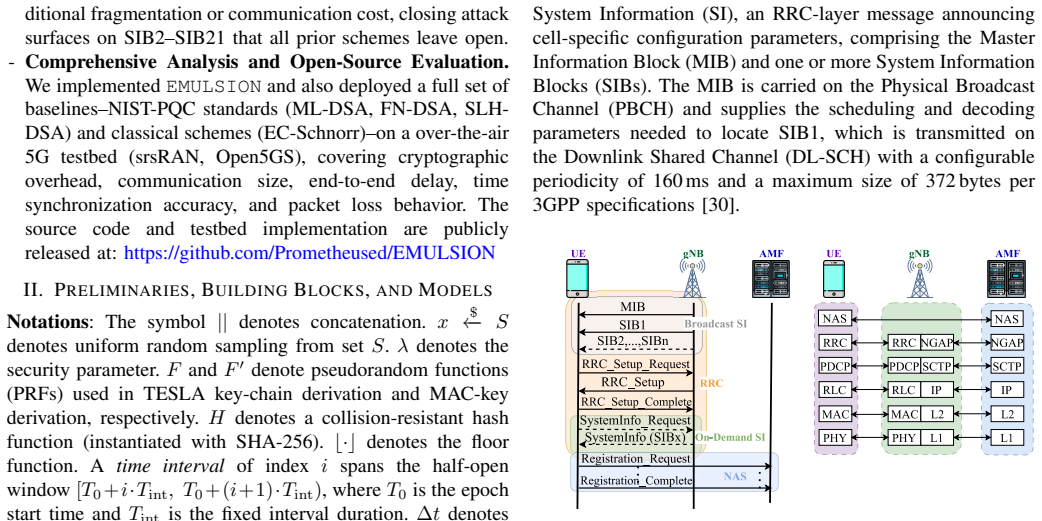
The absence of authenticated bootstrapping between User Equipments (UEs) and Base Stations (BSs) in 5G leaves System Information Block (SIB) broadcasts unprotected, enabling fake BS attacks, man-in-the-middle interception, and spoofed emergency alerts. Prior efforts such as Public Key Infrastructure (PKI)-based certificate chains, token-based schemes, and identity-based signatures either impose overhead exceeding 5G's strict packet-size constraints or lack post-quantum (PQ) security. Direct NIST-PQC integration is infeasible: ML-DSA requires 34 fragmented SIB1 packets and up to 5,282,ms end-to-end delay, and FN-DSA still requires 13 fragments and up to 1,920,ms. We propose $\emulsion$, a symmetric chained publicly verifiable authentication framework for 5G/6G BS broadcast authentication. EMULSION is the first framework to exploit native 5G architectural features: fixed SIB transmission windows, millisecond-level time synchronization, and eSIM/USIM credential management to achieve genuine PQ security at symmetric-key efficiency. It uses a TESLA-style HMAC chain anchored by a compact PQ signature (MAYO) applied once per epoch, fitting authentication within a single packet with no fragmentation and eliminating certificate transmission entirely. Unlike all prior schemes, EMULSION protects the full SIB family (SIB1-SIB21). Evaluated on a real over-the-air 5G testbed, EMULSION achieves 33x lower end-to-end delay and 31x less communication overhead than ML-DSA, and 12x lower delay and 5.4x less overhead than FN-DSA. We formally prove the security of EMULSION and open-source its implementation for public testing and adaptation.
Figures


Figures from the paper (3 more)


Reference graph
Works this paper leans on
-
[1]
Insecure connection bootstrapping in cellular networks: the root of all evil,
S. R. Hussain, M. Echeverria, A. Singla, O. Chowdhury, and E. Bertino, “Insecure connection bootstrapping in cellular networks: the root of all evil,” inProceedings of the 12th conference on security and privacy in wireless and mobile networks, 2019, pp. 1–11
2019
-
[2]
A survey on security aspects for 3gpp 5g networks,
J. Cao, M. Ma, H. Li, R. Ma, Y . Sun, P. Yu, and L. Xiong, “A survey on security aspects for 3gpp 5g networks,”IEEE communications surveys & tutorials, vol. 22, no. 1, pp. 170–195, 2019
2019
-
[3]
Imsi- catch me if you can: Imsi-catcher-catchers,
A. Dabrowski, N. Pianta, T. Klepp, M. Mulazzani, and E. Weippl, “Imsi- catch me if you can: Imsi-catcher-catchers,” inProceedings of the 30th annual computer security applications Conference, 2014, pp. 246–255
2014
-
[4]
NR; Radio Resource Control (RRC) Protocol Specification,
3GPP, “NR; Radio Resource Control (RRC) Protocol Specification,” 3rd Generation Partnership Project, Tech. Rep. TS 38.331 V18.1.0,
-
[5]
Available: https://www.etsi.org/deliver/etsi ts/138300 138399/138331/18.01.00 60/ts 138331v180100p.pdf
[Online]. Available: https://www.etsi.org/deliver/etsi ts/138300 138399/138331/18.01.00 60/ts 138331v180100p.pdf
-
[6]
Touching the untouchables: Dynamic security analysis of the lte control plane,
H. Kim, J. Lee, E. Lee, and Y . Kim, “Touching the untouchables: Dynamic security analysis of the lte control plane,” in2019 IEEE Symposium on Security and Privacy (SP). IEEE, 2019, pp. 1153–1168
2019
-
[7]
Gotta detect ’em all: Fake base station and multi-step attack detection in cellular networks,
K. S. Mubasshir, I. Karim, and E. Bertino, “Gotta detect ’em all: Fake base station and multi-step attack detection in cellular networks,” 2025
2025
-
[8]
{DoLTEst}: In-depth downlink negative testing framework for{LTE}devices,
C. Park, S. Bae, B. Oh, J. Lee, E. Lee, I. Yun, and Y . Kim, “{DoLTEst}: In-depth downlink negative testing framework for{LTE}devices,” in 31st USENIX Security Symposium (USENIX Security 22), 2022, pp. 1325–1342
2022
Show all 59 references
-
[9]
Fixing insecure cellular system information broadcasts for good,
A. J. Ross, B. Reaves, Y . Nasser, G. Cukierman, and R. P. Jover, “Fixing insecure cellular system information broadcasts for good,” inProceedings of the 27th International Symposium on Research in Attacks, Intrusions and Defenses, 2024, pp. 693–708
2024
-
[10]
Base station certificate and multi-factor authentication for cellular radio control communication security,
S. Wuthier, J. Kim, I. Kim, and S.-Y . Chang, “Base station certificate and multi-factor authentication for cellular radio control communication security,”arXiv preprint arXiv:2504.02133, 2025
2025
-
[11]
Study on 5G Security Enhancements against False Base Stations (FBS): Certificate Based Solution for Protecting System Information Messages with Digital Signature in an NPN,
3GPP, “Study on 5G Security Enhancements against False Base Stations (FBS): Certificate Based Solution for Protecting System Information Messages with Digital Signature in an NPN,” 3rd Generation Partnership Project, Tech. Rep. TR 33.809, S3-202717,
-
[12]
Available: https://www.3gpp.org/ftp/TSG SA/WG3 Security/TSGS3 100Bis-e/Docs/S3-202717.zip
[Online]. Available: https://www.3gpp.org/ftp/TSG SA/WG3 Security/TSGS3 100Bis-e/Docs/S3-202717.zip
-
[13]
Baron: Base-station authentication through core network for mobility management in 5g networks,
A. Lotto, V . Singh, B. Ramasubramanian, A. Brighente, M. Conti, and R. Poovendran, “Baron: Base-station authentication through core network for mobility management in 5g networks,” inProceedings of the 16th ACM Conference on Security and Privacy in Wireless and Mobile Network...
2023
-
[14]
Look before you leap: Secure connection bootstrapping for 5g networks to defend against fake base-stations,
A. Singla, R. Behnia, S. R. Hussain, A. Yavuz, and E. Bertino, “Look before you leap: Secure connection bootstrapping for 5g networks to defend against fake base-stations,” inProceedings of the 2021 ACM Asia Conference on Computer and Communications Security, 2021, pp. 501–515
2021
-
[15]
Protecting unauthenticated messages in lte/5g mobile networks: A two-level hierarchical identity- based signature (hibs) solution,
C. Yu, S. Chen, Q. Xing, and Z. Wei, “Protecting unauthenticated messages in lte/5g mobile networks: A two-level hierarchical identity- based signature (hibs) solution,”Computer Networks, vol. 254, p. 110814, 2024
2024
-
[16]
Securing 5g bootstrapping: A two-layer ibs authentication protocol,
Y . Dong, R. Behnia, A. A. Yavuz, and S. R. Hussain, “Securing 5g bootstrapping: A two-layer ibs authentication protocol,”arXiv preprint arXiv:2502.04915, 2025
2025
-
[17]
5g-hcls: An authentication protocol to protect bootstrapping messages in 5g network,
Z. Sun and C. Peng, “5g-hcls: An authentication protocol to protect bootstrapping messages in 5g network,” in2025 IEEE Wireless Com- munications and Networking Conference (WCNC). IEEE, 2025, pp. 1–6
2025
-
[18]
The impact of quantum computing on real-world security: A 5g case study,
C. J. Mitchell, “The impact of quantum computing on real-world security: A 5g case study,”Computers & Security, vol. 93, p. 101825, 2020
2020
-
[19]
Future-proofing authentication against insecure bootstrap- ping for 5g networks: Feasibility, resiliency, and accountability,
S. Darzi, M. M. Rahman, I. Karim, R. Behnia, A. A. Yavuz, and E. Bertino, “Future-proofing authentication against insecure bootstrap- ping for 5g networks: Feasibility, resiliency, and accountability,”arXiv preprint arXiv:2510.23457, 2025
2025 arXiv
-
[20]
Post-Quantum Cryptography Standards: FIPS 203 (ML-KEM), FIPS 204 (ML-DSA), FIPS 205 (SLH-DSA),
NIST, “Post-Quantum Cryptography Standards: FIPS 203 (ML-KEM), FIPS 204 (ML-DSA), FIPS 205 (SLH-DSA),” National Institute of Stan- dards and Technology, Tech. Rep. FIPS 203/204/205, 2024. [Online]. Available: https://csrc.nist.gov/projects/post-quantum-cryptography
2024
-
[21]
Cyber Security (CYBER); Quantum-Safe Cryptography (QSC); Efficient Quantum-Safe Hybrid Key Exchanges with Hidden Access Policies,
ETSI, “Cyber Security (CYBER); Quantum-Safe Cryptography (QSC); Efficient Quantum-Safe Hybrid Key Exchanges with Hidden Access Policies,” European Telecommunications Standards Institute, Tech. Rep. TS 104 015 V1.1.1, 2024. [Online]. Available: https://www.etsi.org/deliver/etsi...
2024
-
[22]
Quantum-Readiness: Migration to Post-Quantum Cryptography,
NSA, CISA, and NIST, “Quantum-Readiness: Migration to Post-Quantum Cryptography,” Cybersecurity and In- frastructure Security Agency, Tech. Rep., 2025. [On- line]. Available: https://www.cisa.gov/resources-tools/resources/ quantum-readiness-migration-post-quantum-cryptography
2025
-
[23]
Framework and Overall Objectives of the Future Development of IMT for 2030 and Beyond,
ITU-R, “Framework and Overall Objectives of the Future Development of IMT for 2030 and Beyond,” International Telecommunication Union, Tech. Rep. Recommendation ITU-R M.2160-0, 2023. [Online]. Available: https://www.itu.int/rec/R-REC-M.2160/en
-
[24]
Embedded SIM Remote Provisioning Architecture,
GSMA, “Embedded SIM Remote Provisioning Architecture,” GSM Association, Tech. Rep. SGP.02 V4.2, 2020. [Online]. Available: https://www.gsma.com/solutions-and-impact/technologies/ esim/wp-content/uploads/2020/07/SGP.02-v4.2.pdf
2020
-
[25]
RSP Technical Specification,
——, “RSP Technical Specification,” GSM Associa- tion, Tech. Rep. SGP.22 V3.1, 2023. [Online]. Avail- able: https://www.gsma.com/solutions-and-impact/technologies/esim/ wp-content/uploads/2023/05/SGP.22-v3.1.pdf
2023
-
[26]
Efficient authentication and signing of multicast streams over lossy channels,
A. Perrig, R. Canetti, J. D. Tygar, and D. Song, “Efficient authentication and signing of multicast streams over lossy channels,” inProceeding 2000 IEEE symposium on security and privacy. S&P 2000. IEEE, 2000, pp. 56–73
2000
-
[27]
Mayo: Practical post-quantum signatures from oiland- vinegar maps,
W. Beullens, “Mayo: Practical post-quantum signatures from oiland- vinegar maps,” inInternational Conference on Selected Areas in Cryp- tography, pp. 355–376
-
[28]
Efficient signature generation by smart cards,
C.-P. Schnorr, “Efficient signature generation by smart cards,”Journal of cryptology, vol. 4, pp. 161–174, 1991
1991
-
[29]
Falcon: Fast-fourier lattice-based compact signatures over ntru,
P.-A. Fouque, J. Hoffstein, P. Kirchner, V . Lyubashevsky, T. Pornin, T. Prest, T. Ricosset, G. Seiler, W. Whyte, Z. Zhanget al., “Falcon: Fast-fourier lattice-based compact signatures over ntru,”Submission to the NIST’s post-quantum cryptography standardization process, vol. ...
2018
-
[30]
Module-lattice-based digital signature standard,
T. Dang, J. Lichtinger, Y .-K. Liu, C. Miller, D. Moody, R. Peralta, R. Perlner, A. Robinsonet al., “Module-lattice-based digital signature standard,”National Institute of Standards and Technology (NIST), Thinh Dang, Jacob, 2024
2024
-
[31]
Comprehensive survey on self-organizing cellular network approaches applied to 5g networks,
H. Fourati, R. Maaloul, L. Chaari, and M. Jmaiel, “Comprehensive survey on self-organizing cellular network approaches applied to 5g networks,”Computer Networks, vol. 199, p. 108435, 2021. [30]3GPP RRC Specification, 2024, https://www.etsi.org/deliver/etsi ts/ 138300 138399/13...
2021
-
[32]
Keying hash functions for message authentication,
M. Bellare, R. Canetti, and H. Krawczyk, “Keying hash functions for message authentication,” inAnnual international cryptology conference. Springer, 1996, pp. 1–15. [32]3GPP Specification on Security architecture and procedures for 5G Sys- tem, 2024, https://www.etsi.org/deliv...
1996
-
[33]
Algorithms for quantum computation: discrete logarithms and factoring,
P. W. Shor, “Algorithms for quantum computation: discrete logarithms and factoring,” in35th annual symp. on found. of CS. Ieee, 1994
1994
-
[34]
Stateless hash-based digital signature standard,
D. Cooperet al., “Stateless hash-based digital signature standard,” 2024
2024
-
[35]
D. Soni, K. Basu, M. Nabeel, N. Aaraj, M. Manzano, and R. Karri, “Falcon,”Hardware Architectures for Post-Quantum Digital Signature Schemes, pp. 31–41, 2021
2021
-
[36]
Additional Digital Signature Schemes – Round 2 Submissions,
NIST, “Additional Digital Signature Schemes – Round 2 Submissions,” National Institute of Standards and Technology, Post-Quantum Cryptography Standardization, 2024. [Online]. Available: https://csrc. nist.gov/Projects/pqc-dig-sig/round-2-additional-signatures
2024
-
[37]
Gotta detect’em all: Fake base station and multi-step attack detection in cellular networks,
K. S. Mubasshir, I. Karim, and E. Bertino, “Gotta detect’em all: Fake base station and multi-step attack detection in cellular networks,” in Proceedings of the 34th USENIX Security Symposium, 2025
2025
-
[38]
Breaking lte on layer two,
D. Rupprecht, K. Kohls, T. Holz, and C. P ¨opper, “Breaking lte on layer two,” in2019 IEEE Symposium on Security and Privacy (SP). IEEE, 2019, pp. 1121–1136
2019
-
[39]
Envisioning the future of cyber security in post-quantum era: A survey on pq standardization, applications, challenges and opportunities,
S. Darzi, K. Ahmadi, S. Aghapour, A. A. Yavuz, and M. M. Kermani, “Envisioning the future of cyber security in post-quantum era: A survey on pq standardization, applications, challenges and opportunities,”arXiv preprint arXiv:2310.12037, 2023
2023
-
[40]
Enhancing the 5g-aka protocol with post-quantum digital signature method,
G. Rossi Figlarz and F. Passuelo Hessel, “Enhancing the 5g-aka protocol with post-quantum digital signature method,” inInternational Confer- ence on Advanced Information Networking and Applications. Springer, 2024, pp. 99–110
2024
-
[41]
A beyond-5g authentication and key agreement protocol,
M. T. Damir, T. Meskanen, S. Ramezanian, and V . Niemi, “A beyond-5g authentication and key agreement protocol,” inInternational Conference on Network and System Security. Springer, 2022, pp. 249–264
2022
-
[42]
A practical transition to post-quantum security in 5g-aka,
A. Braeken, A. K. Yadav, and J. Munilla, “A practical transition to post-quantum security in 5g-aka,”IEEE Transactions on Information Forensics and Security, vol. 20, pp. 13 071–13 084, 2025
2025
-
[43]
On post-quantum identification in 5g,
M. T. Damir and V . Niemi, “On post-quantum identification in 5g,” in Proceedings of the 15th ACM Conference on Security and Privacy in Wireless and Mobile Networks, ser. WiSec ’22. New York, NY , USA: Association for Computing Machinery, 2022, p. 292–294. [Online]. Available:...
2022 doi
-
[44]
NR; Base Station (BS) Radio Transmission and Reception,
3GPP, “NR; Base Station (BS) Radio Transmission and Reception,” 3rd Generation Partnership Project, Tech. Rep. TS 38.104 V17.9.0,
-
[45]
[Online]. Available: https://www.etsi.org/deliver/etsi ts/138100 138199/138104/17.09.00 60/ts 138104v170900p.pdf [46]Network Signal Guru User Manual, https://m.qtrun.com/docs/NSG Manual Aug 2017.pdf
2017
-
[46]
Status report on the third round of the nist post-quantum cryptography standardization process,
G. Alagic, D. Apon, D. Cooper, Q. Dang, T. Dang, J. Kelsey, J. Lichtinger, Y .-K. Liu, C. Milleret al., “Status report on the third round of the nist post-quantum cryptography standardization process,” 2022
2022
-
[47]
Short signatures from the weil pairing,
D. Boneh, B. Lynn, and H. Shacham, “Short signatures from the weil pairing,” inInternational conference on the theory and application of cryptology and information security. Springer, 2001, pp. 514–532
2001
-
[48]
Powder: Platform for open wireless data-driven experimental research,
J. Breen, A. Buffmire, J. Duerig, K. Dutt, E. Eide, A. Ghosh, M. Hibler, D. Johnson, S. K. Kasera, E. Lewis, D. Maas, C. Martin, A. Orange, N. Patwari, D. Reading, R. Ricci, D. Schurig, L. B. Stoller, A. Todd, J. Van der Merwe, N. Viswanathan, K. Webb, and G. Wong, “Powder: Pl...
2021
-
[49]
An extended certificate-based authentication and security protocol for mobile networks,
C.-C. Lee, I.-E. Liao, and M.-S. Hwang, “An extended certificate-based authentication and security protocol for mobile networks,”Information Technology and Control, vol. 38, no. 1, 2009
2009
-
[50]
An authentication and security protocol for mobile com- puting,
Y . Zheng, “An authentication and security protocol for mobile com- puting,” inMobile Communications: Technology, tools, applications, authentication and security IFIP World Conference on Mobile Commu- nications 2–6 September 1996, Canberra, Australia. Springer, 1996, pp. 249–257
1996
-
[51]
On evaluating delegated digital signing of broadcasting messages in 5g,
H. Gao, Y . Zhang, T. Wan, J. Zhang, and H. Duan, “On evaluating delegated digital signing of broadcasting messages in 5g,” in2021 IEEE global communications conference (GLOBECOM). IEEE, 2021, pp. 1– 7
2021
-
[52]
Fake base station detection and blacklisting,
S. Wuthier, J. Kim, J. Kim, and S.-Y . Chang, “Fake base station detection and blacklisting,” in2024 33rd International Conference on Computer Communications and Networks (ICCCN). IEEE, 2024, pp. 1–9
2024
-
[53]
Post-quantum lattice-based forward-secure authentication scheme using fog computing in 5g-assisted vehicular networks,
Z. G. Al-Mekhlafi, M. A. Al-Shareeda, B. A. Mohammed, A. A. Alsadhan, A. Khalil, A. M. Alayba, A. M. S. Saleh, H. A. Al- reshidi, and K. Almekhlafi, “Post-quantum lattice-based forward-secure authentication scheme using fog computing in 5g-assisted vehicular networks,” 2024
2024
-
[54]
Identity-based signature with server-aided verification scheme for 5g mobile systems,
M. Ramadan, Y . Liao, F. Li, and S. Zhou, “Identity-based signature with server-aided verification scheme for 5g mobile systems,”IEEE Access, vol. 8, pp. 51 810–51 820, 2020
2020
-
[55]
Fast verification of on- line/offline threshold signatures for 5g iot,
B. Sengupta and A. Lakshminarayanan, “Fast verification of on- line/offline threshold signatures for 5g iot,” in2024 IEEE International Conference on Advanced Networks and Telecommunications Systems (ANTS). IEEE, 2024, pp. 1–6
2024
-
[56]
Post-quantum secure hybrid methods for ue primary authentication in 6g with forward secrecy,
R. C. Vuppala, D. Kumar, D. Je, N. Sharma, A. Nigam, and D. Kim, “Post-quantum secure hybrid methods for ue primary authentication in 6g with forward secrecy,” inGLOBECOM 2023-2023 IEEE Global Communications Conference. IEEE, 2023, pp. 2590–2595
2023
-
[57]
5g-aka-hpqc: Hybrid post-quantum cryptography protocol for quantum-resilient 5g primary authentication with forward secrecy,
Y . Ko, I. Pawana, and I. You, “5g-aka-hpqc: Hybrid post-quantum cryptography protocol for quantum-resilient 5g primary authentication with forward secrecy,”arXiv preprint arXiv:2502.02851, 2025
2025
-
[58]
An applied analysis of securing 5g/6g core networks with post-quantum key encapsulation methods,
P. Scalise, R. Garcia, M. Boeding, M. Hempel, and H. Sharif, “An applied analysis of securing 5g/6g core networks with post-quantum key encapsulation methods,”Electronics, vol. 13, no. 21, p. 4258, 2024
2024
-
[59]
Post-quantum cryptography in the 5g core,
T. Attema, B. de Kock, S. M. Jayaprakash, D. Schoinianakis, T. Si- jpesteijn, and R. van de Vlasakker, “Post-quantum cryptography in the 5g core,”arXiv preprint arXiv:2512.20243, 2025. APPENDIXA SECURITYPROOFS We present the full proofs of Lemmas 1–3 and Theorem 1. Each lemma ...
2025
Reviewed June 30, 2026 · model on record in the stance chip above.
Discussion (0). Continue with ORCID to comment.