Semantic Noise Aided Secure Image Transmission over MIMO Fading Channels
Pith reviewed 2026-06-30 03:16 UTC · model grok-4.3
The pith
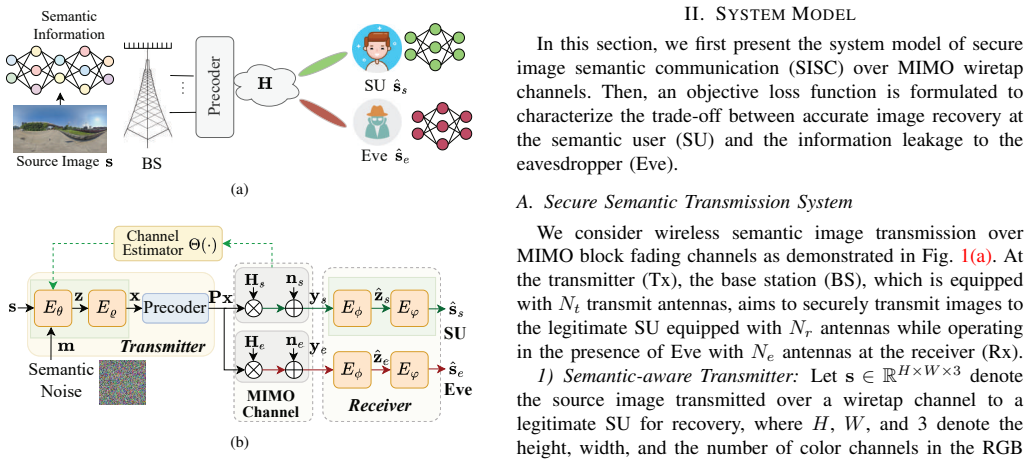
A semantic noise generation network interferes with an eavesdropper's image reconstruction while preserving high fidelity at the legitimate user over MIMO fading channels.
A machine-rendered reading of the paper's core claim, the machinery that carries it, and where it could break.
Core claim
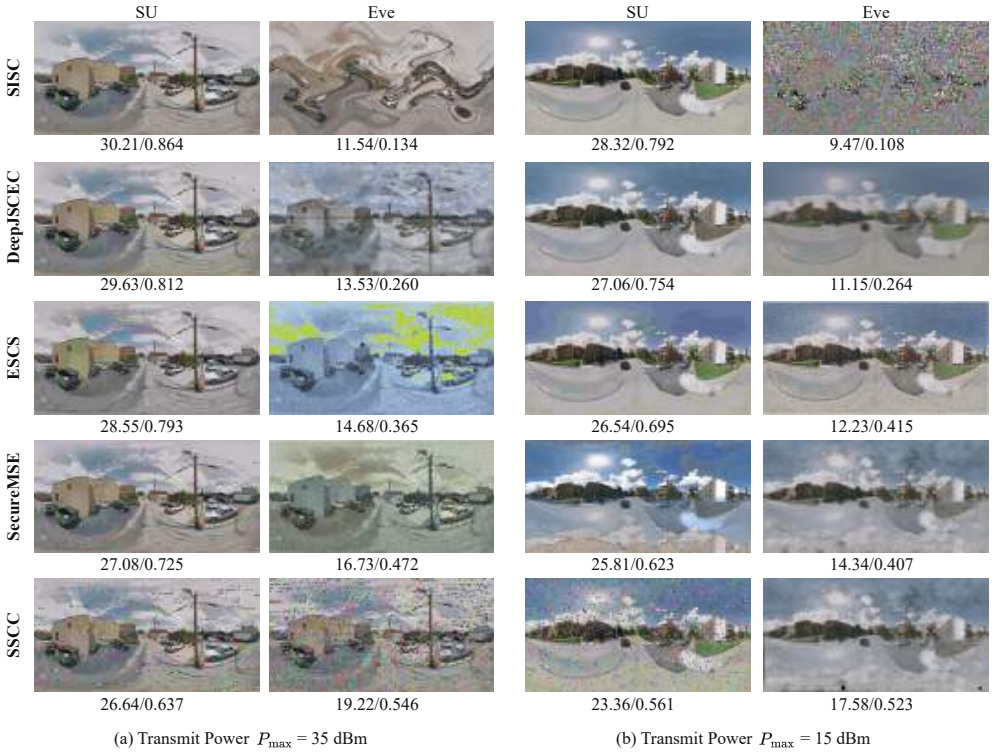
The paper claims that generating semantic noise from source features and the legitimate user's CSI, paired with transceiver beamformer optimization solved via constrained stochastic successive convex approximation, enables secure image transmission over MIMO fading channels. Numerical results show that this combination protects image content from the eavesdropper while delivering high-fidelity reconstruction at the legitimate semantic user.
What carries the argument
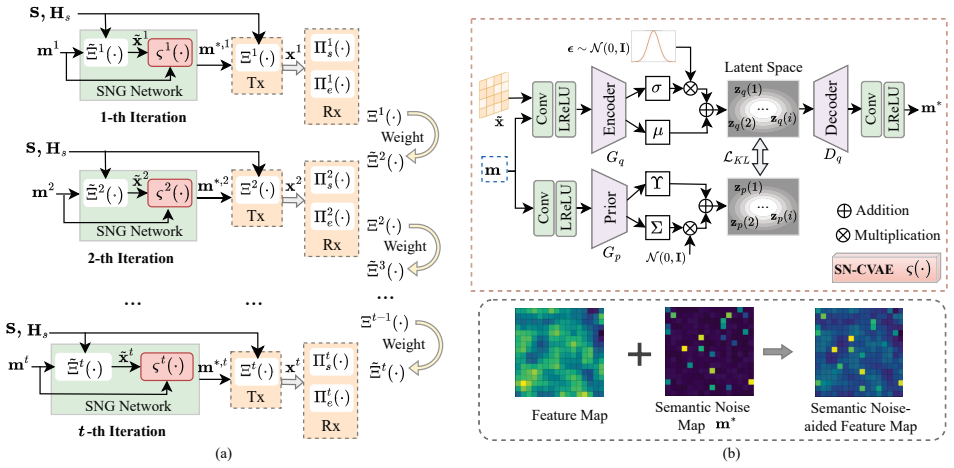
The semantic noise generation network, which produces a noise map from source features and legitimate-user CSI to create selective interference.
If this is right
- Semantic noise and beamforming together block information leakage to the eavesdropper.
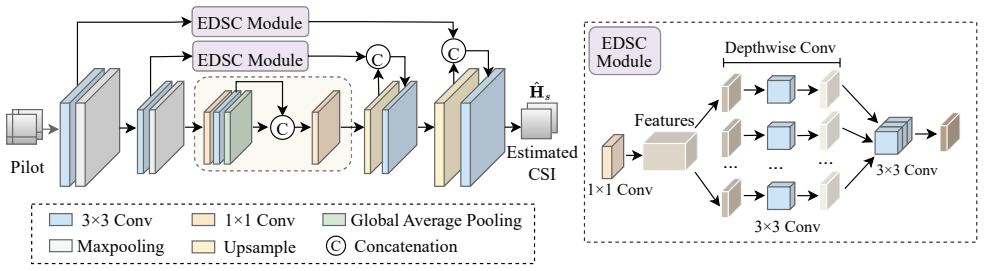
- The channel estimation network improves CSI accuracy and overall system performance.
- The optimization algorithm yields practical beamformer solutions under the stated constraints.
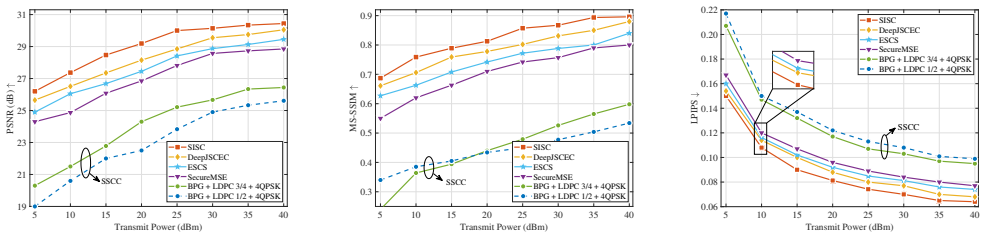
- High-fidelity reconstruction at the legitimate user is preserved alongside the security effect.
Where Pith is reading between the lines
- The same noise-generation idea might extend to video or other semantic tasks if the network generalizes across data types.
- Real deployments would need to verify performance when channel estimates contain errors.
- The framework could reduce reliance on conventional cryptographic overhead in wireless image links.
Load-bearing premise
A noise map created using the legitimate user's channel information will disrupt the eavesdropper's reconstruction without lowering quality at the legitimate receiver.
What would settle it
A test in which the eavesdropper reconstructs the image with quality comparable to the legitimate user after the semantic noise is added.
Figures



read the original abstract
Existing semantic communications have exhibited satisfactory performance in many tasks, but secure image transmission remains insufficiently explored. We propose a novel secure image semantic communication (SISC) framework over multiple-input multiple-output (MIMO) fading channels. To ensure high-quality image reconstruction for the legitimate semantic user (SU) and simultaneously interfere with the eavesdropper (Eve), we design a semantic noise generation (SNG) network. This network generates a beneficial semantic noise map based on both the source features and the SU channel state information (CSI). An efficient channel estimation enhanced network is incorporated to obtain the accurate CSI and enhance the system performance. Furthermore, to improve the secure image reconstruction quality, we develop an efficient transceiver beamformer optimization algorithm, where the formulated problem is solved using the constrained stochastic successive convex approximation method. In the proposed SISC framework, semantic noise generation and beamforming optimization work together to ensure secure and high-quality image transmission. Numerical results demonstrate that the proposed semantic noise aided transmission scheme effectively protects image information from leakage to Eve while maintaining high-fidelity image reconstruction at SU.
Editorial analysis
A structured set of objections, weighed in public.
Referee Report
Summary. The paper proposes a secure image semantic communication (SISC) framework for MIMO fading channels. A semantic noise generation (SNG) network produces a noise map from source features and legitimate-user CSI to degrade eavesdropper reconstruction while preserving high-fidelity reconstruction at the semantic user (SU). An enhanced channel-estimation network is included, and transceiver beamformers are optimized via constrained stochastic successive convex approximation. Numerical results are presented to support that the scheme protects image information from leakage to Eve while maintaining SU fidelity.
Significance. If the selective-interference property of the SNG holds beyond the simulated channel realizations, the work would offer a novel integration of learned semantic noise with physical-layer beamforming for secure semantic communications. The combination of data-driven noise generation with stochastic convex approximation is a potentially useful direction, though the absence of analytic bounds or robustness guarantees limits the strength of the contribution.
major comments (3)
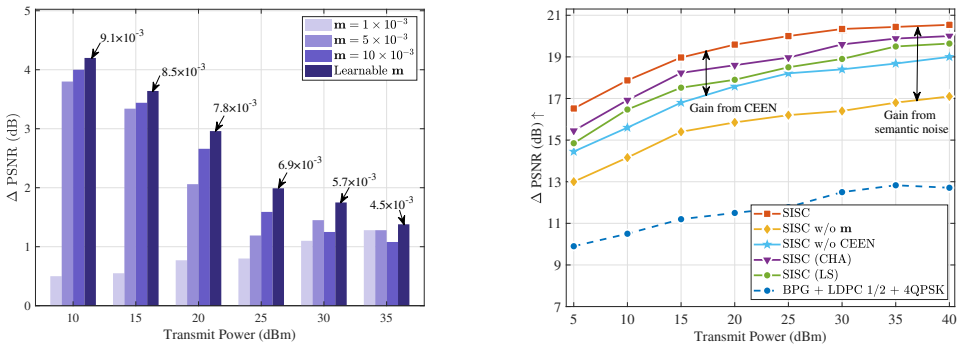
- [Framework description and SNG network section] The central security claim rests on the SNG producing a CSI-tailored noise map that exploits statistical differences between h_SU and h_Eve to create destructive interference at Eve while remaining neutral or constructive at SU. No analytic bound on the resulting mutual-information gap or reconstruction-metric difference is derived, and no analysis is given for correlated fading or imperfect CSI. This assumption is load-bearing for the claim that numerical results demonstrate general protection rather than simulation-specific behavior.
- [Beamformer optimization section] The beamforming optimization is solved with constrained stochastic successive convex approximation, yet the manuscript provides neither convergence guarantees nor an analysis of how estimation errors in the channel-estimation network propagate into the effective noise at Eve. Without these, it is unclear whether the reported security gains are robust or depend on idealized channel knowledge.
- [Numerical results section] Numerical results are invoked to support the selective-interference claim, but the evaluation does not report performance under channel correlation coefficients or CSI estimation error variances. If the training distribution does not sufficiently separate the two channels, the observed gap may not generalize.
minor comments (2)
- [System model] Notation for the SNG output (noise map) and its interaction with the precoder should be defined more explicitly to avoid ambiguity when describing the effective received signals at SU and Eve.
- [Numerical results] The abstract states that 'numerical results demonstrate' the claims; the results section should include error bars or statistics over multiple independent channel realizations to substantiate this.
Simulated Author's Rebuttal
We thank the referee for the thorough review and insightful comments on our manuscript. We address each of the major comments point by point below, providing clarifications and indicating revisions where appropriate.
read point-by-point responses
-
Referee: [Framework description and SNG network section] The central security claim rests on the SNG producing a CSI-tailored noise map that exploits statistical differences between h_SU and h_Eve to create destructive interference at Eve while remaining neutral or constructive at SU. No analytic bound on the resulting mutual-information gap or reconstruction-metric difference is derived, and no analysis is given for correlated fading or imperfect CSI. This assumption is load-bearing for the claim that numerical results demonstrate general protection rather than simulation-specific behavior.
Authors: We acknowledge that the absence of analytic bounds limits the generality of the claims. Deriving such bounds for the data-driven SNG network is challenging due to its non-linear and learned nature. The security is demonstrated through extensive simulations under the MIMO fading channel model. In the revised manuscript, we will add a dedicated subsection discussing the assumptions, including the impact of channel correlation and imperfect CSI, and note this as a direction for future work. Additionally, we will include new simulation results for correlated channels to strengthen the evaluation. revision: partial
-
Referee: [Beamformer optimization section] The beamforming optimization is solved with constrained stochastic successive convex approximation, yet the manuscript provides neither convergence guarantees nor an analysis of how estimation errors in the channel-estimation network propagate into the effective noise at Eve. Without these, it is unclear whether the reported security gains are robust or depend on idealized channel knowledge.
Authors: The constrained stochastic successive convex approximation method is adopted from established optimization literature, where convergence properties have been analyzed under suitable conditions. We will cite the relevant references more explicitly. For the propagation of estimation errors, a complete theoretical analysis is complex given the joint training of the networks. We will add numerical experiments in the revision to evaluate the sensitivity to CSI estimation errors and their effect on the security performance at Eve. revision: partial
-
Referee: [Numerical results section] Numerical results are invoked to support the selective-interference claim, but the evaluation does not report performance under channel correlation coefficients or CSI estimation error variances. If the training distribution does not sufficiently separate the two channels, the observed gap may not generalize.
Authors: We agree that additional evaluations would enhance the robustness assessment. In the revised version, we will extend the numerical results to include performance metrics for various channel correlation coefficients and different levels of CSI estimation error variances. This will provide evidence on the generalization of the selective-interference property. revision: yes
Circularity Check
No circularity: framework proposal validated by independent simulation benchmarks
full rationale
The paper presents a proposed SISC framework consisting of an SNG network, channel estimation network, and beamforming optimization solved via constrained stochastic successive convex approximation. The central claims rest on numerical results from simulations demonstrating selective interference and reconstruction quality. No equations or steps in the provided description reduce a claimed prediction or uniqueness result to a fitted parameter or self-citation by construction. The optimization method is a standard algorithmic technique, and performance is assessed against external simulation benchmarks rather than internal redefinitions. This is the common case of a self-contained engineering proposal.
Axiom & Free-Parameter Ledger
free parameters (2)
- Parameters of the SNG network
- Beamforming optimization parameters
axioms (2)
- domain assumption Standard MIMO fading channel model
- domain assumption Availability of SU CSI for noise generation
invented entities (1)
-
Semantic noise map
no independent evidence
Reference graph
Works this paper leans on
-
[1]
Toward wisdom-evolutionary and primitive-concise 6G: A new paradigm of semantic communication networks,
P. Zhang, W. Xu, H. Gao, and K. Niu, “Toward wisdom-evolutionary and primitive-concise 6G: A new paradigm of semantic communication networks,”Engineering, vol. 8, pp. 60–73, Jan. 2022
2022
-
[2]
SCSC: A novel standards-compatible semantic communication frame- work for image transmission,
X. Han, Y . Wu, Z. Gao, B. Feng, Y . Shi, D. G ¨und¨uz, and W. Zhang, “SCSC: A novel standards-compatible semantic communication frame- work for image transmission,”IEEE Trans. Commun., vol. 73, no. 8, pp. 5682–5698, Aug. 2025
2025
-
[3]
Enhancing image privacy in semantic communication over wiretap channels leveraging differential privacy,
W. Chen, S. Tang, and Q. Yang, “Enhancing image privacy in semantic communication over wiretap channels leveraging differential privacy,” in Proc. IEEE Int. Workshop Mach. Learn. Signal Process. (MLSP), London, United Kingdom, Sept. 2024, pp. 1–6
2024
-
[4]
A survey on wireless security: Technical challenges, recent advances, and future trends,
Y . Zou, J. Zhu, X. Wang, and L. Hanzo, “A survey on wireless security: Technical challenges, recent advances, and future trends,”Proc. IEEE, vol. 104, no. 9, pp. 1727–1765, Sept. 2016
2016
-
[5]
On the secrecy capacity of MIMO wiretap channels: Convex reformulation and efficient numerical methods,
A. Mukherjee, B. Ottersten, and L.-N. Tran, “On the secrecy capacity of MIMO wiretap channels: Convex reformulation and efficient numerical methods,”IEEE Trans. Commun., vol. 69, no. 10, pp. 6865–6878, Oct. 2021
2021
-
[6]
Physical layer security in near-field communications: What will be changed?
Z. Zhang, Y . Liu, Z.-J. Wang, X. Mu, and J. Chen, “Physical layer security in near-field communications: What will be changed?” Feb. 2023, arXiv:2302.04189. [Online]. Available: http://arxiv.org/abs/2302.04189
-
[7]
Exploiting multi-layer refracting RIS-assisted receiver for HAP-SWIPT networks,
K. An, Y . Sun, Z. Lin, Y . Zhu, W. Ni, and N. Al-Dhahir, “Exploiting multi-layer refracting RIS-assisted receiver for HAP-SWIPT networks,” IEEE Wireless Commun., vol. 23, no. 10, pp. 12638–12657, Oct. 2024
2024
-
[8]
Refracting RIS aided hybrid satellite-terrestrial relay networks: Joint beamforming design and optimization,
Z. Lin, H. Niu, K. An, Y . Wang, G. Zheng, and S. Chatzinotas, “Refracting RIS aided hybrid satellite-terrestrial relay networks: Joint beamforming design and optimization,”IEEE Trans. Aerosp. Electron. Syst., vol. 58, no. 4, pp. 3717–3724, Aug. 2022
2022
-
[9]
Self-powered absorptive reconfigurable intelligent surfaces for securing satellite-terrestrial integrated networks,
L. Zhiet al., “Self-powered absorptive reconfigurable intelligent surfaces for securing satellite-terrestrial integrated networks,”China Commun., vol. 21, no. 9, pp. 276–291, Sept. 2024
2024
-
[10]
Artificial-noise-aided space–time line code for enhancing physical layer security of multiuser MIMO downlink transmission,
J. Choi, J. Joung, and Y . -S. Cho, “Artificial-noise-aided space–time line code for enhancing physical layer security of multiuser MIMO downlink transmission,”IEEE Syst. J., vol. 16, no. 1, pp. 1289–1300, Mar. 2022
2022
-
[11]
Artificial noise assisted secure interference networks with wireless power transfer,
N. Zhao, Y . Cao, F. R. Yu, Y . Chen, M. Jin, and V . C. M. Leung, “Artificial noise assisted secure interference networks with wireless power transfer,”IEEE Trans. V eh. Technol., vol. 67, no. 2, pp. 1087–1098, Feb. 2018
2018
-
[12]
Green interference based symbiotic security in integrated satellite-terrestrial communica- tions,
Z. Yin, N. Cheng, T. H. Luan, Y . Hui and W. Wang, “Green interference based symbiotic security in integrated satellite-terrestrial communica- tions,”IEEE Trans. Wireless Commun., vol. 21, no. 11, pp. 9962–9973, Nov. 2022
2022
-
[13]
DT-assisted multi- point symbiotic security in space-air-ground integrated networks,
Z. Yin, N. Cheng, T. H. Luan, Y . Song and W. Wang, “DT-assisted multi- point symbiotic security in space-air-ground integrated networks,”IEEE Trans. Inf. F orensics Secur ., vol. 18, pp. 5721–5734, 2023
2023
-
[14]
Deep artificial noise: Deep learning-based precoding optimization for artificial noise scheme,
S. Yun, J. M. Kang, I. M. Kim, and J. Ha, “Deep artificial noise: Deep learning-based precoding optimization for artificial noise scheme,”IEEE Trans. V eh. Technol., vol. 69, no. 3, pp. 3465–3469, Mar. 2020
2020
-
[15]
Rethinking wireless communication security in semantic Internet of Things,
H. Du, J. Wang, D. Niyato, J. Kang, Z. Xiong, and M. Guizani, “Rethinking wireless communication security in semantic Internet of Things,”IEEE Wireless Commun., vol. 30, no. 3, pp. 36—43, Jun. 2023
2023
-
[16]
Secure semantic communications: Challenges, approaches, and opportunities,
M. Shen, M. Shen, J. Wang, H. Du, D. Niyato, X. Tang, and J. Kang, “Secure semantic communications: Challenges, approaches, and opportunities,”IEEE Netw., vol. 38, no. 4, pp. 197–206, Jul. 2024
2024
-
[17]
Robust semantic communications with masked VQ-V AE enabled codebook,
Q. Hu, G. Zhang, Z. Qin, Y . Cai, G. Yu, and G. Y . Li, “Robust semantic communications with masked VQ-V AE enabled codebook,”IEEE Trans. Wireless Commun., vol. 22, no. 12, pp. 8707–8722, Dec. 2023
2023
-
[18]
Privacy-preserving task-oriented semantic communications against model inversion attacks,
Y . Wang, S. Guo, Y . Deng, H. Zhang, and Y . Fang, “Privacy-preserving task-oriented semantic communications against model inversion attacks,” IEEE Trans. Wireless Commun., vol. 23, no. 8, pp. 10150–10165, Aug. 2024
2024
-
[19]
Deep joint source-channel and encryption coding: secure semantic communications,
T. -Y . Tung and D. G ¨und¨uz, “Deep joint source-channel and encryption coding: secure semantic communications,” inProc. IEEE Int. Conf. Commun. (ICC), Rome, Italy, May 2023, pp. 5620–5625
2023
-
[20]
Privacy-aware communi- cation over a wiretap channel with generative networks,
E. Erdemir, P. L. Dragotti, and D. G ¨und¨uz, “Privacy-aware communi- cation over a wiretap channel with generative networks,” inIEEE Int. Conf. Acoust. Speech Signal Process. (ICASSP), Singapore, May 2022, pp. 2989–2993
2022
-
[21]
Wireless image trans- mission with semantic and security awareness,
M. Zhang, Y . Li, Z. Zhang, G. Zhu, and C. Zhong, “Wireless image trans- mission with semantic and security awareness,”IEEE Wireless Commun. Lett., vol. 12, no. 8, pp. 1389–1393, Aug. 2023
2023
-
[22]
Secure semantic communications: From perspective of physical layer security,
Y . Li, Z. Shi, H. Hu, Y . Fu, H. Wang, and H. Lei, “Secure semantic communications: From perspective of physical layer security,”IEEE Commun. Lett., vol. 28, no. 10, pp. 2243–2247, Oct. 2024
2024
-
[23]
Privacy- preserving resource allocation for asynchronous federated learning,
X. Chen, Z. Zhou, W. Ni, G. Pan, X. Wang, and S. Zhang, “Privacy- preserving resource allocation for asynchronous federated learning,” in Proc. IEEE 99th V eh. Technol. Conf. (VTC2024-Spring), Singapore, Jun. 2024, pp. 1–6
2024
-
[24]
Encrypted semantic communi- cation using adversarial training for privacy preserving,
X. Luo, Z. Chen, M. Tao, and F. Yang, “Encrypted semantic communi- cation using adversarial training for privacy preserving,”IEEE Commun. Lett., vol. 27, no. 6, pp. 1486–1490, Jun. 2023
2023
-
[25]
SemProtector: A unified framework for semantic protection in deep learning-based semantic communication systems,
X. Liu, G. Nan, Q. Cui, Z. Li, P. Liu, and Z. Xing, “SemProtector: A unified framework for semantic protection in deep learning-based semantic communication systems,”IEEE Commun. Mag., vol. 61, no. 11, pp. 56– 62, Nov. 2023
2023
-
[26]
Semantic and technical noise modeling in semantic image communication over wireless channels,
P. Samarathunga, N. Pollwaththage, T. Fernandoet al., “Semantic and technical noise modeling in semantic image communication over wireless channels,”IEEE Access, vol. 13, pp. 150872–150900, Aug. 2025
2025
-
[27]
Robust semantic communications against semantic noise,
Q. Hu, G. Zhang, Z. Qin, Y . Cai, G. Yu, and G. Y . Li, “Robust semantic communications against semantic noise,” inProc. IEEE 96th V eh. Technol. Conf. (VTC2022-Fall), London, United Kingdom, Sept. 2022, pp. 1–6
2022
-
[28]
Semantic communication-assisted physical layer security over fading wiretap channels,
X. Mu and Y . Liu, “Semantic communication-assisted physical layer security over fading wiretap channels,” inProc. IEEE Int. Conf. Commun. (ICC), Denver, CO, USA, Jun. 2024, pp. 2101–2106
2024
-
[29]
Swin transformer: Hierarchical vision transformer using shifted windows,
Z. Liu, Y . Lin, Y . Cao, H. Hu, Y . Wei, and Z. Zhang, “Swin transformer: Hierarchical vision transformer using shifted windows,” inIEEE Conf. Comput. Vis. Pattern Recognit. (CVPR), Montreal, QC, Canada, Oct. 2021, pp. 9992–10002
2021
-
[30]
Massive MIMO detection techniques: A survey,
M. A. Albreem, M. Juntti, and S. Shahabuddin, “Massive MIMO detection techniques: A survey,”IEEE Commun. Surveys Tuts., vol. 21, no. 4, pp. 3109–3132, Aug. 2019
2019
-
[31]
CBAM: Convolutional block attention module,
S. Woo, J. Park, J.-Y . Lee, and I. S. Kweon, “CBAM: Convolutional block attention module,” inProc. Eur . Conf. on Comput. Vis. (ECCV), Munich, Germany, Sept. 2018, pp. 3–19
2018
-
[32]
WITT: A wireless image transmission transformer for semantic communications,
K. Yang, S. Wang, J. Dai, K. Tan, K. Niu, and P. Zhang, “WITT: A wireless image transmission transformer for semantic communications,” in IEEE Int. Conf. Acoust. Speech Signal Process. (ICASSP), Rhodes Island, Greece, Jun. 2023, pp. 1–5
2023
-
[33]
Conditional variational image deraining,
Y . Du, J. Xu, X. Zhen, M. -M. Cheng, and L. Shao, “Conditional variational image deraining,”IEEE Trans. Image Process., vol. 29, pp. 6288–6301, May 2020
2020
-
[34]
Robust image semantic coding with learnable CSI fusion masking over MIMO fading channels,
B. Xie, Y . Wu, Y . Shi, W. Zhang, S. Cui, and M. Debbah, “Robust image semantic coding with learnable CSI fusion masking over MIMO fading channels,”IEEE Trans. Wireless Commun., vol. 23, no. 10, pp. 14155– 14170, Oct. 2024
2024
-
[35]
Learning structured output representation using deep conditional generative models,
K. Sohn, X. Yan, and H. Lee, “Learning structured output representation using deep conditional generative models,”Adv. Neural Inf. Process. Syst. (NIPS), vol. 28, pp. 3483–3491, Dec. 2015
2015
-
[36]
Variational inference: A review for statisticians,
D. M. Blei, A. Kucukelbir, and J. D. McAuliffe, “Variational inference: A review for statisticians,”J. Amer . Stat. Assoc., vol. 112, no. 518, pp. 859–877, Jul. 2017
2017
-
[37]
On information and sufficiency,
S. Kullback and R. A. Leibler, “On information and sufficiency,”Ann. Math. Stat., pp. 79–86, 1951
1951
-
[38]
Auto-Encoding Variational Bayes
D. P. Kingma and M. Welling, “Auto-encoding variational bayes,” Dec. 2013, arXiv:1312.6114. [Online]. Available: http://arxiv.org/abs/1312.6114
work page internal anchor Pith review Pith/arXiv arXiv 2013
-
[39]
Stochastic successive convex approximation for non-convex constrained stochastic optimization,
A. Liu, V . K. N. Lau, and B. Kananian, “Stochastic successive convex approximation for non-convex constrained stochastic optimization,”IEEE Trans. Signal Process., vol. 67, no. 16, pp. 4189–4203, Aug. 2019
2019
-
[40]
The cityscapes dataset for semantic urban scene understanding,
M. Cordts, M. Omran, S. Ramos, T. Rehfeld, M. Enzweiler, R. Benenson, U. Franke, S. Roth, and B. Schiele, “The cityscapes dataset for semantic urban scene understanding,” inProc. IEEE Conf. Comput. Vis. Pattern Recognit. (CVPR), Las Vegas, NV , USA, Jun. 2016, pp. 3213–3223
2016
-
[41]
Semantic segmentation of outdoor panoramic images,
S. Orhan and Y . Bastanlar, “Semantic segmentation of outdoor panoramic images,”Signal Image Video Process., vol. 16, pp. 643–650, Aug. 2021
2021
-
[42]
Adam: A method for stochastic optimiza- tion,
D. P. Kingma and J. L. Ba, “Adam: A method for stochastic optimiza- tion,” inProc. Int. Conf. Learn. Rep. (ICLR), San Diego, CA, USA, 2015, pp. 1–15
2015
-
[43]
OFDM-guided deep joint source channel coding for wireless multipath fading channels,
M. Yang, C. Bian, and H. -S. Kim, “OFDM-guided deep joint source channel coding for wireless multipath fading channels,”IEEE Trans. Cogn. Commun. Netw., vol. 8, no. 2, pp. 584–599, Jun. 2022
2022
discussion (0)
Sign in with ORCID, Apple, or X to comment. Anyone can read and Pith papers without signing in.