Ryu-Takayanagi area from Virasoro modular data
Pith reviewed 2026-07-01 01:55 UTC · model grok-4.3
The pith
In holographic 2d CFTs the O(c) part of entanglement entropy matches the Ryu-Takayanagi area when rewritten via Virasoro crossing symmetry and coarse-graining into Liouville bins.
A machine-rendered reading of the paper's core claim, the machinery that carries it, and where it could break.
Core claim
The O(c) part of the entropy, obtained from the Cardy density of heavy primaries in the dominant Liouville-momentum bin after the coarse-graining step, is identified with the Ryu-Takayanagi area. This identification holds when the rewritten entropy is expressed through Virasoro modular data and provides quantitative criteria on the allowed amount of coarse-graining.
What carries the argument
Coarse-graining heavy BCFT primaries into bins labeled by Liouville momenta, whose saddle-dominated sum yields an O(c) term from the Cardy density that is identified with the Ryu-Takayanagi area.
If this is right
- The O(c) entropy matches the Ryu-Takayanagi area for several choices of global state and subregion.
- Quantitative criteria follow for the amount of coarse-graining that preserves consistency with the algebraic interpretation.
- The result supplies a statistical origin for the Ryu-Takayanagi area in the density of coarse-grained Virasoro intertwiners.
Where Pith is reading between the lines
- The same rewriting might be tested in non-holographic 2d CFTs to see whether the saddle still produces an area-like term without bulk gravity.
- If the Liouville-bin coarse-graining can be made precise at finite c, it could supply a way to compute subleading corrections to the Ryu-Takayanagi formula from the same modular data.
Load-bearing premise
The sum over bins is dominated by a saddle at large c and the chosen coarse-graining of heavy primaries into Liouville momentum bins remains consistent with the algebraic entanglement entropy interpretation.
What would settle it
For a concrete holographic state and subregion, compute the O(c) term from the Cardy density in the dominant bin and check whether it equals the Ryu-Takayanagi area; mismatch at large but finite c would falsify the identification.
Figures

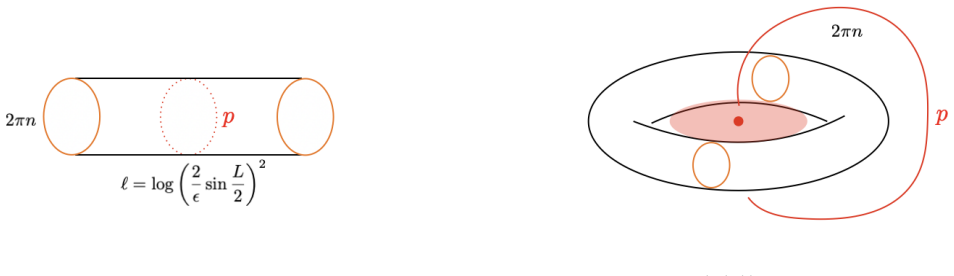
read the original abstract
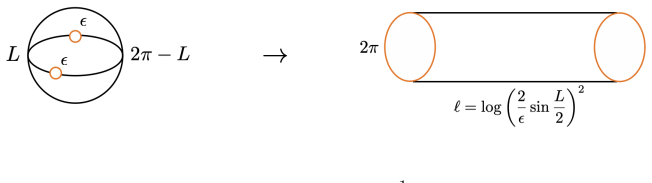
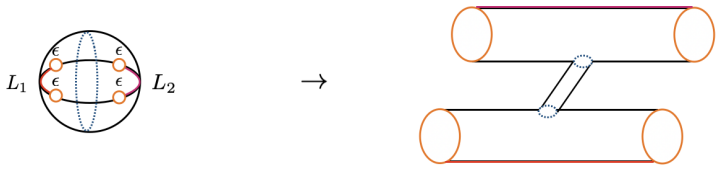
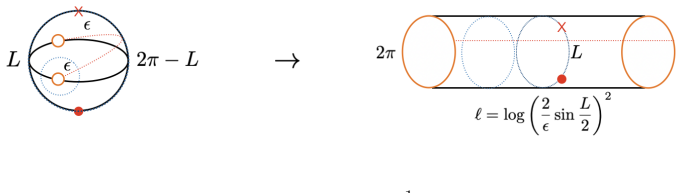
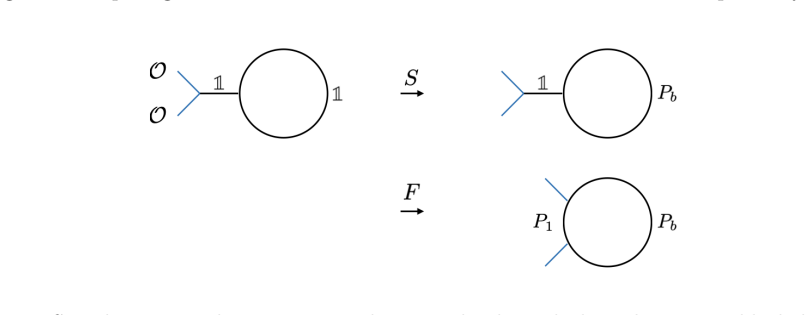
We show that in holographic 2d CFTs, the entanglement entropies across several choices of global state and subregion can be written in a way that at once has a microscopic interpretation and matches the leading large$-c$ organization of the Ryu-Takayanagi formula. This representation is obtained by applying crossing symmetry to the replica manifolds. From the boundary point of view, each rewritten entropy looks like an algebraic entanglement entropy for the Virasoro algebra restricted to the region, with center labels obtained by coarse-graining heavy primaries of the BCFT on the regulated region into bins labeled by Liouville momenta. At large $c$, a resulting sum over bins is dominated by a saddle, and the $O(c)$ part of the entropy comes from the Cardy density of heavy primaries in the dominant bin. We identify this $O(c)$ part of the entropy with the Ryu-Takayanagi area. Physically, this suggests a concrete statistical origin for the Ryu-Takayanagi area as coming from coarse-grained Virasoro intertwiners across the entangling cut. The result also provides quantitative criteria for the amount of coarse-graining allowed for the consistency of the interpretation.
Editorial analysis
A structured set of objections, weighed in public.
Referee Report
Summary. The paper claims that in holographic 2d CFTs, entanglement entropies for various global states and subregions can be rewritten via crossing symmetry applied to replica manifolds. This yields an algebraic entanglement entropy for the Virasoro algebra on the region, with center labels from coarse-graining heavy BCFT primaries into Liouville-momentum bins. At large c the sum over bins is saddle-dominated, the O(c) term arises from the Cardy density of states in the dominant bin, and this term is identified with the Ryu-Takayanagi area, suggesting a statistical origin in coarse-grained Virasoro intertwiners across the cut together with quantitative criteria on allowed coarse-graining.
Significance. If the central identification is established, the work supplies a microscopic statistical interpretation of the leading RT term directly from Virasoro modular data and crossing symmetry, rather than from bulk geometry. It also supplies explicit criteria for the amount of coarse-graining compatible with the algebraic EE interpretation. These are substantive strengths that would connect CFT entanglement calculations to holography in a new way.
major comments (3)
- [Abstract] Abstract (paragraph beginning 'At large c, a resulting sum over bins...'): The identification of the O(c) saddle contribution with the RT area rests on the assertion that the chosen binning of heavy primaries by Liouville momenta preserves the Virasoro center structure required for the algebraic EE interpretation. No derivation is supplied showing that this particular partition is forced by crossing symmetry or modular invariance; alternative partitions consistent with crossing could alter the dominant bin or the O(c) coefficient.
- [Abstract] Abstract (paragraph on saddle dominance): The claim that the sum over bins is dominated by a saddle at large c is introduced to produce the match with the RT formula, but the abstract provides neither an explicit saddle-point analysis with error estimates nor a direct comparison against known RT results for specific states or intervals. Without these checks the identification remains conditional on the validity of the binning procedure.
- [Abstract] Abstract (final paragraph on quantitative criteria): The paper states that the result 'provides quantitative criteria for the amount of coarse-graining allowed,' yet the abstract does not exhibit an explicit bound or inequality derived from crossing equations that would delimit the allowed bin size while preserving the center labels.
minor comments (2)
- [Abstract] The abstract refers to 'several choices of global state and subregion' without enumerating them; a brief list or reference to the relevant sections would improve readability.
- [Abstract] Notation for the coarse-grained bins (Liouville momenta) is introduced without an immediate equation or diagram clarifying how the bin boundaries are defined from the BCFT spectrum.
Simulated Author's Rebuttal
We thank the referee for the careful reading and for highlighting points where the abstract could be strengthened. We address each comment below and will revise the abstract accordingly while preserving the manuscript's core claims.
read point-by-point responses
-
Referee: [Abstract] Abstract (paragraph beginning 'At large c, a resulting sum over bins...'): The identification of the O(c) saddle contribution with the RT area rests on the assertion that the chosen binning of heavy primaries by Liouville momenta preserves the Virasoro center structure required for the algebraic EE interpretation. No derivation is supplied showing that this particular partition is forced by crossing symmetry or modular invariance; alternative partitions consistent with crossing could alter the dominant bin or the O(c) coefficient.
Authors: The abstract summarizes the result; the derivation that this binning preserves the Virasoro center appears in Section 3, where crossing symmetry on the replica manifold is used to show that the Liouville-momentum bins respect the fusion rules and modular invariance of the Virasoro algebra. Alternative partitions that mix distinct centers would violate the algebraic entanglement entropy construction. We will revise the abstract to include a brief clause referencing this section and clarifying that the binning is selected by the requirement of consistent center labels under crossing. revision: yes
-
Referee: [Abstract] Abstract (paragraph on saddle dominance): The claim that the sum over bins is dominated by a saddle at large c is introduced to produce the match with the RT formula, but the abstract provides neither an explicit saddle-point analysis with error estimates nor a direct comparison against known RT results for specific states or intervals. Without these checks the identification remains conditional on the validity of the binning procedure.
Authors: Section 4 contains the explicit saddle-point evaluation at large c, including error estimates of order exp(-c) from the subleading terms in the Cardy density, together with direct comparisons to the RT formula for the vacuum and for heavy primary states on intervals. We will update the abstract to note that the saddle dominance and the match are verified in the body of the paper. revision: yes
-
Referee: [Abstract] Abstract (final paragraph on quantitative criteria): The paper states that the result 'provides quantitative criteria for the amount of coarse-graining allowed,' yet the abstract does not exhibit an explicit bound or inequality derived from crossing equations that would delimit the allowed bin size while preserving the center labels.
Authors: The explicit bound (bin width must remain o(c) to keep distinct centers from mixing under crossing) is derived in Section 5 from the crossing equations. We will revise the abstract to state the bound concisely and reference the section. revision: yes
Circularity Check
No significant circularity; derivation from crossing symmetry is self-contained
full rationale
The paper obtains its representation by applying crossing symmetry to replica manifolds, yielding an algebraic entanglement entropy interpretation whose center labels arise from coarse-graining heavy primaries into Liouville-momentum bins. The O(c) term is extracted from the standard Cardy density of states evaluated in the dominant saddle bin at large c, then identified with the Ryu-Takayanagi area. This identification uses an independent, externally known CFT result (Cardy formula) rather than defining the target quantity into the inputs. No equation or step is shown to reduce the final claim to a tautology, a fitted parameter renamed as prediction, or a self-citation chain. The paper additionally supplies quantitative criteria for allowed coarse-graining, confirming the construction is not forced by construction but derived from the modular data under stated large-c assumptions.
Axiom & Free-Parameter Ledger
axioms (2)
- standard math Crossing symmetry holds for the replica manifold correlators in the 2d CFT.
- domain assumption The large-c saddle-point approximation is valid for the sum over coarse-grained bins.
Reference graph
Works this paper leans on
-
[1]
Holographic derivation of entanglement entropy from AdS/CFT,
S. Ryu and T. Takayanagi, “Holographic derivation of entanglement entropy from AdS/CFT,” Phys. Rev. Lett.96(2006) 181602,hep-th/0603001
Pith/arXiv arXiv 2006
-
[2]
Aspects of Holographic Entanglement Entropy,
S. Ryu and T. Takayanagi, “Aspects of Holographic Entanglement Entropy,” JHEP08 (2006) 045,hep-th/0605073
Pith/arXiv arXiv 2006
-
[3]
Quantum corrections to holographic entanglement entropy,
T. Faulkner, A. Lewkowycz, and J. Maldacena, “Quantum corrections to holographic entanglement entropy,” JHEP11(2013) 074,1307.2892. 25
Pith/arXiv arXiv 2013
-
[4]
Generalized gravitational entropy,
A. Lewkowycz and J. Maldacena, “Generalized gravitational entropy,” JHEP08(2013) 090, 1304.4926
Pith/arXiv arXiv 2013
-
[5]
Entanglement Entropy at Large Central Charge,
T. Hartman, “Entanglement Entropy at Large Central Charge,”1303.6955
-
[6]
A note on the bulk interpretation of the Quantum Extremal Surface formula,
G. Wong, “A note on the bulk interpretation of the Quantum Extremal Surface formula,” 2212.03193
-
[7]
A new look at the entanglement entropy of a single interval in a 2d CFT,
J. Lin, “A new look at the entanglement entropy of a single interval in a 2d CFT,” 2107.12634
-
[8]
Solving 3d gravity with Virasoro TQFT,
S. Collier, L. Eberhardt, and M. Zhang, “Solving 3d gravity with Virasoro TQFT,” SciPost Phys.15(2023), no. 4 151,2304.13650
arXiv 2023
-
[9]
3d gravity from Virasoro TQFT: Holography, wormholes and knots,
S. Collier, L. Eberhardt, and M. Zhang, “3d gravity from Virasoro TQFT: Holography, wormholes and knots,” SciPost Phys.17(2024) 134,2401.13900
arXiv 2024
-
[10]
It from ETH: Multi-interval Entanglement and Replica Wormholes from Large-cBCFT Ensemble,
H. Geng, L.-Y. Hung, and Y. Jiang, “It from ETH: Multi-interval Entanglement and Replica Wormholes from Large-cBCFT Ensemble,”2505.20385
-
[11]
Ryu-Takayanagi formula for multi-boundary black holes from 2D large-c CFT ensemble,
N. Bao, H. Geng, and Y. Jiang, “Ryu-Takayanagi formula for multi-boundary black holes from 2D large-c CFT ensemble,” JHEP10(2025) 042,2504.12388
arXiv 2025
-
[12]
Entanglement entropy and superselection sectors I. Global symmetries,
H. Casini, M. Huerta, J. M. Magan, and D. Pontello, “Entanglement entropy and superselection sectors I. Global symmetries,”1905.10487
arXiv 1905
-
[13]
Liouville bootstrap via harmonic analysis on a noncompact quantum group,
B. Ponsot and J. Teschner, “Liouville bootstrap via harmonic analysis on a noncompact quantum group,”hep-th/9911110
-
[14]
Fine Structure of Jackiw-Teitelboim Quantum Gravity,
A. Blommaert, T. G. Mertens, and H. Verschelde, “Fine Structure of Jackiw-Teitelboim Quantum Gravity,”1812.00918
-
[15]
Physics at the entangling surface,
K. Ohmori and Y. Tachikawa, “Physics at the entangling surface,” J. Stat. Mech.1504 (2015) P04010,1406.4167
Pith/arXiv arXiv 2015
-
[16]
Entanglement hamiltonians in two-dimensional conformal field theory,
J. Cardy and E. Tonni, “Entanglement hamiltonians in two-dimensional conformal field theory,” J. Stat. Mech.1612(2016), no. 12 123103,1608.01283
Pith/arXiv arXiv 2016
-
[17]
Entanglement entropy of two disjoint intervals in conformal field theory II,
P. Calabrese, J. Cardy, and E. Tonni, “Entanglement entropy of two disjoint intervals in conformal field theory II,” J. Stat. Mech.1101(2011) P01021,1011.5482
Pith/arXiv arXiv 2011
-
[18]
Spin structures and entanglement of two disjoint intervals in conformal field theories,
A. Coser, E. Tonni, and P. Calabrese, “Spin structures and entanglement of two disjoint intervals in conformal field theories,” J. Stat. Mech.1605(2016), no. 5 053109,1511.08328
Pith/arXiv arXiv 2016
-
[19]
Universality of Long-Distance AdS Physics from the CFT Bootstrap,
A. L. Fitzpatrick, J. Kaplan, and M. T. Walters, “Universality of Long-Distance AdS Physics from the CFT Bootstrap,” JHEP08(2014) 145,1403.6829. 26
Pith/arXiv arXiv 2014
-
[20]
A universal Schwarzian sector in two-dimensional conformal field theories,
A. Ghosh, H. Maxfield, and G. J. Turiaci, “A universal Schwarzian sector in two-dimensional conformal field theories,” JHEP05(2020) 104,1912.07654
arXiv 2020
-
[21]
Quantum Regge Trajectories and the Virasoro Analytic Bootstrap,
S. Collier, Y. Gobeil, H. Maxfield, and E. Perlmutter, “Quantum Regge Trajectories and the Virasoro Analytic Bootstrap,” JHEP05(2019) 212,1811.05710
Pith/arXiv arXiv 2019
-
[22]
Expanding the Black Hole Interior: Partially Entangled Thermal States in SYK,
A. Goel, H. T. Lam, G. J. Turiaci, and H. Verlinde, “Expanding the Black Hole Interior: Partially Entangled Thermal States in SYK,” JHEP02(2019) 156,1807.03916
Pith/arXiv arXiv 2019
-
[23]
Holographic Entanglement Entropy from 2d CFT: Heavy States and Local Quenches,
C. T. Asplund, A. Bernamonti, F. Galli, and T. Hartman, “Holographic Entanglement Entropy from 2d CFT: Heavy States and Local Quenches,” JHEP02(2015) 171,1410.1392
Pith/arXiv arXiv 2015
-
[24]
Bootstrapping quantum extremal surfaces. Part I. The area operator,
A. Belin and S. Colin-Ellerin, “Bootstrapping quantum extremal surfaces. Part I. The area operator,” JHEP11(2021) 021,2107.07516
arXiv 2021
-
[25]
Lectures on entanglement, von Neumann algebras, and emergence of spacetime,
H. Liu, “Lectures on entanglement, von Neumann algebras, and emergence of spacetime,” 2510.07017
-
[26]
Emergent Area Operators in the Boundary,
R. M. Soni, “Emergent Area Operators in the Boundary,”2511.01382
-
[27]
Entanglement entropy in Jackiw-Teitelboim gravity with matter,
J. Lin, “Entanglement entropy in Jackiw-Teitelboim gravity with matter,”2107.11872
-
[28]
Wormholes, Emergent Gauge Fields, and the Weak Gravity Conjecture,
D. Harlow, “Wormholes, Emergent Gauge Fields, and the Weak Gravity Conjecture,” JHEP 01(2016) 122,1510.07911
Pith/arXiv arXiv 2016
-
[29]
Local subsystems in gauge theory and gravity,
W. Donnelly and L. Freidel, “Local subsystems in gauge theory and gravity,” JHEP09 (2016) 102,1601.04744
Pith/arXiv arXiv 2016
-
[30]
Ryu-Takayanagi Area as an Entanglement Edge Term,
J. Lin, “Ryu-Takayanagi Area as an Entanglement Edge Term,”1704.07763
-
[31]
Entanglement entropy and nonabelian gauge symmetry,
W. Donnelly, “Entanglement entropy and nonabelian gauge symmetry,” Class. Quant. Grav. 31(2014), no. 21 214003,1406.7304
Pith/arXiv arXiv 2014
-
[32]
Decomposition of entanglement entropy in lattice gauge theory,
W. Donnelly, “Decomposition of entanglement entropy in lattice gauge theory,” Phys. Rev. D85(2012) 085004,1109.0036
Pith/arXiv arXiv 2012
-
[33]
On The Entanglement Entropy For Gauge Theories,
S. Ghosh, R. M. Soni, and S. P. Trivedi, “On The Entanglement Entropy For Gauge Theories,” JHEP09(2015) 069,1501.02593
Pith/arXiv arXiv 2015
-
[34]
Minimal Factorization of Chern-Simons Theory – Gravitational Anyonic Edge Modes,
T. G. Mertens and Q.-F. Wu, “Minimal Factorization of Chern-Simons Theory – Gravitational Anyonic Edge Modes,”2505.00501
-
[35]
A proposal for 3d quantum gravity and its bulk factorization,
T. G. Mertens, J. Sim´ on, and G. Wong, “A proposal for 3d quantum gravity and its bulk factorization,” JHEP06(2023) 134,2210.14196. 27
arXiv 2023
discussion (0)
Sign in with ORCID, Apple, or X to comment. Anyone can read and Pith papers without signing in.