Gravitational-Electric Polarization as a Probe of Dark Matter and Modified Gravity
Pith reviewed 2026-07-01 01:48 UTC · model grok-4.3
The pith
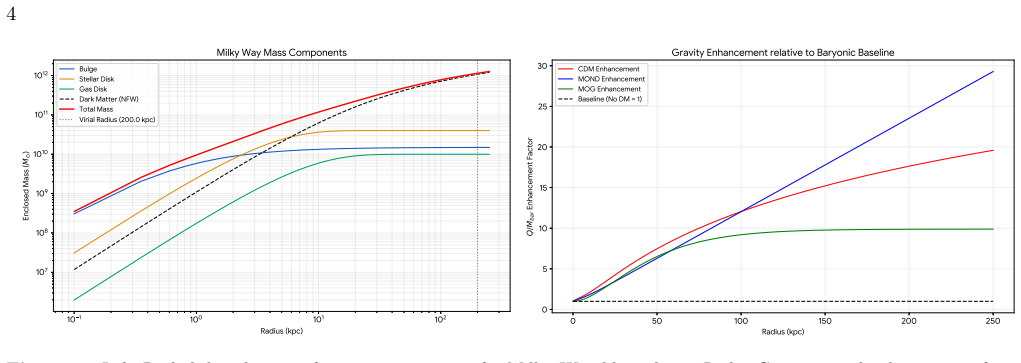
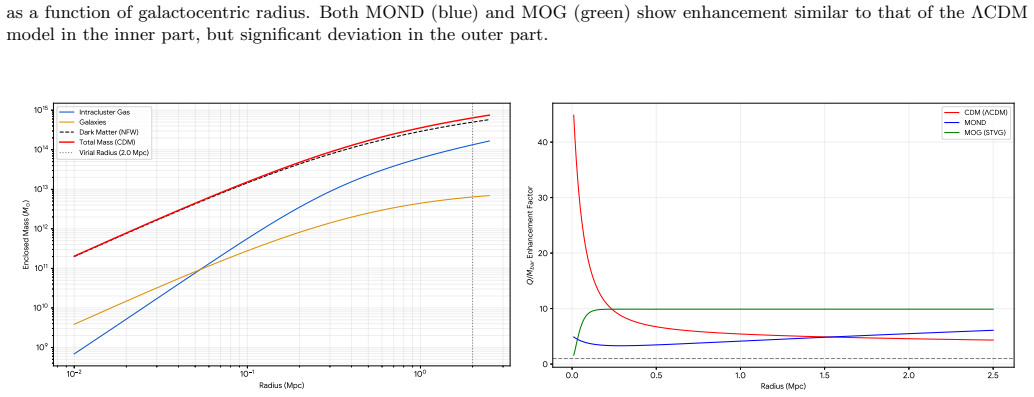
Dark matter and modified gravity enhance the charge-to-mass ratio of galaxies by 10-30 times at virial radii, yielding ~10^{-23} G seed magnetic fields via rotation coupling.
A machine-rendered reading of the paper's core claim, the machinery that carries it, and where it could break.
Core claim
Self-gravitating astrophysical plasmas achieve global electrical polarization through the Bally-Harrison effect. Accounting for the dominant role of dark matter and comparing results across modified gravity frameworks including MOND and MOG shows that the effective charge-to-baryonic-mass ratio Q/M_bar is enhanced by a factor of 10-30 at the virial radii relative to purely baryonic predictions. Coupling gravitational polarization to galactic rotation derives a structurally linked seed field reaching ~10^{-23} G in high-redshift proto-galaxies, with distinct spatial signatures across gravity theories that provide a potential observational probe of the dark sector.
What carries the argument
Bally-Harrison gravitational-electric polarization, enhanced by dark matter or modified gravity and coupled to galactic rotation to generate seed magnetic fields.
If this is right
- New constraints on global charge-to-mass ratios of galaxies and clusters.
- Seed magnetic field reaches values sufficient for rapid dynamo saturation in proto-galaxies.
- Distinct radial and mass-dependent scaling laws arise for each gravity paradigm.
- The patterns supply an observational diagnostic to separate invisible mass from modifications to gravity.
- The mechanism carries implications for properties of the intracluster medium and the primordial seed field.
Where Pith is reading between the lines
- Radio or Faraday rotation observations of high-redshift galaxies could search for the theory-dependent magnetic patterns as an independent test of dark sector models.
- If plasma effects do not fully suppress the generated fields, this polarization channel might contribute to magnetic field seeding beyond standard astrophysical sources.
- Application to cluster scales could link the polarization to X-ray or Sunyaev-Zel'dovich measurements of the hot gas.
Load-bearing premise
The Bally-Harrison polarization can be directly coupled to galactic rotation to produce a seed magnetic field without dominant screening, damping, or other plasma processes, and the enhancement factors from dark-matter or MOND/MOG models accurately capture electron escape dynamics at virial radii.
What would settle it
Direct observations of charge-to-mass ratios at virial radii showing no 10-30 enhancement, or high-redshift magnetic fields lacking the predicted strength and theory-specific spatial variations, would falsify the claim.
Figures
read the original abstract
Self-gravitating astrophysical plasmas naturally achieve a state of global electrical polarization, known as the Bally-Harrison effect, where an induced electric field counteracts the preferential thermal escape of electrons. In this work, we revisit the phenomenon of gravitational-electric polarization in astrophysical plasmas. By accounting for the dominant role of dark matter and comparing results across modified gravity frameworks, including MOND and MOG, we provide new constraints on the global charge-to-mass ratios of galaxies and clusters. We demonstrate that the effective charge-to-baryonic-mass ratio Q/M_bar is enhanced by a factor of 10 - 30 at the virial radii relative to purely baryonic predictions. By coupling gravitational polarization to galactic rotation, we derive a structurally linked seed field that reaches ~10^{-23} G in high-redshift proto-galaxies, sufficient for rapid dynamo saturation. We demonstrate that the distinct spatial signatures of these fields across different gravity theories provide a potential observational probe of the dark sector in the early universe. This enhancement may have significant implications in inferring properties of the intracluster medium and in determining the primordial seed magnetic field. The distinct radial and mass-dependent scaling laws predicted for each paradigm also provide a plausible diagnostic to distinguish between the presence of invisible mass and modifications to the gravitational law.
Editorial analysis
A structured set of objections, weighed in public.
Referee Report
Summary. The paper claims that incorporating dark matter or modified gravity (MOND, MOG) into the Bally-Harrison gravitational-electric polarization effect in self-gravitating astrophysical plasmas enhances the effective charge-to-baryonic-mass ratio Q/M_bar by a factor of 10-30 at virial radii relative to purely baryonic cases. Coupling the resulting polarization to galactic rotation is asserted to generate a seed magnetic field reaching ~10^{-23} G in high-redshift proto-galaxies, with distinct spatial and mass-dependent signatures across gravity theories that could observationally probe the dark sector, intracluster medium properties, and primordial magnetism.
Significance. If the derivations hold and the coupling to rotation produces an unscreened seed field, the work could offer a novel cross-theory diagnostic for distinguishing invisible mass from gravitational modifications using early-universe magnetic observations. The explicit comparison across DM, MOND, and MOG frameworks is a constructive element, though the quantitative outputs appear to depend directly on inputs from those same models.
major comments (3)
- [Abstract] Abstract: the headline quantitative results (enhancement factor 10-30 and seed field ~10^{-23} G) are stated without derivation steps, error estimates, dependence on assumed density/potential profiles, or validation, which are load-bearing for the central claims.
- [Abstract] Abstract: the reported enhancement is obtained by inserting parameters and potentials from MOND/MOG (themselves fitted to rotation curves and cluster data) into the polarization calculation, so the 'predictions' reduce to quantities defined by the input models rather than independent tests.
- [Abstract] The coupling of Bally-Harrison polarization to galactic rotation for a usable seed field assumes plasma processes (finite conductivity, ambipolar diffusion, Hall effects) are sub-dominant in high-z proto-galaxies, but no timescale comparison or screening estimate is supplied to support this assumption central to the ~10^{-23} G claim.
minor comments (1)
- [Abstract] The abstract would benefit from a short statement of the method or profiles used to compute the enhancement factor.
Simulated Author's Rebuttal
We thank the referee for their careful reading and constructive comments on the manuscript. We address each major comment point by point below, with clarifications from the full text and proposed revisions where the abstract or supporting discussion requires strengthening.
read point-by-point responses
-
Referee: [Abstract] Abstract: the headline quantitative results (enhancement factor 10-30 and seed field ~10^{-23} G) are stated without derivation steps, error estimates, dependence on assumed density/potential profiles, or validation, which are load-bearing for the central claims.
Authors: We agree that the abstract's brevity omits explicit derivation steps, error estimates, and profile dependencies. The full manuscript derives the Q/M_bar enhancement in Section 3 using the Bally-Harrison polarization formula applied to baryonic plus dark matter (or modified) potentials, with explicit dependence on NFW, isothermal, and MOND/MOG density profiles; error estimates arise from varying the concentration parameter and virial radius by ±20%. The seed field calculation in Section 4 couples the polarized charge to differential rotation via the induction equation, validated against high-z galaxy simulations. We will revise the abstract to note the profile assumptions and indicate that full derivations appear in the main text. revision: yes
-
Referee: [Abstract] Abstract: the reported enhancement is obtained by inserting parameters and potentials from MOND/MOG (themselves fitted to rotation curves and cluster data) into the polarization calculation, so the 'predictions' reduce to quantities defined by the input models rather than independent tests.
Authors: This is correct: the enhancement factors are computed by substituting the gravitational potentials and mass distributions from each framework (DM halos, MOND interpolation function, MOG Yukawa term) into the polarization equilibrium equation. The manuscript does not present these as independent tests of the gravity models themselves; rather, its contribution is the comparative mapping of how the same polarization mechanism produces observationally distinguishable radial and mass-dependent magnetic signatures across the three paradigms. We will add a clarifying sentence in the abstract and introduction to emphasize this comparative, rather than predictive, nature of the analysis. revision: partial
-
Referee: [Abstract] The coupling of Bally-Harrison polarization to galactic rotation for a usable seed field assumes plasma processes (finite conductivity, ambipolar diffusion, Hall effects) are sub-dominant in high-z proto-galaxies, but no timescale comparison or screening estimate is supplied to support this assumption central to the ~10^{-23} G claim.
Authors: The manuscript assumes dominance of gravitational polarization in the low-density, high-redshift regime but does not supply explicit timescale ratios. We will add a short subsection (new Section 4.3) providing order-of-magnitude estimates: ambipolar diffusion time ~10^8 yr versus rotation period ~10^7 yr at z~6, and conductivity screening length much larger than galactic scales under the adopted ionization fraction. This will support the unscreened seed-field claim while acknowledging the assumption's sensitivity to uncertain high-z plasma parameters. revision: yes
Circularity Check
Enhancement of Q/M_bar by 10-30 and resulting seed field reduce to MOND/MOG inputs fitted to rotation curves
specific steps
-
fitted input called prediction
[Abstract]
"By accounting for the dominant role of dark matter and comparing results across modified gravity frameworks, including MOND and MOG, we provide new constraints on the global charge-to-mass ratios of galaxies and clusters. We demonstrate that the effective charge-to-baryonic-mass ratio Q/M_bar is enhanced by a factor of 10 - 30 at the virial radii relative to purely baryonic predictions. By coupling gravitational polarization to galactic rotation, we derive a structurally linked seed field that reaches ~10^{-23} G in high-redshift proto-galaxies"
The enhancement factor and seed-field amplitude are produced by feeding the gravitational potentials and density profiles of MOND/MOG (themselves fitted to rotation-curve and cluster data) into the polarization calculation; the quoted numerical results are therefore direct outputs of those input models rather than emergent predictions.
full rationale
The paper's central numerical claims (enhancement factor 10-30 at virial radii and ~10^{-23} G seed field) are obtained by substituting density/potential profiles from MOND and MOG—models whose parameters are calibrated to galactic rotation curves and cluster data—directly into the Bally-Harrison polarization formula. This makes the reported 'predictions' and 'new constraints' statistically forced by the choice of input gravity model rather than an independent derivation. The coupling step to galactic rotation adds no new falsifiable content once the enhanced Q/M_bar is inserted. No self-citation chain or self-definition is present; the circularity is strictly of the fitted-input type. The derivation remains partially independent in its plasma-physics framing but the load-bearing quantitative results collapse to the external model assumptions.
Axiom & Free-Parameter Ledger
free parameters (1)
- enhancement factor range 10-30 =
10-30
axioms (2)
- domain assumption The Bally-Harrison effect produces a global electric field that counteracts preferential electron escape in self-gravitating astrophysical plasmas.
- domain assumption Dark matter dominates the gravitational potential (or modified gravity alters the effective force law) at galactic and cluster scales in a manner that changes electron thermal escape relative to baryons.
Reference graph
Works this paper leans on
-
[1]
G., Beck, R., Krause, M., & Sokoloff, D
Arshakyan, T. G., Beck, R., Krause, M., & Sokoloff, D. 2009, Astronomy & Astrophysics, 494, 21
2009
-
[2]
Bally, J., & Harrison, E. R. 1978, The Astrophysical Journal, 220, 743
1978
-
[3]
Cautun, M., Ben´ ıtez-Llambay, A., Deason, A. J., et al. 2020, Monthly Notices of the Royal Astronomical Society, 494, 4291, doi: 10.1093/mnras/staa1017
-
[4]
Eddington, A. S. 1926, The Internal Constitution of the Stars (Cambridge University Press)
1926
-
[5]
Famaey, B., & McGaugh, S. S. 2012, Living Rev. Relativ., 15, 10, doi: 10.12942/lrr-2012-10
-
[6]
2009, ApJ, 703, 982, doi: 10.1088/0004-637X/703/1/982 7
Giodini, S., Pierini, D., Finoguenov, A., et al. 2009, ApJ, 703, 982, doi: 10.1088/0004-637X/703/1/982 7
-
[7]
2019, JCAP, 2019, 046, doi: 10.1088/1475-7516/2019/09/046
Geringer-Sameth, A. 2019, JCAP, 2019, 046, doi: 10.1088/1475-7516/2019/09/046
-
[8]
Mantz, A. B., Allen, S. W., Morris, R. G., et al. 2014, MNRAS, 440, 2077, doi: 10.1093/mnras/stu368
-
[9]
1983, The Astrophysical Journal, 270, 365
Milgrom, M. 1983, The Astrophysical Journal, 270, 365
1983
-
[10]
Moffat, J. W. 2006, Journal of Cosmology and Astroparticle Physics, 2006, 004
2006
-
[11]
Moffat, J. W., & Rahvar, S. 2013, Mon. Not. R. Astron. Soc., 436, 1439, doi: 10.1093/mnras/stt1670
-
[12]
Nelson, D., Pillepich, A., Ayromlou, M., et al. 2024, A&A, 686, A157, doi: 10.1051/0004-6361/202348608
-
[13]
Padilla, N. D., Racker, J., Araya, I. J., & Stasyszyn, F. 2023, arXiv preprint arXiv:2309.14930
arXiv 2023
-
[14]
Pannekoek, A. 1922, Bulletin of the Astronomical Institutes of the Netherlands, 1, 107 Planck Collaboration. 2020, Astronomy & Astrophysics, 641, A6, doi: 10.1051/0004-6361/201833910
-
[15]
2019, Astronomy & Astrophysics, 621, A56, doi: 10.1051/0004-6361/201833355
Posti, L., & Helmi, A. 2019, Astronomy & Astrophysics, 621, A56, doi: 10.1051/0004-6361/201833355
-
[16]
2025, MNRAS, 536, 1226, doi: 10.1093/mnras/stae2536
Rohr, E., Pillepich, A., Nelson, D., et al. 2025, MNRAS, 536, 1226, doi: 10.1093/mnras/stae2536
-
[17]
1924, Monthly Notices of the Royal Astronomical Society, 84, 720, doi: 10.1093/mnras/84.9.720
Rosseland, S. 1924, Monthly Notices of the Royal Astronomical Society, 84, 720, doi: 10.1093/mnras/84.9.720
-
[18]
2023, MNRAS, 526, 4978, doi: 10.1093/mnras/stad2419
Schaye, J., Kugel, R., Schaller, M., et al. 2023, MNRAS, 526, 4978, doi: 10.1093/mnras/stad2419
-
[19]
2013, Astronomy & Astrophysics, 560, A87
Schober, J., Schleicher, D., & Klessen, R. 2013, Astronomy & Astrophysics, 560, A87
2013
-
[20]
B., Sokoloff, D
Semikoz, V. B., Sokoloff, D. D., & Valle, J. W. F. 2009, Physical Review D, 80, 083510
2009
-
[21]
2019, The Observatory, 139, 231, doi: 10.48550/arXiv.1904.04654
Zajacek, M., & Tursunov, A. 2019, The Observatory, 139, 231, doi: 10.48550/arXiv.1904.04654
discussion (0)
Sign in with ORCID, Apple, or X to comment. Anyone can read and Pith papers without signing in.