Parameterizing the Standing Accretion Shock Instability for Inference with Galactic Supernova Neutrino Signals at IceCube
Pith reviewed 2026-07-01 01:44 UTC · model grok-4.3
The pith
A parametrization of the standing accretion shock instability allows IceCube to reconstruct its frequency, peak time, amplitude, and duration from Galactic supernova neutrino signals.
A machine-rendered reading of the paper's core claim, the machinery that carries it, and where it could break.
Core claim
By parametrizing the SASI-modulation to study its broad features, statistical inference of SASI parameters becomes possible. For the benchmark Galactic supernovae considered, IceCube can identify this epoch of instability and reconstruct its parameters with precision at the sub-percent level for the SASI frequency, percent level for the peak time, and a few to ten percent level for the amplitude and duration.
What carries the argument
The parametrization of the SASI-modulation in the neutrino event-rate time series, which encodes the quasi-periodic oscillations produced by the standing accretion shock instability.
If this is right
- IceCube can identify the epoch of SASI instability in a Galactic supernova neutrino signal.
- The SASI frequency can be recovered at sub-percent precision.
- The time of peak SASI activity can be recovered at percent-level precision.
- The SASI amplitude and duration can be recovered at a few-to-ten-percent precision.
Where Pith is reading between the lines
- The same parametrization could be applied to data from other high-statistics neutrino detectors to test consistency of the recovered SASI parameters.
- Once a real Galactic supernova is observed, the inferred parameters could be compared directly with outputs from three-dimensional core-collapse simulations.
Load-bearing premise
The proposed parametrization of SASI modulation accurately represents the broad features present in detailed core-collapse supernova simulations, and that other neutrino production and propagation effects do not significantly contaminate the signal used for inference.
What would settle it
A real Galactic supernova whose measured neutrino rate time series cannot be adequately fit by the parametrization, or whose best-fit parameters lie far outside the ranges found in simulations, would falsify the method's utility.
Figures
read the original abstract
Simulations of core-collapse supernovae have revealed an epoch of hydrodynamic instability in which the matter of the collapsing star undergoes quasi-periodic oscillations, known as the standing accretion shock instability (SASI). Neutrinos produced in the core of the star travel through this oscillating matter, and information about this epoch is encoded in their high-statistics event rate observable at neutrino observatories. We propose a parametrization of the SASI-modulation to study its broad features, enabling statistical inference of SASI parameters. For the benchmark Galactic supernovae considered, we show that IceCube can identify this epoch of instability and reconstruct its parameters with precision at the sub-percent level for the SASI frequency, percent level for the peak time, and a few to ten percent level for the amplitude and duration.
Editorial analysis
A structured set of objections, weighed in public.
Referee Report
Summary. The manuscript proposes a parametrization of the SASI modulation imprinted on the neutrino event rate from core-collapse supernovae. It then claims that, for benchmark Galactic supernovae, IceCube can identify the SASI epoch and reconstruct the four free parameters (frequency, peak time, amplitude, duration) at the stated precisions (sub-percent for frequency, percent for peak time, few-to-ten percent for amplitude and duration).
Significance. If the parametrization is shown to be faithful to simulations and the inference pipeline is validated without circularity, the result would open a new channel for extracting hydrodynamic information from high-statistics neutrino data at IceCube. This is potentially significant for supernova explosion physics, as SASI properties are directly tied to the shock dynamics.
major comments (3)
- [§3] §3 (Parametrization): the functional form of the SASI modulation is introduced without a quantitative comparison (e.g., residuals or power-spectrum match) to the suite of core-collapse simulations used later for testing; this makes it impossible to judge whether the four-parameter model captures the dominant features or merely fits the chosen benchmarks.
- [§4.2] §4.2 (Inference and validation): the reported reconstruction precisions are obtained from fits to signals generated from the same simulations that presumably informed the parametrization; no independent test set, cross-validation, or injection-recovery study with varied microphysics is presented, raising the circularity concern noted in the stress-test.
- [§5] §5 (Systematics): the analysis does not quantify the impact of other neutrino-production and propagation effects (flavor conversion, Earth matter effects, detector systematics) on the extracted SASI parameters; the claim that these do not contaminate the signal therefore remains untested.
minor comments (2)
- [Abstract] The abstract states precisions but supplies no equation or table reference; a forward pointer to the relevant section or table would improve readability.
- Notation for the four SASI parameters is introduced without a compact table summarizing their definitions and units.
Simulated Author's Rebuttal
We thank the referee for the detailed and constructive report. The comments highlight important aspects of validation and robustness that we will address in a revised manuscript. We respond point by point below.
read point-by-point responses
-
Referee: [§3] §3 (Parametrization): the functional form of the SASI modulation is introduced without a quantitative comparison (e.g., residuals or power-spectrum match) to the suite of core-collapse simulations used later for testing; this makes it impossible to judge whether the four-parameter model captures the dominant features or merely fits the chosen benchmarks.
Authors: We agree that an explicit quantitative comparison strengthens the case for the parametrization. The four-parameter form was selected to capture the main quasi-periodic features observed across a range of published core-collapse simulations, but the original text did not include residuals or power-spectrum metrics. In the revision we will add a dedicated panel or subsection in §3 that shows time-domain residuals and a power-spectrum comparison between the parametrized modulation and the underlying simulation signals for the benchmark models. revision: yes
-
Referee: [§4.2] §4.2 (Inference and validation): the reported reconstruction precisions are obtained from fits to signals generated from the same simulations that presumably informed the parametrization; no independent test set, cross-validation, or injection-recovery study with varied microphysics is presented, raising the circularity concern noted in the stress-test.
Authors: The functional form itself is a general phenomenological choice motivated by the characteristic SASI signatures reported in the broader simulation literature and was not tuned to the specific benchmark runs used for the inference demonstration. Nevertheless, we acknowledge that the validation is performed on the same class of models. In the revised §4.2 we will add an explicit statement clarifying the independent motivation of the parametrization and will include a short discussion of the scope of the current test; we view a full cross-validation with varied microphysics as valuable future work beyond the present scope. revision: partial
-
Referee: [§5] §5 (Systematics): the analysis does not quantify the impact of other neutrino-production and propagation effects (flavor conversion, Earth matter effects, detector systematics) on the extracted SASI parameters; the claim that these do not contaminate the signal therefore remains untested.
Authors: We will revise §5 to provide order-of-magnitude estimates, supported by references to existing literature, for the influence of flavor conversion, Earth matter effects, and the dominant IceCube detector systematics on the recovered SASI parameters. Where quantitative assessment is feasible within the current framework we will include it; otherwise we will clearly state the limitation and its implications for the quoted precisions. revision: yes
Circularity Check
No significant circularity detected
full rationale
The provided text proposes a parametrization of SASI modulation to enable inference and reports reconstruction precisions on benchmark cases. No equations, self-citations, or steps are quoted that reduce any claimed prediction to its inputs by construction, nor is there evidence of fitted parameters being relabeled as independent predictions. The central claim rests on an explicit assumption about the parametrization's fidelity to simulations, which is not internally derived from the inference results themselves. This is a standard self-contained proposal of a model plus demonstration on external benchmarks.
Axiom & Free-Parameter Ledger
free parameters (4)
- SASI frequency
- peak time
- amplitude
- duration
axioms (1)
- domain assumption The neutrino event rate modulation is dominated by the SASI epoch in the manner described by the parametrization.
Reference graph
Works this paper leans on
-
[1]
Gaussian Likelihood and Fisher Information 11
-
[2]
Scaling of Diagonal Fisher Elements 11 References 13 I. INTRODUCTION Core-collapse supernovae (CCSNe) are among the most intense sources of neutrinos in the Universe, emit- ting copious amounts of neutrinos and antineutrinos of all flavors over timescales of a few seconds [1–4]. However, Galactic supernovae (SNe) are rare [5], with only one confirmed dete...
Pith/arXiv arXiv 2026
-
[3]
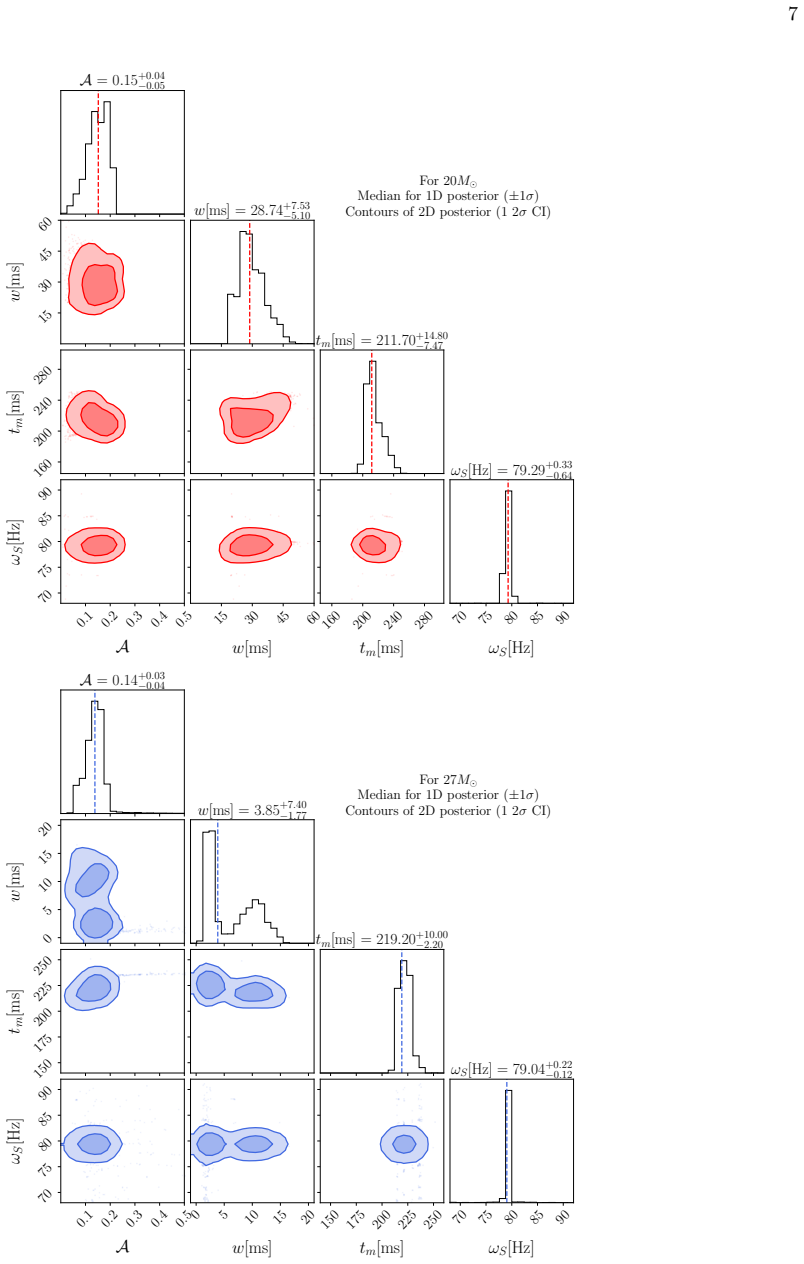
The SASI activity reaches its maximum aroundt m ≃212ms for 20M ⊙ and tm ≃219ms for 27M ⊙
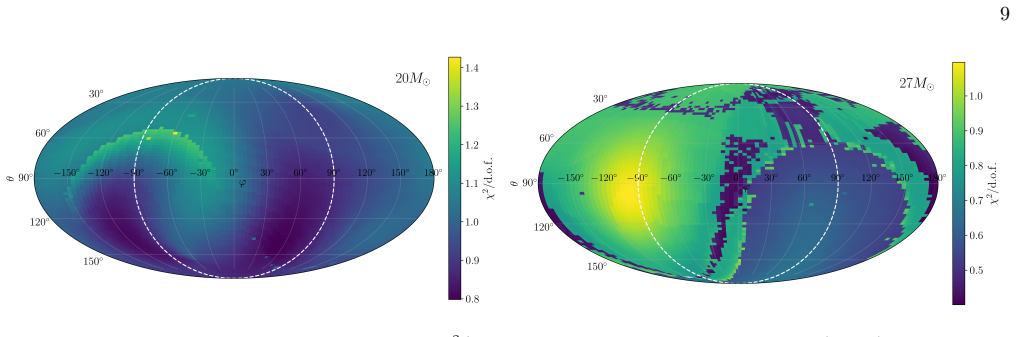
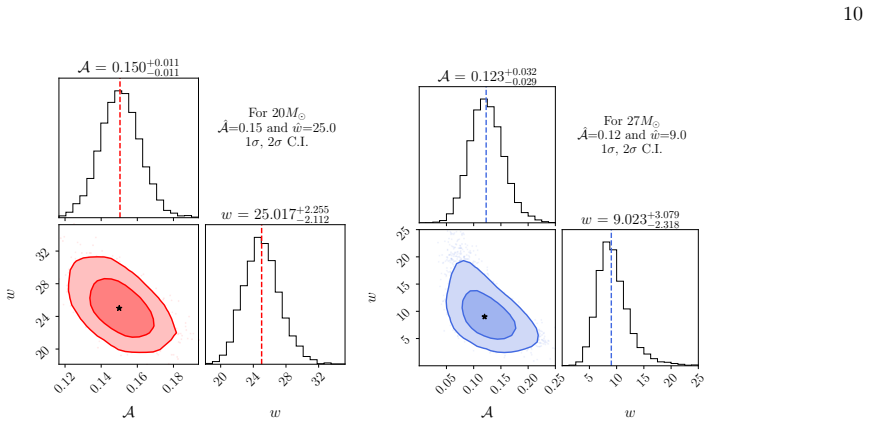
The distributions oftm andω S are sharply peaked for both models. The SASI activity reaches its maximum aroundt m ≃212ms for 20M ⊙ and tm ≃219ms for 27M ⊙. The frequency distribution is peaked nearωS ≃79Hz in both cases, consistent 7 A = 0 .15+0.04 −0.05 15 30 45 60 w[ms] w[ms] = 28 .74+7.53 −5.10 160 200 240 280 tm[ms] tm[ms] = 211 .70+14.80 −7.47 0.1 0....
-
[4]
The spread inA across viewing directions indicates that the inferred amplitude modulation depends on the line-of-sight projection with respect to the SASI spiral plane
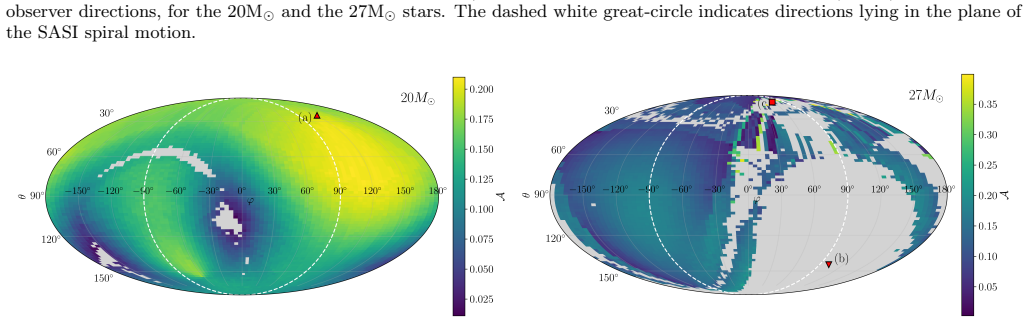
The distribution of amplitudeAis centered around 0.15 for 20M⊙ and 0.14 for 27M⊙, with larger val- ues occurring less frequently. The spread inA across viewing directions indicates that the inferred amplitude modulation depends on the line-of-sight projection with respect to the SASI spiral plane
-
[5]
For 20M⊙, the distribution is broad and peaked near 29 ms, indicating a longer duration of SASI-modulation
The posterior distribution ofwshows different be- havior in the two cases. For 20M⊙, the distribution is broad and peaked near 29 ms, indicating a longer duration of SASI-modulation. For 27M⊙, the dis- tribution has a sharp peak near 4 ms, suggesting that SASI-modulation is short-lived. The inferred valueofwdependsonhowtheonsetandtheabrupt termination of ...
-
[6]
This arises from directions where the modulation is weaker and not well described by a symmetric Gaussian enve- lope, causing the fit to shiftt m and broaden the inferred width
We observe that for the 27M⊙ case, the width dis- tribution has a second peak at largerw. This arises from directions where the modulation is weaker and not well described by a symmetric Gaussian enve- lope, causing the fit to shiftt m and broaden the inferred width. This second peak is likely a fitting artifact. The directions where we see this consti- t...
-
[7]
Gaussian Likelihood and Fisher Information We assume that the observed counts in each bin can be approximated as Gaussian-distributed around the model prediction, Ni ∼ N N th i (θ), σ 2 i ,(A3) with known variancesσ2 i. The Gaussian log-likelihood is then lnL(θ) =− 1 2 X i " Ni −N th i (θ) 2 σ2 i + ln(2πσ2 i ) # .(A4) The Fisher information matrix is defi...
-
[8]
Scaling of Diagonal Fisher Elements To derive the approximate scaling of the parameter variances, we focus on the diagonal Fisher elementsFmm and make certain assumptions as follows:
-
[9]
Furthermore,R ν(t) does not vary during the SASI period, and we treat it as a constantR0
The variance in each bin is set by the smooth signal plus background and varies slowly over the SASI envelope,σ 2 i ≃R(t i;θ) ∆t. Furthermore,R ν(t) does not vary during the SASI period, and we treat it as a constantR0
-
[10]
Under these assumptions, the overall time-dependence in eachF mm can be expressed as Gaussian integrals that determine how the Fisher element scales withA,w,t m, andω S
The envelopeG(t)is localized aroundt≃t m with width∼w, so the sums overican be approximated by integrals over a Gaussian centered attm in the limit of a large number of time bins. Under these assumptions, the overall time-dependence in eachF mm can be expressed as Gaussian integrals that determine how the Fisher element scales withA,w,t m, andω S. Substit...
-
[11]
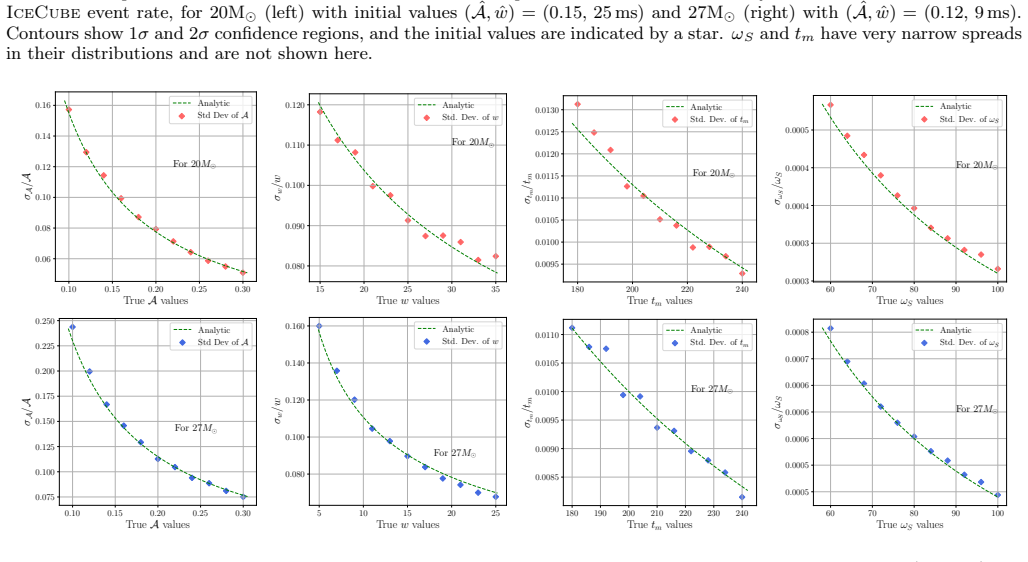
AmplitudeA: ∂R ∂A =R 0 G(t) sin(ωSt).(A10) The derivative has no explicitAdependence; the leading dependence enters through FAA = Z dt R0G2(t) sin2(ωSt) 1 +a .(A11) We are in the regime whereA<1and|sin| ≤1, so we expand1/(1 +a)≈1−a+a 2 +. . .. Keeping the leading term gives, FAA = √π 2 R0w h 1−ycos(2t mωS) i .(A12) Thus, from Eq.A7 we obtain σA ≃ 1√FAA .(...
-
[12]
Widthw: ∂R ∂w =R 0 AG(t) sin(ω St) (t−t m)2 w3 .(A15) The corresponding Fisher element is Fww = Z dt R0a2(t−t m)4 w6(1 +a) .(A16) Keeping the leading term in the denominator ex- pansion and evaluating the Gaussian integral using Mathematicagives, Fww = x 4 6−2y 4w4ωS 4 −12w 2ωS 2 + 3 cos(2tmωS) .(A17) Fory≪1, the second term can be neglected. Thus, Fww ≈3...
-
[13]
Max-timet m: ∂R ∂tm =R 0 AG(t) sin(ω St) (t−t m) w2 ,(A20) leading to the Fisher element, Ftmtm = Z dt R0a2(t−t m)2 w4(1 +a) .(A21) At leading order, we get Ftmtm =x h 1+y(2w 2ωS 2 −1) cos(2tmωS) i .(A22) Neglecting theyterm, there is no explicit depen- dence ont m itself (whent m is well within the SASI active period). Therefore,F tmtm ≈xand, σtm ≃ 1p Ft...
-
[14]
SASI frequencyωS: ∂R ∂ωS =R 0 AG(t)tcos(ω St).(A25) Thus, the Fisher element is FωS ωS = Z dt R0t2(A2G2(t)−a 2) (1 +a) .(A26) Keeping the leading term inA, the integral be- comes, FωS ωS =xw 2 (2t2 m +w 2) +y (2t2 m +w 2 −2ω S 2w4) cos(2tmωS) −4ω Stmw2 sin(2tmωS) .(A27) For fixedA,t m, andw, the sine and cosine terms are suppressed byy. Hence,F ωS ωS ≈x w...
-
[15]
H. T. Janka,Neutrino Emission from Supernovae, 1702.08713
-
[16]
G. G. Raffelt,Stars as Laboratories for Fundamental Physics. University of Chicago Press, Chicago, IL, 1996
1996
-
[17]
H. T. Janka, T. Melson and A. Summa,Physics of Core-Collapse Supernovae in Three Dimensions: a Sneak Preview,Ann. Rev. Nucl. Part. Sci.66(2016) 341 [1602.05576]
Pith/arXiv arXiv 2016
-
[18]
H.-T. Janka, K. Langanke, A. Marek, G. Martinez-Pinedo and B. Mueller,Theory of Core-Collapse Supernovae,Phys. Rept.442(2007) 38 [astro-ph/0612072]
Pith/arXiv arXiv 2007
-
[19]
K. Rozwadowska, F. Vissani and E. Cappellaro,On the rate of core collapse supernovae in the milky way,New Astron.83(2021) 101498 [2009.03438]
arXiv 2021
-
[20]
R. M. Bionta,Observation of a neutrino burst in coincidence with supernova 1987a in the large magellanic cloud,Phys. Rev. Lett.58(1987) 1494
1987
-
[21]
K. S. Hirata et al.,Observation in the Kamiokande-II Detector of the Neutrino Burst from Supernova SN 1987a,Phys. Rev. D38(1988) 448. [8]Kamiokande-IIcollaboration, K. Hirata et al., Observation of a Neutrino Burst from the Supernova SN 1987a,Phys. Rev. Lett.58(1987) 1490
1988
-
[22]
Alexeyev, L
E. Alexeyev, L. Alexeyeva, I. Krivosheina and V. Volchenko,Detection of the neutrino signal from SN 1987A in the LMC using the INR Baksan underground scintillation telescope,Physics Letters B205(1988) 209
1988
-
[23]
Burrows and J
A. Burrows and J. M. Lattimer,Neutrinos from SN 1987A,Astrophys. J. Lett.318(1987) L63
1987
-
[24]
W. D. Arnett, J. N. Bahcall, R. P. Kirshner and S. E. Woosley,Supernova 1987a,Annual Review of Astronomy and Astrophysics27(1989) 629
1989
-
[25]
Herant and W
M. Herant and W. Benz,Hydrodynamical instabilities and mixing in sn 1987a - two-dimensional simulations of the first 3 months,The Astrophysical Journal370 (1991) L81
1991
-
[26]
F. Vissani and G. Pagliaroli,How much can we learn from SN1987A events?Or: An analysis with a two-Component model for the antineutrino signal, pp. 215–231, 7, 2008,0807.1301
Pith/arXiv arXiv 2008
-
[27]
V. P. Utrobin, A. Wongwathanarat, H.-T. Janka and E. Müller,Supernova 1987a: neutrino-driven explosions in three dimensions and light curves,Astronomy and Astrophysics581(2015) A40
2015
-
[28]
D. F. G. Fiorillo, M. Heinlein, H.-T. Janka, G. Raffelt, E. Vitagliano and R. Bollig,Supernova simulations confront SN 1987A neutrinos,Phys. Rev. D108(2023) 083040 [2308.01403]
arXiv 2023
-
[29]
S. W. Li, J. F. Beacom, L. F. Roberts and F. Capozzi, Old data, new forensics: The first second of SN 1987A neutrino emission,Phys. Rev. D109(2024) 083025 [2306.08024]. [17]IceCubecollaboration, R. Abbasi et al.,IceCube Sensitivity for Low-Energy Neutrinos from Nearby Supernovae,Astron. Astrophys.535(2011) A109 [1108.0171]. [18]IceCubecollaboration, M. G....
arXiv 2024
-
[30]
S. M. Adams, C. S. Kochanek, J. F. Beacom, M. R. Vagins and K. Z. Stanek,Observing the Next Galactic Supernova,Astrophys. J.778(2013) 164 [1306.0559]
Pith/arXiv arXiv 2013
-
[31]
S. W. Li, L. F. Roberts and J. F. Beacom,Exciting Prospects for Detecting Late-Time Neutrinos from Core-Collapse Supernovae,Phys. Rev. D103(2021) 023016 [2008.04340]
arXiv 2021
-
[32]
A. Mirizzi, I. Tamborra, H.-T. Janka, N. Saviano, K. Scholberg, R. Bollig et al.,Supernova Neutrinos: Production, Oscillations and Detection,Riv. Nuovo Cim.39(2016) 1 [1508.00785]
Pith/arXiv arXiv 2016
-
[33]
G. G. Raffelt, H.-T. Janka and D. F. G. Fiorillo, Neutrinos from core-collapse supernovae, 9, 2025, 2509.16306
arXiv 2025
-
[34]
Fryxell, K
B. Fryxell, K. Olson, P. Ricker, F. X. Timmes, M. Zingale, D. Q. Lamb et al.,Flash: An adaptive mesh hydrodynamics code for modeling astrophysical thermonuclear flashes,The Astrophysical Journal Supplement Series131(2000) 273
2000
-
[35]
M. Rampp and H. T. Janka,Radiation hydrodynamics with neutrinos: Variable Eddington factor method for core collapse supernova simulations,Astron. Astrophys. 396(2002) 361 [astro-ph/0203101]
Pith/arXiv arXiv 2002
-
[36]
M. Liebendoerfer, O. E. B. Messer, A. Mezzacappa, S. W. Bruenn, C. Y. Cardall and F. K. Thielemann,A Finite difference representation of neutrino radiation hydrodynamics for spherically symmetric general relativistic supernova simulations,Astrophys. J. Suppl. 150(2004) 263 [astro-ph/0207036]
Pith/arXiv arXiv 2004
-
[37]
R. Buras, M. Rampp, H. T. Janka and K. Kifonidis, Two-dimensional hydrodynamic core-collapse supernova simulations with spectral neutrino transport. 1. Numerical method and results for a 15 solar mass star, Astron. Astrophys.447(2006) 1049 [astro-ph/0507135]
Pith/arXiv arXiv 2006
-
[38]
Fischer, S
T. Fischer, S. C. Whitehouse, A. Mezzacappa, F.-K. Thielemann and M. Liebendörfer,Protoneutron star evolution and the neutrino-driven wind in general relativistic neutrino radiation hydrodynamics simulations,Astronomy and Astrophysics517(2010) 14 A80
2010
-
[39]
M. A. Skinner, J. C. Dolence, A. Burrows, D. Radice and D. Vartanyan,Fornax: a Flexible Code for Multiphysics Astrophysical Simulations,Astrophys. J. Suppl.241(2019) 7 [1806.07390]
Pith/arXiv arXiv 2019
-
[40]
S. W. Bruenn et al.,CHIMERA: A Massively Parallel Code for Core-collapse Supernova Simulations, Astrophys. J. Suppl.248(2020) 11 [1809.05608]
arXiv 2020
-
[41]
O’Connor et al.,Global Comparison of Core-Collapse Supernova Simulations in Spherical Symmetry,J
E. O’Connor et al.,Global Comparison of Core-Collapse Supernova Simulations in Spherical Symmetry,J. Phys. G45(2018) 104001 [1806.04175]
Pith/arXiv arXiv 2018
-
[42]
H. Nagakura, A. Burrows, D. Vartanyan and D. Radice, Core-collapse supernova neutrino emission and detection informed by state-of-the-art three-dimensional numerical models,Mon. Not. Roy. Astron. Soc.500 (2020) 696 [2007.05000]
arXiv 2020
- [43]
-
[44]
T. Foglizzo,Non-radial instabilities of isothermal Bondi accretion with a shock: Vortical-acoustic cycle versus post-shock acceleration,Astron. Astrophys.392(2002) 353 [astro-ph/0206274]
Pith/arXiv arXiv 2002
-
[45]
J. M. Blondin, A. Mezzacappa and C. DeMarino, Stability of standing accretion shocks, with an eye toward core collapse supernovae,Astrophys. J.584 (2003) 971 [astro-ph/0210634]
Pith/arXiv arXiv 2003
-
[46]
N. Ohnishi, K. Kotake and S. Yamada,Numerical analysis on standing accretion shock instability with neutrino heating in the supernova cores,Astrophys. J. 641(2006) 1018 [astro-ph/0509765]
Pith/arXiv arXiv 2006
-
[47]
J. M. Blondin and A. Mezzacappa,Pulsar spins from an instability in the accretion shock of supernovae, Nature445(2007) 58 [astro-ph/0611680]
Pith/arXiv arXiv 2007
-
[48]
J. M. Blondin and S. Shaw,Linear growth of spiral sasi modes in core-collapse supernovae,The Astrophysical Journal656(2007) 366
2007
-
[49]
L. Scheck, H. T. Janka, T. Foglizzo and K. Kifonidis, Multidimensional supernova simulations with approximative neutrino transport. II. Convection and the advective-acoustic cycle in the supernova core, Astron. Astrophys.477(2008) 931 [0704.3001]
Pith/arXiv arXiv 2008
-
[50]
W. Iwakami, K. Kotake, N. Ohnishi, S. Yamada and K. Sawada,Three-Dimensional Simulations of Standing Accretion Shock Instability in Core-Collapse Supernovae,Astrophys. J.678(2008) 1207 [0710.2191]
Pith/arXiv arXiv 2008
-
[51]
W. Iwakami, K. Kotake, N. Ohnishi, S. Yamada and K. Sawada,Effects of Rotation on Standing Accretion Shock Instability in Nonlinear Phase for Core-Collapse Supernovae,Astrophys. J.700(2009) 232 [0811.0651]
Pith/arXiv arXiv 2009
-
[52]
Fernandez,The Spiral Modes of the Standing Accretion Shock Instability,Astrophys
R. Fernandez,The Spiral Modes of the Standing Accretion Shock Instability,Astrophys. J.725(2010) 1563 [1003.1730]
Pith/arXiv arXiv 2010
-
[53]
F. Hanke, A. Marek, B. Muller and H.-T. Janka,Is Strong SASI Activity the Key to Successful Neutrino-Driven Supernova Explosions?,Astrophys. J. 755(2012) 138 [1108.4355]
Pith/arXiv arXiv 2012
-
[54]
T. Foglizzo, P. Galletti, L. Scheck and H. T. Janka, Instability of a stalled accretion shock: evidence for the advective-acoustic cycle,Astrophys. J.654(2007) 1006 [astro-ph/0606640]
Pith/arXiv arXiv 2007
-
[55]
Foglizzo, F
T. Foglizzo, F. Masset, J. Guilet and G. Durand, Shallow water analogue of the standing accretion shock instability: Experimental demonstration and a two-dimensional model,Physical Review Letters108 (2012)
2012
-
[56]
I. Tamborra, F. Hanke, B. Müller, H.-T. Janka and G. Raffelt,Neutrino signature of supernova hydrodynamical instabilities in three dimensions,Phys. Rev. Lett.111(2013) 121104 [1307.7936]
Pith/arXiv arXiv 2013
-
[57]
F. Hanke, B. Müller, A. Wongwathanarat, A. Marek and H.-T. Janka,SASI Activity in Three-Dimensional Neutrino-Hydrodynamics Simulations of Supernova Cores,Astrophys. J.770(2013) 66 [1303.6269]
Pith/arXiv arXiv 2013
-
[58]
Hanke,Two- and Three-Dimensional Simulations of Core-Collapse Supernova Explosions of Massive Stars Applying Neutrino Hydrodynamics, Ph.D
F. Hanke,Two- and Three-Dimensional Simulations of Core-Collapse Supernova Explosions of Massive Stars Applying Neutrino Hydrodynamics, Ph.D. thesis, Max-Planck-Institut für Astrophysik, Germany, 2014
2014
-
[59]
B. Müller and H.-T. Janka,A New Multi-Dimensional General Relativistic Neutrino Hydrodynamics Code for Core-Collapse Supernovae IV. The Neutrino Signal, Astrophys. J.788(2014) 82 [1402.3415]
Pith/arXiv arXiv 2014
-
[60]
I. Tamborra, F. Hanke, H.-T. Janka, B. Müller, G. G. Raffelt and A. Marek,Self-sustained asymmetry of lepton-number emission: A new phenomenon during the supernova shock-accretion phase in three dimensions, Astrophys. J.792(2014) 96 [1402.5418]
Pith/arXiv arXiv 2014
-
[61]
I. Tamborra, G. Raffelt, F. Hanke, H.-T. Janka and B. Mueller,Neutrino emission characteristics and detection opportunities based on three-dimensional supernova simulations,Phys. Rev. D90(2014) 045032 [1406.0006]
Pith/arXiv arXiv 2014
-
[62]
D. Vartanyan, A. Burrows and D. Radice,Temporal and Angular Variations of 3D Core-Collapse Supernova Emissions and their Physical Correlations,Mon. Not. Roy. Astron. Soc.489(2019) 2227 [1906.08787]
arXiv 2019
-
[63]
L. Choi, A. Burrows and D. Vartanyan,Predicted neutrino signal features of core-collapse supernovae, Phys. Rev. D111(2025) 123038 [2503.07531]
arXiv 2025
-
[64]
B. Müller,Hydrodynamics of core-collapse supernovae and their progenitors,Astrophysics6(2020) 3 [2006.05083]
arXiv 2020
-
[65]
F. Halzen, J. E. Jacobsen and E. Zas,Ultratransparent Antarctic ice as a supernova detector,Phys. Rev. D53 (1996) 7359 [astro-ph/9512080]
Pith/arXiv arXiv 1996
-
[66]
Köpke,Supernova neutrino detection with icecube, Journal of Physics: Conference Series309(2011) 012029
L. Köpke,Supernova neutrino detection with icecube, Journal of Physics: Conference Series309(2011) 012029
2011
-
[67]
T. Lund, A. Marek, C. Lunardini, H.-T. Janka and G. Raffelt,Fast time variations of supernova neutrino fluxes and their detectability,Phys. Rev. D82(2010) 063007 [1006.1889]. [65]IceCube-Gen2collaboration, J. Beise,Prospects for the Detection of the Standing Accretion Shock Instability in IceCube-Gen2,PoST AUP2023(2024) 159 [2311.08898]
Pith/arXiv arXiv 2010
- [68]
-
[69]
Z. Lin, C. Lunardini, M. Zanolin, K. Kotake and C. Richardson,Detectability of standing accretion shock instabilities activity in supernova neutrino signals, Phys. Rev. D101(2020) 123028 [1911.10656]
arXiv 2020
-
[70]
Kuroda, K
T. Kuroda, K. Kotake, K. Hayama and T. Takiwaki, Correlated signatures of gravitational-wave and neutrino emission in three-dimensional general-relativistic core-collapse supernova simulations,The Astrophysical Journal851(2017) 62
2017
-
[71]
Z. Lin, A. Rijal, C. Lunardini, M. D. Morales and M. Zanolin,Characterizing a supernova’s standing accretion shock instability with neutrinos and gravitational waves,Phys. Rev. D107(2023) 083017 15 [2211.07878]
arXiv 2023
-
[72]
A. Mezzacappa, M. Liebendoerfer, O. E. B. Messer, W. R. Hix, F.-K. Thielemann and S. W. Bruenn,The Simulation of a spherically symmetric supernova of a 13 solar mass star with Boltzmann neutrino transport, and its implications for the supernova mechanism,Phys. Rev. Lett.86(2001) 1935 [astro-ph/0005366]
Pith/arXiv arXiv 2001
-
[73]
M. Rampp and H. T. Janka,Spherically symmetric simulation with Boltzmann neutrino transport of core collapse and post bounce evolution of a 15 solar mass star,Astrophys. J. Lett.539(2000) L33 [astro-ph/0005438]
Pith/arXiv arXiv 2000
-
[74]
H. A. Bethe,Supernova mechanisms,Rev. Mod. Phys. 62(1990) 801
1990
-
[75]
Janka, F
H.-T. Janka, F. Hanke, L. Huedepohl, A. Marek, B. Mueller and M. Obergaulinger,Core-collapse supernovae: Reflections and directions,Progress of Theoretical and Experimental Physics2012(2012)
2012
-
[76]
Burrows,Colloquium: Perspectives on core-collapse supernova theory,Rev
A. Burrows,Colloquium: Perspectives on core-collapse supernova theory,Rev. Mod. Phys.85(2013) 245 [1210.4921]
Pith/arXiv arXiv 2013
-
[77]
The Garching Core-Collapse Supernova Archive
Max Planck Institute for Astrophysics, “The Garching Core-Collapse Supernova Archive.” https://wwwmpa.mpa-garching.mpg.de/ccsnarchive/
-
[78]
H.-T. Janka. Personal correspondence, June, 2024
2024
-
[79]
E. Muller, H. T. Janka and A. Wongwathanarat, Parametrized 3D models of neutrino-driven supernova explosions: Neutrino emission asymmetries and gravitational-wave signals,Astron. Astrophys.537 (2012) A63 [1106.6301]. [78]IceCubecollaboration, M. G. Aartsen et al.,Energy Reconstruction Methods in the IceCube Neutrino Telescope,JINST9(2014) P03009 [1311.4767]
Pith/arXiv arXiv 2012
-
[80]
D. F. Heereman von Zuydtwyck,HitSpooling: An Improvement for the Supernova Neutrino Detection System in IceCube, Ph.D. thesis, U. Brussels (main), 2015
2015
discussion (0)
Sign in with ORCID, Apple, or X to comment. Anyone can read and Pith papers without signing in.