REVIEW 2 major objections 2 minor 29 references
High-resolution detection of reflected light from the exo-Neptune LTT-9779 b
T0 review · 2 major / 2 minor · reviewed 2026-07-01 · grok-4.3
Pith's one-line read High-resolution spectroscopy with ESPRESSO detects reflected light from the ultra-hot exo-Neptune LTT-9779 b at 102 ppm planet-to-star flux ratio.
desk verdict The paper reports a new 5.4σ CCF detection of reflected light from LTT-9779 b giving Fp/F* ~102 ppm and Ag~0.88, consistent with prior photometry, but the modest significance and reliance on an unvalidated theoretical kernel leave the result vulnerable to systematics. read the letter →
The pith
A machine-rendered reading of the paper's core claim, the machinery that carries it, and where it could break.
The reading
What carries the argument
Cross-correlation of the observed spectra with a theoretical reflection kernel that encodes the wavelength-dependent shape and Doppler-shifted morphology of the planetary reflected-light signal.
What would settle it
An independent dataset from another high-resolution spectrograph that fails to recover a cross-correlation peak with the same radial-velocity semi-amplitude and equivalent-width ratio would indicate the signal is not planetary reflection.
Extended reading notes
Core claim
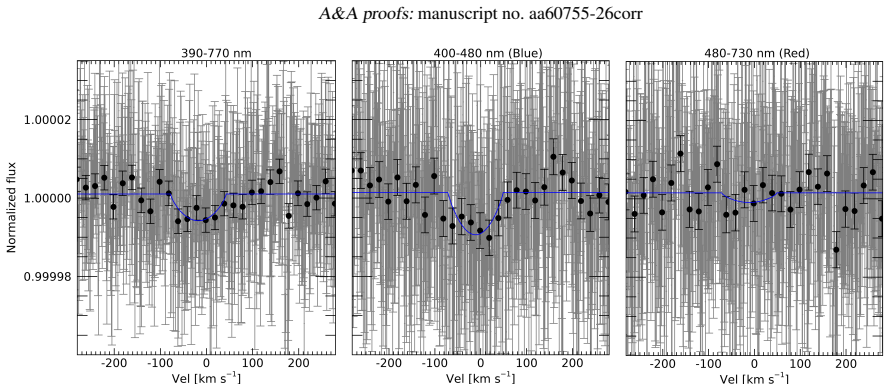
By combining multiple epochs of ESPRESSO 4UT data and cross-correlating with a theoretical reflection kernel, the authors identify a planetary signal whose kinematic and morphological properties match the expected reflected-light profile. The ratio of equivalent widths between the planetary and stellar cross-correlation functions yields Fp/F⋆ = 102+29−30 ppm in the 380–770 nm band; assuming a Lambertian phase function, this corresponds to Ag = 0.88 ± 0.25. The albedo is consistent with prior space-based photometry and shows stronger reflectivity at shorter wavelengths.
Load-bearing premise
The cross-correlation peak must originate from planetary reflected light rather than residual stellar activity, instrumental systematics, or noise, and the adopted reflection kernel must correctly reproduce the wavelength dependence of the planetary signal.
Editorial extensions
If this is right
- The measured geometric albedo agrees with previous space-based photometric measurements.
- Reflectivity increases toward blue wavelengths within the observed range.
- Detailed atmospheric characterization from the reflected-light spectrum alone remains beyond current sensitivity.
- The detection illustrates the capability of future high-resolution spectrographs on extremely large telescopes for reflected-light studies of additional exoplanets.
Reading between the lines
- The same cross-correlation approach could be tested on cooler or smaller planets once larger collecting areas become available.
- A high albedo may trace high-altitude clouds or Rayleigh scattering that could be compared across the broader exoplanet population.
- Separating reflected light from thermal emission opens a route to joint retrievals that constrain both scattering and temperature structure.
Signed reviews
Editorial analysis
A structured set of objections, weighed in public.
Referee Report
Summary. The manuscript reports the detection of reflected starlight from the ultra-hot exo-Neptune LTT-9779 b via high-resolution spectroscopy with ESPRESSO in 4UT mode. Multiple epochs are combined and cross-correlated against a theoretical reflection kernel, yielding a signal at SNR ∼5.4 whose RV semi-amplitude matches the expected orbital motion. The planet-to-star flux ratio is measured as Fp/F⋆ = 102+29−30 ppm (380–770 nm) from the ratio of equivalent widths of the planetary and stellar CCFs; assuming a Lambertian phase function this implies Ag = 0.88 ± 0.25. The result is stated to be consistent with prior space-based photometry and suggestive of a highly reflective atmosphere.
Significance. If the detection holds after rigorous validation, the work would constitute a notable technical achievement: high-resolution reflected-light detections remain rare, and extending the technique to Neptune-sized planets with modest SNR demonstrates the viability of ESPRESSO 4UT observations and the promise of future ELT instruments. The direct consistency check against existing photometry is a strength. The modest SNR, however, means the immediate scientific impact on atmospheric characterization is limited.
major comments (2)
- [Abstract] Abstract: the central flux-ratio measurement (Fp/F⋆ = 102+29−30 ppm) is obtained from the ratio of equivalent widths after cross-correlation with a single theoretical reflection kernel; the manuscript provides no quantitative test (kernel-mismatch simulations or injected-signal recovery) that the kernel reproduces the wavelength-dependent line depths and continuum shape across 380–770 nm, which is load-bearing for converting the CCF amplitude into a physical albedo.
- [Abstract] Abstract: at the reported SNR of only ∼5.4, the claim that the CCF peak arises from planetary reflected light rather than residual stellar activity, tellurics, or ESPRESSO 4UT systematics aligned with the planetary RV curve requires explicit null-hypothesis CCF maps or activity-indicator checks; these are not described and are essential given the modest significance.
minor comments (2)
- [Abstract] The abstract states that 'reflectivity is enhanced towards blue wavelengths' but supplies neither a quantitative wavelength-dependent measurement nor a reference to the supporting figure or table.
- [Abstract] The wavelength range 380–770 nm is quoted for the flux ratio; it would be helpful to state the exact number of spectral orders or pixels retained after masking.
Simulated Author's Rebuttal
We thank the referee for their constructive feedback. We address the two major comments below and will revise the manuscript to incorporate the requested validation tests.
read point-by-point responses
-
Referee: [Abstract] Abstract: the central flux-ratio measurement (Fp/F⋆ = 102+29−30 ppm) is obtained from the ratio of equivalent widths after cross-correlation with a single theoretical reflection kernel; the manuscript provides no quantitative test (kernel-mismatch simulations or injected-signal recovery) that the kernel reproduces the wavelength-dependent line depths and continuum shape across 380–770 nm, which is load-bearing for converting the CCF amplitude into a physical albedo.
Authors: We agree that quantitative validation of the reflection kernel is important for the robustness of the derived flux ratio. In the revised manuscript we will add kernel-mismatch simulations and injected-signal recovery tests across the ESPRESSO 380–770 nm bandpass to demonstrate that the kernel reproduces the relevant line depths and continuum shape. revision: yes
-
Referee: [Abstract] Abstract: at the reported SNR of only ∼5.4, the claim that the CCF peak arises from planetary reflected light rather than residual stellar activity, tellurics, or ESPRESSO 4UT systematics aligned with the planetary RV curve requires explicit null-hypothesis CCF maps or activity-indicator checks; these are not described and are essential given the modest significance.
Authors: We acknowledge that explicit null tests are warranted at this significance level. In the revised manuscript we will include null-hypothesis CCF maps (e.g., at incorrect periods/phases) and checks against activity indicators to strengthen the case that the detected signal is planetary in origin. revision: yes
Circularity Check
No circularity: flux ratio measured directly from CCF equivalent-width ratio; albedo follows from standard Lambertian assumption
full rationale
The central result Fp/F⋆ = 102+29−30 ppm is obtained by taking the ratio of equivalent widths of the planetary and stellar cross-correlation functions after applying a fixed theoretical reflection kernel. This is a direct observational measurement, not a fitted parameter renamed as a prediction, nor a quantity defined in terms of itself. The geometric albedo Ag = 0.88 ± 0.25 is then computed from the measured flux ratio under the explicit assumption of a Lambertian phase function, which is an external modeling choice rather than a self-referential derivation. No self-citation chains, uniqueness theorems, or ansatzes imported from prior author work are invoked to justify the numerical value. The derivation chain therefore remains independent of its own outputs.
Assumptions & free parameters
free parameters (1)
- Lambertian phase function
assumptions (1)
- domain assumption Cross-correlation with a theoretical reflection kernel isolates the planetary reflected-light signal
Cite this review
Pith. "Pith review of High-resolution detection of reflected light from the exo-Neptune LTT-9779 b." pith.science (2026). https://pith.science/paper/6EJJAABC
@misc{pith2026260630793,
  author       = {Pith},
  title        = {Pith review of: High-resolution detection of reflected light from the exo-Neptune LTT-9779 b},
  year         = {2026},
  howpublished = {\url{https://pith.science/paper/6EJJAABC}},
  note         = {Machine review of arXiv:2606.30793}
}
abstract
While high-resolution spectroscopy is routinely used to probe exoplanetary atmospheres, detecting reflected starlight remains highly challenging due to the extremely low planet-to-star optical flux ratios. We report the detection of reflected light from the ultra-hot exo-Neptune LTT-9779 b using high-resolution spectroscopy with ESPRESSO in its 4UT mode. By combining multiple epochs and applying a cross-correlation analysis with a theoretical reflection kernel, we were able to identify a faint signal matching the expected morphological and kinematic profile of the planetary reflection. This signature, whose presence has been detected at a signal-to-noise ratio of $\sim$5.4, exhibits a radial velocity semi-amplitude consistent with the expected orbital motion. We measured the planet-to-star flux ratio from the ratio of the equivalent widths of the planetary and stellar cross-correlation functions, finding $F_{\mathrm{p}}/F_\star = 102^{+29}_{-30}$ ppm for the ESPRESSO 380--770 nm wavelength range. Assuming a Lambertian phase function, this corresponds to a geometric albedo of $A_{\mathrm{g}} = 0.88 \pm 0.25$. The inferred albedo is consistent with previous space-based photometric measurements, suggesting a highly reflective atmosphere potentially dominated by scattering processes or high-altitude clouds. While we show that reflectivity is enhanced towards blue wavelengths, a detailed spectroscopic characterization of the planetary atmosphere from the reflected-light signal remains out of reach. This result highlights the scientific potential of future high-resolution spectrographs on extremely large telescopes, paving the way for systematic reflected-light detections across a broader exoplanet population, including cooler and smaller planets.
Figures


Reference graph
Works this paper leans on
-
[1]
Birkby, J. L. 2018, in Handbook of Exoplanets, ed. H. J. Deeg & J. A. Belmonte
work page 2018
- [2]
-
[3]
Borra, E. F. & Deschatelets, D. 2018, MNRAS, 481, 4841
work page 2018
- [4]
- [5]
-
[6]
Charbonneau, D., Noyes, R. W., Korzennik, S. G., et al. 1999, ApJ, 522, L145 Collier Cameron, A., Horne, K., Penny, A., & James, D. 1999, Nature, 402, 751
work page 1999
-
[7]
2025, Nature Astronomy, 9, 512 Di Marcantonio, P., Morossi, C., Franchini, M., et al
Coulombe, L.-P., Radica, M., Benneke, B., et al. 2025, Nature Astronomy, 9, 512 Di Marcantonio, P., Morossi, C., Franchini, M., et al. 2019, AJ, 158, 161
work page 2025
- [8]
Show all 29 references
-
[9]
2023, AJ, 166, 158
Edwards, B., Changeat, Q., Tsiaras, A., et al. 2023, AJ, 166, 158
2023
-
[10]
M., Pont, F., Sing, D
Evans, T. M., Pont, F., Sing, D. K., et al. 2013, ApJ, 772, L16
2013
-
[11]
Gray, D. F. 2008, The Observation and Analysis of Stellar Photospheres
2008
-
[12]
J., Seidel, J
Hoeijmakers, H. J., Seidel, J. V ., Pino, L., et al. 2020, A&A, 641, A123
2020
-
[13]
J., Snellen, I
Hoeijmakers, H. J., Snellen, I. A. G., & van Terwisga, S. 2018, A&A, 610, A47
2018
-
[14]
S., Parmentier, V ., et al
Hoyer, S., Jenkins, J. S., Parmentier, V ., et al. 2023, A&A, 675, A81
2023
-
[15]
S., Díaz, M
Jenkins, J. S., Díaz, M. R., Kurtovic, N., et al. 2020, Nature Astronomy, 4, 1148
2020
-
[16]
2003, MNRAS, 344, 1271
Leigh, C., Collier Cameron, A., Horne, K., et al. 2003, MNRAS, 344, 1271
2003
-
[17]
2024, in SPIE Conf
Marconi, A., Abreu, M., Adibekyan, V ., et al. 2024, in SPIE Conf. Proc., 13096
2024
-
[18]
S., Gelino, C., Stephens, D., et al
Marley, M. S., Gelino, C., Stephens, D., et al. 1999, ApJ, 513, 879
1999
-
[19]
Martins, J. H. C., Santos, N. C., Figueira, P., et al. 2015, A&A, 576, A134
2015
-
[20]
2025, Experimental Astronomy, 59, 29
Palle, E., Biazzo, K., Bolmont, E., et al. 2025, Experimental Astronomy, 59, 29
2025
-
[21]
& Aigrain, S
Parviainen, H. & Aigrain, S. 2015, MNRAS, 453, 3821
2015
-
[22]
2021, A&A, 645, A96
Pepe, F., Cristiani, S., Rebolo, R., et al. 2021, A&A, 645, A96
2021
-
[23]
2024, ApJ, 962, L20
Radica, M., Coulombe, L.-P., Taylor, J., et al. 2024, ApJ, 962, L20
2024
-
[24]
2010, A&A, 514, A23
Rodler, F., Kürster, M., & Henning, T. 2010, A&A, 514, A23
2010
-
[25]
2021, A&A, 646, A159
Scandariato, G., Borsa, F., Sicilia, D., et al. 2021, A&A, 646, A159
2021
-
[26]
Snellen, I. A. G. 2025, ARA&A, 63, 83
2025
-
[27]
Snellen, I. A. G., de Kok, R. J., de Mooij, E. J. W., et al. 2010, Nature, 465, 1049
2010
-
[28]
F., Birkby, J
Spring, E. F., Birkby, J. L., Pino, L., et al. 2022, A&A, 659, A121 Ter Braak, C. J. F. 2006, Statistics and Computing, 16, 239
2022
-
[29]
R., Birkby, J
Vaughan, S. R., Birkby, J. L., Batalha, N. E., et al. 2026, A&A, 705, A27 Article number, page 4 F. Borsa: High-resolution detection of reflected light from the exo-Neptune LTT-9779 b Appendix A: Extended results A.1. Looking for chromatic and longitudinal variations Our analy...
2026
Reviewed July 1, 2026 · model on record in the stance chip above.
Discussion (0). Continue with ORCID to comment.