Search for New Physics through the Observables of Semileptonic B_(c)^+to D^(ast+)ell⁺ell⁻ Decay
Pith reviewed 2026-07-01 01:15 UTC · model grok-4.3
The pith
The decay B_c^+ to D^{*+} lepton pair shows sensitivity to New Physics in b to d transitions through several observables.
A machine-rendered reading of the paper's core claim, the machinery that carries it, and where it could break.
Core claim
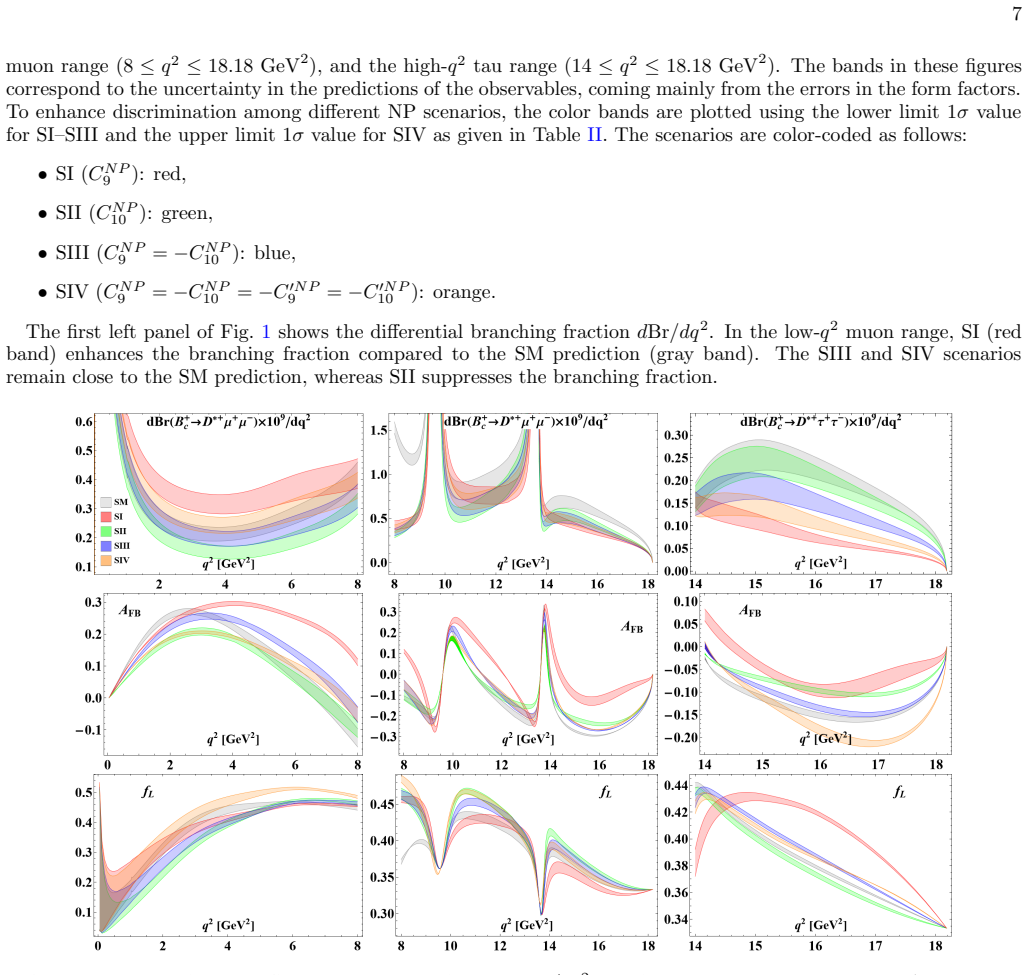
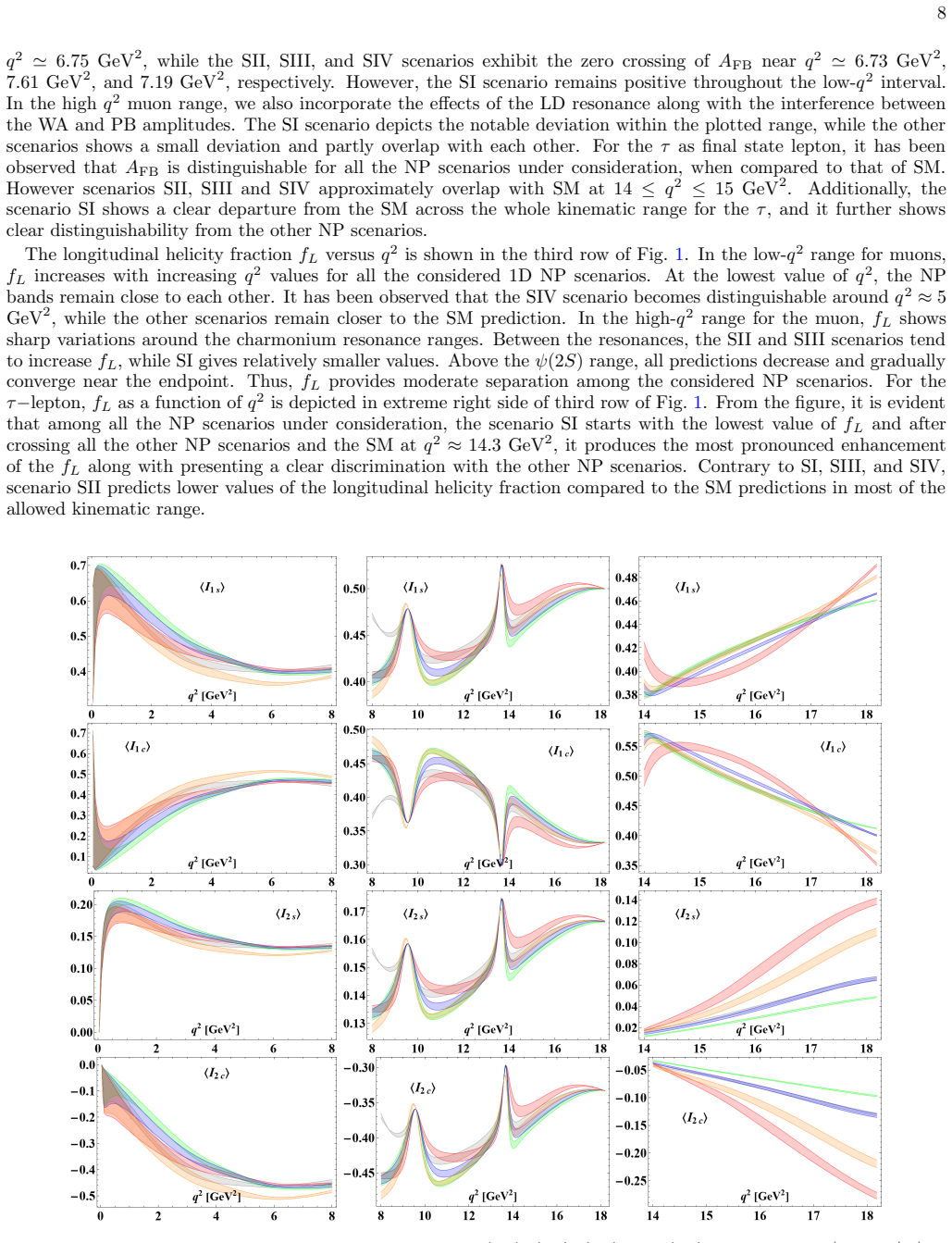
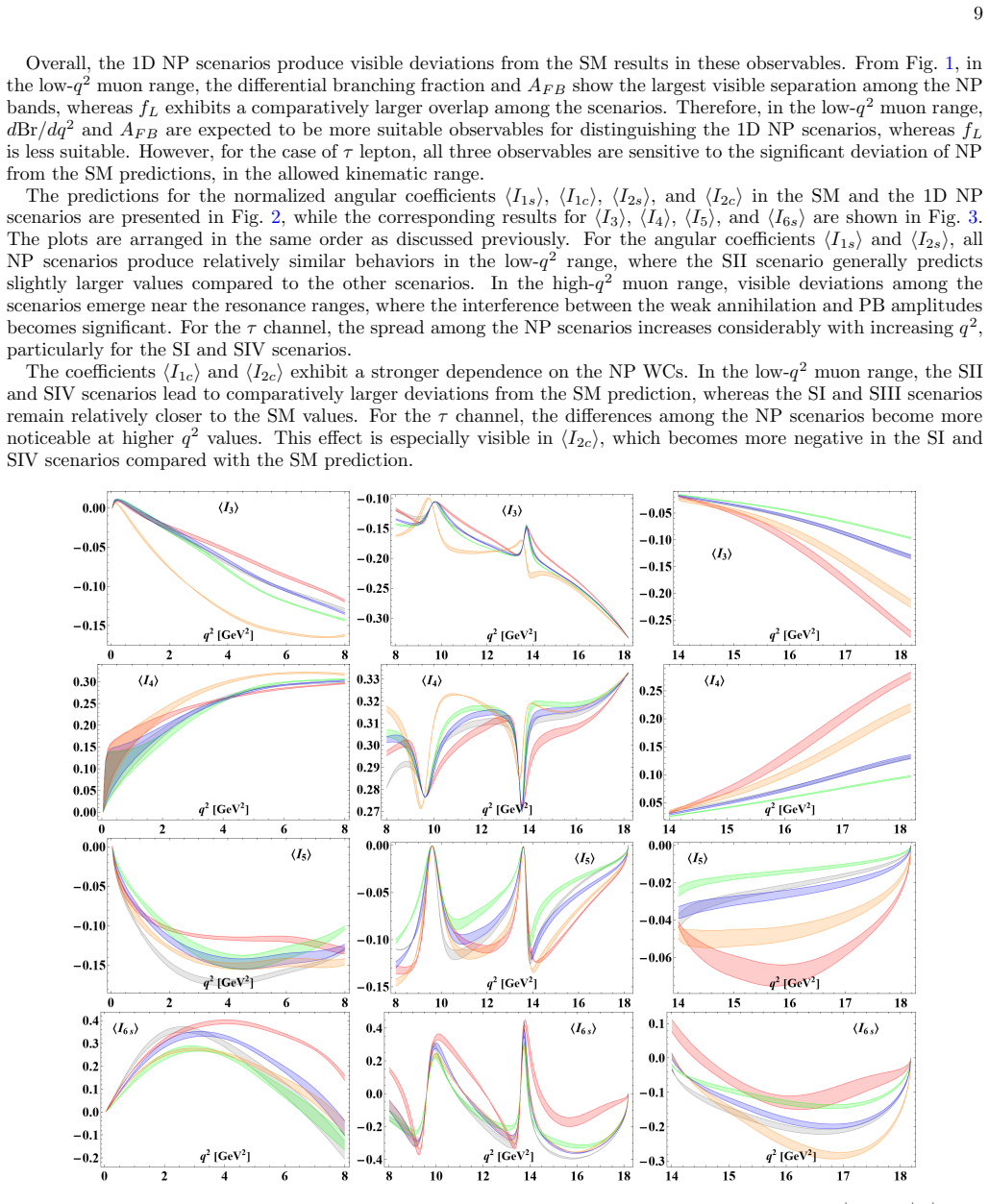
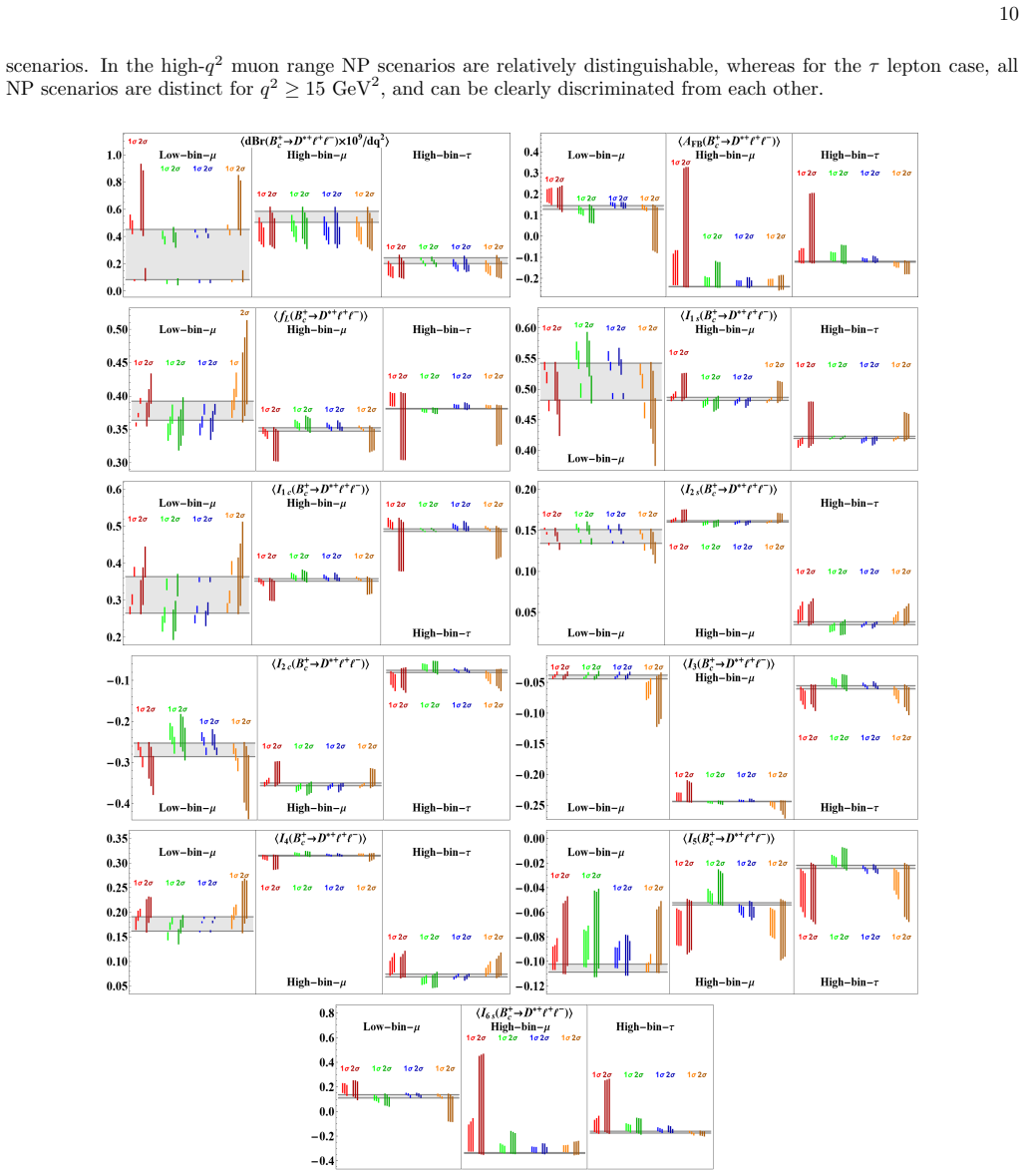
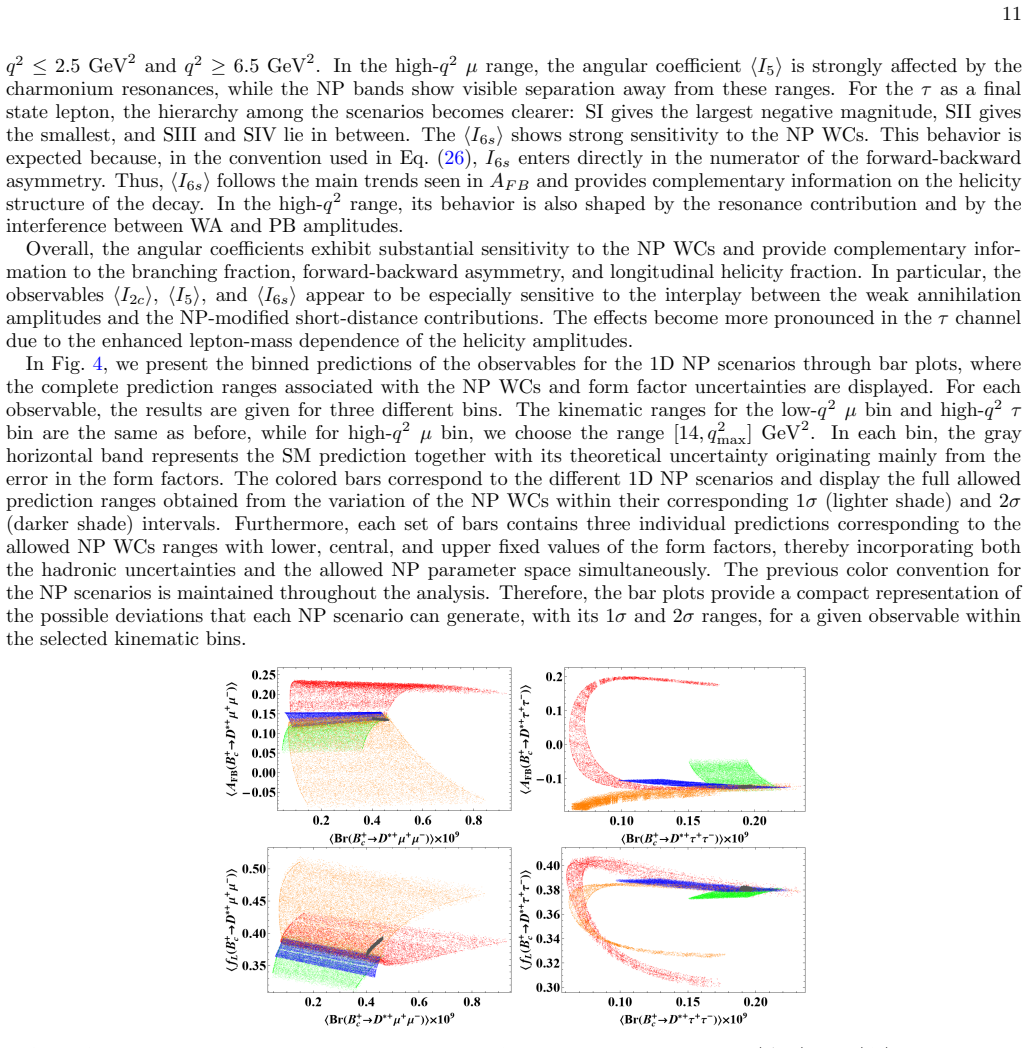
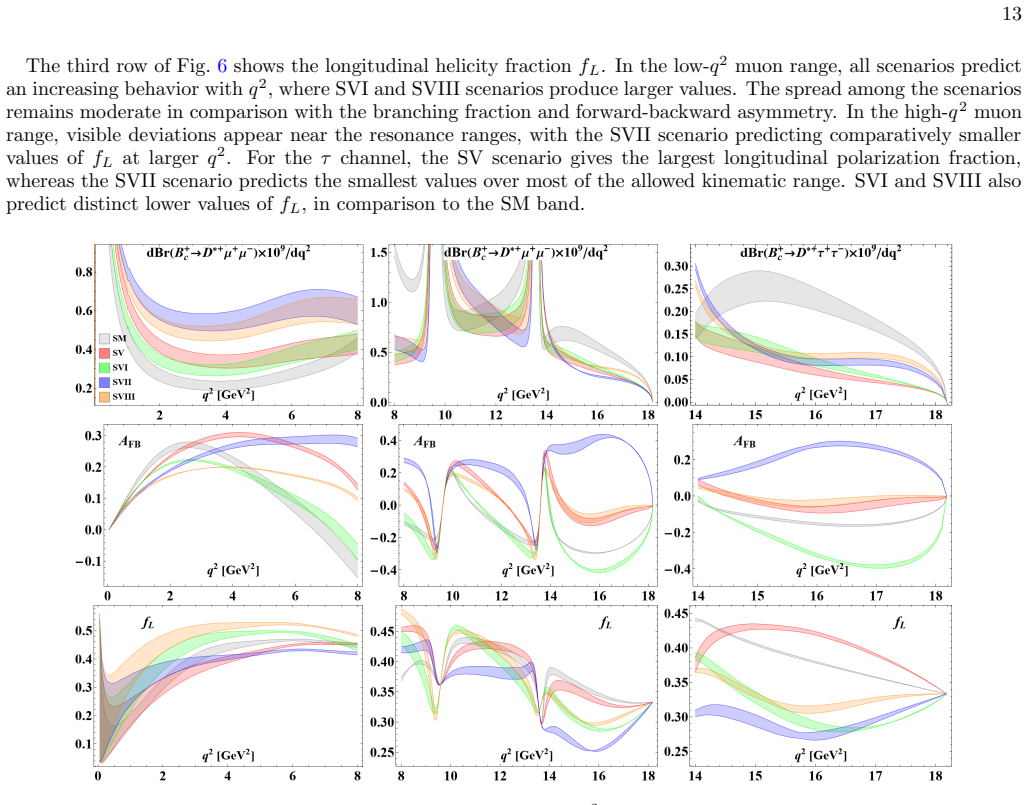
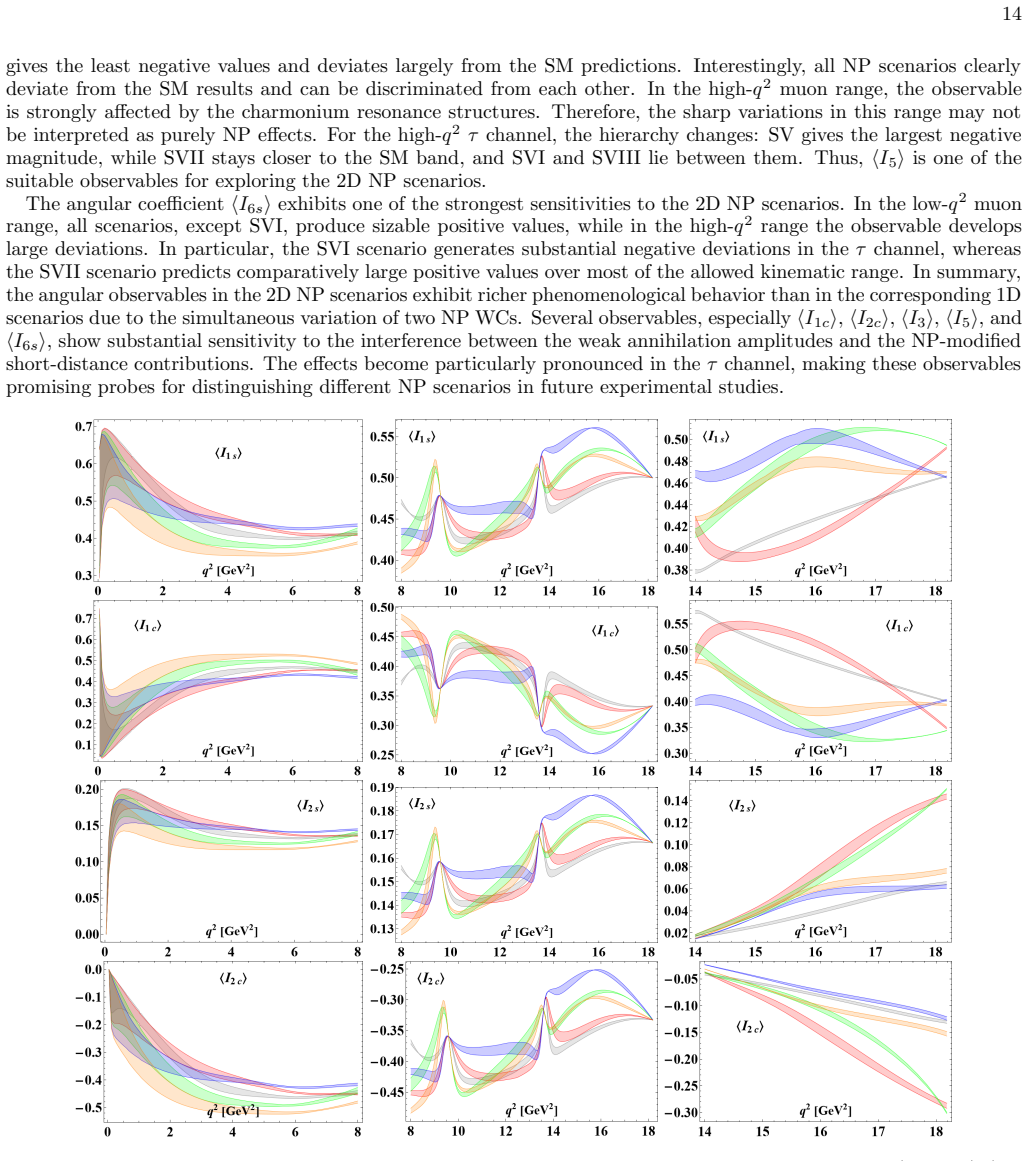
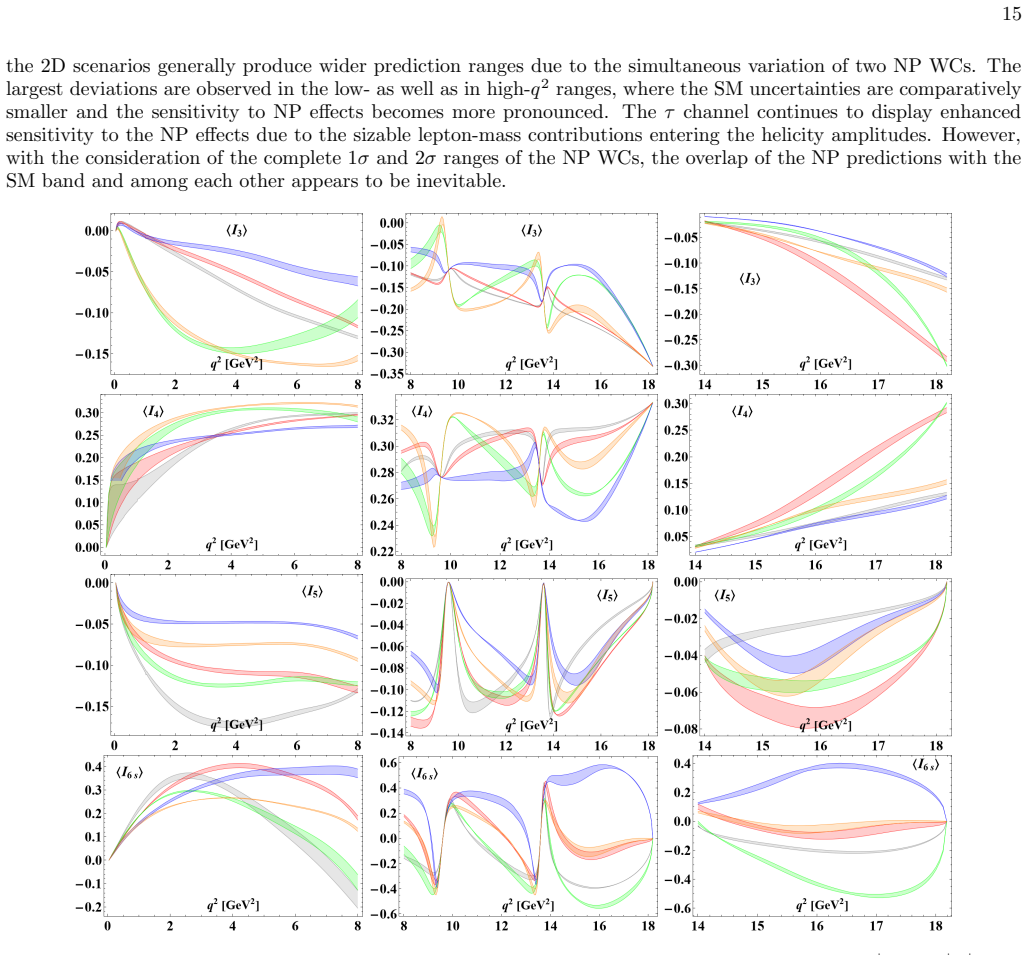
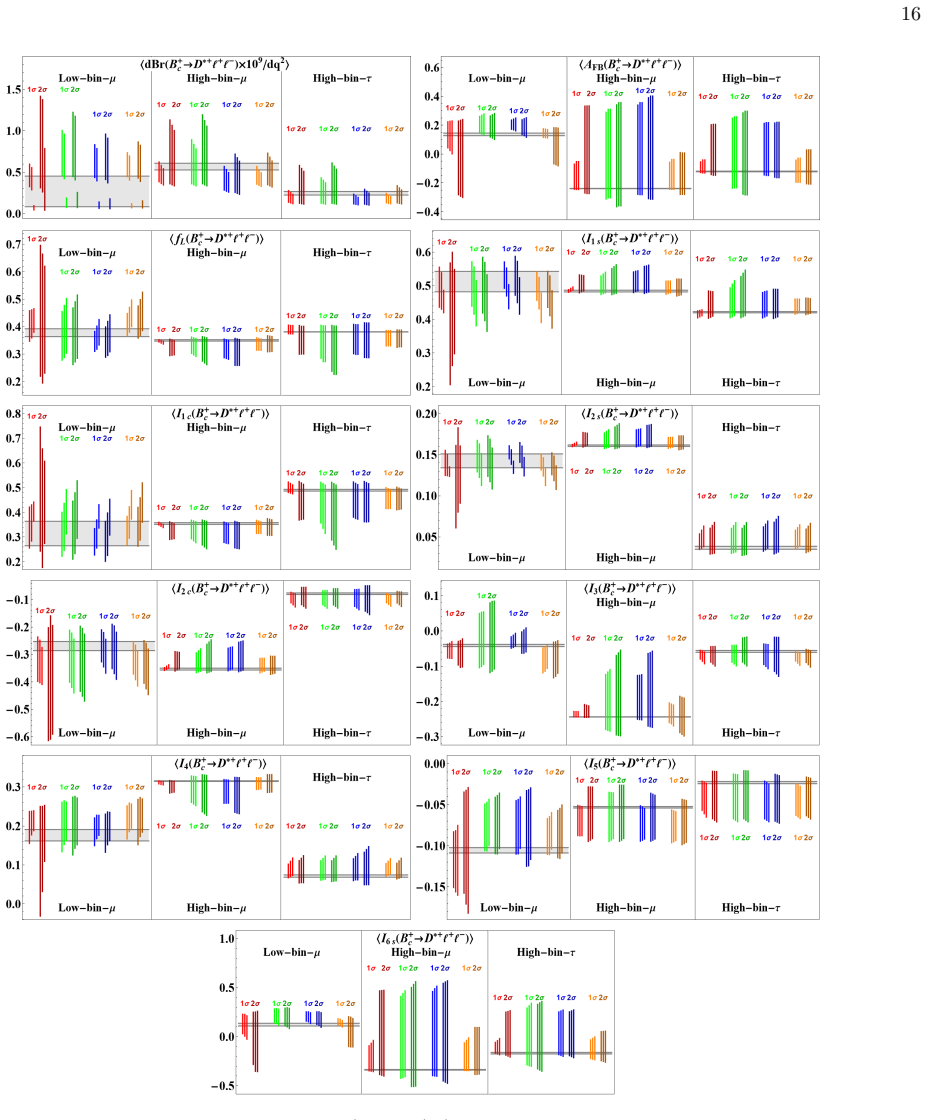
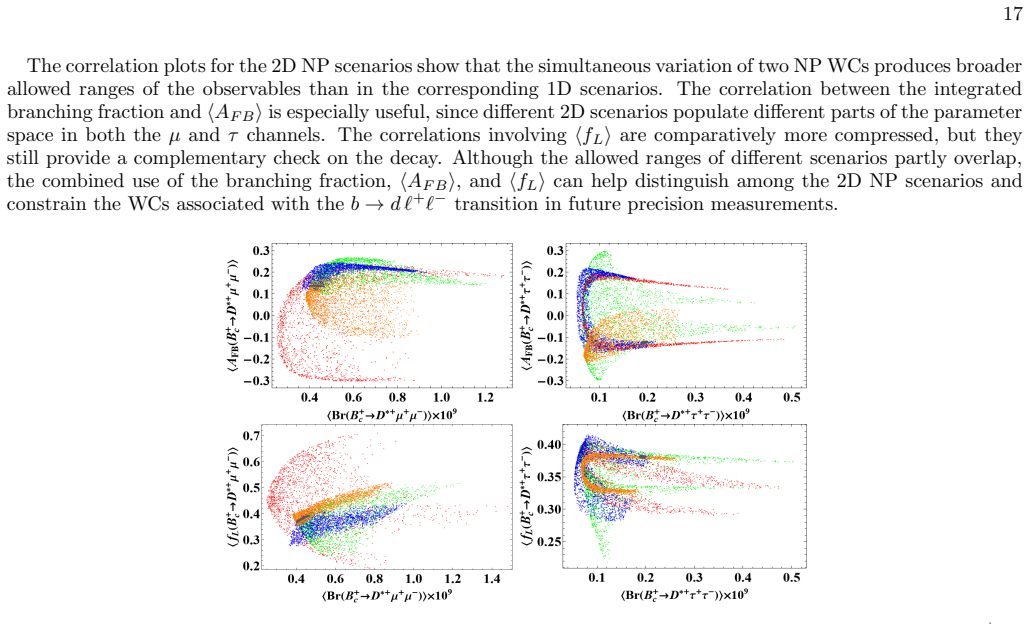
Using B_c to D^* transition form factors from the covariant confined quark model and weak-annihilation form factors from the Bethe-Salpeter approach, the branching fraction, forward-backward asymmetry, and normalized angular coefficients ⟨I_{2c}⟩, ⟨I_3⟩, ⟨I_5⟩, and ⟨I_{6s}⟩ exhibit clear sensitivity to New Physics effects in one- and two-dimensional scenarios, while other observables remain closer to Standard Model values.
What carries the argument
The B_c → D^* transition form factors from the covariant confined quark model combined with weak-annihilation form factors from the Bethe-Salpeter approach, incorporating penguin-box and resonance effects to compute differential and angular observables.
Load-bearing premise
The hadronic matrix elements for the B_c to D^* transition and weak annihilation are accurately captured by the form factors from the covariant confined quark model and Bethe-Salpeter approach.
What would settle it
A measurement at LHCb of the differential branching fraction or forward-backward asymmetry that matches Standard Model predictions within experimental errors across the full dilepton mass range would show no detectable New Physics sensitivity in this channel.
Figures
read the original abstract
Motivated by the current flavor anomalies and the comparatively less explored nature of the $b\to d$ sector, we present a model-independent study of the rare semileptonic $B_c^{+}\to D^{\ast+}\ell^{+}\ell^{-}$ ($\ell=\mu,\tau$) decay, to investigate its sensitivity to New Physics effects. The analysis incorporates penguin-box contributions, long-distance resonance effects, and the sizable weak-annihilation amplitudes. Using the $B_c\to D^\ast$ transition form factors calculated in the covariant confined quark model and the weak-annihilation form factors obtained within the Bethe--Salpeter approach, we analyze the differential branching fraction, forward-backward asymmetry, longitudinal helicity fraction, and a comprehensive set of normalized angular observables in several one- and two-dimensional New Physics scenarios and compare our results with the Standard Model predictions. Notably, the branching fraction, forward-backward asymmetry, and the normalized angular coefficients such as, $\langle I_{2c}\rangle$, $\langle I_{3}\rangle$, $\langle I_{5}\rangle$, and $\langle I_{6s} \rangle$, show clear sensitivity to New Physics effects. Our results indicate that the decay $B_c^{+}\to D^{\ast+}\ell^{+}\ell^{-}$ serves as a complementary probe of the flavor structure of New Physics and can therefore be investigated in future measurements at LHCb and other high-luminosity flavor experiments.
Editorial analysis
A structured set of objections, weighed in public.
Referee Report
Summary. The paper claims to perform a model-independent analysis of the rare semileptonic decay B_c^+ → D^{*+} ℓ^+ ℓ^- (ℓ=μ,τ), incorporating penguin-box, resonance, and weak-annihilation contributions. Using B_c → D^* transition form factors from the covariant confined quark model and weak-annihilation form factors from the Bethe-Salpeter approach, it computes the differential branching fraction, forward-backward asymmetry, longitudinal helicity fraction, and normalized angular observables (including ⟨I_{2c}⟩, ⟨I_3⟩, ⟨I_5⟩, ⟨I_{6s}⟩) in several one- and two-dimensional NP scenarios parameterized by Wilson coefficients, reporting clear deviations from SM predictions in multiple observables and concluding that the decay is a complementary probe of NP flavor structure for future LHCb measurements.
Significance. If the results hold, the work adds a useful theoretical exploration of the less-studied b→d sector with explicit inclusion of weak-annihilation amplitudes, which strengthens the analysis relative to simpler treatments. This could help motivate targeted experimental searches at high-luminosity flavor facilities.
major comments (1)
- [hadronic form factor section] Hadronic form factor section: the central claim that observables such as the branching fraction, A_FB, ⟨I_{2c}⟩, ⟨I_5⟩ and ⟨I_{6s}⟩ exhibit clear NP sensitivity rests on the accuracy of the B_c → D^* form factors computed in the covariant confined quark model and the weak-annihilation form factors from the Bethe-Salpeter approach. The manuscript provides no cross-validation against lattice QCD, no systematic uncertainty estimates from these specific model choices, and no discussion of how O(1) variations in the inputs would affect the reported deviations; this is load-bearing for the sensitivity conclusions.
Simulated Author's Rebuttal
We thank the referee for the constructive comments, which help strengthen the presentation of our results. We respond to the major comment below.
read point-by-point responses
-
Referee: [hadronic form factor section] Hadronic form factor section: the central claim that observables such as the branching fraction, A_FB, ⟨I_{2c}⟩, ⟨I_5⟩ and ⟨I_{6s}⟩ exhibit clear NP sensitivity rests on the accuracy of the B_c → D^* form factors computed in the covariant confined quark model and the weak-annihilation form factors from the Bethe-Salpeter approach. The manuscript provides no cross-validation against lattice QCD, no systematic uncertainty estimates from these specific model choices, and no discussion of how O(1) variations in the inputs would affect the reported deviations; this is load-bearing for the sensitivity conclusions.
Authors: We agree that the form factor inputs underpin the reported NP sensitivities and that a quantitative discussion of their uncertainties is needed. The covariant confined quark model and Bethe-Salpeter approach were adopted because they furnish the complete set of required form factors and have been validated against data in related channels. In the revised manuscript we will add a dedicated subsection that varies the input parameters within their quoted uncertainties (O(1) ranges) and shows the resulting bands on the branching fraction, A_FB, ⟨I_{2c}⟩, ⟨I_5⟩ and ⟨I_{6s}⟩; this will demonstrate that the deviations from the SM remain visible. Direct cross-validation with lattice QCD is not possible at present, as no lattice results exist for the B_c → D^* transition form factors. revision: partial
- Cross-validation of the B_c → D^* form factors against lattice QCD, as no such lattice calculations are currently available in the literature.
Circularity Check
No significant circularity: external form factors and independent NP parameterization
full rationale
The paper conducts a model-independent NP analysis by varying Wilson coefficients in one- and two-dimensional scenarios and computing observables (branching fraction, A_FB, angular coefficients) using B_c to D* transition form factors from the covariant confined quark model plus weak-annihilation amplitudes from the Bethe-Salpeter approach. These hadronic inputs are cited as external calculations rather than derived or fitted internally. The NP effects are parameterized independently of the form-factor values, and the reported sensitivities are forward predictions for future data rather than statistical fits or self-definitions. No load-bearing step reduces by construction to a self-citation chain, fitted input, or ansatz smuggled from prior author work; the derivation remains self-contained against external benchmarks.
Axiom & Free-Parameter Ledger
axioms (3)
- domain assumption The form factors from the covariant confined quark model accurately describe the B_c to D* transition
- domain assumption Weak annihilation form factors from the Bethe-Salpeter approach are reliable inputs
- domain assumption New Physics effects can be parameterized through modifications to Wilson coefficients in the effective operators
Reference graph
Works this paper leans on
-
[1]
Cabibbo,Unitary Symmetry and Leptonic Decays, Phys
N. Cabibbo,Unitary Symmetry and Leptonic Decays, Phys. Rev. Lett.10(1963) 531–533
1963
-
[2]
M. Kobayashi and T. Maskawa,CP Violation in the Renormalizable Theory of Weak Interaction, Prog. Theor. Phys.49 (1973) 652–657. [3]LHCbCollaboration, R. Aaij et al.,Test of lepton universality inb→sℓ +ℓ− decays, Phys. Rev. Lett.131(2023), no. 5 051803, [arXiv:2212.09152]. [4]LHCbCollaboration, R. Aaij et al.,Measurement ofCP-Averaged Observables in theB 0...
-
[3]
Kou et al.,The Belle II Physics Book, PTEP2019(2019), no
E. Kou et al.,The Belle II Physics Book, PTEP2019(2019), no. 12 123C01, [arXiv:1808.10567]
-
[4]
Ishaq, F
S. Ishaq, F. Munir, and I. Ahmed,Lepton polarization asymmetries inB→K 1l+l− decay as a searching tool for new physics, JHEP07(2013) 006
2013
- [5]
-
[6]
F. Munir, S. Ishaq, and I. Ahmed,Polarized forward-backward asymmetries of lepton pair inB→K 1ℓ+ℓ− decay in the presence of New physics, PTEP2016(2016), no. 1 013B02, [arXiv:1511.07075]
work page internal anchor Pith review Pith/arXiv arXiv 2016
-
[7]
F. Munir Bhutta, Z.-R. Huang, C.-D. L¨ u, M. A. Paracha, and W. Wang,New physics inb→sℓℓanomalies and its implications for the complementary neutral current decays, Nucl. Phys. B979(2022) 115763, [arXiv:2009.03588]
- [8]
-
[9]
D. Das, B. Kindra, G. Kumar, and N. Mahajan,B→K ∗ 2 (1430)ℓ+ℓ− distributions at large recoil in the Standard Model and beyond, Phys. Rev. D99(2019), no. 9 093012, [arXiv:1812.11803]
work page internal anchor Pith review Pith/arXiv arXiv 2019
- [10]
-
[11]
N. Rajeev, N. Sahoo, and R. Dutta,Angular analysis ofB s →f ′ 2 (1525) (→K + K −)µ + µ− decays as a probe to lepton flavor universality violation, Phys. Rev. D103(2021), no. 9 095007, [arXiv:2009.06213]. [21]LHCbCollaboration, R. Aaij et al.,First observation of the decayB + c →J/ψπ +π−π+, Phys. Rev. Lett.108(2012) 251802, [arXiv:1204.0079]
-
[12]
R. Dutta,Model independent analysis of new physics effects onB c →(D s, D ∗ s)µ +µ− decay observables, Phys. Rev. D 100(2019), no. 7 075025, [arXiv:1906.02412]
- [13]
- [14]
- [15]
- [16]
-
[17]
C. Q. Geng, C.-W. Hwang, and C. C. Liu,Study of rareB + c →D (∗)+ d,s l¯ldecays, Phys. Rev. D65(2002) 094037, [hep-ph/0110376]
work page internal anchor Pith review Pith/arXiv arXiv 2002
-
[18]
Analysis of the Rare $B_c \to D_{s,d}^{*} l^+ l^-$ Decays in QCD
K. Azizi, F. Falahati, V. Bashiry, and S. M. Zebarjad,Analysis of the RareB c →D ∗ s,d ℓ+ℓ− Decays in QCD, Phys. Rev. D77(2008) 114024, [arXiv:0806.0583]
work page internal anchor Pith review Pith/arXiv arXiv 2008
-
[19]
K. Azizi and R. Khosravi,Analysis of the rare semileptonicB c →P(D, D s)ℓ+ℓ−/ν¯νdecays within QCD sum rules, Phys. Rev. D78(2008) 036005, [arXiv:0806.0590]
work page internal anchor Pith review Pith/arXiv arXiv 2008
-
[20]
The exclusive rare decays B -> K l(bar) l and B_c -> D(D*) l(bar) l in a relativistic quark model
A. Faessler, T. Gutsche, M. A. Ivanov, J. G. Korner, and V. E. Lyubovitskij,The Exclusive rare decaysB→K(K*) ¯ℓℓ andB c →D(D*) ¯ℓℓin a relativistic quark model, Eur. Phys. J. direct4(2002), no. 1 18, [hep-ph/0205287]
work page internal anchor Pith review Pith/arXiv arXiv 2002
-
[21]
H.-M. Choi,Light-front quark model analysis of the exclusive rareB c →D (s)(ℓ+ℓ−, νℓ¯νℓ)decays, Phys. Rev. D81(2010) 054003, [arXiv:1001.3432]. 21
work page internal anchor Pith review Pith/arXiv arXiv 2010
-
[22]
W.-F. Wang, X. Yu, C.-D. L¨ u, and Z.-J. Xiao,Semileptonic decaysB + c →D (∗) (s)(l+νl, l+l−, ν¯ν) in the perturbative QCD approach, Phys. Rev. D90(2014), no. 9 094018, [arXiv:1401.0391]
work page internal anchor Pith review Pith/arXiv arXiv 2014
-
[23]
U. O. Yilmaz,Study ofB c →D ∗ s ℓ+ℓ− in Single Universal Extra Dimension, Phys. Rev. D85(2012) 115026, [arXiv:1204.1261]
work page internal anchor Pith review Pith/arXiv arXiv 2012
-
[24]
Rare semileptonic decays of B and B_c mesons in the relativistic quark model
D. Ebert, R. N. Faustov, and V. O. Galkin,Rare Semileptonic Decays ofBandB c Mesons in the Relativistic Quark Model, Phys. Rev. D82(2010) 034032, [arXiv:1006.4231]
work page internal anchor Pith review Pith/arXiv arXiv 2010
- [25]
- [26]
-
[27]
M. A. Paracha, I. Ahmed, and M. J. Aslam,Semileptonic charmedBmeson decays in Universal Extra Dimension Model, Phys. Rev. D84(2011) 035003, [arXiv:1101.2323]
work page internal anchor Pith review Pith/arXiv arXiv 2011
-
[28]
Analysis of B_{C} --> D_{s}^{*}l^{+}l^{-} in the Standard Model Beyond Third Generation
I. Ahmed, M. A. Paracha, M. Junaid, A. Ahmed, A. Rehman, and M. J. Aslam,Analysis ofB c →D ∗ s ℓ+ℓ− in the Standard Model Beyond Third Generation, [arXiv:1107.5694]
work page internal anchor Pith review Pith/arXiv arXiv
-
[29]
A. Ahmed, I. Ahmed, M. A. Paracha, M. Junaid, A. Rehman, and M. J. Aslam,Comparative Study ofB c →D ∗ s ℓ+ℓ− Decays in Standard Model and Supersymmetric Models, 8, 2011.arXiv:1108.1058
work page internal anchor Pith review Pith/arXiv arXiv 2011
-
[30]
Z. Aarfi, Q. M. U. Salam, I. Ahmed, F. M. Bhutta, and M. A. Paracha,Weak annihilation contribution to angular observables inB + c →D ∗+ℓ+ℓ− decays, Eur. Phys. J. C86(2026), no. 5 456, [arXiv:2602.10903]
work page internal anchor Pith review Pith/arXiv arXiv 2026
- [31]
-
[32]
The Study of Rare $B_c\rightarrow D^{(*)}_{s,d}l\bar{l}$ Decays
W.-L. Ju, G.-L. Wang, H.-F. Fu, T.-H. Wang, and Y. Jiang,The Study of RareB c →D (∗) s,dl¯lDecays, JHEP04(2014) 065, [arXiv:1307.5492]
work page internal anchor Pith review Pith/arXiv arXiv 2014
- [33]
- [34]
-
[35]
Photonic penguins at two loops and m_t-dependence of BR[ B -> X_s l^+ l^-]
C. Bobeth, M. Misiak, and J. Urban,Photonic penguins at two loops andm t dependence ofBR[B→X sl+l−], Nucl. Phys. B574(2000) 291–330, [hep-ph/9910220]
work page internal anchor Pith review Pith/arXiv arXiv 2000
-
[36]
Systematic approach to exclusive B ->V l^+l^-, V gamma decays
M. Beneke, T. Feldmann, and D. Seidel,Systematic approach to exclusiveB→V l +l−,V γdecays, Nucl. Phys.B612 (2001) 25–58, [hep-ph/0106067]
work page internal anchor Pith review Pith/arXiv arXiv 2001
-
[37]
H. H. Asatrian, H. M. Asatrian, C. Greub, and M. Walker,Two loop virtual corrections toB→X sl+l− in the standard model, Phys. Lett. B507(2001) 162–172, [hep-ph/0103087]
work page internal anchor Pith review Pith/arXiv arXiv 2001
-
[38]
H. H. Asatryan, H. M. Asatrian, C. Greub, and M. Walker,Calculation of two loop virtual corrections tob→sl +l− in the standard model, Phys. Rev.D65(2002) 074004, [hep-ph/0109140]
work page internal anchor Pith review Pith/arXiv arXiv 2002
-
[39]
Analytic calculation of two-loop QCD corrections to b\to s\ell^+\ell^- in the high q^2 region
C. Greub, V. Pilipp, and C. Schupbach,Analytic calculation of two-loop QCD corrections tob→sl +l− in the highq 2 region, JHEP12(2008) 040, [arXiv:0810.4077]
work page internal anchor Pith review Pith/arXiv arXiv 2008
-
[40]
D. Du, A. X. El-Khadra, S. Gottlieb, A. S. Kronfeld, J. Laiho, E. Lunghi, R. S. Van de Water, and R. Zhou, Phenomenology of semileptonic B-meson decays with form factors from lattice QCD, Phys. Rev. D93(2016), no. 3 034005, [arXiv:1510.02349]
work page internal anchor Pith review Pith/arXiv arXiv 2016
-
[41]
Z. Aarfi, Q. M. U. Salam, I. Ahmed, F. M. Bhutta, R. Khalid, and M. A. Paracha,Investigating New Physics through the Observables of SemileptonicB s →K ∗(→Kπ)µ +µ− Decay, PTEP2025(2025), no. 12 123B10, [arXiv:2506.20446]
work page internal anchor Pith review Pith/arXiv arXiv 2025
-
[42]
The rare semi-leptonic $B_c$ decays involving orbitally excited final mesons
W.-L. Ju, G.-L. Wang, H.-F. Fu, Z.-H. Wang, and Y. Li,The rare semi-leptonic B c decays involving orbitally excited final mesons, JHEP09(2015) 171, [arXiv:1407.7968]. [53]Particle Data GroupCollaboration, S. Navas et al.,Review of particle physics, Phys. Rev. D110(2024), no. 3 030001
work page internal anchor Pith review Pith/arXiv arXiv 2015
-
[43]
A. Crivellin, C. Greub, D. M¨ uller, and F. Saturnino,Importance of Loop Effects in Explaining the Accumulated Evidence for New Physics in B Decays with a Vector Leptoquark, Phys. Rev. Lett.122(2019), no. 1 011805, [arXiv:1807.02068]
work page internal anchor Pith review Pith/arXiv arXiv 2019
-
[44]
Patterns of Flavour Violation in Models with Vector-Like Quarks
C. Bobeth, A. J. Buras, A. Celis, and M. Jung,Patterns of Flavour Violation in Models with Vector-Like Quarks, JHEP 04(2017) 079, [arXiv:1609.04783]
work page internal anchor Pith review Pith/arXiv arXiv 2017
-
[45]
A. D’Alise, G. Fabiano, D. Frattulillo, D. Iacobacci, F. Sannino, P. Santorelli, and N. Vignaroli,New physics pathways from B processes, Nucl. Phys. B1006(2024) 116631, [arXiv:2403.17614]
discussion (0)
Sign in with ORCID, Apple, or X to comment. Anyone can read and Pith papers without signing in.