The Organizational Behavior of Agentic AI: Collective Intelligence in Human-Agent Workflows
Pith reviewed 2026-07-01 00:43 UTC · model grok-4.3
The pith
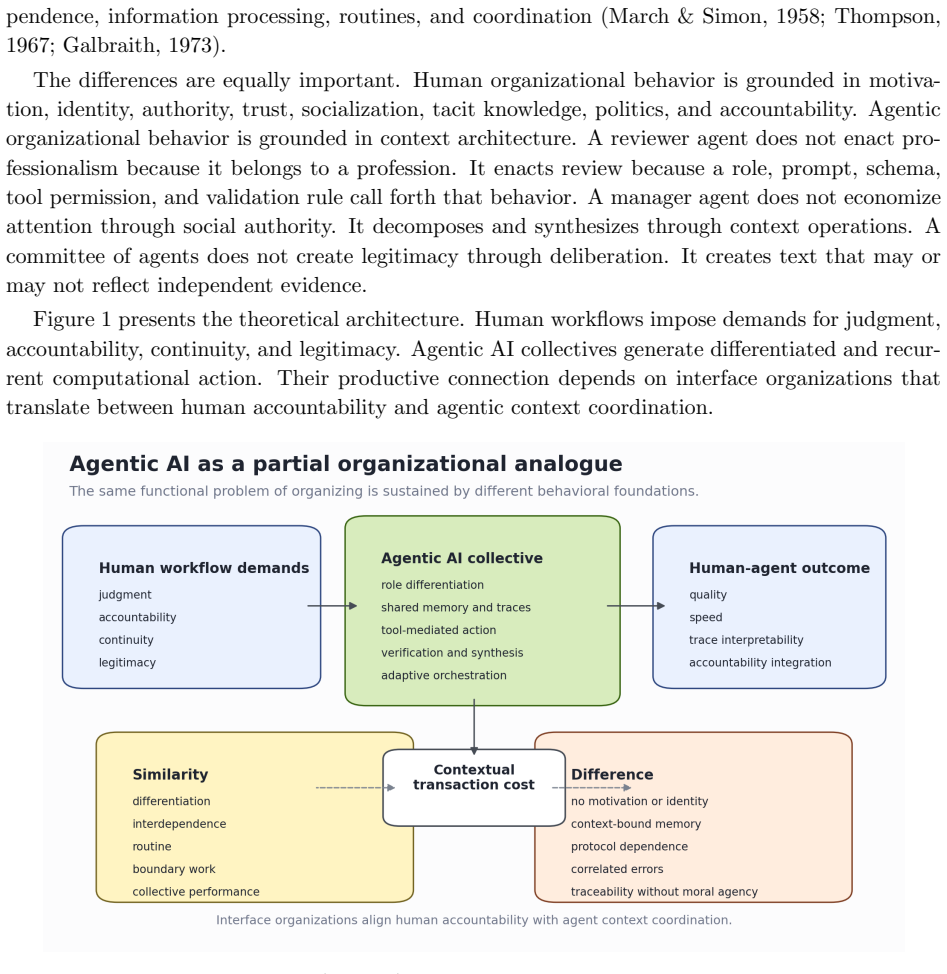
Agentic AI collectives resemble human organizations in differentiating work and coordinating tasks but sustain these patterns through context architecture rather than motivation or trust.
A machine-rendered reading of the paper's core claim, the machinery that carries it, and where it could break.
Core claim
Agentic artificial intelligence is a partial organisational analogue. It resembles a human organisation because it differentiates work, coordinates interdependence, performs recurrent routines, crosses boundaries, and produces collective outcomes. It differs because these patterns are not sustained by motivation, identity, trust, employment, socialisation, or moral accountability. They are sustained by context architecture: prompts, memory, traces, schemas, tools, validators, and permissions. The article develops contextual transaction cost as the central mechanism linking these similarities and differences. Computational theorising, synthetic task simulations, real LLM agent traces, and rob
What carries the argument
Contextual transaction cost, the mechanism that links structural similarities to performance differences by measuring the costs of maintaining and transferring context across agents in collectives.
If this is right
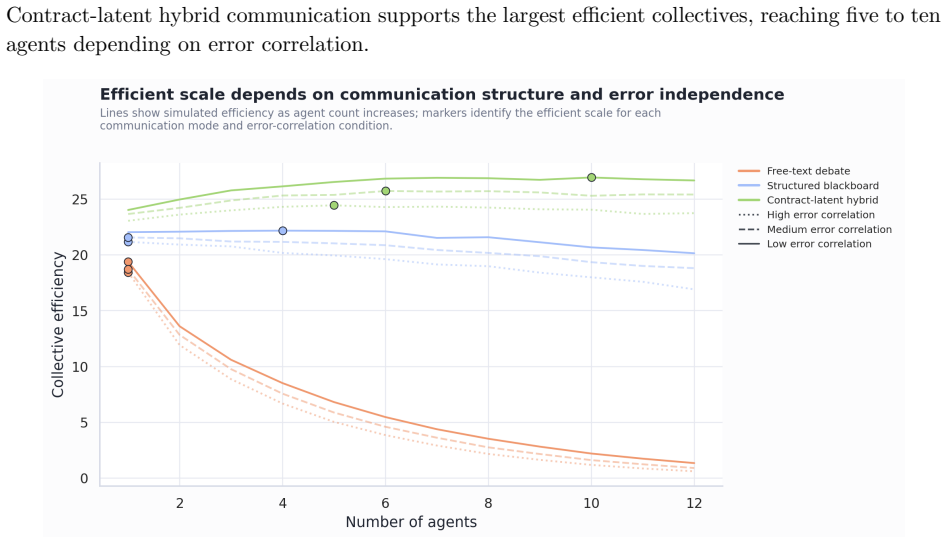
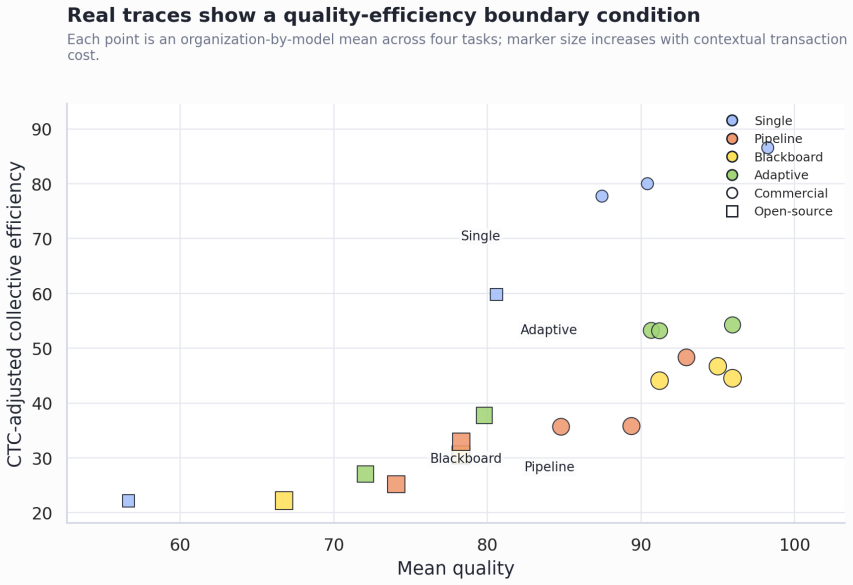
- Human-imitation agent structures often add lossy handoffs, correlated deliberation, and verification burdens that reduce performance.
- Shared-state and adaptive coordination forms perform better when context is made durable, inspectable, and task-contingent.
- Agent collectives can jointly support collective intelligence with human workflows under interface conditions that align context architecture with task demands.
- The patterns of work differentiation and coordination in agent systems can be analyzed and improved independently of social or motivational factors.
Where Pith is reading between the lines
- Workflow designers should prioritize minimizing contextual transaction costs over directly copying human team structures when building multi-agent systems.
- This view could extend to diagnosing coordination failures in existing agent deployments where context is lost or duplicated across steps.
- Hybrid human-agent setups may gain from exposing agent memory and traces to human participants to lower overall coordination costs.
- Testing on tasks with high interdependence could reveal whether durable context reduces error rates more than adding reviewer agents.
Load-bearing premise
Computational theorising, synthetic task simulations, and real LLM agent traces can demonstrate organisational behaviour and performance differences in a manner analytically comparable to human organisations despite the complete absence of social and motivational elements.
What would settle it
A controlled comparison in which human-imitation agent teams with high verification burdens achieve higher collective task performance than shared-state designs with durable context on identical interdependent tasks.
Figures

read the original abstract
Agentic artificial intelligence is increasingly deployed not as a single assistant but as a collective of planners, solvers, reviewers, memory managers, tool users, and orchestrators. These systems are entering organisational workflows under familiar labels such as teams, managers, committees, markets, and workflows. This article asks whether such agent collectives exhibit organisational behaviour in a sense that is analytically comparable to, yet distinct from, human organisational behaviour. I argue that agentic AI is a partial organisational analogue. It resembles a human organisation because it differentiates work, coordinates interdependence, performs recurrent routines, crosses boundaries, and produces collective outcomes. It differs because these patterns are not sustained by motivation, identity, trust, employment, socialisation, or moral accountability. They are sustained by context architecture: prompts, memory, traces, schemas, tools, validators, and permissions. The article develops contextual transaction cost as the central mechanism linking these similarities and differences. Computational theorising, synthetic task simulations, real LLM agent traces, and robustness analyses show that human-imitation forms often underperform when they add lossy handoffs, correlated deliberation, and verification burdens, whereas shared-state and adaptive forms perform better when they make context durable, inspectable, and task-contingent. The article contributes to organisation studies by theorising agentic AI as an emerging object of organising and by specifying the interface conditions under which human and agentic organisational behaviour can jointly support collective intelligence.
Editorial analysis
A structured set of objections, weighed in public.
Referee Report
Summary. The paper claims that agentic AI collectives exhibit organizational behaviour analogous to human organisations because they differentiate work, coordinate interdependence, perform recurrent routines, cross boundaries, and produce collective outcomes. It differs because these patterns are sustained by context architecture (prompts, memory, traces, schemas, tools, validators, permissions) rather than motivation, identity, trust, employment, socialisation, or moral accountability. The central mechanism is contextual transaction cost. Computational theorising, synthetic task simulations, real LLM agent traces, and robustness analyses show that human-imitation forms underperform due to lossy handoffs, correlated deliberation, and verification burdens, while shared-state and adaptive forms perform better when context is durable, inspectable, and task-contingent. The contribution is to organisation studies by theorising agentic AI as an object of organising and specifying interface conditions for joint human-agent collective intelligence.
Significance. If the results hold, the paper contributes to organisation studies by extending theory to agentic AI systems and providing a framework for collective intelligence in human-agent workflows. It introduces contextual transaction cost as a linking mechanism and uses simulations to compare organisational forms, which could inform AI system design and the study of emerging technologies. The use of synthetic tasks and LLM traces offers a computational approach to organisational questions.
major comments (2)
- [Simulations and traces section] Simulations and traces section: performance differences between human-imitation and shared-state forms are reported, but the organisational constructs (differentiation, interdependence coordination, routines, boundary crossing) are not operationalised or measured with established organisation-theory metrics or human baselines. This is load-bearing for the central claim of analytical comparability.
- [Contextual transaction cost development] Contextual transaction cost development: the construct is introduced and developed inside the paper to explain why context architecture substitutes for social mechanisms, yet simulation outcomes appear defined in terms of context durability and lossy handoffs, creating a risk of circularity rather than independent grounding.
minor comments (1)
- The abstract states that robustness analyses were performed but supplies no details on sample sizes, error measures, or exclusion rules; these should be added to the methods description.
Simulated Author's Rebuttal
We thank the referee for the constructive review and the recommendation for major revision. The two major comments identify opportunities to strengthen the manuscript's links to organization theory. We respond point by point below.
read point-by-point responses
-
Referee: [Simulations and traces section] Simulations and traces section: performance differences between human-imitation and shared-state forms are reported, but the organisational constructs (differentiation, interdependence coordination, routines, boundary crossing) are not operationalised or measured with established organisation-theory metrics or human baselines. This is load-bearing for the central claim of analytical comparability.
Authors: We agree that greater explicitness would help. In revision we will add a dedicated subsection and mapping table that operationalizes each construct inside the simulation and trace designs: differentiation via role-specific prompts and tool permissions; interdependence coordination via shared-state versus message-passing protocols; routines via recurrent task sequences in the traces; and boundary crossing via validator and external-tool interfaces. Performance metrics (task completion, error propagation, coordination overhead) will be explicitly tied to these operationalizations. We will also clarify that human baselines fall outside the paper's scope, which compares alternative agent organizational forms rather than benchmarking against human teams; adding such baselines would require a separate empirical study. revision: partial
-
Referee: [Contextual transaction cost development] Contextual transaction cost development: the construct is introduced and developed inside the paper to explain why context architecture substitutes for social mechanisms, yet simulation outcomes appear defined in terms of context durability and lossy handoffs, creating a risk of circularity rather than independent grounding.
Authors: We disagree that the argument is circular. Contextual transaction cost is derived from classical transaction-cost economics and specified as the costs of context loss, duplication, and verification that arise when agents must hand off or reconstruct state. The simulations measure independent outcomes—task success rate, latency, and error types—that the theory predicts will differ across architectures. Descriptions of durability and handoffs are the observable mechanisms through which the costs operate, not the outcome variables themselves. In revision we will present the construct formally in a dedicated theory subsection before describing the simulation measures, making the separation between theoretical mechanism and empirical indicators explicit. revision: no
Circularity Check
No circularity; derivation self-contained with independent simulation evidence
full rationale
The abstract and description introduce contextual transaction cost as a new theoretical mechanism and present computational theorising plus synthetic task simulations and LLM agent traces as separate evidence showing performance differences (e.g., human-imitation forms underperform due to lossy handoffs). No equations, self-citations, fitted parameters renamed as predictions, or reductions of claims to inputs by construction are present in the provided text. The simulations are described as demonstrating outcomes independently, satisfying the requirement for external grounding rather than definitional equivalence.
Axiom & Free-Parameter Ledger
axioms (1)
- domain assumption Organisational behaviour consists of work differentiation, interdependence coordination, recurrent routines, boundary crossing, and collective outcomes.
invented entities (1)
-
contextual transaction cost
no independent evidence
Reference graph
Works this paper leans on
-
[1]
Alchian, A. A., & Demsetz, H. (1972). Production, information costs, and economic organization. American Economic Review, 62(5), 777-795
work page 1972
-
[2]
Arrow, K. J. (1974). The Limits of Organization. Norton
work page 1974
-
[3]
Bai, Y., Lv, X., Zhang, J., Lyu, H., Tang, J., Huang, Z., Du, Z., Liu, X., Zeng, A., Hou, L., Dong, Y., Tang, J., & Li, J. (2024). LongBench: A bilingual, multitask benchmark for long context understanding. Proceedings of the Association for Computational Linguistics
work page 2024
-
[4]
Barley, S. R. (1986). Technology as an occasion for structuring: Evidence from observations of CT scanners and the social order of radiology departments. Administrative Science Quarterly, 31(1), 78-108
work page 1986
-
[5]
Benkler, Y. (2002). Coase’s Penguin, or, Linux and the nature of the firm. Yale Law Journal, 112(3), 369-446
work page 2002
-
[6]
Brown, J. S., & Duguid, P. (1991). Organizational learning and communities-of-practice: Toward a unified view of working, learning, and innovation. Organization Science, 2(1), 40-57
work page 1991
-
[7]
Brynjolfsson, E., Li, D., & Raymond, L. R. (2025). Generative AI at work. Quarterly Journal of Economics, 140(2), 889-942
work page 2025
-
[8]
Carlile, P. R. (2002). A pragmatic view of knowledge and boundaries: Boundary objects in new product development. Organization Science, 13(4), 442-455
work page 2002
-
[9]
Carlile, P. R. (2004). Transferring, translating, and transforming: An integrative framework for managing knowledge across boundaries. Organization Science, 15(5), 555-568
work page 2004
-
[10]
Coase, R. H. (1937). The nature of the firm. Economica, 4(16), 386-405
work page 1937
-
[11]
Cohen, M. D., & Bacdayan, P. (1994). Organizational routines are stored as procedural memory: Evidence from a laboratory study. Organization Science, 5(4), 554-568
work page 1994
-
[12]
Cyert, R. M., & March, J. G. (1963). A Behavioral Theory of the Firm. Prentice-Hall. 17
work page 1963
-
[13]
Dasigi, P., Lo, K., Beltagy, I., Cohan, A., Smith, N. A., & Gardner, M. (2021). A dataset of information-seeking questions and answers anchored in research papers. Proceedings of NAACL
work page 2021
-
[14]
Davis, J. P., Eisenhardt, K. M., & Bingham, C. B. (2007). Developing theory through simulation methods. Academy of Management Review, 32(2), 480-499
work page 2007
-
[15]
Faraj, S., Pachidi, S., & Sayegh, K. (2018). Working and organizing in the age of the learning algorithm. Information and Organization, 28(1), 62-70
work page 2018
-
[16]
Feldman, M. S., & Pentland, B. T. (2003). Reconceptualizing organizational routines as a source of flexibility and change. Administrative Science Quarterly, 48(1), 94-118
work page 2003
-
[17]
Galbraith, J. R. (1973). Designing Complex Organizations. Addison-Wesley
work page 1973
-
[18]
Iyer, V., & Li, Z. (2023). LegalBench: A collaboratively built benchmark for measuring legal reasoning in large language models. Advances in Neural Information Processing Systems
work page 2023
-
[19]
Harrison, J. R., Lin, Z., Carroll, G. R., & Carley, K. M. (2007). Simulation modeling in organiza- tional and management research. Academy of Management Review, 32(4), 1229-1245
work page 2007
-
[20]
Hecker, A. (2012). Knowledge beyond the individual? Making sense of a notion of collective knowl- edge in organization theory. Organization Studies, 33(3), 423-445
work page 2012
-
[21]
Hong, L., & Page, S. E. (2004). Groups of diverse problem solvers can outperform groups of high- ability problem solvers. Proceedings of the National Academy of Sciences, 101(46), 16385-16389
work page 2004
-
[22]
E., Yang, J., Wettig, A., Yao, S., Pei, K., Press, O., & Narasimhan, K
Jimenez, C. E., Yang, J., Wettig, A., Yao, S., Pei, K., Press, O., & Narasimhan, K. (2024). SWE- bench: Can language models resolve real-world GitHub issues? International Conference on Learning Representations
work page 2024
-
[23]
Kellogg, K. C., Valentine, M. A., & Christin, A. (2020). Algorithms at work: The new contested terrain of control. Academy of Management Annals, 14(1), 366-410
work page 2020
-
[24]
W., Laubacher, R., & Dellarocas, C
Malone, T. W., Laubacher, R., & Dellarocas, C. (2010). The collective intelligence genome. MIT Sloan Management Review, 51(3), 21-31. 18
work page 2010
- [25]
-
[26]
Mnih, V., Kavukcuoglu, K., Silver, D., Rusu, A. A., Veness, J., Bellemare, M. G., Graves, A., Ried- miller, M., Fidjeland, A. K., Ostrovski, G., Petersen, S., Beattie, C., Sadik, A., Antonoglou, I., King, H., Kumaran, D., Wierstra, D., Legg, S., & Hassabis, D. (2015). Human-level control through deep reinforcement learning. Nature, 518, 529-533
work page 2015
-
[27]
Oborn, E., Barrett, M., & Dawson, S. (2013). Distributed leadership in policy formulation: A sociomaterial perspective. Organization Studies, 34(2), 253-276
work page 2013
-
[28]
Orlikowski, W. J. (2000). Using technology and constituting structures: A practice lens for study- ing technology in organizations. Organization Science, 11(4), 404-428
work page 2000
-
[29]
Orlikowski, W. J. (2007). Sociomaterial practices: Exploring technology at work. Organization Studies, 28(9), 1435-1448
work page 2007
-
[30]
Orlikowski, W. J., & Scott, S. V. (2008). Sociomateriality: Challenging the separation of technol- ogy, work and organization. Academy of Management Annals, 2(1), 433-474
work page 2008
-
[31]
Pentland, B. T., Haerem, T., & Hillison, D. (2010). Comparing organizational routines as recurrent patterns of action. Organization Studies, 31(7), 917-940
work page 2010
-
[32]
Powell, W. W. (1990). Neither market nor hierarchy: Network forms of organization. Research in Organizational Behavior, 12, 295-336
work page 1990
-
[33]
Raisch, S., & Krakowski, S. (2021). Artificial intelligence and management: The automation- augmentation paradox. Academy of Management Review, 46(1), 192-210
work page 2021
-
[34]
Ratner, H., & Plotnikof, M. (2022). Technology and dis/organization: Digital data infrastructures as partial connections. Organization Studies, 43(7), 1049-1067
work page 2022
-
[35]
Riedl, C., De Cremer, D., Lucarelli, G., & Antoine-Souklaye, E. (2025). The potential and chal- lenges of AI for collective intelligence. Collective Intelligence, 4(1)
work page 2025
-
[36]
Shrestha, Y. R., Ben-Menahem, S. M., & von Krogh, G. (2019). Organizational decision-making structures in the age of artificial intelligence. California Management Review, 61(4), 66-83
work page 2019
-
[37]
Simon, H. A. (1947). Administrative Behavior. Macmillan
work page 1947
-
[38]
Star, S. L., & Griesemer, J. R. (1989). Institutional ecology, translations, and boundary objects. 19 Social Studies of Science, 19(3), 387-420
work page 1989
-
[39]
Stark, D., & Vanden Broeck, P. (2024). Principles of algorithmic management. Organization The- ory, 5(2)
work page 2024
-
[40]
Steinberg, M. (2022). From automobile capitalism to platform capitalism: Toyotism as a prehistory of digital platforms. Organization Studies, 43(7), 1069-1090
work page 2022
-
[41]
Symon, G., & Pritchard, K. (2015). Performing the responsive and committed employee through the sociomaterial mangle of connection. Organization Studies, 36(2), 241-263
work page 2015
-
[42]
Thompson, J. D. (1967). Organizations in Action. McGraw-Hill
work page 1967
-
[43]
Tsoukas, H. (1996). The firm as a distributed knowledge system: A constructionist approach. Strategic Management Journal, 17(S2), 11-25
work page 1996
-
[44]
Tsvetkova, M., Yasseri, T., Pescetelli, N., & Werner, T. (2024). A new sociology of humans and machines. Nature Human Behaviour, 8, 1864-1876
work page 2024
-
[45]
Weick, K. E. (1979). The Social Psychology of Organizing. Addison-Wesley
work page 1979
-
[46]
Williamson, O. E. (1985). The Economic Institutions of Capitalism. Free Press
work page 1985
-
[47]
Woolley, A. W., Chabris, C. F., Pentland, A., Hashmi, N., & Malone, T. W. (2010). Evidence for a collective intelligence factor in the performance of human groups. Science, 330(6004), 686-688. A Appendix A. Additional Simulation Evidence B Appendix B. Prompt Robustness and Prompt-Free Organiza- tion Selection Prompt robustness analysis addresses the possi...
work page 2010
discussion (0)
Sign in with ORCID, Apple, or X to comment. Anyone can read and Pith papers without signing in.