Bayesian Uncertainty Quantification for Ranked Choice Voting Polls
Pith reviewed 2026-07-01 03:22 UTC · model grok-4.3
The pith
A Bayesian model estimates each leading candidate's win probability in ranked choice voting polls by conditioning directly on the observed ballot counts.
A machine-rendered reading of the paper's core claim, the machinery that carries it, and where it could break.
Core claim
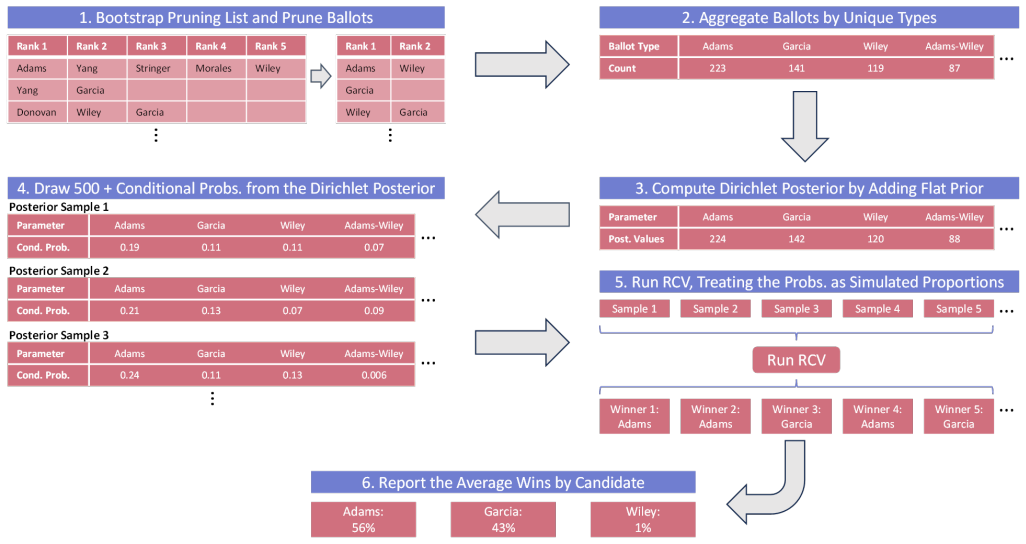
The paper claims that a Dirichlet-multinomial model for ranked ballots yields a conjugacy relationship that lets poll counts be plugged in directly to compute the posterior probability that any given candidate wins the RCV tabulation, thereby supplying a single-number uncertainty measure for each leading contender.
What carries the argument
The conjugacy relationship between the Dirichlet prior and the multinomial likelihood on preference vectors, which updates win probabilities conditional on the poll sample.
If this is right
- Polls can report the probability that each candidate wins rather than a margin around a point estimate.
- Uncertainty statements automatically incorporate the full sequence of possible eliminations and vote transfers.
- Direct comparison of the two real elections shows where frequentist intervals fail to reflect path dependence.
- The same conjugacy lets analysts update the probabilities as new poll waves arrive without refitting.
Where Pith is reading between the lines
- Campaigns could use the output probabilities to decide which voters to target for second-preference persuasion.
- The framework could be extended to include demographic weighting of the poll sample while retaining the closed-form update.
- Repeated application across many RCV races would let analysts test whether the model probabilities are well calibrated.
Load-bearing premise
The poll respondents are drawn from the same underlying preference distribution that will determine the actual election outcome.
What would settle it
A pre-election RCV poll analyzed with the method produces win probabilities that can be checked directly against the observed winner and elimination sequence in the subsequent election.
Figures


read the original abstract
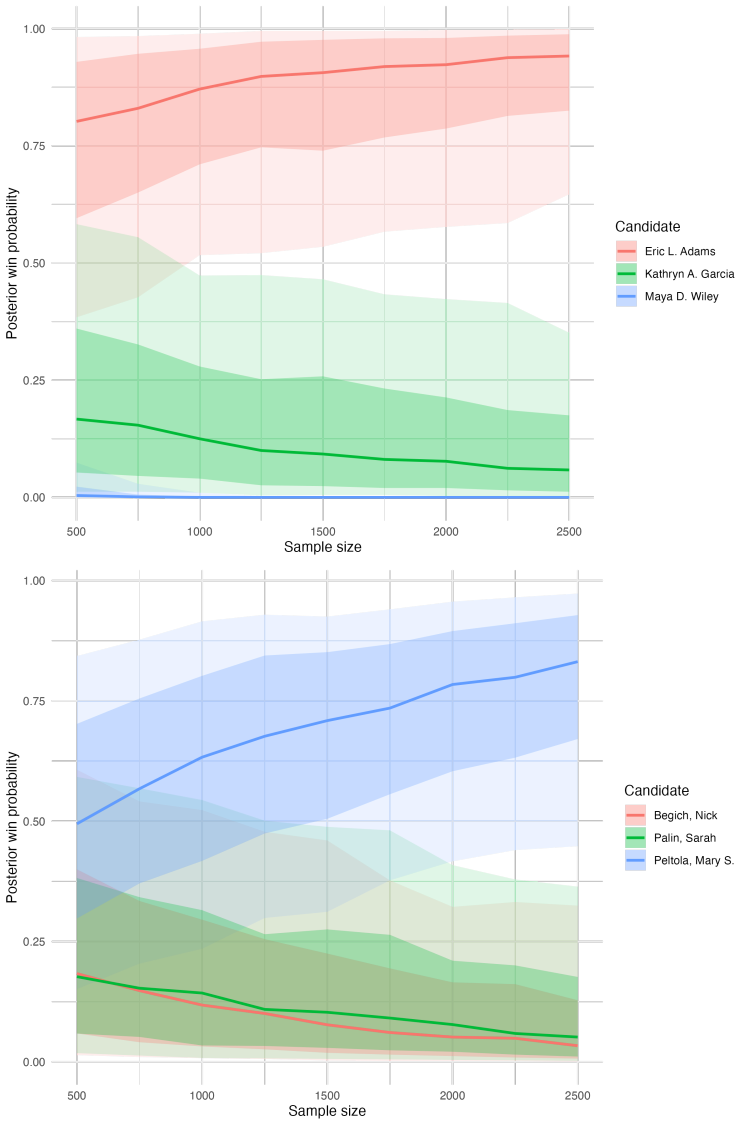
Ranked choice voting (RCV) is a popular alternative voting method in which voters are asked to list their favored candidates in preference order, rather than vote for a single candidate. When these ballots are tabulated, candidates are successively eliminated, and their votes are reallocated to each voter's next-preferred choice. The process continues until a candidate commands a majority of the active ballots and is declared the winner. As RCV gains wider adoption, the method poses novel challenges for pollsters. Unlike plurality elections, the event that a candidate wins cannot be expressed in terms of a single population parameter. Hence, the basic concept of a margin-of-error is not straightforward to define. Moreover, a candidate's ability to win may depend on both their support across the ballot and the order in which other candidates are eliminated. Existing measures of sampling uncertainty for polls of RCV elections do not clearly quantify these path-dependent outcomes. Here, we propose a simple, Bayesian framework to quantify uncertainty in polls of RCV elections. We cast the problem as one of estimating win probabilities for each leading candidate, and leverage a simple conjugacy relationship to estimate these probabilities conditional on the poll results. We include applied analyses involving two prominent ranked choice voting elections: the 2021 New York City Democratic mayoral primary, in which Eric Adams narrowly defeated Kathryn Garcia in the final round; and the 2022 special election to Alaska's U.S. House seat, in which Mary Peltola was elected despite not being a Condorcet winner. Using the cast vote records from both elections, we demonstrate some challenges of traditional frequentist uncertainty quantification in RCV polls. We also demonstrate the utility of our approach using a poll of the NYC primary obtained from the polling firm Data for Progress.
Editorial analysis
A structured set of objections, weighed in public.
Referee Report
Summary. The paper proposes a Bayesian framework for uncertainty quantification in ranked choice voting (RCV) polls. It models voter preference distributions via a Dirichlet prior updated with poll counts through Multinomial conjugacy, then induces posterior distributions on candidate win probabilities by simulating the RCV elimination process on draws from the posterior. The approach is demonstrated on cast vote records (CVRs) from the 2021 NYC Democratic mayoral primary and 2022 Alaska U.S. House special election, plus a real poll from Data for Progress, to contrast with frequentist methods that struggle with path-dependent outcomes.
Significance. If the exchangeability assumption holds, the method supplies a computationally convenient route to credible intervals for RCV win probabilities that fully incorporate the sequential elimination mechanics, addressing a gap in existing poll uncertainty measures. The use of actual CVRs to illustrate frequentist difficulties and the application to a live poll are concrete strengths; the conjugacy yields an exact posterior without requiring MCMC for the preference parameters themselves.
major comments (2)
- [§3] §3 (Bayesian model and conjugacy): the posterior win probabilities are obtained by conditioning the RCV outcome function directly on the observed poll counts via Dirichlet-Multinomial updating; this step is valid only under the assumption that poll ballots are i.i.d. draws from the identical preference distribution that will generate election-day ballots, yet no sensitivity analysis to differential non-response, turnout bias, or weighting is reported.
- [§4.2 and §4.3] §4.2 (Alaska application) and §4.3 (NYC poll application): the reported credible intervals for Peltola and Adams are presented without any diagnostic comparing the posterior predictive distribution of rankings to the observed CVR marginals or to external benchmarks for non-response bias, leaving the practical reliability of the intervals under real polling conditions unquantified.
minor comments (2)
- [§2] Notation for the preference vector θ and the RCV win indicator W_c(θ) could be introduced earlier and used consistently when describing the induced posterior p(W_c | data).
- [§3] The manuscript would benefit from a short table listing the Dirichlet hyperparameters chosen for each election and the effective sample size after updating.
Simulated Author's Rebuttal
We thank the referee for their constructive comments. We respond to each major comment below.
read point-by-point responses
-
Referee: [§3] §3 (Bayesian model and conjugacy): the posterior win probabilities are obtained by conditioning the RCV outcome function directly on the observed poll counts via Dirichlet-Multinomial updating; this step is valid only under the assumption that poll ballots are i.i.d. draws from the identical preference distribution that will generate election-day ballots, yet no sensitivity analysis to differential non-response, turnout bias, or weighting is reported.
Authors: The Dirichlet-Multinomial conjugacy does rest on the i.i.d. sampling assumption, which is the same modeling choice made by standard frequentist poll margins of error. The manuscript's contribution is the exact posterior simulation of the full RCV elimination process under this assumption. When poll weights or non-response adjustments are available they can be folded into the effective counts before the Dirichlet update; the framework is modular in that respect. Because the applications use either full CVRs or an unweighted poll, we did not perform sensitivity analyses. We will revise §3 to state the assumption explicitly and flag sensitivity to turnout bias and weighting as an important direction for applied follow-up work. revision: partial
-
Referee: [§4.2 and §4.3] §4.2 (Alaska application) and §4.3 (NYC poll application): the reported credible intervals for Peltola and Adams are presented without any diagnostic comparing the posterior predictive distribution of rankings to the observed CVR marginals or to external benchmarks for non-response bias, leaving the practical reliability of the intervals under real polling conditions unquantified.
Authors: The CVR illustrations in §4.2 and the first part of §4.3 treat the full election records as the population; the exercise is to show how frequentist intervals behave when the RCV outcome is path-dependent, not to validate a sampling model. For the Data for Progress poll in §4.3 we will add, in revision, a short posterior-predictive check that compares the marginal distribution of simulated rankings to the observed poll counts. This will provide a direct diagnostic of model fit for the polling application. revision: yes
Circularity Check
No circularity: standard conjugate updating applied without self-referential definitions or fitted predictions.
full rationale
The derivation relies on Dirichlet-Multinomial conjugacy to obtain posterior win probabilities directly from observed poll counts under an exchangeability assumption. This is a standard Bayesian update with no evidence that win probabilities are defined in terms of the fitted quantities, that a parameter is fitted to data and then renamed as a prediction, or that load-bearing steps reduce to self-citations. The method is self-contained against external benchmarks once the representativeness assumption is granted; no reduction by construction is exhibited in the provided text.
Axiom & Free-Parameter Ledger
Reference graph
Works this paper leans on
-
[1]
Arrow, K. J. (1951). Social Choice and Individual Values . Yale University Press
work page 1951
-
[2]
Atkinson, N., Foley, E., & Ganz, S. C. (2024). Beyond the spoiler effect: Can ranked-choice voting solve the problem of political polarization? University of Illinois Law Review , (pp.\ 1655)
work page 2024
-
[3]
Blom, M., Conway, A., Stuckey, P. J., & Teague, V. J. (2020). Did that lost ballot box cost me a seat? C omputing manipulations of STV elections. In Proceedings of the AAAI Conference on Artificial Intelligence , volume 34 (pp.\ 13235--13240)
work page 2020
-
[4]
Blom, M., Stuckey, P. J., & Teague, V. J. (2019). Toward computing the margin of victory in single transferable vote elections. INFORMS Journal on Computing , 31(4), 636--653
work page 2019
-
[5]
Bolstad, W. M. (2007). Introduction to Bayesian Statistics . Hoboken, NJ: Wiley-Interscience, 2. ed edition
work page 2007
-
[6]
Bridges, K. (2025). Siena College 2025 AARP New York Mayoral Race Poll . Technical report, AARP Research, Washington, DC
work page 2025
-
[7]
Burnett, C. M. & Kogan, V. (2014). Ballot (and voter) ``exhaustion'': A failure of ranked-choice voting. Electoral Studies , 37, 41--51
work page 2014
-
[8]
Cary, D. (2011). Estimating the margin of victory for Instant-Runoff voting. In 2011 Electronic Voting Technology Workshop/Workshop on Trustworthy Elections (EVT/WOTE 11). San Francisco, CA: USENIX Association
work page 2011
-
[9]
After heated second debate and SuperPAC attacks, Mamdani and Cuomo race to statistical tie
Center for Strategic Politics (2025). After heated second debate and SuperPAC attacks, Mamdani and Cuomo race to statistical tie. https://stratpolitics.org/2025/06/after-heated-second-debate-and-superpac-attacks-mamdani-and-cuomo-race-to-statistical-tie/
work page 2025
-
[10]
New York City mayor's race new Democratic primary poll
Change Research (2021). New York City mayor's race new Democratic primary poll. https://changeresearch.com/new-york-city-mayoral-democratic-primary-poll/
work page 2021
-
[11]
Coll, J. A. (2021). Demographic disparities using ranked-choice voting? R anking difficulty, under-voting, and the 2020 D emocratic primary. Politics and Governance , 9(2), 293--305
work page 2021
-
[12]
Cormack, L. (2026). More chances, fewer problems? R evisiting ranked choice voting errors in New York City . American Politics Research , 54(3), 340--346
work page 2026
-
[13]
New Y ork C ity mayoral and comptroller Democratic primary crosstabs
Data for Progress (2021). New Y ork C ity mayoral and comptroller Democratic primary crosstabs. https://www.filesforprogress.org/datasets/2021/6/dfp_nyc_pre_election_mayoral_comptroller_crosstabs.pdf
work page 2021
-
[14]
Mary P eltola would be front-runner for A laska governor
Data for Progress (2025). Mary P eltola would be front-runner for A laska governor. https://www.dataforprogress.org/blog/2025/8/8/mary-peltola-would-be-front-runner-for-alaska-governor
work page 2025
-
[15]
Ranked-choice voting simulation for the 2021 New York City Democratic primary
Data for Progress Tech Team (2021). Ranked-choice voting simulation for the 2021 New York City Democratic primary. https://www.dropbox.com/scl/fi/fiuhzhchvs3ci8hum8jsr/dfp_tech_team_memo_nyc_rcv_2021_06_21.pdf. Technical memorandum
work page 2021
-
[16]
De Condorcet, N. et al. (2014). Essai sur l'application de l'analyse \`a la probabilit \'e des d \'e cisions rendues \`a la pluralit \'e des voix . Cambridge University Press
work page 2014
-
[17]
Deshpande, S., Garg, N., & Jacobson, S. (2026). Simpler than you think: The practical dynamics of ranked choice voting. Journal of Computational Social Science , 9(2), 40
work page 2026
-
[18]
Dowling, E., Tolbert, C., Micatka, N., & Donovan, T. (2024). Does ranked choice voting increase voter turnout and mobilization? Electoral Studies , 90, 102816
work page 2024
-
[19]
Drutman, L. & Strano, M. (2021). What we know about ranked-choice voting . New America Washington, DC
work page 2021
-
[20]
NYC mayor 2021: Adams stays ahead but rank choice voting closes gap for Wiley and Garcia
Emerson College Polling (2021). NYC mayor 2021: Adams stays ahead but rank choice voting closes gap for Wiley and Garcia . https://emersonpolling.reportablenews.com/pr/nyc-mayor-2021-adams-stays-ahead-but-rank-choice-voting-closes-gap-for-wiley-and-garcia
work page 2021
-
[21]
New York City mayoral poll: Mamdani catches Cuomo in rank choice voting
Emerson College Polling (2025). New York City mayoral poll: Mamdani catches Cuomo in rank choice voting. https://emersoncollegepolling.com/new-york-city-mayoral-poll-june/
work page 2025
-
[22]
Fix the city final pre-primary poll: Cuomo maintains ‘comfortable’ lead over M amdani
Empire Report New York (2025). Fix the city final pre-primary poll: Cuomo maintains ‘comfortable’ lead over M amdani. https://empirereportnewyork.com/fix-the-city-final-pre-primary-poll-cuomo-maintains-comfortable-lead-over-mamdani/
work page 2025
-
[23]
June 2021 FairVote / Citizen data poll of New York City likely Democratic primary voters
FairVote (2021). June 2021 FairVote / Citizen data poll of New York City likely Democratic primary voters. https://fairvote.app.box.com/s/uwqzhjcmu6pvjuz5qve33ioff0u7zndp
work page 2021
-
[24]
Graham-Squire, A. & McCune, D. (2022). A mathematical analysis of the 2022 Alaska special election for us house. arXiv preprint arXiv:2209.04764
-
[25]
Graham-Squire, A. & McCune, D. (2025). An examination of ranked-choice voting in the United States , 2004--2022. Representation , 61(1), 1--19
work page 2025
-
[26]
Ipsos (2021). In the race to be the next mayor of New York, Adams leads but ranked-choice voting means the race is still wide open. https://www.ipsos.com/en-us/news-polls/Adams-leads-but-ranked-choice-voting
work page 2021
-
[27]
Jeffreys, H. (1946). An invariant form for the prior probability in estimation problems. Proceedings of the Royal Society of London. A. Mathematical and Physical Sciences , 186(1007), 453--461
work page 1946
-
[28]
Kish, L. (1995). Methods for design effects. Journal of Official Statistics , 11(1), 55
work page 1995
-
[29]
Kropf, M. (2021). Using campaign communications to analyze civility in ranked choice voting elections. Politics and Governance , 9(2), 280--292
work page 2021
-
[30]
R., Mutlu, C., Samarth, T., Acevedo Jetter, K
Kuriwaki, S., Reece, M., Baltz, S., Conevska, A., Loffredo, J. R., Mutlu, C., Samarth, T., Acevedo Jetter, K. E., Djanogly Garai, Z., Murray, K., Hirano, S., Lewis, J. B., Snyder, J. M., & Stewart, C. (2024). Cast vote records: A database of ballots from the 2020 U.S. election. Scientific Data , 11(1), 1304
work page 2024
-
[31]
Lehmann, E. L. & Romano, J. P. (2005). Testing Statistical Hypotheses . Springer
work page 2005
-
[32]
Maloy, J. S. & Ward, M. (2021). The impact of input rules and ballot options on voting error: An experimental analysis. Politics and Governance , 9(2), 306--318
work page 2021
-
[33]
Manhattan Institute (2025). 2025 NYC mayoral poll: C uomo holds his lead one week before primary day, as voters express unease with city’s direction. https://manhattan.institute/article/2025-nyc-mayoral-poll
work page 2025
-
[34]
Marist Poll (2021). New York City Democratic mayoralty primary: Adams leads with G arcia and W iley in final round top tier. https://maristpoll.marist.edu/polls/wnbc-telemundo-47-politico-marist-poll-nyc-democratic-primary-for-mayor/
work page 2021
-
[35]
Marist Poll (2025). NYC mayoralty, J une 2025: Cuomo breaks 50\ https://maristpoll.marist.edu/polls/nyc-mayoralty-june-2025/
work page 2025
-
[36]
McCune, D. & Wilson, J. (2023). Ranked-choice voting and the spoiler effect. Public Choice , 196(1), 19--50
work page 2023
-
[37]
McDaniel, J. A. (2016). Writing the rules to rank the candidates: Examining the impact of instant-runoff voting on racial group turnout in S an F rancisco mayoral elections. Journal of Urban Affairs , 38(3), 387--408
work page 2016
-
[38]
Mercer, A. (2016). 5 key things to know about the margin of error in election polls. Pew Research Center. https://www.pewresearch.org/short-reads/2016/09/08/understanding-the-margin-of-error-in-election-polls/
work page 2016
-
[39]
Mercer, A., Lau, A., & Kennedy, C. (2018). For weighting online opt-in samples, what matters most? Pew Research Center. https://www.pewresearch.org/methods/2018/01/26/for-weighting-online-opt-in-samples-what-matters-most/
work page 2018
-
[40]
Pettigrew, S., Wolff, M., Wallsten, K., & Prillaman, S. (2023). Overvotes, overranks, and skips: Mismarked and rejected votes in ranked choice voting. Election Law Journal , 22(3), 181--195
work page 2023
-
[41]
Santucci, J. (2021). Variants of ranked-choice voting from a strategic perspective. Politics and Governance , 9(2), 344--353
work page 2021
-
[42]
Shirani-Mehr, H., Rothschild, D., Goel, S., & Gelman, A. (2018). Disentangling bias and variance in election polls. Journal of the American Statistical Association , 113(522), 607--614
work page 2018
-
[43]
Silvapulle, M. J. & Sen, P. K. (2011). Constrained Statistical Inference: Order, Inequality, and Shape Constraints . John Wiley & Sons
work page 2011
-
[44]
Singh, M., Donnini, Z., Beck, S., Cortes, K., Richardson, L., Quintos, M., & Wang, D. (2025). We polled New York City . here’s what we found. Yale Youth Poll. https://yalepolling.substack.com/p/new-yoll-city
work page 2025
-
[45]
Van der Vaart, A. W. (2000). Asymptotic Statistics , volume 3. Cambridge university press
work page 2000
-
[46]
Vishwanath, A. (2025). The effects of ranked choice voting on substantive representation. Quarterly Journal of Political Science , 20(3), 409--437
work page 2025
discussion (0)
Sign in with ORCID, Apple, or X to comment. Anyone can read and Pith papers without signing in.