Two-stage semiparametric inference for regime-switching jump diffusions with unknown L\'evy densities
Pith reviewed 2026-07-01 03:45 UTC · model grok-4.3
The pith
A two-stage procedure consistently estimates continuous parameters and Lévy densities in regime-switching jump diffusions from high-frequency data.
A machine-rendered reading of the paper's core claim, the machinery that carries it, and where it could break.
Core claim
For ergodic regime-switching jump diffusions with parametric continuous coefficients and unknown regime-wise Lévy densities, the two-stage procedure using truncated Gaussian quasi-maximum likelihood on small increments for the continuous parameters and exposure-normalized kernel smoothing on large residuals for the Lévy densities yields consistent estimators, with the quasi-maximum likelihood estimator satisfying mixed-rate asymptotic normality and the density estimator satisfying L2(B) convergence rates.
What carries the argument
The separation of small increments for parametric quasi-likelihood estimation from large increments for nonparametric estimation of the Lévy intensity densities, with normalization by empirical regime exposure time.
If this is right
- The quasi-maximum likelihood estimator for drift and diffusion parameters is consistent and satisfies mixed-rate asymptotic normality.
- The exposure-normalized residual density estimator converges in L2(B) on compact sets bounded away from zero.
- The procedure applies to high-frequency observations under ergodicity of the switching process.
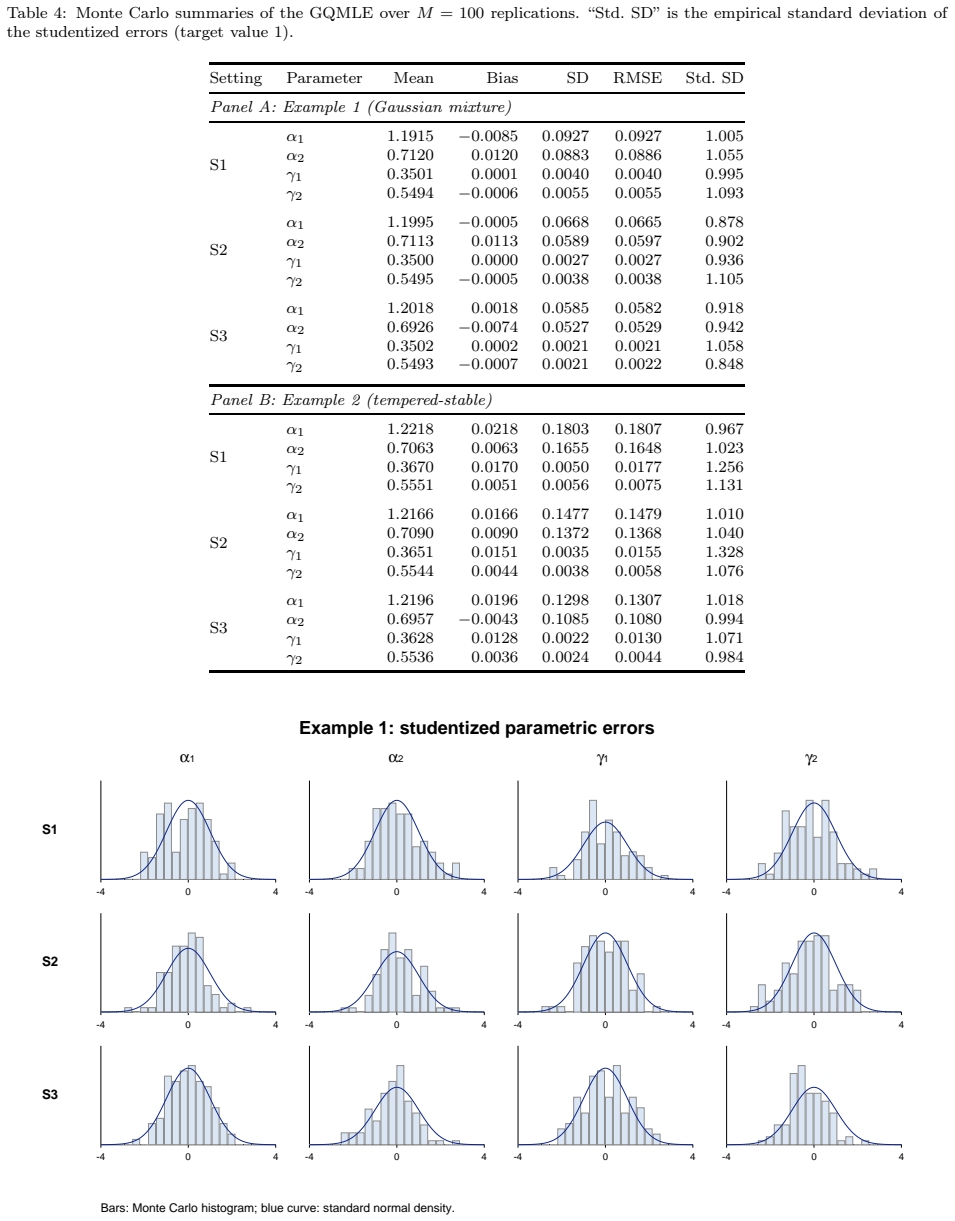
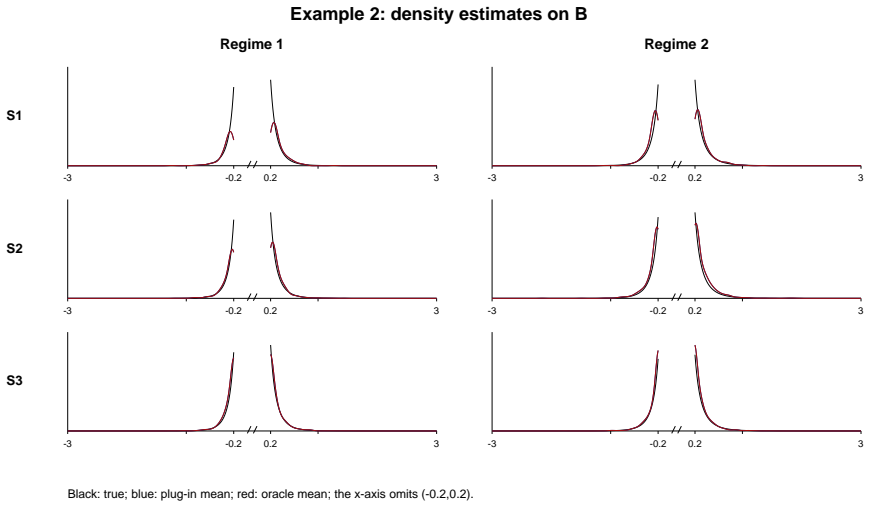
- Finite-sample performance holds in simulations for switching Ornstein-Uhlenbeck models.
Where Pith is reading between the lines
- The separation of increments may extend to estimating other functionals of the jump measure beyond densities in switching models.
- Adaptive selection of the small-large increment threshold could improve the convergence rates in practice.
- The two-stage structure may apply to other latent-regime models where an unknown component contaminates the likelihood.
Load-bearing premise
The underlying regime-switching jump diffusion is ergodic so that each regime receives positive exposure time and small increments can be isolated to estimate the continuous coefficients without jump contamination.
What would settle it
Simulated high-frequency paths from a known regime-switching jump diffusion where the two-stage estimators fail to converge to the true continuous parameters or the density estimates fail to achieve the claimed L2 rates on compact sets away from zero.
Figures


read the original abstract
We study high-frequency semiparametric inference for ergodic regime-switching jump diffusions whose continuous coefficients are parametric and whose regime-wise L\'evy densities are unknown. The motivation is that jumps contaminate increments while their law is itself unknown, making likelihood-based inference circular in switching models. We propose a two-stage procedure. First, small increments are used in a truncated Gaussian quasi-likelihood to estimate the drift and diffusion parameters. Second, large drift-corrected residuals are sorted by regime and smoothed with a kernel, with normalization by empirical regime exposure time, to estimate the L\'evy intensity densities on compact sets away from zero. We establish consistency and mixed-rate asymptotic normality for the quasi-maximum likelihood estimator, and derive \(L^2(B)\)-convergence rates for the exposure-normalized residual density estimator. Simulations for switching Ornstein--Uhlenbeck models illustrate the finite-sample performance of the method.
Editorial analysis
A structured set of objections, weighed in public.
Referee Report
Summary. The paper proposes a two-stage semiparametric procedure for ergodic regime-switching jump diffusions with parametric continuous coefficients and unknown regime-specific Lévy densities. Small increments are used for a truncated Gaussian quasi-maximum likelihood estimator of the drift and diffusion parameters; large drift-corrected residuals are then sorted by regime and kernel-smoothed with exposure-time normalization to recover the Lévy densities on compact sets away from zero. The central claims are consistency and mixed-rate asymptotic normality for the QMLE together with L²(B)-convergence rates for the exposure-normalized density estimators.
Significance. If the asymptotic results hold, the two-stage design offers a concrete way to break the circular dependence of the likelihood on the unknown Lévy law in switching models. The separation of small and large increments, combined with explicit rates for both the parametric and nonparametric stages, would be a useful contribution for high-frequency inference in regime-switching jump processes.
major comments (2)
- [Abstract] Abstract: the L²(B)-convergence claim for the exposure-normalized residual density estimator requires that regime assignment of large residuals occurs with classification error that vanishes faster than the bandwidth rate. Because the continuous coefficients are regime-specific, any assignment rule must ultimately depend on the first-stage QMLE; no explicit bound on the resulting mis-assignment probability (or its effect on the kernel bias) is supplied, leaving the rate justification incomplete.
- [Abstract] Abstract: the mixed-rate asymptotic normality for the QMLE is asserted after truncation of small increments, yet the interaction between the truncation threshold, the regime-switching intensity, and the ergodicity assumption is not quantified. Without a concrete condition ensuring that the truncation does not introduce regime-dependent bias of the same order as the parametric rate, the normality statement rests on an unverified separation.
minor comments (1)
- [Abstract] The abstract refers to 'compact sets away from zero' for the Lévy densities but does not specify how the sets B are chosen relative to the jump-size distribution or the bandwidth sequence.
Simulated Author's Rebuttal
We thank the referee for the careful reading and constructive comments. We address each major comment below.
read point-by-point responses
-
Referee: [Abstract] Abstract: the L²(B)-convergence claim for the exposure-normalized residual density estimator requires that regime assignment of large residuals occurs with classification error that vanishes faster than the bandwidth rate. Because the continuous coefficients are regime-specific, any assignment rule must ultimately depend on the first-stage QMLE; no explicit bound on the resulting mis-assignment probability (or its effect on the kernel bias) is supplied, leaving the rate justification incomplete.
Authors: We agree that an explicit bound on the misclassification probability is required to close the argument. The manuscript derives consistency of the first-stage QMLE but does not supply a quantitative bound on the resulting regime-assignment error for large increments. In the revision we will add a lemma establishing that, under the maintained separation of the regime-specific continuous coefficients together with ergodicity, the misassignment probability decays exponentially in the sample size and is therefore negligible relative to the nonparametric bandwidth rate. revision: yes
-
Referee: [Abstract] Abstract: the mixed-rate asymptotic normality for the QMLE is asserted after truncation of small increments, yet the interaction between the truncation threshold, the regime-switching intensity, and the ergodicity assumption is not quantified. Without a concrete condition ensuring that the truncation does not introduce regime-dependent bias of the same order as the parametric rate, the normality statement rests on an unverified separation.
Authors: The comment correctly identifies a missing quantitative link. The current truncation argument controls the probability of jump contamination but does not explicitly relate the threshold to the regime-switching intensity. In the revision we will insert a concrete condition on the truncation level (relative to the minimal jump size and the ergodic occupation measure of each regime) that guarantees the induced bias is o_p of the parametric rate, thereby justifying the mixed-rate normality statement. revision: yes
Circularity Check
Two-stage procedure avoids circular dependence on unknown Lévy law by construction
full rationale
The paper's derivation chain is self-contained: the first-stage QMLE uses only small increments and a truncated Gaussian quasi-likelihood whose form does not depend on the unknown Lévy densities, while the second-stage kernel estimator is applied to large residuals after drift correction and regime sorting justified by ergodicity. No equation reduces a claimed rate or normality result to a fitted parameter by definition, no uniqueness theorem is imported from self-citation, and the separation of small/large increments is an explicit modeling choice rather than a tautology. The abstract and procedure description confirm the method is motivated precisely to break the circularity that would arise from a joint likelihood.
Axiom & Free-Parameter Ledger
axioms (2)
- domain assumption The regime-switching jump diffusion process is ergodic
- domain assumption Small increments can be treated as approximately Gaussian after truncation
Reference graph
Works this paper leans on
-
[1]
C. Amorino and A. Gloter. Contrast function estimation f or the drift parameter of ergodic jump diffusion process. Scandinavian Journal of Statistics , 47(2):279–346, 2020
work page 2020
-
[2]
R. N. Bhattacharya. On the functional central limit theo rem and the law of the iterated logarithm for Markov processes. Zeitschrift für Wahrscheinlichkeitstheorie und Verwandte Geb iete, 60(2):185–201, 1982
work page 1982
-
[3]
Y. Cheng and H. Masuda. Statistical inference for ergodi c diffusion with Markovian switching. Discrete and Continuous Dynamical Systems - B , 30(10):3910–3940, 2025
work page 2025
-
[4]
J. Chevallier and S. Goutte. On the estimation of regime- switching Lévy models. Studies in Nonlinear Dynamics & Econometrics , 21(1):3–29, 2017
work page 2017
-
[5]
F. Comte and V. Genon-Catalot. Estimation for Lévy proce sses from high frequency data within a long time interval. The Annals of Statistics , 39(2):803–837, 2011
work page 2011
-
[6]
J. E. Figueroa-López. Small-time moment asymptotics fo r Lévy processes. Statistics & Probability Letters, 78(18):3355–3365, 2008
work page 2008
-
[7]
J. E. Figueroa-López and C. Houdré. Risk bounds for the no n-parametric estimation of Lévy processes. In E. Giné, V. Koltchinskii, W. Li, and J. Zinn, editors, High Dimensional Probability, volume 51 of Institute of Mathematical Statistics Lecture Notes–Monograph Series , pages 96–116. Institute of Mathematical Statistics, Beachwood, OH, 2006
work page 2006
-
[8]
J. E. Figueroa-López and C. Houdré. Small-time expansio ns for the transition distributions of Lévy processes. Stochastic Processes and their Applications , 119(11):3862–3889, 2009
work page 2009
- [9]
-
[10]
E. Gobet. LAN property for ergodic diffusions with discr ete observations. Annales de l’Institut Henri Poincaré. Probabilités et Statistiques , 38(5):711–737, 2002
work page 2002
-
[11]
M. Kessler. Estimation of an ergodic diffusion from disc rete observations. Scandinavian Journal of Statistics, 24(2):211–229, 1997
work page 1997
-
[12]
M. Kessler, A. Lindner, and M. Sørensen. Statistical methods for stochastic differential equations , volume 124 of Monographs on Statistics and Applied Probability . CRC Press, 2012
work page 2012
-
[13]
H. Kunita. Tightness of probability measures in D([0, t]; C) and D([0, t]; D). Journal of the Mathematical Society of Japan , 38(2):309–334, 1986
work page 1986
- [14]
-
[15]
C. Mancini. Non-parametric threshold estimation for m odels with stochastic diffusion coefficient and jumps. Scandinavian Journal of Statistics , 36(2):270–296, 2009
work page 2009
- [16]
-
[17]
H. Masuda. Convergence of Gaussian quasi-likelihood r andom fields for ergodic Lévy driven SDE ob- served at high frequency. The Annals of Statistics , 41(3):1593–1641, 2013
work page 2013
-
[18]
S. P. Meyn and R. L. Tweedie. Markov chains and stochastic stability . Springer, 2012
work page 2012
-
[19]
T. Ogihara and N. Yoshida. Quasi-likelihood analysis f or the stochastic differential equation with jumps. Statistical Inference for Stochastic Processes , 14(3):189–229, 2011
work page 2011
-
[20]
P. E. Protter. Stochastic integration and differential equations , volume 21 of Stochastic Modelling and Applied Probability. Springer-Verlag, Berlin, 2005. Second edition. Version 2 .1, Corrected third printing
work page 2005
-
[21]
Y. Shimizu. Density estimation of Lévy measures for dis cretely observed diffusion processes with jumps. Journal of the Japan Statistical Society , 36(1):37–62, 2006
work page 2006
-
[22]
Y. Shimizu and N. Yoshida. Estimation of parameters for diffusion processes with jumps from discrete observations. Statistical Inference for Stochastic Processes , 9(3):227–277, 2006
work page 2006
-
[23]
F. Xi. Asymptotic properties of jump-diffusion process es with state-dependent switching. Stochastic Processes and their Applications , 119(7):2198–2221, 2009
work page 2009
- [24]
-
[25]
G. G. Yin and C. Zhu. Hybrid switching diffusions: properties and applications , volume 63. Springer, 2009. 38
work page 2009
discussion (0)
Sign in with ORCID, Apple, or X to comment. Anyone can read and Pith papers without signing in.