Andreev reflection mediated by topological corner states in a two-dimensional honeycomb lattice
Pith reviewed 2026-07-01 04:37 UTC · model grok-4.3
The pith
Topological corner states mediate Andreev reflection by creating resonant tunneling paths in second-order topological insulators.
A machine-rendered reading of the paper's core claim, the machinery that carries it, and where it could break.
Core claim
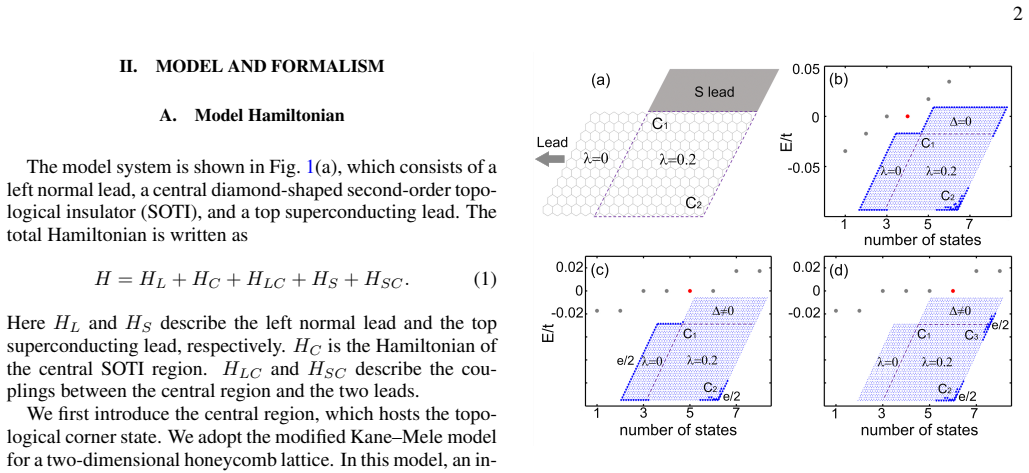
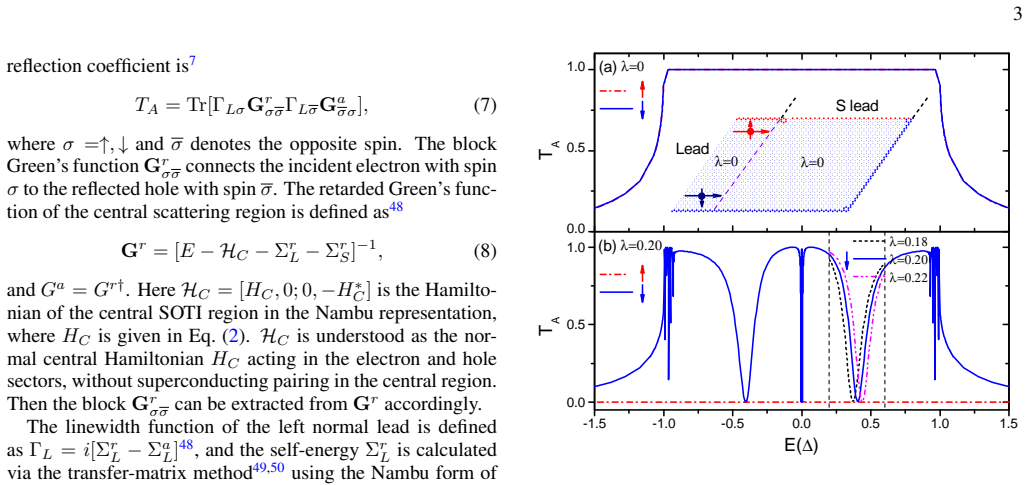
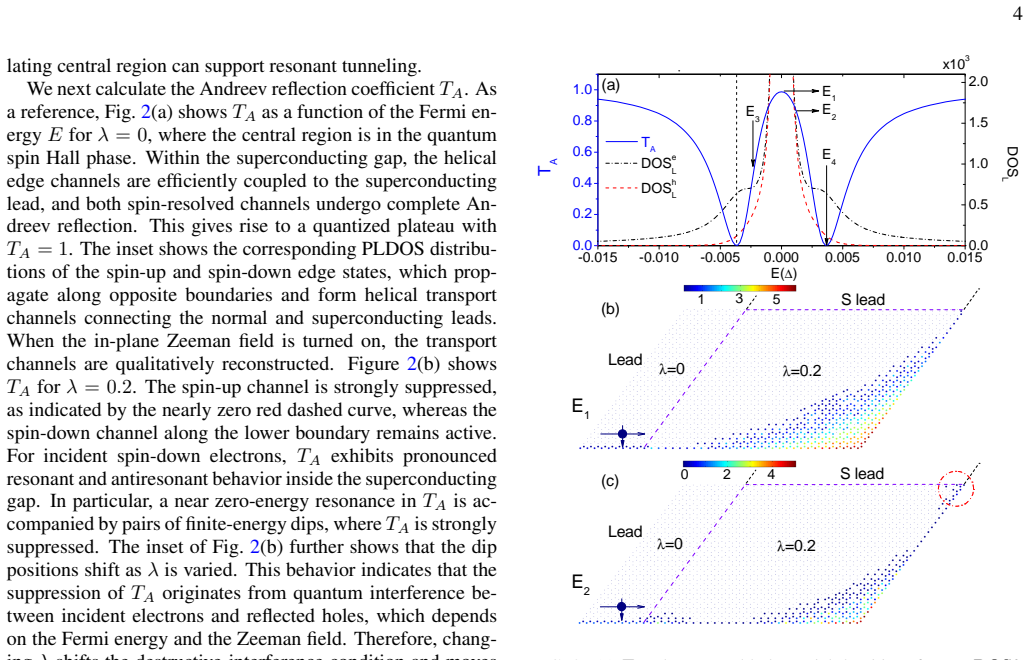
In the modified Kane-Mele model with an in-plane Zeeman field, topological corner states localized in a diamond-shaped flake of a honeycomb lattice can mediate Andreev reflection when the system is coupled to a superconducting lead. Incident electrons transform these localized states into extended scattering states that serve as a resonant tunneling path, resulting in a perfect Andreev reflection peak near zero energy. Away from resonance, antiresonance dips occur due to quantum interference and the imbalance between electron and hole dwell times in the central region.
What carries the argument
The resonant tunneling channel created when localized topological corner states are turned into extended scattering states by coupling to the leads.
If this is right
- Perfect Andreev reflection occurs near zero energy through the corner-state channel.
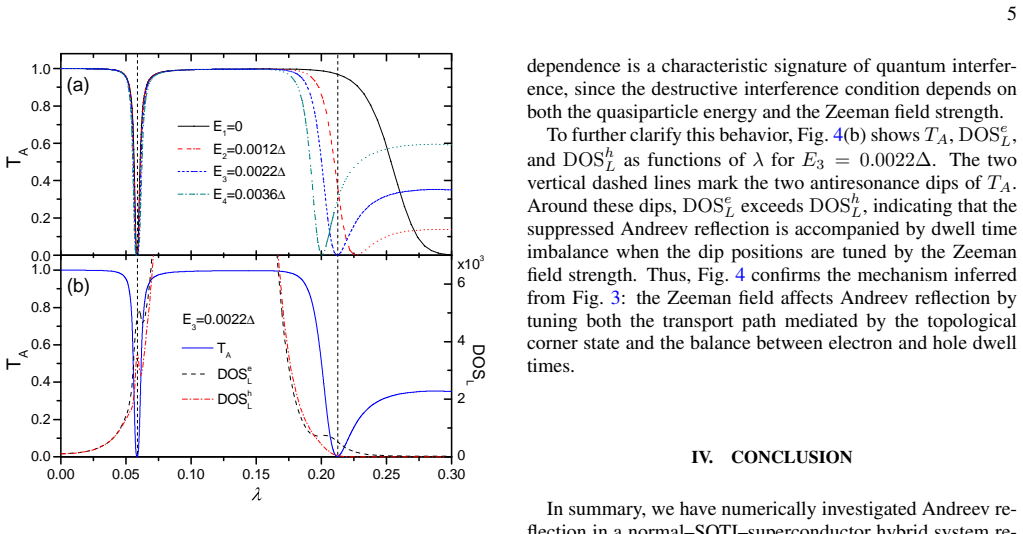
- Antiresonance dips appear in the Andreev reflection spectrum at positions tunable by the Zeeman field strength.
- Suppression of Andreev reflection results from quantum interference combined with unequal electron and hole dwell times.
- The corner states provide a resonant tunneling path to the superconducting interface in second-order topological systems.
Where Pith is reading between the lines
- The mechanism may allow control of superconducting proximity effects using magnetic fields in higher-order topological materials.
- Similar resonant mediation could occur in other lattice geometries or second-order topological insulators beyond the honeycomb case.
- Device applications might exploit the tunability of the resonance and antiresonances for Andreev processes.
Load-bearing premise
The coupling of topological corner states to the leads produces an extended scattering state that forms a resonant tunneling channel to the superconducting lead.
What would settle it
No perfect Andreev reflection peak near zero energy in numerical transport calculations when the central region is configured to host topological corner states.
Figures
read the original abstract
Topological corner states in two-dimensional second-order topological insulators (SOTIs) are localized in real space. We numerically demonstrate that such localized topological corner states can mediate Andreev reflection when coupled to a superconducting lead. We consider a transport setup based on a two-dimensional honeycomb lattice, consisting of a normal lead, a central SOTI region, and a superconducting lead. The central SOTI region is described by the modified Kane--Mele model with an in-plane Zeeman field and hosts topological corner states in a diamond-shaped flake. Although the central region is insulating, the local density of states shows that incident electrons can turn the localized corner state into an extended scattering state, which forms a resonant tunneling channel to the superconducting lead. This process leads to a perfect Andreev reflection peak near zero energy. Away from this resonance, antiresonance dips appear in the Andreev reflection spectrum, and their positions can be tuned by the Zeeman field strength. We show that the suppression of Andreev reflection is caused by quantum interference and the imbalance between electron and hole dwell times in the central region. These results demonstrate that topological corner states can provide a resonant tunneling path to the superconducting interface and mediate Andreev reflection in second-order topological systems.
Editorial analysis
A structured set of objections, weighed in public.
Referee Report
Summary. The manuscript numerically studies Andreev reflection in a normal-SOTI-superconductor junction on a honeycomb lattice. The central region is a diamond-shaped flake described by the modified Kane-Mele model plus in-plane Zeeman field, which hosts topological corner states. The authors report that these localized states are converted by incident electrons into extended scattering states that form a resonant channel to the superconducting lead, producing a perfect Andreev reflection peak at zero energy; antiresonance dips appear away from resonance and are tunable by the Zeeman strength. The suppression mechanism is attributed to quantum interference and electron-hole dwell-time imbalance.
Significance. If the central claim is substantiated, the work would establish that second-order topological corner states can serve as tunable mediators of resonant Andreev processes in an otherwise insulating region. This would add a concrete transport signature to the phenomenology of higher-order topological insulators and could motivate further studies of corner-state-assisted superconducting proximity effects.
major comments (2)
- [Numerical results / LDOS and conductance spectra] The central claim that the zero-energy Andreev peak is mediated specifically by the topological corner states rests on LDOS visualizations showing a localized corner mode becoming extended. No wave-function decomposition (projection onto a corner-localized basis) or control calculations (zero Zeeman field or trivial phase without corner states) are presented to exclude generic interface or finite-size resonances. This absence directly weakens the attribution of the resonance to the topological corner states.
- [Transport setup and results] The manuscript states that the central region is insulating yet supports resonant tunneling via corner states, but provides no quantitative check (e.g., comparison of conductance with and without the Zeeman-induced corner states, or scaling with flake size) that the perfect Andreev peak disappears when corner states are absent. Without such a control, the reported peak could arise from lead hybridization effects unrelated to the second-order topology.
minor comments (2)
- [Methods] Lattice size, lead-coupling strength, and convergence criteria for the scattering calculations are not specified; these details are needed to assess numerical reliability.
- [Results] The antiresonance positions are said to be tunable by Zeeman field strength, but no explicit functional dependence or additional plots quantifying the shift are shown.
Simulated Author's Rebuttal
We thank the referee for the careful reading of our manuscript and the constructive comments. We address the major comments point by point below.
read point-by-point responses
-
Referee: [Numerical results / LDOS and conductance spectra] The central claim that the zero-energy Andreev peak is mediated specifically by the topological corner states rests on LDOS visualizations showing a localized corner mode becoming extended. No wave-function decomposition (projection onto a corner-localized basis) or control calculations (zero Zeeman field or trivial phase without corner states) are presented to exclude generic interface or finite-size resonances. This absence directly weakens the attribution of the resonance to the topological corner states.
Authors: We agree that the attribution would be strengthened by explicit controls. In the revised manuscript we will add (i) calculations at zero Zeeman field (trivial phase, no corner states) to show the zero-energy Andreev peak is absent and (ii) a projection of the scattering wave functions onto a corner-localized basis to quantify the contribution of the topological corner states. revision: yes
-
Referee: [Transport setup and results] The manuscript states that the central region is insulating yet supports resonant tunneling via corner states, but provides no quantitative check (e.g., comparison of conductance with and without the Zeeman-induced corner states, or scaling with flake size) that the perfect Andreev peak disappears when corner states are absent. Without such a control, the reported peak could arise from lead hybridization effects unrelated to the second-order topology.
Authors: We concur that a direct quantitative comparison is needed. The revised manuscript will include (i) a side-by-side comparison of the Andreev reflection spectra with and without the in-plane Zeeman field and (ii) a finite-size scaling analysis of the diamond flake to confirm that the resonance is tied to the corner states rather than lead hybridization or generic finite-size effects. revision: yes
Circularity Check
No circularity; numerical results are independent of fitted parameters or self-referential definitions
full rationale
The paper reports direct numerical simulations of transport in a modified Kane-Mele model with Zeeman field on a diamond flake, computing LDOS and Andreev reflection coefficients from the scattering setup. No quantity is defined in terms of another (e.g., no fitted resonance parameter renamed as prediction), no self-citation chain justifies the central claim, and the model Hamiltonian is standard rather than ansatz-smuggled. The observed perfect Andreev peak is an output of the computation, not an input by construction. This is the normal case of a self-contained numerical study.
Axiom & Free-Parameter Ledger
free parameters (1)
- in-plane Zeeman field strength
axioms (1)
- domain assumption The modified Kane-Mele model with in-plane Zeeman field on a diamond-shaped flake is a second-order topological insulator hosting localized corner states.
Reference graph
Works this paper leans on
-
[1]
A. F. Andreev, The thermal conductivity of the intermediate state in superconductors, Sov. Phys. JETP 19, 1228 (1964). https://www.jetp.ras.ru/cgi-bin/dn/e_019_05_1228.pdf
1964
-
[2]
I. K. Marmorkos, C. W. J. Beenakker, and R. A. Jalabert, Three signatures of phase-coherent Andreev reflection, Phys. Rev. B 48, 2811 (1993). https://doi.org/10.1103/PhysRevB.48.2811
-
[3]
Q.-F. Sun, J. Wang, and T.-H. Lin, Resonant Andreev reflection in a normal-metal-quantum-dot-superconductor system, Phys. Rev. B 59, 3831 (1999). https://doi.org/10.1103/PhysRevB.59.3831
-
[4]
A. Costa, A. Matos-Abiague, and J. Fabian, Skew Andreev reflection in ferromagnet/superconductor junctions, Phys. Rev. B 100, 060507(R) (2019). https://doi.org/10.1103/PhysRevB.100.060507
-
[5]
C. W. J. Beenakker, Specular Andreev Reflection in Graphene, Phys. Rev. Lett. 97, 067007 (2006). https://doi.org/10.1103/PhysRevLett.97.067007
-
[6]
C. W. J. Beenakker, Colloquium: Andreev reflection and Klein tunneling in graphene, Rev. Mod. Phys. 80, 1337 (2008). https://doi.org/10.1103/RevModPhys.80.1337
-
[7]
Q.-F. Sun and X. C. Xie, Quantum transport through a graphene nanoribbon-superconductor junction, J. Phys.: Condens. Matter 21, 344204 (2009). https://doi.org/10.1088/0953-8984/21/34/344204
-
[8]
Q.-F. Sun, Y.-X. Li, W. Long, and J. Wang, Quantum Andreev effect in two-dimensional HgTe/CdTe quantum well/superconductor systems, Phys. Rev. B 83, 115315 (2011). https://doi.org/10.1103/PhysRevB.83.115315
-
[9]
A. Narayan and S. Sanvito, Andreev reflection in two-dimensional topological insulators with either conserved or broken time-reversal symmetry, Phys. Rev. B 86, 041104(R) (2012). https://doi.org/10.1103/PhysRevB.86.041104
-
[10]
I. Knez, and R.-R. Du, Andreev Reflection of Helical Edge Modes in InAs/GaSb Quantum Spin Hall Insulator, Phys. Rev. Lett. 109, 186603 (2012). https://doi.org/10.1103/PhysRevLett.109.186603
-
[11]
Z. Hou, Y. Xing, A.-M. Guo, and Q.-F. Sun, Crossed Andreev effects in two-dimensional quantum Hall systems, Phys. Rev. B 94, 064516 (2016). https://doi.org/10.1103/PhysRevB.94.064516
-
[12]
M. Wei, M. Zhou, Y.-T. Zhang, and Y. Xing, From quantized local Andreev reflection to perfect crossed Andreev reflection in topological insulator-superconductor hybrid systems, Phys. Rev. B 101, 155408 (2020). https://doi.org/10.1103/PhysRevB.101.155408
-
[13]
M. Diez, J. P. Dahlhaus, M. Wimmer, and C. W. J. Beenakker, Andreev reflection from a topological superconductor with chiral symmetry, Phys. Rev. B 86, 094501 (2012). https://doi.org/10.1103/PhysRevB.86.094501
-
[14]
N. Bovenzi, M. Breitkreiz, P. Baireuther, T. E. O'Brien, J. Tworzyd o, \. I . Adagideli, and C. W. J. Beenakker, Chirality blockade of Andreev reflection in a magnetic Weyl semimetal, Phys. Rev. B 96, 035437 (2017). https://doi.org/10.1103/PhysRevB.96.035437
-
[15]
Q. Cheng, Z. Hou, and Q.-F. Sun, Double Andreev reflections and double normal reflections in nodal-line semimetal-superconductor junctions, Phys. Rev. B 101, 094508 (2020). https://doi.org/10.1103/PhysRevB.101.094508
-
[16]
A. Azizi and B. Abdollahipour, Andreev reflection at the interface of a normal Weyl semimetal and a superconducting type-II Weyl semimetal, Phys. Rev. B 102, 024512 (2020). https://doi.org/10.1103/PhysRevB.102.024512
-
[17]
Z.-M. Yu, Y. Liu, Y. Yao, and S. A. Yang, Unconventional Pairing Induced Anomalous Transverse Shift in Andreev Reflection, Phys. Rev. Lett. 121, 176602 (2018). https://doi.org/10.1103/PhysRevLett.121.176602
-
[18]
M. Wei, L. Xiang, F. Xu, B. Wang, and J. Wang, Unconventional Hall Effect in Gapless Superconductors, Phys. Rev. Lett. 135, 166304 (2025). https://doi.org/10.1103/fql8-f3tl
-
[19]
C. Sun, A. Brataas, and J. Linder, Andreev reflection in altermagnets, Phys. Rev. B 108, 054511 (2023). https://doi.org/10.1103/PhysRevB.108.054511
-
[20]
Y. Nagae, A. P. Schnyder, and S. Ikegaya, Spin-polarized specular Andreev reflections in altermagnets, Phys. Rev. B 111, L100507 (2025). https://doi.org/10.1103/PhysRevB.111.L100507
-
[21]
M. Z. Hasan and C. L. Kane, Colloquium: Topological insulators, Rev. Mod. Phys. 82, 3045 (2010). https://doi.org/10.1103/RevModPhys.82.3045
-
[22]
X.-L. Qi and S.-C. Zhang, Topological insulators and superconductors, Rev. Mod. Phys. 83, 1057 (2011). https://doi.org/10.1103/RevModPhys.83.1057
-
[23]
W. A. Benalcazar, B. A. Bernevig, and T. L. Hughes, Quantized electric multipole insulators, Science 357, 61 (2017). https://doi.org/10.1126/science.aah6442
-
[24]
W. A. Benalcazar, B. A. Bernevig, and T. L. Hughes, Electric multipole moments, topological multipole moment pumping, and chiral hinge states in crystalline insulators, Phys. Rev. B 96, 245115 (2017). https://doi.org/10.1103/PhysRevB.96.245115
-
[25]
F. Schindler, A. M. Cook, M. G. Vergniory, Z. Wang, S. S. P. Parkin, B. A. Bernevig, and T. Neupert, Higher-order topological insulators, Sci. Adv. 4, eaat0346 (2018). https://doi.org/10.1126/sciadv.aat0346
-
[26]
B. Xie, H.-X. Wang, X. Zhang, P. Zhan, J.-H. Jiang, M. Lu, and Y. Chen, Higher-order band topology, Nat. Rev. Phys. 3, 520 (2021). https://doi.org/10.1038/s42254-021-00323-4
-
[27]
M. S. Hossain, Q. Zhang, Z. Wang, N. Dhale, W. Liu, M. Litskevich, B. Casas, N. Shumiya, J.-X. Yin, T. A. Cochran, Y. Li, Y.-X. Jiang, Y. Zhang, G. Cheng, Z.-J. Cheng, X. P. Yang, N. Yao, T. Neupert, L. Balicas, Y. Yao, B. Lv, and M. Z. Hasan, Quantum transport response of topological hinge modes, Nat. Phys. 20, 776 (2024). https://doi.org/10.1038/s41567-...
-
[28]
Y. Ren, Z. Qiao, and Q. Niu, Engineering Corner States from Two-Dimensional Topological Insulators, Phys. Rev. Lett. 124, 166804 (2020). https://doi.org/10.1103/PhysRevLett.124.166804
-
[29]
L. Liu, J. An, Y. Ren, Y.-T. Zhang, Z. Qiao, and Q. Niu, Engineering corner states by coupling two-dimensional topological insulators, Phys. Rev. B 111, 045403 (2025). https://doi.org/10.1103/PhysRevB.111.045403
-
[30]
M. Ezawa, Higher-order topological insulators and semimetals on the breathing kagome and pyrochlore lattices, Phys. Rev. Lett. 120, 026801 (2018). https://doi.org/10.1103/PhysRevLett.120.026801
-
[31]
X.-L. Sheng, C. Chen, H. Liu, Z. Chen, Z.-M. Yu, Y.-X. Zhao, and S. A. Yang, Two-dimensional second-order topological insulator in graphdiyne, Phys. Rev. Lett. 123, 256402 (2019). https://doi.org/10.1103/PhysRevLett.123.256402
-
[32]
Z.-H. Li, P. Zhou, Q.-H. Yan, X.-Y. Peng, Z.-S. Ma, and L.-Z. Sun, Second-order topological insulator in two-dimensional C _2 N and its derivatives, Phys. Rev. B 106, 085126 (2022). https://doi.org/10.1103/PhysRevB.106.085126
-
[33]
M. J. Park, Y. Kim, G. Y. Cho, and S. B. Lee, Higher-order topological insulator in twisted bilayer graphene, Phys. Rev. Lett. 123, 216803 (2019). https://doi.org/10.1103/PhysRevLett.123.216803
-
[34]
M. J. Park, S. Jeon, S. Lee, H. C. Park, and Y. Kim, Higher-Order Topological Corner State Tunneling in Twisted Bilayer Graphene, Carbon 174, 260 (2021). https://doi.org/10.1016/j.carbon.2020.12.037
-
[35]
R. Chen, C.-Z. Chen, J.-H. Gao, B. Zhou, and D.-H. Xu, Higher-Order Topological Insulators in Quasicrystals, Phys. Rev. Lett. 124, 036803 (2020). https://doi.org/10.1103/PhysRevLett.124.036803
-
[36]
W. Zhang, D. Zou, Q. Pei, W. He, J. Bao, H. Sun, and X. Zhang, Experimental Observation of Higher-Order Topological Anderson Insulators, Phys. Rev. Lett. 126, 146802 (2021). https://doi.org/10.1103/PhysRevLett.126.146802
-
[37]
Y.-B. Yang, K. Li, L.-M. Duan, and Y. Xu, Higher-order topological Anderson insulators, Phys. Rev. B 103, 085408 (2021). https://doi.org/10.1103/PhysRevB.103.085408
-
[38]
Z. Wang, B. J. Wieder, J. Li, B. Yan, and B. A. Bernevig, Higher-order topology, monopole nodal lines, and the origin of large Fermi arcs in transition metal dichalcogenides X Te _2 ( X= Mo,W ), Phys. Rev. Lett. 123, 186401 (2019). https://doi.org/10.1103/PhysRevLett.123.186401
-
[39]
J. Zeng, H. Liu, H. Jiang, Q.-F. Sun, and X. C. Xie, Multiorbital model reveals a second-order topological insulator in 1H transition metal dichalcogenides, Phys. Rev. B 104, L161108 (2021). https://doi.org/10.1103/PhysRevB.104.L161108
-
[40]
B. Liu, L. Xian, H. Mu, G. Zhao, Z. Liu, A. Rubio, and Z. F. Wang, Higher-Order Band Topology in Twisted Moir\' e Superlattice, Phys. Rev. Lett. 126, 066401 (2021). https://doi.org/10.1103/PhysRevLett.126.066401
-
[41]
K.-T. Wang, Y. Ren, F. Xu, Y. Wei, and J. Wang, Transport induced dimer state from topological corner states, Sci. China-Phys. Mech. Astron. 64, 257811 (2021). https://doi.org/10.1007/s11433-020-1677-9
-
[42]
K.-T. Wang, F. Xu, B. Wang, Y. Yu, and Y. Wei, Transport features of topological corner states in honeycomb lattice with multihollow structure, Front. Phys. 17, 43501 (2022). https://doi.org/10.1007/s11467-021-1136-z
-
[43]
B.-L. Wu, A.-M. Guo, Z.-Q. Zhang, and H. Jiang, Quantized charge-pumping in higher-order topological insulators, Phys. Rev. B 106, 165401 (2022). https://doi.org/10.1103/PhysRevB.106.165401
-
[44]
Y. Long, M. Wei, F. Xu, and J. Wang, Bulk-boundary-transport correspondence of the second-order topological insulators, Sci. China-Phys. Mech. Astron. 66, 127811 (2023). https://doi.org/10.1007/s11433-023-2206-2
-
[45]
K.-T. Wang, H. Wang, S. Liu, M. Wei, and F. Xu, Spin separation and filtering assisted by topological corner states in the Kekul\'e lattice, Phys. Rev. B 110, 125433 (2024). https://doi.org/10.1103/PhysRevB.110.125433
-
[46]
J. Poata, F. Taddei, and M. Governale, Topological nano-switches in higher-order topological insulators, New J. Phys. 26, 053038 (2024). https://doi.org/10.1088/1367-2630/ad4abd
-
[47]
C. L. Kane, and E. J. Mele, Quantum Spin Hall Effect in Graphene, Phys. Rev. Lett. 95, 226801 (2005). https://doi.org/10.1103/PhysRevLett.95.226801
-
[48]
Datta, Electronic Transport in Mesoscopic System (Cambridge University Press, Cambridge, UK, 1995)
S. Datta, Electronic Transport in Mesoscopic System (Cambridge University Press, Cambridge, UK, 1995)
1995
-
[49]
D. H. Lee, and J. D. Joannopoulos, Simple scheme for surface-band calculations. I, Phys. Rev. B 23, 4988 (1981). https://doi.org/10.1103/PhysRevB.23.4988
-
[50]
D. H. Lee, and J. D. Joannopoulos, Simple scheme for surface-band calculations. II, Phys. Rev. B 23, 4997 (1981). https://doi.org/10.1103/PhysRevB.23.4997
-
[51]
Y. X. Xing, B. Wang, Y. D. Wei, B. G. Wang, and J. Wang, Spin pump in the presence of a superconducting lead, Phys. Rev. B 70, 245324 (2004). https://doi.org/10.1103/PhysRevB.70.245324
-
[52]
E. P. Wigner, Lower limit for the energy derivative of the scattering phase shift, Phys. Rev. 98, 145 (1955). https://doi.org/10.1103/PhysRev.98.145
-
[53]
F. T. Smith, Lifetime matrix in collision theory, Phys. Rev. 118, 349 (1960). https://doi.org/10.1103/PhysRev.118.349
-
[54]
M. B\"uttiker, A. Pr\^etre, and H. Thomas, Dynamic conductance and the scattering matrix of small conductors, Phys. Rev. Lett. 70, 4114 (1993). https://doi.org/10.1103/PhysRevLett.70.4114
-
[55]
Iannaccone, General relation between density of states and dwell times in mesoscopic systems, Phys
G. Iannaccone, General relation between density of states and dwell times in mesoscopic systems, Phys. Rev. B 51, 4727 (1995). https://doi.org/10.1103/PhysRevB.51.4727
-
[56]
V. Gasparian, T. Christen, and M. B\"uttiker, Partial densities of states, scattering matrices, and Green's functions, Phys. Rev. A 54, 4022 (1996). https://doi.org/10.1103/PhysRevA.54.4022
-
[57]
P. W. Brouwer and M. B\"uttiker, Charge-relaxation and dwell time in the fluctuating admittance of a chaotic cavity, Europhys. Lett. 37, 441 (1997). https://doi.org/10.1209/epl/i1997-00169-0
-
[58]
F. Xu and J. Wang, Statistics of Wigner delay time in Anderson disordered systems, Phys. Rev. B 84, 024205 (2011). https://doi.org/10.1103/PhysRevB.84.024205
-
[59]
Ossipov, Scattering approach to Anderson localization, Phys
A. Ossipov, Scattering approach to Anderson localization, Phys. Rev. Lett. 121, 076601 (2018). https://doi.org/10.1103/PhysRevLett.121.076601
-
[60]
Y. Xing, J. Wang, and Q.-F. Sun, Parity of specular Andreev reflection under a mirror operation in a zigzag graphene ribbon, Phys. Rev. B 83, 205418 (2011). https://doi.org/10.1103/PhysRevB.83.205418
-
[61]
Z. Hou and Q.-F. Sun, Double Andreev reflections in type-II Weyl semimetal-superconductor junctions, Phys. Rev. B 96, 155305 (2017). https://doi.org/10.1103/PhysRevB.96.155305
-
[62]
P. Lv, Y.-F. Zhou, N.-X. Yang, and Q.-F. Sun, Magnetoanisotropic spin-triplet Andreev reflection in ferromagnet-Ising superconductor junctions, Phys. Rev. B 97, 144501 (2018). https://doi.org/10.1103/PhysRevB.97.144501
-
[63]
S.-G. Cheng, Y. Xing, J. Wang and Q.-F. Sun, Controllable Andreev Retroreflection and Specular Andreev Reflection in a Four-Terminal Graphene-Superconductor Hybrid System, Phys. Rev. Lett. 103, 167003 (2009). https://doi.org/10.1103/PhysRevLett.103.167003
-
[64]
Y. Liu, Z.-M. Yu, and S. A. Yang, Transverse shift in Andreev reflection, Phys. Rev. B 96, 121101(R) (2017). https://doi.org/10.1103/PhysRevB.96.121101
-
[65]
Y. Liu, Z.-M. Yu, J. Liu, H. Jiang and S. A. Yang, Transverse shift in crossed Andreev reflection, Phys. Rev. B 98, 195141 (2018). https://doi.org/10.1103/PhysRevB.98.195141
-
[66]
X. Feng, Y. Liu, Z.-M. Yu, Z. Ma, L. K. Ang, Y. S. Ang, and S. A. Yang, Super-Andreev reflection and longitudinal shift of pseudospin-1 fermions, Phys. Rev. B 101, 235417 (2020). https://doi.org/10.1103/PhysRevB.101.235417
-
[67]
Q. Li, Y. Han, K. Zhang, Y.-T. Zhang, J.-J. Liu, and Z. Qiao, Multiple Majorana edge modes in magnetic topological insulator-superconductor heterostructures, Phys. Rev. B 102, 205402 (2020). https://doi.org/10.1103/PhysRevB.102.205402
-
[68]
Y.-T. Zhang, Z. Hou, X. C. Xie, and Q.-F. Sun, Quantum perfect crossed Andreev reflection in top-gated quantum anomalous Hall insulator-superconductor junctions, Phys. Rev. B 95, 245433 (2017). https://doi.org/10.1103/PhysRevB.95.245433
-
[69]
C. Wang, Y. Zou, J. Song, and Y.-X. Li, Andreev reflection in a Y-shaped graphene-superconductor device, Phys. Rev. B 98, 035403 (2018). https://doi.org/10.1103/PhysRevB.98.035403
-
[70]
P. Pandey, R. Kraft, R. Krupke, D. Beckmann, and R. Danneau, Andreev reflection in ballistic normal metal/graphene/superconductor junctions, Phys. Rev. B 100, 165416 (2019). https://doi.org/10.1103/PhysRevB.100.165416
-
[71]
B. Lu, P. Burset, and Y. Tanaka, Spin-polarized multiple Andreev reflections in spin-split superconductors, Phys. Rev. B 101, 020502(R) (2020). https://doi.org/10.1103/PhysRevB.101.020502
-
[72]
C. Wang, L. Zhang, P. Zhang, J. Song, and Y.-X. Li, Influence of antichiral edge states on Andreev reflection in graphene-superconductor junction, Phys. Rev. B 101, 045407 (2020). https://doi.org/10.1103/PhysRevB.101.045407
-
[73]
Zhou, Anomalous Andreev reflection in an 8-Pmmn borophene-based superconducting junction, Phys
X. Zhou, Anomalous Andreev reflection in an 8-Pmmn borophene-based superconducting junction, Phys. Rev. B 102, 045132 (2020). https://doi.org/10.1103/PhysRevB.102.045132
-
[74]
D. V. Averin, G. Wang, and A. S. Vasenko, Time-dependent Andreev reflection, Phys. Rev. B 102, 144516 (2020). https://doi.org/10.1103/PhysRevB.102.144516
-
[75]
S.-B. Zhang, and B. Trauzettel, Perfect Crossed Andreev Reflection in Dirac Hybrid Junctions in the Quantum Hall Regime, Phys. Rev. Lett. 122, 257701 (2019). https://doi.org/10.1103/PhysRevLett.122.257701
-
[76]
X. Cheng, J. Chen, L. Zhang, L. Xiao, and S. Jia, Antichiral edge states and hinge states based on the Haldane model, Phys. Rev. B 104, L081401 (2021). https://doi.org/10.1103/PhysRevB.104.L081401
-
[77]
J.-H. Wang, Y.-B. Yang, N. Dai, and Y. Xu, Structural-Disorder-Induced Second-Order Topological Insulators in Three Dimensions, Phys. Rev. Lett. 126, 206404 (2021). https://doi.org/10.1103/PhysRevLett.126.206404
-
[78]
Y.-L. Tao, N. Dai, Y.-B. Yang, Q.-B. Zeng, and Y. Xu, Hinge solitons in three-dimensional second-order topological insulators, New J. Phys. 22, 103058 (2020). https://doi.org/10.1088/1367-2630/abc1f9
-
[79]
H. Li and K. Sun, Topological insulators and higher-order topological insulators from gauge-invariant one-dimensional lines, Phys. Rev. B 102, 085108 (2020). https://doi.org/10.1103/PhysRevB.102.085108
-
[80]
H.-X. Wang, Z.-K. Lin, B. Jiang, G.-Y. Guo, and J.-H. Jiang, Higher-Order Weyl Semimetals, Phys. Rev. Lett. 125, 146401 (2020). https://doi.org/10.1103/PhysRevLett.125.146401
discussion (0)
Sign in with ORCID, Apple, or X to comment. Anyone can read and Pith papers without signing in.