DDIAgents: Mechanism-Conditioned Context Flow for Drug-Drug Interaction Prediction
Pith reviewed 2026-07-01 06:03 UTC · model grok-4.3
The pith
DDIAgents routes mechanism-specific knowledge to expert agents for more accurate drug-drug interaction predictions.
A machine-rendered reading of the paper's core claim, the machinery that carries it, and where it could break.
Core claim
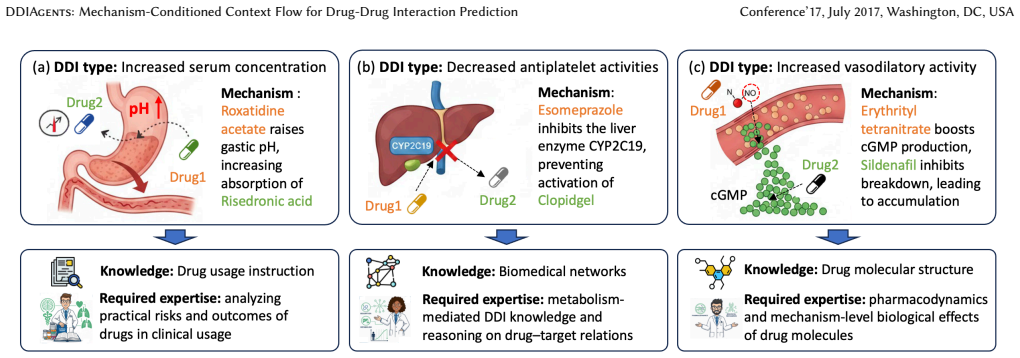
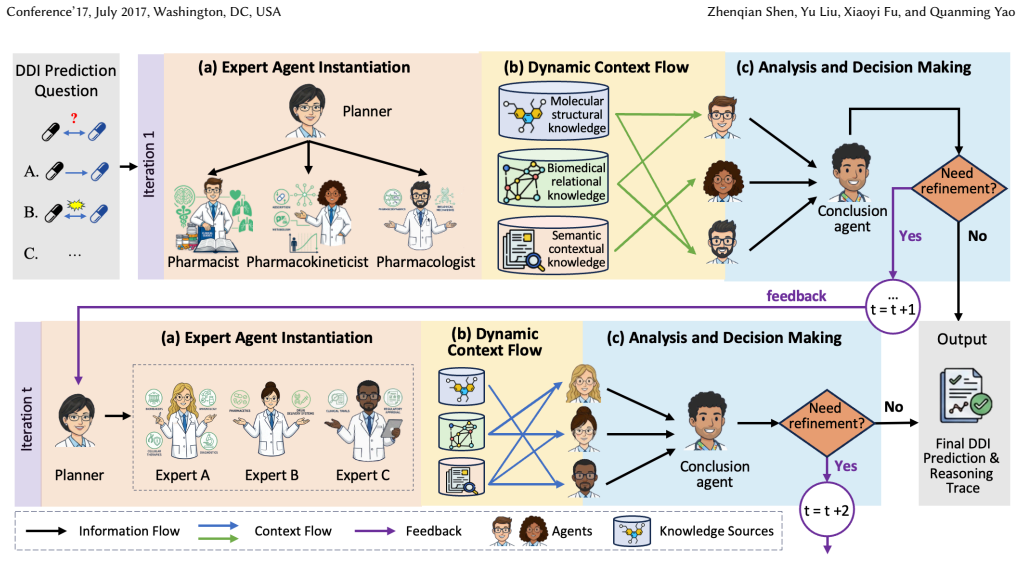
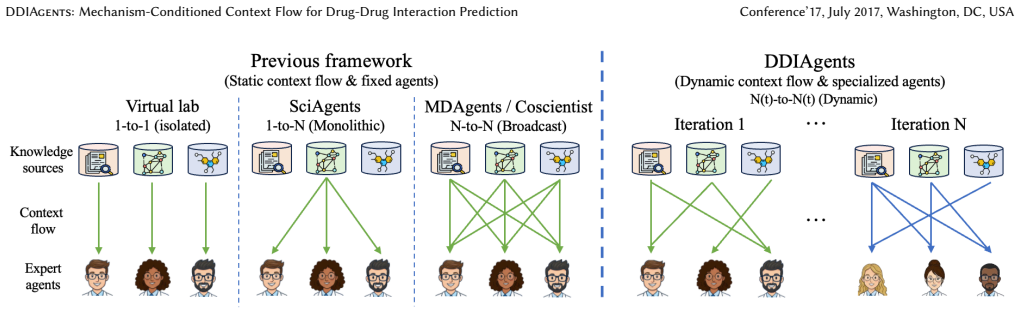
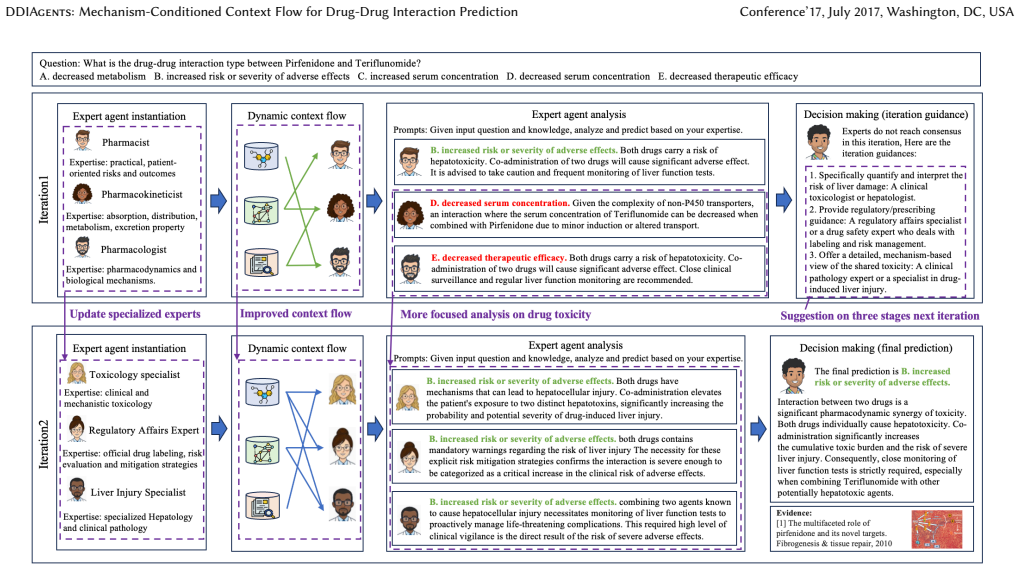
DDIAgents is a mechanism-conditioned multi-agent framework that performs DDI prediction through dynamic knowledge orchestration. Given a drug pair, a planner agent instantiates specialized expert agents, routes mechanism-relevant knowledge sources to each agent, and aggregates their analyses through a conclusion agent. By adapting context flow to the inferred interaction mechanism, DDIAgents reduces irrelevant information, supports complementary expert reasoning, and produces interpretable agent-level rationales. Extensive experiments on realistic DDI prediction benchmarks show that DDIAgents consistently outperforms existing feature-based, graph-based, LLM-based, and agent-based baselines.
What carries the argument
mechanism-conditioned context flow in which a planner agent infers the interaction type and routes filtered knowledge to matching expert agents
If this is right
- Predictions improve because only mechanism-matched evidence reaches each expert instead of the full heterogeneous collection.
- Each agent's contribution remains traceable, supplying per-agent rationales that explain the final output.
- The same orchestration pattern can organize other forms of scientific knowledge that vary by underlying mechanism.
- Performance exceeds that of feature-based, graph-based, LLM-based, and prior agent-based methods on standard DDI benchmarks.
Where Pith is reading between the lines
- The same planner-plus-experts structure might transfer to other biomedical tasks where evidence relevance depends on hidden mechanisms, such as adverse event prediction.
- If the planner's mechanism inference can be audited separately, the system could surface cases where the inferred mechanism itself is uncertain.
- Replacing the conclusion agent with a voting or evidence-weighing step could further test whether the gain comes mainly from routing or from the aggregation method.
Load-bearing premise
The planner agent can correctly identify which interaction mechanism applies to a given drug pair so that the right experts and knowledge get activated.
What would settle it
A test set of drug pairs whose interaction mechanisms are already labeled by domain experts, where the planner's mechanism inferences match the labels less than 60 percent of the time and performance gains disappear.
Figures
read the original abstract
Drug-drug interaction (DDI) prediction is essential for medication safety, yet it requires reasoning over heterogeneous biomedical evidence whose relevance changes across interaction mechanisms. We propose DDIAgents, a mechanism-conditioned multi-agent framework that performs DDI prediction through dynamic knowledge orchestration. Given a drug pair, a planner agent instantiates specialized expert agents, routes mechanism-relevant knowledge sources to each agent, and aggregates their analyses through a conclusion agent. By adapting context flow to the inferred interaction mechanism, DDIAgents reduces irrelevant information, supports complementary expert reasoning, and produces interpretable agent-level rationales. Extensive experiments on realistic DDI prediction benchmarks show that DDIAgents consistently outperforms existing feature-based, graph-based, LLM-based, and agent-based baselines. Beyond prediction performance, DDIAgents demonstrates how multi-agent systems can organize heterogeneous scientific knowledge for adaptive and interpretable AI4Science reasoning.
Editorial analysis
A structured set of objections, weighed in public.
Referee Report
Summary. The paper proposes DDIAgents, a mechanism-conditioned multi-agent framework for drug-drug interaction (DDI) prediction. A planner agent infers the interaction mechanism from a drug pair, instantiates specialized expert agents, routes mechanism-relevant knowledge sources to each, and a conclusion agent aggregates their analyses. The central claim is that adapting context flow to the inferred mechanism reduces irrelevant information, enables complementary expert reasoning, produces interpretable rationales, and yields consistent outperformance over feature-based, graph-based, LLM-based, and agent-based baselines on realistic DDI benchmarks.
Significance. If the experimental results and planner inference hold, the framework would illustrate how multi-agent orchestration can adaptively organize heterogeneous biomedical knowledge for DDI prediction, with potential value for interpretable AI4Science applications. The emphasis on mechanism-specific routing and agent-level rationales addresses a relevant challenge in handling varying evidence relevance across interaction types.
major comments (2)
- [Abstract] Abstract: the claim of consistent outperformance on realistic benchmarks is asserted without any reported metrics, baselines, controls, or experimental details, preventing assessment of whether results support the central claim that gains arise from mechanism-conditioned flow rather than the multi-agent setup alone.
- [Planner agent / mechanism inference (method section)] Planner agent description: the architecture's performance edge requires reliable inference of the interaction mechanism to route knowledge correctly to expert agents. No accuracy, confusion matrix, ablation study, or evaluation of this inference step is provided, leaving the load-bearing conditioning mechanism unsupported and any attribution of gains to the proposed design unverified.
Simulated Author's Rebuttal
We thank the referee for the constructive feedback. The comments correctly identify areas where additional detail would strengthen the manuscript. We respond to each major comment below.
read point-by-point responses
-
Referee: [Abstract] Abstract: the claim of consistent outperformance on realistic benchmarks is asserted without any reported metrics, baselines, controls, or experimental details, preventing assessment of whether results support the central claim that gains arise from mechanism-conditioned flow rather than the multi-agent setup alone.
Authors: We agree that the abstract would benefit from quantitative support. In the revision we will add the primary performance metrics (e.g., average AUROC or F1 improvement) and list the main baseline categories to make the experimental claims more concrete. revision: yes
-
Referee: [Planner agent / mechanism inference (method section)] Planner agent description: the architecture's performance edge requires reliable inference of the interaction mechanism to route knowledge correctly to expert agents. No accuracy, confusion matrix, ablation study, or evaluation of this inference step is provided, leaving the load-bearing conditioning mechanism unsupported and any attribution of gains to the proposed design unverified.
Authors: We acknowledge that an explicit evaluation of the planner's mechanism inference is required to substantiate the conditioning mechanism. We will add an analysis of planner accuracy, a confusion matrix over mechanism classes, and an ablation that compares the full mechanism-conditioned system against a non-conditioned multi-agent variant. revision: yes
Circularity Check
No circularity: framework is a descriptive orchestration without self-referential reductions
full rationale
The paper presents DDIAgents as a multi-agent system where a planner infers mechanisms to route knowledge to expert agents. No equations, fitted parameters renamed as predictions, or derivation chains appear in the provided text. Claims rest on experimental outperformance against baselines rather than any internal reduction to inputs by construction. No self-citations are invoked as load-bearing uniqueness theorems, and the architecture is presented as an organizational proposal rather than a tautological redefinition of its own components. This is a standard non-circular empirical systems paper.
Axiom & Free-Parameter Ledger
Reference graph
Works this paper leans on
- [1]
-
[2]
Josh Achiam, Steven Adler, Sandhini Agarwal, Lama Ahmad, Ilge Akkaya, Floren- cia Leoni Aleman, Diogo Almeida, Janko Altenschmidt, Sam Altman, Shyamal Anadkat, et al. 2023. GPT-4 technical report. arXiv preprint arXiv:2303.08774 (2023)
work page internal anchor Pith review Pith/arXiv arXiv 2023
-
[3]
Daniil A Boiko, Robert MacKnight, Ben Kline, and Gabe Gomes. 2023. Au- tonomous chemical research with large language models. Nature 624, 7992 (2023), 570–578
2023
-
[4]
Weize Chen, Yusheng Su, Jingwei Zuo, Cheng Yang, Chenfei Yuan, Chi-Min Chan, Heyang Yu, Yaxi Lu, Yi-Hsin Hung, Chen Qian, et al. 2023. Agentverse: facilitating multi-agent collaboration and exploring emergent behaviors. In International Conference on Learning Representations
2023
-
[5]
Joseph A DiMasi, Henry G Grabowski, and Ronald W Hansen. 2016. Innovation in the pharmaceutical industry: new estimates of R&D costs. Journal of Health Economics 47 (2016), 20–33
2016
-
[6]
Yilun Du, Shuang Li, Antonio Torralba, Joshua B Tenenbaum, and Igor Mordatch
-
[7]
In International Conference on Machine Learning
Improving factuality and reasoning in language models through multiagent debate. In International Conference on Machine Learning
-
[8]
Zhengxiao Du, Yujie Qian, Xiao Liu, Ming Ding, Jiezhong Qiu, Zhilin Yang, and Jie Tang. 2022. GLM: general language model pretraining with autoregressive blank infilling. In Association for Computational Linguistics. 320–335
2022
-
[9]
Abhimanyu Dubey, Abhinav Jauhri, Abhinav Pandey, Abhishek Kadian, Ahmad Al-Dahle, Aiesha Letman, Akhil Mathur, Alan Schelten, Amy Yang, Angela Fan, et al. 2024. The Llama 3 herd of models. arXiv preprint arXiv:2407.21783 (2024)
work page internal anchor Pith review Pith/arXiv arXiv 2024
-
[10]
Alireza Ghafarollahi and Markus J Buehler. 2025. SciAgents: automating scientific discovery through bioinspired multi-agent intelligent graph reasoning.Advanced Materials 37, 22 (2025), 2413523
2025
-
[11]
Zirui Guo, Lianghao Xia, Yanhua Yu, Tu Ao, and Chao Huang. 2024. LightRAG: simple and fast retrieval-augmented generation.arXiv preprint arXiv:2410.05779 (2024)
work page internal anchor Pith review Pith/arXiv arXiv 2024
-
[12]
Ke Han, Peigang Cao, Yu Wang, Fang Xie, Jiaqi Ma, Mengyao Yu, Jianchun Wang, Yaoqun Xu, Yu Zhang, and Jie Wan. 2022. A review of approaches for predicting drug–drug interactions based on machine learning. Frontiers in Pharmacology 12 (2022), 814858
2022
-
[13]
Sirui Hong, Mingchen Zhuge, Jonathan Chen, Xiawu Zheng, Yuheng Cheng, Jinlin Wang, Ceyao Zhang, Zili Wang, Steven Ka Shing Yau, Zijuan Lin, et al
-
[14]
In International Conference on Learning Representations
MetaGPT: meta programming for a multi-agent collaborative framework. In International Conference on Learning Representations
-
[15]
Yubin Kim, Chanwoo Park, Hyewon Jeong, Yik S Chan, Xuhai Xu, Daniel Mc- Duff, Hyeonhoon Lee, Marzyeh Ghassemi, Cynthia Breazeal, and Hae W Park
-
[16]
Advances in Neural Information Processing Systems 37 (2024), 79410–79452
MDagents: an adaptive collaboration of LLMs for medical decision-making. Advances in Neural Information Processing Systems 37 (2024), 79410–79452
2024
-
[17]
Xuan Lin, Lichang Dai, Yafang Zhou, Zu-Guo Yu, Wen Zhang, Jian-Yu Shi, Dong- Sheng Cao, Li Zeng, Haowen Chen, Bosheng Song, et al. 2023. Comprehensive evaluation of deep and graph learning on drug–drug interactions prediction. Briefings in Bioinformatics 24, 4 (2023), bbad235
2023
- [18]
-
[19]
Zun Liu et al . 2022. Predict multi-type drug–drug interactions in cold start scenario. BMC Bioinformatics (2022), 75
2022
-
[20]
José Macías-Barragán, Ana Sandoval-Rodríguez, Jose Navarro-Partida, and Juan Armendáriz-Borunda. 2010. The multifaceted role of pirfenidone and its novel targets. Fibrogenesis & Tissue Repair 3, 1 (2010), 16
2010
-
[21]
Jin Niu, Robert M Straubinger, and Donald E Mager. 2019. Pharmacodynamic drug–drug interactions. Clinical Pharmacology & Therapeutics 105, 6 (2019), 1395–1406
2019
-
[22]
Arnold K Nyamabo, Hui Yu, and Jian-Yu Shi. 2021. SSI–DDI: substructure– substructure interactions for drug–drug interaction prediction. Briefings in Bioinformatics 22, 6 (2021), bbab133
2021
-
[23]
Caterina Palleria, Antonello Di Paolo, Chiara Giofrè, Chiara Caglioti, Giacomo Leuzzi, Antonio Siniscalchi, Giovambattista De Sarro, and Luca Gallelli. 2013. Pharmacokinetic drug–drug interaction and their implication in clinical manage- ment. Journal of Research in Medical Sciences 18, 7 (2013), 601
2013
-
[24]
Vinay Prasad, Kevin De Jesús, and Sham Mailankody. 2017. The high price of anticancer drugs: origins, implications, barriers, solutions. Nature Reviews Clinical Oncology 14, 6 (2017), 381–390
2017
-
[25]
Yang Qiu, Yang Zhang, Yifan Deng, Shichao Liu, and Wen Zhang. 2021. A comprehensive review of computational methods for drug-drug interaction de- tection. IEEE/ACM Transactions on Computational Biology and Bioinformatics 19, 4 (2021), 1968–1985
2021
-
[26]
Kithusshand Raveendran, Deshan Sumanathilaka, Kanagasabai Thiruthanigesan, Pavinithan Retnakumar, and Yathukulan Sivapiragasam. 2025. PharmaMap-LLM: Fine-Tuning Large Language Models for Drug-Drug Interaction (DDI) Analysis. In International Conference on Advancements in Computing (ICAC). 1–6
2025
-
[27]
Arthur G Roberts and Morgan E Gibbs. 2018. Mechanisms and the clinical relevance of complex drug–drug interactions. Clinical Pharmacology: Advances and Applications (2018), 123–134. Conference’17, July 2017, Washington, DC, USA Zhenqian Shen, Yu Liu, Xiaoyi Fu, and Quanming Yao
2018
-
[28]
David Rogers and Mathew Hahn. 2010. Extended-connectivity fingerprints. Journal of Chemical Information and Modeling 50 (2010), 742–754
2010
-
[29]
Jae Yong Ryu et al. 2018. Deep learning improves prediction of drug–drug and drug–food interactions. Proceedings of the National Academy of Sciences 115 (2018), E4304–E4311
2018
-
[30]
Leyang Shen, Gongwei Chen, Rui Shao, Weili Guan, and Liqiang Nie. 2024. MoME: mixture of multimodal experts for generalist multimodal large language models. Advances in Neural Information Processing Systems 37 (2024), 42048–42070
2024
-
[31]
Freda Shi, Xinyun Chen, Kanishka Misra, Nathan Scales, David Dohan, Ed H Chi, Nathanael Schärli, and Denny Zhou. 2023. Large language models can be easily distracted by irrelevant context. In International Conference on Machine Learning. 31210–31227
2023
-
[32]
Noah Shinn, Federico Cassano, Ashwin Gopinath, Karthik Narasimhan, and Shunyu Yao. 2023. Reflexion: language agents with verbal reinforcement learning. Advances in Neural Information Processing Systems 36 (2023), 8634–8652
2023
-
[33]
Xiaorui Su et al. 2024. Dual-channel learning framework for drug-drug interac- tion prediction via relation-aware heterogeneous graph transformer. In AAAI Conference on Artificial Intelligence. 249–256
2024
-
[34]
Kyle Swanson, Wesley Wu, Nash L Bulaong, John E Pak, and James Zou. 2025. The virtual lab of AI agents designs new SARS-CoV-2 nanobodies. Nature (2025), 1–3
2025
-
[35]
Xiangru Tang, Anni Zou, Zhuosheng Zhang, Ziming Li, Yilun Zhao, Xingyao Zhang, Arman Cohan, and Mark Gerstein. 2024. Medagents: large language models as collaborators for zero-shot medical reasoning. In Findings of the Association for Computational Linguistics. 599–621
2024
-
[36]
Nicholas P Tatonetti et al . 2012. Data-driven prediction of drug effects and interactions. Science Translational Medicine (2012)
2012
-
[37]
Gemma Team, Morgane Riviere, Shreya Pathak, Pier Giuseppe Sessa, Cassidy Hardin, Surya Bhupatiraju, Léonard Hussenot, Thomas Mesnard, Bobak Shahriari, Alexandre Ramé, et al. 2024. Gemma 2: improving open language models at a practical size. arXiv preprint arXiv:2408.00118 (2024)
work page internal anchor Pith review Pith/arXiv arXiv 2024
-
[38]
Qwen Team. 2024. Qwen2.5: a party of foundation models. https://qwenlm. github.io/blog/qwen2.5/
2024
-
[39]
Yaqing Wang, Zhenlin Luo, Peiyao Zhao, Yunfeng Cai, and Quanming Yao. 2026. Beyond scaling: A survey on data-efficient agentic learning. InInternational Joint Conference on Artificial Intelligence
2026
-
[40]
Yaqing Wang, Quanming Yao, James T. Kwok, and Lionel M. Ni. 2020. Generalizing from a few examples: A survey on few-shot learning. Comput. Surveys 53, 3, Article 63 (2020), 34 pages. https://doi.org/10.1145/3386252
-
[41]
Rick A Weideman, Ira H Bernstein, and W Paul McKinney. 1999. Pharmacist recognition of potential drug interactions. American Journal of Health-System Pharmacy 56, 15 (1999), 1524–1529
1999
-
[42]
David S Wishart et al . 2018. DrugBank 5.0: a major update to the DrugBank database for 2018. Nucleic Acids Research 46 (2018), 1074–1082
2018
-
[43]
Lingxuan Xie, Tengfei Ma, Yuqin He, Yiping Liu, and Xiangxiang Zeng. 2025. Predicting Drug–Drug Interaction via Dual-Drug Visual Representation. Journal of Chemical Information and Modeling 65, 19 (2025), 9999–10010
2025
-
[44]
Chengqi Xu et al. 2024. DDI-GPT: explainable prediction of drug-drug interac- tions using large language models enhanced with knowledge graphs. bioRxiv (2024), 2024–12
2024
-
[45]
Ziduo Yang, Weihe Zhong, Qiujie Lv, and Calvin Yu-Chian Chen. 2022. Learning size-adaptive molecular substructures for explainable drug–drug interaction prediction by substructure-aware graph neural network. Chemical Science 13, 29 (2022), 8693–8703
2022
-
[46]
Junfeng Yao et al . 2022. Effective knowledge graph embeddings based on multidirectional semantics relations for polypharmacy side effects prediction. Bioinformatics 38 (2022), 2315–2322
2022
-
[47]
Jingjing Yu, Ichiko D Petrie, René H Levy, and Isabelle Ragueneau-Majlessi
-
[48]
Mechanisms and clinical significance of pharmacokinetic-based drug-drug interactions with drugs approved by the US Food and Drug Administration in
-
[49]
Drug Metabolism and Disposition 47, 2 (2019), 135–144
2019
-
[50]
Yue Yu et al. 2021. SumGNN: multi-typed drug interaction prediction via efficient knowledge graph summarization. Bioinformatics 37 (2021), 2988–2995
2021
-
[51]
Yongqi Zhang et al. 2023. Emerging drug interaction prediction enabled by a flow- based graph neural network with biomedical network. Nature Computational Science 3 (2023), 1023–1033
2023
-
[52]
Fangqi Zhu et al . 2023. Learning to describe for predicting zero-shot drug- drug interactions. In Conference on Empirical Methods in Natural Language Processing
2023
-
[53]
Case-Based Reasoning
Marinka Zitnik et al . 2018. Modeling polypharmacy side effects with graph convolutional networks. Bioinformatics 34 (2018), 457–466. DDIAgents: Mechanism-Conditioned Context Flow for Drug-Drug Interaction Prediction Conference’17, July 2017, Washington, DC, USA A Supplementary Information A.1 Description of DDI Examples in Motivation Part In Table 6, we ...
2018
-
[54]
Carefully read the drug-drug interaction prediction problem with candidate choices and feedbacks from last iteration round
-
[55]
Based on the problem, provide three experts that are suitable to answer the question from different perspectives
-
[56]
Cardiologist
Provide three expert names and use one sentence to describe their roles, respectively. You should output in exactly the same format as: (1) [expert1 name]: [one sentence describes the role of expert1]. (2) [expert2 name]: [one sentence describes the role of expert2]. (3) [expert3 name]: [one sentence describes the role of expert3]. Question: {{Question}} ...
2017
discussion (0)
Sign in with ORCID, Apple, or X to comment. Anyone can read and Pith papers without signing in.