Floquet Quasienergy-Resolved Dissipation, Dynamics, and Spectroscopy in Ultrastrong Cavity-QED
Pith reviewed 2026-07-01 05:45 UTC · model grok-4.3
The pith
Periodic driving in ultrastrong cavity-QED makes dissipation intrinsically quasienergy-resolved rather than resonance-based.
A machine-rendered reading of the paper's core claim, the machinery that carries it, and where it could break.
Core claim
Strong periodic driving of cavity-QED in the ultrastrong-coupling regime creates nonequilibrium states whose dissipation is governed by Floquet quasienergies rather than undriven dressed resonances. The authors introduce a nonsecular Floquet generalized master equation framework formulated in the dressed basis of the quantum Rabi model, applicable to structured reservoirs without rotating-wave approximations. Systematic comparisons show that static dressed-basis equations reproduce steady-state populations only in restricted regimes, fail for frequency-resolved observables, and break down under Floquet engineering even for flat baths, with discrepancies amplified by structured environments t
What carries the argument
The nonsecular Floquet generalized master equation formulated in the dressed basis of the quantum Rabi model, which resolves observable resonances into hybridized quasienergy channels and associated decay rates.
If this is right
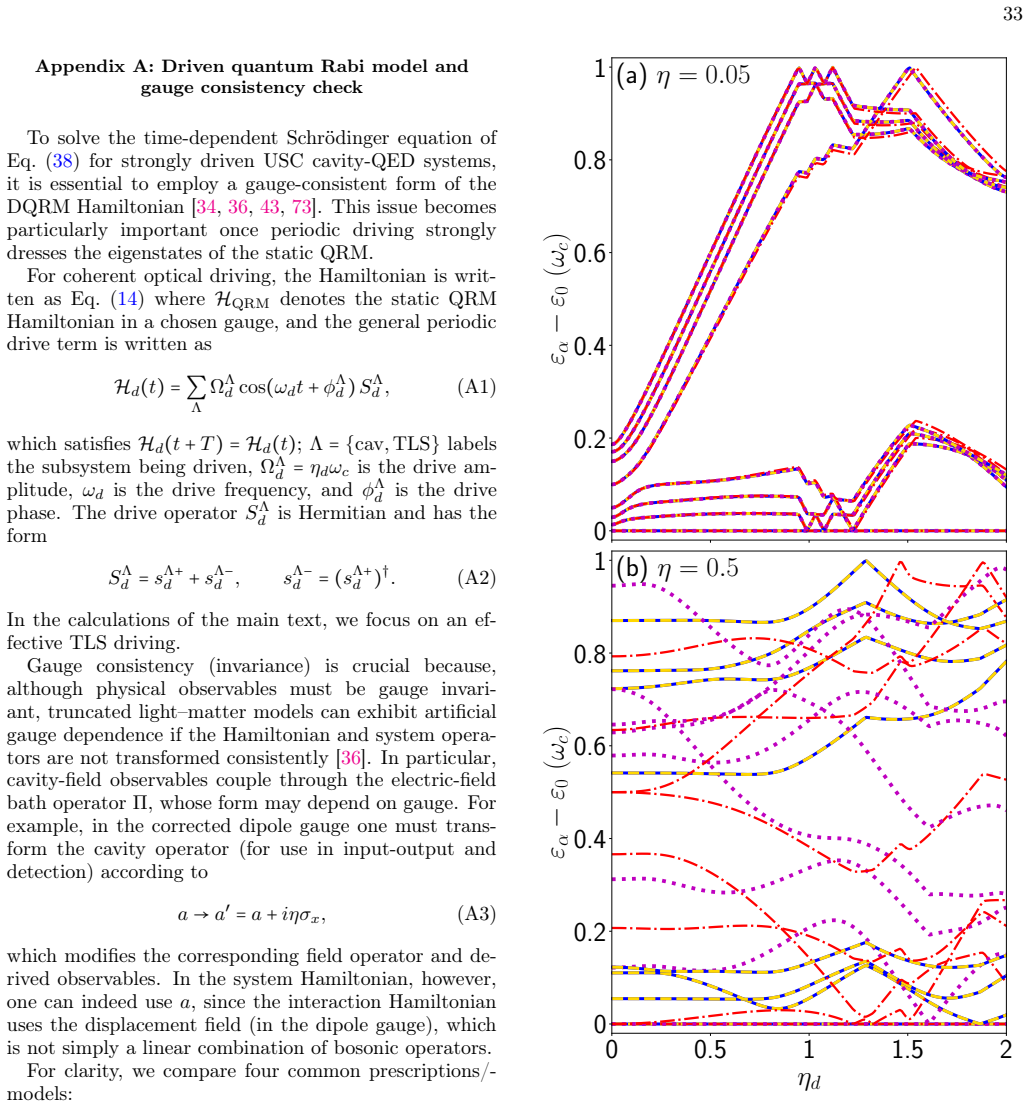
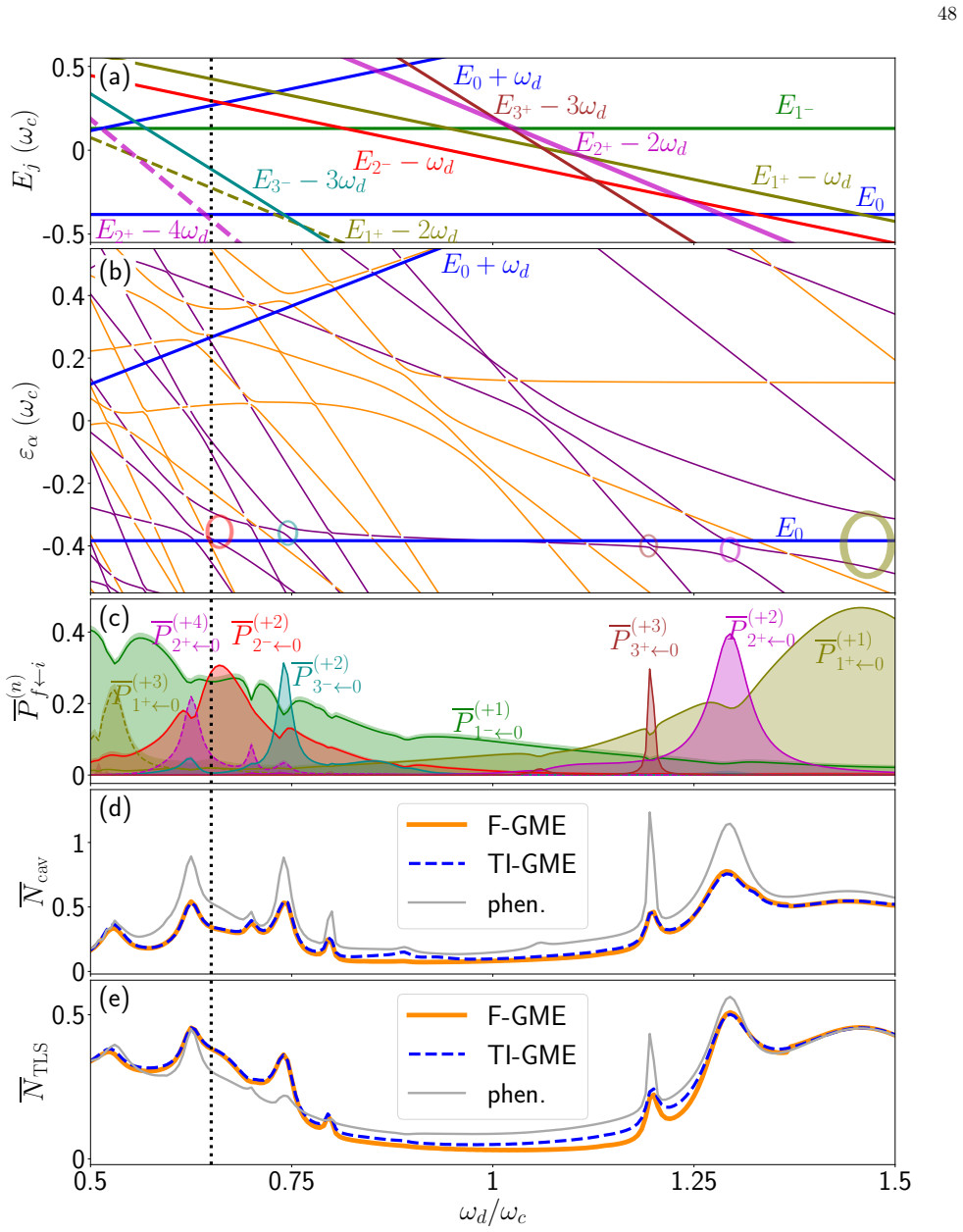
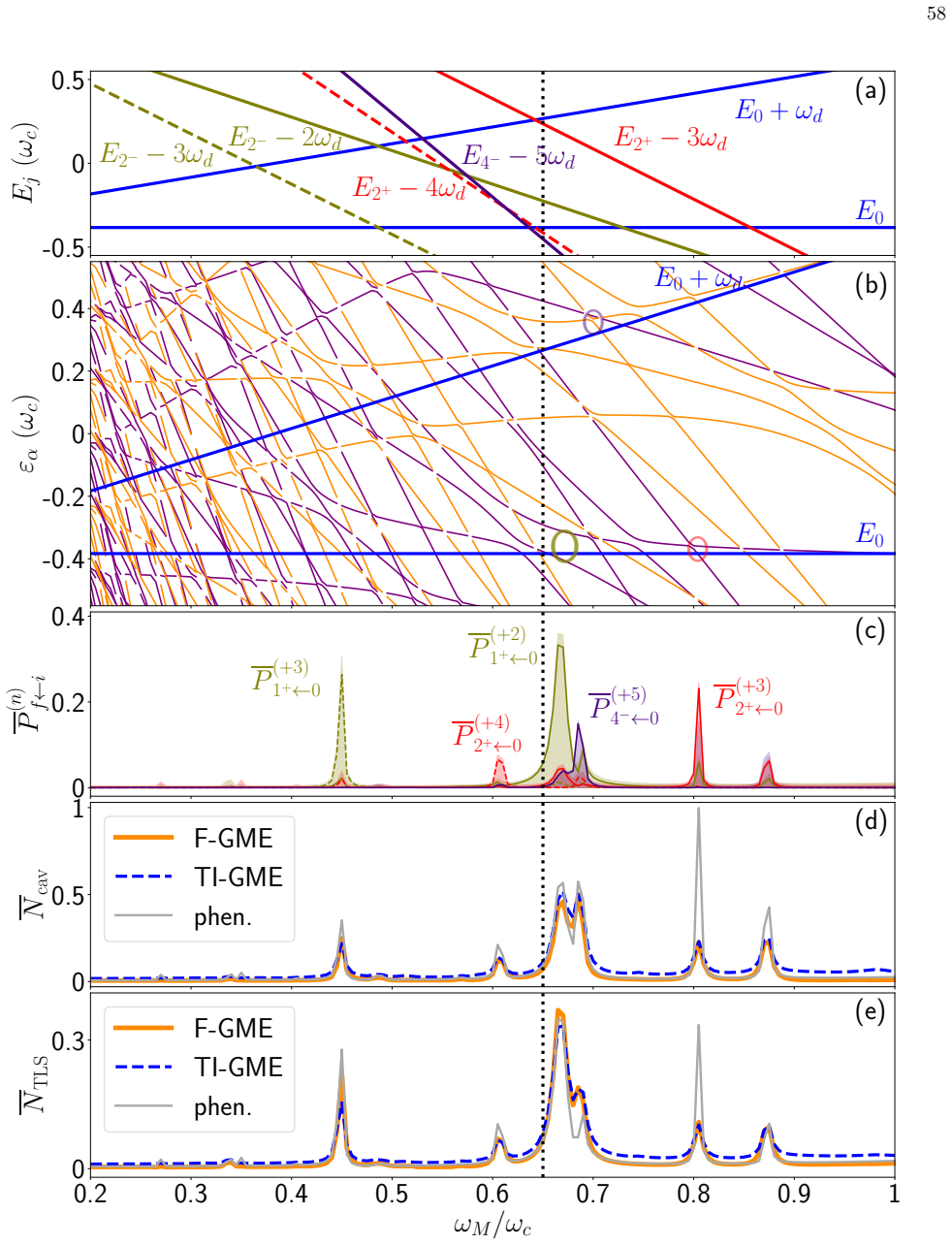
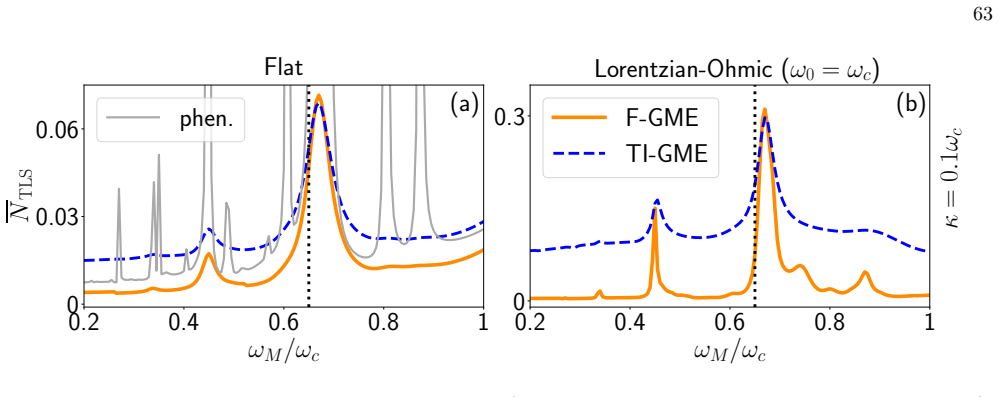
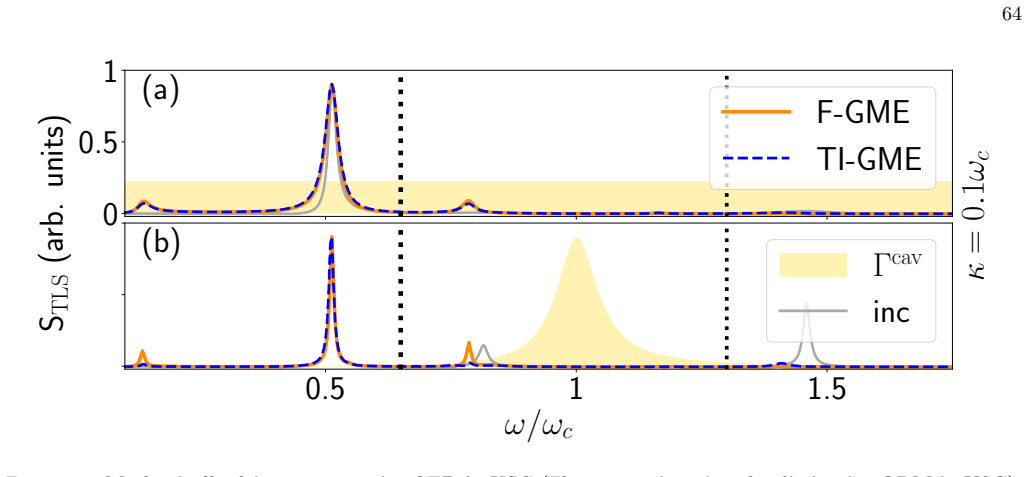
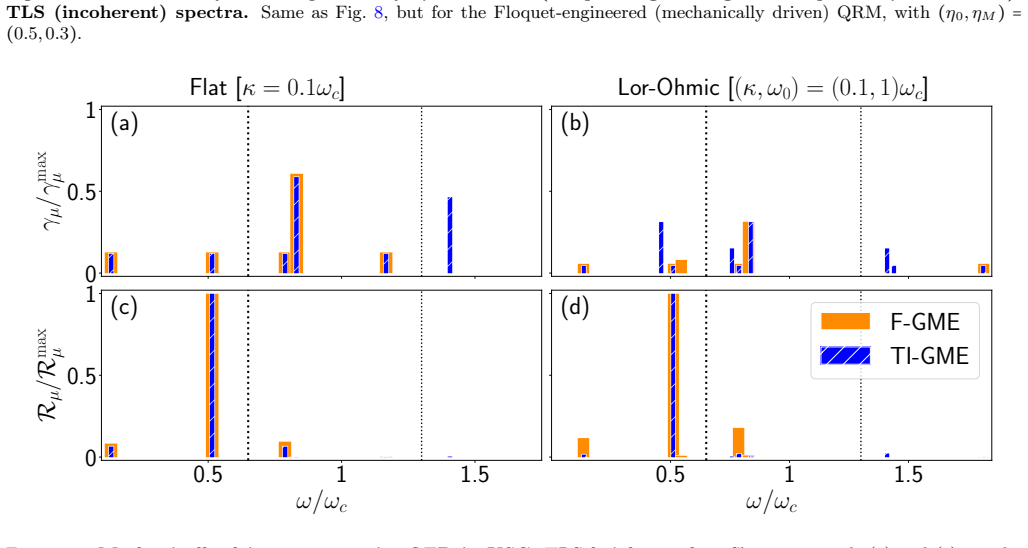
- Long-time populations, fluorescence spectra, and Floquet-Liouville eigenspectra can be computed by resolving resonances into hybridized quasienergy channels and decay rates.
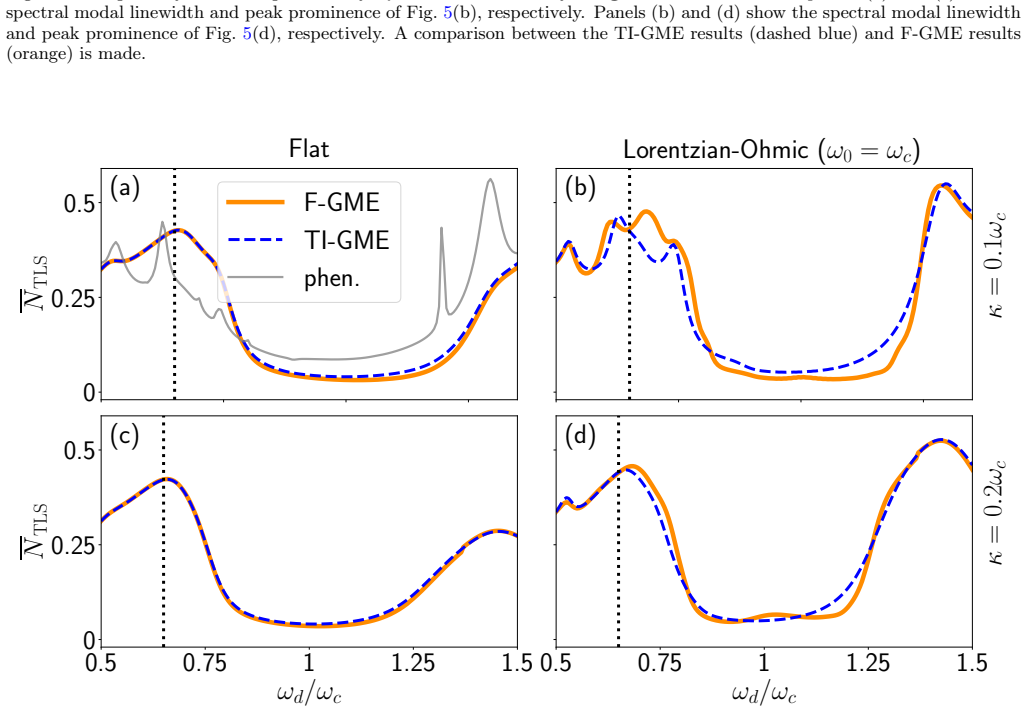
- Static time-independent dressed-basis master equations reproduce steady-state populations only in restricted excitation regimes and fail for frequency-resolved observables.
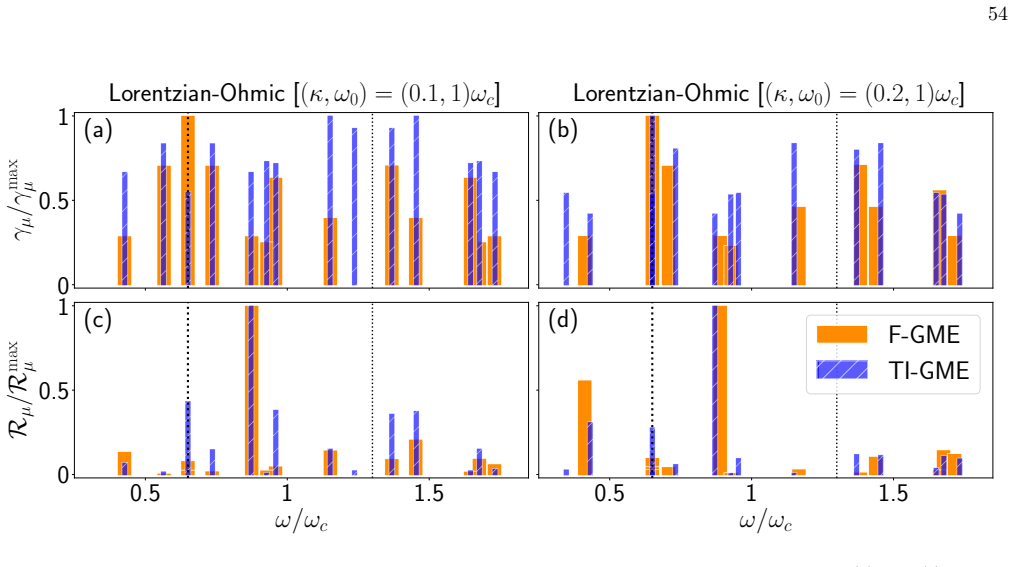
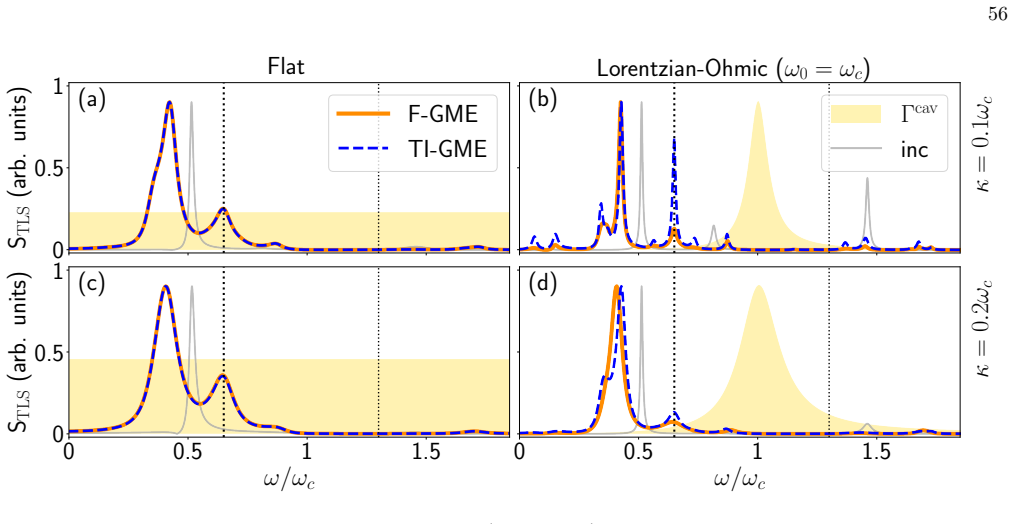
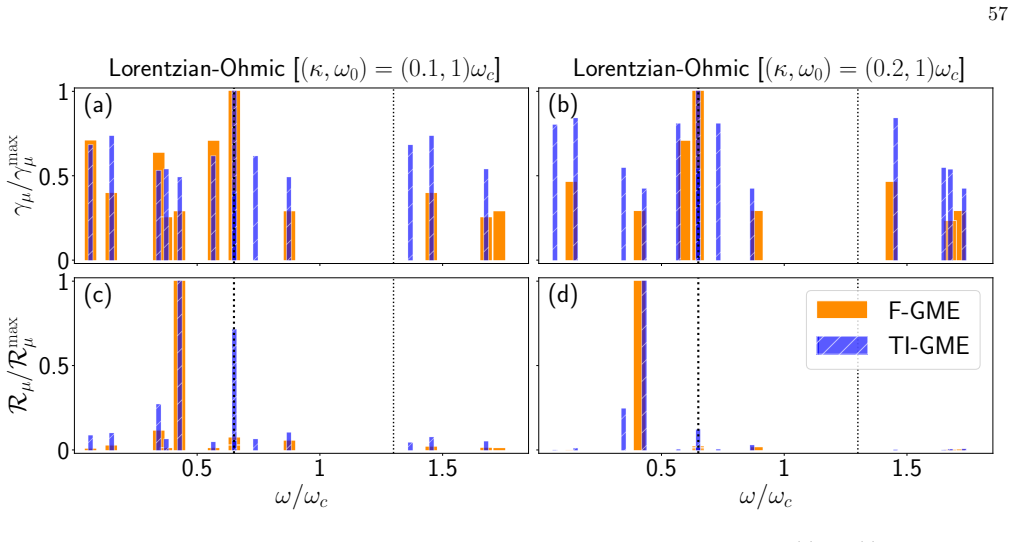
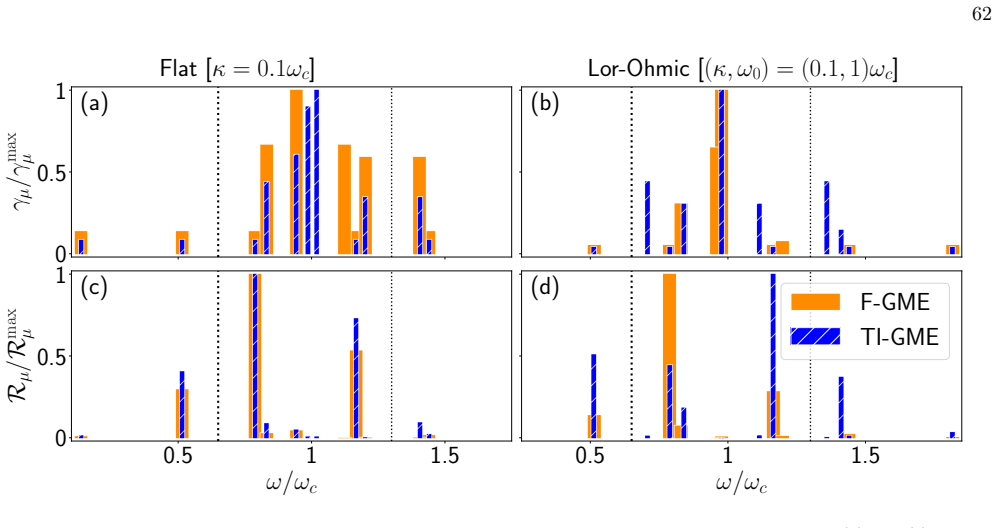
- Even spectrally flat baths produce incorrect results under Floquet engineering, while structured reservoirs such as Lorentzian-Ohmic baths amplify discrepancies via sideband-selective decay.
- The theory enables systematic control of decay pathways and engineering of nonequilibrium quantum states and reservoirs.
Where Pith is reading between the lines
- The same quasienergy-resolution principle may apply to other periodically driven open quantum systems such as superconducting circuits or trapped ions.
- Experiments could test the framework by measuring sideband-resolved decay rates under parametric mechanical modulation in circuit QED.
- Floquet engineering might allow selective suppression of unwanted decay channels that static theories cannot predict.
- Quasienergy-resolved dissipation could affect nonequilibrium thermodynamics, such as heat currents in driven reservoirs.
Load-bearing premise
The framework assumes that gauge invariance can be ensured for truncated matter-cavity systems under time-dependent driving when formulated in the dressed basis of the quantum Rabi model.
What would settle it
Compare the measured fluorescence spectrum of a strongly optically pumped or parametrically modulated ultrastrongly coupled cavity-QED device against the quasienergy-resolved resonances predicted by the Floquet master equation versus the static dressed-state predictions.
Figures
read the original abstract
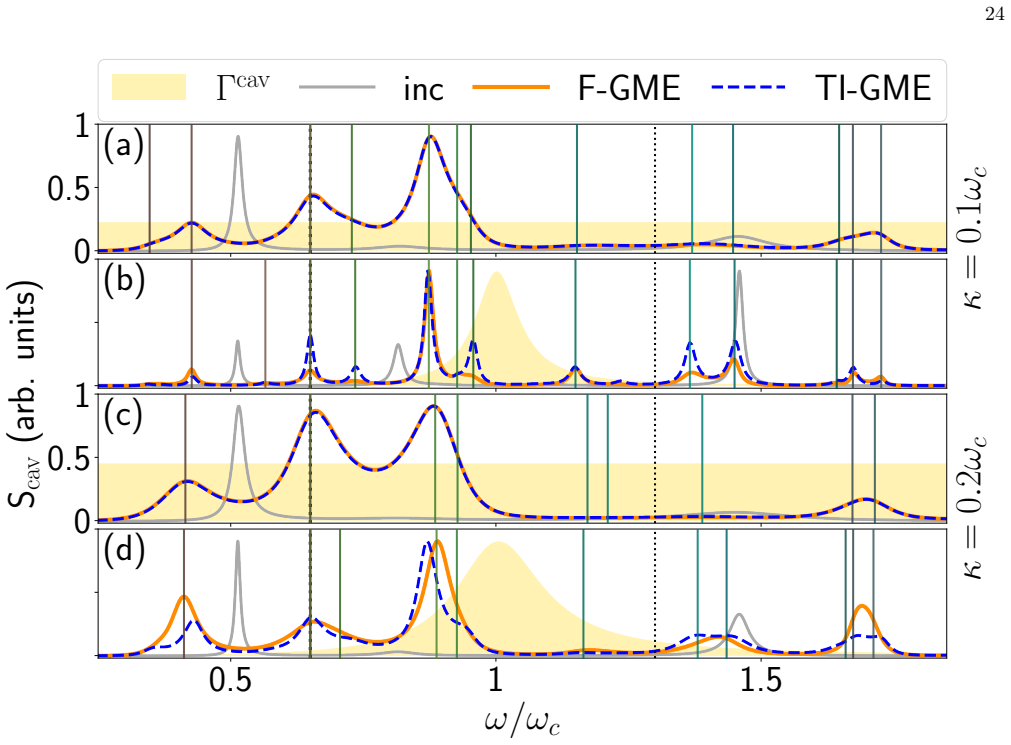
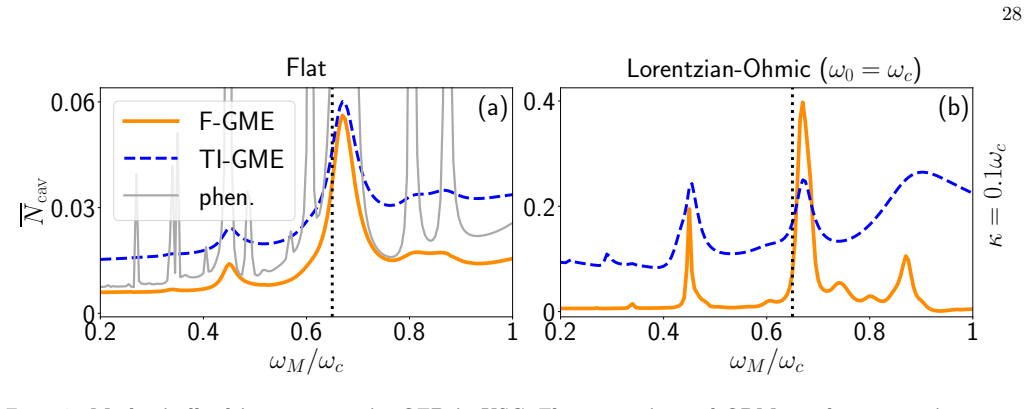
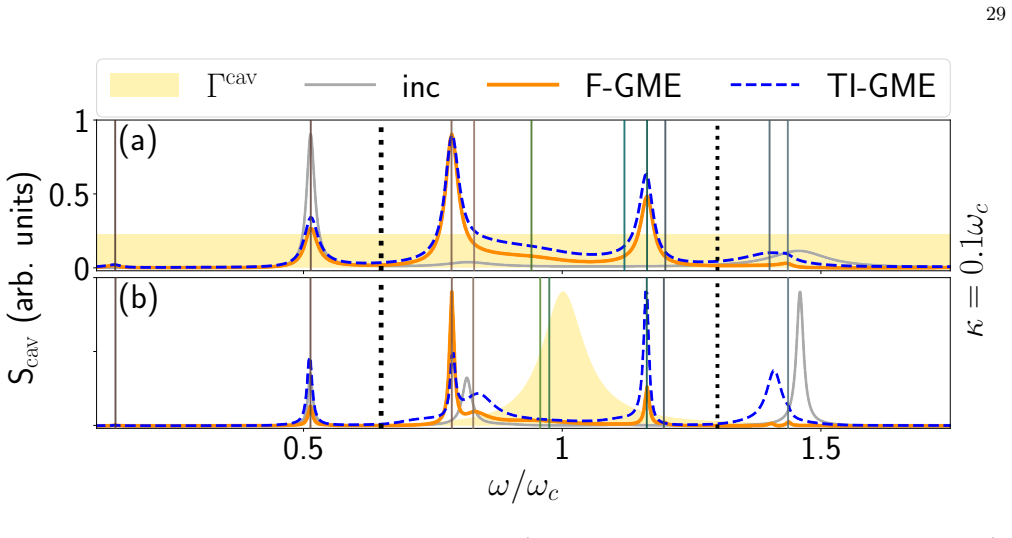
Strong periodic driving of cavity-quantum electrodynamics (QED) in the ultrastrong-coupling regime creates nonequilibrium states whose dissipation is governed by Floquet quasienergies rather than undriven dressed resonances. However, modeling such a regime is a significant theoretical challenge, including a number of subtle problems such as the need to ensure gauge invariance for truncated matter-cavity systems with time-dependent driving. To fill this theoretical gap, we introduce a nonsecular Floquet generalized master equation framework for strongly driven open cavity-QED systems, formulated in the dressed basis of the quantum Rabi model and applicable to structured reservoirs without rotating-wave approximations. Our theory can thus model Floquet-driven dynamics in open ultrastrong-coupling cavity-QED, and demonstrates a wide range of quantum state control. Using strong optical pumping and parametric mechanical modulation, we compute long-time populations, fluorescence spectra, and the Floquet-Liouville eigenspectra, resolving observable resonances into hybridized quasienergy channels and decay rates. By systematically comparing with conventional time-independent dressed-basis generalized master equations, we show that static approaches only reproduce steady-state populations in restricted excitation regimes, and fail for frequency-resolved observables and break down under appropriate Floquet engineering, surprisingly, even for spectrally flat baths. Structured environments, such as Lorentzian-Ohmic reservoirs, further amplify these discrepancies through sideband-selective decay. Our results demonstrate that dissipation in driven ultrastrong cavity-QED is intrinsically quasienergy resolved and we establish Floquet-dissipative theory as an accurate and powerful framework for predicting spectra, controlling decay pathways, and engineering nonequilibrium quantum states and reservoirs.
Editorial analysis
A structured set of objections, weighed in public.
Referee Report
Summary. The manuscript introduces a nonsecular Floquet generalized master equation framework formulated in the dressed basis of the quantum Rabi model for strongly driven open ultrastrong-coupling cavity-QED systems. It addresses gauge invariance in truncated systems under time-dependent driving and applies the theory to compute long-time populations, fluorescence spectra, and Floquet-Liouville eigenspectra under optical pumping and parametric modulation. Systematic comparisons demonstrate that conventional time-independent dressed-basis GMEs reproduce steady-state populations only in restricted regimes and fail for frequency-resolved observables, even for flat baths, with larger discrepancies in structured (Lorentzian-Ohmic) reservoirs; the work concludes that dissipation is intrinsically quasienergy-resolved.
Significance. If the central results hold, the framework establishes Floquet-dissipative theory as necessary for accurate prediction of spectra, decay pathways, and nonequilibrium state engineering in driven USC cavity-QED, with explicit demonstrations of sideband-selective effects and breakdown of static approaches. The systematic comparisons across excitation regimes and reservoir types provide concrete evidence of the framework's advantages.
major comments (1)
- [Abstract and §1] Abstract and §1 (gauge-invariance discussion): The load-bearing assumption is that gauge invariance can be ensured for truncated matter-cavity systems under periodic driving when working in the dressed Rabi basis. The manuscript correctly identifies this as a subtle problem, yet provides no explicit verification such as cross-comparison of length- versus velocity-gauge observables or other gauge-invariant quantities to confirm that the computed quasienergy channels, decay rates, and sideband spectra remain physical after truncation. This directly affects the validity of all quasienergy-resolved claims.
minor comments (2)
- Figure captions and axis labels should explicitly state the driving amplitude and modulation parameters used for each panel to facilitate direct comparison with the text.
- The manuscript would benefit from a short table summarizing the regimes (e.g., driving strength, bath spectral density) where static GMEs agree or disagree with the Floquet results.
Simulated Author's Rebuttal
We thank the referee for their thorough review and for identifying a key point on gauge invariance. We address the comment below and will revise the manuscript accordingly.
read point-by-point responses
-
Referee: [Abstract and §1] Abstract and §1 (gauge-invariance discussion): The load-bearing assumption is that gauge invariance can be ensured for truncated matter-cavity systems under periodic driving when working in the dressed Rabi basis. The manuscript correctly identifies this as a subtle problem, yet provides no explicit verification such as cross-comparison of length- versus velocity-gauge observables or other gauge-invariant quantities to confirm that the computed quasienergy channels, decay rates, and sideband spectra remain physical after truncation. This directly affects the validity of all quasienergy-resolved claims.
Authors: We agree that explicit verification strengthens the claims. The manuscript identifies the gauge issue and adopts the dressed Rabi basis to mitigate truncation artifacts under driving, but does not include direct numerical checks such as length- versus velocity-gauge comparisons for the quasienergy-resolved quantities. In the revised manuscript we will add such a cross-comparison (for steady-state populations, fluorescence spectra, and selected decay rates) in §1 or a dedicated appendix, confirming that the reported quasienergy channels and sideband features remain consistent across gauges within the truncation employed. revision: yes
Circularity Check
No circularity; framework extends standard techniques without reduction to inputs
full rationale
The derivation introduces a nonsecular Floquet generalized master equation in the dressed quantum Rabi basis for driven open cavity-QED systems and compares its predictions (populations, spectra, Liouville eigenspectra) against conventional time-independent dressed-basis GMEs. No quoted equations or steps reduce by construction to fitted inputs, self-definitions, or unverified self-citation chains; the gauge-invariance handling is presented as a careful formulation choice rather than a tautology. The central claim that dissipation is quasienergy-resolved follows from the Floquet structure applied to structured reservoirs, with explicit numerical contrasts to static approaches serving as independent content. This is a standard extension of established methods and remains self-contained against external benchmarks.
Axiom & Free-Parameter Ledger
axioms (2)
- standard math Markovian and Born approximations underlying generalized master equations
- domain assumption Validity of the quantum Rabi model dressed basis for ultrastrong coupling
Reference graph
Works this paper leans on
-
[1]
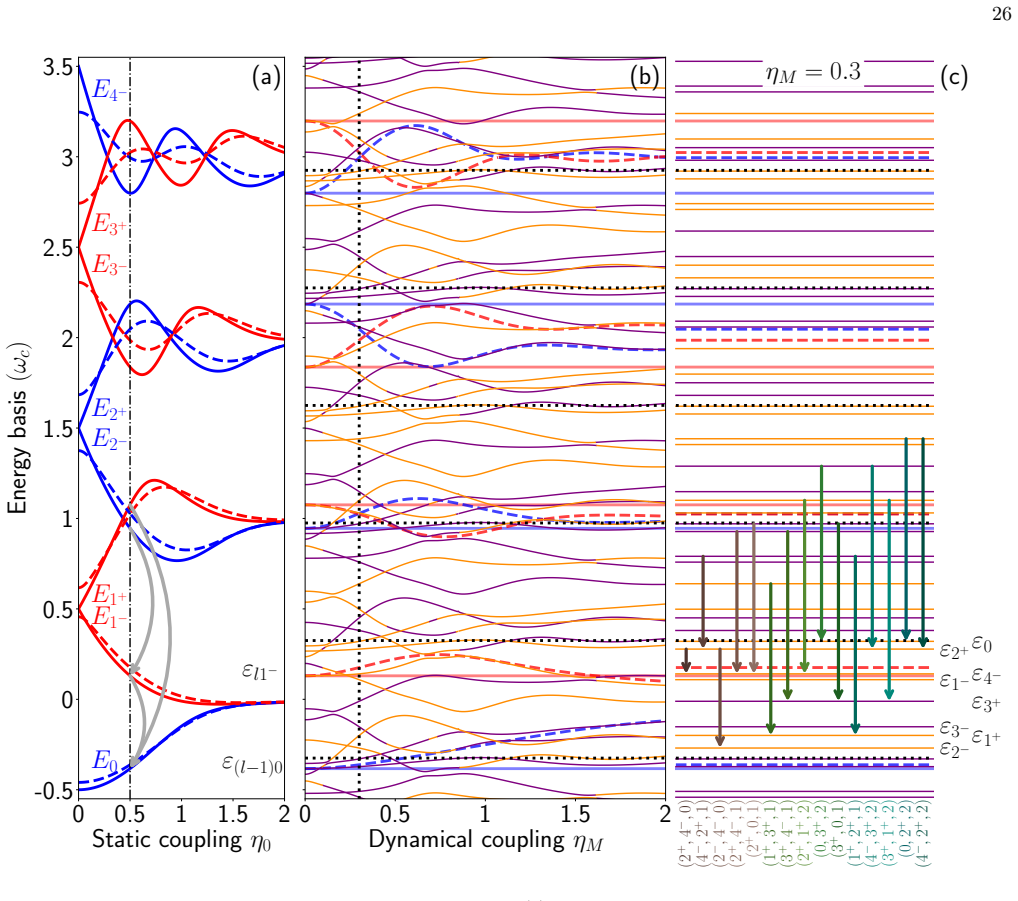
6(a) is the same as that of the optical drive case, as the static QRM eigenenergiesremainthesame
Periodic mechanical drive For the (periodic) mechanical drive case, the energy state labels based on their orders from Fig. 6(a) is the same as that of the optical drive case, as the static QRM eigenenergiesremainthesame. However, thequasienergy state labels from their orders in the range[−ωd/2, ωd/2) from Fig. 6(b), from bottom to top atηM =0.3(verti- ca...
-
[2]
S.HarocheandJ.-M.Raimond,Exploring the Quantum: Atoms, Cavities, and Photons(OxfordUniversityPress, 2006)
2006
-
[3]
K. M. Birnbaum, A. Boca, R. Miller, A. D. Boozer, T. E. Northup, and H. J. Kimble, Photon blockade in an optical cavity with one trapped atom, Nature436, 87 (2005)
2005
-
[4]
M. B. et al., Quantum Rabi oscillation: A direct test of field quantization in a cavity, Phys. Rev. Lett.76, 1800 (1996)
1996
-
[5]
Niemczyk, F
T. Niemczyk, F. Deppe, H. Huebl, E. P. Menzel, F. Hocke, M. J. Schwarz, J. J. Garcia-Ripoll, D. Zueco, T. Hümmer, E. Solano, A. Marx, and R. Gross, Circuit quantum electrodynamics in the ultrastrong-coupling regime, Nature Physics6, 772 (2010)
2010
-
[6]
Forn-Díaz, J
P. Forn-Díaz, J. Lisenfeld, D. Marcos, J. J. Garcia- Ripoll, E. Solano, C. J. P. M. Harmans, and J. E. Mooij, Observation of the bloch-siegert shift in a qubit- oscillator system in the ultrastrong coupling regime, Phys. Rev. Lett.105, 237001 (2010)
2010
-
[7]
Tomonaga, R
A. Tomonaga, R. Stassi, H. Mukai, F. Nori, F. Yoshi- hara, and J. S. Tsai, Spectral properties of two super- conducting artificial atoms coupled to a resonator in the ultrastrong coupling regime, Nat Commun16, 5294 (2025)
2025
-
[8]
S.-P. Wang, A. Mercurio, A. Ridolfo, Y. Wang, M. Chen, W. Wang, Y. Liu, H. Sun, T. Li, F. Nori, S. Savasta, and J. Q. You, Strong coupling between a single-photon and a two-photon Fock state, Nat Com- mun16, 8730 (2025)
2025
-
[9]
Frisk Kockum, A
A. Frisk Kockum, A. Miranowicz, S. De Liberato, S. Savasta, and F. Nori, Ultrastrong coupling between light and matter, Nature Reviews Physics1, 19 (2019)
2019
-
[10]
Forn-Díaz, L
P. Forn-Díaz, L. Lamata, E. Rico, J. Kono, and E. Solano, Ultrastrong coupling regimes of light-matter interaction, Rev. Mod. Phys.91, 025005 (2019)
2019
-
[11]
De Liberato, Virtual photons in the ground state of a dissipative system, Nat Commun8, 1465 (2017)
S. De Liberato, Virtual photons in the ground state of a dissipative system, Nat Commun8, 1465 (2017)
2017
-
[12]
Sinova, S
J. Sinova, S. O. Valenzuela, J. Wunderlich, C. H. Back, and T. Jungwirth, Spin Hall effects, Rev. Mod. Phys. 87, 1213 (2015)
2015
-
[13]
Etxezarreta Martinez, P
J. Etxezarreta Martinez, P. Fuentes, P. Crespo, and J. Garcia-Frias, Time-varying quantum channel mod- els for superconducting qubits, npj Quantum Inf7, 1 (2021)
2021
-
[14]
Hamazaki, Exceptional dynamical quantum phase transitions in periodically driven systems, Nat Commun 12, 5108 (2021)
R. Hamazaki, Exceptional dynamical quantum phase transitions in periodically driven systems, Nat Commun 12, 5108 (2021)
2021
-
[15]
BÃękkegaard, L
T. BÃękkegaard, L. B. Kristensen, N. J. S. Loft, C. K. Andersen, D. Petrosyan, and N. T. Zinner, Realization ofefficientquantumgateswithasuperconductingqubit- qutrit circuit, Sci Rep9, 13389 (2019)
2019
-
[16]
Y.-H. Chen, A. Kalev, and I. Hen, Quantum algorithm for time-dependent Hamiltonian simulation by permu- tation expansion, PRX Quantum2, 030342 (2021)
2021
-
[17]
Floquet, Sur les équations différentielles linéaires à coefficients périodiques, Annales Scientifiques de l’École Normale Supérieure 2,12, 47 (1883)
G. Floquet, Sur les équations différentielles linéaires à coefficients périodiques, Annales Scientifiques de l’École Normale Supérieure 2,12, 47 (1883)
-
[18]
J. H. Shirley, Solution of the Schrödinger equation with a Hamiltonian periodic in time, Phys. Rev.138, B979 (1965)
1965
-
[19]
Deng, J.-L
C. Deng, J.-L. Orgiazzi, F. Shen, S. Ashhab, and A. Lu- pascu,ObservationofFloquetstatesinastronglydriven artificial atom, Phys. Rev. Lett.115, 133601 (2015)
2015
-
[20]
Sambe, Steady states and quasienergies of a quantum-mechanical system in an oscillating field, Phys
H. Sambe, Steady states and quasienergies of a quantum-mechanical system in an oscillating field, Phys. Rev. A7, 2203 (1973)
1973
-
[21]
Grifoni and P
M. Grifoni and P. Hänggi, Driven quantum tunneling, Physics Reports304, 229 (1998)
1998
-
[22]
Kohler, T
S. Kohler, T. Dittrich, and P. Hänggi, Floquet- Markovian description of the parametrically driven, dis- sipative harmonic quantum oscillator, Phys. Rev. E55, 300 (1997)
1997
-
[23]
Kohler, J
S. Kohler, J. Lehmann, and P. HÃďnggi, Driven quan- tum transport on the nanoscale, Physics Reports406, 379 (2005)
2005
-
[24]
Hausinger and M
J. Hausinger and M. Grifoni, Dissipative two-level sys- tem under strong ac driving: A combination of Floquet and Van Vleck perturbation theory, Phys. Rev. A81, 022117 (2010)
2010
-
[25]
Hausinger,Dissipative dynamics of a qubit-oscillator system in the ultrastrong coupling and driving regimes, Ph.D
J. Hausinger,Dissipative dynamics of a qubit-oscillator system in the ultrastrong coupling and driving regimes, Ph.D. thesis (2010)
2010
-
[26]
Hausinger and M
J. Hausinger and M. Grifoni, Qubit-oscillator system: An analytical treatment of the ultrastrong coupling regime, Phys. Rev. A82, 062320 (2010)
2010
-
[27]
Restrepo,Driven Open Quantum Systems: Aspects of Non-Markovianity and Strong Coupling, Ph.D
S. Restrepo,Driven Open Quantum Systems: Aspects of Non-Markovianity and Strong Coupling, Ph.D. thesis (2019)
2019
-
[28]
Restrepo, J
S. Restrepo, J. Cerrillo, P. Strasberg, and G. Schaller, From quantum heat engines to laser cooling: Flo- quet theory beyond the BornâĂŞMarkov approxima- tion, New Journal of Physics20, 053063 (2018)
2018
-
[29]
Akbari and S
K. Akbari and S. Hughes, Double dressing in strongly driven, strongly interacting open quantum systems: Floquet generalized master equation and Floquet- Liouville spectroscopy (2026), arXiv:To be submitted [quant-ph]
2026
-
[30]
I. I. Rabi, On the Process of Space Quantization, Phys- ical Review49, 324 (1936)
1936
-
[31]
I. I. Rabi, Space quantization in a gyrating magnetic field, Physical Review51, 652 (1937)
1937
-
[32]
Nataf and C
P. Nataf and C. Ciuti, Vacuum degeneracy of a circuit qed system in the ultrastrong coupling regime, Physical Review Letters104, 023601 (2010)
2010
-
[33]
Ashhab, J
S. Ashhab, J. R. Johansson, A. M. Zagoskin, and 67 F. Nori, Two-level systems driven by large-amplitude fields, Phys. Rev. A75, 063414 (2007)
2007
-
[34]
De Bernardis, P
D. De Bernardis, P. Pilar, T. Jaako, S. De Liberato, and P. Rabl, Breakdown of gauge invariance in ultrastrong- coupling cavity QED, Phys. Rev. A98, 053819 (2018)
2018
-
[35]
Di Stefano, A
O. Di Stefano, A. Settineri, V. MacrÃň, L. Garziano, R. Stassi, S. Savasta, and F. Nori, Resolution of gauge ambiguities in ultrastrong-coupling cavity quan- tum electrodynamics, Nat. Phys.15, 803 (2019)
2019
-
[36]
Settineri, O
A. Settineri, O. Di Stefano, D. Zueco, S. Hughes, S. Savasta, and F. Nori, Gauge freedom, quantum mea- surements, and time-dependent interactions in cavity QED, Phys. Rev. Res.3, 023079 (2021)
2021
-
[37]
Salmon, C
W. Salmon, C. Gustin, A. Settineri, O. D. Stefano, D. Zueco, S. Savasta, F. Nori, and S. Hughes, Gauge- independent emission spectra and quantum correla- tions in the ultrastrong coupling regime of open system cavity-QED, Nanophotonics11, 1573 (2022)
2022
-
[38]
Gustin, S
C. Gustin, S. Franke, and S. Hughes, Gauge-invariant theory of truncated quantum light-matter interactions in arbitrary media, Phys. Rev. A107, 013722 (2023)
2023
- [39]
-
[40]
Beaudoin, J
F. Beaudoin, J. M. Gambetta, and A. Blais, Dissipation and ultrastrong coupling in circuit QED, Phys. Rev. A 84, 043832 (2011)
2011
-
[41]
Ridolfo, M
A. Ridolfo, M. Leib, S. Savasta, and M. J. Hartmann, Photon blockade in the ultrastrong coupling regime, Physical Review Letters109, 193602 (2012)
2012
-
[42]
Ridolfo, O
A. Ridolfo, O. Di Stefano, N. Fina, R. Saija, and S. Savasta, Quantum regression theorem in the ultra- strong coupling regime, Physical Review Letters109, 193602 (2012)
2012
-
[43]
Settineri, V
A. Settineri, V. Macrí, A. Ridolfo, O. Di Stefano, A. F. Kockum, F. Nori, and S. Savasta, Dissipation and ther- mal noise in hybrid quantum systems in the ultrastrong- coupling regime, Phys. Rev. A98, 053834 (2018)
2018
-
[44]
Akbari, F
K. Akbari, F. Nori, and S. Hughes, Floquet engineering the quantum Rabi model in the ultrastrong coupling regime, Phys. Rev. Lett.134, 063602 (2025)
2025
-
[45]
Hughes and H
S. Hughes and H. J. Carmichael, Phonon-mediated pop- ulation inversion in a semiconductor quantum-dot cav- ity system, New Journal of Physics15, 053039 (2013)
2013
-
[46]
Q. Wang, Z. Gong, C. Duan, Z. Tang, and J. Wu, Dy- namical scaling in the Ohmic spin-boson model studied by extended hierarchical equations of motion, The Jour- nal of Chemical Physics150, 084114 (2019)
2019
-
[47]
Kaldewey, S
T. Kaldewey, S. Lüker, A. V. Kuhlmann, S. R. Valentin, J.-M. Chauveau, A. Ludwig, A. D. Wieck, D. E. Reiter, T. Kuhn, and R. J. Warburton, Demonstrating the de- coupling regime of the electron-phonon interaction in a quantum dot using chirped optical excitation, Phys. Rev. B95, 241306 (2017)
2017
-
[48]
C.GustinandS.Hughes,Efficientpulse-excitationtech- niques for single photon sources from quantum dots in optical cavities, Advanced Quantum Technologies3, 1900073 (2020)
2020
-
[49]
Zhou, Y.-A
Z.-Y. Zhou, Y.-A. Yan, S. Hughes, J. Q. You, and F. Nori, Accessing the bath information in open quan- tum systems with the stochasticc-number Langevin equation method, Phys. Rev. A100, 042112 (2019)
2019
-
[50]
R.-C. Ge, C. Van Vlack, P. Yao, J. F. Young, and S. Hughes, Accessing quantum nanoplasmonics in a hy- brid quantum dot–metal nanosystem: Mollow triplet of a quantum dot near a metal nanoparticle, Phys. Rev. B 87, 205425 (2013)
2013
-
[51]
Vannucci and N
L. Vannucci and N. Gregersen, Highly efficient and indistinguishable single-photon sources via phonon- decoupled two-color excitation, Phys. Rev. B107, 195306 (2023)
2023
-
[52]
Schnell, C
A. Schnell, C. Weitenberg, and A. Eckardt, Dissipative preparation of a Floquet topological insulator in an op- tical lattice via bath engineering, SciPost Phys.17, 052 (2024)
2024
-
[53]
Jaynes and F
E. Jaynes and F. Cummings, Comparison of quantum and semiclassical radiation theories with application to the beam maser, Proceedings of the IEEE51, 89 (1963)
1963
-
[54]
F. W. Cummings, Reminiscing about thesis work with E T Jaynes at Stanford in the 1950s, J. Phys. B: At. Mol. Opt. Phys.46, 220202 (2013)
2013
-
[55]
Larson and T
J. Larson and T. Mavrogordatos,The JaynesâĂŞCum- mings Model and its Descendants (Second Edition), 2053-2563 (IOP Publishing, 2024)
2053
-
[56]
M. V. Rybin, S. F. Mingaleev, M. F. Limonov, and Y. S. Kivshar, Purcell effect and Lamb shift as interference phenomena, Sci Rep6, 20599 (2016)
2016
-
[57]
Kiraz, P
A. Kiraz, P. Michler, C. Becher, B. Gayral, A. Imamoħlu, L. Zhang, E. Hu, W. V. Schoenfeld, and P. M. Petroff, Cavity-quantum electrodynamics us- ing a single InAs quantum dot in a microdisk structure, Applied Physics Letters78, 3932 (2001)
2001
-
[58]
G. S. Agarwal, Control of the Purcell effect via unex- cited atoms and exceptional points, Phys. Rev. Res.6, L012050 (2024)
2024
-
[59]
Yamamoto and H
Y. Yamamoto and H. A. Haus, Preparation, mea- surement and information capacity of optical quantum states, Rev. Mod. Phys.58, 1001 (1986)
1986
-
[60]
R. J. Thompson, G. Rempe, and H. J. Kimble, Observa- tion of normal-mode splitting for an atom in an optical cavity, Phys. Rev. Lett.68, 1132 (1992)
1992
-
[61]
R. H. Dicke, Coherence in Spontaneous Radiation Pro- cesses, Phys. Rev.93, 99 (1954)
1954
-
[62]
R. H. Lehmberg, Radiation from ann-atom system. i. general formalism, Phys. Rev. A2, 883 (1970)
1970
-
[63]
G. S. Agarwal, Master-equation approach to sponta- neous emission, Phys. Rev. A2, 2038 (1970)
2038
-
[64]
C. C. Tannoudji, G. Grynberg, and J. Dupont-Roe, Atom-photon interactions(New York, NY (United States); John Wiley and Sons Inc., 1991)
1991
-
[65]
L.C.Andreani, G.Panzarini,andJ.-M.Gérard,Strong- coupling regime for quantum boxes in pillar microcavi- ties: Theory, Phys. Rev. B60, 13276 (1999)
1999
-
[66]
C. M. Lange, E. Daggett, V. Walther, L. Huang, and J. D. Hood, Superradiant and subradiant states in lifetime-limited organic molecules through laser-induced tuning, Nat. Phys.20, 836 (2024)
2024
-
[67]
M. O. Scully and M. S. Zubairy,Quantum Optics(Cam- bridge University Press, Cambridge, 1997)
1997
-
[68]
G. S. Agarwal,Quantum Optics(Cambridge University Press, 2012)
2012
-
[69]
W. Qin, A. F. Kockum, C. S. MuÃśoz, A. Miranow- icz, and F. Nori, Quantum amplification and simulation of strong and ultrastrong coupling of light and matter, Physics Reports1078, 1 (2024). 68
2024
-
[70]
H. J. Carmichael, Dissipation in Quantum Mechanics: The Master Equation Approach, inStatistical Methods in Quantum Optics 1: Master Equations and Fokker- Planck Equations, Texts and Monographs in Physics, edited by H. J. Carmichael (Springer, Berlin, Heidel- berg, 1999) pp. 1–28
1999
-
[71]
Breuer and F
H. Breuer and F. Petruccione,The Theory of Open Quantum Systems(Oxford University Press, 2002)
2002
-
[72]
H. J. Carmichael,Statistical Methods in Quantum Op- tics 1: Master Equations and Fokker-Planck Equations (Springer Science & Business Media, 2013)
2013
- [73]
-
[74]
Akbari, W
K. Akbari, W. Salmon, F. Nori, and S. Hughes, General- ized dicke model and gauge-invariant master equations for two atoms in ultrastrongly-coupled cavity quantum electrodynamics, Phys. Rev. Res.5, 033002 (2023)
2023
-
[75]
Jeske, D
J. Jeske, D. J. Ing, M. B. Plenio, S. F. Huelga, and J. H. Cole, Bloch-Redfield equations for modeling light- harvesting complexes, The Journal of Chemical Physics 142, 064104 (2015)
2015
-
[76]
T. V. Tscherbul and P. Brumer, Partial secular Bloch- Redfield master equation for incoherent excitation of multilevel quantum systems, J. Chem. Phys.142, 104107 (2015)
2015
-
[77]
J. Lim, D. J. Ing, J. Rosskopf, J. Jeske, J. H. Cole, S. F. Huelga, and M. B. Plenio, Signatures of spa- tially correlated noise and non-secular effects in two- dimensional electronic spectroscopy, The Journal of Chemical Physics146, 024109 (2017)
2017
-
[78]
Nafari Qaleh and A
Z. Nafari Qaleh and A. T. Rezakhani, Enhancing en- ergy transfer in quantum systems via periodic driving: Floquet master equations, Phys. Rev. A105, 012208 (2022)
2022
-
[79]
Mori, Floquet states in open quantum systems, An- nualReviewofCondensedMatterPhysics14,35(2023)
T. Mori, Floquet states in open quantum systems, An- nualReviewofCondensedMatterPhysics14,35(2023)
2023
-
[80]
Winczewski, A
M. Winczewski, A. Mandarino, G. Suarez, R. Alicki, andM.Horodecki,Intermediate-timesdilemmaforopen quantum system: Filtered approximation to the refined weak-coupling limit, Phys. Rev. E110, 024110 (2024)
2024
discussion (0)
Sign in with ORCID, Apple, or X to comment. Anyone can read and Pith papers without signing in.