The effect of TMD evolution on the Sivers asymmetry in back-to-back J/psi+γ and J/psi+jet production at the Electron-Ion-Collider
Pith reviewed 2026-07-01 05:18 UTC · model grok-4.3
The pith
Sivers asymmetry in back-to-back J/ψ + photon and J/ψ + jet production at the EIC remains sizable after TMD evolution and provides a robust probe of the gluon Sivers function.
A machine-rendered reading of the paper's core claim, the machinery that carries it, and where it could break.
Core claim
The Sivers asymmetry in both J/ψ + γ and J/ψ + jet back-to-back production is a robust probe of the gluon Sivers function at the EIC. It remains sizable after TMD evolution, is largely unaffected by LDME choices in the jet channel, and is independent of LDME at leading order in the photon channel.
What carries the argument
TMD factorization in the Collins-Soper-Sterman evolution approach combined with NRQCD for J/ψ production.
If this is right
- The asymmetry provides a way to access the gluon Sivers function at the EIC.
- The cross section for J/ψ-jet depends on LDME but the asymmetry does not.
- The asymmetry for J/ψ-photon is independent of LDME at LO.
- Both processes can probe the gluon Sivers function reliably even with evolution included.
Where Pith is reading between the lines
- If confirmed, this would allow clean extraction of gluon Sivers from EIC data without needing precise LDME knowledge.
- Similar robustness might apply to other quarkonium production processes at hadron colliders.
- Future measurements could test if evolution effects suppress the asymmetry more than predicted.
Load-bearing premise
The gluon-induced channel dominates the production and the NRQCD model accurately describes J/ψ production in the relevant EIC kinematics.
What would settle it
A measurement at the EIC showing the Sivers asymmetry much smaller than the predicted size after evolution, or strong dependence on LDME choices for the photon case, would falsify the claim.
Figures
read the original abstract
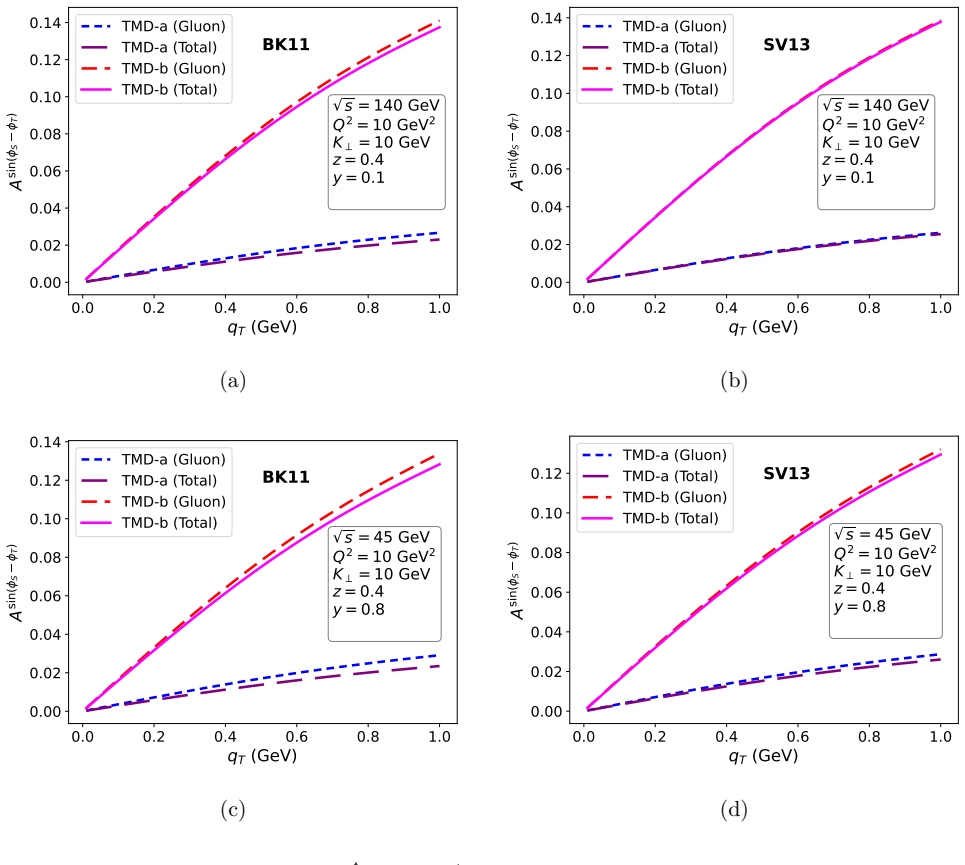
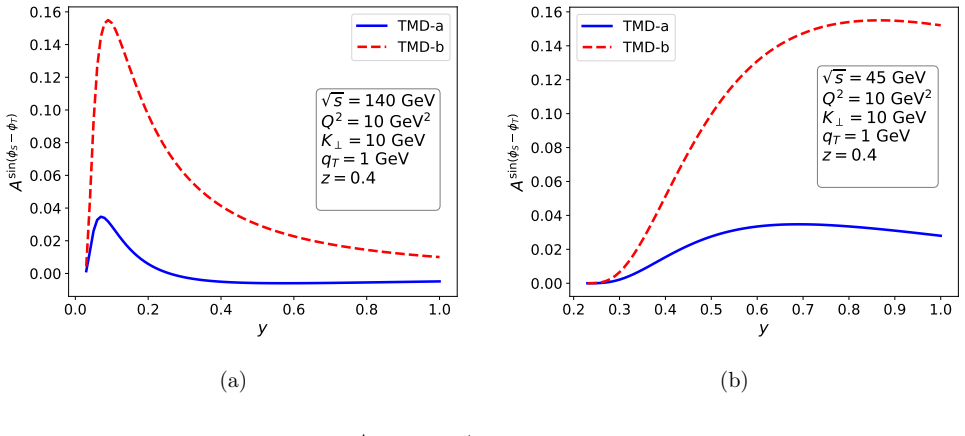
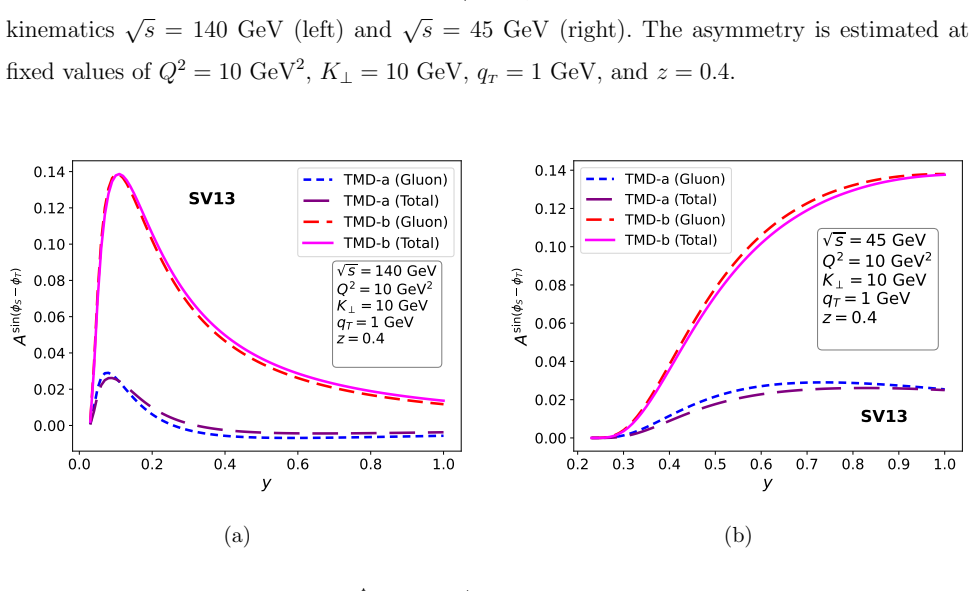
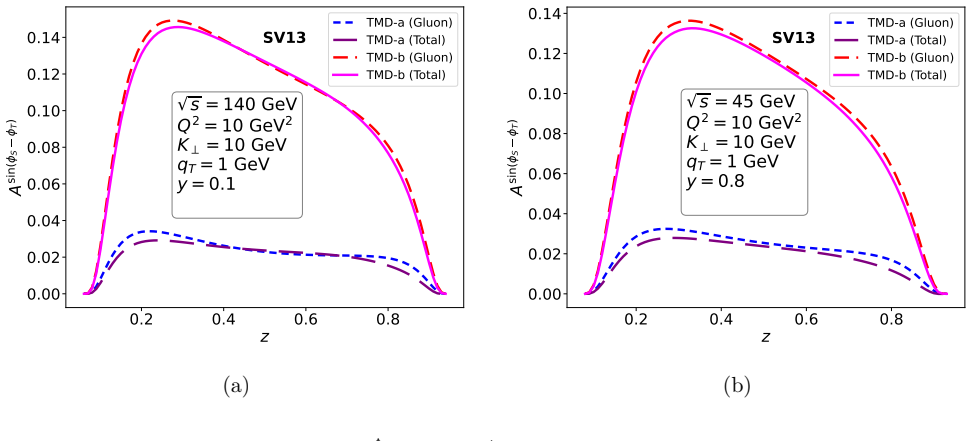
We present an estimate of the Sivers asymmetry in back-to-back $J/\psi$-photon and $J/\psi$-jet production in electron-proton collisions in the kinematics of the upcoming Electron-Ion Collider (EIC) in a transverse momentum dependent (TMD) factorization framework, and also incorporating the TMD evolution. We use the non-relativistic Quantum Chromodynamics (NRQCD) model to study the production mechanism of $J/\psi$. The gluon induced channel dominates, and these are promising probes of the less known gluon Sivers function. We incorporate the TMD evolution in the cross section and Sivers asymmetry in the Collins-Soper-Sterman (CSS) approach and show that the asymmetry is sizable even after the evolution. Although the cross section for $J/\psi$-jet production depends on the long-distance matrix element (LDME) set chosen, the asymmetry remains largely unaffected. The asymmetry is independent of the LDME at leading order for $J/\psi$-photon production. Thus, the Sivers asymmetry in both processes is a robust probe of the gluon Sivers function.
Editorial analysis
A structured set of objections, weighed in public.
Referee Report
Summary. The paper calculates the Sivers asymmetry for back-to-back J/ψ+γ and J/ψ+jet production in ep collisions at EIC kinematics using TMD factorization with CSS evolution and NRQCD for J/ψ production. It claims gluon-induced channels dominate, the asymmetry remains sizable after TMD evolution, is independent of LDME at leading order for the photon case, and largely unaffected by LDME choice for the jet case, making both processes robust probes of the gluon Sivers function.
Significance. If the results hold, this supplies concrete EIC predictions for accessing the poorly constrained gluon Sivers function via TMD observables that incorporate evolution. The explicit demonstration of LDME independence (at LO for γ and largely for jet) and the inclusion of evolution effects are strengths that enhance the utility of these channels as probes.
major comments (2)
- [§3] §3 (Production mechanism and NRQCD): The central claim that 'the gluon induced channel dominates' is load-bearing for the robustness interpretation, yet the manuscript provides no explicit channel decomposition (e.g., relative fractions of gluon- vs. quark-initiated subprocesses or color-singlet vs. octet contributions) as a function of kinematics or LDME set. Without such a breakdown or a scale-variation study, the 20-30% contamination threshold raised in the stress-test note cannot be bounded, undermining the assertion that the asymmetry is a clean gluon-Sivers probe.
- [§4] §4 (Numerical results and asymmetry plots): The statement that the asymmetry 'remains largely unaffected' by LDME choice for J/ψ+jet and is 'independent of the LDME at leading order' for J/ψ+γ is presented without showing the full variation across multiple LDME sets (including color-octet dominated ones) or higher-order relativistic corrections relevant at moderate p_T ~ few GeV. If non-gluon channels contribute appreciably, the reported LDME independence would not hold, directly affecting the probe interpretation.
minor comments (2)
- [§2] The CSS evolution implementation (kernel choice, b* prescription, and non-perturbative Sudakov parameters) should be stated explicitly in §2 to allow reproduction of the 'sizable even after evolution' result.
- Figure captions for the asymmetry plots should include the specific LDME sets and kinematic cuts used, as well as error bands from scale variation.
Simulated Author's Rebuttal
We thank the referee for the careful reading of our manuscript and the constructive comments. We address each major comment below and indicate the revisions we plan to make.
read point-by-point responses
-
Referee: [§3] §3 (Production mechanism and NRQCD): The central claim that 'the gluon induced channel dominates' is load-bearing for the robustness interpretation, yet the manuscript provides no explicit channel decomposition (e.g., relative fractions of gluon- vs. quark-initiated subprocesses or color-singlet vs. octet contributions) as a function of kinematics or LDME set. Without such a breakdown or a scale-variation study, the 20-30% contamination threshold raised in the stress-test note cannot be bounded, undermining the assertion that the asymmetry is a clean gluon-Sivers probe.
Authors: We agree that an explicit channel decomposition would strengthen the presentation of the gluon-dominance claim. The manuscript is based on the standard NRQCD expectation that gluon-fusion channels dominate J/ψ production in the EIC kinematics considered, but numerical fractions were not provided. In the revised version we will add a table (or supplementary figure) showing the relative contributions of gluon- versus quark-initiated subprocesses and color-singlet versus octet channels for the default LDME set across the relevant kinematic range. We will also perform a modest scale-variation exercise to bound the possible contamination level. revision: yes
-
Referee: [§4] §4 (Numerical results and asymmetry plots): The statement that the asymmetry 'remains largely unaffected' by LDME choice for J/ψ+jet and is 'independent of the LDME at leading order' for J/ψ+γ is presented without showing the full variation across multiple LDME sets (including color-octet dominated ones) or higher-order relativistic corrections relevant at moderate p_T ~ few GeV. If non-gluon channels contribute appreciably, the reported LDME independence would not hold, directly affecting the probe interpretation.
Authors: We partially agree. For the J/ψ+γ process the LDME independence at leading order follows directly from NRQCD factorization: the same LDME multiplies both the unpolarized and Sivers-modulated cross sections and therefore cancels in the asymmetry ratio. For J/ψ+jet the asymmetry remains largely insensitive because the dominant gluon channel’s LDME likewise factors out. To make this more explicit we will add results for two additional LDME sets (including one with larger color-octet weight) in the revised manuscript. Higher-order relativistic corrections lie outside the scope of the present leading-order TMD+NRQCD calculation; we will add a clarifying remark to this effect. revision: partial
Circularity Check
No significant circularity; derivation uses external inputs and standard frameworks
full rationale
The paper applies TMD factorization in the CSS evolution framework to the Sivers asymmetry for the specified processes, taking the gluon Sivers function from prior parametrizations and using NRQCD with stated dominance of the gluon channel. No step reduces a claimed prediction or first-principles result to a fitted parameter or self-citation by construction; the LDME independence statements and post-evolution size claims follow from explicit cross-section formulas rather than redefinition of inputs. The derivation remains self-contained against external benchmarks and does not invoke uniqueness theorems or ansatze traceable only to the authors' own prior unverified work.
Axiom & Free-Parameter Ledger
free parameters (2)
- gluon Sivers function parameters
- LDME sets
axioms (3)
- domain assumption TMD factorization holds for back-to-back kinematics at EIC
- domain assumption NRQCD model describes J/ψ production mechanism
- domain assumption CSS evolution correctly captures TMD scale dependence
Reference graph
Works this paper leans on
-
[1]
P. J. Mulders and R. D. Tangerman, Nucl. Phys. B461, 197 (1996), [Erratum: Nucl.Phys.B 484, 538–540 (1997)], hep-ph/9510301
work page internal anchor Pith review Pith/arXiv arXiv 1996
-
[2]
Time-reversal odd distribution functions in leptoproduction
D. Boer and P. J. Mulders, Phys. Rev. D57, 5780 (1998), hep-ph/9711485
work page internal anchor Pith review Pith/arXiv arXiv 1998
-
[3]
D. Boer, R. Jakob, and P. J. Mulders, Nucl. Phys. B564, 471 (2000), hep-ph/9907504
work page internal anchor Pith review Pith/arXiv arXiv 2000
-
[4]
Phenomenology of single spin asymmetries in p(transv. polarized)-p -> pion + X
M. Anselmino, M. Boglione, and F. Murgia, Phys. Rev. D60, 054027 (1999), hep-ph/9901442
work page internal anchor Pith review Pith/arXiv arXiv 1999
-
[5]
Single spin asymmetry for $p^{\uparrow}p \to \pi X$ in perturbative QCD
M. Anselmino, M. Boglione, and F. Murgia, Phys. Lett. B362, 164 (1995), hep-ph/9503290
work page internal anchor Pith review Pith/arXiv arXiv 1995
-
[6]
Transverse Polarisation of Quarks in Hadrons
V. Barone, A. Drago, and P. G. Ratcliffe, Phys. Rept.359, 1 (2002), hep-ph/0104283
work page internal anchor Pith review Pith/arXiv arXiv 2002
-
[7]
P. J. Mulders and J. Rodrigues, Phys. Rev. D63, 094021 (2001), hep-ph/0009343
work page internal anchor Pith review Pith/arXiv arXiv 2001
-
[8]
M. G. A. Buffing, A. Mukherjee, and P. J. Mulders, Phys. Rev. D88, 054027 (2013), 1306.5897
work page internal anchor Pith review Pith/arXiv arXiv 2013
-
[9]
D. W. Sivers, Phys. Rev. D41, 83 (1990)
1990
-
[10]
D. W. Sivers, Phys. Rev. D43, 261 (1991)
1991
-
[11]
Chromodynamic Lensing and Transverse Single Spin Asymmetries
M. Burkardt, Nucl. Phys. A735, 185 (2004), hep-ph/0302144
work page internal anchor Pith review Pith/arXiv arXiv 2004
-
[12]
Sivers Asymmetry and Generalized Parton Distributions in Impact Parameter Space
M. Burkardt and D. S. Hwang, Phys. Rev. D69, 074032 (2004), hep-ph/0309072
work page internal anchor Pith review Pith/arXiv arXiv 2004
-
[13]
Qiu and G
J.-w. Qiu and G. F. Sterman, Phys. Rev. Lett.67, 2264 (1991)
1991
-
[14]
Single Transverse-Spin Asymmetries in Hadronic Pion Production
J.-w. Qiu and G. F. Sterman, Phys. Rev. D59, 014004 (1999), hep-ph/9806356
work page internal anchor Pith review Pith/arXiv arXiv 1999
-
[15]
S. J. Brodsky, D. S. Hwang, and I. Schmidt, Nucl. Phys. B642, 344 (2002), hep-ph/0206259
work page internal anchor Pith review Pith/arXiv arXiv 2002
-
[16]
J. C. Collins, Phys. Lett. B536, 43 (2002), hep-ph/0204004
work page internal anchor Pith review Pith/arXiv arXiv 2002
-
[17]
Indication on the process-dependence of the Sivers effect
L. Gamberg, Z.-B. Kang, and A. Prokudin, Phys. Rev. Lett.110, 232301 (2013), 1302.3218
work page internal anchor Pith review Pith/arXiv arXiv 2013
-
[18]
An Observation Concerning the Process Dependence of the Sivers Functions
Z.-B. Kang, J.-W. Qiu, W. Vogelsang, and F. Yuan, Phys. Rev. D83, 094001 (2011), 1103.1591
work page internal anchor Pith review Pith/arXiv arXiv 2011
-
[19]
Measurement of the transverse single-spin asymmetry in $p^\uparrow+p \to W^{\pm}/Z^0$ at RHIC
L. Adamczyk et al. (STAR), Phys. Rev. Lett.116, 132301 (2016), 1511.06003
work page internal anchor Pith review Pith/arXiv arXiv 2016
-
[20]
First measurement of transverse-spin-dependent azimuthal asymmetries in the Drell-Yan process
M. Aghasyan et al. (COMPASS), Phys. Rev. Lett.119, 112002 (2017), 1704.00488
work page internal anchor Pith review Pith/arXiv arXiv 2017
-
[21]
Study of the sign change of the Sivers function from STAR Collaboration W/Z production data
M. Anselmino, M. Boglione, U. D’Alesio, F. Murgia, and A. Prokudin, JHEP04, 046 (2017), 1612.06413
work page internal anchor Pith review Pith/arXiv arXiv 2017
-
[22]
S. J. Brodsky, D. S. Hwang, and I. Schmidt, Phys. Lett. B530, 99 (2002), hep-ph/0201296
work page internal anchor Pith review Pith/arXiv arXiv 2002
-
[23]
A. V. Belitsky, X. Ji, and F. Yuan, Nucl. Phys. B656, 165 (2003), hep-ph/0208038
work page internal anchor Pith review Pith/arXiv arXiv 2003
-
[24]
Parton Distributions in Light-Cone Gauge: Where Are the Final-State Interactions?
X.-d. Ji and F. Yuan, Phys. Lett. B543, 66 (2002), hep-ph/0206057
work page internal anchor Pith review Pith/arXiv arXiv 2002
-
[25]
D. Boer, P. J. Mulders, and F. Pijlman, Nucl. Phys. B667, 201 (2003), hep-ph/0303034. 31
work page internal anchor Pith review Pith/arXiv arXiv 2003
-
[26]
A. Airapetian et al. (HERMES), Phys. Rev. Lett.94, 012002 (2005), hep-ex/0408013
work page internal anchor Pith review Pith/arXiv arXiv 2005
-
[27]
Observation of the Naive-T-odd Sivers Effect in Deep-Inelastic Scattering
A. Airapetian et al. (HERMES), Phys. Rev. Lett.103, 152002 (2009), 0906.3918
work page internal anchor Pith review Pith/arXiv arXiv 2009
-
[28]
C. Adolph et al. (COMPASS), Phys. Lett. B717, 383 (2012), 1205.5122
work page internal anchor Pith review Pith/arXiv arXiv 2012
-
[29]
X. Qian et al. (Jefferson Lab Hall A), Phys. Rev. Lett.107, 072003 (2011), 1106.0363
work page internal anchor Pith review Pith/arXiv arXiv 2011
-
[30]
Towards a first estimate of the gluon Sivers function from $A_N$ data in $pp$ collisions at RHIC
U. D’Alesio, F. Murgia, and C. Pisano, JHEP09, 119 (2015), 1506.03078
work page internal anchor Pith review Pith/arXiv arXiv 2015
-
[31]
Unraveling the Gluon Sivers Function in Hadronic Collisions at RHIC
U. D’Alesio, C. Flore, F. Murgia, C. Pisano, and P. Taels, Phys. Rev. D99, 036013 (2019), 1811.02970
work page internal anchor Pith review Pith/arXiv arXiv 2019
- [32]
-
[33]
J. C. Collins, D. E. Soper, and G. F. Sterman, Nucl. Phys. B250, 199 (1985)
1985
-
[34]
QCD prediction for heavy boson transverse momentum distributions
J.-w. Qiu and X.-f. Zhang, Phys. Rev. Lett.86, 2724 (2001), hep-ph/0012058
work page internal anchor Pith review Pith/arXiv arXiv 2001
- [35]
-
[36]
M. G. Echevarria, A. Idilbi, Z.-B. Kang, and I. Vitev, Phys. Rev. D89, 074013 (2014), 1401.5078
work page internal anchor Pith review Pith/arXiv arXiv 2014
-
[37]
M. Burkardt, Phys. Rev. D69, 091501 (2004), hep-ph/0402014
work page internal anchor Pith review Pith/arXiv arXiv 2004
-
[38]
Sivers Effect for Pion and Kaon Production in Semi-Inclusive Deep Inelastic Scattering
M. Anselmino, M. Boglione, U. D’Alesio, A. Kotzinian, S. Melis, F. Murgia, A. Prokudin, and C. Turk, Eur. Phys. J. A39, 89 (2009), 0805.2677
work page internal anchor Pith review Pith/arXiv arXiv 2009
-
[39]
Electron Ion Collider: The Next QCD Frontier - Understanding the glue that binds us all
A. Accardi et al., Eur. Phys. J. A52, 268 (2016), 1212.1701
work page internal anchor Pith review Pith/arXiv arXiv 2016
-
[40]
S. M. Aybat, J. C. Collins, J.-W. Qiu, and T. C. Rogers, Phys. Rev. D85, 034043 (2012), 1110.6428
work page internal anchor Pith review Pith/arXiv arXiv 2012
-
[41]
S. M. Aybat and T. C. Rogers, Phys. Rev. D83, 114042 (2011), 1101.5057
work page internal anchor Pith review Pith/arXiv arXiv 2011
-
[42]
Collins,Foundations of Perturbative QCD, vol
J. Collins,Foundations of Perturbative QCD, vol. 32 (Cambridge University Press, 2011), ISBN 978-1-009-40184-5, 978-1-009-40183-8, 978-1-009-40182-1
2011
-
[43]
G. T. Bodwin, E. Braaten, and G. P. Lepage, Phys. Rev. D51, 1125 (1995), [Erratum: Phys.Rev.D 55, 5853 (1997)], hep-ph/9407339
work page internal anchor Pith review Pith/arXiv arXiv 1995
-
[44]
Polarized gluon studies with charmonium and bottomonium at LHCb and AFTER
D. Boer and C. Pisano, Phys. Rev. D86, 094007 (2012), 1208.3642
work page internal anchor Pith review Pith/arXiv arXiv 2012
-
[45]
A. Mukherjee and S. Rajesh, Eur. Phys. J. C77, 854 (2017), 1609.05596
work page internal anchor Pith review Pith/arXiv arXiv 2017
-
[46]
R. M. Godbole, A. Misra, A. Mukherjee, and V. S. Rawoot, Phys. Rev. D85, 094013 (2012), 1201.1066. 32
work page internal anchor Pith review Pith/arXiv arXiv 2012
-
[47]
R. M. Godbole, A. Misra, A. Mukherjee, and V. S. Rawoot, Phys. Rev. D88, 014029 (2013), 1304.2584
work page internal anchor Pith review Pith/arXiv arXiv 2013
-
[48]
Sivers effect in Inelastic $J/\psi$ Photoproduction in $ep^\uparrow$ Collision in Color Octet Model
S. Rajesh, R. Kishore, and A. Mukherjee, Phys. Rev. D98, 014007 (2018), 1802.10359
work page internal anchor Pith review Pith/arXiv arXiv 2018
-
[49]
U. D’Alesio, F. Murgia, C. Pisano, and P. Taels, Phys. Rev. D100, 094016 (2019), 1908.00446
-
[50]
D. Chakrabarti, R. Kishore, A. Mukherjee, and S. Rajesh, Phys. Rev. D107, 014008 (2023), 2211.08709
-
[51]
R. Kishore, A. Mukherjee, and S. Rajesh, Phys. Rev. D101, 054003 (2020), 1908.03698
-
[52]
Probing the gluon Sivers function in $p^\uparrow p\to J/\psi\,X$ and $p^\uparrow p \to D\,X$
U. D’Alesio, F. Murgia, C. Pisano, and P. Taels, Phys. Rev. D96, 036011 (2017), 1705.04169
work page internal anchor Pith review Pith/arXiv arXiv 2017
-
[53]
B. A. Kniehl and C. P. Palisoc, Eur. Phys. J. C48, 451 (2006), hep-ph/0608245
work page internal anchor Pith review Pith/arXiv arXiv 2006
-
[54]
Linear polarization of gluons and photons in unpolarized collider experiments
C. Pisano, D. Boer, S. J. Brodsky, M. G. A. Buffing, and P. J. Mulders, JHEP10, 024 (2013), 1307.3417
work page internal anchor Pith review Pith/arXiv arXiv 2013
-
[55]
Relations between generalized and transverse momentum dependent parton distributions
S. Meissner, A. Metz, and K. Goeke, Phys. Rev. D76, 034002 (2007), hep-ph/0703176
work page internal anchor Pith review Pith/arXiv arXiv 2007
- [56]
- [57]
-
[58]
C. Kouvaris, J.-W. Qiu, W. Vogelsang, and F. Yuan, Phys. Rev. D74, 114013 (2006), hep- ph/0609238
-
[59]
Transverse single spin asymmetries in Drell-Yan processes
M. Anselmino, U. D’Alesio, and F. Murgia, Phys. Rev. D67, 074010 (2003), hep-ph/0210371
work page internal anchor Pith review Pith/arXiv arXiv 2003
-
[60]
Asymmetric jet correlations in p p^\uparrow scattering
D. Boer and W. Vogelsang, Phys. Rev. D69, 094025 (2004), hep-ph/0312320
work page internal anchor Pith review Pith/arXiv arXiv 2004
- [61]
-
[62]
Catani, E
S. Catani, E. D’Emilio, and L. Trentadue, Phys. Lett. B211, 335 (1988)
1988
-
[63]
World data of J/psi production consolidate NRQCD factorization at NLO
M. Butenschoen and B. A. Kniehl, Phys. Rev. D84, 051501 (2011), 1105.0820
work page internal anchor Pith review Pith/arXiv arXiv 2011
-
[64]
High transverse momentum quarkonium production and dissociation in heavy ion collisions
R. Sharma and I. Vitev, Phys. Rev. C87, 044905 (2013), 1203.0329
work page internal anchor Pith review Pith/arXiv arXiv 2013
-
[65]
New CTEQ global analysis of quantum chromodynamics with high-precision data from the LHC
T.-J. Hou et al., Phys. Rev. D103, 014013 (2021), 1912.10053
work page internal anchor Pith review Pith/arXiv arXiv 2021
-
[66]
A. Bacchetta, U. D’Alesio, M. Diehl, and C. A. Miller, Phys. Rev. D70, 117504 (2004), hep- ph/0410050. 33
discussion (0)
Sign in with ORCID, Apple, or X to comment. Anyone can read and Pith papers without signing in.