Boosted Higgs-strahlung off a W boson at next-to-next-to-next-to-leading order in QCD
Pith reviewed 2026-07-01 05:08 UTC · model grok-4.3
The pith
The first fully differential N³LO QCD calculation for boosted Higgs plus W production finds corrections of about +2% that sit at or beyond the NNLO scale-variation band.
A machine-rendered reading of the paper's core claim, the machinery that carries it, and where it could break.
Core claim
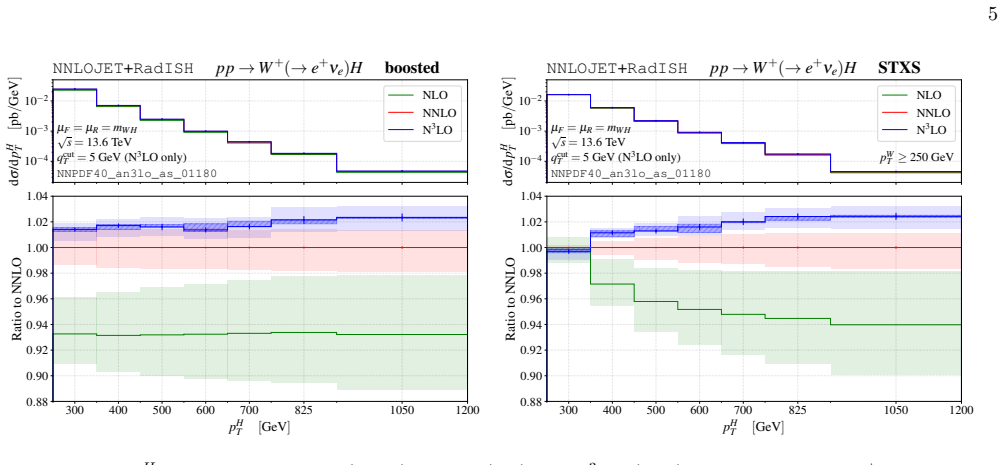
We present the first fully differential calculation of boosted Higgs-strahlung off a W boson at N³LO in perturbative QCD. The N³LO corrections amount to approximately +2% in the boosted regime and generally lie at the edge of or outside the standard scale variation band of the previous perturbative order, while the residual dependence of the N³LO prediction on perturbative scales is reduced to below the percent level.
What carries the argument
The fully differential N³LO QCD computation of the pp → WH cross section, incorporating all virtual and real-emission contributions through third order in the strong coupling.
Load-bearing premise
That the conventional scale-variation procedure performed at NNLO supplies a reliable estimate of the size of the missing higher-order corrections.
What would settle it
A high-precision measurement of the boosted WH cross section whose central value lies well inside the NNLO scale band but outside the N³LO prediction band.
Figures
read the original abstract
The production of a boosted Higgs boson in association with a charged weak ($W$) boson is a key process to scrutinize the electroweak symmetry breaking mechanism at hadron colliders. This reaction constitutes the dominant Higgs production channel at large transverse momentum, providing unique sensitivity to Higgs-boson interactions with other Standard Model particles as well as to physics beyond the Standard Model. In this Letter, we present the first fully differential calculation of this important scattering process at next-to-next-to-next-to-leading order (N$^3$LO) in perturbative Quantum Chromodynamics (QCD). We find that the N$^3$LO corrections, amounting to approximately $+2\%$ in the boosted regime, generally lie at the edge of or outside the standard scale variation band of the previous perturbative order. The residual dependence of the N$^3$LO prediction on perturbative scales is reduced to below the percent level, marking a milestone for the Higgs precision program.
Editorial analysis
A structured set of objections, weighed in public.
Referee Report
Summary. The manuscript presents the first fully differential N³LO QCD calculation of Higgs-strahlung off a W boson (WH production) in the boosted Higgs regime at hadron colliders. The central numerical result is that N³LO corrections amount to approximately +2% and generally lie at the edge of or outside the NNLO scale-variation band, while reducing residual perturbative scale dependence to below the percent level.
Significance. If the result holds, this constitutes a milestone for precision Higgs phenomenology, as boosted WH is the dominant production mode at high pT and provides direct sensitivity to Higgs couplings and potential BSM effects. Achieving sub-percent residual scale uncertainty supplies more robust theoretical inputs for LHC analyses than previous orders.
major comments (1)
- [Abstract] Abstract: The statement that the N³LO corrections 'generally lie at the edge of or outside the standard scale variation band of the previous perturbative order' rests on the assumption that the conventional 7-point scale variation performed at NNLO furnishes a faithful envelope for the size of the uncalculated N³LO terms. The manuscript provides no independent cross-check of this assumption (e.g., via an alternative uncertainty prescription, comparison against a known N³LO process, or explicit demonstration in a solvable limit). This directly affects the strength of the claim that the N³LO shift lies outside the previous uncertainty estimate.
minor comments (1)
- [Abstract] The abstract would benefit from a brief statement of the collider energy and the precise kinematic definition of the 'boosted regime' used for the quoted +2% correction.
Simulated Author's Rebuttal
We thank the referee for the careful reading of our manuscript and the positive overall assessment. We address the major comment below.
read point-by-point responses
-
Referee: [Abstract] Abstract: The statement that the N³LO corrections 'generally lie at the edge of or outside the standard scale variation band of the previous perturbative order' rests on the assumption that the conventional 7-point scale variation performed at NNLO furnishes a faithful envelope for the size of the uncalculated N³LO terms. The manuscript provides no independent cross-check of this assumption (e.g., via an alternative uncertainty prescription, comparison against a known N³LO process, or explicit demonstration in a solvable limit). This directly affects the strength of the claim that the N³LO shift lies outside the previous uncertainty estimate.
Authors: We agree that conventional 7-point scale variation provides an estimate of higher-order effects rather than a rigorous bound, and that the manuscript does not include an independent cross-check such as an alternative prescription or comparison to a different N³LO process. Our statement is an empirical observation based on the explicit computation: the N³LO correction size is compared directly to the NNLO 7-point band obtained with the same scale choices. This follows the standard practice used in all prior N³LO QCD calculations. In the revised manuscript we have added a clarifying sentence after the abstract claim noting that the observation relies on the conventional scale-variation prescription and does not constitute a general proof. We have also softened the wording slightly to 'lie at or beyond the edge of the NNLO scale-variation band obtained with the standard 7-point prescription.' We believe this addresses the concern without altering the numerical results or the main conclusions. revision: partial
Circularity Check
No circularity: direct N³LO perturbative computation
full rationale
The paper reports an explicit higher-order QCD calculation of differential distributions for WH production at N³LO. All results follow from standard matrix-element evaluation, infrared subtraction, and phase-space integration; no quantity is obtained by fitting a parameter to a subset of the same data and then relabeling it a prediction, nor does any central claim reduce to a self-citation chain or imported ansatz. Scale variation is used only as a conventional uncertainty estimate after the calculation is complete and does not enter the derivation itself.
Axiom & Free-Parameter Ledger
free parameters (1)
- renormalization and factorization scales
axioms (1)
- domain assumption Perturbative QCD expansion remains valid and convergent at N³LO for this process
Reference graph
Works this paper leans on
-
[1]
G. Aadet al.(ATLAS), Eur. Phys. J. C81, 178 (2021), arXiv:2007.02873 [hep-ex]
arXiv 2021
-
[2]
G. Aadet al.(ATLAS), Phys. Rev. D105, 092003 (2022), arXiv:2111.08340 [hep-ex]
arXiv 2022
-
[3]
G. Aadet al.(ATLAS), Phys. Rev. Lett.132, 131802 (2024), arXiv:2312.07605 [hep-ex]
arXiv 2024
-
[4]
A. M. Sirunyanet al.(CMS), JHEP12, 085, arXiv:2006.13251 [hep-ex]
arXiv 2006
-
[5]
A. M. Sirunyanet al.(CMS), Phys. Rev. D104, 052004 (2021), arXiv:2104.12152 [hep-ex]
arXiv 2021
-
[6]
Hayrapetyanet al.(CMS), JHEP12, 035, arXiv:2407.08012 [hep-ex]
A. Hayrapetyanet al.(CMS), JHEP12, 035, arXiv:2407.08012 [hep-ex]
- [7]
-
[8]
W. Bizon, M. Gorbahn, U. Haisch, and G. Zanderighi, JHEP07, 083, arXiv:1610.05771 [hep-ph]
-
[9]
W. Bizo´ n, F. Caola, K. Melnikov, and R. R¨ ontsch, Phys. Rev. D105, 014023 (2022), arXiv:2106.06328 [hep-ph]
arXiv 2022
- [10]
-
[11]
M. Bonetti, R. V. Harlander, D. Korneev, M.-M. Long, K. Melnikov, R. R¨ ontsch, and D. M. Tagliabue, Phys. Rev. D112, 034033 (2025), arXiv:2502.12846 [hep-ph]
arXiv 2025
-
[12]
K. Beckeret al., SciPost Phys. Core7, 001 (2024), arXiv:2005.07762 [hep-ph]
arXiv 2024
- [13]
-
[14]
M. L. Ciccolini, S. Dittmaier, and M. Kramer, Phys. Rev. D68, 073003 (2003), arXiv:hep-ph/0306234
Pith/arXiv arXiv 2003
-
[15]
A. Denner, S. Dittmaier, S. Kallweit, and A. Muck, JHEP 03, 075, arXiv:1112.5142 [hep-ph]
-
[16]
A. Denner, S. Dittmaier, S. Kallweit, and A. M¨ uck, Com- put. Phys. Commun.195, 161 (2015), arXiv:1412.5390 [hep-ph]
Pith/arXiv arXiv 2015
-
[17]
F. Granata, J. M. Lindert, C. Oleari, and S. Pozzorini, 6 JHEP09, 012, arXiv:1706.03522 [hep-ph]
-
[18]
G. Ferrera, M. Grazzini, and F. Tramontano, Phys. Rev. Lett.107, 152003 (2011), arXiv:1107.1164 [hep-ph]
Pith/arXiv arXiv 2011
-
[19]
G. Ferrera, M. Grazzini, and F. Tramontano, JHEP04, 039, arXiv:1312.1669 [hep-ph]
-
[20]
W. Astill, W. Bizon, E. Re, and G. Zanderighi, JHEP 06, 154, arXiv:1603.01620 [hep-ph]
-
[21]
J. M. Campbell, R. K. Ellis, and C. Williams, JHEP06, 179, arXiv:1601.00658 [hep-ph]
-
[22]
F. Caola, G. Luisoni, K. Melnikov, and R. R¨ ontsch, Phys. Rev. D97, 074022 (2018), arXiv:1712.06954 [hep-ph]
Pith/arXiv arXiv 2018
-
[23]
G. Ferrera, G. Somogyi, and F. Tramontano, Phys. Lett. B780, 346 (2018), arXiv:1705.10304 [hep-ph]
Pith/arXiv arXiv 2018
- [24]
-
[25]
A. Behring, W. Bizo´ n, F. Caola, K. Melnikov, and R. R¨ ontsch, Phys. Rev. D101, 114012 (2020), arXiv:2003.08321 [hep-ph]
arXiv 2020
-
[26]
Majer,Associated Higgs Boson Production at NNLO QCD, Ph.D
I. Majer,Associated Higgs Boson Production at NNLO QCD, Ph.D. thesis, Zurich, ETH, Zurich, ETH (2020)
2020
- [27]
- [28]
- [29]
-
[30]
C. Anastasiou, C. Duhr, F. Dulat, F. Herzog, and B. Mistlberger, Phys. Rev. Lett.114, 212001 (2015), arXiv:1503.06056 [hep-ph]
Pith/arXiv arXiv 2015
-
[31]
C. Anastasiou, C. Duhr, F. Dulat, E. Furlan, T. Gehrmann, F. Herzog, A. Lazopoulos, and B. Mistl- berger, JHEP05, 058, arXiv:1602.00695 [hep-ph]
-
[32]
F. A. Dreyer and A. Karlberg, Phys. Rev. Lett.117, 072001 (2016), arXiv:1606.00840 [hep-ph]
Pith/arXiv arXiv 2016
-
[33]
Mistlberger, JHEP05, 028, arXiv:1802.00833 [hep- ph]
B. Mistlberger, JHEP05, 028, arXiv:1802.00833 [hep- ph]
-
[34]
F. A. Dreyer and A. Karlberg, Phys. Rev. D98, 114016 (2018), arXiv:1811.07906 [hep-ph]
Pith/arXiv arXiv 2018
-
[35]
L. Cieri, X. Chen, T. Gehrmann, E. W. N. Glover, and A. Huss, JHEP02, 096, arXiv:1807.11501 [hep-ph]
-
[36]
L.-B. Chen, H. T. Li, H.-S. Shao, and J. Wang, Phys. Lett. B803, 135292 (2020), arXiv:1909.06808 [hep-ph]
arXiv 2020
-
[37]
L.-B. Chen, H. T. Li, H.-S. Shao, and J. Wang, JHEP 03, 072, arXiv:1912.13001 [hep-ph]
arXiv 1912
-
[38]
C. Duhr, F. Dulat, and B. Mistlberger, Phys. Rev. Lett. 125, 051804 (2020), arXiv:1904.09990 [hep-ph]
arXiv 2020
-
[39]
C. Duhr, F. Dulat, and B. Mistlberger, JHEP11, 143, arXiv:2007.13313 [hep-ph]
arXiv 2007
- [40]
-
[41]
X. Chen, T. Gehrmann, E. W. N. Glover, A. Huss, B. Mistlberger, and A. Pelloni, Phys. Rev. Lett.127, 072002 (2021), arXiv:2102.07607 [hep-ph]
arXiv 2021
- [42]
-
[43]
S. Camarda, L. Cieri, and G. Ferrera, Phys. Rev. D104, L111503 (2021), arXiv:2103.04974 [hep-ph]
arXiv 2021
-
[44]
X. Chen, T. Gehrmann, N. Glover, A. Huss, T.-Z. Yang, and H. X. Zhu, Phys. Rev. Lett.128, 052001 (2022), arXiv:2107.09085 [hep-ph]
arXiv 2022
-
[45]
X. Chen, T. Gehrmann, E. W. N. Glover, A. Huss, P. F. Monni, E. Re, L. Rottoli, and P. Torrielli, Phys. Rev. Lett.128, 252001 (2022), arXiv:2203.01565 [hep-ph]
arXiv 2022
-
[46]
T. Neumann and J. Campbell, Phys. Rev. D107, L011506 (2023), arXiv:2207.07056 [hep-ph]
arXiv 2023
-
[47]
X. Chen, T. Gehrmann, N. Glover, A. Huss, T.-Z. Yang, and H. X. Zhu, Phys. Lett. B840, 137876 (2023), arXiv:2205.11426 [hep-ph]
arXiv 2023
- [48]
-
[49]
M. Czakon, F. Eschment, T. Generet, and R. Poncelet, (2026), arXiv:2604.12613 [hep-ph]
Pith/arXiv arXiv 2026
-
[50]
X. Chen, Y. Dai, H. T. Li, S.-Y. Li, H.-S. Shao, and J. Wang, (2026), arXiv:2601.19990 [hep-ph]
Pith/arXiv arXiv 2026
-
[51]
S. Catani and M. Grazzini, Phys. Rev. Lett.98, 222002 (2007), arXiv:hep-ph/0703012
Pith/arXiv arXiv 2007
-
[52]
T. Gehrmann, E. W. N. Glover, T. Huber, N. Ikizlerli, and C. Studerus, JHEP06, 094, arXiv:1004.3653 [hep- ph]
-
[53]
S. Catani, L. Cieri, D. de Florian, G. Ferrera, and M. Grazzini, Eur. Phys. J. C72, 2195 (2012), arXiv:1209.0158 [hep-ph]
Pith/arXiv arXiv 2012
- [54]
-
[55]
T. L¨ ubbert, J. Oredsson, and M. Stahlhofen, JHEP03, 168, arXiv:1602.01829 [hep-ph]
-
[56]
M. G. Echevarria, I. Scimemi, and A. Vladimirov, JHEP 09, 004, arXiv:1604.07869 [hep-ph]
-
[57]
Y. Li and H. X. Zhu, Phys. Rev. Lett.118, 022004 (2017), arXiv:1604.01404 [hep-ph]
Pith/arXiv arXiv 2017
-
[58]
A. A. Vladimirov, Phys. Rev. Lett.118, 062001 (2017), arXiv:1610.05791 [hep-ph]
Pith/arXiv arXiv 2017
- [59]
-
[60]
M. A. Ebert, B. Mistlberger, and G. Vita, JHEP09, 146, arXiv:2006.05329 [hep-ph]
arXiv 2006
- [61]
-
[62]
P. F. Monni, E. Re, and P. Torrielli, Phys. Rev. Lett. 116, 242001 (2016), arXiv:1604.02191 [hep-ph]
Pith/arXiv arXiv 2016
- [63]
-
[64]
E. Re, L. Rottoli, and P. Torrielli, JHEP2109, 108, arXiv:2104.07509 [hep-ph]
-
[65]
Husset al.(NNLOJET), SciPost Phys
A. Husset al.(NNLOJET), SciPost Phys. Codeb.69, 1 (2026), arXiv:2503.22804 [hep-ph]
Pith/arXiv arXiv 2026
-
[66]
A. Gehrmann-De Ridder, T. Gehrmann, and E. W. N. Glover, JHEP09, 056, arXiv:hep-ph/0505111
-
[67]
J. Currie, E. W. N. Glover, and S. Wells, JHEP04, 066, arXiv:1301.4693 [hep-ph]
- [68]
- [69]
-
[70]
F. Buccioni, J.-N. Lang, J. M. Lindert, P. Maierh¨ ofer, S. Pozzorini, H. Zhang, and M. F. Zoller, Eur. Phys. J. C79, 866 (2019), arXiv:1907.13071 [hep-ph]
arXiv 2019
-
[71]
O. Brein, R. Harlander, M. Wiesemann, and T. Zirke, Eur. Phys. J. C72, 1868 (2012), arXiv:1111.0761 [hep- ph]
Pith/arXiv arXiv 2012
-
[72]
R. D. Ballet al.(NNPDF), Eur. Phys. J. C84, 659 (2024), arXiv:2402.18635 [hep-ph]. 7
arXiv 2024
-
[73]
A. Buckley, J. Ferrando, S. Lloyd, K. Nordstr¨ om, B. Page, M. R¨ ufenacht, M. Sch¨ onherr, and G. Watt, Eur. Phys. J. C75, 132 (2015), arXiv:1412.7420 [hep-ph]
Pith/arXiv arXiv 2015
-
[74]
LHCHXSWG, Higgs production cross section for run iii (2025)
2025
-
[75]
J. R. Andersenet al., in9th Les Houches Workshop on Physics at TeV Colliders(2016) arXiv:1605.04692 [hep- ph]
Pith/arXiv arXiv 2016
-
[76]
N. Bergeret al., SciPost Phys. Comm. Rep. 10.21468/Sci- PostPhysCommRep.15 (2019), arXiv:1906.02754 [hep- ph]
-
[77]
Aaboudet al.(ATLAS), JHEP05, 141, arXiv:1903.04618 [hep-ex]
M. Aaboudet al.(ATLAS), JHEP05, 141, arXiv:1903.04618 [hep-ex]
Pith/arXiv arXiv 1903
-
[78]
Gehrmann-De Ridder, A
A. Gehrmann-De Ridder, A. Huss, M. Marcoli, P. F. Monni, E. Re, L. Rottoli, F. Silvetti, and P. Torrielli, (2026), Supplemental Material to this Letter
2026
-
[79]
S. Frixione and G. Ridolfi, Phys. Lett. B383, 227 (1996), arXiv:hep-ph/9605209
Pith/arXiv arXiv 1996
-
[80]
M. Grazzini, S. Kallweit, and M. Wiesemann, Eur. Phys. J. C78, 537 (2018), arXiv:1711.06631 [hep-ph]
Pith/arXiv arXiv 2018
discussion (0)
Sign in with ORCID, Apple, or X to comment. Anyone can read and Pith papers without signing in.