A Quantum-Classical Surrogate Model for the Collision Operator of the Lattice Boltzmann Method
Pith reviewed 2026-07-01 05:33 UTC · model grok-4.3
The pith
A single parameterized quantum circuit with data re-uploading approximates the full range of BGK collision operators without retraining.
A machine-rendered reading of the paper's core claim, the machinery that carries it, and where it could break.
Core claim
The surrogate recovers the complete Bhatnagar-Gross-Krook (BGK) collision dynamics across the full physically admissible range of relaxation without retraining, built on the ability of parameterized quantum circuits to implement partial Fourier series with data re-uploading to extend representable frequencies.
What carries the argument
Parameterized quantum circuit with data re-uploading that implements partial Fourier series to represent the collision operator for varying relaxation parameters.
If this is right
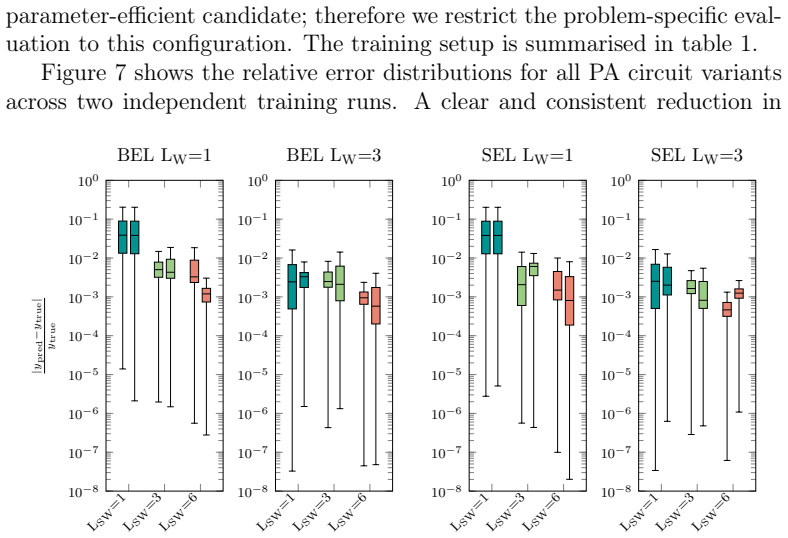
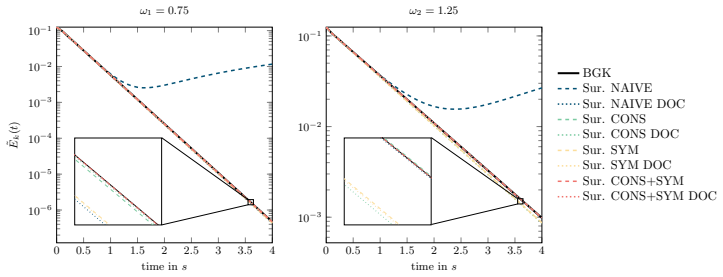
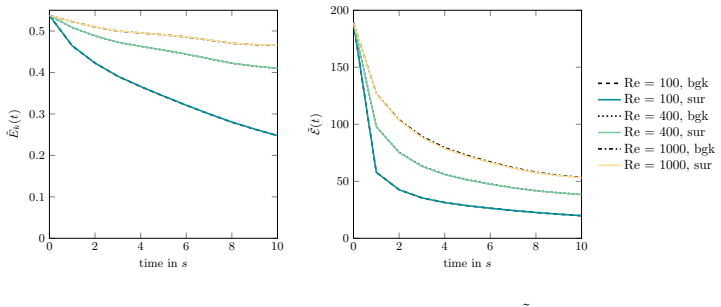
- The hybrid model reproduces energy dissipation rates in the Taylor-Green vortex to high accuracy.
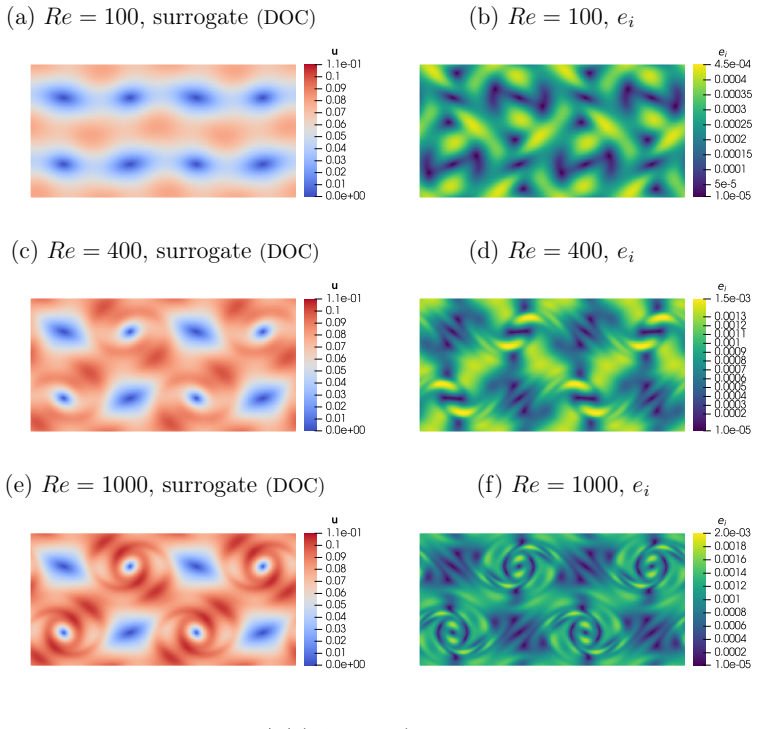
- The surrogate captures shear-driven instabilities and nonlinear evolution in the double shear layer.
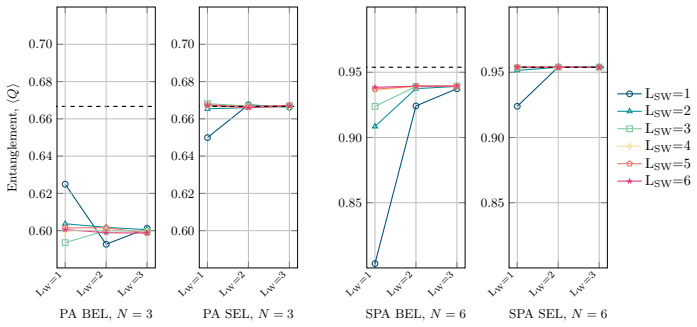
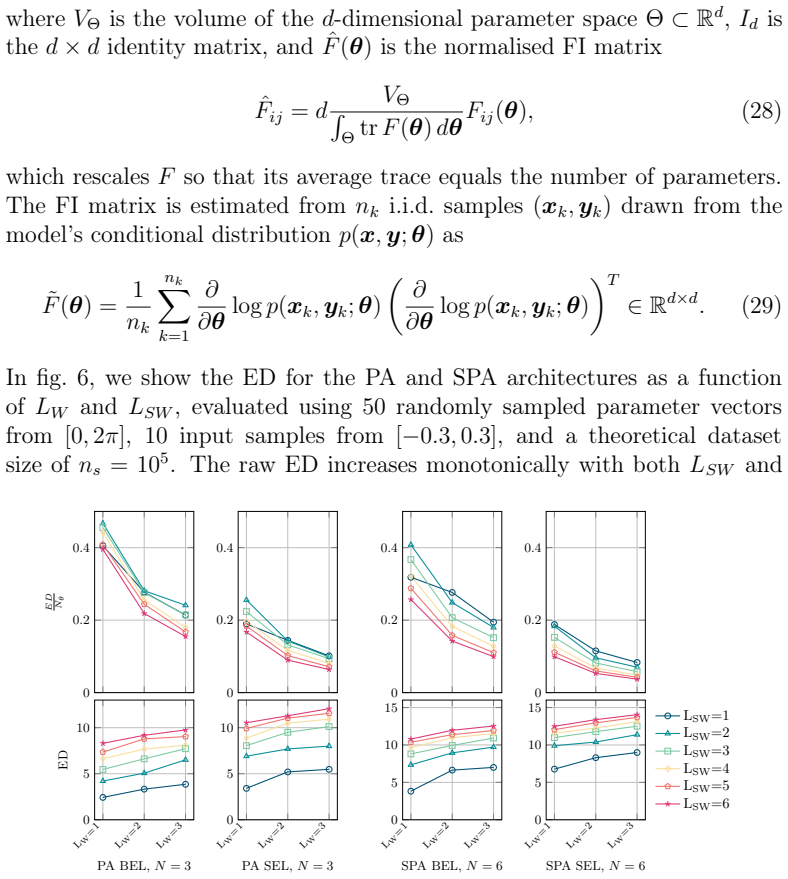
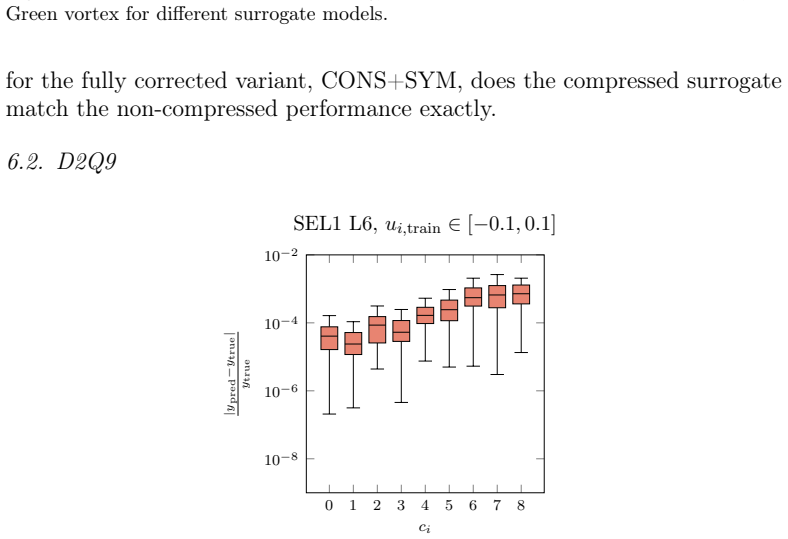
- Expressibility, entanglement, and effective dimension of the circuit can be related directly to surrogate error on the collision task.
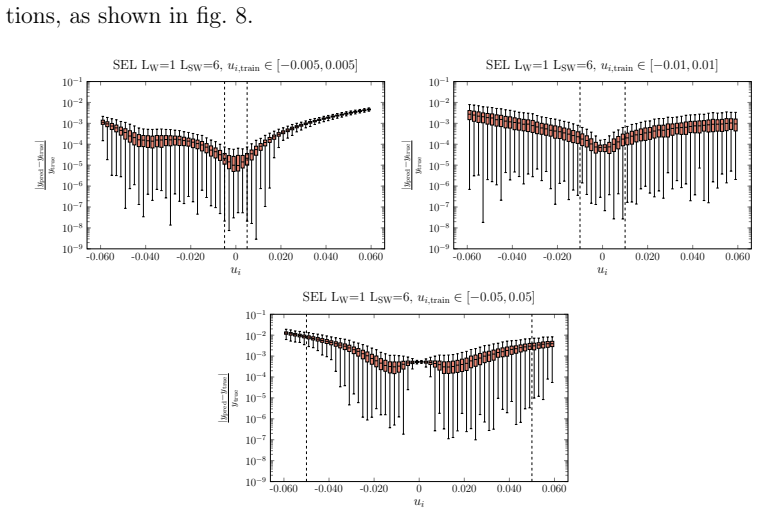
- Specific architectural choices in the circuit determine the achieved approximation accuracy.
- The approach offloads non-unitary collision operations while retaining classical handling of the streaming step.
Where Pith is reading between the lines
- The same circuit structure might extend to other collision models such as multiple-relaxation-time variants if the Fourier representation generalizes.
- Integration into larger-scale engineering simulations could test whether the surrogate reduces wall-clock time relative to classical collision evaluations.
- The re-assessment of variational metrics suggests similar task-specific validation could be applied to quantum surrogates in other transport or kinetic problems.
- Demonstration on three-dimensional or turbulent regimes would clarify whether the current accuracy holds beyond the two-dimensional benchmarks used.
Load-bearing premise
A single trained parameterized quantum circuit with data re-uploading can represent the BGK collision operator accurately for any relaxation parameter in the admissible range.
What would settle it
Apply the surrogate to a third benchmark flow such as lid-driven cavity flow at a relaxation parameter outside the training distribution and compare the resulting velocity field or energy spectrum against the classical BGK operator.
Figures
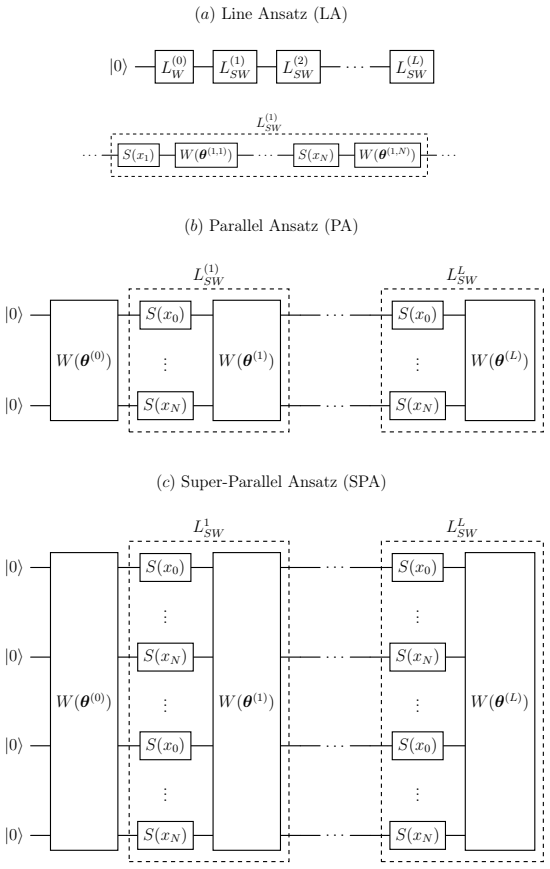
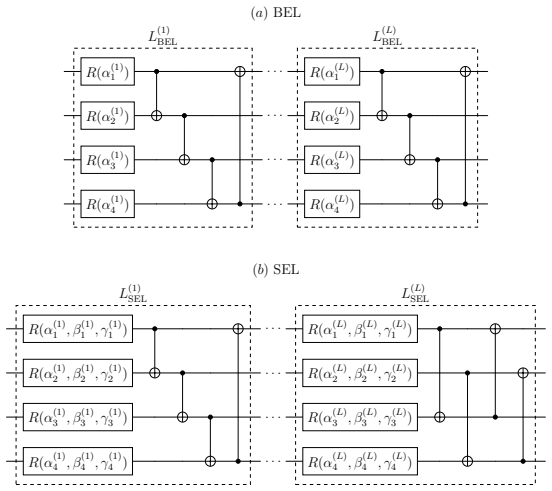
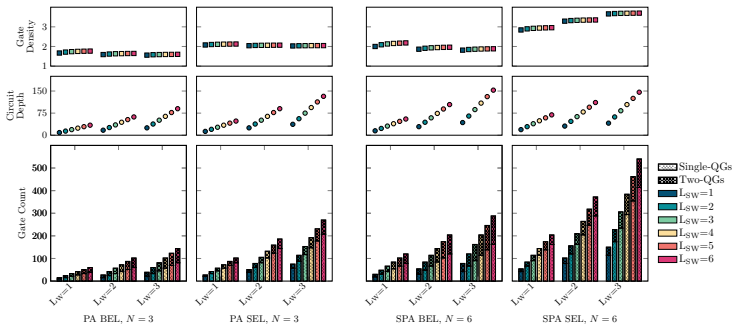
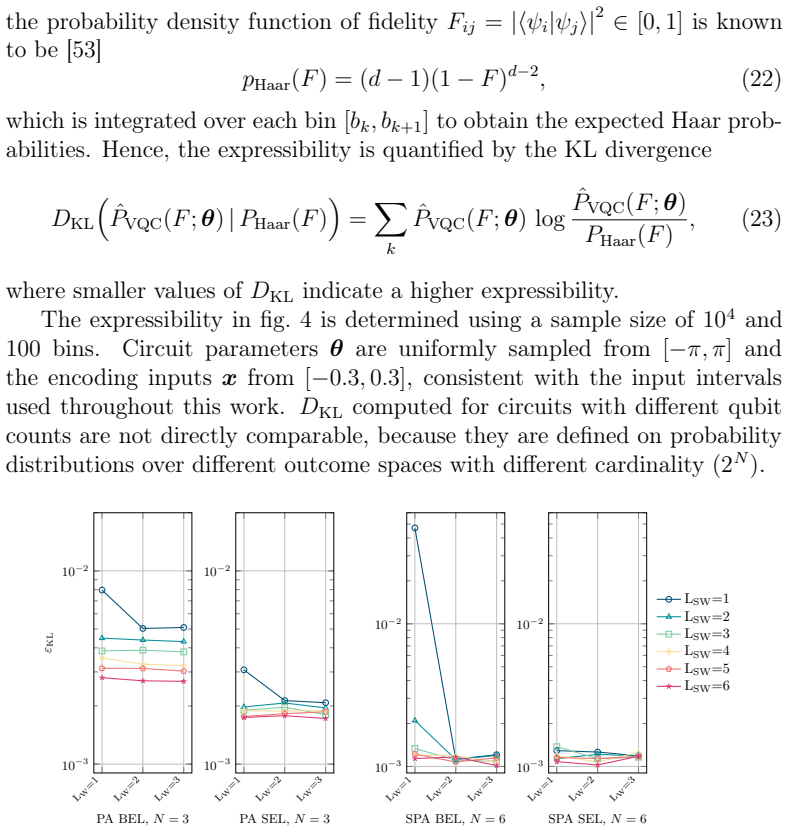
read the original abstract
We introduce a hybrid approach utilising a quantum machine learning surrogate model to approximate the non-linear collision dynamics of the LBM. It effectively offloads the non-unitary operations that challenge pure quantum solvers. The expressivity of the surrogate is built on the ability of parameterised quantum circuits to implement partial Fourier series, with data re-uploading extending the spectrum of representable frequencies. Unlike previous approaches with a fixed relaxation parameter, the surrogate recovers the complete Bhatnagar-Gross-Krook (BGK) collision dynamics across the full physically admissible range of relaxation without retraining. We reassess the relevance of standard variational quantum circuit (VQC) metrics, including expressibility, entanglement, and effective dimension, by relating them directly to task-specific surrogate performance and identifying the key architectural parameters that determine approximation accuracy. The proposed surrogate is validated against the classical BGK collision operator using established benchmark problems, including the Taylor-Green vortex for evaluating energy dissipation and the double shear layer for assessing shear-driven instabilities and nonlinear flow evolution. Our results demonstrate that the hybrid model achieves high accuracy and generalisability while closely replicating classical solutions. These findings suggest that hybrid quantum-classical strategies offer a practical path toward realising the potential of quantum computing in fluid engineering.
Editorial analysis
A structured set of objections, weighed in public.
Referee Report
Summary. The manuscript introduces a hybrid quantum-classical surrogate for the Lattice Boltzmann Method collision operator, employing a parameterized quantum circuit (PQC) with data re-uploading to approximate the full Bhatnagar-Gross-Krook (BGK) operator f' = f - (f - f_eq)/tau. It claims that a single fixed trained model recovers the complete BGK dynamics for arbitrary relaxation parameters across the physically admissible range without retraining, reassesses standard VQC metrics (expressibility, entanglement, effective dimension) against task performance, and validates the approach on the Taylor-Green vortex (energy dissipation) and double shear layer (shear instabilities) benchmarks, asserting high accuracy and generalisability.
Significance. If the central generalization claim holds with quantitative support, the work would demonstrate a practical hybrid strategy for handling non-unitary collision steps in quantum LBM solvers and could advance quantum machine learning applications in computational fluid dynamics by linking VQC architectural choices directly to surrogate fidelity.
major comments (2)
- [Abstract] Abstract: the claim that the surrogate 'recovers the complete BGK collision dynamics across the full physically admissible range of relaxation without retraining' is load-bearing for the central contribution yet rests only on validation for the Taylor-Green vortex and double shear layer at specific (unspecified) tau values; no parameter sweeps, continuous tau variation tests, or out-of-distribution checks are described to substantiate the 'arbitrary' and 'complete' qualifiers.
- [Abstract] Abstract and validation description: the assertions of 'high accuracy and generalisability' are unsupported by any reported quantitative error metrics, training details, loss values, or error bars comparing the surrogate output to the classical BGK operator.
minor comments (1)
- [Abstract] Abstract: the phrase 'closely replicating classical solutions' is vague without reference to specific figures, tables, or error norms.
Simulated Author's Rebuttal
We thank the referee for the constructive comments. We address each major point below and will revise the manuscript to strengthen the presentation of our results.
read point-by-point responses
-
Referee: [Abstract] Abstract: the claim that the surrogate 'recovers the complete BGK collision dynamics across the full physically admissible range of relaxation without retraining' is load-bearing for the central contribution yet rests only on validation for the Taylor-Green vortex and double shear layer at specific (unspecified) tau values; no parameter sweeps, continuous tau variation tests, or out-of-distribution checks are described to substantiate the 'arbitrary' and 'complete' qualifiers.
Authors: We agree that explicit parameter sweeps and out-of-distribution tests for tau are not described in the current validation sections. The surrogate is trained on data sampled across the admissible tau range to support generalization, but to fully substantiate the claim we will add a dedicated analysis with continuous tau sweeps and error metrics in the revised manuscript. revision: yes
-
Referee: [Abstract] Abstract and validation description: the assertions of 'high accuracy and generalisability' are unsupported by any reported quantitative error metrics, training details, loss values, or error bars comparing the surrogate output to the classical BGK operator.
Authors: Quantitative metrics, training details and error comparisons are included in the results section of the full manuscript. To address the concern directly in the abstract, we will revise it to report key quantitative error metrics, loss values and error bars. revision: yes
Circularity Check
No significant circularity detected
full rationale
The paper trains a parameterized quantum circuit surrogate on classical BGK data and validates performance by direct comparison to the classical collision operator on independent benchmark flows (Taylor-Green vortex, double shear layer). No quoted step defines a quantity in terms of itself, renames a fitted parameter as a prediction, or relies on a self-citation chain for the central claim. The generalization statement is an empirical assertion tested against external classical solutions rather than a reduction by construction. The derivation remains self-contained against the stated classical benchmarks.
Axiom & Free-Parameter Ledger
free parameters (1)
- VQC parameters
axioms (1)
- domain assumption Parameterized quantum circuits with data re-uploading can implement partial Fourier series sufficient to represent BGK collision dynamics
Reference graph
Works this paper leans on
-
[1]
P. W. Shor, Polynomial-time algorithms for prime factorization and dis- crete logarithms on a quantum computer, SIAM Journal on Computing 26 (5) (1997) 1484–1509. doi:10.1137/S0097539795293172. 36
-
[2]
L. K. Grover, A fast quantum mechanical algorithm for database search. URLhttp://arxiv.org/pdf/quant-ph/9605043
work page internal anchor Pith review Pith/arXiv arXiv
-
[3]
A. W. Harrow, A. Hassidim, S. Lloyd, Quantum algorithm for linear systems of equations, Physical review letters 103 (15) (2009) 150502. doi:10.1103/PhysRevLett.103.150502. URLhttp://arxiv.org/pdf/0811.3171
work page internal anchor Pith review Pith/arXiv arXiv doi:10.1103/physrevlett.103.150502 2009
-
[4]
N. Ray, T. Banerjee, B. Nadiga, S. Karra, Towards solving the navier- stokes equation on quantum computers, LA-UR-19-. URLhttp://arxiv.org/pdf/1904.09033
work page internal anchor Pith review Pith/arXiv arXiv 1904
-
[5]
Steijl, Quantum algorithms for fluid simulations, in: F
R. Steijl, Quantum algorithms for fluid simulations, in: F. Bulnes, V. N. Stavrou, O. Morozov, A. V. Bourdine (Eds.), Advances in Quantum Communication and Information, IntechOpen, 2020. doi:10.5772/intechopen.86685
-
[6]
R. Steijl, G. N. Barakos, Parallel evaluation of quantum algorithms for computational fluid dynamics, Computers & Fluids 173 (2018) 22–28. doi:10.1016/j.compfluid.2018.03.080
-
[7]
F. Gaitan, Finding flows of a navier–stokes fluid through quantum com- puting, npj Quantum Information 6 (1) (2020). doi:10.1038/s41534-020- 00291-0
-
[8]
F. Oz, R. K. S. S. Vuppala, K. Kara, F. Gaitan, Solving burgers’ equa- tion with quantum computing, Quantum Information Processing 21 (1) (2022). doi:10.1007/s11128-021-03391-8
-
[9]
Yepez, Quantum lattice-gas model for computational fluid dynamics, Physical review
J. Yepez, Quantum lattice-gas model for computational fluid dynamics, Physical review. E, Statistical, nonlinear, and soft matter physics 63 (4 Pt 2) (2001) 046702. doi:10.1103/PhysRevE.63.046702
-
[10]
G. P. Berman, A. A. Ezhov, D. I. Kamenev, J. Yepez, Simulation of the diffusion equation on a type-ii quantum computer, Physical Review A 66 (1) (2002). doi:10.1103/PhysRevA.66.012310
-
[11]
B. N. Todorova, R. Steijl, Quantum algorithm for the collisionless boltz- mann equation, Journal of Computational Physics 409 (2020) 109347. doi:10.1016/j.jcp.2020.109347. 37
-
[12]
F. Alouges, F. de Vuyst, G. Le Coq, E. Lorin, The reservoir technique: a way to make godunov-type schemes zero or very low diffuse. application to colella–glaz solver, European Journal of Mechanics - B/Fluids 27 (6) (2008) 643–664. doi:10.1016/j.euromechflu.2008.01.001
-
[13]
M. A. Schalkers, M. Möller, Efficient and fail-safe quantum algorithm for the transport equation, Journal of Computational Physics 502 (2024) 112816. doi:10.1016/j.jcp.2024.112816
-
[14]
T. G. Draper, Addition on a quantum computer. URLhttp://arxiv.org/pdf/quant-ph/0008033
work page internal anchor Pith review Pith/arXiv arXiv
-
[15]
L. Budinski, Quantum algorithm for the advection–diffusion equation simulated with the lattice boltzmann method, Quantum Information Processing 20 (2) (2021). doi:10.1007/s11128-021-02996-3
-
[16]
L. Budinski, Quantum algorithm for the navier–stokes equations by us- ing the streamfunction-vorticity formulation and the lattice boltzmann method, International Journal of Quantum Information 20 (02) (2022). doi:10.1142/S0219749921500398. URLhttp://arxiv.org/pdf/2103.03804
-
[17]
D. Wawrzyniak, J. Winter, S. Schmidt, T. Indinger, C. F. Janßen, U. Schramm, N. A. Adams, Linearized quantum lattice- boltzmann method for the advection-diffusion equation using dy- namic circuits, Computer Physics Communications 317 (2025) 109856. doi:10.1016/j.cpc.2025.109856
-
[18]
C. Sanavio, S. Succi, Lattice boltzmann–carleman quantum algorithm and circuit for fluid flows at moderate reynolds number, AVS Quantum Science 6 (2) (2024). doi:10.1116/5.0195549. URLhttp://arxiv.org/pdf/2310.17973
-
[19]
T. Carleman, Application de la théorie des équations intégrales linéaires aux systèmes d’équations différentielles non linéaires, Acta Mathematica 59 (0) (1932) 63–87. doi:10.1007/BF02546499
-
[20]
Itani, Towards a quantum algorithm for lattice boltzmann (qalb) simulation with a nonlinear collision term, Dissertation, New York Uni- versity, NY, USA (03//2025)
W. Itani, Towards a quantum algorithm for lattice boltzmann (qalb) simulation with a nonlinear collision term, Dissertation, New York Uni- versity, NY, USA (03//2025). 38
2025
-
[21]
M. Lăcătuş, M. Möller, Surrogate quantum circuit design for the lattice boltzmann collision operator. doi:10.48550/arXiv.2507.12256
-
[22]
Quantum computing in the NISQ era and beyond,
J. Preskill, Quantum computing in the nisq era and beyond, Quantum 2 (2018) 79. doi:10.22331/q-2018-08-06-79
work page internal anchor Pith review doi:10.22331/q-2018-08-06-79 2018
-
[23]
Cerezo, A
M. Cerezo, A. Arrasmith, R. Babbush, S. C. Benjamin, S. Endo, K. Fu- jii, J. R. McClean, K. Mitarai, X. Yuan, L. Cincio, P. J. Coles, Varia- tional quantum algorithms, Nature Reviews Physics 3 (9) (2021) 625–
2021
-
[24]
doi:10.1038/s42254-021-00348-9
-
[25]
Boltzmann, Weitere studien über das wärmegleichgewicht unter gas- molekülen, in: Sitzungsberichte der Kaiserlichen Akademie der Wis- senschaften, Vol
L. Boltzmann, Weitere studien über das wärmegleichgewicht unter gas- molekülen, in: Sitzungsberichte der Kaiserlichen Akademie der Wis- senschaften, Vol. 66, Carl Gerold’s Sohn, Wien, 1872, pp. 275–370
-
[26]
Chapman, T
S. Chapman, T. G. Cowling, The mathematical theory of non-uniform gases: An account of the kinetic theory of viscosity, thermal conduction, and diffusion in gases, 3rd Edition, Cambridge mathematical library, Cambridge University Press, Cambridge and New York, 1990
1990
-
[27]
T. Abe, Derivation of the lattice boltzmann method by means of the discrete ordinate method for the boltzmann equation, Journal of Com- putational Physics 131 (1) (1997) 241–246. doi:10.1006/jcph.1996.5595
-
[28]
X. He, L.-S. Luo, Theory of the lattice boltzmann method: From the boltzmann equation to the lattice boltzmann equation, Physical Review E 56 (6) (1997) 6811–6817. doi:10.1103/PhysRevE.56.6811
-
[29]
G. R. McNamara, G. Zanetti, Use of the boltzmann equation to simulate lattice gas automata, Physical review letters 61 (20) (1988) 2332–2335. doi:10.1103/PhysRevLett.61.2332
-
[30]
S. Succi, R. Benzi, F. Higuera, The lattice boltzmann equation: A new toolforcomputationalfluid-dynamics, PhysicaD:NonlinearPhenomena 47 (1-2) (1991) 219–230. doi:10.1016/0167-2789(91)90292-H
-
[31]
A. A. Mohamad, Lattice Boltzmann Method, Springer London, London,
-
[32]
doi:10.1007/978-0-85729-455-5
-
[33]
T. Krüger, H. Kusumaatmaja, A. Kuzmin, O. Shardt, G. Silva, E. M. Viggen, The Lattice Boltzmann Method, Springer International Pub- lishing, Cham, 2017. doi:10.1007/978-3-319-44649-3. 39
-
[34]
S. Succi, The lattice Boltzmann equation for fluid dynamics and be- yond, Numerical mathematics and scientific computation, Clarendon Press and Oxford University Press, Oxford and New York, 2001
2001
-
[35]
P. L. Bhatnagar, E. P. Gross, M. Krook, A model for collision pro- cesses in gases. i. small amplitude processes in charged and neu- tral one-component systems, Physical Review 94 (3) (1954) 511–525. doi:10.1103/PhysRev.94.511
-
[36]
K.Mitarai, M.Negoro, M.Kitagawa, K.Fujii, Quantumcircuitlearning, Physical Review A 98 (3) (2018). doi:10.1103/PhysRevA.98.032309
-
[37]
M. A. Nielsen, I. L. Chuang, Quantum computation and quantum in- formation, 10th Edition, Cambridge University Press, Cambridge and New York, 2010. doi:10.1017/CBO9780511976667
-
[38]
M. Schuld, R. Sweke, J. J. Meyer, Effect of data encoding on the expres- sive power of variational quantum-machine-learning models, Physical Review A 103 (3) (2021). doi:10.1103/PhysRevA.103.032430
-
[39]
M. Ostaszewski, E. Grant, M. Benedetti, Structure optimization for parameterizedquantumcircuits, Quantum5(2021)391. doi:10.22331/q- 2021-01-28-391
work page doi:10.22331/q- 2021
-
[40]
F. J. Gil Vidal, D. O. Theis, Input redundancy for parameterized quan- tum circuits, Frontiers in Physics 8 (2020). doi:10.3389/fphy.2020.00297
-
[41]
A. Pérez-Salinas, A. Cervera-Lierta, E. Gil-Fuster, J. I. Latorre, Data re-uploading for a universal quantum classifier, Quantum 4 (2020) 226. doi:10.22331/q-2020-02-06-226
-
[42]
B. Casas, A. Cervera-Lierta, Multidimensional fourier series with quantum circuits, Physical Review A 107 (6) (2023). doi:10.1103/PhysRevA.107.062612. URLhttp://arxiv.org/pdf/2302.03389
-
[43]
J. Landman, S. Thabet, C. Dalyac, H. Mhiri, E. Kashefi, Classically ap- proximating variational quantum machine learning with random fourier features. doi:10.48550/arXiv.2210.13200. 40
-
[44]
S. Shin, Y. S. Teo, H. Jeong, Exponential data encoding for quantum supervised learning, Physical Review A 107 (1) (2023). doi:10.1103/PhysRevA.107.012422
-
[45]
H. Mhiri, L. Monbroussou, M. Herrero-Gonzalez, S. Thabet, E. Kashefi, J. Landman, Constrained and vanishing expressivity of quantum fourier models, Quantum 9 (2025) 1847. doi:10.22331/q-2025-09-03-1847
-
[46]
M. Wiedmann, M. Periyasamy, D. D. Scherer, Fourier anal- ysis of variational quantum circuits for supervised learning. doi:10.48550/arXiv.2411.03450
-
[47]
J. R. McClean, S. Boixo, V. N. Smelyanskiy, R. Babbush, H. Neven, Barren plateaus in quantum neural network training landscapes, Nature communications 9 (1) (2018) 4812. doi:10.1038/s41467-018-07090-4
-
[48]
C. Ortiz Marrero, M. Kieferová, N. Wiebe, Entanglement- induced barren plateaus, PRX Quantum 2 (4) (2021). doi:10.1103/PRXQuantum.2.040316
-
[49]
Z. Holmes, A. Arrasmith, B. Yan, P. J. Coles, A. Albrecht, A. T. Sorn- borger, Barren plateaus preclude learning scramblers, Physical review letters 126 (19) (2021) 190501. doi:10.1103/PhysRevLett.126.190501
-
[50]
Z. Holmes, K. Sharma, M. Cerezo, P. J. Coles, Connecting ansatz ex- pressibility to gradient magnitudes and barren plateaus, PRX Quantum 3 (1) (2022). doi:10.1103/PRXQuantum.3.010313
-
[51]
URLhttps://pennylane.ai/
Pennylane: Quantum programming software (03/01/2025). URLhttps://pennylane.ai/
2025
-
[52]
A. Corbetta, A. Gabbana, V. Gyrya, D. Livescu, J. Prins, F. Toschi, To- ward learning lattice boltzmann collision operators, The European phys- ical journal. E, Soft matter 46 (3) (2023) 10. doi:10.1140/epje/s10189- 023-00267-w
-
[53]
S. Sim, P. D. Johnson, A. Aspuru-Guzik, Expressibility and entan- gling capability of parameterized quantum circuits for hybrid quantum– classical algorithms, Advanced Quantum Technologies 2 (12) (2019). doi:10.1002/qute.201900070. 41
-
[54]
On Information and Sufficiency,
S. Kullback, R. A. Leibler, On information and sufficiency, The Annals of Mathematical Statistics 22 (1) (1951) 79–86. doi:10.1214/aoms/1177729694
-
[55]
K. Życzkowski, H.-J. Sommers, Average fidelity between ran- dom quantum states, Physical Review A 71 (3) (2005). doi:10.1103/PhysRevA.71.032313
-
[56]
D. A. Meyer, N. R. Wallach, Global entanglement in multiparticle systems, Journal of Mathematical Physics 43 (9) (2002) 4273–4278. doi:10.1063/1.1497700
-
[57]
A. J. Scott, C. M. Caves, Entangling power of the quantum baker s map, Journal of Physics A: Mathematical and General 36 (36) (2003) 9553–9576. doi:10.1088/0305-4470/36/36/308
-
[58]
The power of quantum neural networks,
A. Abbas, D. Sutter, C. Zoufal, A. Lucchi, A. Figalli, S. Woerner, The power of quantum neural networks, Nature computational science 1 (6) (2021) 403–409. doi:10.1038/s43588-021-00084-1
-
[59]
Abbas, D
A. Abbas, D. Sutter, A. Figalli, S. Woerner, Effective dimension of ma- chine learning models
-
[60]
O.Berezniuk, A.Figalli, R.Ghigliazza, K.Musaelian, Ascale-dependent notion of effective dimension. doi:10.48550/arXiv.2001.10872
-
[61]
Ragone, B
M. Ragone, B. N. Bakalov, F. Sauvage, A. F. Kemper, C. Ortiz Marrero, M. Larocca, M. Cerezo, A lie algebraic theory of barren plateaus for deep parameterized quantum circuits, Nature communications 15 (1) (2024)
2024
-
[62]
doi:10.1038/s41467-024-49909-3
-
[63]
M. E. Brachet, D. Meiron, S. Orszag, B. Nickel, R. Morf, U. Frisch, The taylor-green vortex and fully developed turbulence, Journal of Statistical Physics 34 (5-6) (1984) 1049–1063. doi:10.1007/BF01009458. 42
discussion (0)
Sign in with ORCID, Apple, or X to comment. Anyone can read and Pith papers without signing in.