Impact of Sub-2.5 MeV 12C+12CResonances on the Production of Elements from C to Pd in Core-Collapse Supernovae
Pith reviewed 2026-07-01 03:22 UTC · model grok-4.3
The pith
Increased 12C+12C reaction rate changes pre-supernova structure and boosts s-process production of elements heavier than iron in core-collapse supernova ejecta
A machine-rendered reading of the paper's core claim, the machinery that carries it, and where it could break.
Core claim
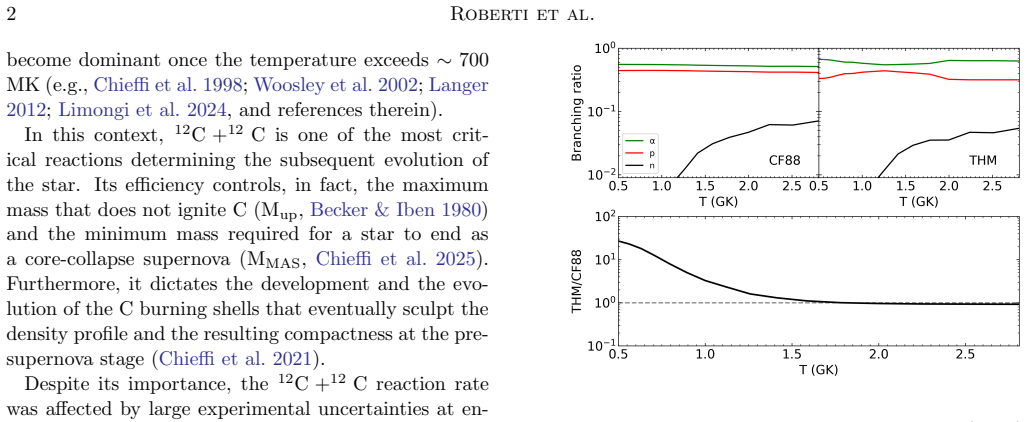
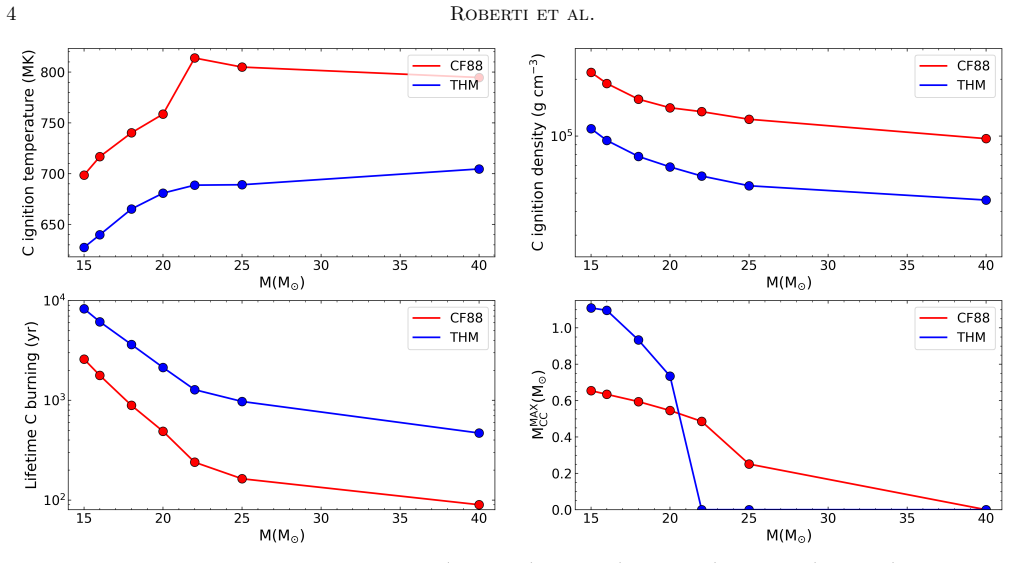
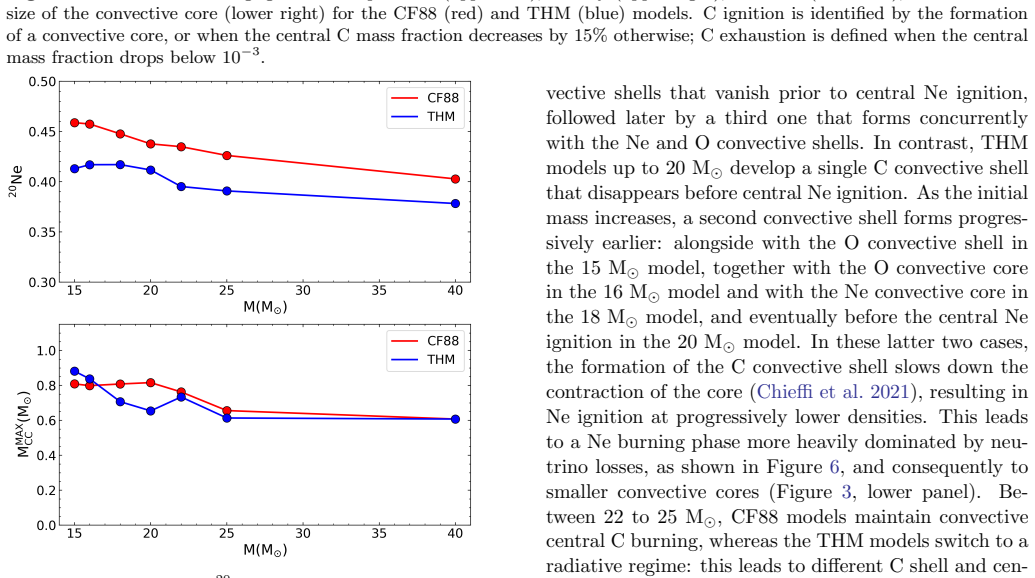
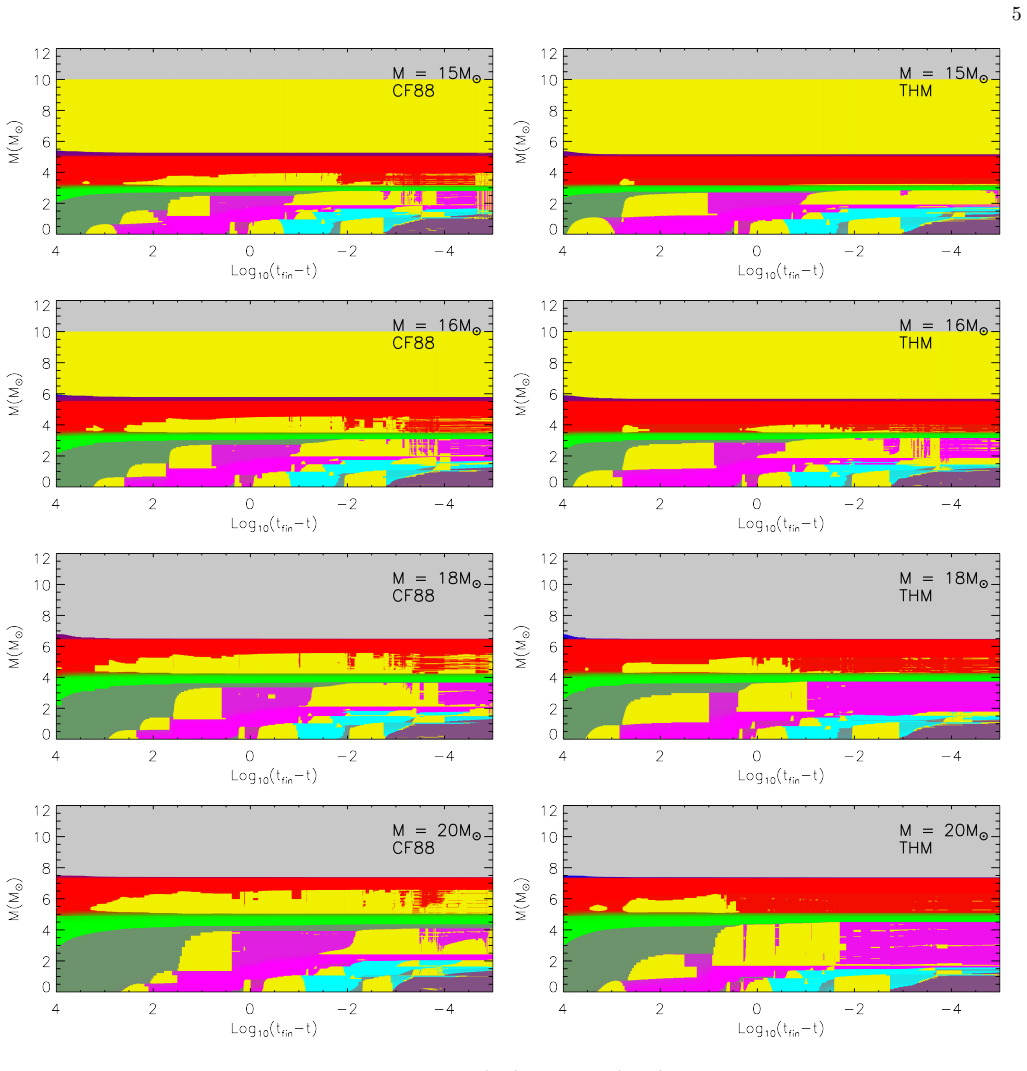
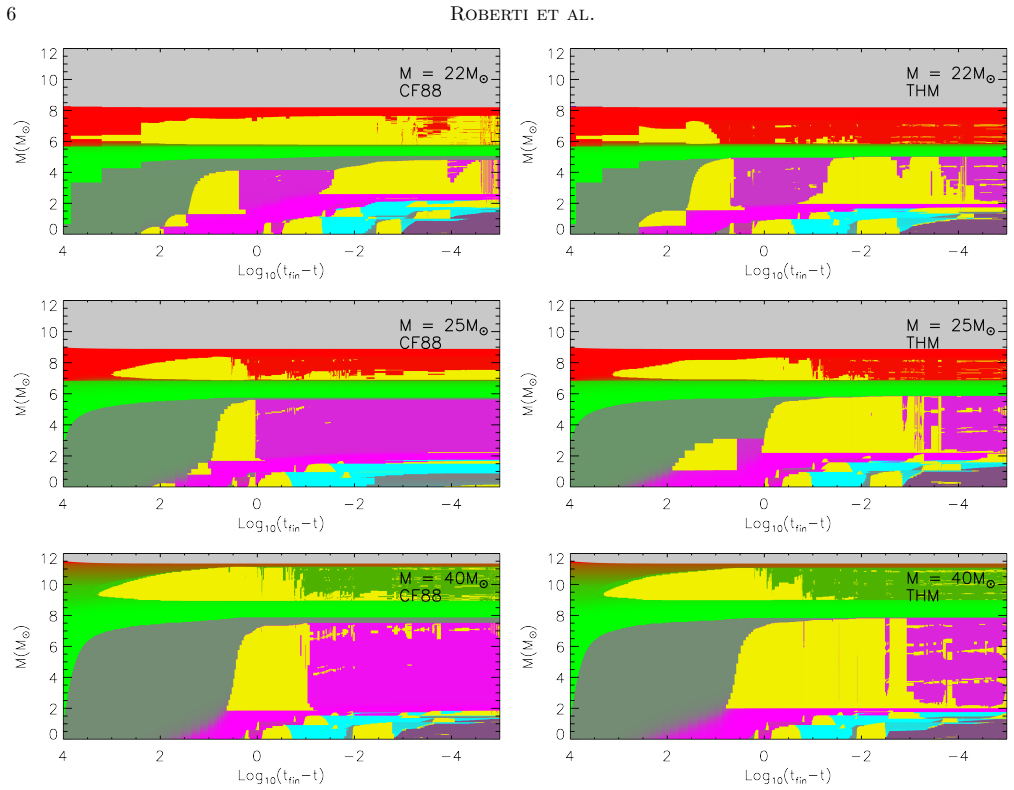
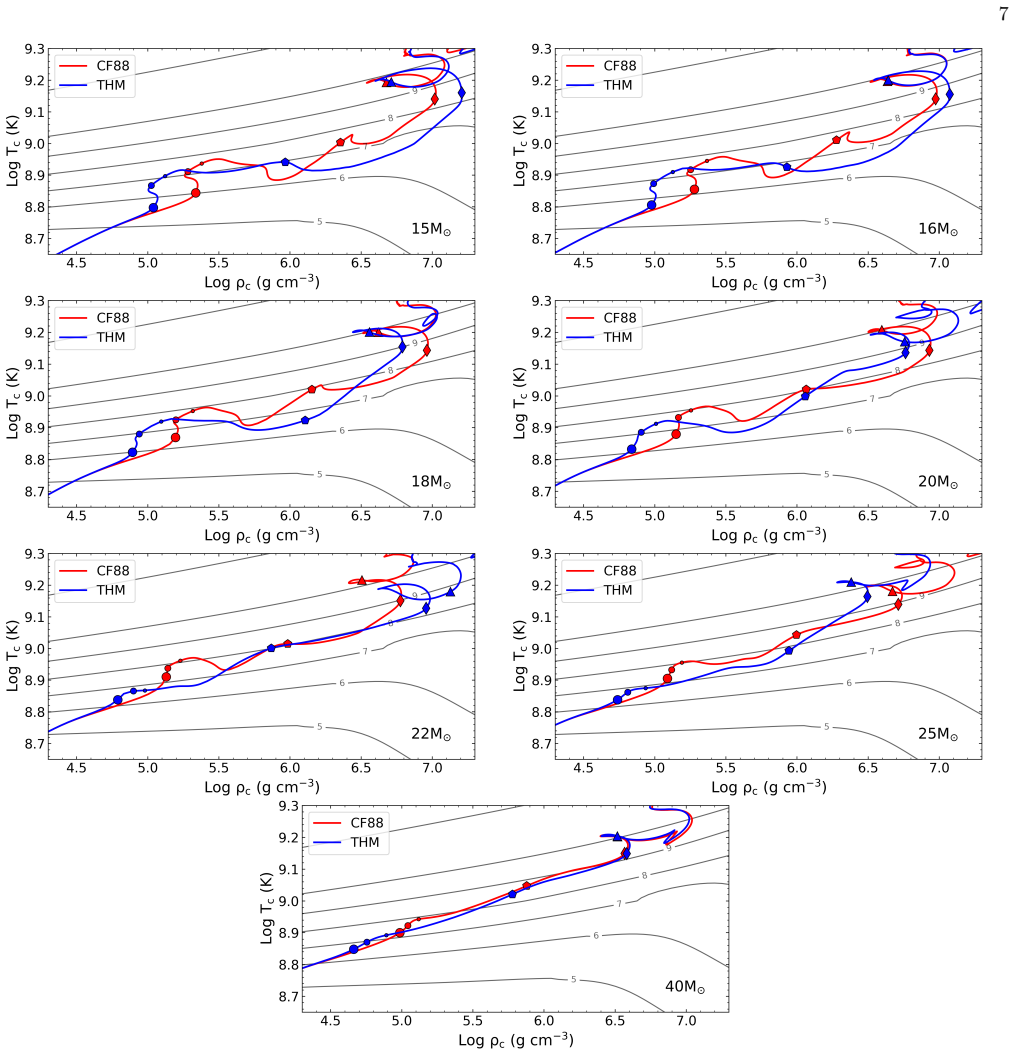
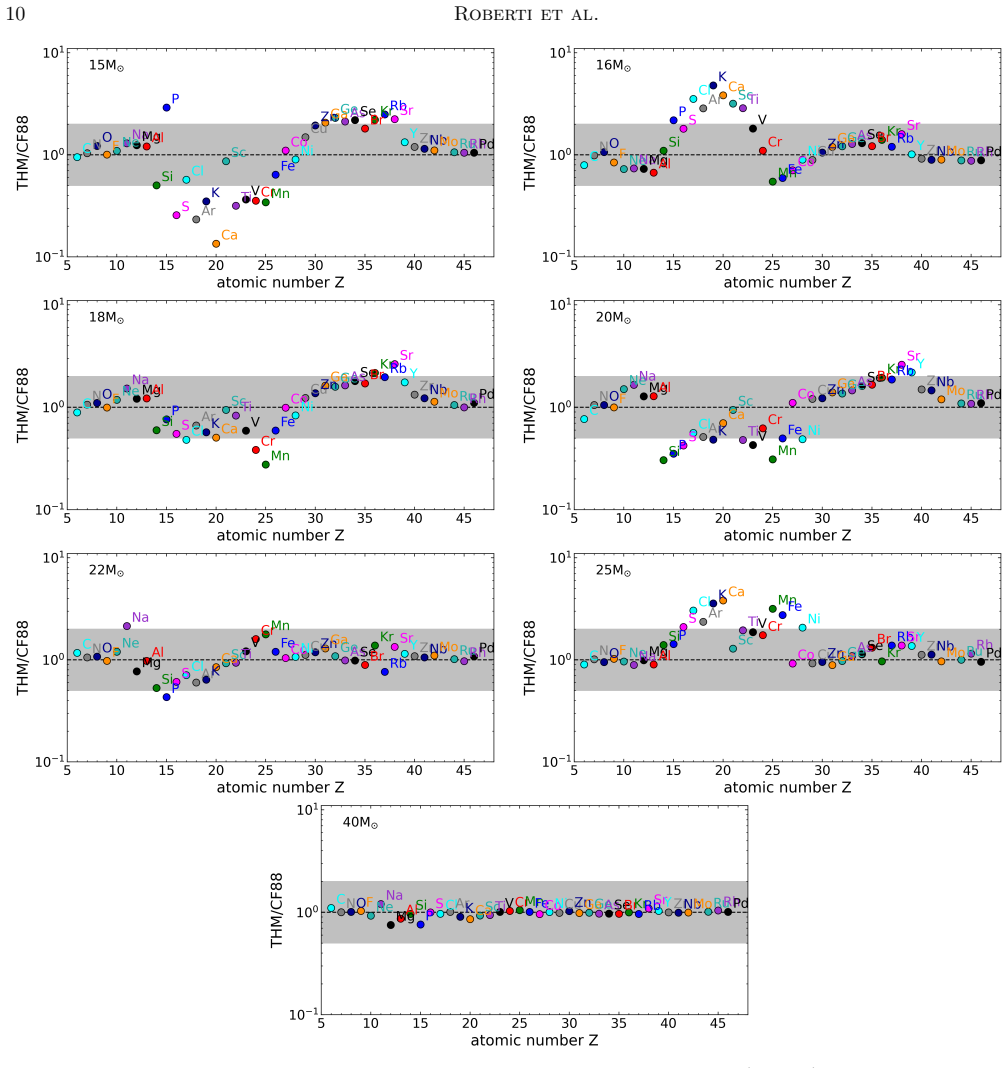
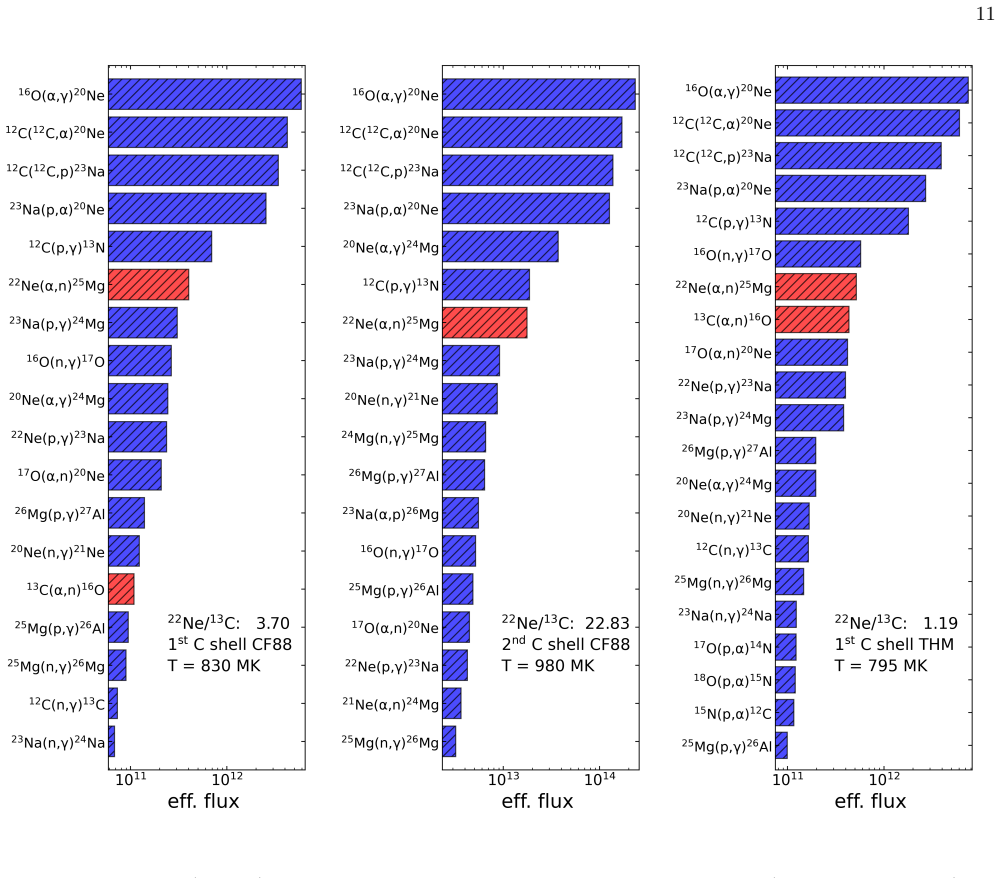
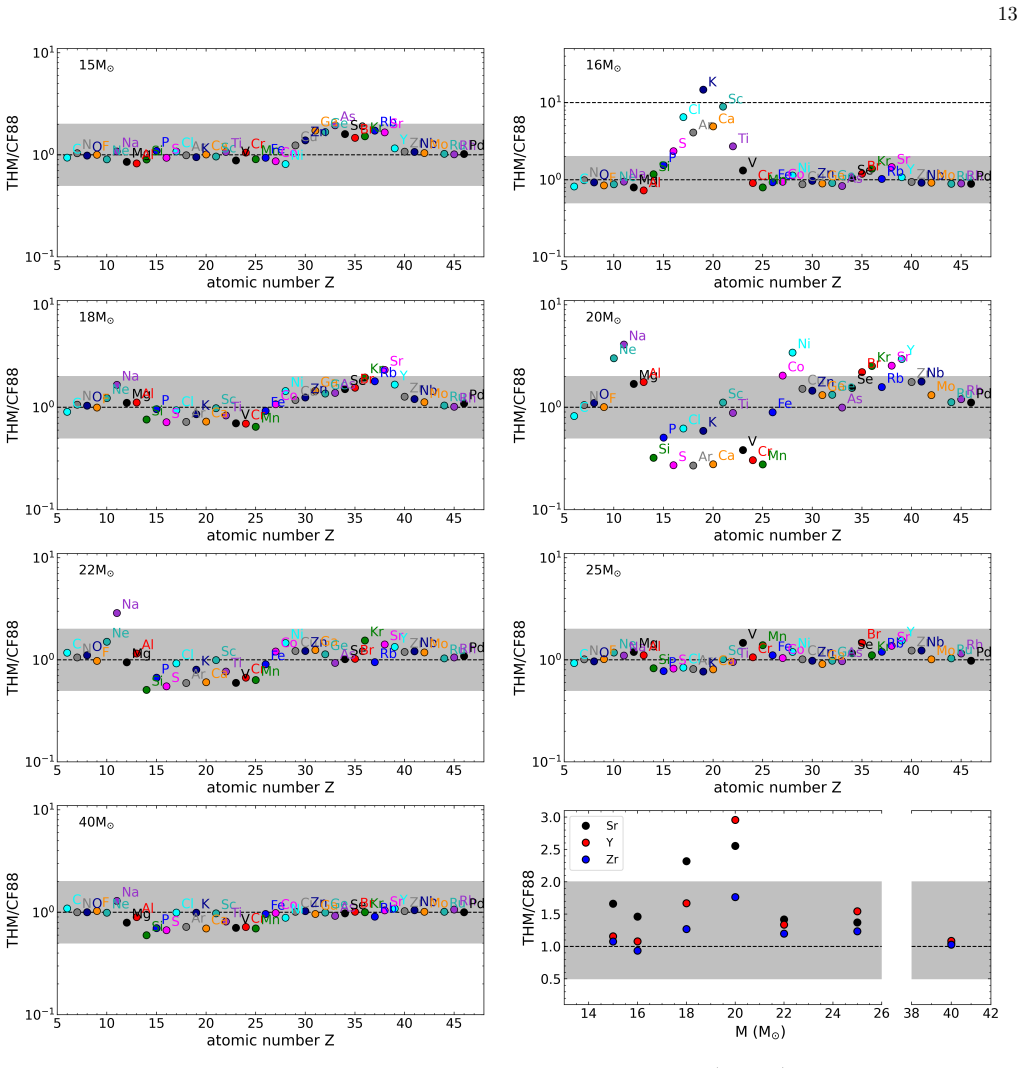
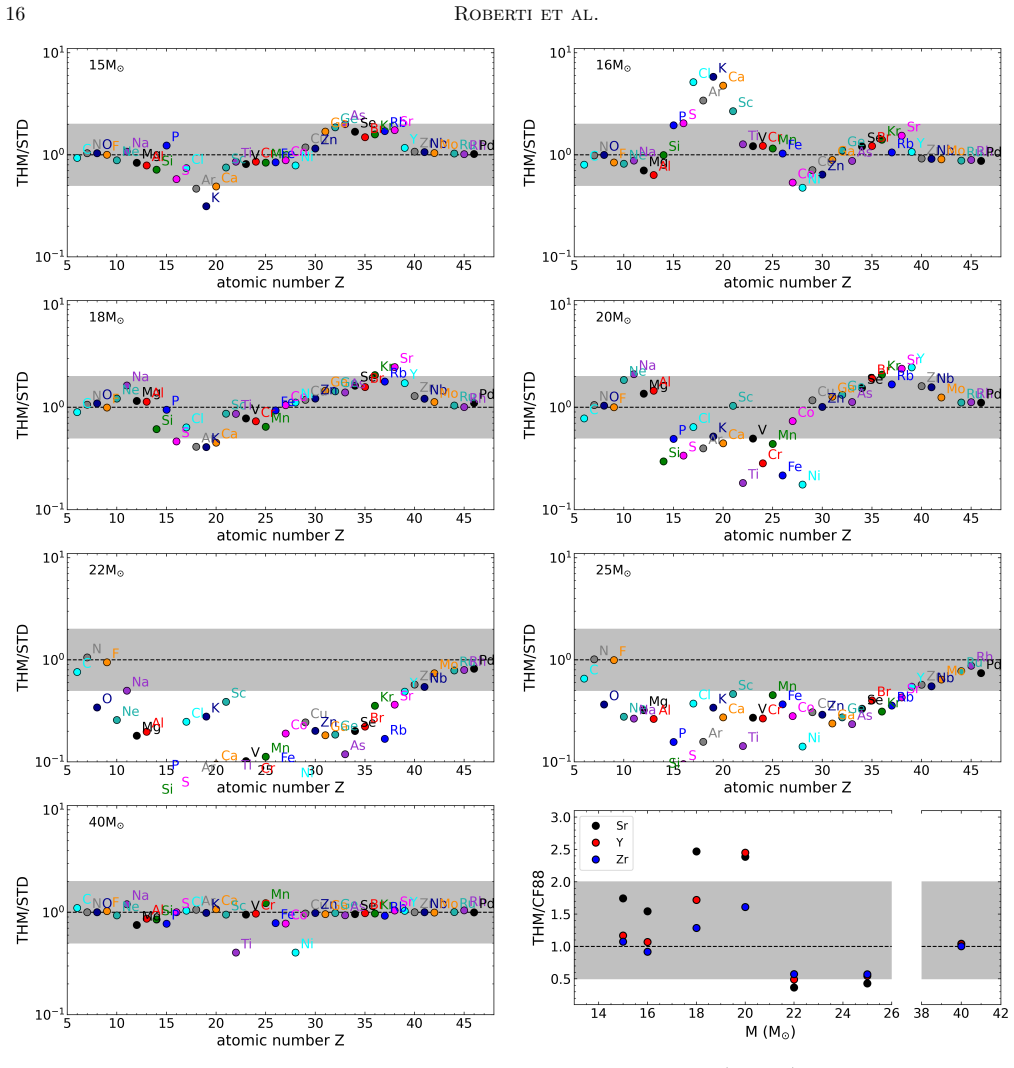
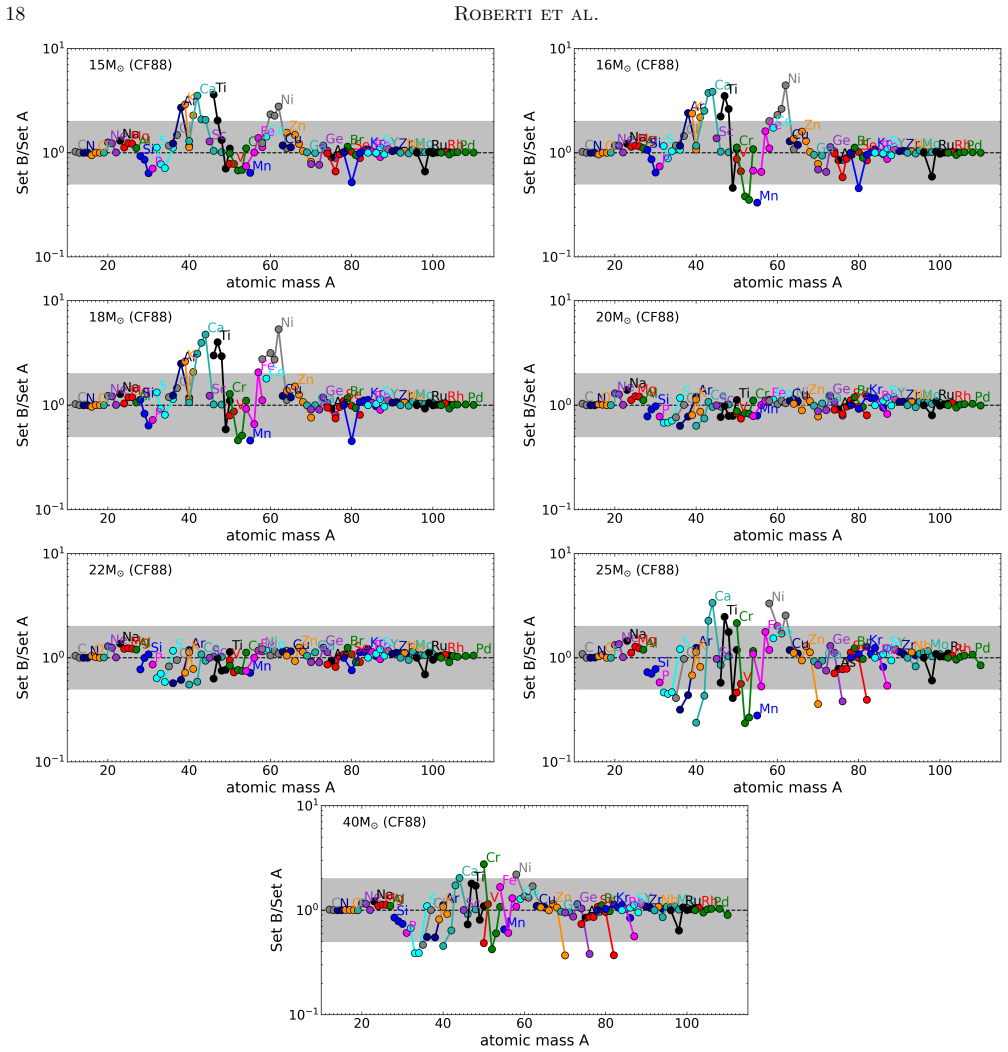
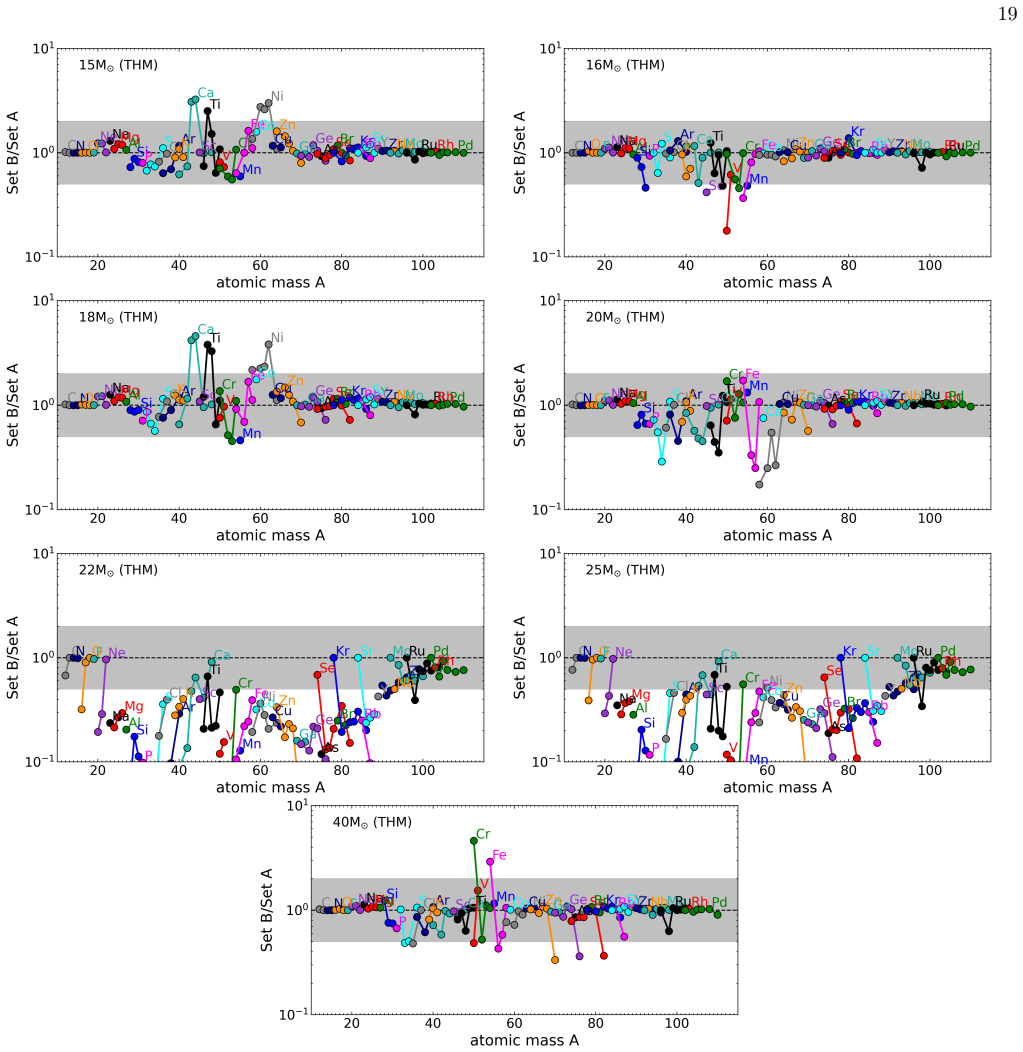
Non-rotating models at solar metallicity with initial masses of 15, 16, 18, 20, 22, 25, and 40 solar masses show that a more efficient 12C+12C rate extends the duration of the central carbon burning phase, develops more massive convective cores, and leads to a different and less compact pre-supernova structure. These structural differences significantly impact nucleosynthesis by enhancing the production of elements heavier than Fe through more efficient activation of the 13C(α,n) neutron source in the early carbon burning shells. The differences in the chemical composition of the core-collapse supernova ejecta are primarily determined by these pre-supernova structural changes, which dominate
What carries the argument
The sub-2.5 MeV 12C+12C reaction rate, which sets the length of central carbon burning and the size of convective cores and thereby controls activation of the 13C(α,n) neutron source for s-process nucleosynthesis
If this is right
- Central carbon burning lasts longer and convective cores grow more massive
- Pre-supernova structures become less compact
- s-process nucleosynthesis produces more elements heavier than Fe via stronger 13C(α,n) activation in carbon shells
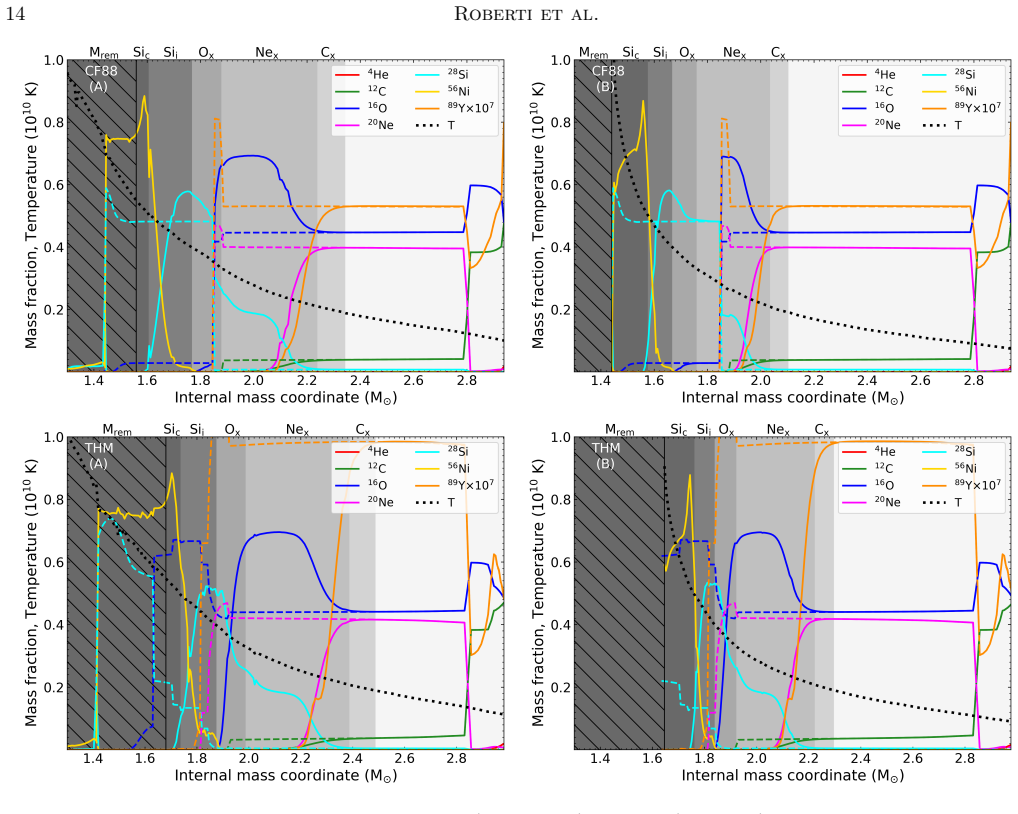
- Ejecta composition differences are driven mainly by pre-supernova structure rather than explosion details
- Yields from carbon to palladium shift, with the largest changes above iron
Where Pith is reading between the lines
- If the rate increase holds, galactic chemical evolution models would predict higher contributions from core-collapse supernovae to elements from strontium to palladium
- Abundance patterns in supernova remnants or metal-poor star atmospheres could be compared directly to the predicted yields
- The effect might change in rotating models or at low metallicity, where convective boundaries and mixing differ
Load-bearing premise
Non-rotating models at solar metallicity without rotation or extra mixing capture the dominant physics that sets convective core sizes and neutron source activation
What would settle it
A laboratory measurement or theoretical calculation showing the 12C+12C rate below 2.5 MeV is not increased, or supernova remnant abundance data showing no excess of s-process elements heavier than iron
Figures
read the original abstract
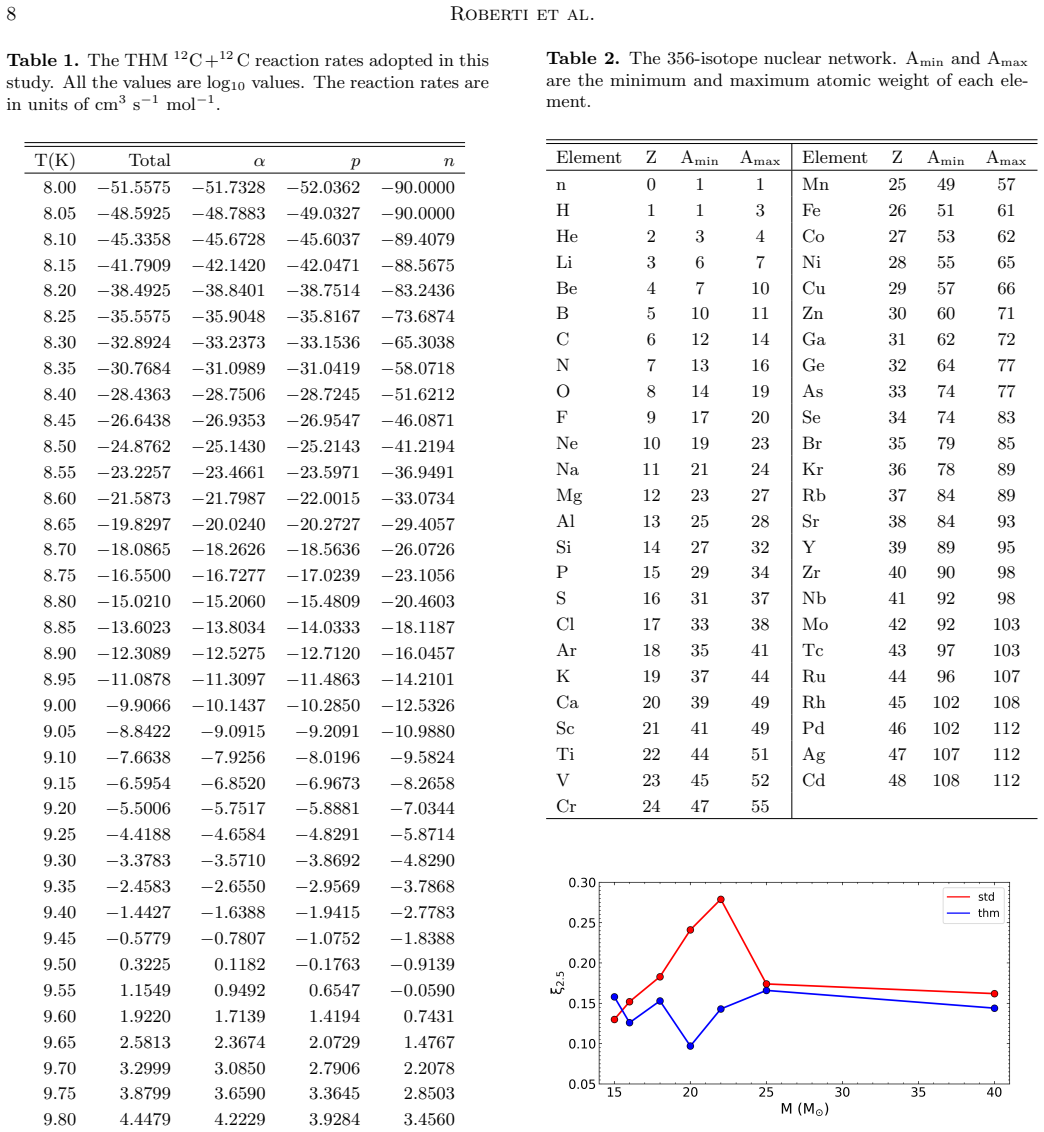
We explore the impact of a more efficient 12C+12C reaction on the structure and nucleosynthesis of massive stars. We calculate non-rotating stellar models with initial masses of 15, 16, 18, 20, 22, 25, and 40 Msun and solar metallicity by means of the FRANEC code. Furthermore, we simulate the core-collapse supernova of these models with the thermal bomb technique, using two different approaches to inject the thermal energy into the pre-supernova structure. Our results show that a more efficient 12C+12C rate extends the duration of the central carbon burning phase, developing more massive convective cores and leading to a different and less compact pre-supernova structure with respect to models calculated with a standard 12C+12C rate. These structural differences significantly impact nucleosynthesis. In particular, an increased rate enhances the production of elements heavier than Fe, produced by the s-process nucleosynthesis and driven by the more efficient activation of the 13C($\alpha$,n) neutron source in the early carbon burning shells. We find that the differences in the chemical composition of the core-collapse supernova ejecta are primarily determined by these pre-supernova structural changes, which dominate over the effects of different explosion prescriptions.
Editorial analysis
A structured set of objections, weighed in public.
Referee Report
Summary. The paper explores the impact of an enhanced 12C+12C reaction rate on the structure and nucleosynthesis of non-rotating massive stars (15-40 Msun, solar metallicity) using the FRANEC code. It finds that the enhanced rate extends carbon burning, leads to more massive convective cores and less compact pre-SN structures, enhancing s-process yields through more efficient 13C(α,n) activation in early carbon burning shells. Pre-SN structural changes dominate the differences in CCSN ejecta composition over variations in explosion prescriptions using the thermal bomb technique.
Significance. If the results hold, this demonstrates a direct computational chain from nuclear rate to pre-SN structure to s-process yields in CCSNe, with the use of multiple initial masses and two distinct thermal bomb prescriptions providing evidence that structural effects outweigh explosion variations within the modeled setup. The explicit non-rotating, solar-metallicity framework allows clear isolation of the rate effect.
minor comments (3)
- [Abstract] Abstract: the statement that pre-SN structural changes 'dominate over the effects of different explosion prescriptions' is well-supported by the two thermal bomb approaches described, but the scope is limited to non-rotating models; a sentence noting that rotation (known to affect core sizes and 13C reservoirs) is outside the present study would clarify the domain of the dominance claim without altering the central result.
- The manuscript should confirm that the 12C+12C rate enhancement factor is applied consistently across all burning phases and that no post-hoc adjustments were made to match external data; this is implied by the forward simulation approach but would benefit from explicit statement in the methods.
- Ensure all yield comparisons (e.g., elements from C to Pd) are presented with both rate cases side-by-side in tables or figures to allow direct assessment of the s-process enhancement magnitude.
Simulated Author's Rebuttal
We thank the referee for the careful review and positive recommendation for minor revision. The summary accurately reflects our main results on the effects of an enhanced 12C+12C rate on stellar structure and s-process yields in non-rotating models. No specific major comments were raised in the report.
Circularity Check
No significant circularity; forward simulations with rate as independent input
full rationale
The paper runs non-rotating FRANEC stellar models with two different 12C+12C rate inputs (standard vs. enhanced sub-2.5 MeV resonances) and compares the resulting pre-SN structures and post-explosion yields. The rate modification is an external nuclear-physics input; the structural changes (convective-core size, compactness) and consequent 13C(α,n) activation are computed outputs, not fitted or redefined quantities. No self-citation chain, ansatz smuggling, or uniqueness theorem is invoked to justify the central claim. The derivation is therefore self-contained against external nuclear data and standard stellar-evolution codes.
Axiom & Free-Parameter Ledger
free parameters (1)
- 12C+12C rate enhancement
axioms (2)
- domain assumption Non-rotating stellar models with solar metallicity accurately represent the relevant massive stars
- domain assumption Thermal bomb technique with two energy-injection approaches sufficiently approximates core-collapse supernova dynamics for nucleosynthesis purposes
Reference graph
Works this paper leans on
-
[1]
E., O'Connor, E., Andresen, H., da Silva Schneider , A., & Couch, S
Andersen, O. E., O'Connor, E., Andresen, H., da Silva Schneider , A., & Couch, S. M. 2025, The Astrophysical Journal, 980, 53, 10.3847/1538-4357/ada899
-
[2]
1999, Nuclear Physics A, 656, 3, https://doi.org/10.1016/S0375-9474(99)00030-5
Angulo, C., Arnould, M., Rayet, M., et al. 1999, Nuclear Physics A, 656, 3, https://doi.org/10.1016/S0375-9474(99)00030-5
-
[3]
Arnett , W. D., Bahcall , J. N., Kirshner , R. P., & Woosley , S. E. 1989, , 27, 629, 10.1146/annurev.aa.27.090189.003213
-
[4]
2003, , 384, 1, 10.1016/S0370-1573(03)00242-4
Arnould , M., & Goriely , S. 2003, , 384, 1, 10.1016/S0370-1573(03)00242-4
-
[5]
Asplund , M., Grevesse , N., Sauval , A. J., & Scott , P. 2009, ARA&A, 47, 481, 10.1146/annurev.astro.46.060407.145222
-
[6]
Becker , S. A., & Iben , Jr., I. 1980, , 237, 111, 10.1086/157850
-
[7]
Bennett , M. E., Hirschi , R., Pignatari , M., et al. 2012, , 420, 3047, 10.1111/j.1365-2966.2012.20193.x
-
[8]
Best, A., G\"orres, J., Couder, M., et al. 2011, Phys. Rev. C, 83, 052802, 10.1103/PhysRevC.83.052802
-
[9]
Best, A., Beard, M., G\"orres, J., et al. 2013, Phys. Rev. C, 87, 045805, 10.1103/PhysRevC.87.045805
-
[10]
2024, Physical Review D, 110, 023007, 10.1103/PhysRevD.110.023007
Boccioli, L., & Fragione, G. 2024, Physical Review D, 110, 023007, 10.1103/PhysRevD.110.023007
-
[11]
Boccioli, L., Gogilashvili, M., Murphy, J., & O'Connor, E. P. 2025 a , Monthly Notices of the Royal Astronomical Society, 537, 1182, 10.1093/mnras/staf066
-
[12]
Boccioli , L., & Roberti , L. 2025, arXiv e-prints, arXiv:2510.16365, 10.48550/arXiv.2510.16365
work page internal anchor Pith review Pith/arXiv arXiv doi:10.48550/arxiv.2510.16365 2025
-
[13]
Boccioli , L., Roberti , L., Fryer , C. L., et al. 2026, arXiv e-prints, arXiv:2603.24758, 10.48550/arXiv.2603.24758
work page internal anchor Pith review Pith/arXiv arXiv doi:10.48550/arxiv.2603.24758 2026
-
[14]
Boccioli, L., Roberti, L., Limongi, M., Mathews, G. J., & Chieffi, A. 2023, The Astrophysical Journal, 949, 17, 10.3847/1538-4357/acc06a
-
[15]
Boccioli, L., Vartanyan, D., O'Connor, E. P., & Kasen, D. 2025 b , Mon. Not. Roy. Astron. Soc., 540, 3885, 10.1093/mnras/staf963
-
[16]
Bruenn, S. W., Lentz, E. J., Hix, W. R., et al. 2016, The Astrophysical Journal, 818, 123, 10.3847/0004-637X/818/2/123
-
[17]
Bruenn, S. W., Sieverding, A., Lentz, E. J., et al. 2023, The Astrophysical Journal, 947, 35, 10.3847/1538-4357/acbb65
-
[18]
2023, The Astrophysical Journal, 957, 68, 10.3847/1538-4357/acfc1c
Burrows, A., Vartanyan, D., & Wang, T. 2023, The Astrophysical Journal, 957, 68, 10.3847/1538-4357/acfc1c
-
[19]
2024, The Astrophysical Journal, 964, L16, 10.3847/2041-8213/ad319e
Burrows, A., Wang, T., & Vartanyan, D. 2024, The Astrophysical Journal, 964, L16, 10.3847/2041-8213/ad319e
-
[20]
M., Kratz , K.-L., Palmerini , S., Akram , W., & Antonuccio-Delogu , V
Busso , M. M., Kratz , K.-L., Palmerini , S., Akram , W., & Antonuccio-Delogu , V. 2022, Frontiers in Astronomy and Space Sciences, 9, 956633, 10.3389/fspas.2022.956633
-
[21]
R., & Fowler, W
Caughlan, G. R., & Fowler, W. A. 1988, Atom.\ Data Nucl.\ Data Tables, 40, 283
1988
-
[22]
2018, The Astrophysical Journal, 852, L19, 10.3847/2041-8213/aaa28c
Chan, C., M \"u ller, B., Heger, A., Pakmor, R., & Springel, V. 2018, The Astrophysical Journal, 852, L19, 10.3847/2041-8213/aaa28c
-
[23]
1998, ApJ, 502, 737
Chieffi, A., Limongi, M., & Straniero, O. 1998, ApJ, 502, 737
1998
-
[24]
2021, , 916, 79, 10.3847/1538-4357/ac06ca
Chieffi , A., Roberti , L., Limongi , M., et al. 2021, , 916, 79, 10.3847/1538-4357/ac06ca
-
[25]
Chieffi , A., Courtin , S., deBoer , R. J., et al. 2025, European Physical Journal A, 61, 280, 10.1140/epja/s10050-025-01759-3
-
[26]
2020, Journal of Physics: Conference Series, 1668, 012006, 10.1088/1742-6596/1668/1/012006
Choplin, A., & Hirschi, R. 2020, Journal of Physics: Conference Series, 1668, 012006, 10.1088/1742-6596/1668/1/012006
-
[27]
2019, , 870, 2, 10.3847/1538-4357/aae7d2
Curtis , S., Ebinger , K., Fr \"o hlich , C., et al. 2019, , 870, 2, 10.3847/1538-4357/aae7d2
-
[28]
2025, , 702, A86, 10.1051/0004-6361/202555326
Dumont , T., Bonhomme , A., Griffiths , A., et al. 2025, , 702, A86, 10.1051/0004-6361/202555326
-
[29]
E., Sukhbold, T., & Ugliano, M
Ertl, T., Janka, H.-T., Woosley, S. E., Sukhbold, T., & Ugliano, M. 2016, The Astrophysical Journal, 818, 124, 10.3847/0004-637X/818/2/124
-
[30]
2025, , 991, 21, 10.3847/1538-4357/adfa05
Falla , A., Roberti , L., Limongi , M., & Chieffi , A. 2025, , 991, 21, 10.3847/1538-4357/adfa05
-
[31]
2016, Monthly Notices of the Royal Astronomical Society, 456, 1803, 10.1093/mnras/stv2723
Frischknecht, U., Hirschi, R., Pignatari, M., et al. 2016, Monthly Notices of the Royal Astronomical Society, 456, 1803, 10.1093/mnras/stv2723
-
[32]
2020, , 124, 192701, 10.1103/PhysRevLett.124.192701
Fruet , G., Courtin , S., Heine , M., et al. 2020, , 124, 192701, 10.1103/PhysRevLett.124.192701
-
[33]
Fynbo , H. O. U., Diget , C. A., Bergmann , U. C., et al. 2005, Nature, 433, 136
2005
-
[34]
Gasques , L. R., Brown , E. F., Chieffi , A., et al. 2007, , 76, 035802, 10.1103/PhysRevC.76.035802
-
[35]
Goldberg, J. A., Bildsten, L., & Paxton, B. 2019, The Astrophysical Journal, 879, 3, 10.3847/1538-4357/ab22b6
-
[36]
Janka, H.-T. 2025, Ann. Rev. Nucl. Part. Sci., 75, 425, 10.1146/annurev-nucl-121423-100945
-
[37]
1989, Rep
K \"a ppeler , F., Beer , H., & Wisshak , K. 1989, Rep. Prog. Phys., 52, 945
1989
-
[38]
Kasen, D., & Woosley, S. E. 2009, The Astrophysical Journal, 703, 2205, 10.1088/0004-637X/703/2/2205
-
[39]
2012, , 50, 107, 10.1146/annurev-astro-081811-125534
Langer , N. 2012, , 50, 107, 10.1146/annurev-astro-081811-125534
-
[40]
Laplace , E., Schneider , F. R. N., & Podsiadlowski , P. 2025, , 695, A71, 10.1051/0004-6361/202451077
-
[41]
2003, , 592, 404, 10.1086/375703
Limongi , M., & Chieffi , A. 2003, , 592, 404, 10.1086/375703
-
[42]
2020, The Astrophysical Journal, 902, 95, 10.3847/1538-4357/abb4e8
Limongi, M., & Chieffi, A. 2020, The Astrophysical Journal, 902, 95, 10.3847/1538-4357/abb4e8
-
[43]
2024, , 270, 29, 10.3847/1538-4365/ad12c1
Limongi , M., Roberti , L., Chieffi , A., & Nomoto , K. 2024, , 270, 29, 10.3847/1538-4365/ad12c1
-
[44]
Limongi, M. , & Chieffi, A. 2018, , 237, 13, 10.3847/1538-4365/aacb24
-
[45]
Lombardo , L., Hansen , C. J., Rizzuti , F., et al. 2025, , 693, A293, 10.1051/0004-6361/202452283
-
[46]
2022, , 660, A47, 10.1051/0004-6361/202141858
Monpribat , E., Martinet , S., Courtin , S., et al. 2022, , 660, A47, 10.1051/0004-6361/202141858
-
[47]
Nucleosynthesis in Stars and the Chemical Enrichment of Galaxies
Nomoto , K., Kobayashi , C., & Tominaga , N. 2013, , 51, 457, 10.1146/annurev-astro-082812-140956
-
[48]
O Connor, E., & Ott, C. D. 2011, The Astrophysical Journal, 730, 70, 10.1088/0004-637x/730/2/70
-
[49]
2021, , 921, 7, 10.3847/1538-4357/ac1786
Palmerini , S., Busso , M., Vescovi , D., et al. 2021, , 921, 7, 10.3847/1538-4357/ac1786
-
[50]
Pejcha, O., & Prieto, J. L. 2015, The Astrophysical Journal, 806, 225, 10.1088/0004-637X/806/2/225
-
[51]
2010, , 710, 1557, 10.1088/0004-637X/710/2/1557
Pignatari , M., Gallino , R., Heil , M., et al. 2010, , 710, 1557, 10.1088/0004-637X/710/2/1557
-
[52]
2016, International Journal of Modern Physics E, 25, 1630003, 10.1142/S0218301316300034
Pignatari , M., G \"o bel , K., Reifarth , R., & Travaglio , C. 2016, International Journal of Modern Physics E, 25, 1630003, 10.1142/S0218301316300034
-
[53]
2013, , 762, 31, 10.1088/0004-637X/762/1/31
Pignatari , M., Hirschi , R., Wiescher , M., et al. 2013, , 762, 31, 10.1088/0004-637X/762/1/31
-
[54]
2020, , 491, 1832, 10.1093/mnras/stz3154
Prantzos , N., Abia , C., Cristallo , S., Limongi , M., & Chieffi , A. 2020, , 491, 1832, 10.1093/mnras/stz3154
-
[55]
2018, , 476, 3432, 10.1093/mnras/sty316
Prantzos , N., Abia , C., Limongi , M., Chieffi , A., & Cristallo , S. 2018, , 476, 3432, 10.1093/mnras/sty316
-
[56]
2013, Reports on Progress in Physics, 76, 066201, 10.1088/0034-4885/76/6/066201
Rauscher , T., Dauphas , N., Dillmann , I., et al. 2013, Reports on Progress in Physics, 76, 066201, 10.1088/0034-4885/76/6/066201
-
[57]
2021, , 502, 2495, 10.1093/mnras/stab158
Rizzuti , F., Cescutti , G., Matteucci , F., et al. 2021, , 502, 2495, 10.1093/mnras/stab158
-
[58]
2024 a , , 272, 15, 10.3847/1538-4365/ad391d
Roberti , L., Limongi , M., & Chieffi , A. 2024 a , , 272, 15, 10.3847/1538-4365/ad391d
-
[59]
2024 b , , 270, 28, 10.3847/1538-4365/ad1686
---. 2024 b , , 270, 28, 10.3847/1538-4365/ad1686
-
[60]
2025, , 703, L15, 10.1051/0004-6361/202556941
Roberti , L., & Pignatari , M. 2025, , 703, L15, 10.1051/0004-6361/202556941
-
[61]
2024 c , , 686, L8, 10.1051/0004-6361/202449994
Roberti , L., Pignatari , M., Fryer , C., & Lugaro , M. 2024 c , , 686, L8, 10.1051/0004-6361/202449994
-
[62]
Roberti , L., Pignatari , M., Brinkman , H. E., et al. 2025, , 698, A216, 10.1051/0004-6361/202554461
-
[63]
Roberti, L. , Pignatari, M. , Psaltis, A. , et al. 2023, A&A, 677, A22, 10.1051/0004-6361/202346556
-
[64]
2007, , 98, 122501, 10.1103/PhysRevLett.98.122501
Spillane , T., Raiola , F., Rolfs , C., et al. 2007, , 98, 122501, 10.1103/PhysRevLett.98.122501
-
[65]
2016, The Astrophysical Journal, 825, 6, 10.3847/0004-637X/825/1/6
Summa, A., Hanke, F., Janka, H.-T., et al. 2016, The Astrophysical Journal, 825, 6, 10.3847/0004-637X/825/1/6
-
[66]
2025, Monthly Notices of the Royal Astronomical Society, 538, 572, 10.1093/mnras/staf317
Sykes, B., & M \"u ller, B. 2025, Monthly Notices of the Royal Astronomical Society, 538, 572, 10.1093/mnras/staf317
-
[67]
X., Woosley , S
Timmes , F. X., Woosley , S. E., & Weaver , T. A. 1996, APJ, 457, 834. http://adsabs.harvard.edu/abs/1996ApJ...457..834T
1996
-
[68]
2018, , 557, 687, 10.1038/s41586-018-0149-4
Tumino , A., Spitaleri , C., La Cognata , M., et al. 2018, , 557, 687, 10.1038/s41586-018-0149-4
-
[69]
Vartanyan, D., Burrows, A., Radice, D., Skinner, M. A., & Dolence, J. 2018, Monthly Notices of the Royal Astronomical Society, 477, 3091, 10.1093/mnras/sty809
-
[70]
E., Heger, A., & Weaver, T
Woosley, S. E., Heger, A., & Weaver, T. A. 2002, Rev.\ Mod.\ Phys., 74, 1015
2002
discussion (0)
Sign in with ORCID, Apple, or X to comment. Anyone can read and Pith papers without signing in.