Contextual Slate GLM Bandits with Limited Adaptivity
Reviewed by Pith T0 review T1 audit T2 compute T3 formal T4 kernel 2026-07-01 06:47 UTCgrok-4.3pith:VSMK4E4Mrecord.jsonopen to challenge →
The pith
Two limited-adaptivity algorithms for contextual slate GLM bandits achieve regret bounds independent of the non-linearity parameter kappa.
A machine-rendered reading of the paper's core claim, the machinery that carries it, and where it could break.
Core claim
Under a diversity assumption on the item sequences, B-SlateGLinCB and RS-SlateGLinCB achieve regret bounds of O(Nd^{3/2}√T) and O(Nd√T) respectively. Both bounds are independent of the non-linearity parameter kappa that typically scales GLM bandit regret. The algorithms remain computationally efficient, requiring only poly(N) time per round.
What carries the argument
B-SlateGLinCB and RS-SlateGLinCB, which enforce limited policy updates (O(log log T) batches or O(Nd log T) switches) using only data from prior periods.
Load-bearing premise
The sequences of presented items must satisfy a diversity assumption for the stated regret bounds to hold without scaling by kappa.
What would settle it
Empirical observation that regret scales linearly with kappa or exceeds O(Nd^{3/2}√T) when the presented item sequences lack the required diversity.
Figures


read the original abstract
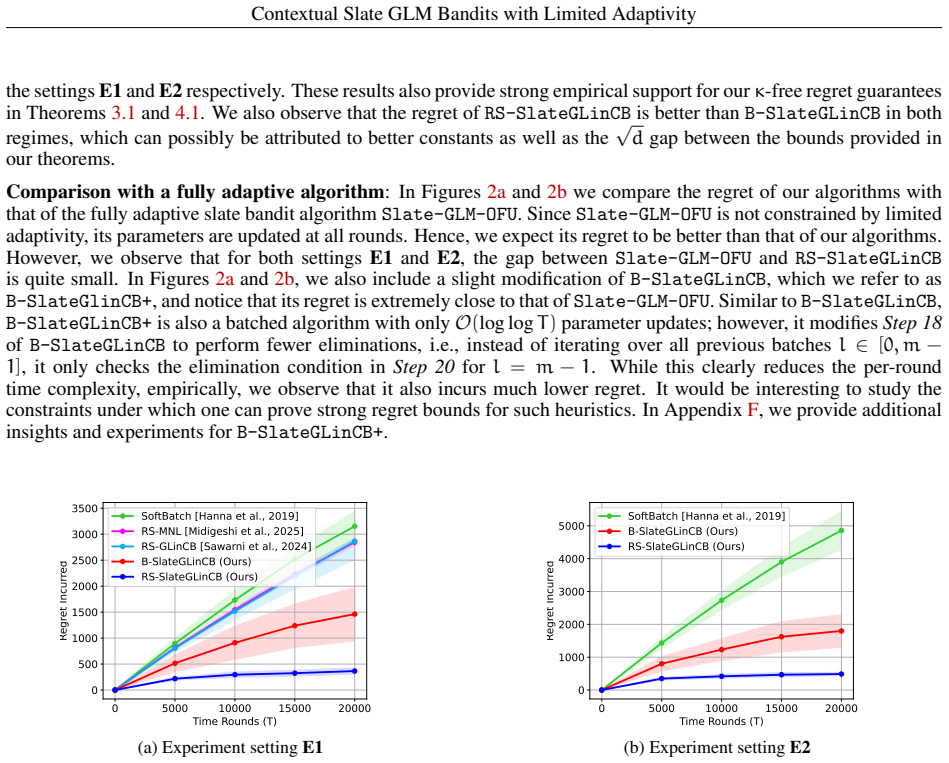
We investigate the contextual slate bandit problem with generalized linear rewards under limited adaptivity. At each round, the learner is presented with $N$ sets of items, where each item is represented by a $d$-dimensional feature vector. The learner then constructs a slate by selecting one item per set; the resulting slate yields a scalar reward sampled from a Generalized Linear Model (GLM). We propose algorithms under two limited-adaptivity settings: (a) Batched and (b) Rarely-Switching. For the batched setting, we introduce B-SlateGLinCB, which partitions the time horizon into $\mathcal{O}(\log\log T)$ batches such that each batch's policy relies only on data from previous batches. For the rarely-switching setting, we propose RS-SlateGLinCB, which adaptively performs only $\mathcal{O}(Nd\log T)$ parameter updates. Under a diversity assumption on the item sequences, we prove that B-SlateGLinCB and RS-SlateGLinCB achieve regret bounds of $\mathcal{O}(Nd^{3/2}\sqrt{T})$ and $\mathcal{O}(Nd\sqrt{T})$, respectively. Notably, both bounds are independent of the non-linearity parameter $\kappa$ that is typically found to scale the regret of GLM bandit algorithms. Our algorithms are computationally efficient, requiring only $\text{poly}(N)$ time per round despite $2^{\Omega(N)}$ possible slates. Simulations show our algorithms outperform existing baselines with limited adaptivity and remain competitive with Slate-GLM-OFU, a fully adaptive state-of-the-art algorithm. Notably, a slightly modified B-SlateGLinCB empirically matches this baseline. Finally, we demonstrate strong performance in a practical in-context example selection task for language models.
Editorial analysis
A structured set of objections, weighed in public.
Referee Report
Summary. The manuscript studies the contextual slate bandit problem with GLM rewards under limited adaptivity. It introduces B-SlateGLinCB, which uses O(log log T) batches where each batch's policy depends only on prior data, and RS-SlateGLinCB, which performs only O(Nd log T) parameter updates. Under a diversity assumption on the presented item sequences, the paper claims regret bounds of O(N d^{3/2} √T) for B-SlateGLinCB and O(N d √T) for RS-SlateGLinCB; both are independent of the GLM nonlinearity parameter κ. The algorithms run in poly(N) time per round despite an exponential number of possible slates and are evaluated in simulations and a language-model in-context example selection task.
Significance. If the regret analysis holds, the work would be a meaningful contribution by delivering limited-adaptivity algorithms for slate GLM bandits whose rates do not scale with κ, a factor that ordinarily appears through the link-function curvature. The poly(N) per-round complexity and the practical demonstration on language-model example selection are concrete strengths. The diversity assumption is presented as the mechanism that removes κ dependence, which would be a useful structural insight if rigorously established.
major comments (2)
- [Abstract] Abstract: the diversity assumption on item sequences is invoked to obtain κ-independent regret, yet its precise quantitative form (e.g., a lower bound on the minimum eigenvalue of the N feature matrices or a uniform spread condition across rounds) is not stated. This assumption is load-bearing for the central claim, because it is what purportedly supplies the eigenvalue lower bounds that absorb the GLM curvature factor and thereby eliminate κ from the final rates.
- [Theoretical analysis] Theoretical analysis (regret proofs): the stated bounds O(N d^{3/2} √T) and O(N d √T) are asserted to hold under the diversity assumption, but the provided description gives no derivation showing how the batching schedule (O(log log T) batches) or the O(Nd log T) update limit interacts with the GLM MLE estimation to preserve these rates without reintroducing a κ factor. Verification of the eigenvalue control step that absorbs the link-function derivative is required.
minor comments (1)
- [Abstract] Abstract: the per-round runtime is described only as 'poly(N)'; stating the explicit degree would help readers assess practicality.
Simulated Author's Rebuttal
We thank the referee for the careful review and constructive feedback. We address the two major comments point by point below, indicating the revisions we will make to the manuscript.
read point-by-point responses
-
Referee: [Abstract] Abstract: the diversity assumption on item sequences is invoked to obtain κ-independent regret, yet its precise quantitative form (e.g., a lower bound on the minimum eigenvalue of the N feature matrices or a uniform spread condition across rounds) is not stated. This assumption is load-bearing for the central claim, because it is what purportedly supplies the eigenvalue lower bounds that absorb the GLM curvature factor and thereby eliminate κ from the final rates.
Authors: We agree that the abstract should state the diversity assumption more explicitly, as it is central to the κ-independent bounds. In the revised manuscript we will update the abstract to read: 'Under a diversity assumption ensuring that the minimum eigenvalue of each of the N feature matrices is bounded below by a positive constant λ independent of κ and T...' This makes the quantitative form and its role in absorbing the link-function curvature clear from the outset. revision: yes
-
Referee: [Theoretical analysis] Theoretical analysis (regret proofs): the stated bounds O(N d^{3/2} √T) and O(N d √T) are asserted to hold under the diversity assumption, but the provided description gives no derivation showing how the batching schedule (O(log log T) batches) or the O(Nd log T) update limit interacts with the GLM MLE estimation to preserve these rates without reintroducing a κ factor. Verification of the eigenvalue control step that absorbs the link-function derivative is required.
Authors: The full proofs appear in the appendix and establish the claimed rates. The diversity assumption supplies a uniform lower bound λ on the eigenvalues of the N per-set Gram matrices; this bound enters the GLM MLE concentration inequality and cancels the 1/κ factor that would otherwise arise from the link-function derivative. The O(log log T) batching schedule is constructed so that each batch collects enough samples to maintain the eigenvalue lower bound while using only prior-batch data, and the O(Nd log T) update limit for the rarely-switching algorithm is chosen to keep the estimation error controlled at the same rate. If the main-text presentation is insufficiently transparent, we will add a one-paragraph high-level sketch of these steps (eigenvalue control → MLE error → regret decomposition) to Section 4 in the revision. revision: partial
Circularity Check
No circularity; regret bounds derived from diversity assumption without reduction to inputs
full rationale
The paper states algorithms B-SlateGLinCB and RS-SlateGLinCB and proves regret bounds O(Nd^{3/2}√T) and O(Nd√T) under an explicit diversity assumption on item sequences. The claimed independence from the GLM nonlinearity parameter κ is presented as a structural consequence of that assumption absorbing curvature effects in the analysis, not as a fitted quantity or self-referential definition. No equations or steps in the abstract reduce by construction to prior outputs, self-citations, or renamed empirical patterns. The derivation chain is therefore self-contained against the stated assumption, consistent with standard proof structures in bandit literature.
Axiom & Free-Parameter Ledger
axioms (1)
- domain assumption Diversity assumption on the item sequences
Reference graph
Works this paper leans on
-
[1]
Kale, Satyen and Reyzin, Lev and Schapire, Robert E , booktitle =
-
[2]
Proceedings of the Twenty-Eighth International Joint Conference on Artificial Intelligence,
Marginal Posterior Sampling for Slate Bandits , author =. Proceedings of the Twenty-Eighth International Joint Conference on Artificial Intelligence,. 2019 , month =
work page 2019
-
[3]
Algorithms for slate bandits with non-separable reward functions , doi =
Rhuggenaath, Jason and Akcay, Alp and Zhang, Yingqian and Kaymak, Uzay , year =. Algorithms for slate bandits with non-separable reward functions , doi =
-
[4]
Generalized Linear Bandits with Limited Adaptivity , volume =
Sawarni, Ayush and Das, Nirjhar and Barman, Siddharth and Sinha, Gaurav , booktitle =. Generalized Linear Bandits with Limited Adaptivity , volume =
-
[5]
The 41st Conference on Uncertainty in Artificial Intelligence , year=
Efficient Algorithms for Logistic Contextual Slate Bandits with Bandit Feedback , author=. The 41st Conference on Uncertainty in Artificial Intelligence , year=
-
[6]
Ruan, Yufei and Yang, Jiaqi and Zhou, Yuan , title =. 2021 , isbn =. doi:10.1145/3406325.3451004 , booktitle =
-
[7]
Hanna, Osama and Yang, Lin and Fragouli, Christina , booktitle =. Efficient Batched Algorithm for Contextual Linear Bandits with Large Action Space via Soft Elimination , volume =
-
[8]
Reinforcement Learning Conference , year=
Achieving Limited Adaptivity for Multinomial Logistic Bandits , author=. Reinforcement Learning Conference , year=
-
[9]
Batched Multi-armed Bandits Problem , volume =
Gao, Zijun and Han, Yanjun and Ren, Zhimei and Zhou, Zhengqing , booktitle =. Batched Multi-armed Bandits Problem , volume =
-
[10]
Parametric Bandits: The Generalized Linear Case , volume =
Filippi, Sarah and Cappe, Olivier and Garivier, Aur\'. Parametric Bandits: The Generalized Linear Case , volume =. Advances in Neural Information Processing Systems , editor =
-
[11]
The Thirty-ninth Annual Conference on Neural Information Processing Systems , year=
Generalized Linear Bandits: Almost Optimal Regret with One-Pass Update , author=. The Thirty-ninth Annual Conference on Neural Information Processing Systems , year=
-
[12]
Proceedings of The 24th International Conference on Artificial Intelligence and Statistics , pages =
Instance-Wise Minimax-Optimal Algorithms for Logistic Bandits , author =. Proceedings of The 24th International Conference on Artificial Intelligence and Statistics , pages =. 2021 , editor =
work page 2021
-
[13]
Proceedings of the 37th International Conference on Machine Learning , pages =
Improved Optimistic Algorithms for Logistic Bandits , author =. Proceedings of the 37th International Conference on Machine Learning , pages =. 2020 , editor =
work page 2020
-
[14]
Proceedings of The 25th International Conference on Artificial Intelligence and Statistics , pages =
Jointly Efficient and Optimal Algorithms for Logistic Bandits , author =. Proceedings of The 25th International Conference on Artificial Intelligence and Statistics , pages =. 2022 , editor =
work page 2022
-
[15]
Online (Multinomial) Logistic Bandit: Improved Regret and Constant Computation Cost , volume =
Zhang, Yu-Jie and Sugiyama, Masashi , booktitle =. Online (Multinomial) Logistic Bandit: Improved Regret and Constant Computation Cost , volume =
-
[16]
Proceedings of the 38th International Conference on Machine Learning , pages =
Leveraging Good Representations in Linear Contextual Bandits , author =. Proceedings of the 38th International Conference on Machine Learning , pages =. 2021 , editor =
work page 2021
- [17]
-
[18]
J. Kiefer and J. Wolfowitz , title =. The Annals of Mathematical Statistics , number =. 1959 , doi =
work page 1959
-
[19]
Proceedings of the Thirty-First AAAI Conference on Artificial Intelligence , year=
Efficient ordered combinatorial semi-bandits for whole-page recommendation , author=. Proceedings of the Thirty-First AAAI Conference on Artificial Intelligence , year=
-
[20]
Advances in Neural Information Processing Systems , pages=
Multiple-play bandits in the position-based model , author=. Advances in Neural Information Processing Systems , pages=
-
[21]
An efficient bandit algorithm for realtime multivariate optimization , author=. Proceedings of the 23rd ACM SIGKDD International Conference on Knowledge Discovery and Data Mining (KDD '17) , publisher=. 2017 , month=
work page 2017
-
[22]
Proceedings of the Web Conference 2021 (WWW '21) , year=
Automated creative optimization for e-commerce advertising , author=. Proceedings of the Web Conference 2021 (WWW '21) , year=
work page 2021
-
[23]
Advances in Neural Information Processing Systems 24 (NeurIPS) , pages =
Yasin Abbasi-Yadkori and Dávid Pál and Csaba Szepesvári , title =. Advances in Neural Information Processing Systems 24 (NeurIPS) , pages =
-
[24]
Improved Algorithms for Linear Stochastic Bandits , volume =
Abbasi-yadkori, Yasin and P\'. Improved Algorithms for Linear Stochastic Bandits , volume =. Advances in Neural Information Processing Systems , editor =
-
[25]
Proceedings of the 20th Chinese National Conference on Computational Linguistics , editor =
Liu, Zhuang and Lin, Wayne and Shi, Ya and Zhao, Jun , title =. Proceedings of the 20th Chinese National Conference on Computational Linguistics , editor =. 2021 , publisher =
work page 2021
-
[26]
Lattimore, Tor and Szepesvari, Csaba , description =
-
[27]
Nomic Embed: Training a Reproducible Long Context Text Embedder , author =. 2024 , eprint =
work page 2024
-
[28]
Proceedings of the 2013 Conference on Empirical Methods in Natural Language Processing , pages=
Recursive Deep Models for Semantic Compositionality over a Sentiment Treebank , author=. Proceedings of the 2013 Conference on Empirical Methods in Natural Language Processing , pages=. 2013 , organization=
work page 2013
-
[29]
ACM-SIAM Symposium on Discrete Algorithms , year=
On largest volume simplices and sub-determinants , author=. ACM-SIAM Symposium on Discrete Algorithms , year=
-
[30]
Geometric Algorithms and Combinatorial Optimization , author=. 2012 , publisher=
work page 2012
-
[31]
TEMPERA: Test-Time Prompting via Reinforcement Learning , author=. 2022 , eprint=
work page 2022
-
[32]
Online learning with switching costs and other adaptive adversaries , year =
Cesa-Bianchi, Nicol\`. Online learning with switching costs and other adaptive adversaries , year =. Proceedings of the 27th International Conference on Neural Information Processing Systems - Volume 1 , pages =
-
[33]
Proceedings of The 28th Conference on Learning Theory , pages =
Batched Bandit Problems , author =. Proceedings of The 28th Conference on Learning Theory , pages =. 2015 , editor =
work page 2015
-
[34]
OSOM: A simultaneously optimal algorithm for multi-armed and linear contextual bandits , author =. Proceedings of the Twenty Third International Conference on Artificial Intelligence and Statistics , pages =. 2020 , editor =
work page 2020
-
[35]
Mostly Exploration-Free Algorithms for Contextual Bandits , author=. Management Science , volume=. 2021 , publisher=
work page 2021
-
[36]
A Smoothed Analysis of the Greedy Algorithm for the Linear Contextual Bandit Problem , url =
Kannan, Sampath and Morgenstern, Jamie H and Roth, Aaron and Waggoner, Bo and Wu, Zhiwei Steven , booktitle =. A Smoothed Analysis of the Greedy Algorithm for the Linear Contextual Bandit Problem , url =
-
[37]
Proceedings of the 31st Conference On Learning Theory , pages =
The Externalities of Exploration and How Data Diversity Helps Exploitation , author =. Proceedings of the 31st Conference On Learning Theory , pages =. 2018 , editor =
work page 2018
discussion (0)
Sign in with ORCID, Apple, or X to comment. Anyone can read and Pith papers without signing in.