Functional Principal Component Analysis for Manifold-Indexed Data
Pith reviewed 2026-07-01 04:24 UTC · model grok-4.3
The pith
FPCA for scalar functions indexed by d-dimensional Riemannian manifolds achieves uniform convergence rates governed by the manifold's intrinsic dimension.
A machine-rendered reading of the paper's core claim, the machinery that carries it, and where it could break.
Core claim
Intrinsic kernel estimators for the mean and covariance functions are constructed from geodesic distances on the manifold together with a Riemannian volume-density correction. These estimators are shown to satisfy uniform convergence rates whose dependence on sampling density is governed by the intrinsic dimension d of the indexing manifold. Hilbert-Schmidt and operator-norm bounds on the estimated covariance operator follow, and spectral perturbation then yields rates for the eigenvalues and eigenfunctions. The same rates hold under both equal-weight-per-observation and equal-weight-per-subject schemes and reduce exactly to the classical one-dimensional boundary case when d equals one.
What carries the argument
Intrinsic kernel estimators that replace Euclidean distance with geodesic distance on the manifold and incorporate a Riemannian volume-density correction.
If this is right
- The sparse-to-dense transition threshold for consistent estimation scales with the intrinsic dimension d of the indexing manifold.
- When the manifold is one-dimensional the rates coincide with those of classical functional data analysis on an interval.
- The estimators remain consistent under subject-specific sampling frequencies that vary arbitrarily across observations.
- Spectral perturbation applied to the covariance-operator bounds directly supplies rates for the eigenfunctions and eigenvalues used in dimension reduction.
Where Pith is reading between the lines
- The same geometric correction could be inserted into other functional-data procedures such as functional linear regression or clustering when the domain is a manifold.
- Sampling designs for manifold-indexed experiments could be optimized by allocating more points where the volume density is low to maintain the predicted rates.
- The framework suggests that ignoring the manifold geometry and working in ambient coordinates will incur a bias whose size grows with d.
Load-bearing premise
The intrinsic kernel classes satisfy VC-type empirical-process conditions that permit uniform stochastic bounds even when the kernels are not Lipschitz.
What would settle it
Empirical convergence rates on a two-dimensional manifold that fail to exhibit the predicted slower transition from sparse to dense regimes compared with the one-dimensional case.
Figures


read the original abstract
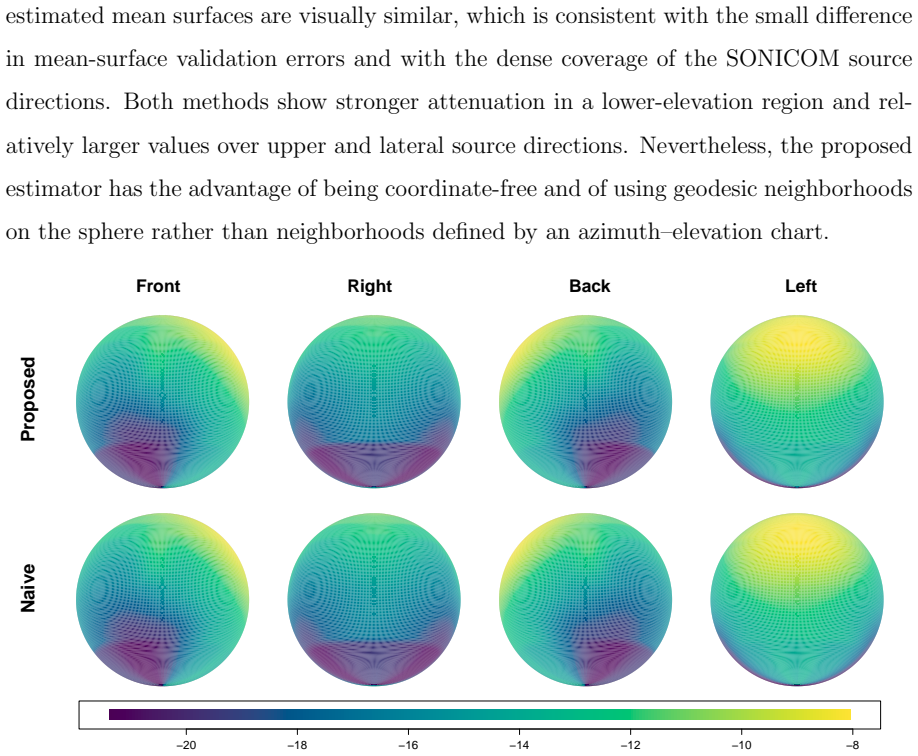
Functional principal component analysis (FPCA) is a central tool for dimension reduction and covariance analysis in functional data analysis. We study FPCA for discretely observed scalar-valued functional data indexed by a compact d-dimensional Riemannian manifold M; that is, each subject is modeled as a random function from M to R. This setting is distinct from manifold-valued functional data, where the function values themselves lie on a manifold. We develop intrinsic kernel estimators for the mean and covariance functions using geodesic distances and a Riemannian volume-density correction. The proposed framework accommodates general subject-specific sampling frequencies and includes both equal-weight-per-observation and equal-weight-per-subject schemes. The uniform stochastic analysis uses VC-type empirical-process conditions for intrinsic kernel classes, together with clustered empirical-process compatibility conditions, allowing non-Lipschitz kernels under the stated assumptions. We establish uniform convergence rates for the mean and covariance estimators, Hilbert-Schmidt and operator-norm error bounds for the estimated covariance operator, and convergence rates for eigenvalues and eigenfunctions via spectral perturbation. The rates show that the sparse-to-dense transition is governed by the intrinsic dimension of the indexing manifold, reducing to the classical one-dimensional boundary when d=1. Simulations on S^1 and S^2 and a SONICOM head-related transfer function analysis illustrate the method and show modest but consistent improvements over a coordinate-based baseline when intrinsic geometry is ignored.
Editorial analysis
A structured set of objections, weighed in public.
Referee Report
Summary. The paper develops intrinsic kernel estimators for the mean and covariance of scalar-valued functions indexed by a compact d-dimensional Riemannian manifold, using geodesic distances and Riemannian volume-density corrections. It accommodates subject-specific sampling designs with both per-observation and per-subject weighting. Under VC-type empirical-process conditions on intrinsic kernel classes and clustered empirical-process compatibility conditions (allowing non-Lipschitz kernels), the authors derive uniform convergence rates for the mean and covariance estimators, Hilbert-Schmidt and operator-norm bounds on the estimated covariance operator, and eigenvalue/eigenfunction convergence rates via spectral perturbation. These rates depend on the intrinsic dimension d and reduce to the classical one-dimensional case when d=1. The claims are illustrated by simulations on S^1 and S^2 and an application to SONICOM head-related transfer function data, showing modest gains over a coordinate-based baseline.
Significance. If the stochastic analysis holds, the work provides a geometrically intrinsic extension of FPCA to manifold-indexed functional data, with rates that correctly reflect the role of intrinsic dimension in the sparse-to-dense transition. This is a substantive advance for applications where the indexing domain has non-Euclidean geometry. The explicit treatment of both weighting schemes and the reduction to the d=1 boundary case are clear strengths.
major comments (1)
- [Assumptions and uniform stochastic analysis] Assumptions (abstract and the uniform stochastic analysis section): The clustered empirical-process compatibility conditions are asserted to enable the uniform rates and d-dependent sparse-to-dense transition for the specific geodesic-distance kernels with Riemannian correction under subject-specific sampling. However, no explicit verification or argument is supplied that these kernels satisfy the compatibility conditions when d>1. This is load-bearing for the central claims on uniform convergence, operator-norm bounds, and the dimension-dependent rates.
minor comments (2)
- [Abstract] Abstract: the phrasing 'allowing non-Lipschitz kernels under the stated assumptions' could be expanded to indicate whether the kernels are Lipschitz or not in the manifold setting.
- [Simulations] Simulations section: the comparison to the coordinate-based baseline would benefit from reporting the precise manifold dimension and sampling design used in the S^2 case to make the improvement attributable to intrinsic geometry fully transparent.
Simulated Author's Rebuttal
We thank the referee for their thorough review and for identifying this important point about the assumptions. We address the major comment below and will revise the manuscript accordingly.
read point-by-point responses
-
Referee: Assumptions (abstract and the uniform stochastic analysis section): The clustered empirical-process compatibility conditions are asserted to enable the uniform rates and d-dependent sparse-to-dense transition for the specific geodesic-distance kernels with Riemannian correction under subject-specific sampling. However, no explicit verification or argument is supplied that these kernels satisfy the compatibility conditions when d>1. This is load-bearing for the central claims on uniform convergence, operator-norm bounds, and the dimension-dependent rates.
Authors: We agree that an explicit verification for the geodesic-distance kernels with Riemannian volume-density correction is not supplied in the current manuscript and would strengthen the presentation. In the revision we will add a short dedicated paragraph (or appendix subsection) showing that these kernels satisfy the VC-type conditions and the clustered empirical-process compatibility conditions for d>1. The argument relies on the fact that, locally, the manifold is Euclidean, the geodesic distance is bi-Lipschitz in normal coordinates, and the volume-density factor is C^infty; these properties ensure that the kernel classes have polynomial covering numbers controlled by the intrinsic dimension d, exactly as required by the general theorems. The same local-chart argument also verifies the compatibility conditions under subject-specific sampling designs. We will make this verification self-contained and independent of the main convergence theorems. revision: yes
Circularity Check
No significant circularity
full rationale
The paper derives uniform convergence rates, HS/operator-norm bounds, and spectral perturbation results for eigenvalues/eigenfunctions from standard empirical-process theory applied to intrinsic kernel estimators under explicitly stated VC-type conditions and clustered compatibility assumptions. These assumptions are external inputs to the argument rather than outputs, and no equations or claims reduce by construction to fitted parameters, self-definitions, or self-citation chains. The sparse-to-dense transition governed by manifold dimension d follows directly from the perturbation analysis without circular reduction. The derivation is self-contained against external benchmarks in empirical process theory.
Axiom & Free-Parameter Ledger
axioms (1)
- domain assumption VC-type empirical-process conditions for intrinsic kernel classes together with clustered empirical-process compatibility conditions
Reference graph
Works this paper leans on
-
[1]
Bouzebda, S. and Taachouche, N. (2023). Rates of the strong uniform consistency for the kernel-type regression function estimators with general kernels on manifolds. Mathematical Methods of Statistics , 32, 27-80
work page 2023
-
[2]
Cai, T. T. and Yuan, M. (2011). Optimal estimation of the mean function based on discretely sampled functional data: Phase transition. The Annals of Statistics , 39, 2330-2355
work page 2011
-
[3]
Chavel, I. (2006). Riemannian Geometry: A Modern Introduction (2nd ed.). Cambridge University Press
work page 2006
-
[4]
Davis, C. and Kahan, W. M. (1970). The rotation of eigenvectors by a perturbation. III. SIAM Journal on Numerical Analysis , 7, 1-46
work page 1970
-
[5]
Dai, X. and M\" u ller, H.-G. (2018). Principal component analysis for functional data on Riemannian manifolds. Biometrika , 105(1), 177-190
work page 2018
-
[6]
Do Carmo, M. P. (1992). Riemannian Geometry . Birkh\"auser
work page 1992
-
[7]
Einmahl, U. and Mason, D. M. (2005). Uniform in bandwidth consistency of kernel-type function estimators. The Annals of Statistics , 33, 1380-1403
work page 2005
-
[8]
Engel, I., Daugintis, R., Vicente, T., Hogg, A. O. T., Pauwels, J., Tournier, A. J. R. and Picinali, L. (2023). The SONICOM HRTF dataset. Journal of the Audio Engineering Society , 71, 241--253
work page 2023
-
[9]
Gin \'e , E. and Nickl, R. (2016). Mathematical Foundations of Infinite-Dimensional Statistical Models. Cambridge University Press
work page 2016
-
[10]
Hall, P., M\" u ller, H.-G. and Wang, J.-L. (2006). Properties of principal component methods for functional and longitudinal data analysis. The Annals of Statistics , 34, 1493-1537
work page 2006
-
[11]
Jeon, J. M., Park, B. U. and Van Keilegom, I. (2021). Additive regression for non-Euclidean responses and predictors. Annals of Statistics , 49, 2611-2641
work page 2021
-
[12]
Li, Y. and Hsing, T. (2010). Uniform convergence rates for nonparametric regression and principal component analysis in functional data. The Annals of Statistics , 38, 3321-3351
work page 2010
-
[13]
Lin, Z. and Yao, F. (2019). Intrinsic Riemannian functional data analysis. Annals of Statistics , 47, 3533-3577
work page 2019
-
[14]
Nolan, D. and Pollard, D. (1987). U-processes: Rates of convergence. The Annals of Statistics , 15, 780-799
work page 1987
-
[15]
Pelletier, B. (2005). Kernel density estimation on Riemannian manifolds. Statistics and Probability Letters , 73, 297-304
work page 2005
-
[16]
Pelletier, B. (2006). Non-parametric regression estimation on closed Riemannian manifolds. Journal of Nonparametric Statistics , 18, 57-67
work page 2006
-
[17]
Ramsay, J. O. and Silverman, B. W. (2005). Functional Data Analysis . Springer
work page 2005
-
[18]
Shao, L., Lin, Z. and Yao, F. (2022). Intrinsic Riemannian functional data analysis for sparse longitudinal observations. Annals of Statistics , 50, 1696-1721
work page 2022
-
[19]
van der Vaart, A. and Wellner, J. A. (1996). Weak Convergence and Empirical Processes: With Applications to Statistics . Springer
work page 1996
-
[20]
Yao, F., M\" u ller, H.-G. and Wang, J.-L. (2005). Functional data analysis for sparse longitudinal data. Journal of the American Statistical Association , 100, 577-590
work page 2005
-
[21]
Zhang, X. and Wang, J.-L. (2016). From sparse to dense functional data and beyond. The Annals of Statistics , 44, 2281-2321
work page 2016
discussion (0)
Sign in with ORCID, Apple, or X to comment. Anyone can read and Pith papers without signing in.