Antenna Orientation Optimization for Rotatable Antenna-Enabled ISAC Systems
Pith reviewed 2026-07-03 22:11 UTC · model grok-4.3
The pith
Rotatable antennas at the base station can be oriented to maximize minimum sensing echo power in ISAC systems while satisfying user communication rates.
A machine-rendered reading of the paper's core claim, the machinery that carries it, and where it could break.
Core claim
The paper shows that by allowing individual rotation of each antenna in the array, the ISAC system gains extra degrees of freedom that can be exploited through joint optimization of orientations and signals to achieve higher sensing performance under communication constraints, with a closed-form solution available when users and targets are in the far field.
What carries the argument
Alternating optimization of transmit beamforming, probing signal covariance matrix, and individual RA pointing vectors.
If this is right
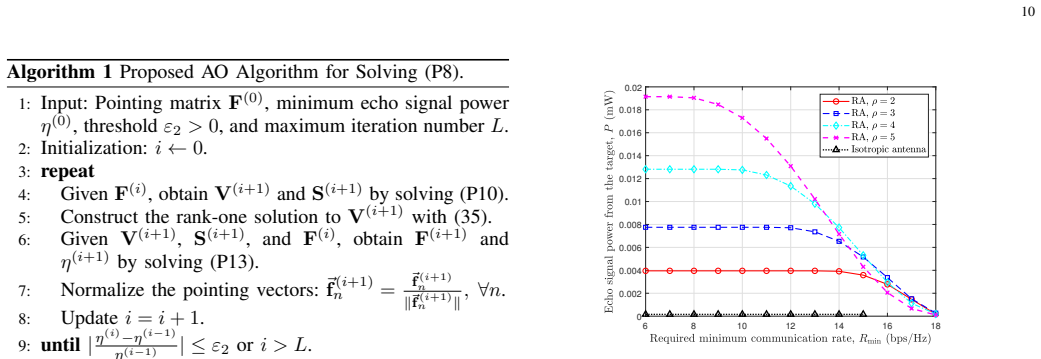
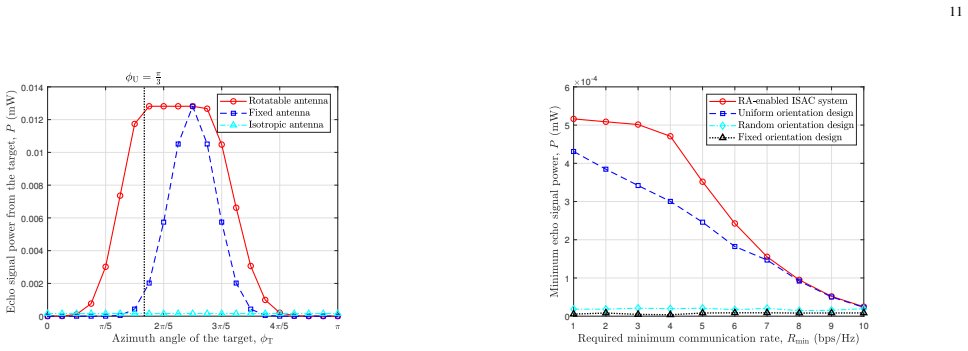
- Simulation results show significantly higher minimum echo signal power than benchmark schemes.
- The closed-form solution provides optimal identical orientations for far-field single-user point-target cases.
- The AO algorithm converges to better solutions than array-wise rotation optimization.
Where Pith is reading between the lines
- Similar optimization could apply to other flexible antenna architectures like movable antennas.
- Performance gains might diminish in near-field scenarios where the far-field assumption fails.
- Extending to dynamic targets or mobile users would require additional tracking mechanisms.
Load-bearing premise
The communication user and sensing target lie in the far-field region, which allows the optimal antenna orientations to be identical and admits a closed-form solution.
What would settle it
A simulation or measurement in the near-field region where the derived closed-form pointing vector fails to maximize the minimum echo power.
Figures




read the original abstract
Non-fixed flexible antenna architectures, such as fluid antenna system (FAS), movable antenna (MA), and pinching antenna, have garnered significant interest in recent years. In this paper, we deploy a rotatable antenna (RA) array at the base station (BS) to improve the integrated sensing and communication (ISAC) performance by exploiting the additional spatial degrees of freedom (DoFs) introduced by antenna rotation. To enhance the sensing performance over an extended region containing a potential target while meeting the communication requirements of multiple users, we aim to maximize the minimum echo signal power within the sensing region, subject to required minimum communication rates of the users. For the special case of a single user and a point target, we show that the optimal orientation of all RAs is identical when both the communication user and the sensing target are located in the far-field region, and then derive a closed-form solution for the optimal RA pointing vector. For the general multi-user and extended-target case, we propose an alternating optimization (AO) algorithm that alternately optimizes the transmit beamforming for communication, the covariance matrix of the probing signal, and the pointing vectors of the RAs in an iterative manner. Simulation results demonstrate that the proposed RA-enabled ISAC system can significantly outperform various benchmark schemes, including systems with array-wise rotation optimization and fixed antenna orientation.
Editorial analysis
A structured set of objections, weighed in public.
Referee Report
Summary. The manuscript presents an approach to optimize the orientation of rotatable antennas (RAs) in an ISAC system at the base station. The goal is to maximize the minimum echo signal power in a sensing region subject to communication rate constraints for multiple users. For the special case of single user and point target in the far-field, all RAs have the same optimal orientation, for which a closed-form solution is derived. For the general case, an alternating optimization algorithm is proposed that iterates over transmit beamforming, probing signal covariance matrix, and RA pointing vectors. Simulation results show that the proposed system outperforms benchmarks including array-wise rotation optimization and fixed antenna orientation.
Significance. If valid, the paper demonstrates the value of antenna rotation as an additional degree of freedom in ISAC systems, providing both a closed-form solution in a special case and a practical AO algorithm for the general case. The simulation results supporting outperformance over several benchmarks add to the evidence for the benefits of flexible antenna architectures. The derivation under standard far-field assumptions aligns with existing literature without introducing circularity.
minor comments (3)
- [Abstract] Consider including quantitative performance improvements (e.g., percentage gains in echo power) in the abstract to better highlight the results.
- [Simulation Results] The figures would benefit from error bars or multiple Monte Carlo runs to indicate variability in the reported outperformance.
- Check for consistent use of notation for the pointing vectors and channel models throughout the paper.
Simulated Author's Rebuttal
We thank the referee for the positive assessment of the manuscript, the accurate summary of its contributions, and the recommendation for minor revision. No major comments were provided in the report.
Circularity Check
No significant circularity detected
full rationale
The paper derives a closed-form solution for the single-user point-target case from the standard far-field assumption and proposes an alternating optimization algorithm for the general case using conventional convex optimization steps on beamforming and covariance matrices. No load-bearing step reduces by construction to a fitted parameter, self-defined quantity, or self-citation chain; the simulation outperformance claims rest on external benchmarks rather than internal redefinitions. The derivation chain is self-contained against standard ISAC channel models.
Axiom & Free-Parameter Ledger
axioms (1)
- domain assumption Far-field approximation holds for user and target locations in the special case
Reference graph
Works this paper leans on
-
[1]
Integrated sensing and communications: Toward dual-functional wire- less networks for 6G and beyond,
F. Liu, Y . Cui, C. Masouros, J. Xu, T. X. Han, Y . C. Eldar, and S. Buzzi, “Integrated sensing and communications: Toward dual-functional wire- less networks for 6G and beyond,”IEEE J. Sel. Areas Commun., vol. 40, no. 6, pp. 1728–1767, Jun. 2022
work page 2022
-
[2]
M. Z. Chowdhury, M. Shahjalal, S. Ahmed, and Y . M. Jang, “6G wire- less communication systems: Applications, requirements, technologies, challenges, and research directions,”IEEE Open J. Commun. Soc., vol. 1, pp. 957–975, Aug. 2020
work page 2020
-
[3]
A vision of 6G wireless systems: Applications, trends, technologies, and open research problems,
W. Saad, M. Bennis, and M. Chen, “A vision of 6G wireless systems: Applications, trends, technologies, and open research problems,”IEEE Network, vol. 34, no. 3, pp. 134–142, May 2020
work page 2020
-
[4]
A survey on fundamental limits of integrated sensing and communication,
A. Liu, Z. Huang, M. Liet al., “A survey on fundamental limits of integrated sensing and communication,”IEEE Commun. Surveys Tuts., vol. 24, no. 2, pp. 994–1034, 2nd Quart., 2022
work page 2022
-
[5]
MIMO integrated sensing and commu- nication: CRB-rate tradeoff,
H. Hua, T. X. Han, and J. Xu, “MIMO integrated sensing and commu- nication: CRB-rate tradeoff,”IEEE Trans. Wireless Commun., vol. 23, no. 4, pp. 2839–2854, Apr. 2024
work page 2024
-
[6]
W. K. New, K.-K. Wong, H. Xuet al., “A tutorial on fluid antenna system for 6G networks: Encompassing communication theory, optimization methods and hardware designs,”IEEE Commun. Surveys Tuts., vol. 27, no. 4, pp. 2325–2377, Aug. 2025
work page 2025
-
[7]
Movable antennas for wireless commu- nication: Opportunities and challenges,
L. Zhu, W. Ma, and R. Zhang, “Movable antennas for wireless commu- nication: Opportunities and challenges,”IEEE Commun. Mag., vol. 62, no. 6, pp. 114–120, Jun. 2024
work page 2024
-
[8]
X. Shao, W. Mei, C. Youet al., “A tutorial on six-dimensional mov- able antenna for 6G networks: Synergizing positionable and rotatable antennas,”IEEE Commun. Surveys Tuts., vol. 28, pp. 3666–3709, Aug. 2025
work page 2025
-
[9]
Rotatable antenna enabled wireless communication and sensing: Opportunities and challenges,
B. Zheng, T. Ma, C. You, J. Tang, R. Schober, and R. Zhang, “Rotatable antenna enabled wireless communication and sensing: Opportunities and challenges,”IEEE Wireless Commun., Early Access, Oct. 2025
work page 2025
-
[10]
Fluid antenna-assisted ISAC systems,
L. Zhou, J. Yao, M. Jin, T. Wu, and K.-K. Wong, “Fluid antenna-assisted ISAC systems,”IEEE Wireless Commun. Lett., vol. 13, no. 12, pp. 3533– 3537, Dec. 2024
work page 2024
-
[11]
Fluid antenna system liberating multiuser MIMO for ISAC via deep reinforcement learning,
C. Wang, G. Li, H. Zhang, K.-K. Wong, Z. Li, D. W. K. Ng, and C.-B. Chae, “Fluid antenna system liberating multiuser MIMO for ISAC via deep reinforcement learning,”IEEE Trans. Wireless Commun., vol. 23, no. 9, pp. 10 879–10 894, Sep. 2024
work page 2024
-
[12]
L. Chen, M.-M. Zhao, M.-J. Zhao, and R. Zhang, “Antenna position and beamforming optimization for movable antenna enabled ISAC: Optimal solutions and efficient algorithms,”IEEE Trans. Signal Process., vol. 73, Jul. 2025
work page 2025
-
[13]
Movable antenna- aided near-field integrated sensing and communication,
J. Ding, Z. Zhou, X. Shao, B. Jiao, and R. Zhang, “Movable antenna- aided near-field integrated sensing and communication,”IEEE Trans. Wireless Commun., vol. 25, pp. 493–508, 2026
work page 2026
-
[14]
Movable antenna enhanced wireless sensing via antenna position optimization,
W. Ma, L. Zhu, and R. Zhang, “Movable antenna enhanced wireless sensing via antenna position optimization,”IEEE Trans. Wireless Com- mun., vol. 23, no. 11, pp. 16 575–16 589, Nov. 2024
work page 2024
-
[15]
Movable-antenna array empowered ISAC systems for low-altitude economy,
Z. Kuang, W. Liu, C. Wang, Z. Jin, J. Ren, X. Zhang, and Y . Shen, “Movable-antenna array empowered ISAC systems for low-altitude economy,” inProc. IEEE/CIC Int. Conf. Commun. China (ICCC Work- shops), Hangzhou, China, Aug. 2024, pp. 776–781
work page 2024
-
[16]
Exploiting six-dimensional mov- able antenna for wireless sensing,
X. Shao, R. Zhang, and R. Schober, “Exploiting six-dimensional mov- able antenna for wireless sensing,”IEEE Wireless Commun. Lett., vol. 14, no. 2, pp. 265–269, Feb. 2025
work page 2025
-
[17]
P. Wang, Y . Xue, W. Mei, J. Fang, and R. Zhang, “UA V-enabled passive 6D movable antenna for ISAC: Joint location, orientation, and reflection optimization,”IEEE Wireless Commun. Lett., vol. 14, no. 12, pp. 3982– 3986, Dec. 2025
work page 2025
-
[18]
X. Shao and R. Zhang, “6DMA enhanced wireless network with flexible antenna position and rotation: Opportunities and challenges,”IEEE Commun. Mag., vol. 63, no. 4, pp. 121–128, Apr. 2025
work page 2025
-
[19]
Modeling and optimization for rotatable antenna enabled wireless communication,
Q. Wu, B. Zheng, T. Ma, and R. Zhang, “Modeling and optimization for rotatable antenna enabled wireless communication,” inProc. IEEE Int. Conf. Commun. (ICC), Montreal, Canada, Jun. 2025, pp. 1055–1060
work page 2025
-
[20]
Rotatable antenna enabled wireless communication: Modeling and optimization,
B. Zheng, Q. Wu, T. Ma, and R. Zhang, “Rotatable antenna enabled wireless communication: Modeling and optimization,”IEEE Trans. Commun., vol. 74, pp. 6825–6842, Mar. 2026
work page 2026
-
[21]
Rotatable antenna-empowered wireless networks: A tutorial,
B. Zheng, Q. Wu, X. Xionget al., “Rotatable antenna-empowered wireless networks: A tutorial,”arXiv preprint arXiv:2603.25559, Mar. 2026
-
[22]
Ro- tatable antenna-enabled secure wireless communication,
L. Dai, B. Zheng, Q. Wu, C. You, R. Schober, and R. Zhang, “Ro- tatable antenna-enabled secure wireless communication,”IEEE Wireless Commun. Lett., vol. 14, no. 11, pp. 3440–3444, Nov. 2025
work page 2025
-
[23]
Rotatable antenna enabled spectrum sharing: Joint antenna orientation and beam- forming design,
X. Peng, Q. Wu, Z. Zheng, W. Chen, Y . Zhu, and Y . Gao, “Rotatable antenna enabled spectrum sharing: Joint antenna orientation and beam- forming design,”IEEE Trans. Wireless Commun., vol. 25, pp. 15 660– 15 674, Apr. 2026
work page 2026
-
[24]
Ro- tatable antenna-enabled spectrum sharing in cognitive radio systems,
Y . Tan, B. Zheng, Y . Fang, D. W. Kwan Ng, J. Xu, and R. Zhang, “Ro- tatable antenna-enabled spectrum sharing in cognitive radio systems,” IEEE Wireless Commun. Lett., vol. 15, pp. 1732–1736, Jan. 2026
work page 2026
-
[25]
Rotatable Antenna-Enhanced Cell-Free Communication
K. Pan, B. Zheng, Y . Tan, E. Bj ¨ornson, R. Schober, and R. Zhang, “Rotatable antenna-enhanced cell-free communication,”arXiv preprint arXiv:2512.04742, 2025
work page internal anchor Pith review Pith/arXiv arXiv 2025
-
[26]
Cell-Free MIMO with Rotatable Antennas: When Macro-Diversity Meets Antenna Directivity
X. Peng, Q. Wu, Z. Zheng, Y . Zhu, W. Chen, P. Huang, Y . Gao, and H. Wang, “Cell-free MIMO with rotatable antennas: When macro- diversity meets antenna directivity,”arXiv preprint arXiv:2601.16543, May 2026
work page internal anchor Pith review Pith/arXiv arXiv 2026
-
[27]
Rotatable antenna enhanced integrated sensing and communication,
Q. Wu, B. Zheng, C. You, and J. Tang, “Rotatable antenna enhanced integrated sensing and communication,” inProc. IEEE GLOBECOM Workshops (GC Wkshps), Taipei, Taiwan, Dec. 2025, pp. 1–6
work page 2025
-
[28]
X. Xiong, B. Zheng, W. Wu, W. Zhu, M. Wen, S. Lin, and Y . Zeng, “Intelligent rotatable antenna for integrated sensing, communication, and computation: Challenges and opportunities,”IEEE Wireless Commun., vol. 33, no. 1, pp. 173–180, 2026
work page 2026
-
[29]
Rotatable antennas for integrated sensing and communications,
C. Zhou, C. You, B. Zheng, X. Shao, and R. Zhang, “Rotatable antennas for integrated sensing and communications,”IEEE Wireless Commun. Lett., vol. 14, no. 9, pp. 2838–2842, Sep. 2025
work page 2025
-
[30]
Rotatable antennas for near-field integrated sensing and communication,
Y . Zhang, H. C. So, D. Niyato, and C. Masouros, “Rotatable antennas for near-field integrated sensing and communication,”IEEE Trans. Wireless Commun., vol. 25, pp. 10 986–11 001, Jan. 2026
work page 2026
-
[31]
Rotatable array-enabled multi-bs cooperative ISAC transmit beampattern design,
K. Qu, H. Li, C. Sun, W. Zhang, S. Guo, and H. Zhang, “Rotatable array-enabled multi-bs cooperative ISAC transmit beampattern design,” IEEE Trans. V eh. Technol., vol. 74, no. 9, pp. 14 775–14 780, Sep. 2025
work page 2025
-
[32]
C. A. Balanis,Antenna Theory: Analysis and Design. John wiley & sons, 2015
work page 2015
-
[33]
Efficient channel estimation for rotatable antenna-enabled wireless communication,
X. Xiong, B. Zheng, W. Wu, X. Shao, L. Dai, M.-M. Zhao, and J. Tang, “Efficient channel estimation for rotatable antenna-enabled wireless communication,”IEEE Wireless Commun. Lett., vol. 14, no. 11, pp. 3719–3723, Nov. 2025
work page 2025
-
[34]
S. Boyd and L. Vandenberghe,Convex Optimization. Cambridge, U.K.: Cambridge Univ. Press, 2004
work page 2004
-
[35]
Quaternions, interpolation and animation,
E. B. Dam, M. Koch, and M. Lillholm, “Quaternions, interpolation and animation,” 1998
work page 1998
-
[36]
Joint transmit beamforming for multiuser MIMO communications and MIMO radar,
X. Liu, T. Huang, N. Shlezinger, Y . Liu, J. Zhou, and Y . C. Eldar, “Joint transmit beamforming for multiuser MIMO communications and MIMO radar,”IEEE Trans. Signal Process., vol. 68, pp. 3929–3944, Jul. 2020
work page 2020
-
[37]
R. A. Horn and C. R. Johnson,Matrix Analysis. Cambridge, U.K.: Cambridge Univ. Press, 1985
work page 1985
-
[38]
Convex optimization: Algorithms and complexity,
S. Bubeck, “Convex optimization: Algorithms and complexity,”F ound. Trends Mach. Learn., vol. 8, no. 3-4, pp. 231–357, 2015
work page 2015
discussion (0)
Sign in with ORCID, Apple, or X to comment. Anyone can read and Pith papers without signing in.