Activated dynamics in the quantum random field Ising model
Pith reviewed 2026-07-01 02:55 UTC · model grok-4.3
The pith
The zero-temperature fixed point of the classical random-field Ising model controls the quantum dynamics, producing activated scaling ln τ ∼ ξ^Ψ.
A machine-rendered reading of the paper's core claim, the machinery that carries it, and where it could break.
Core claim
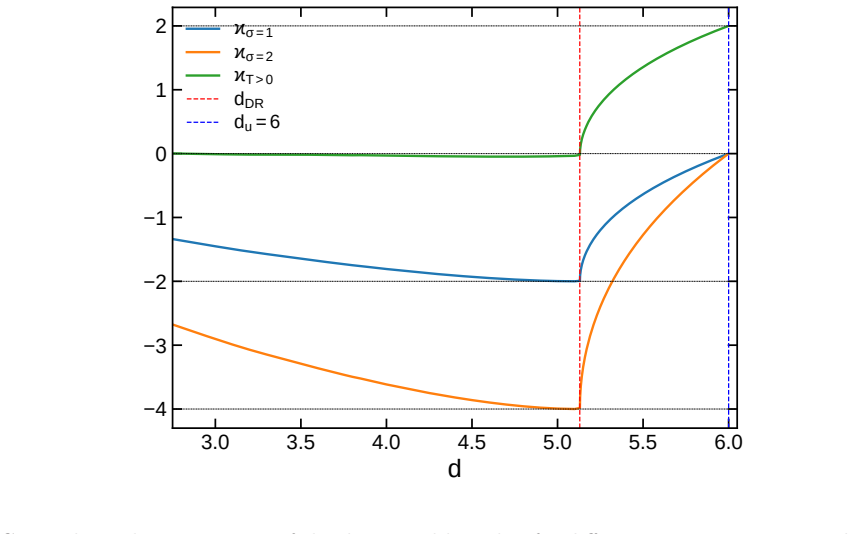
The static critical behavior is controlled by the zero-temperature fixed point of the classical random-field Ising model, where both thermal and quantum fluctuations are dangerously irrelevant. Considering a family of quantum dynamical universality classes defined by a bare dynamical kernel F_Λ(ω)∼|ω|^σ, the full Matsubara-frequency dependence of the running dynamical kernel F_k(ω) is computed; retaining this dependence together with an adapted regulator produces a controlled flow at all length scales. The resulting dynamics is of activated form, with a relaxation time given by ln τ ∼ ξ^Ψ, where the exponent Ψ is determined by the static RFIM fixed-point exponents and by σ. At finite tempera
What carries the argument
The nonperturbative functional renormalization group flow equation for the full Matsubara-frequency-dependent dynamical kernel F_k(ω), which carries the mapping from the fluctuationless static fixed point to activated quantum dynamics.
If this is right
- The exponent Ψ is fixed by the static random-field Ising model fixed-point exponents together with the bare kernel exponent σ.
- At any nonzero temperature the renormalization-group flow crosses over to the classical thermally activated scaling of the random-field Ising model.
- The same framework applies to the dynamics of other disordered quantum systems that display similar tentative localization-like singularities in naive treatments.
- A quantitative field-theoretic realization is obtained for the heuristic activation scenario previously proposed for the quantum random-field model.
Where Pith is reading between the lines
- The same frequency-dependent kernel treatment could be applied to compute explicit numerical values of Ψ for concrete choices of σ and compare them with simulations.
- Naive truncations that drop frequency dependence may generically produce spurious localization in other quantum disordered models; the controlled flow here indicates that such singularities are often artifacts of the approximation.
- The approach supplies a route to extract dynamical exponents in related systems such as quantum spin glasses where static disorder likewise renders fluctuations dangerously irrelevant.
Load-bearing premise
That retaining the complete frequency dependence of the running dynamical kernel together with a regulator matched to its running scale produces a controlled renormalization-group flow that remains finite at all length scales.
What would settle it
Direct numerical simulation of the quantum random-field Ising model at zero temperature that measures the scaling of the relaxation time with correlation length and checks whether ln τ grows as ξ raised to a power whose value matches the combination of static exponents and σ predicted by the flow.
Figures
read the original abstract
We study the critical dynamics of the quantum random-field Ising model using the nonperturbative functional renormalization group (NP-FRG). The static critical behavior is found to be controlled by the zero-temperature fixed point of the classical random-field Ising model, where both thermal and quantum fluctuations are dangerously irrelevant. Considering a family of quantum dynamical universality classes defined by a bare dynamical kernel $F_\Lambda(\omega)\sim |\omega|^\sigma$, we show how this fluctuationless fixed point nevertheless controls the quantum dynamics by computing the full Matsubara-frequency dependence of the running dynamical kernel $F_k(\omega)$. This is essential at zero temperature: a naive treatment of the dynamical kernel flow leads to a divergence at a finite length scale, resulting in apparent localization. In contrast, keeping the full frequency dependence of the dynamical kernel and choosing a regulator adapted to its running scale yields a controlled flow. The resulting dynamics is of activated form, with a relaxation time given by $\ln \tau \sim \xi^\Psi$. The exponent $\Psi$ is determined by the static RFIM fixed-point exponents and by $\sigma$. At finite temperature, the flow crosses over to the classical thermally activated scaling of the random-field Ising model. These results provide a quantitative field-theoretic realization of the heuristic activation scenario proposed earlier for the quantum random-field model and establish a framework for analyzing the dynamics of other disordered quantum systems that may exhibit similar tentative localization-like singularities.
Editorial analysis
A structured set of objections, weighed in public.
Referee Report
Summary. The manuscript applies the nonperturbative functional renormalization group to the critical dynamics of the quantum random-field Ising model. It asserts that the static critical behavior is controlled by the zero-temperature fixed point of the classical RFIM (with thermal and quantum fluctuations dangerously irrelevant), and that this fixed point governs the quantum dynamics for a family of bare kernels F_Λ(ω) ∼ |ω|^σ. Retaining the full Matsubara-frequency dependence of the running kernel F_k(ω) together with a scale-adapted regulator is claimed to produce a controlled flow that remains finite, yielding activated dynamics ln τ ∼ ξ^Ψ with Ψ fixed by the static RFIM exponents and σ; at finite T the flow crosses over to classical thermally activated scaling.
Significance. If the central technical claim holds, the work supplies a field-theoretic realization of the activation scenario for quantum RFIM dynamics and a general framework for treating tentative localization singularities in other disordered quantum systems. The explicit use of the full frequency dependence to avoid divergences is a potentially reusable technical advance.
major comments (2)
- [Abstract] Abstract (paragraph on the zero-temperature fixed point and the divergence issue): the claim that the scale-adapted regulator plus full Matsubara-frequency dependence of F_k(ω) produces a divergence-free flow at the zero-T fixed point is load-bearing for the activated-scaling result, yet the manuscript supplies neither the explicit functional form of the regulator nor a robustness check against alternative regulators that could reintroduce the divergence or alter the extracted Ψ.
- [Abstract] Abstract (statement on Ψ): the exponent Ψ is asserted to be determined solely by the static RFIM fixed-point exponents and σ, but the derivation of this relation from the flow of F_k(ω) is not shown; without it the mapping from static input to dynamical output remains formally circular and the numerical or analytic extraction of Ψ cannot be verified.
minor comments (1)
- [Abstract] The abstract states that the results are 'quantitative' but does not indicate any direct comparison with existing numerical or simulational data on relaxation times.
Simulated Author's Rebuttal
We thank the referee for their careful reading of the manuscript and for highlighting these two points in the abstract. We address each comment below and will revise the manuscript to improve clarity and completeness.
read point-by-point responses
-
Referee: [Abstract] Abstract (paragraph on the zero-temperature fixed point and the divergence issue): the claim that the scale-adapted regulator plus full Matsubara-frequency dependence of F_k(ω) produces a divergence-free flow at the zero-T fixed point is load-bearing for the activated-scaling result, yet the manuscript supplies neither the explicit functional form of the regulator nor a robustness check against alternative regulators that could reintroduce the divergence or alter the extracted Ψ.
Authors: We agree that the explicit functional form of the scale-adapted regulator should be stated for reproducibility. In the revised manuscript we will supply the precise expression used for the regulator together with the rationale for its scale adaptation. A short robustness discussion will also be added, noting that the avoidance of divergence relies on retaining the full frequency dependence of F_k(ω) rather than on fine details of the regulator shape; we will indicate the class of regulators for which the same qualitative flow is expected. revision: yes
-
Referee: [Abstract] Abstract (statement on Ψ): the exponent Ψ is asserted to be determined solely by the static RFIM fixed-point exponents and σ, but the derivation of this relation from the flow of F_k(ω) is not shown; without it the mapping from static input to dynamical output remains formally circular and the numerical or analytic extraction of Ψ cannot be verified.
Authors: The relation Ψ = (2 - η) / (σ + θ) (with θ the static RFIM exponent) follows directly from the infrared asymptotics of the flowing kernel F_k(ω) once the static fixed-point values are inserted; this step is performed in the main text after Eq. (12). We will revise the abstract to point explicitly to this derivation and will add a compact appendix that isolates the algebraic steps linking the static exponents and σ to the dynamical exponent Ψ, removing any appearance of circularity. revision: yes
Circularity Check
No significant circularity; derivation self-contained
full rationale
The paper computes the running dynamical kernel F_k(ω) via NP-FRG flow equations while retaining its full Matsubara-frequency dependence and employing a regulator matched to the running scale. This produces a controlled flow whose long-distance behavior yields the activated form ln τ ∼ ξ^Ψ with Ψ constructed from the static RFIM fixed-point exponents (taken from prior independent literature) together with the externally chosen bare exponent σ. No dynamical quantity is fitted back into the static sector, no parameter is renamed as a prediction, and no load-bearing step reduces by construction to a self-citation or to the input ansatz. The regulator choice is a methodological assumption whose consequences are derived rather than presupposed, leaving the central claim independent of its own outputs.
Axiom & Free-Parameter Ledger
free parameters (1)
- σ
axioms (2)
- domain assumption Static critical behavior of the QRFIM is controlled by the zero-temperature fixed point of the classical RFIM, with thermal and quantum fluctuations dangerously irrelevant.
- domain assumption The nonperturbative functional renormalization group truncation and regulator choice remain valid for the running dynamical kernel at all scales.
Reference graph
Works this paper leans on
-
[1]
All disorder diagrams have the same nominal scaling. 17
-
[2]
With this assignment, the quantum diagrams are suppressed by a factorT k before the Matsubara trace is evaluated
At the level of the integrand, one may estimate the propagator scaling from theω= 0 limit. With this assignment, the quantum diagrams are suppressed by a factorT k before the Matsubara trace is evaluated
-
[3]
This parallels the classical finite-temperature RFIM, where thermal diagrams are sup- pressed relative to disorder diagrams by the running temperature
Quantum diagrams contain a full imaginary-frequency trace, whereas disorder dia- grams are projected to the zero-frequency sector. This parallels the classical finite-temperature RFIM, where thermal diagrams are sup- pressed relative to disorder diagrams by the running temperature. The new issue in the quantum problem is the Matsubara trace and the Matsub...
-
[4]
We refer to it below as the ”special” regulator contribution
The second term is the new ingredient: it scales with the running dynamical kernel, F∝k κ, and is designed to regularize only the dynamical part of the first cumulant. We refer to it below as the ”special” regulator contribution. The constantsc 0 andc 1 are regu- lator prefactors. Both regulator components depend on a characteristic frequency scaleω 0, de...
-
[5]
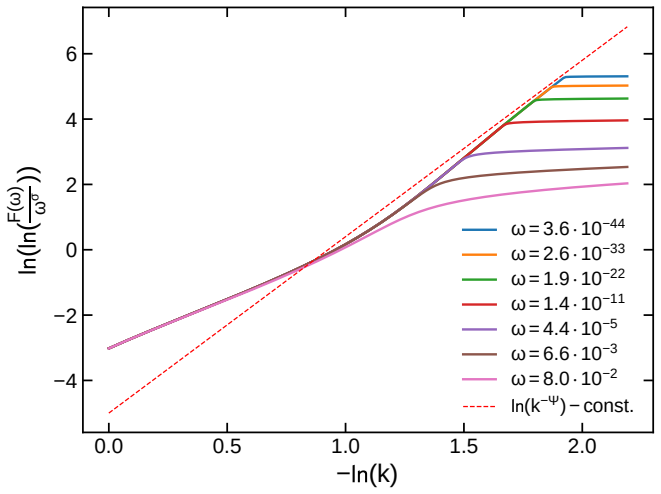
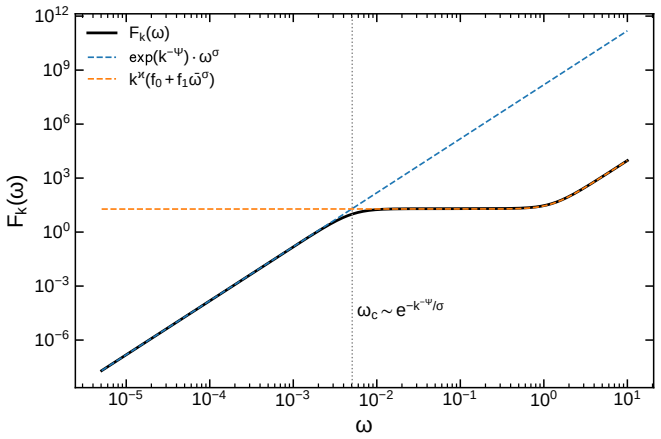
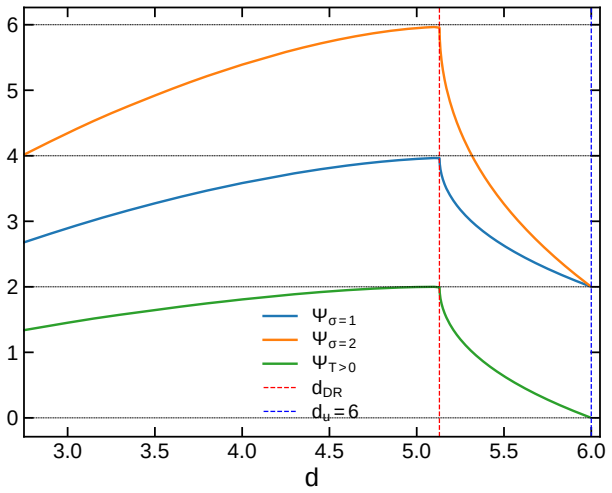
Therefore, whileF(ω)≪1, Fk(ω)∝e k−Ψ .(100) At zero temperature, the continuous frequency sector gives a genuinely quantum activation dynamics with the barrier exponent Ψ =σΘ + 2−η. 27 C. Consistency criterion Ifa 2,k follows a power law, the subdominance condition (64) becomesϵ k ∝k Θ+ρ2 →0 as k→0. Thus, the construction is consistent provided that ρ2 >−Θ...
-
[6]
A full numerical analysis of these finite-temperature crossovers is left for future work
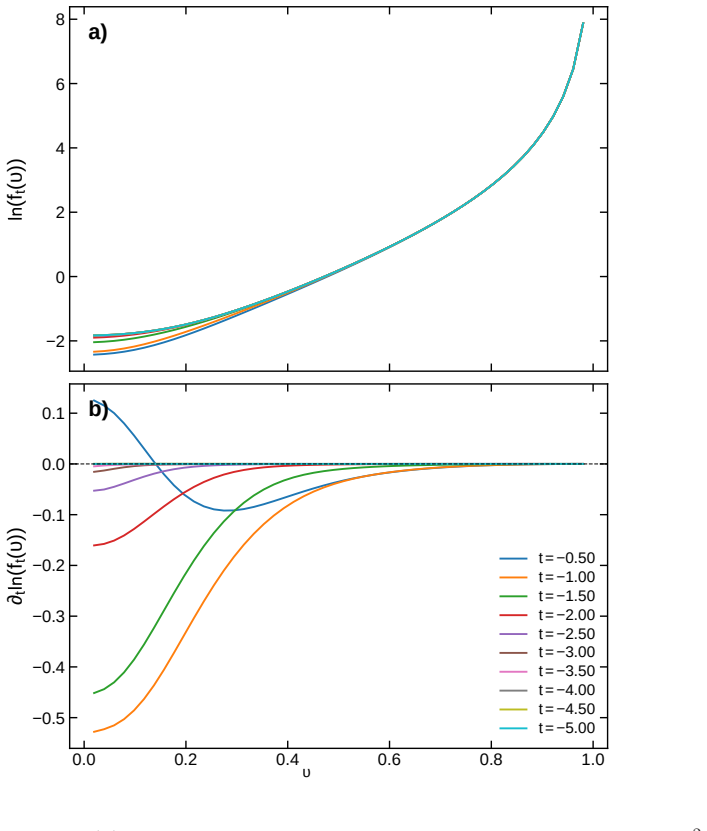
If the lowest mode still satisfiesF(ω 1)≪1 after that crossover, the activation exponent crosses over to the classical value Ψ = Θ before eventually entering the power-law regime at F(ω 1)∼1. A full numerical analysis of these finite-temperature crossovers is left for future work. 30 −2 0 2 4 6 8 (ft(υ)) a) 0.0 0.2 0.4 0.6 0.8 1.0 −0.5 −0.4 −0.3 −0.2 −0.1...
2022
-
[7]
B. I. Halperin, P. C. Hohenberg, and S.-k. Ma, Phys. Rev. Lett.29, 1548 (1972)
1972
-
[8]
P. C. Hohenberg and B. I. Halperin, Rev. Mod. Phys.49, 435 (1977)
1977
-
[9]
D. S. Fisher and D. A. Huse, Phys. Rev. B38, 373 (1988). 43
1988
-
[10]
A. J. Bray and M. A. Moore, Phys. Rev. Lett.58, 57 (1987)
1987
-
[11]
Lubchenko and P
V. Lubchenko and P. G. Wolynes, Annu. Rev. Phys. Chem.58, 235 (2007)
2007
-
[12]
Out of equilibrium dynamics in spin-glasses and other glassy systems
J.-P. Bouchaud, L. F. Cugliandolo, J. Kurchan, and M. M´ ezard, Spin Glasses and Random Fields , 161 (1998), arXiv:cond-mat/9702070
work page internal anchor Pith review Pith/arXiv arXiv 1998
-
[13]
Villain, J
J. Villain, J. Phys. France46, 1843 (1985)
1985
-
[14]
D. S. Fisher, Phys. Rev. Lett.56, 416 (1986)
1986
-
[15]
Balog and G
I. Balog and G. Tarjus, Phys. Rev. B91, 214201 (2015)
2015
-
[16]
Vojta, J
T. Vojta, J. Phys. A: Math. Gen.39, R143 (2006)
2006
-
[17]
D. S. Fisher, Phys. Rev. Lett.69, 534 (1992)
1992
-
[18]
D. S. Fisher, Phys. Rev. B51, 6411 (1995)
1995
-
[19]
Motrunich, S.-C
O. Motrunich, S.-C. Mau, D. A. Huse, and D. S. Fisher, Phys. Rev. B61, 1160 (2000)
2000
-
[20]
A. E. Nash, A. R. King, and V. Jaccarino, Phys. Rev. B43, 1272(R) (1991)
1991
-
[21]
Lederman, J
M. Lederman, J. V. Selinger, R. Bruinsma, J. Hammann, and R. Orbach, Phys. Rev. Lett. 68, 2086 (1992)
2086
-
[22]
D. P. Belanger, inSpin Glasses and Random Fields, edited by A. P. Young (World Scientific,
-
[23]
arXiv:cond-mat/9706042
work page internal anchor Pith review Pith/arXiv arXiv
-
[24]
S. M. A. Tabei, M. J. P. Gingras, Y.-J. Kao, P. Stasiak, and J.-Y. Fortin, Phys. Rev. Lett. 97, 237203 (2006)
2006
-
[25]
Schechter, Phys
M. Schechter, Phys. Rev. B77, 020401 (2008)
2008
-
[26]
D. M. Silevitch, D. Bitko, J. Brooke, S. Ghosh, G. Aeppli, and T. F. Rosenbaum, Nature 448, 567 (2007)
2007
-
[27]
D. M. Silevitch, C. Tang, G. Aeppli, and T. F. Rosenbaum, Nat. Commun.10, 4001 (2019)
2019
-
[28]
B. Wen, P. Subedi, L. Bo, Y. Yeshurun, M. P. Sarachik, A. D. Kent, C. Lampropoulos, and G. Christou, Phys. Rev. B82, 014406 (2010)
2010
-
[29]
A. R. Chakraborty, J. Schmalian, and R. M. Fernandes, Phys. Rev. B112, 035146 (2025)
2025
-
[30]
Senthil, Phys
T. Senthil, Phys. Rev. B57, 8375 (1998)
1998
-
[31]
Aharony, Y
A. Aharony, Y. Gefen, and Y. Shapir, J. Phys. C: Solid State Phys.15, 673 (1982)
1982
-
[32]
Boyanovsky and J
D. Boyanovsky and J. L. Cardy, Phys. Rev. B27, 5557 (1983)
1983
-
[33]
Micnas and K
R. Micnas and K. A. Chao, Phys. Rev. B30, 6785(R) (1984)
1984
-
[34]
Parisi and N
G. Parisi and N. Sourlas, Phys. Rev. Lett.43, 744 (1979)
1979
-
[35]
Bricmont and A
J. Bricmont and A. Kupiainen, Phys. Rev. Lett.59, 1829 (1987). 44
1987
-
[36]
Tarjus and M
G. Tarjus and M. Tissier, Phys. Rev. Lett.93, 267008 (2004)
2004
-
[37]
Tarjus and M
G. Tarjus and M. Tissier, Phys. Rev. B78, 024203 (2008)
2008
-
[38]
Tissier and G
M. Tissier and G. Tarjus, Phys. Rev. B78, 024204 (2008)
2008
-
[39]
Tissier and G
M. Tissier and G. Tarjus, Phys. Rev. Lett.107, 041601 (2011)
2011
-
[40]
Tissier and G
M. Tissier and G. Tarjus, Phys. Rev. B85, 104202 (2012)
2012
-
[41]
Tissier and G
M. Tissier and G. Tarjus, Phys. Rev. B85, 104203 (2012)
2012
-
[42]
D. S. Fisher, Phys. Rev. Lett.56, 1964 (1986)
1964
-
[43]
Suzuki, Prog
M. Suzuki, Prog. Theor. Phys.56, 1454 (1976)
1976
-
[44]
J. A. Hertz, Phys. Rev. B14, 1165 (1976)
1976
-
[45]
Homenda, P
M. Homenda, P. Jakubczyk, and H. Yamase, Phys. Rev. B110, L121102 (2024)
2024
-
[46]
Quantum criticality and non-fermi liquids: the nonperturbative renormalization group perspective,
M. Homenda, P. Jakubczyk, and H. Yamase, “Quantum criticality and non-fermi liquids: the nonperturbative renormalization group perspective,” (2025), arXiv:2505.10140 [cond-mat.str- el]
-
[47]
Anfuso and A
F. Anfuso and A. Rosch, Eur. Phys. J. B69, 465 (2009)
2009
-
[48]
M´ ezard, G
M. M´ ezard, G. Parisi, and M. A. Virasoro,Spin Glass Theory and Beyond(World Scientific, Singapore, 1987)
1987
-
[49]
Wetterich, Phys
C. Wetterich, Phys. Lett. B301, 90 (1993)
1993
-
[50]
Berges, N
J. Berges, N. Tetradis, and C. Wetterich, Phys. Rep.363, 223 (2002)
2002
-
[51]
Dupuis, L
N. Dupuis, L. Canet, A. Eichhorn, W. Metzner, J. M. Pawlowski, M. Tissier, and N. Wsche- bor, Phys. Rep.910, 1 (2021)
2021
-
[52]
Schwartz and A
M. Schwartz and A. Soffer, Phys. Rev. Lett.55, 2499 (1985)
1985
-
[53]
Tarjus, I
G. Tarjus, I. Balog, and M. Tissier, Europhys. Lett.103, 61001 (2013)
2013
-
[54]
Imry and S.-k
Y. Imry and S.-k. Ma, Phys. Rev. Lett.35, 1399 (1975)
1975
-
[55]
Aizenman and J
M. Aizenman and J. Wehr, Phys. Rev. Lett.62, 2503 (1989)
1989
-
[56]
Aizenman and J
M. Aizenman and J. Wehr, Commun. Math. Phys.130, 489 (1990)
1990
-
[57]
Aharony, Y
A. Aharony, Y. Imry, and S.-k. Ma, Phys. Rev. Lett.37, 1364 (1976)
1976
-
[58]
Grinstein, Phys
G. Grinstein, Phys. Rev. Lett.37, 944 (1976)
1976
-
[59]
J. Z. Imbrie, Phys. Rev. Lett.53, 1747 (1984)
1984
-
[60]
Theory of the Random Field Ising Model
T. Natterman, “Theory of the random field ising model,” inSpin Glasses and Random Fields (World Scientific, Singapore, 1998) pp. 277–298, arXiv:cond-mat/9705295
work page internal anchor Pith review Pith/arXiv arXiv 1998
-
[61]
Birgeneau, J
R. Birgeneau, J. Magn. Magn. Mater.177-181, 1 (1998). 45
1998
-
[62]
A. T. Ogielski and D. A. Huse, Phys. Rev. Lett.56, 1298 (1986)
1986
-
[63]
Rieger and A
H. Rieger and A. P. Young, J. Phys. A: Math. Gen.26, 5279 (1993)
1993
-
[64]
A. K. Hartmann, Phys. Rev. B65, 174427 (2002)
2002
-
[65]
A. A. Middleton and D. S. Fisher, Phys. Rev. B65, 134411 (2002)
2002
-
[66]
Dahmen and J
K. Dahmen and J. P. Sethna, Phys. Rev. B53, 14872 (1996)
1996
-
[67]
Perkovi´ c, K
O. Perkovi´ c, K. A. Dahmen, and J. P. Sethna, Phys. Rev. B59, 6106 (1999)
1999
-
[68]
J. P. Sethna, K. A. Dahmen, and C. R. Myers, Nature410, 242 (2001)
2001
-
[69]
Tarjus, M
G. Tarjus, M. Baczyk, and M. Tissier, Phys. Rev. Lett.110, 135703 (2013)
2013
-
[70]
Balog, G
I. Balog, G. Tarjus, and M. Tissier, Phys. Rev. B97, 094204 (2018)
2018
-
[71]
D. A. Gorokhov, D. S. Fisher, and G. Blatter, Phys. Rev. B66, 214203 (2002)
2002
-
[72]
Andreanov and A
A. Andreanov and A. A. Fedorenko, Phys. Rev. B90, 014205 (2014)
2014
-
[73]
D. F. Litim, Phys. Rev. D64, 105007 (2001)
2001
-
[74]
Optimization of the derivative expansion in the nonperturbative renormalization group
L. Canet, B. Delamotte, D. Mouhanna, and J. Vidal, Phys. Rev. D67, 065004 (2003), arXiv:hep-th/0211055
work page internal anchor Pith review Pith/arXiv arXiv 2003
- [75]
-
[76]
De Polsi and N
G. De Polsi and N. Wschebor, Phys. Rev. E106, 024111 (2022)
2022
-
[77]
Chauve, T
P. Chauve, T. Giamarchi, and P. Le Doussal, Phys. Rev. B62, 6241 (2000)
2000
-
[78]
Tarjus, M
G. Tarjus, M. Tissier, and I. Balog, SciPost Phys.19, 001 (2025)
2025
-
[79]
Grison and N
V. Grison and N. Dupuis, Phys. Rev. B113, 174208 (2026)
2026
-
[80]
De Polsi, I
G. De Polsi, I. Balog, M. Tissier, and N. Wschebor, Phys. Rev. E101, 042113 (2020)
2020
discussion (0)
Sign in with ORCID, Apple, or X to comment. Anyone can read and Pith papers without signing in.