Monitoring a de Sitter universe through an anti-de Sitter window
Pith reviewed 2026-07-01 04:21 UTC · model grok-4.3
The pith
AdS3 gravity with dS2 branes is dual to a unitary CFT2 with non-unitary boundary conditions that prepare states whose evolution encodes a de Sitter universe.
A machine-rendered reading of the paper's core claim, the machinery that carries it, and where it could break.
Core claim
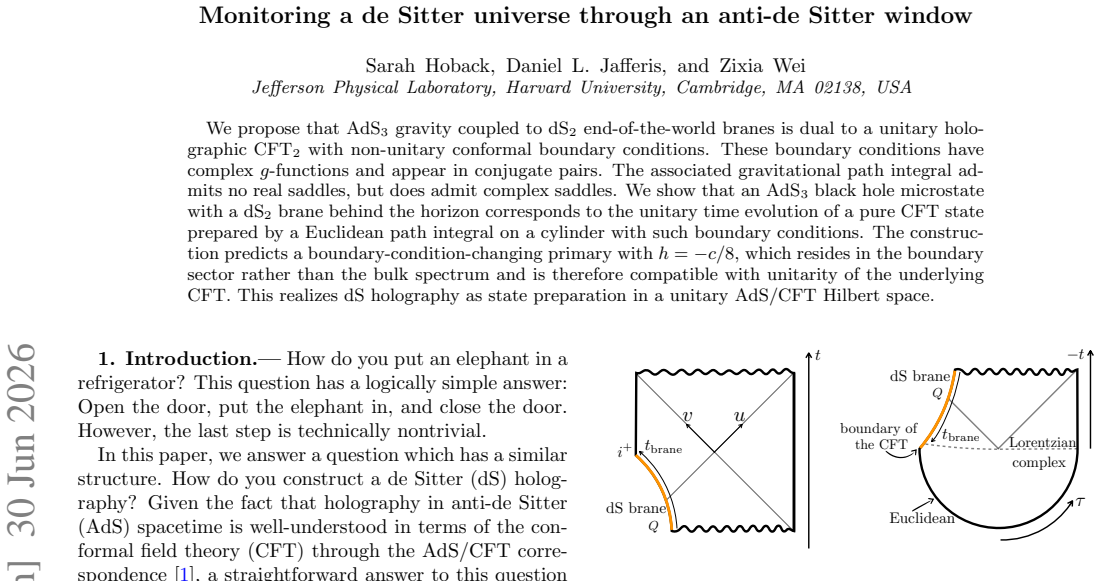
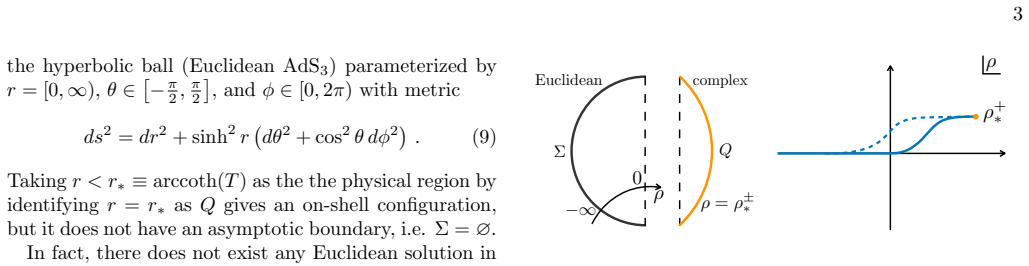
AdS₃ gravity coupled to dS₂ end-of-the-world branes is dual to a unitary holographic CFT₂ with non-unitary conformal boundary conditions. The gravitational path integral admits no real saddles but does admit complex saddles. An AdS₃ black hole microstate with a dS₂ brane behind the horizon corresponds to the unitary time evolution of a pure CFT state prepared by a Euclidean path integral on a cylinder with such boundary conditions. The construction predicts a boundary-condition-changing primary with h = −c/8 that resides in the boundary sector rather than the bulk spectrum.
What carries the argument
The duality between AdS3 gravity with dS2 end-of-the-world branes and a CFT2 with non-unitary conformal boundary conditions, realized through complex saddles in the gravitational path integral that describe unitary CFT time evolution.
If this is right
- The black hole microstate with the dS2 brane maps directly onto the time evolution of the prepared CFT state.
- The non-unitary boundary conditions must appear in conjugate pairs to maintain overall consistency.
- The boundary-condition-changing primary of weight h = −c/8 remains compatible with CFT unitarity because it lives in the boundary sector.
- De Sitter observables can be extracted from the unitary evolution inside the AdS/CFT Hilbert space.
Where Pith is reading between the lines
- This approach may allow numerical or analytic CFT calculations to approximate cosmological evolution in de Sitter space.
- Similar constructions could apply to higher-dimensional cases where end-of-the-world branes are replaced by other non-unitary interfaces.
- The absence of real saddles suggests that standard real-time holographic methods may need analytic continuation when applied to de Sitter interiors.
Load-bearing premise
The gravitational path integral can use complex saddles with no real saddles that still correspond to the unitary time evolution of a pure CFT state prepared with the non-unitary boundary conditions.
What would settle it
An explicit computation of the path integral for the cylinder with these boundary conditions that finds only real saddles, or a demonstration that the predicted primary with h = −c/8 appears in the bulk spectrum rather than the boundary sector.
Figures
read the original abstract
We propose that AdS$_3$ gravity coupled to dS$_2$ end-of-the-world branes is dual to a unitary holographic CFT$_2$ with non-unitary conformal boundary conditions. These boundary conditions have complex $g$-functions and appear in conjugate pairs. The associated gravitational path integral admits no real saddles, but does admit complex saddles. We show that an AdS$_3$ black hole microstate with a dS$_2$ brane behind the horizon corresponds to the unitary time evolution of a pure CFT state prepared by a Euclidean path integral on a cylinder with such boundary conditions. The construction predicts a boundary-condition-changing primary with $h=-c/8$, which resides in the boundary sector rather than the bulk spectrum and is therefore compatible with unitarity of the underlying CFT. This realizes dS holography as state preparation in a unitary AdS/CFT Hilbert space.
Editorial analysis
A structured set of objections, weighed in public.
Referee Report
Summary. The paper proposes that AdS3 gravity coupled to dS2 end-of-the-world branes is dual to a unitary CFT2 with non-unitary conformal boundary conditions (complex g-functions appearing in conjugate pairs). The gravitational path integral admits no real saddles but complex ones; an AdS3 black-hole microstate with a dS2 brane behind the horizon is argued to correspond to unitary time evolution of a pure CFT state prepared by a Euclidean cylinder path integral with these boundary conditions. The setup predicts a boundary-condition-changing primary with h = -c/8 residing in the boundary sector, realizing dS holography as state preparation inside unitary AdS/CFT.
Significance. If substantiated, the proposal embeds dS holography within unitary AdS/CFT via state preparation and supplies a concrete, testable prediction (h = -c/8 boundary primary). The emphasis on complex saddles with no real saddles is a distinctive technical element that could inform other holographic constructions involving non-unitary boundaries.
major comments (1)
- [Abstract] Abstract (black-hole microstate correspondence paragraph): the assertion that complex saddles reproduce unitary time evolution of the pure CFT state prepared with non-unitary boundary conditions supplies no explicit contour choice, deformation argument, or demonstration that the resulting operator preserves the CFT inner product (i.e., that imaginary parts cancel to yield a unitary operator). This justification is load-bearing for the central identification of dS holography with state preparation in unitary AdS/CFT.
minor comments (2)
- [Introduction] The definition and explicit functional form of the complex g-functions are referenced but not displayed in the abstract; a short equation or example in the introduction would improve accessibility.
- Notation for the cylinder geometry and the placement of the dS2 brane relative to the horizon could be clarified with a single schematic figure early in the text.
Simulated Author's Rebuttal
We thank the referee for their careful reading and for recognizing the potential significance of the proposal. We respond to the single major comment below.
read point-by-point responses
-
Referee: [Abstract] Abstract (black-hole microstate correspondence paragraph): the assertion that complex saddles reproduce unitary time evolution of the pure CFT state prepared with non-unitary boundary conditions supplies no explicit contour choice, deformation argument, or demonstration that the resulting operator preserves the CFT inner product (i.e., that imaginary parts cancel to yield a unitary operator). This justification is load-bearing for the central identification of dS holography with state preparation in unitary AdS/CFT.
Authors: We agree that the abstract, as a concise summary, does not itself contain the full technical details of the contour. The manuscript body (particularly the analysis of the gravitational path integral and the pairing of complex saddles) supplies the relevant arguments: the absence of real saddles is established by direct inspection of the equations of motion, the contour is obtained by a controlled deformation away from the real axis in the space of metrics, and the conjugate pairing of the complex g-functions (explicitly stated in the abstract) ensures that imaginary contributions to the overlap cancel, yielding a unitary operator on the CFT Hilbert space. To make this identification more transparent on first reading, we will revise the abstract to include a short parenthetical reference to the contour deformation and the conjugate-pair mechanism, together with a pointer to the relevant section. revision: yes
Circularity Check
No significant circularity; proposal is self-contained within AdS/CFT framework
full rationale
The paper proposes a duality between AdS3 gravity with dS2 branes and a CFT2 with non-unitary boundary conditions, then asserts that complex saddles realize unitary time evolution and predict h=-c/8. No load-bearing step reduces by construction to its own inputs or to a self-citation chain; the correspondence is derived from the gravitational path integral with the stated boundary conditions rather than being tautological. The abstract presents the h=-c/8 result as an output of the construction, not a redefinition of the input. Without explicit equations showing a fitted parameter renamed as prediction or an ansatz smuggled via self-citation, the derivation remains independent of the target claim.
Axiom & Free-Parameter Ledger
axioms (2)
- domain assumption AdS/CFT correspondence applies to the AdS3 setup with the added dS2 branes
- ad hoc to paper Complex saddles in the gravitational path integral correspond to physical unitary time evolution
invented entities (1)
-
dS2 end-of-the-world branes
no independent evidence
Reference graph
Works this paper leans on
-
[1]
Let the interval direction of Σ be parameterized byτ∈[−L/2, L/2] and theS 1 direction be parameterized byϕ∈[−π, π) withϕ∼ϕ+ 2π
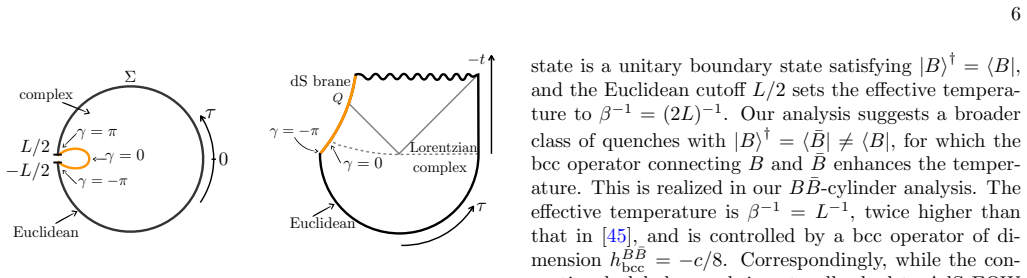
CylinderΣwithBBboundaries.—Let us then proceed to consider the case where Σ is a cylinder, which has two boundaries. Let the interval direction of Σ be parameterized byτ∈[−L/2, L/2] and theS 1 direction be parameterized byϕ∈[−π, π) withϕ∼ϕ+ 2π. We first consider imposingBon both boundaries. We refer to this case asBB-cylinder. There are two solutions in t...
-
[2]
D7Y1o0TiHQrkdDAzgZ0fQHWeE7g=
CylinderΣwithB ¯Bboundaries.—Let us then consider theB ¯B-cylinder, whereBis imposed on one boundary and ¯Bis imposed on the other. Again, we find two complex solutions. One is discon- nected and is constructed analogously to theBB-cylinder case. The difference is that, instead of attaching two identical complex disk wedges, we attach one wedge as- sociat...
-
[3]
Thanks to the time reflection symmetry with respect toτ= 0, it realizes a density matrixρ=e −LHCFT/2|B⟩⟨ ¯B|e−LHCFT/2 atτ= 0
Analytic continuation and global quench.— Let us consider the analytic continuation of theB ¯Bcylin- der setup discussed above. Thanks to the time reflection symmetry with respect toτ= 0, it realizes a density matrixρ=e −LHCFT/2|B⟩⟨ ¯B|e−LHCFT/2 atτ= 0. At high temperature, i.e. smallL, the analytic continuation τ=itof the connected solution is dual to th...
-
[4]
In fact, unitarity of the open-string theory is often required to construct physical boundary conditions [43]
Nonunitary boundary conditions in unitary CFT.—In unitary CFTs, not all the linear combina- tions of Ishibashi states in the form of (17) are consid- ered to be physical. In fact, unitarity of the open-string theory is often required to construct physical boundary conditions [43]. This leaves the question of whether we are allowed to consider non-unitary ...
-
[5]
putting the elephant into the refrigerator
Conclusion and Discussion.—How do you put a dS EOW brane in AdS/CFT? One includes such branes in the gravitational action and performs the GPI with an asymptotic boundary Σ that is itself a manifold with boundary. The dS EOW branes then appear in complex saddle points. The dual theory is a BCFT built from a unitary parent CFT, but endowed with non-unitary...
-
[6]
J. M. Maldacena, The Large N limit of superconfor- mal field theories and supergravity, Int. J. Theor. Phys. 38, 1113 (1999), [Adv. Theor. Math. Phys.2,231(1998)], arXiv:hep-th/9711200 [hep-th]
Pith/arXiv arXiv 1999
-
[7]
Strominger, The dS / CFT correspondence, JHEP10, 034, arXiv:hep-th/0106113
A. Strominger, The dS / CFT correspondence, JHEP10, 034, arXiv:hep-th/0106113
-
[8]
E. Witten, Quantum gravity in de Sitter space, inStrings 2001: International Conference(2001) arXiv:hep- th/0106109
arXiv 2001
-
[9]
J. M. Maldacena, Non-Gaussian features of primordial fluctuations in single field inflationary models, JHEP05, 013, arXiv:astro-ph/0210603
-
[10]
M. Alishahiha, A. Karch, E. Silverstein, and D. Tong, The dS/dS correspondence, AIP Conf. Proc.743, 393 (2004), arXiv:hep-th/0407125
Pith/arXiv arXiv 2004
-
[11]
D. Anninos, S. A. Hartnoll, and D. M. Hofman, Static Patch Solipsism: Conformal Symmetry of the de Sit- ter Worldline, Class. Quant. Grav.29, 075002 (2012), arXiv:1109.4942 [hep-th]
Pith/arXiv arXiv 2012
-
[12]
V. Gorbenko, E. Silverstein, and G. Torroba, dS/dS and T T, JHEP03, 085, arXiv:1811.07965 [hep-th]
-
[13]
L. Susskind, Entanglement and Chaos in De Sitter Space Holography: An SYK Example, JHAP1, 1 (2021), arXiv:2109.14104 [hep-th]
arXiv 2021
-
[14]
V. Narovlansky and H. Verlinde, Double-scaled SYK and de Sitter holography, JHEP05, 032, arXiv:2310.16994 [hep-th]
-
[15]
B. Freivogel, V. E. Hubeny, A. Maloney, R. C. Myers, M. Rangamani, and S. Shenker, Inflation in AdS/CFT, JHEP03, 007, arXiv:hep-th/0510046
-
[16]
Mirbabayi, Uptunneling to de Sitter, JHEP09, 070, arXiv:2003.05460 [hep-th]
M. Mirbabayi, Uptunneling to de Sitter, JHEP09, 070, arXiv:2003.05460 [hep-th]
arXiv 2003
-
[17]
I. Akal, Y. Kusuki, T. Takayanagi, and Z. Wei, Codi- mension two holography for wedges, Phys. Rev. D102, 126007 (2020), arXiv:2007.06800 [hep-th]
arXiv 2020
-
[18]
V. Balasubramanian, Y. Nomura, and T. Ugajin, De Sitter space is sometimes not empty, JHEP02, 135, arXiv:2308.09748 [hep-th]
-
[19]
Wei, Holographic dual of crosscap conformal field the- ory, JHEP03, 086, arXiv:2405.03755 [hep-th]
Z. Wei, Holographic dual of crosscap conformal field the- ory, JHEP03, 086, arXiv:2405.03755 [hep-th]
-
[20]
Penrose, Gravitational collapse and space-time singu- larities, Phys
R. Penrose, Gravitational collapse and space-time singu- larities, Phys. Rev. Lett.14, 57 (1965)
1965
-
[21]
S. W. Hawking and R. Penrose, The Singularities of grav- itational collapse and cosmology, Proc. Roy. Soc. Lond. A314, 529 (1970)
1970
-
[22]
An argument is that on a null congruence from the AdS timelike boundary there is initially contraction, and thus it cannot re-expand to reachi + of dS given the averaged null energy condition. 8
-
[23]
Higuchi, Quantum linearization instabilities of de Sit- ter space-time
A. Higuchi, Quantum linearization instabilities of de Sit- ter space-time. 1, Class. Quant. Grav.8, 1961 (1991)
1961
-
[24]
Higuchi, Quantum linearization instabilities of de Sit- ter space-time
A. Higuchi, Quantum linearization instabilities of de Sit- ter space-time. 2, Class. Quant. Grav.8, 1983 (1991)
1983
-
[25]
D. Marolf and I. A. Morrison, Group Averaging for de Sitter free fields, Class. Quant. Grav.26, 235003 (2009), arXiv:0810.5163 [gr-qc]
Pith/arXiv arXiv 2009
-
[26]
T. Chakraborty, J. Chakravarty, V. Godet, P. Paul, and S. Raju, The Hilbert space of de Sitter quantum gravity, JHEP01, 132, arXiv:2303.16315 [hep-th]
-
[27]
J. McNamara and C. Vafa, Baby Universes, Holography, and the Swampland, (2020), arXiv:2004.06738 [hep-th]
arXiv 2020
-
[28]
V. Balasubramanian, A. Kar, and T. Ugajin, Islands in de Sitter space, JHEP02, 072, arXiv:2008.05275 [hep- th]
arXiv 2008
-
[29]
M. Usatyuk, Z.-Y. Wang, and Y. Zhao, Closed universes in two dimensional gravity, SciPost Phys.17, 051 (2024), arXiv:2402.00098 [hep-th]
arXiv 2024
- [30]
-
[31]
A. I. Abdalla, S. Antonini, L. V. Iliesiu, and A. Levine, The gravitational path integral from an observer’s point of view, JHEP05, 059, arXiv:2501.02632 [hep-th]
-
[32]
A. Almheiri, R. Mahajan, J. Maldacena, and Y. Zhao, The Page curve of Hawking radiation from semiclassical geometry, JHEP03, 149, arXiv:1908.10996 [hep-th]
Pith/arXiv arXiv 1908
-
[33]
L. Randall and R. Sundrum, A Large mass hierarchy from a small extra dimension, Phys. Rev. Lett.83, 3370 (1999), arXiv:hep-ph/9905221
Pith/arXiv arXiv 1999
-
[34]
L. Randall and R. Sundrum, An Alternative to compact- ification, Phys. Rev. Lett.83, 4690 (1999), arXiv:hep- th/9906064
arXiv 1999
-
[35]
A. Karch and L. Randall, Locally localized gravity, JHEP 05, 008, arXiv:hep-th/0011156
-
[36]
M. Banados, C. Teitelboim, and J. Zanelli, The Black hole in three-dimensional space-time, Phys. Rev. Lett. 69, 1849 (1992), arXiv:hep-th/9204099
Pith/arXiv arXiv 1992
-
[37]
S. S. Gubser, I. R. Klebanov, and A. M. Polyakov, Gauge theory correlators from noncritical string theory, Phys. Lett.B428, 105 (1998), arXiv:hep-th/9802109 [hep-th]
Pith/arXiv arXiv 1998
-
[38]
Witten, Anti-de Sitter space and holography, Adv
E. Witten, Anti-de Sitter space and holography, Adv. Theor. Math. Phys.2, 253 (1998), arXiv:hep-th/9802150 [hep-th]
Pith/arXiv arXiv 1998
-
[39]
Takayanagi, Holographic Dual of BCFT, Phys
T. Takayanagi, Holographic Dual of BCFT, Phys. Rev. Lett.107, 101602 (2011), arXiv:1105.5165 [hep-th]
Pith/arXiv arXiv 2011
-
[40]
M. Fujita, T. Takayanagi, and E. Tonni, Aspects of AdS/BCFT, JHEP11, 043, arXiv:1108.5152 [hep-th]
-
[41]
I. Akal, T. Kawamoto, S.-M. Ruan, T. Takayanagi, and Z. Wei, Page curve under final state projection, Phys. Rev. D105, 126026 (2022), arXiv:2112.08433 [hep-th]
arXiv 2022
-
[42]
I. Akal, T. Kawamoto, S.-M. Ruan, T. Takayanagi, and Z. Wei, Zoo of holographic moving mirrors, JHEP08, 296, arXiv:2205.02663 [hep-th]
- [43]
-
[44]
D. Wang, Z. Wang, and Z. Wei, Wormholes with ends of the world, JHEP09, 166, arXiv:2504.12278 [hep-th]
-
[45]
We adopt the latter representation here for convenience
Complex metrics on real coordinates can equivalently be represented as real metrics on complexified coordinates. We adopt the latter representation here for convenience
-
[46]
J. D. Brown and M. Henneaux, Central Charges in the Canonical Realization of Asymptotic Symmetries: An Example from Three-Dimensional Gravity, Commun. Math. Phys.104, 207 (1986)
1986
-
[47]
Ishibashi, The Boundary and Crosscap States in Conformal Field Theories,IN *TSUKUBA 1988, PRO- CEEDINGS, SUPERSTRINGS* 119-131., Mod
N. Ishibashi, The Boundary and Crosscap States in Conformal Field Theories,IN *TSUKUBA 1988, PRO- CEEDINGS, SUPERSTRINGS* 119-131., Mod. Phys. Lett.A4, 251 (1989)
1988
-
[48]
J. L. Cardy, Boundary Conditions, Fusion Rules and the Verlinde Formula, Nucl. Phys.B324, 581 (1989)
1989
-
[49]
In fact, as we will see, it is not necessary but convenient to take the constantεto be small
-
[50]
P. Calabrese and J. L. Cardy, Evolution of entanglement entropy in one-dimensional systems, J. Stat. Mech.0504, P04010 (2005), arXiv:cond-mat/0503393 [cond-mat]
Pith/arXiv arXiv 2005
-
[51]
T. Hartman and J. Maldacena, Time Evolution of En- tanglement Entropy from Black Hole Interiors, JHEP05, 014, arXiv:1303.1080 [hep-th]
-
[52]
R. Maeda, N. Nakamura, and T. Takayanagi, Holo- graphic Dual of PT Symmetric BCFT, (2026), arXiv:2606.18629 [hep-th]
Pith/arXiv arXiv 2026
-
[53]
Q. Tang, Z. Wei, and X. Wen, to appear, (2026)
2026
- [54]
-
[55]
M. R. Gaberdiel, A. Recknagel, and G. M. T. Watts, The Conformal boundary states for SU(2) at level 1, Nucl. Phys. B626, 344 (2002), arXiv:hep-th/0108102
Pith/arXiv arXiv 2002
-
[56]
N. Agia and D. L. Jafferis, Angular Quantization in CFT, (2022), arXiv:2204.11872 [hep-th]
arXiv 2022
-
[57]
Teschner, Remarks on Liouville theory with boundary, PoStmr2000, 041 (2000), arXiv:hep-th/0009138
J. Teschner, Remarks on Liouville theory with boundary, PoStmr2000, 041 (2000), arXiv:hep-th/0009138
Pith/arXiv arXiv 2000
-
[58]
Gao and D
P. Gao and D. Jafferis, work in progress, (2026)
2026
- [59]
discussion (0)
Sign in with ORCID, Apple, or X to comment. Anyone can read and Pith papers without signing in.