Laser-based metrology systems vs wavefront sensing techniques: a comparative overview between the Large Binocular Telescope and the Vera C. Rubin Observatory for the telescope alignment and collimation tracking
Pith reviewed 2026-07-01 02:44 UTC · model grok-4.3
The pith
The Large Binocular Telescope and Vera C. Rubin Observatory use reciprocal strategies for initial alignment and collimation maintenance.
A machine-rendered reading of the paper's core claim, the machinery that carries it, and where it could break.
Core claim
The paper establishes that the LBT and the Vera C. Rubin Observatory have adopted reciprocal architectures for the initial optical alignment strategy and for maintaining collimation during the night. LBT relies on Focal Plane Image Analysis for initial alignment and a laser-based Telescope Metrology System to monitor relative optic positions in real time between exposures. Rubin Observatory uses a Laser Tracker system to establish initial optical states and Curvature Wavefront Sensing with dedicated detectors at the four corners of the focal plane for ongoing corrections against flexure and drift.
What carries the argument
Reciprocal architectures that assign wavefront sensing and laser-based metrology to opposite phases of initial alignment versus ongoing collimation tracking.
If this is right
- Open-loop look-up tables alone cannot fully compensate for gravitational flexure and thermal drift during observations.
- Laser-based metrology enables real-time relative position monitoring and corrections applied between exposures.
- Curvature wavefront sensing at focal plane corners provides continuous alignment feedback integrated with science detectors.
- The complementary assignment of techniques at the two sites produces distinct operational trade-offs in speed, integration, and environmental sensitivity.
- Synthesis of these approaches supplies design guidance for alignment systems on future extremely large telescopes.
Where Pith is reading between the lines
- Different development histories or site-specific constraints may have driven each observatory toward its particular assignment of the two techniques.
- A hybrid system that combines laser metrology with curvature sensing could reduce single-point failure risks in future facilities.
- Long-term performance data from both telescopes under comparable conditions could quantify which method better handles rapid thermal changes.
- The comparison implies that initial alignment and maintenance phases may benefit from fundamentally different sensor types rather than a single universal solution.
Load-bearing premise
The specific techniques and their assignment to initial versus maintenance roles at each observatory are accurately and completely described without significant undisclosed hybrid implementations or recent changes in operational practice.
What would settle it
Operational logs or technical documentation from either observatory demonstrating that the initial alignment method and the maintenance method are not reversed relative to the other facility.
Figures
read the original abstract
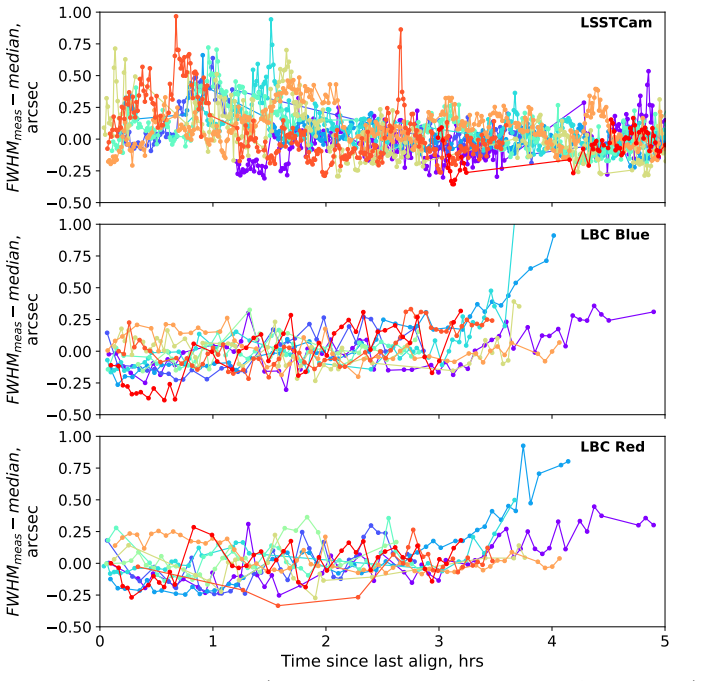
This work presents a comparative overview of the collimation and alignment strategies employed by two leading 8m-class facilities: the Large Binocular Telescope (LBT) and the Vera C. Rubin Observatory. While both telescopes share a challenging fast f-number of approximately f/1.2 (considering the LBT in its Prime Focus configuration), they have adopted reciprocal architectures for the initial optical alignment strategy and for maintaining collimation during the night. As an initial alignment strategy, the LBT relies on a Wavefront Sensing technique called Focal Plane Image Analysis. Conversely, the Vera C. Rubin Observatory baseline foresees the usage of a Laser Tracker system to establish the initial optical states. The strategies for preserving the optical alignment and maintaining the collimation against gravitational flexure and thermal drift during observations are instead reversed. Besides the use of open-loop corrections based on Look-Up Tables, common on both telescopes, the LBT utilizes a laser-based Telescope Metrology System to monitor the relative position of optics in real-time, applying the corrections between the exposures. In contrast, the Rubin Observatory employs a Curvature Wavefront Sensing technique, using dedicated detectors at the four corners of the focal plane. Rather than identifying a best strategy, this work aims to synthesize the strengths, limitations, and operational trade-offs of these complementary approaches, from the perspective of the next generation of Extremely Large Telescopes and their instruments.
Editorial analysis
A structured set of objections, weighed in public.
Referee Report
Summary. The paper presents a comparative overview of collimation and alignment strategies at the Large Binocular Telescope (LBT) and Vera C. Rubin Observatory, claiming they employ reciprocal architectures: LBT uses Focal Plane Image Analysis (wavefront sensing) for initial alignment and laser-based metrology for real-time maintenance against flexure and drift, while Rubin uses a Laser Tracker for initial alignment and curvature wavefront sensing at focal-plane corners for maintenance, with both relying on look-up tables in addition.
Significance. If the technique assignments and operational details are accurate and current, the synthesis of strengths, limitations, and trade-offs between laser metrology and wavefront sensing approaches could inform alignment system design choices for future Extremely Large Telescopes.
major comments (2)
- [Abstract] Abstract and comparison sections: the central claim of exact reciprocity in initial vs. maintenance roles is load-bearing for the thesis but is presented as factual without citation to primary sources such as observatory technical reports, commissioning papers, or operational manuals that would allow verification of the attributed primary methods.
- [Main text comparison] Sections describing LBT and Rubin strategies: the manuscript does not address whether the described techniques are exclusive or if hybrid implementations, look-up table dominance, or post-2023 operational changes exist at either facility, which directly affects whether the reciprocal contrast holds.
minor comments (1)
- [Abstract] Abstract: the statement that both share an f/1.2 focal ratio would benefit from explicit confirmation of the LBT Prime Focus configuration details for precision.
Simulated Author's Rebuttal
We thank the referee for the constructive comments on our manuscript. We address each major point below and will revise the paper accordingly to improve verifiability and clarity while preserving the core comparative overview.
read point-by-point responses
-
Referee: [Abstract] Abstract and comparison sections: the central claim of exact reciprocity in initial vs. maintenance roles is load-bearing for the thesis but is presented as factual without citation to primary sources such as observatory technical reports, commissioning papers, or operational manuals that would allow verification of the attributed primary methods.
Authors: We agree that the reciprocity claim requires supporting citations for verification. In the revised manuscript we will add references to LBT technical reports and commissioning papers describing Focal Plane Image Analysis for initial alignment and the laser metrology system for real-time maintenance. For Rubin Observatory we will cite documentation on the Laser Tracker initial alignment and curvature wavefront sensing at the focal-plane corners. These additions will allow readers to trace the attributed primary methods to primary sources. revision: yes
-
Referee: [Main text comparison] Sections describing LBT and Rubin strategies: the manuscript does not address whether the described techniques are exclusive or if hybrid implementations, look-up table dominance, or post-2023 operational changes exist at either facility, which directly affects whether the reciprocal contrast holds.
Authors: The manuscript presents the baseline reciprocal strategies drawn from available published documentation and explicitly notes the shared use of look-up tables. We do not assert exclusivity. We will add a clarifying paragraph stating that hybrid implementations may exist in practice and that the description reflects the primary documented architectures. Regarding post-2023 changes, we will include a note that the overview is based on information current at the time of submission and recommend consulting the most recent observatory operational reports for any updates. This preserves the value of the synthesis for ELT design while acknowledging potential operational nuances. revision: partial
Circularity Check
No circularity: purely descriptive comparison with no derivations or fitted claims
full rationale
The paper contains no equations, predictions, fitted parameters, or derivation chains of any kind. It is a factual comparative overview of alignment and collimation strategies at two observatories, presenting reciprocal architectures as observed operational choices rather than results derived from internal logic or self-citations. No patterns of self-definition, fitted-input-as-prediction, load-bearing self-citation, uniqueness theorems, or ansatz smuggling apply. The work is self-contained as a synthesis of strengths and trade-offs, with the central claim resting on external operational descriptions rather than any reduction to its own inputs.
Axiom & Free-Parameter Ledger
axioms (1)
- domain assumption Both telescopes operate at a fast f-number of approximately f/1.2
Reference graph
Works this paper leans on
-
[1]
Active optics. I. A system for optimizing the optical quality and reducing the costs of large telescopes.,
Wilson, R. N., Franza, F., and Noethe, L., “Active optics. I. A system for optimizing the optical quality and reducing the costs of large telescopes.,”Journal of Modern Optics34, 485–509 (Jan. 1987). ADS Bibcode: 1987JMOp...34..485W
1987
-
[2]
Active Optics in Modern, Large Optical Telescopes
Noethe, L., “Active Optics in Modern, Large Optical Telescopes,” (Nov. 2001). arXiv:astro-ph/0111136 version: 1
work page internal anchor Pith review Pith/arXiv arXiv 2001
-
[3]
The Extremely Large Telescope,
Padovani, P. and Cirasuolo, M., “The Extremely Large Telescope,”Contemporary Physics64, 47–64 (Jan. 2023). ADS Bibcode: 2023ConPh..64...47P
2023
-
[4]
Giant Magellan Telescope: overview,
Johns, M., McCarthy, P., Raybould, K., Bouchez, A., Farahani, A., Filgueira, J., Jacoby, G., Shectman, S., and Sheehan, M., “Giant Magellan Telescope: overview,” in [Ground-based and Airborne Telescopes IV], 8444, 526–541, SPIE (Sept. 2012)
2012
-
[5]
The Thirty Meter Telescope (TMT): An International Observatory,
Sanders, G. H., “The Thirty Meter Telescope (TMT): An International Observatory,”Journal of Astro- physics and Astronomy34, 81–86 (June 2013). ADS Bibcode: 2013JApA...34...81S
2013
-
[6]
Final optical design of MORFEO for the ELT,
Magrin, D., Pariani, G., Munari, M., Rabou, P., Bianco, A., Bergomi, M., Redaelli, E., Aliverti, M., Riva, M., Farinato, J., Pinard, L., Michel, C., Sassolas, B., Ballone, A., Rodeghiero, G., Carl` a, G., Greggio, D., Busoni, L., Caprio, V. D., Cianniello, V., Kurita, M., Teodori, L., Rocco, A. D., and Ciliegi, P., “Final optical design of MORFEO for the ...
2024
-
[7]
The MICADO first light imager for the ELT: overview and current status,
Sturm, E., Davies, R., Alves, J., Cl´ enet, Y., Kotilainen, J., Monna, A., Nicklas, H., Pott, J. U., Tolstoy, E., Vulcani, B., Achren, J., Annadevara, S., Anwand-Heerwart, H., Arcidiacono, C., Barboza, S., Barl, L., Baudoz, P., Bender, R., Bezawada, N., Biondi, F., Bizenberger, P., Blin, A., Bon´ e, A., Bonifacio, P., Borgo, B., Born, J. v. d., Buey, T., ...
2024
-
[8]
The Large Binocular Telescope,
Hill, J. M., “The Large Binocular Telescope,”Applied Optics49, D115–D122 (June 2010)
2010
-
[9]
LSST: From Science Drivers to Reference Design and Anticipated Data Products,
Ivezi´ c, v., Kahn, S. M., Tyson, J. A., Abel, B., Acosta, E., Allsman, R., Alonso, D., AlSayyad, Y., Anderson, S. F., Andrew, J., P. Angel, J. R., Angeli, G. Z., Ansari, R., Antilogus, P., Araujo, C., Armstrong, R., Arndt, K. T., Astier, P., Aubourg, E., Auza, N., Axelrod, T. S., Bard, D. J., Barr, J. D., Barrau, A., Bartlett, J. G., Bauer, A. E., Bauman...
2019
-
[10]
Large Binocular Telescope Adaptive Optics System: new achievements and perspectives in adaptive optics,
Esposito, S., Riccardi, A., Pinna, E., Puglisi, A., Quir´ os-Pacheco, F., Arcidiacono, C., Xompero, M., Briguglio, R., Agapito, G., Busoni, L., Fini, L., Argomedo, J., Gherardi, A., Brusa, G., Miller, D., Guerra, J. C., Stefanini, P., and Salinari, P., “Large Binocular Telescope Adaptive Optics System: new achievements and perspectives in adaptive optics,...
2011
-
[11]
A laser-truss based optical alignment system on LBT,
Rakich, A., Choi, H., Veillet, C., Hill, J. M., Bec, M., Zhang, Y., Brendel, T., Sitarski, B., Gardiner, M., Kim, D. W., and Rodriguez, S., “A laser-truss based optical alignment system on LBT,” in [Ground-based and Airborne Telescopes VIII],11445, 127–139, SPIE (Dec. 2020)
2020
-
[12]
Commissioning a laser metrology truss for active optics on the Large Binocular Telescope,
Rakich, A., Choi, H., Veillet, C., Hill, J., Kuhn, O., Bec, M., Zhang, Y., Brendel, T., Sitarski, B., and Schoenell, W., “Commissioning a laser metrology truss for active optics on the Large Binocular Telescope,” in [Ground-based and Airborne Telescopes IX],12182, 132–146, SPIE (Sept. 2022)
2022
-
[13]
Imple- mentation of a laser-truss based telescope metrology system at the Large Binocular Telescope,
Rodriguez, S., Rakich, A., Hill, J., Kuhn, O., Brendel, T., Veillet, C., Kim, D. W., and Choi, H., “Imple- mentation of a laser-truss based telescope metrology system at the Large Binocular Telescope,” in [Optical Manufacturing and Testing XIII],11487, 78–87, SPIE (Aug. 2020)
2020
-
[14]
Prototyping the GMT telescope metrology system on LBT,
Rakich, A., Schurter, P., Conan, R., Hill, J. M., Gardiner, M., Bec, M., and Kuhn, O., “Prototyping the GMT telescope metrology system on LBT,” in [Ground-based and Airborne Telescopes VII],10700, 548–558, SPIE (July 2018)
2018
-
[15]
Development of the GMT telescope metrology system,
Xin, B., Nemati, B., Demers, R., Schurter, P., Chiquito, H., Schoenell, W., Filgueira, J., Haddad, J. P., Thompson, P., Beifus, K., Bouchez, A., Sitarski, B., Nissen, J., Choi, H., Gonzalez, G., Nemati, D., and Williams, P., “Development of the GMT telescope metrology system,” in [Ground-based and Airborne Tele- scopes X],13094, 969–982, SPIE (Sept. 2024)
2024
-
[16]
Real-time collimation correction at the large binocular telescope using a laser truss metrology system,
Jeong, B., Brendel, T., Hill, J. M., Zhang, Y., Veillet, C., Kuhn, O. P., Rakich, A., Sitarski, B. N., Rosignoli, L., Rodeghiero, G., Chu, J., Kim, D., and Choi, H., “Real-time collimation correction at the large binocular telescope using a laser truss metrology system,”Journal of Astronomical Telescopes, Instruments, and Systems11, 027002 (June 2025)
2025
-
[17]
N., [Reflecting Telescope Optics II], Astronomy and Astrophysics Library, Springer, Berlin, Heidelberg (1999)
Wilson, R. N., [Reflecting Telescope Optics II], Astronomy and Astrophysics Library, Springer, Berlin, Heidelberg (1999)
1999
-
[18]
Prime focus active optics with the Large Binocular Telescope,
Hill, J. M., Ragazzoni, R., Baruffolo, A., Biddick, C. J., Kuhn, O. P., Diolaiti, E., Thompson, D., and Rakich, A., “Prime focus active optics with the Large Binocular Telescope,” in [Ground-based and Airborne Telescopes II],7012, 655–664, SPIE (July 2008)
2008
-
[19]
Modeling metrology systems between primary and secondary mirrors at the Large Binocular Telescope,
Rosignoli, L., Rodeghiero, G., Choi, H., Hill, J., Kuhn, O., Rakich, A., Jeong, B., Mechtley, B., Zhang, Y., Veillet, C., and Chu, J., “Modeling metrology systems between primary and secondary mirrors at the Large Binocular Telescope,” in [Astronomical Optics: Design, Manufacture, and Test of Space and Ground Systems V],13624, 39–55, SPIE (Sept. 2025)
2025
-
[20]
Fabrica- tion of the LSST monolithic primary-tertiary mirror,
Tuell, M. T., Martin, H. M., Burge, J. H., Ketelsen, D. A., Law, K., Gressler, W. J., and Zhao, C., “Fabrica- tion of the LSST monolithic primary-tertiary mirror,” in [Modern Technologies in Space- and Ground-based Telescopes and Instrumentation II],8450, 1531–1546, SPIE (Sept. 2012)
2012
-
[21]
The Vera C. Rubin’s M2 support system integration and verification at the TMA,
Rodeghiero, G., Rosignoli, L., Canestrari, R., Giro, E., Zorzi, P., Tsai, T.-W., Drass, H., Kang, Y., Tighe, R., Neil, D., Colleoni, F., Daruich, F., Lutfi, M., Homar, G. M., Quint, B. C., Ribeiro, T., Roberts, A., Sebag, J., Stalder, B., Siruno, K., Sonaniskar, M., Fanning, K., Ferguson, P., Kub´ anek, P., Thomas, S. J., Claver, C., Clemens, A. W., Reil,...
2024
-
[22]
The LSST camera overview: design and performance,
Gilmore, K., Kahn, S., Nordby, M., O’Connor, P., Oliver, J., Radeka, V., Schalk, T., Schindler, R., and Berg, R. V., “The LSST camera overview: design and performance,” in [Ground-based and Airborne Instru- mentation for Astronomy II],7014, 167–177, SPIE (July 2008)
2008
-
[23]
Optimization of the Observing Cadence for the Rubin Observatory Legacy Survey of Space and Time: A Pioneering Process of Community-focused Experimental Design,
Bianco, F. B., Ivezi´ c, v., Jones, R. L., Graham, M. L., Marshall, P., Saha, A., Strauss, M. A., Yoachim, P., Ribeiro, T., Anguita, T., Bauer, A. E., Bauer, F. E., Bellm, E. C., Blum, R. D., Brandt, W. N., Brough, S., Catelan, M., Clarkson, W. I., Connolly, A. J., Gawiser, E., Gizis, J. E., Hloˇ zek, R., Kaviraj, S., Liu, C. T., Lochner, M., Mahabal, A. ...
2021
-
[24]
Overview of the LSST active optics system,
Neill, D., Angeli, G., Claver, C., Hileman, E., DeVries, J., Sebag, J., and Xin, B., “Overview of the LSST active optics system,” in [Modeling, Systems Engineering, and Project Management for Astronomy VI], 9150, 143–158, SPIE (Aug. 2014)
2014
-
[25]
Rubin Observatory Simonyi Survey Telescope Active Optics,
Thomas, S., Connolly, A., Crenshaw, J. F., Bryce, K. J., Megias, G., Meyers, J. E., Ribeiro, T., Tsai, T.-W., Claver, C., Neill, D., Braga, V. F., Fiorentino, G., Savarese, S., Schipani, P., Schreiber, L., and Criscienzo, M. D., “Rubin Observatory Simonyi Survey Telescope Active Optics,” (June 2023)
2023
-
[26]
Integration and optical alignment of the Rubin Observatory Simonyi Survey Telescope with a laser tracker,
Homar, G. M., Tighe, R., Thomas, S., Sandwith, S., Sebag, J., Stalder, B., Rivera, M., Ribeiro, T., Palmateer, J., Meyers, J. E., Mills, D., Kahn, S. M., Mu˜ noz, F., L´ opez, J., Araya, C., and Aguilar, C., “Integration and optical alignment of the Rubin Observatory Simonyi Survey Telescope with a laser tracker,” in [Ground-based and Airborne Telescopes ...
2024
-
[27]
Wave-front reconstruction from defocused images and the testing of ground- based optical telescopes,
Roddier, C. and Roddier, F., “Wave-front reconstruction from defocused images and the testing of ground- based optical telescopes,”JOSA A10, 2277–2287 (Nov. 1993)
1993
-
[28]
Curvature wavefront sensing for the large synoptic survey telescope,
Xin, B., Claver, C., Liang, M., Chandrasekharan, S., Angeli, G., and Shipsey, I., “Curvature wavefront sensing for the large synoptic survey telescope,”Applied Optics54, 9045–9054 (Oct. 2015)
2015
-
[29]
Janish, R. J. R. J.,An algorithm for rapid measurement of aberrations in pairs of out-of-focus images, thesis, Massachusetts Institute of Technology (2012). Accepted: 2013-04-12T19:37:48Z
2012
-
[30]
Using AI for Wave-front Estimation with the Rubin Observatory Active Optics System,
Crenshaw, J. F., Connolly, A. J., Meyers, J. E., Kalmbach, J. B., Megias Homar, G., Ribeiro, T., Suberlak, K., Thomas, S., and Tsai, T.-W., “Using AI for Wave-front Estimation with the Rubin Observatory Active Optics System,”The Astronomical Journal167, 86 (Jan. 2024)
2024
-
[31]
Advancing the Vera C. Rubin Observatory active optics control system,
Homar, G. M., Meyers, J. M., Thomas, S. J., Kahn, S. M., Connolly, A. J., Crenshaw, J. F., Kalmbach, J. B., Suberlak, K., Polen, R., Tsai, T.-W., Ribeiro, T., Tighe, R., Rodeghiero, G., Canestrari, R., Giro, E., Niell, D., Kub´ anek, P., Rosignoli, L., Rivera, M., Sebag, J., Mills, D., Zorzi, P., L´ opez, J., Jimenez, D., Ordenes, I., and Fabrega, J., “Ad...
2024
-
[32]
The Active Optics System on the Vera C. Rubin Observatory: Optimal Control of Degeneracy among the Large Number of Degrees of Freedom,
Megias Homar, G., Kahn, S. M., Meyers, J. M., Crenshaw, J. F., and Thomas, S. J., “The Active Optics System on the Vera C. Rubin Observatory: Optimal Control of Degeneracy among the Large Number of Degrees of Freedom,”The Astrophysical Journal974, 108 (Oct. 2024)
2024
-
[33]
The Consolidated Database of Image Metadata,
Lim, K.-T., “The Consolidated Database of Image Metadata,” (Oct. 2025). Number: DMTN-227
2025
-
[34]
MIRROR, DOME, AND NATURAL SEEING AT CFHT,
Racine, R., Salmon, D., Cowley, D., and Sovka, J., “MIRROR, DOME, AND NATURAL SEEING AT CFHT,”Publications of the Astronomical Society of the Pacific103, 1020 (Sept. 1991)
1991
-
[35]
The ESO differential image motion monitor,
Sarazin, M. and Roddier, F., “The ESO differential image motion monitor,”Astronomy and Astro- physics227, 294–300 (Jan. 1990). ADS Bibcode: 1990A&A...227..294S
1990
-
[36]
Statistics of a Geometric Representation of Wavefront Distortion,
Fried, D. L., “Statistics of a Geometric Representation of Wavefront Distortion,”Journal of the Optical Society of America (1917-1983)55, 1427–1431 (Nov. 1965). ADS Bibcode: 1965JOSA...55.1427F
1917
-
[37]
From Differential Image Motion to Seeing,
Tokovinin, A., “From Differential Image Motion to Seeing,”Publications of the Astronomical Society of the Pacific114, 1156–1166 (Oct. 2002). ADS Bibcode: 2002PASP..114.1156T
2002
-
[38]
Wave Propagation in a Turbulent Medium,
Tatarski, V. I., Silverman, R. A., and Chako, N., “Wave Propagation in a Turbulent Medium,”Physics Today14, 46 (Jan. 1961). ADS Bibcode: 1961PhT....14l..46T
1961
-
[39]
On the Difference between Seeing and Image Quality: When the Turbulence Outer Scale Enters the Game,
Martinez, P., Kolb, J., Sarazin, M., and Tokovinin, A., “On the Difference between Seeing and Image Quality: When the Turbulence Outer Scale Enters the Game,”The Messenger141, 5–8 (Sept. 2010). ADS Bibcode: 2010Msngr.141....5M
2010
-
[40]
First statistical data on wavefront outer scale at La Silla observatory from the GSM instrument,
Martin, F., Tokovinin, A., Ziad, A., Conan, R., Borgnino, J., Avila, R., Agabi, A., and Sarazin, M., “First statistical data on wavefront outer scale at La Silla observatory from the GSM instrument,”Astronomy and Astrophysics336, L49–L52 (Aug. 1998). ADS Bibcode: 1998A&A...336L..49M
1998
-
[41]
From the grating scale monitor to the generalized seeing monitor,
Ziad, A., Conan, R., Tokovinin, A., Martin, F., and Borgnino, J., “From the grating scale monitor to the generalized seeing monitor,”Applied Optics39, 5415–5425 (Oct. 2000)
2000
-
[42]
Wavefront outer scale and seeing measurements at San Pedro M´ artir Observatory,
Conan, R., Avila, R., S´ anchez, L. J., Ziad, A., Martin, F., Borgnino, J., Harris, O., Gonz´ alez, S. I., Michel, R., and Hiriart, D., “Wavefront outer scale and seeing measurements at San Pedro M´ artir Observatory,” Astronomy & Astrophysics396, 723–730 (Dec. 2002)
2002
-
[43]
Com- parison of measurements of the outer scale of turbulence by three different techniques,
Ziad, A., Sch¨ ock, M., Chanan, G. A., Troy, M., Dekany, R., Lane, B. F., Borgnino, J., and Martin, F., “Com- parison of measurements of the outer scale of turbulence by three different techniques,”Applied Optics43, 2316–2324 (Apr. 2004)
2004
-
[44]
Performance of active optics at the VLT,
Guisard, S., Noethe, L., and Spyromilio, J., “Performance of active optics at the VLT,” in [Optical Design, Materials, Fabrication, and Maintenance],4003, 154–164, SPIE (July 2000)
2000
-
[45]
Performance and improvement of active optics at the Very Large Telescope,
Guisard, S., Noethe, L., Spyromilio, J., and Delgado, F., “Performance and improvement of active optics at the Very Large Telescope,”4837, 637–648 (Feb. 2003). ADS Bibcode: 2003SPIE.4837..637G
2003
-
[46]
Long-term performance of the VLT UT active optics system,
Stephan, C., Guisard, S., and Bourget, P., “Long-term performance of the VLT UT active optics system,” in [Ground-based and Airborne Telescopes VI],9906, 1587–1600, SPIE (July 2016)
2016
-
[47]
Characterization of LBT atmospheric and turbulence conditions in the context of ALTA project,
Turchi, D. A., Masciadri, D. E., and Veillet, D. C., “Characterization of LBT atmospheric and turbulence conditions in the context of ALTA project,” in [Ground-based and Airborne Telescopes IX],12182, 1476, SPIE (Aug. 2022)
2022
-
[48]
Estimating the dimension of a model,
Schwarz, G., “Estimating the dimension of a model,”The annals of statistics6(2), 461–464 (1978)
1978
discussion (0)
Sign in with ORCID, Apple, or X to comment. Anyone can read and Pith papers without signing in.